1. Introduction
Triple-negative breast cancer (TNBC) is an invasive
subtype of breast cancer, characterized by <1% expression of
estrogen receptor and progesterone receptor, as determined using
immunohistochemistry (IHC). Notably, TNBC is also characterized by
absent or reduced levels of human epidermal growth factor
receptor-2 expression by IHC, with negative results by in
situ hybridization testing. It is associated with high rates of
recurrence and metastasis with a short survival time, is more
predominant in premenopausal women <40 years of age, and
accounts for ~15-20% of all breast cancer cases (1-3).
Moreover, it contributes to 40% of breast cancer mortality rates
(4).
The treatment of TNBC represents a formidable
challenge in oncology due to various clinical and biological
reasons. TNBC is characterized by extensive intertumoral and
intratumoral molecular heterogeneity; accordingly, TNBC can be
classified into different subtypes based on the Lehmann
classification as follows: Basal-like 1 (BL-1), basal-like 2
(BL-2), a mesenchymal subtype (M), an immunomodulatory subtype
(IM), a mesenchymal stem-like subtype (MSL) and a luminal androgen
receptor subtype (LAR) (5).
Subsequently, this classification system was refined
into four tumor-specific molecular subtypes: BL1, BL2, M and LAR,
after taking into consideration the contribution of transcripts
from normal stromal and immune cells in the tumor environment
(6). Although the heterogeneous
nature of TNBC is associated with drug resistance and a poor
prognosis, this genetic variation supports the need for
individualized treatment rather than uniform treatment strategies,
and can be utilized to identify therapeutic targets and enhance
treatment response (7,8).
The management of TNBC primarily relies on a
multimodal approach that depends on the stage of the disease,
involving surgery and radiotherapy, with chemotherapy remaining the
standard treatment in both systemic neoadjuvant and adjuvant
therapy, particularly for patients with early-stage disease
(9). Developing resistance and
off-target toxicity associated with chemotherapy highlight the
requirement for a novel therapeutic strategy to counter the
aggressiveness of TNBC (10).
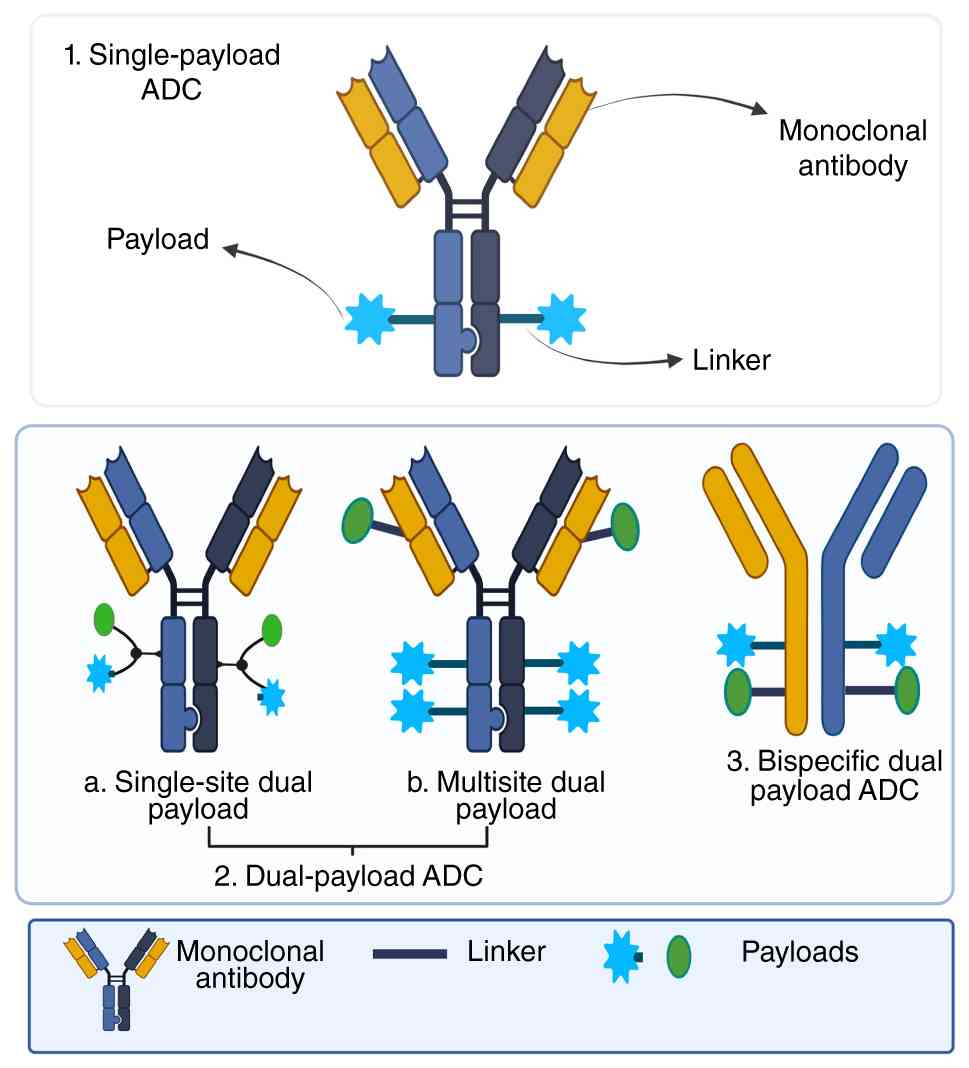
Single- and dual-payload antibody-drug conjugates
(ADCs) represent a promising therapeutic approach for the treatment
of TNBC by selectively delivering cytotoxic payloads to target
cells. Single-payload ADCs consist of a monoclonal antibody and a
cytotoxic payload connected by a linker, in comparison to
dual-payload ADCs, which consist of two distinct payloads
conjugated to a monoclonal antibody (11). This field of anticancer drugs has
grown rapidly over the past few decades; as of April, 2025, the US
Food and Drug Administration (FDA) has approved 15 ADCs for the
treatment of a wide range of solid tumors and hematological
malignancies, of which four are approved for the treatment of
breast cancer: trastuzumab emtansine, trastuzumab deruxtecan,
sacituzumab govitecan (SG) and datopotamab deruxtecan (12). However, the clinical efficacy of
ADCs is often limited by issues associated with tumor
heterogeneity, relapse and intrinsic or acquired resistance
(13).
To address the limitations of single-payload ADCs,
particularly resistance mechanisms and tumor heterogeneity in TNBC,
research efforts have increasingly focused on developing
dual-payload ADCs as a promising drug class by taking advantage of
targeting pivotal antigens associated with tumor proliferation,
invasion and immune modulation, including trophoblast cell-surface
antigen 2 (TROP2) and CD276 (also known as B7-H3), and applying the
dual-target approach to present agents with potentially greater
therapeutic efficacy than single-payload ADCs. The present review
highlights the design, mechanism, recent advances, current and
future perspectives of dual-payload ADCs for the treatment of TNBC.
With a comprehensive understanding of these aspects, researchers
could collaboratively contribute to the next generations of ADCs
and to improved therapeutic outcomes for patients with TNBC.
2. Key design requirements of dual-payload
ADCs
Dual-payload ADCs are designed using a humanized or
chimeric IgG monoclonal antibody (mAb), which targets
tumor-specific antigens, while simultaneously carrying two or more
distinct payloads through cleavable or non-cleavable linkers.
Beyond the design principles of conventional ADCs, dual-payload
ADCs involve additional design considerations that need to be
carefully considered (14). The
ideal dual-payload ADC design should promote tumor cell death,
induce apoptosis, exhibit a high target binding specificity and
affinity, a good internalization rate, low immunogenicity, potent
cytotoxic payloads and stable linkers (15) (Fig.
1).
mAbs
Humanized or fully human mAbs are the preferred
delivery system to ensure high target-cell specificity and a long
circulating half-life in the systemic circulation. The antibody
component of the ADC recognizes and binds to cell-surface antigens
that are highly expressed in tumor cells (16,17).
Healthy cells lack the expression of this antigen or express only
minimal levels of such an antigen. Moreover, the targeted antigen
should be a cell surface antigen so that circulating mAbs can
recognize and bind to it easily (18). Several novel dual-payload ADCs have
entered preclinical evaluation, targeting antigens, such as TROP2,
B7-H3 and epidermal growth factor receptor (EGFR), which are
overexpressed in TNBC (19,20).
IgG1 antibodies are the preferred subclass due to
their high stability in the bloodstream and robust activation of
innate immune cells, such as natural killer (NK) cells and
macrophages, through interactions with Fcγ receptors (21). Moreover, human IgG1 exhibits low
immunogenicity, which minimizes the risk of hypersensitivity
reactions and the formation of anti-drug antibodies (22). Bispecific antibodies (bsAbs) can
also be used to bind either two distinct antigens or two
non-overlapping epitopes on the same antigen (a subgroup termed
‘biparatopic’) (23,24). Bispecific antibodies help overcome
drug resistance, further enhancing the therapeutic potential of
dual-payload ADCs (21).
Payload
Cytotoxic agents are the core payloads in ADCs
(25). In addition to payload
criteria in a single ADC, a dual-payload ADC requires the
conjugation of potent and/or synergistic payload combinations
(e.g., dual anti-tubulin inhibitors, TOPI inhibitors and
immunotherapy) to reduce the therapeutically effective dose
required to kill tumor cells. Dual-payloads could have distinct
mechanisms of action, biological activity and pharmacokinetic (PK)
properties. Therefore, they have disparate effective dose ranges
and toxicity profiles; consequently, it is essential to determine
the potential toxicity of payload combinations and the overlapping
toxicities of the two payloads (26).
Linker
The linker is the spacer component that chemically
binds the cytotoxic payload to the antibody (27). The fundamental requirement of a
linker is to ensure the chemical stability of the ADC within the
bloodstream. Linker-drug stability plays a critical role in
determining PK properties, selectivity, therapeutic index and the
overall success of the ADC (28).
Therefore, it is critical to optimize linker stability,
hydrophilicity, steric hindrance and linker length, which can
affect the drug antibody ratio DAR of ADCs and PK properties
(29-31).
ADC linkers can be divided into two types according
to the cleavage method: Cleavable and non-cleavable. Cleavable
linkers are often less stable in the blood, resulting in various
off-target effects. By contrast, non-cleavable linkers require
internalization by the target cell and release a linker-payload.
This latter mechanism does not produce efficient bystander killing
and thus results in lower toxicity profiles (32,33).
Dual-payload ADCs may employ either a linear linker
or a branched linker. Both the multifunctional adapter and
multifunctional linker payload methods provide adaptable paths for
dual-payload ADCs; each approach can contribute to optimizing drug
efficacy and targeting precision through strategic adjustments in
DAR and payload distribution. Moreover, the option of a
non-cleavable linker instead of a cleavable one is a decision for a
particular strategy in which the stability of the complex is more
critical than the rapid release of the active fragment (34).
DAR
DAR is defined as the average number of payloads
conjugated to a single monoclonal antibody within an ADC. It is
particularly challenging to adjust the total DAR and the ratio of
the two payloads, which is critical for optimizing the therapeutic
efficacy and safety profiles of different linker payload
combinations. DAR measurement is pivotal in predicting essential
properties, such as hydrophobicity, drug clearance, PK and
biodistribution (35,36). A low DAR may reduce the antitumor
efficacy, whereas an excessively high DAR increases hydrophobicity,
promoting aggregation, reducing molecular stability and antigen
binding affinity, leading to diminished biological activity.
Although ADCs with a high DAR are generally more potent, they have
been shown to exhibit more rapid clearance or efflux through
multidrug resistance transporters, thereby reducing the therapeutic
index (37).
3. Mechanisms of action of dual-payload
ADCs
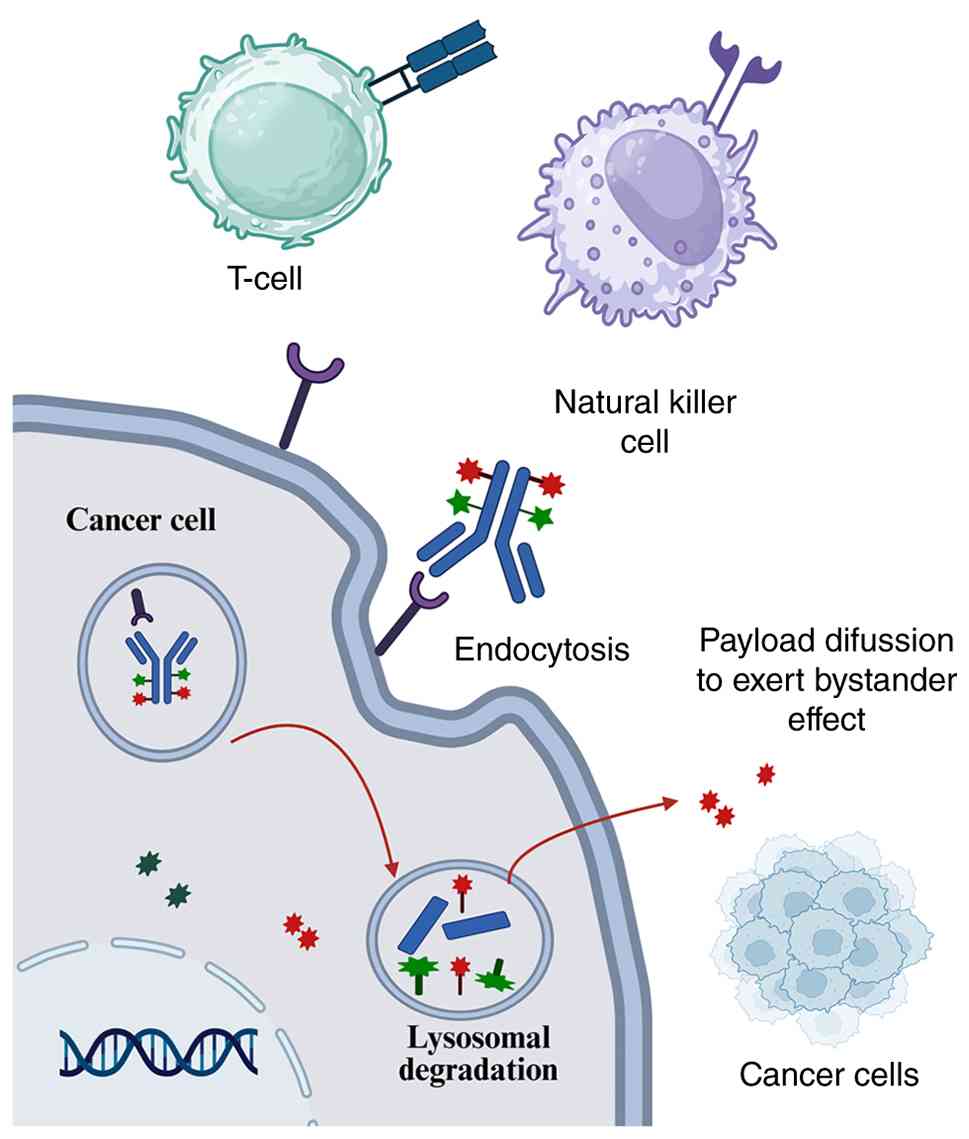
The mechanisms of action of dual-payload ADCs vary
according to the targeted antigen, the dual-cytotoxic payloads, the
monoclonal antibody and the linker connecting these components
(38) (Fig. 2).
Upon binding to a specific cell-surface receptor
antigen, the antibody-antigen complex is internalized via
endocytosis, forming an endosome, which later fuses with a
lysosome, where it is exposed to lysosomal proteases and degraded.
The linker is cleaved in response to the acidic environment or the
lysosomal proteases, thereby releasing the cytotoxic payloads into
the cytoplasm (39).
Generally, chemotherapeutic agents exert their
antitumor effects through three distinct mechanisms of action: Some
drugs exhibit anti-tubulin activity or serve as DNA-damaging
agents, whereas others function as topoisomerase inhibitors; the
outcome is the apoptosis or necrosis of cancer cells (40,41).
In addition to direct cytotoxicity, dual-payload
ADCs exert other mechanisms of action as immunomodulators, in which
the antibody moiety is not only a vehicle for cytotoxic payloads or
responsible for antigen recognition and targeting; this monoclonal
antibody also promotes the activation of natural killer cells and
T-cells in the tumor microenvironment (TME), as demonstrated by
CD276 mAb-monomethyl auristatin F (MMAF)/IMQ (42,43).
Loo et al (44) found that an anti-CD276 mAb induced
potent antibody-dependent cellular cytotoxicity (ADCC) in several
tumor cell types. These findings suggest that CD276 mAb-MMAF/IMQ
may also induce ADCC. In the study by Zhou et al (45), which investigated the anticancer
mechanisms of this dual-payload ADC, the marked infiltration of
activated cytotoxic CD8 T-cells, increased levels of CD45, the
activation of natural killer cells and macrophage-mediated
phagocytosis were observed. Additionally, a certain level of cell
death was observed in single-payload ADCs (mAb-MMAF and mAb-IMQ),
whereas more extensive cell death was observed in the CD276
mAb-MMAF/IMQ group. These findings suggest that the dual-payload
ADCs may enhance antitumor immune responses more potently compared
with single-payload ADCs. However, further evidence is required to
establish whether this effect is mediated by enhanced ADCC
(45).
Apart from the selective drug delivery to tumor
cells, some dual-payload ADCs have been found to have a bystander
killing effect [such as in anti-TROP2 monomethyl auristatin E
(MMAE)/F 4 + 2 ADC and 412a-MMAF + SN38), whereby cytotoxic drugs
are diffused passively into neighboring cells, which can induce the
death of cancer cells that exhibit a low receptor expression or
none at all (46,47). This is crucial in heterogeneous
tumors to enhance therapeutic efficacy by allowing cytotoxic
payloads to eliminate antigen-negative tumor cells (48).
The bystander killing effect depends largely on
factors, such as the extent of internalization after binding to a
specific receptor antigen, the hydrophobicity of the cytotoxic
payload and the type of linker, whether cleavable or non-cleavable.
In the case of certain forms of cleavable linker, the drug could be
released within the extracellular space before internalization,
presenting an efficient bystander killing effect in the TME
(49).
4. Dual-payload ADCs in TNBC: Preclinical
drugs and advancements
Beyond the conventional single-payload ADCs,
dual-payload ADCs combine the targeting specificity of monoclonal
antibodies with the potent cytotoxic activity of two cytotoxic
payloads to selectively eradicate cancer cells, including TNBC. Due
to the heterogeneous nature of this disease, constructing
dual-payload ADCs to target novel antigens that are overexpressed
in TNBC, such as TROP2, is pivotal, as its overexpression is
associated with tumor aggressiveness and a poor prognosis.
To enhance therapeutic strategies for TNBC with
dual-payload ADCs, immunotherapy and bispecific antibodies have
been employed in their design, targeting the overexpression of the
immune checkpoint transmembrane, CD276, and the Toll-like 7/8
receptor (TLR7/8), which could overcome the limitations of
immunotherapy in TNBC. Additionally, incorporating bsAbs further
enhances their selectivity and efficacy.
TROP2-directed dual-cytotoxic payload
ADCs
The TROP2 receptor is a type I surface glycoprotein
receptor (50). It is consistently
overexpressed in a variety of malignant tumors, including in
>80% of patients with advanced-stage TNBC; TROP2 activation is
also associated with several signaling pathways, depending on the
tumor type, that affect cell proliferation and metastasis (51).
Stimulation of the TROP2 receptor leads to the
increased expression of proto-oncogenes and anti-apoptotic
proteins, which are responsible for the promotion of cell
proliferation and the inhibition of the apoptosis of cancer cells
(52). Moreover, the
overexpression of TROP2 is associated with the increased expression
of VEGF, a key mediator of tumor angiogenesis. Additionally, the
activation of the TROP2 receptor stimulates the expression of genes
that are responsible for preventing immune cell infiltration in the
TME (53). TROP2 is also
associated with a poor prognosis. Further investigations have also
demonstrated that TROP2 gene deletion causes the suppression of
TNBC growth in vivo and in vitro; therefore, TROP2
becomes a novel, attractive target for drug delivery (54).
TROP2 is the target of SG, a single-payload ADC. In
April 2020, SG received accelerated approval from the FDA for
patients with metastatic TNBC who have received at least two prior
therapies for metastatic disease. In April 2021, SG received
regular (full) FDA approval for use in patients with unresectable
locally advanced or metastatic TNBC who had received two or more
prior systemic therapies. This approval was supported by findings
from the phase III ASCENT trial (55,56).
TNBC has a high relapse rate, which may partly be due to multidrug
resistance caused by SN38(57).
TROP2 is also expressed in normal tissues, such as the skin,
leading to concerns about on-target, off-tumor toxicity. This
encourages researchers to develop strategies that reduce multidrug
resistance, mitigate toxicity and improve antitumor efficacy.
One of the strategies involved the discovery of a
novel fully human mAb with reduced affinity to TROP2 and was
engineered into homogenous dual-payload ADCs to successfully obtain
anti-TROP2 MMAE/F and DuoDM/MMAE dual ADCs (58) (Table
I). MMAE/F ADC is a dual-warhead ADC with MMAE and MMAF,
functioning as anti-tubulin agents (59), while anti-TROP2 DuoDM/MMAE with
duocarmycin DM functions as a DNA-damaging cytotoxic payload
(60).
 | Table ISummary of pre-clinical dual-payload
ADCs. |
Table I
Summary of pre-clinical dual-payload
ADCs.
| Dual-payload
ADCs | Target | Payloads | Conjugation
method | DAR | Tested doses
(mg/kg) | (Refs.) |
|---|
| mAb-MMAE/MMAF | TROP2 | Anti-tubulin
agents | MTGase
conjugation | 4+2 | 3 | (58) |
| mAb-DuoDM/MMAE | TROP2 | DNA damaging +
anti-tubulin agents | MTGase
conjugation | 4+2 | 3 | (58) |
| mAb-MMAF/IMQ | CD276 | Anti-tubulin agent
+ TLR7/8 agonist | Site specific
conjugation at lysin and cysteine residues | 3 to 4+7 to 14
4+4.03 | 8, 16 and 24 | (45,70) |
| mAb-DM1/IMQ | CD276 | Anti-tubulin agent
+ TLR7/8 agonist | Site specific
conjugation at lysin and cysteine residues | 3.55+3.33 | 16 | (70) |
| mAb-DXd/IMQ | CD276 | TOP1 inhibitor +
TLR7/8 agonist | Site specific
conjugation at lysin and cysteine residues | 8+2.9 | 16 | (70) |
| 412a-SN38+MMAF | EGFR x cMET | TOP1 inhibitor +
anti-tubulin agent | Maleimide
conjugation | Closer to 2 | 1, 3 and 9 | (72) |
The combination of two payloads to target-resistant
tumors, as in TNBC, can enhance antitumor activity by overcoming
therapeutic resistance. Additionally, MMAE exhibits a bystander
killing effect; to maximize the advantages of such an effect, one
payload agent should be a small, lipophilic molecule (MMAE) to
enhance penetration to the adjacent tumor cells, and the second one
should be a larger and less hydrophobic agent (MMAF) to enhance
retention within target antigen-expressing cells (61).
In 2026, Yamaguchi et al (58) demonstrated that anti-TROP2 MMAE/F
with optimized antibody binding affinity exhibited significant
antitumor activity in an immunocompromised orthotopic breast cancer
model expressing TROP2 at a dose of 3 mg/kg, which was comparable
to the efficacy of the sacituzumab-based variant. In vitro,
MMAE/MMAF dual ADC did not demonstrate significant antitumor
activity; this was probably due to the expression of multidrug
resistance protein. By contrast, anti-TROP2 DuoDM/MMAE and SG
surrogate led to the dose-dependent inhibition of tumor cell
growth. In vivo, the antitumor activity of anti-TROP2
DuoDM/MMAE was demonstrated at an early phase of treatment with a
dose of 3 mg/kg. However, tumor regrowth was observed 2 weeks
following treatment, compared with the MMAE/MMAF dual-payload ADC.
All animals remained tumor-free for >80 days (58).
As regards the toxicity profile according to the
study by Yamaguchi et al (58), no significant acute toxicity was
observed with the administration of ADCs; this may be due to the
fact that the breast cancer models used in that experiment did not
express the TROP2 as the same characterization that mimic human
tissue; therefore, further investigations are required to address
the toxicity of anti-TROP2 dual-payload ADCs. This is particularly
critical as SG exhibits a distinct toxicity profile arising either
from the expression of TROP2 in normal tissues, such as
keratinocytes and oral mucosa, manifesting as localized effects
(mucositis and skin reactions), or from the toxicity associated
with the SN38 payload, such as neutropenia, febrile neutropenia,
anemia and leukopenia, among patients treated with SG (62,63).
CD276 (B7-H3)-directed
dual-chemoimmunotherapy ADCs
Recent evidence indicates that TNBC has a high tumor
mutation burden and the overexpression of immune checkpoints, such
as B7-H3, which is expressed in >60% of all patients with TNBC.
It is associated with poor patient survival and TNBC progression.
Moreover, CD276 is involved in tumor growth, metastasis and
treatment resistance. Therefore, CD276 has emerged as a potential
target for anticancer therapy (64).
Several clinical and preclinical trials have
demonstrated the efficacy of the combination of immune checkpoint
and ADCs, including MORPHEUS-panBC and BEGONIA. However, several
challenges are involved. These include overlapping toxicity between
ADC and immunotherapy, as well as multiple resistance mechanisms,
such as target antigen downregulation, resistance to the cytotoxic
payload, impaired immune infiltration, or the upregulation of
alternative immune checkpoints. These challenges are in addition to
the limitations of single ADCs (65,66).
To address these challenges, Zhou et al
(45) developed a
chemoimmunotherapy conjugate by incorporating MMAF and TLR7/8
agonist (IMQ), on cysteine and lysine residues of anti-CD276 mAb.
Preclinical data demonstrated that mAb-MMAF/IMQ exerted a
synergistic effect in vitro. In vivo, a significant
reduction in tumor burden was observed in immunocompromised and
immunocompetent mouse models at 16 and 24 mg/kg. Additionally,
mAb-MMAF/IMQ prevented tumor recurrence in both the patient-derived
xenograft (PDX) model and the immunocompromised mouse model
(45).
MMAF induces direct tumor cell death by blocking
microtubule polymerization (67).
IMQ inhibits cell proliferation via the MyD88/IRF7 signaling
pathway through the activation of TLR7/8, which results in the
secretion of several tumor cytokines (68). Moreover, the inhibition of the
CD276 immune checkpoint by the mAb results in the activation of
T-cells and natural killer cells in the TME (69). Thus, dual payload ADCs exert a
synergistic antitumor effect and activate the immune system in the
TME.
Building upon these findings, a subsequent
preclinical trial developed a novel co-conjugation technology to
conjugate highly potent payloads (MMAF, DM1 or DXd), which are
microtubulin inhibitors or TOPI inhibitors, and IMQ to mAb-CD276 on
cysteine and lysine. The optimized protocol achieved a high mAb
conjugation efficacy, thus allowing the flexible conjugation of
potent payloads, ensuring safety and optimizing therapeutic
efficacy. Most notably, mAb-DXd/IMQ exhibited a significant potency
compared to mAb-MMAF/IMQ and mAb-DM1/IMQ, in vivo at 16
mg/kg. This superior activity is likely attributable to its
favorable biodistribution profile in TNBC; DXd causes DNA damage,
which induces cell apoptosis regardless of the mitotic state.
Moreover, it has a bystander killing effect that results in a
significant tumor burden reduction (70).
Collectively, data confirmed that all three
anti-CD276mAb ADCs are more effective in eradicating TNBC cells
than single-payload ADCs, and address the off-target-induced immune
toxicity of free TLR agonists by integrating complementary
anticancer mechanisms and an optimized conjugation protocol
(71). This strategy has greater
potential to bypass drug resistance and overcome tumor relapse,
with a manageable systemic toxicity profile of anti-CD276 at all
tested doses. Furthermore, neither the in vitro nor the
in vivo models address advanced-stage metastatic disease or
the complex mechanisms of therapeutic resistance. Therefore, the
development of heterogeneous, spontaneous metastatic humanized
mouse models in the future will be crucial for preclinical
evaluation. Targeting a single antigen, CD276, may induce
resistance to anti-CD276mAb ADCs in patients who do not express
this antigen. Additionally, the maximum tolerated dose was not
reached; therefore, further toxicologic studies are warranted
(45,70).
Dual-payload bispecific ADCs
412a-MMAF + SN38 is an innovative dual-payload ADC,
composed of a bispecific EGFR x mesenchymal epithelial transition
factor (cMET) antibody conjugated to two cytotoxic payloads (MMAF
and SN38) utilizing a novel tri-functional linker, which has been
designed to overcome mechanisms of resistance reported with
single-payload ADCs in both dividing and non-dividing tumor
cells.
The 412a-MMAF + SN38 ADC was generated using
maleimide-based conjugation, resulting in an average DAR of ~2. As
discussed above, ADCs with higher DARs are generally associated
with increased cytotoxic potency; however, excessive drug loading
may adversely affect pharmacokinetics, including a negative impact
on therapeutic index due to faster clearance rate. Suggesting that
dual-payload ADCs with a dual-target strategy may enhance antitumor
activity without requiring a higher overall DAR (72,73).
BsAbs are engineered molecules constructed to target
two distinct antigens or epitopes. Generally, bsAbs are generated
by the incorporation of two different light chains and two
different heavy chains (Fig. 1);
the two binding variable domains allow the targeting of two
antigens or epitopes to enhance therapeutic efficacy and reduce
on-target, off-tumor toxicity (74). This field has evolved considerably;
by early 2026, 15 bsAbs had received regulatory and/or conditional
approval for hematological malignancies and solid tumors (75).
The distinctive structure of bsAbs and different
design strategies permit a range of mechanisms of action, involving
redirecting immune cells to the TME or blocking driver signaling
pathways. bsAb in 412a-MMAF + SN38 targets simultaneously members
of receptor belong to the tyrosine kinase family, including the
EGFR and cMET receptor; blocking these receptors obstructs
ligand-induced phosphorylation, hence affecting tumor
proliferation, invasion and metastasis (76).
Apart from the direct cytotoxic effect of SN38 that
functions as a potent topoisomerase I inhibitor, MMAF as an
anti-tubulin agent and the bystander killing effect of SN38,
amivantamab, a bispecific antibody targeting EGFR and MET, has been
approved for EGFR-mutant non-small cell lung cancer. It has been
reported to trigger an antitumor immune response through ADCC,
antibody-dependent cellular phagocytosis activity and trogocytosis,
involving the recruitment and activation of natural killer cells
and macrophages through its Fc region. Moreover, Yoshichika et
al (77) provided the first
direct evidence from human clinical specimens of an
immunostimulatory effect associated with amivantamab treatment.
These findings may provide a rationale for investigating whether
similar immune-mediated mechanisms contribute to the antitumor
activity of 412a-MMAF + SN38 (72,77).
TNBC is a highly heterogeneous subtype of breast
cancer, which is characterized by substantial variability in drug
sensitivity and antigen expression; the engineering of dual-payload
ADCs with dual-targeting bispecific antibodies could address intra-
and inter-tumor heterogeneity. Furthermore, a bispecific antibody
may reduce resistance caused by target antigen downregulation, and
this strategy enhances the internalization of cytotoxic payloads
into the tumor cells.
Recently, in the investigation of the novel
412a-MMAF + SN38 by Wilski et al (72) on multiple cancer cell lines,
including TNBC, this drug was more effective in inhibiting tumor
cell proliferation than single-payload ADCs. In the in vivo
BxPC-3 human pancreatic cancer xenograft model, 412a-MMAF + SN38
more efficiently inhibited tumor growth compared to 412a-MMAF at a
dose of 1 mg/kg. However, a surprising finding 412a-SN38 was not
effective at any dose (Table I),
this may be due to SN38 being a substrate of drug efflux pumps
(72,78). Additionally, another mechanism of
resistance associated with single-payload ADCs, chemotherapy and
radiation is the development of dormant and non-dividing tumor cell
populations; these cells are considered to contribute to tumor
recurrence. 412a-MMAF + SN38 has been found to have a greater
inhibitory activity when compared to single-payload ADCs in
non-dividing (72).
5. Therapeutic rationale and challenges of
dual-payload ADCs in TNBC
Dual-payload ADCs have been developed to address the
limitations of single-payload ADCs, particularly in heterogenous
tumors, such as TNBC. Incorporating two distinct payloads on a
single monoclonal antibody could help overcome resistance
mechanisms associated with the overexpression of drug efflux
transporters, such as breast cancer resistance proteins, Multidrug
resistance-associated proteins and P-glycoprotein (78). Furthermore, cancer cells could
develop resistance to certain drug classes such as topoisomerase
inhibitors. Therefore, delivering payloads with different
mechanisms of action may help overcome resistance to individual
agents (34).
Antigen heterogeneity is a hallmark of TNBC and
represents a substantial obstacle that limits single-payload ADC
efficacy. It may arise from antigen mutations, downregulation, or
heterogenous antigen expression within tumors. This heterogeneity
drives the production of subpopulations of cancer cells that arise
within a single tumor site or patient, ultimately leading to tumor
resistance (79).
The selection of a payload with a bystander killing
effect, such as SN38 could overcome this limitation. However, the
therapeutic effectiveness of SG may be diminished by several
resistance mechanisms, including alteration in target antigen
expression (78). Therefore,
combining dual-targeting and dual-payload strategies has emerged as
a potential approach to address tumor heterogeneity. For example,
the dual-payload ADC 412a-MMAF + SN38 has demonstrated antitumor
activity in preclinical studies (72). Moreover, anti-CD276 mAb conjugated
to an immunomodulator (IMQ) and a potent cytotoxic payload has a
bystander killing effect, such as DXd, which may help address
antigen heterogeneity and payload resistance by delivering two
agents with distinct mechanisms of action. In addition, the
immunomodulatory component may overcome the immunosuppressive TME
characteristic of immunologically cold tumors, including TNBC
(70).
Compared to combinations of two single-payload ADCs
and combinations of single-payload ADC with immunotherapy or
chemotherapy, the key innovation of dual-payload ADCs lies in their
capability to deliver both payloads to the same cancer cell
directly per single internalization of antibody. This is
particularly critical in the case of heterogenous tumors, where the
availability of antigen-binding sites may be limited (34). However, the design of dual-payload
ADCs is complex and requires additional development steps compared
to single-payload ADCs. This complexity is influenced by
optimization of individual DAR of each payload and total DAR, the
conjugation strategy and post-protein synthesis steps. Several
conjugation approaches are available, and the selection of an
appropriate method depends largely on process complexity,
linker-payload characteristics, and antibody production platforms
(34).
Furthermore, the conjugation strategy should provide
flexibility in adjusting the DAR of each payload, allowing the
physicochemical properties, efficacy, and toxicity profiles of ADCs
to be optimized according to the disease target and payload
combination. Yamaguchi et al (58) prepared anti-TROP2 MMAE/MMAF and
anti-TROP2 DuoDM/MMAE using microbial transglutaminase and branched
spacers to obtain homogenous dual-payload ADCs with DAR 4+2 and
acceptable physicochemical properties. This DAR configuration
exhibited favorable properties in preclinical studies, including a
high monomeric fraction and antitumor activity in different breast
cancer models (58). Additionally,
a dual-payload ADC strategy may provide improved antitumor activity
at a lower overall DAR, as demonstrated by 412a-MMAF + SN38
compared with single-payload ADCs having higher DAR (72).
The selection of payloads with different
hydrophobicity profiles is critical for minimizing aggregation and
potentially enhancing the bystander killing effect. For example,
MMAE is more lipophilic than MMAF; therefore, combining these
payloads results in dual-payload ADCs with intermediate
hydrophobicity. Thus, the complementary properties of these two
drugs may enhance cytotoxic activity against cancer cells when
incorporated into a dual-payload ADC (51). Furthermore, the dual-payload ADC
platform has the potential to reduce off-target toxicity by
optimizing the dose of a highly potent payload and combining it
with a less potent payload that may have more favorable PK
properties. However, integrating two payloads with different
toxicity profiles, PK properties, and potencies increases the
complexity of ADC design (26).
Overall, dual-payload ADCs directed against
different tumor-associated antigens have demonstrated encouraging
antitumor activity in preclinical studies. However, several
limitations associated with these preclinical findings remain
regarding their safety and clinical applicability; neither the
study by Yamaguchi et al (58) nor the study by Wilski et al
(72) established the toxicity
profiles of the TROP2-directed dual-payload ADCs and dual-payload
bispecific ADC, respectively. Furthermore, CD276-directed
dual-chemoimmunotherapy ADCs require additional toxicity studies,
including determination of the maximum tolerated dose. Therefore,
further studies are required to establish their safety and efficacy
before their clinical potential can be determined (45,58,70,72).
6. Conclusion and future perspectives
Despite the promising preclinical results of
dual-payload ADCs in TNBC treatment, the determination of their
optimal design remains a time-consuming and costly process.
Therefore, the integration of artificial intelligence and machine
learning is accelerating the development of single-payload ADCs by
optimizing linker-payload design, predicting PK properties,
reducing on-target/off-tumor toxicity and predicting cytotoxic
potency. These advances may represent a promising approach for the
rational design and optimization of next generations of
dual-payload ADCs (80,81).
Combination strategies integrating bispecific
antibodies and dual-payload ADCs represent a promising approach to
overcome the limitations of immune checkpoint inhibitor
monotherapy, resistance, tumor heterogeneity and to enhance
antitumor activity in TNBC through complementary mechanisms. The
combination of KH815 with PD-L1/VEGF and B7-H3 mAb-DXd/IMQ with
PD-L1/4-1BB demonstrated a significant enhancement of tumor growth
inhibition compared to monotherapy in preclinical models. Moreover,
the former induces long-term immunological memory response in
vivo (82,83).
Triple-payload ADCs may represent a future direction
for cancer therapy, particularly for aggressive types of cancer,
such as TNBC. Triple-payload ADCs allow multiple cytotoxic payloads
to be delivered to the tumor cells, enhancing the eradication of
heterogeneous and resistant tumors. A triple-payload incorporating
MMAE and two distinct topoisomerase-1 inhibitors conjugated to a
novel Nectin-4 targeting antibody has been engineered and
demonstrated potent anti-tumor activity in a low
Nectin-4-expressing TNBC PDX model comparing to single payload ADCs
(84).
Nanoantibody technology represents a potential
advance for ADC design to overcome the large molecular weight of
ADCs (>150 kDa) that affects payload penetration into solid
tumors. Furthermore, engineering bsAbs as a conditionally activated
prodrug in TME may be an avenue to mitigate off-target toxicity.
Although there are currently limited data for such strategies in
dual-payload ADC design. However, both may present an opportunity
for further optimization of dual-warhead ADC development (85,86).
In addition to CD276, EGFR and cMET, which are
attractive targets for TNBC drug development, TROP2 was the most
extensively investigated target, owing to the clinical success of
SG for TNBC and its overexpression in TNBC and other solid tumors,
such as gastric, colorectal, pancreatic, squamous cell carcinoma of
the oral cavity, non-small cell lung cancer and prostate
cancer.
Building on these findings, several TROP2-directed
dual-payload ADCs were developed, with preclinical antitumor
activity demonstrated in various cancer models. Moreover, two
Trop2-directed dual-payload ADCs, KH815 and ASP2998, have advanced
to clinical trials for solid tumors (52,87,88).
However, the available published evidence for KH815 and ASP2998
does not clearly establish whether patients with TNBC have been
enrolled in these trials. Nevertheless, the clinical development of
these agents, particularly KH815, represents progress toward the
clinical evaluation of TROP2-directed dual-payload ADCs,
particularly given the reported preclinical antitumor activity of
KH815 in TNBC models (89).
In conclusion, to date, none of thes preclinical
dual-payload ADCs discussed in the present review has been
specifically evaluated in clinical trials for TNBC. Furthermore,
preclinical findings may not necessarily translate into clinical
benefits. Therefore, further preclinical and clinical studies are
required to optimize ADC design, establish therapeutic efficacy
compared with single-payload ADCs, understand the potential
synergistic mechanisms of action, determine the therapeutic index
and evaluate safety profiles. These efforts will be essential for
maximizing the therapeutic potential of dual-payloads in TNBC.
Furthermore, the progression of the anti-TROP2 dual-payload ADCs,
KH815 and ASP2998, into clinical evaluation for solid tumors
highlights progress towards the clinical transition of this
therapeutic strategy. Overall, dual-payload ADCs represent an
evolving approach in oncology, and continued research may help to
establish their role in future cancer treatment strategies.
Acknowledgements
Not applicable.
Funding
Funding: No funding was received.
Availability of data and materials
Not applicable.
Authors' contributions
FAA and MNA were involved in the conceptualization
of the review and the approach to literature identification and
synthesis. RJS, EGY, MNA and FAA were involved in the preparation
of the figures and in the writing of the original draft of the
manuscript. All authors edited and revised the manuscript. All
authors have read and agreed to the final version of the
manuscript. Data authentication is not applicable.
Ethics approval and consent to
participate
Not applicable.
Patient consent for publication
Not applicable.
Competing interests
The authors declare that they have no competing
interests.
References
|
1
|
Yin L, Duan JJ, Bian XW and Yu SC:
Triple-negative breast cancer molecular subtyping and treatment
progress. Breast Cancer Res. 22(61)2020.PubMed/NCBI View Article : Google Scholar
|
|
2
|
Wolff AC, Somerfield MR, Dowsett M,
Hammond MEH, Hayes DF, McShane LM, Saphner TJ, Spears PA and
Allison KH: Human epidermal growth factor receptor 2 testing in
breast cancer: ASCO-college of american pathologists guideline
update. J Clin Oncol. 41:3867–3872. 2023.PubMed/NCBI View Article : Google Scholar
|
|
3
|
Bouzid RS, Bouzid R, Labed H, Serhani I,
Hellal D, Oumeddour L, Boudhiaf I, Ibrir M, Khadraoui H and
Belaaloui G: Molecular subtyping and target identification in
triple negative breast cancer through immunohistochemistry
biomarkers. BMC Cancer. 25(454)2025.PubMed/NCBI View Article : Google Scholar
|
|
4
|
Wu Q, Siddharth S and Sharma D: Triple
negative breast cancer: A mountain yet to be scaled despite the
triumphs. Cancers (Basel). 13(3697)2021.PubMed/NCBI View Article : Google Scholar
|
|
5
|
Xiong N, Wu H and Yu Z: Advancements and
challenges in triple-negative breast cancer: A comprehensive review
of therapeutic and diagnostic strategies. Front Oncol.
14(1405491)2024.PubMed/NCBI View Article : Google Scholar
|
|
6
|
Lehmann BD, Jovanović B, Chen X, Estrada
MV, Johnson KN, Shyr Y, Moses HL, Sanders ME and Pietenpol JA:
Refinement of triple-negative breast cancer molecular subtypes:
Implications for neoadjuvant chemotherapy selection. PLoS One.
11(e0157368)2016.PubMed/NCBI View Article : Google Scholar
|
|
7
|
Obidiro O, Battogtokh G and Akala EO:
Triple negative breast cancer treatment options and limitations:
Future outlook. Pharmaceutics. 15(1796)2023.PubMed/NCBI View Article : Google Scholar
|
|
8
|
Chen Z, Liu Y, Lyu M, Chan CH, Sun M, Yang
X, Qiao S, Chen Z, Yu S, Ren M, et al: Classifications of
triple-negative breast cancer: Insights and current therapeutic
approaches. Cell Biosci. 15(13)2025.PubMed/NCBI View Article : Google Scholar
|
|
9
|
Li Y, Zhang H, Merkher Y, Chen L, Liu N,
Leonov S and Chen Y: Recent advances in therapeutic strategies for
triple-negative breast cancer. J Hematol Oncol.
15(121)2022.PubMed/NCBI View Article : Google Scholar
|
|
10
|
Kumar H, Gupta NV, Jain R, Madhunapantula
SV, Babu CS, Kesharwani SS, Dey S and Jain V: A review of
biological targets and therapeutic approaches in the management of
triple-negative breast cancer. J Adv Res. 54:271–292.
2023.PubMed/NCBI View Article : Google Scholar
|
|
11
|
Tsuchikama K, Anami Y, Ha SYY and Yamazaki
CM: Exploring the next generation of antibody-drug conjugates. Nat
Rev Clin Oncol. 21:203–223. 2024.PubMed/NCBI View Article : Google Scholar
|
|
12
|
Seo M, Lee J and Ueno NT: Understanding
and overcoming antibody-drug conjugate resistance: Biological
mechanisms and emerging analytical frameworks in breast cancer. Adv
Sci (Weinh). 13(e15498)2026.PubMed/NCBI View Article : Google Scholar
|
|
13
|
Nagayama A, Vidula N, Ellisen L and Bardia
A: Novel antibody-drug conjugates for triple negative breast
cancer. Ther Adv Med Oncol. 12(1758835920915980)2020.PubMed/NCBI View Article : Google Scholar
|
|
14
|
Khosravifarsani M, Njotu FN, Fon DA and
Fonge H: Maximizing therapeutic potential and safety: Exploring
multi/dual-payload antibody conjugates as cancer theranostics. Adv
Drug Deliv Rev. 222(115608)2025.PubMed/NCBI View Article : Google Scholar
|
|
15
|
Yang J and Bae H: Drug conjugates for
targeting regulatory T cells in the tumor microenvironment: Guided
missiles for cancer treatment. Exp Mol Med. 55:1996–2004.
2023.PubMed/NCBI View Article : Google Scholar
|
|
16
|
Tsuchikama K and An Z: Antibody-drug
conjugates: Recent advances in conjugation and linker chemistries.
Protein Cell. 9:33–46. 2018.PubMed/NCBI View Article : Google Scholar
|
|
17
|
Loganzo F, Sung M and Gerber HP:
Mechanisms of resistance to antibody-drug conjugates. Mol Cancer
Ther. 15:2825–2834. 2016.PubMed/NCBI View Article : Google Scholar
|
|
18
|
Aggarwal D, Yang J, Salam MA, Sengupta S,
Al-Amin MY, Mustafa S, Khan MA, Huang X and Pawar JS: Antibody-drug
conjugates: The paradigm shifts in the targeted cancer therapy.
Front Immunol. 14(1203073)2023.PubMed/NCBI View Article : Google Scholar
|
|
19
|
Zhou DD, Bai WQ, Zhai XT, Sun LP, Zhen YS,
Li ZR and Miao QF: Excellent effects and possible mechanisms of
action of a new antibody-drug conjugate against EGFR-positive
triple-negative breast cancer. Mil Med Res. 8(63)2021.PubMed/NCBI View Article : Google Scholar
|
|
20
|
Li T, Zhang T, Dang Y, Lin Y, Li X and
Ling X: Trop2-based antibody-drug conjugates: Emerging strategy and
progress in triple-negative breast cancer therapy Curr. Oncol.
33(92)2026.PubMed/NCBI View Article : Google Scholar
|
|
21
|
Fu Z, Li S, Han S, Shi C and Zhang Y:
Antibody drug conjugate: The ‘biological missile’ for targeted
cancer therapy. Signal Transduct Target Ther. 7(93)2022.PubMed/NCBI View Article : Google Scholar
|
|
22
|
Wang R, Hu B, Pan Z, Mo C, Zhao X, Liu G,
Hou P, Cui Q, Xu Z, Wang W, et al: Antibody-Drug Conjugates (ADCs):
Current and future biopharmaceuticals. J Hematol Oncol.
18(51)2025.PubMed/NCBI View Article : Google Scholar
|
|
23
|
Beishenaliev A, Loke YL, Goh SJ, Geo HN,
Mugila M, Misran M, Chung LY, Kiew LV, Roffler S and Teo YY:
Bispecific antibodies for targeted delivery of anti-cancer
therapeutic agents: A review. J Control Release. 359:268–286.
2023.PubMed/NCBI View Article : Google Scholar
|
|
24
|
Gu Y, Wang Z and Wang Y: Bispecific
antibody drug conjugates: Making 1+1>2. Acta Pharm Sin B.
14:1965–1986. 2024.PubMed/NCBI View Article : Google Scholar
|
|
25
|
Long R, Zuo H, Tang G, Zhang C, Yue X,
Yang J, Luo X, Deng Y, Qiu J, Li J and Zuo J: Antibody-drug
conjugates in cancer therapy: Applications and future advances.
Front Immunol. 16(1516419)2025.PubMed/NCBI View Article : Google Scholar
|
|
26
|
Tao J, Gu Y, Zhou W and Wang Y:
Dual-payload antibody-drug conjugates: Taking a dual shot. Eur J
Med Chem. 281(116995)2025.PubMed/NCBI View Article : Google Scholar
|
|
27
|
Mihaylova R, Momekova D, Elincheva V and
Momekov G: Immunoconjugates as an efficient platform for drug
delivery: A resurgence of natural products in targeted antitumor
therapy. Pharmaceuticals (Basel). 17(1701)2024.PubMed/NCBI View Article : Google Scholar
|
|
28
|
Sheyi R, de la Torre BG and Albericio F:
Linkers: An assurance for controlled delivery of antibody-drug
conjugate. Pharmaceutics. 14(396)2022.PubMed/NCBI View Article : Google Scholar
|
|
29
|
Anami Y, Xiong W, Gui X, Deng M, Zhang CC,
Zhang N, An Z and Tsuchikama K: Enzymatic conjugation using
branched linkers for constructing homogeneous antibody-drug
conjugates with high potency. Org Biomol Chem. 15:5635–5642.
2017.PubMed/NCBI View Article : Google Scholar
|
|
30
|
Su D and Zhang D: Linker design impacts
antibody-drug conjugate pharmacokinetics and efficacy via
modulating the stability and payload release efficiency. Front
Pharmacol. 12(687926)2021.PubMed/NCBI View Article : Google Scholar
|
|
31
|
Han TH and Zhao B: Absorption,
distribution, metabolism, and excretion considerations for the
development of antibody-drug conjugates. Drug Metab Dispos.
42:1914–1920. 2014.PubMed/NCBI View Article : Google Scholar
|
|
32
|
Tang SC, Wynn C, Le T, McCandless M, Zhang
Y, Patel R, Maihle N and Hillegass W: Influence of antibody-drug
conjugate cleavability, drug-to-antibody ratio, and free payload
concentration on systemic toxicities: A systematic review and
meta-analysis. Cancer Metastasis Rev. 44(18)2024.PubMed/NCBI View Article : Google Scholar
|
|
33
|
Bargh JD, Walsh SJ, Isidro-Llobet A,
Omarjee S, Carroll JS and Spring DR: Sulfatase-cleavable linkers
for antibody-drug conjugates. Chem Sci. 11:2375–2380.
2020.PubMed/NCBI View Article : Google Scholar
|
|
34
|
Wen M, Yu A, Park Y, Calarese D, Gerber HP
and Yin G: Homogeneous antibody-drug conjugates with dual payloads:
Potential, methods and considerations. MAbs.
17(2498162)2025.PubMed/NCBI View Article : Google Scholar
|
|
35
|
Ochtrop P, Jahzerah J, Machui P, Mai I,
Schumacher D, Helma J, Kasper MA and Hackenberger CPR: Compact
hydrophilic electrophiles enable highly efficacious high DAR ADCs
with excellent in vivo PK profile. Chem Sci. 14:2259–2266.
2023.PubMed/NCBI View Article : Google Scholar
|
|
36
|
Gupta N, Kancharla J, Kaushik S, Ansari A,
Hossain S, Goyal R, Pandey M, Sivaccumar J, Hussain S, Sarkar A, et
al: Development of a facile antibody-drug conjugate platform for
increased stability and homogeneity. Chem Sci. 8:2387–2395.
2017.PubMed/NCBI View Article : Google Scholar
|
|
37
|
Tang Y, Tang F, Yang Y, Zhao L, Zhou H,
Dong J and Huang W: Real-time analysis on drug-antibody ratio of
antibody-drug conjugates for synthesis, process optimization, and
quality control. Sci Rep. 7(7763)2017.PubMed/NCBI View Article : Google Scholar
|
|
38
|
Su Z, Xiao D, Xie F, Liu L, Wang Y, Fan S,
Zhou X and Li S: Antibody-drug conjugates: Recent advances in
linker chemistry. Acta Pharm Sin B. 11:3889–3907. 2021.PubMed/NCBI View Article : Google Scholar
|
|
39
|
Balamkundu S and Liu CF:
Lysosomal-cleavable peptide linkers in antibody-drug conjugates.
Biomedicines. 11(3080)2023.PubMed/NCBI View Article : Google Scholar
|
|
40
|
Deng Z and Leng F: A T5 exonuclease-based
assay for DNA topoisomerases and DNA intercalators. ACS Omega.
6:12205–12212. 2021.PubMed/NCBI View Article : Google Scholar
|
|
41
|
Mollaei M, Hassan ZM, Khorshidi F and
Langroudi L: Chemotherapeutic drugs: Cell death- and
resistance-related signaling pathways. Are they really as smart as
the tumor cells? Transl Oncol. 14(101056)2021.PubMed/NCBI View Article : Google Scholar
|
|
42
|
Wang Y, Zhang H, Liu C, Wang Z, Wu W,
Zhang N, Zhang L, Hu J, Luo P, Zhang J, et al: Immune checkpoint
modulators in cancer immunotherapy: Recent advances and emerging
concepts. J Hematol Oncol. 15(111)2022.PubMed/NCBI View Article : Google Scholar
|
|
43
|
Yang S, Wei W and Zhao Q: B7-H3, a
checkpoint molecule, as a target for cancer immunotherapy. Int J
Biol Sci. 16:1767–1773. 2020.PubMed/NCBI View Article : Google Scholar
|
|
44
|
Loo D, Alderson R, Chen F, Huang L, Zhang
W, Gorlatov S, Burke S, Ciccarone V, Li H, Yang Y, et al:
Development of an Fc-enhanced anti-B7-H3 monoclonal antibody with
potent antitumor activity. Clin Cancer Res. 18:3834–3845.
2012.PubMed/NCBI View Article : Google Scholar
|
|
45
|
Zhou ZZ, Si Y, Zhang J, Chen K, George A,
Kim S, Zhou L and Liu XM: A dual-payload antibody-drug conjugate
targeting CD276/B7-H3 elicits cytotoxicity and immune activation in
triple-negative breast cancer. Cancer Res. 84:3848–3863.
2024.PubMed/NCBI View Article : Google Scholar
|
|
46
|
Staudacher AH and Brown MP: Antibody drug
conjugates and bystander killing: Is antigen-dependent
internalisation required? Br J Cancer. 117:1736–1742.
2017.PubMed/NCBI View Article : Google Scholar
|
|
47
|
Guo Y, Shen Z, Zhao W, Lu J, Song Y, Shen
L, Lu Y, Wu M, Shi Q, Zhuang W, et al: Rational identification of
novel antibody-drug conjugate with high bystander killing effect
against heterogeneous tumors. Adv Sci (Weinh).
11(e2306309)2024.PubMed/NCBI View Article : Google Scholar
|
|
48
|
Nguyen TD, Bordeau BM and Balthasar JP:
Mechanisms of ADC toxicity and strategies to increase ADC
tolerability. Cancers (Basel). 15(713)2023.PubMed/NCBI View Article : Google Scholar
|
|
49
|
Cruz VL, Duro-Sánchez J, Franco-Mateos E,
García-Estévez L, Pérez-García J, Gion M, Garrigós L, Cortez P,
Saavedra C, Gómez P, et al: In silico decrypting of the bystander
effect in antibody-drug conjugates for breast cancer therapy. Sci
Rep. 15(28715)2025.PubMed/NCBI View Article : Google Scholar
|
|
50
|
Liu X, Li J, Deng J, Zhao J, Zhao G, Zhang
T, Jiang H, Liang B, Xing D and Wang J: Targeting Trop2 in solid
tumors: A look into structures and novel epitopes. Front Immunol.
14(1332489)2023.PubMed/NCBI View Article : Google Scholar
|
|
51
|
Yamazaki CM, Yamaguchi A, Anami Y, Xiong
W, Otani Y, Lee J, Ueno NT, Zhang N, An Z and Tsuchikama K:
Antibody-drug conjugates with dual payloads for combating breast
tumor heterogeneity and drug resistance. Nat Commun.
12(3528)2021.PubMed/NCBI View Article : Google Scholar
|
|
52
|
Liu X, Deng J, Yuan Y, Chen W, Sun W, Wang
Y, Huang H, Liang B, Ming T, Wen J, et al: Advances in
Trop2-targeted therapy: Novel agents and opportunities beyond
breast cancer. Pharmacol Ther. 239(108296)2022.PubMed/NCBI View Article : Google Scholar
|
|
53
|
Kubiatowski T and Kalinka E: Antibody-drug
conjugates in the treatment of advanced triple-negative breast
cancer. Prz Menopauzalny. 24:206–210. 2025.PubMed/NCBI View Article : Google Scholar
|
|
54
|
Sakach E, Sacks R and Kalinsky K: Trop-2
as a therapeutic target in breast cancer. Cancers (Basel).
14(5936)2022.PubMed/NCBI View Article : Google Scholar
|
|
55
|
Wahby S, Fashoyin-Aje L, Osgood CL, Cheng
J, Fiero MH, Zhang L, Tang S, Hamed SS, Song P, Charlab R, et al:
FDA approval summary: Accelerated approval of sacituzumab
govitecan-hziy for third-line treatment of metastatic
triple-negative breast cancer. Clin Cancer Res. 27:1850–1854.
2021.PubMed/NCBI View Article : Google Scholar
|
|
56
|
Bardia A, Rugo HS, Tolaney SM, Loirat D,
Punie K, Oliveira M, Brufsky A, Kalinsky K, Cortés J, Shaughnessy
JO, et al: Final results from the randomized phase III ASCENT
clinical trial in metastatic triple-negative breast cancer and
association of outcomes by human epidermal growth factor receptor 2
and trophoblast cell surface antigen 2 expression. J Clin Oncol.
42:1738–1744. 2024.PubMed/NCBI View Article : Google Scholar
|
|
57
|
Lee HJ and Choi CH: Characterization of
SN38-resistant T47D breast cancer cell sublines overexpressing
BCRP, MRP1, MRP2, MRP3, and MRP4. BMC Cancer.
22(446)2022.PubMed/NCBI View Article : Google Scholar
|
|
58
|
Yamaguchi A, Hong J, Li L, Kobayashi K,
Yamazaki CM, Ha SYY, Anami Y, Xiong W, Liu J, An Z, et al:
Affinity-optimized TROP2 antibodies support potent antitumor
activity in antibody-drug conjugates. Antib Ther. 9:127–138.
2026.PubMed/NCBI View Article : Google Scholar
|
|
59
|
Cheng Z, Lu X and Feng B: A review of
research progress of antitumor drugs based on tubulin targets.
Transl Cancer Res. 9:4020–4027. 2020.PubMed/NCBI View Article : Google Scholar
|
|
60
|
Morcos A, Jung Y, Galvan Bustillos J,
Fuller RN, Caba Molina D, Bertucci A, Boyle KE, Vazquez ME and Wall
NR: A comprehensive review of the antitumor properties and
mechanistic insights of duocarmycin analogs. Cancers (Basel).
16(3293)2024.PubMed/NCBI View Article : Google Scholar
|
|
61
|
Levengood MR, Zhang X, Hunter JH, Emmerton
KK, Miyamoto JB, Lewis TS and Senter PD: Orthogonal cysteine
protection enables homogeneous multi-drug antibody-drug conjugates.
Angew Chem. 129:751–755. 2017.PubMed/NCBI View Article : Google Scholar
|
|
62
|
Rugo HS, Tolaney SM, Loirat D, Punie K,
Bardia A, Hurvitz SA, O'Shaughnessy J, Cortés J, Diéras V, Carey
LA, et al: Safety analyses from the phase 3 ASCENT trial of
sacituzumab govitecan in metastatic triple-negative breast cancer.
NPJ Breast Cancer. 8(98)2022.PubMed/NCBI View Article : Google Scholar
|
|
63
|
Dacoregio MI, Michelon I, Ernesto do Rego
Castro C, Cezar Aquino de Moraes F, Rossato de Almeida G, Ravani
LV, Vilbert M and Barros Costa RL: Safety profile of sacituzumab
govitecan in patients with breast cancer: A systematic review and
meta-analysis. Breast. 79(103853)2025.PubMed/NCBI View Article : Google Scholar
|
|
64
|
Ran R, Chen X, Yang J and Xu B:
Immunotherapy in breast cancer: Current landscape and emerging
trends. Exp Hematol Oncol. 14(77)2025.PubMed/NCBI View Article : Google Scholar
|
|
65
|
Chen H, Lu W, Zhou Y, Guo X, Wu S and Chen
Y: Recent advances in antibody-drug conjugates and immunotherapy
combinations for treatment of triple-negative breast cancer. Breast
Cancer (Dove Med Press). 18(571054)2026.PubMed/NCBI View Article : Google Scholar
|
|
66
|
Marchesi S, Marinello A, Ambrosini P,
Cavalli C, Lo Russo G and Occhipinti M: Immune-checkpoint targeting
drug conjugates: A novel class of promising therapeutic agents for
cancer treatment. NPJ Precis Oncol. 9(219)2025.PubMed/NCBI View Article : Google Scholar
|
|
67
|
Ponziani S, Di Vittorio G, Pitari G,
Cimini AM, Ardini M, Gentile R, Iacobelli S, Sala G, Capone E,
Flavell DJ, et al: Antibody-drug conjugates: The new frontier of
chemotherapy. Int J Mol Sci. 21(5510)2020.PubMed/NCBI View Article : Google Scholar
|
|
68
|
Colak E, Leslie A, Zausmer K, Khatamzas E,
Kubarenko AV, Pichulik T, Klimosch SN, Mayer A, Siggs O, Hector A,
et al: RNA and imidazoquinolines are sensed by distinct TLR7/8
ectodomain sites resulting in functionally disparate signaling
events. J Immunol. 192:5963–5973. 2014.PubMed/NCBI View Article : Google Scholar
|
|
69
|
Picarda E, Ohaegbulam KC and Zang X:
Molecular pathways: Targeting B7-H3 (CD276) for human cancer
immunotherapy. Clin Cancer Res. 22:3425–3431. 2016.PubMed/NCBI View Article : Google Scholar
|
|
70
|
Zhou Z, Ballard D, Zhang J, Du Z,
Watcharadulyarat N, Varadkar T, Chowdhury S, Kambam SR, Hu P,
Khanal S, et al: Advanced CD276-targeting dual-payload
antibody-drug conjugates for cancer therapy. Cancer Res Commun.
6:898–912. 2026.PubMed/NCBI View Article : Google Scholar
|
|
71
|
Varshney D, Qiu SY, Graf TP and McHugh KJ:
Employing drug delivery strategies to overcome challenges using
TLR7/8 agonists for cancer immunotherapy. AAPS J.
23(90)2021.PubMed/NCBI View Article : Google Scholar
|
|
72
|
Wilski NA, Haytko P, Zha Z, Wu S, Jin Y,
Chen P, Han C and Chiu ML: A Dual-payload bispecific ADC improved
potency and efficacy over single-payload bispecific ADCs.
Pharmaceutics. 17(967)2025.PubMed/NCBI View Article : Google Scholar
|
|
73
|
Colucci M, Sarill M, Maddalena M, Valdata
A, Troiani M, Massarotti M, Bolis M, Bressan S, Kohl A, Robesti D,
et al: Senescence in cancer. Cancer Cell. 43:1204–1226.
2025.PubMed/NCBI View Article : Google Scholar
|
|
74
|
Herrera M, Pretelli G, Desai J, Garralda
E, Siu LL, Steiner TM and Au L: Bispecific antibodies: Advancing
precision oncology. Trends Cancer. 10:893–919. 2024.PubMed/NCBI View Article : Google Scholar
|
|
75
|
Fan Z: Bispecific antibodies for cancer
therapy: Evolution of structural formats and co-targeting
strategies from wet-lab to AI-driven in silico modeling. Cancer
Let. 653(218578)2026.PubMed/NCBI View Article : Google Scholar
|
|
76
|
Raj S, Kesari KK, Kumar A, Rathi B, Sharma
A, Gupta PK, Jha SK, Jha NK, Slama P, Roychoudhury S and Kumar D:
Molecular mechanism(s) of regulation(s) of c-MET/HGF signaling in
head and neck cancer. Mol Cancer. 21(31)2022.PubMed/NCBI View Article : Google Scholar
|
|
77
|
Yoshichika R, Mukohara F, Yamada K,
Nagasaki J, Watanabe H, Ueda Y, Suzawa K, Shien K, Toyooka S,
Ishino T and Togashi Y: Immunological effects of amivantamab in
EGFR or MET-expressing non-small cell lung cancer. Cancer Immunol
Immunother. 75(121)2026.PubMed/NCBI View Article : Google Scholar
|
|
78
|
Zhou K, Liu X and Zhu H: Overcoming
resistance to antibody-drug conjugates: From mechanistic insights
to cutting-edge strategies. J Hematol Oncol. 18(96)2025.PubMed/NCBI View Article : Google Scholar
|
|
79
|
Duhon AA and McLean K: Navigating solid
tumor heterogeneity: The promise and challenges of antibody-drug
conjugates. Cancer Heterog Plast. 2:10.47248/chp2502040017.
2025.PubMed/NCBI View Article : Google Scholar
|
|
80
|
Noriega HA and Wang XS: AI-driven
innovation in antibody-drug conjugate design. Front Drug Discov.
5(1628789)2025.
|
|
81
|
Lu Y, Huang W, Li Y, Xu Y, Wei Q, Sha C
and Guo P: Leveraging artificial intelligence in antibody-drug
conjugate development: From target identification to clinical
translation in oncology. NPJ Precis Oncol. 9(374)2025.PubMed/NCBI View Article : Google Scholar
|
|
82
|
Pan J, Yuan X, Yu H, Liu Z, Chen S, Zhu F,
Shang Y, Hong S, Han X, Zhu Z, et al: Igniting cold tumors:
Reprogramming the tumor immune microenvironment with dual-payload
ADCs in combination with PD-L1&4-1BB bispecific antibodies. J
Immunother Cancer. 14(e014392)2026.PubMed/NCBI View Article : Google Scholar
|
|
83
|
Zhao Y, Li Y, Wu F, Qi L, Lei G, Li Y, Xu
Y and Ke X: Abstract LB333: Synergistic antitumor efficacy and
clinical translation of a novel dual-payload TROP2 ADC KH815 in
combination with a PD-L1/VEGF bispecific antibody. Cancer Res. 86
(Suppl 8)(LB333)2026.
|
|
84
|
Attinger-Toller I, Probst P, Bertrand R,
Fay R, Kallenberger L, Maurhofer P, Stark R, Renard E, Santimaria
R, Grabulovski D, et al: Abstract 7334: Targeting nectin-4 with a
first-in-class triple MMAE/dual TOP1i payload ADC showing
synergistic and durable activity across all target expression
levels and favorable tolerability. Cancer Res. 85 (Suppl
8)(S7334)2025.
|
|
85
|
Richardson GE, Kichenadasse G, Zorko N,
Wee Ma W, Chen H, Starks D, Sutherland S, Kamasani S, Khot A, Ma X,
et al: A phase 1/2, first-in-human, open-label, dose-escalation
study of TAK-280, an investigational B7-H3 x CD3ε conditional
bispecific redirected activation (COBRA) T-cell engager, in adult
patients with unresectable, locally advanced, or metastatic solid
tumors. J Clin Oncol. 42(TPS2684)2024.
|
|
86
|
Grairi M and Le Borgne M: Antibody-drug
conjugates: Prospects for the next generation. Drug Discov Today.
29(104241)2024.PubMed/NCBI View Article : Google Scholar
|
|
87
|
Ravenstijn P, Kakinuma T, Hamed S,
Kadokura T, Okada Y and Poondru S: Clinical pharmacology and
translational science considerations in the development of
dual-payload antibody drug conjugates. Clin Transl Sci.
19(e70569)2026.PubMed/NCBI View Article : Google Scholar
|
|
88
|
Liu X, Ma L, Li J, Sun L, Yang Y, Liu T,
Xing D, Yan S and Zhang M: Trop2-targeted therapies in solid
tumors: Advances and future directions. Theranostics. 14:3674–3692.
2024.PubMed/NCBI View Article : Google Scholar
|
|
89
|
Ma F, Wang J, Zhao Y, Song L, Ren P, Qi L,
Qin T, Wu F and Ke X: 653eTiP Translational study and
first-in-human (FIH) study design of KH815, a novel dual-payload
TROP-2 targeted antibody-drug conjugate (ADC), in patients with
advanced solid tumors. Ann Oncol. 36 (Suppl 2)(S451)2025.
|