Introduction
Myomas, also known as fibroids, are benign smooth
muscle tumors of the uterus. Two-thirds of women with fibroids are
often symptomless but the remaining third present with symptoms
that are severe enough to warrant removing the myomas surgically
(1). For women who are considering
future childbearing or simply wish to preserve their uterus, the
standard treatment of symptomatic fibroids is myomectomy. Abdominal
myomectomy, transvaginal myomectomy, laparoscopic myomectomy (LM),
laparoscopic-assisted myomectomy through a mini-laparotomy
incision, and robotic-assisted laparoscopic myomectomy are
alternative approaches in gynecological myomectomy practice. Recent
technological advances in endoscopy have allowed gynecological
surgeons to implement myomectomy practice laparoscopically
(2–4). LM is a priority approach for women with
fibroids who are suitable for laparoscopic procedures.
The safety and efficacy of LM is associated with the
control of bleeding during the performance of the procedure.
Prevention of bleeding makes correct dissection during LM easier.
Skillful surgical techniques may decrease operative blood loss and
blood transfusion rate, and the results will be better when
combined with other hemorrhage-reducing approaches. Vasopressin and
oxytocin are often used to control blood loss during LM (5,6). The
antidiuretic hormone vasopressin is often used locally to the
uterus to reduce blood loss during surgery (7). Carboprost tromethamine is mainly used
for the prevention of postpartum hemorrhage and hemorrhage
associated with abortion in the second trimester of pregnancy
(between 13 and 20 weeks). Carboprost tromethamine can also prevent
postpartum hemorrhage effectively in cesarean deliveries (8). The present study aimed to evaluate the
hemorrhage-reducing effects of carboprost tromethamine during
LM.
Patients and methods
Patients
Ninety women who were scheduled to undergo LM for
symptomatic intramural fibroids were collected from the Department
of Gynecology, First Affiliated Hospital of Zhengzhou University
(Zhengzhou, China) from April 2012 to August 2014. Enrolled
patients had a single or <4 intramural fibroids and suffered
from an increase in menstrual flow and/or anemia, and/or pelvic
pressure symptoms and/or intercourse discomfort. The diameter of a
single myoma ranged from 35 to 82 mm. The median age of the
enrolled patients was 35 years (range, 18–46 years). All the
enrolled patients were scheduled to undergo LM for the first time,
and had not received any medication in nearly 3 months. Patients
with coagulation disorders or contraindications for receiving
prostaglandin drugs were excluded from the present study. The
consent of all enrolled patients was obtained for using carboprost
tromethamine prior to surgery, and the present study was approved
by the Local Ethics Committee of Zhengzhou University. Enrolled
patients were randomly divided into three groups, and received
vasopressin, carboprost tromethamine and carboprost tromethamine
combined with oxytocin during the LM procedure, respectively. There
were no significant differences in patient age, body weight and
myoma numbers among the three groups.
Interventions
LM was performed on all patients under intravenous
general anesthesia by the same experienced anesthesia team.
Patients in the vasopressin group were intramyometrially injected
with 12 IU vasopressin (Xinbai Pharmaceutical Co. Ltd., Nanjing,
China) diluted with 40 ml saline solution. In the carboprost
groups, women received a deep intramuscular injection of 250 µg
carboprost tromethamine (Changzhou Siyao Pharmaceutical Co. Ltd.,
Changzhou, China) 30 min prior to undergoing myomectomy. The
remaining patients were intramuscularly injected with 250 µg
carboprost tromethamine 30 min prior to the myomectomy, and then
received an intravenous infusion of 20 IU oxytocin (Xinbai
Pharmaceutical Co. Ltd.) in 250 ml 5% glucose solution at a rate of
120 mU/min during the LM procedure. All the LM procedures for the
enrolled patients were performed by the same surgical team. Data
were recorded including the procedure time, amount of hemorrhage,
postoperative reduction in hemoglobin levels, adverse events, bowel
deflation time and time of postoperative hospital stay. The surgery
time was defined as the time from the incision of the uterus
myometrium by monopolar coagulation device to the end of
laparoscopic pneumoperitoneum, with the exclusion of the time taken
to crush and remove fibroids. Amount of hemorrhage = amount of
liquid inside the suction device during the LM procedure - amount
of saline solution used for rinsing the pelvis during surgery. The
reduction in hemoglobin levels was defined as the difference in
hemoglobin levels between pre-surgery and 24 h following the
surgery. Bowel deflation time was calculated from the end of
intravenous general anesthesia.
Statistical analysis
Measurement data are expressed as mean ± standard
deviation. Counted data are expressed as percentages. Measurement
data were analyzed by one-way analysis of variance and Bonferroni
test using the SPSS software package, version 17.0 (SPSS, Inc.,
Chicago, IL, USA). Count data were analyzed by χ2 and
Fisher's exact tests. Differences were considered statistically
significant when the P-value was <0.05.
Results
Procedure time, hemorrhage and
reduction in hemoglobin levels
There were no evident differences between the
vasopressin and carboprost groups regarding procedure time, amount
of hemorrhage and postoperative hemoglobin reduction but all were
markedly different from those of the carboprost plus oxytocin group
(Table I).
 | Table I.Differences in procedure time,
hemorrhage and hemoglobin reduction in the three groups. |
Table I.
Differences in procedure time,
hemorrhage and hemoglobin reduction in the three groups.
| Group | N | Procedure time
(min) | P-value | Hemorrhage (ml) | P-value | Hemoglobin reduction
(g/l) | P-value |
|---|
| Vasopressin | 24 |
31.2±5.1 |
|
74.9±7.3 |
|
11.4±2.1 |
|
| Carboprost | 30 |
32.7±3.4 | 0.152a |
76.4±6.1 | 0.098a |
10.3±3.0 | 0.102a |
| Carboprost plus
oxytocin | 36 |
24.3±2.6 | 0.017b |
51.1±8.4 | 0.021b |
6.9±1.5 | 0.009b |
Adverse effects
Transient increases of blood pressure, heart rate,
breathing and airway pressure, and transient reductions of oxygen
saturation were common intra-operative complications in the three
groups (Table II). There were no
clear differences in the incidence of intra-operative complications
among the three groups. Mild uterine contraction pain, low fever,
nausea, mild vomiting and diarrhea were common postoperative
complications in the three groups (Table III). The incidence of mild uterine
contraction pain in the vasopressin group was significantly lower
than in the other two groups (χ2=12.913, P=0.002).
| Table II.Intra-operative complications in the
three groups. |
Table II.
Intra-operative complications in the
three groups.
| Variables | Vasopressin group
(n=24) | Carboprost group
(n=30) | Carboprost plus
oxytocin group (n=36) | P-value |
|---|
| Blood pressure | 6
(25.0) | 7 (23.3) | 8 (22.2) | 0.969 |
| Heart rate | 3
(12.5) | 4 (13.3) | 6 (16.7) | 0.867a |
| Breathing | 2 (8.3) | 3 (10.0) | 5 (13.9) | 0.838a |
| Airway pressure | 1 (4.2) | 3 (10.0) | 3 (8.3) | 0.791a |
| Oxygen
saturation | 4
(16.7) | 4 (13.3) | 7 (19.4) | 0.936a |
| Table III.Postoperative complications in the
three groups. |
Table III.
Postoperative complications in the
three groups.
| Variables | Vasopressin group
(n=24) | Carboprost group
(n=30) | Carboprost plus
oxytocin group (n=36) | P-value |
|---|
| Uterine contraction
pain | 1 (4.2) | 12 (40.0) | 17 (47.2) | 0.002a |
| Fever | 1 (4.2) | 4
(13.3) | 6
(16.7) | 0.396b |
| Nausea | 3
(12.5) | 5
(16.7) | 7
(19.4) | 0.883b |
| Vomiting | 1 (4.2) | 2
(6.7) | 4
(11.1) | 0.698b |
| Diarrhea | 1 (4.2) | 3
(10.0) | 5
(16.7) | 0.555b |
Time of bowel deflation and
postoperative hospital stay
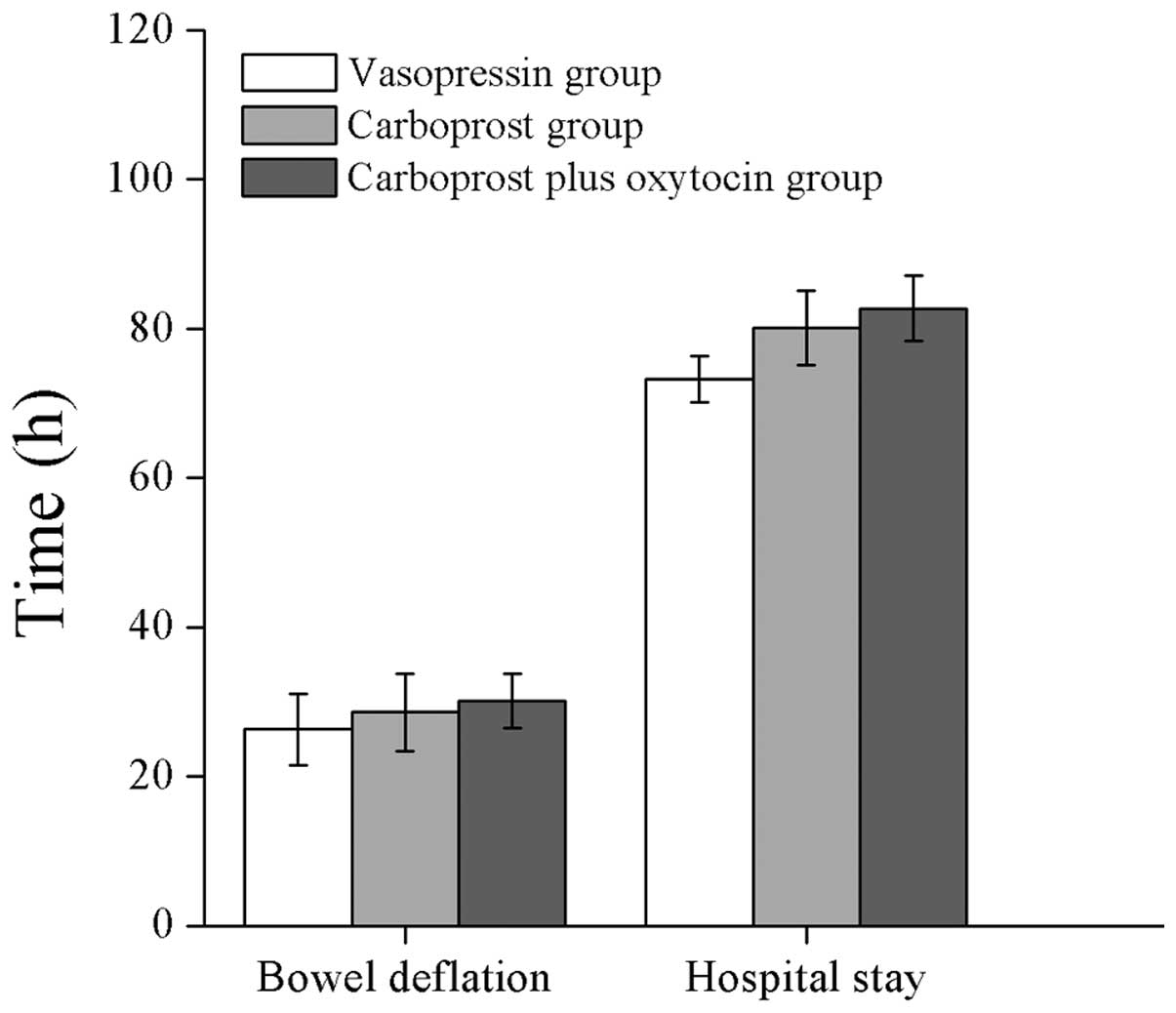
The bowel deflation times were 26.3±4.8 h, 28.6±5.2
h and 30.1±3.6 h in the vasopressin, carboprost and carboprost plus
oxytocin groups, respectively. The times of postoperative stay were
73.3±3.1 h, 80.1±5.0 h and 82.7±4.4 h in the vasopressin,
carboprost and carboprost plus oxytocin groups, respectively. The
times of bowel deflation and postoperative stay were marginally
increased in the carboprost and carboprost plus oxytocin groups
compared with the vasopressin group; however, no significant
differences were found among the three groups (Fig. 1).
Discussion
LM is a commonly used method of management of
uterine myomas, however, the bleeding or blood staining of tissues
may prevent gynecological surgeons from completing the dissection
correctly. The local use of vasopressin, intravenous oxytocin,
vaginal misoprostol, temporary blockage of the uterine artery, and
loop ligation of the myoma pseudocapsule are all intra-operative
approaches to control blood loss in LM (9,10). Local
administration of vasopressin to the myometrium has been verified
to effectively reduce the regional blood flow from the uterine
artery to the peripheral vessels, and is a safe hemostatic
technique for use in the LM procedure (7). Carboprost tromethamine, a synthetic
15-methyl analog of prostaglandin F2α, is effective at reducing
persistent hemorrhage due to uterine atony in delivery (11). Carboprost tromethamine has also been
shown to effectively prevent and control postpartum hemorrhage
(12,13).
The present study showed that the surgery time,
amount of hemorrhage and postoperative reduction in hemoglobin
levels were not significantly different between the carboprost and
vasopressin groups but were clearly decreased in the carboprost
plus oxytocin group. These data indicated that deep intramuscular
injections of carboprost tromethamine and myometrial injections of
vasopressin had similar hemostatic effects in the LM procedure, and
that carboprost tromethamine combined with a continuous intravenous
infusion of oxytocin had a superior hemostatic effect.
Vasopressin and oxytocin can cause uterine and
gastrointestinal smooth muscle contraction. Vasopressin is
associated with hypertension, due to its vasoconstrictive
properties, as well as uterine contraction pain, nausea and
vomiting (14–16). Chest tightness, palpitations, uterine
contraction pain, low fever, nausea, vomiting and diarrhea are
common adverse effects of oxytocin (17,18).
Carboprost tromethamine can cause prostaglandin-like side-effects,
such as nausea, vomiting, diarrhea, headaches, hypertension, fever
and bronchial asthma (8).
The present data showed that the incidence of mild
uterine contraction pain was higher in the groups using carboprost
tromethamine than in the vasopressin-treated patients; however, the
incidence of the other above-mentioned side-effects was not
evidently different among the three groups. The bowel deflation
time indicates the recovery of gastrointestinal motility, and
influences the postoperative recovery of patients. Though the times
of bowel deflation and postoperative stay were marginally increased
in the patients treated with carboprost tromethamine, no clear
differences were found among the three groups in the present study.
The current results indicate that carboprost tromethamine may have
stronger effects on the uterine and gastrointestinal smooth muscle
than vasopressin and oxytocin. Even though carboprost tromethamine
had marginal, yet manageable, adverse effects on gastrointestinal
smooth muscle, the evident hemostatic effect should be considered
valuable by the clinicians in the LM procedure.
In conclusion, according to the limited number of
enrolled patients and the data captured in the present study, it
was shown that a deep intramuscular injection of carboprost
tromethamine prior to performing myomectomy could be an effective
approach for reducing blood loss in laparoscopic intramural
myomectomy, in particular when combined with an intravenous
infusion of oxytocin.
Acknowledgements
The authors would like to thank Zheying Liu, Yanyan
Jia and Wenlong Feng for their support with data collection. This
study was supported by the Hospital Youth Fund Project of the First
Affiliated Hospital of Zhengzhou University.
References
|
1
|
Kongnyuy EJ and Wiysonge CS: Interventions
to reduce haemorrhage during myomectomy for fibroids. Cochrane
Database Syst Rev. 8:CD0053552014.PubMed/NCBI
|
|
2
|
Rovio PH and Heinonen PK: Transvaginal
myomectomy with screw traction by colpotomy. Arch Gynecol Obst.
273:211–215. 2006. View Article : Google Scholar
|
|
3
|
Fukuda M, Tanaka T, Kamada M, Hayashi A,
Yamashita Y, Terai Y and Ohmichi M: Comparison of the perinatal
outcomes after laparoscopic myomectomy versus abdominal myomectomy.
Gynecol Obstet Invest. 76:203–208. 2013. View Article : Google Scholar : PubMed/NCBI
|
|
4
|
Soto E, Flyckt R and Falcone T: Endoscopic
management of uterine fibroids: An update. Minerva Ginecol.
64:507–520. 2012.PubMed/NCBI
|
|
5
|
Trehan N: Laparoscopic myomectomy: Methods
to control bleeding. J Gynecol Endosc Surg. 2:33–35. 2011.
View Article : Google Scholar : PubMed/NCBI
|
|
6
|
Wang CJ, Lee CL, Yuen LT, Kay N, Han CM
and Soong YK: Oxytocin infusion in laparoscopic myomectomy may
decrease operative blood loss. J Minim Invasive Gynecol.
14:184–188. 2007. View Article : Google Scholar : PubMed/NCBI
|
|
7
|
Shimanuki H, Takeuchi H, Kitade M, Kikuchi
I, Kumakiri J and Kinoshita K: The effect of vasopressin on local
and general circulation during laparoscopic surgery. J Minim
Invasive Gynecol. 13:190–194. 2006. View Article : Google Scholar : PubMed/NCBI
|
|
8
|
Bai J, Sun Q and Zhai H: A comparison of
oxytocin and carboprost tromethamine in the prevention of
postpartum hemorrhage in high-risk patients undergoing cesarean
delivery. Exp Ther Med. 7:46–50. 2014.PubMed/NCBI
|
|
9
|
Matsuoka S, Kikuchi I, Kitade M, Kumakiri
J, Kuroda K, Tokita S, Kuroda M and Takeda S: Strategy for
laparoscopic cervical myomectomy. J Minim Invasive Gynecol.
17:301–305. 2010. View Article : Google Scholar : PubMed/NCBI
|
|
10
|
Zhao F, Jiao Y, Guo Z, Hou R and Wang M:
Evaluation of loop ligation of larger myoma pseudocapsule combined
with vasopressin on laparoscopic myomectomy. Fertil Steril.
95:762–766. 2011. View Article : Google Scholar : PubMed/NCBI
|
|
11
|
Buttino L Jr and Garite TJ: The use of 15
methyl F2 alpha prostaglandin (Prostin 15 M) for the control of
postpartum hemorrhage. Am J Perinatol. 3:241–243. 1986. View Article : Google Scholar : PubMed/NCBI
|
|
12
|
Abdel-Aleem H, Abol-Oyoun EM, Moustafa SA,
Kamel HS and Abdel-Wahab HA: Carboprost trometamol in the
management of the third stage of labor. Int J Gynaecol Obstet.
42:247–250. 1993. View Article : Google Scholar : PubMed/NCBI
|
|
13
|
Vaid A, Dadhwal V, Mittal S, Deka D, Misra
R, Sharma JB and Vimla N: A randomized controlled trial of
prophylactic sublingual misoprostol versus intramuscular
methyl-ergometrine versus intramuscular 15-methyl PGF2 alpha in
active management of third stage of labor. Arch Gynecol Obstet.
280:893–897. 2009. View Article : Google Scholar : PubMed/NCBI
|
|
14
|
Hauksson A, Akerlund M and Melin P:
Uterine blood flow and myometrial activity at menstruation, and the
action of vasopressin and a synthtic antagonist. Br J Obstet
Gynaecol. 95:898–904. 1988. View Article : Google Scholar : PubMed/NCBI
|
|
15
|
Caras SD, Soykan I, Beverly V, Lin Z and
McCallum RW: The effect of intravenous vasopressin on gastric
myoelectrical activity in human subjects. Neurogastroenterol Motil.
9:151–156. 1997. View Article : Google Scholar : PubMed/NCBI
|
|
16
|
Bankir L, Bouby N and Ritz E: Vasopressin:
A novel target for the prevention and retardation of kidney
disease? Nat Rev Nephrol. 9:223–239. 2013. View Article : Google Scholar : PubMed/NCBI
|
|
17
|
Tehseen F, Anwar A and Arfat Y:
Intraumbilical veinous injection oxytocin in the active management
of third stage of labour. J Coll Physicians Surg Pak. 18:551–554.
2008.PubMed/NCBI
|
|
18
|
Ozalp E, Tanir HM and Sener T:
Dinoprostone vaginal insert versis intravenous oxytocin to reduce
postpartum blood loss following vaginal or cesarean delivery. Clin
Exp Obstet Gynecol. 37:53–55. 2010.PubMed/NCBI
|