Spandidos Publications Logo
  • About
    • About Spandidos
    • Aims and Scopes
    • Abstracting and Indexing
    • Editorial Policies
    • Reprints and Permissions
    • Job Opportunities
    • Terms and Conditions
    • Contact
  • Journals
    • All Journals
    • Oncology Letters
      • Oncology Letters
      • Information for Authors
      • Editorial Policies
      • Editorial Board
      • Aims and Scope
      • Abstracting and Indexing
      • Bibliographic Information
      • Archive
    • International Journal of Oncology
      • International Journal of Oncology
      • Information for Authors
      • Editorial Policies
      • Editorial Board
      • Aims and Scope
      • Abstracting and Indexing
      • Bibliographic Information
      • Archive
    • Molecular and Clinical Oncology
      • Molecular and Clinical Oncology
      • Information for Authors
      • Editorial Policies
      • Editorial Board
      • Aims and Scope
      • Abstracting and Indexing
      • Bibliographic Information
      • Archive
    • Experimental and Therapeutic Medicine
      • Experimental and Therapeutic Medicine
      • Information for Authors
      • Editorial Policies
      • Editorial Board
      • Aims and Scope
      • Abstracting and Indexing
      • Bibliographic Information
      • Archive
    • International Journal of Molecular Medicine
      • International Journal of Molecular Medicine
      • Information for Authors
      • Editorial Policies
      • Editorial Board
      • Aims and Scope
      • Abstracting and Indexing
      • Bibliographic Information
      • Archive
    • Biomedical Reports
      • Biomedical Reports
      • Information for Authors
      • Editorial Policies
      • Editorial Board
      • Aims and Scope
      • Abstracting and Indexing
      • Bibliographic Information
      • Archive
    • Oncology Reports
      • Oncology Reports
      • Information for Authors
      • Editorial Policies
      • Editorial Board
      • Aims and Scope
      • Abstracting and Indexing
      • Bibliographic Information
      • Archive
    • Molecular Medicine Reports
      • Molecular Medicine Reports
      • Information for Authors
      • Editorial Policies
      • Editorial Board
      • Aims and Scope
      • Abstracting and Indexing
      • Bibliographic Information
      • Archive
    • World Academy of Sciences Journal
      • World Academy of Sciences Journal
      • Information for Authors
      • Editorial Policies
      • Editorial Board
      • Aims and Scope
      • Abstracting and Indexing
      • Bibliographic Information
      • Archive
    • International Journal of Functional Nutrition
      • International Journal of Functional Nutrition
      • Information for Authors
      • Editorial Policies
      • Editorial Board
      • Aims and Scope
      • Abstracting and Indexing
      • Bibliographic Information
      • Archive
    • International Journal of Epigenetics
      • International Journal of Epigenetics
      • Information for Authors
      • Editorial Policies
      • Editorial Board
      • Aims and Scope
      • Abstracting and Indexing
      • Bibliographic Information
      • Archive
    • Medicine International
      • Medicine International
      • Information for Authors
      • Editorial Policies
      • Editorial Board
      • Aims and Scope
      • Abstracting and Indexing
      • Bibliographic Information
      • Archive
  • Articles
  • Information
    • Information for Authors
    • Information for Reviewers
    • Information for Librarians
    • Information for Advertisers
    • Conferences
  • Language Editing
Spandidos Publications Logo
  • About
    • About Spandidos
    • Aims and Scopes
    • Abstracting and Indexing
    • Editorial Policies
    • Reprints and Permissions
    • Job Opportunities
    • Terms and Conditions
    • Contact
  • Journals
    • All Journals
    • Biomedical Reports
      • Information for Authors
      • Editorial Policies
      • Editorial Board
      • Aims and Scope
      • Abstracting and Indexing
      • Bibliographic Information
      • Archive
    • Experimental and Therapeutic Medicine
      • Information for Authors
      • Editorial Policies
      • Editorial Board
      • Aims and Scope
      • Abstracting and Indexing
      • Bibliographic Information
      • Archive
    • International Journal of Epigenetics
      • Information for Authors
      • Editorial Policies
      • Editorial Board
      • Aims and Scope
      • Abstracting and Indexing
      • Bibliographic Information
      • Archive
    • International Journal of Functional Nutrition
      • Information for Authors
      • Editorial Policies
      • Editorial Board
      • Aims and Scope
      • Abstracting and Indexing
      • Bibliographic Information
      • Archive
    • International Journal of Molecular Medicine
      • Information for Authors
      • Editorial Policies
      • Editorial Board
      • Aims and Scope
      • Abstracting and Indexing
      • Bibliographic Information
      • Archive
    • International Journal of Oncology
      • Information for Authors
      • Editorial Policies
      • Editorial Board
      • Aims and Scope
      • Abstracting and Indexing
      • Bibliographic Information
      • Archive
    • Medicine International
      • Information for Authors
      • Editorial Policies
      • Editorial Board
      • Aims and Scope
      • Abstracting and Indexing
      • Bibliographic Information
      • Archive
    • Molecular and Clinical Oncology
      • Information for Authors
      • Editorial Policies
      • Editorial Board
      • Aims and Scope
      • Abstracting and Indexing
      • Bibliographic Information
      • Archive
    • Molecular Medicine Reports
      • Information for Authors
      • Editorial Policies
      • Editorial Board
      • Aims and Scope
      • Abstracting and Indexing
      • Bibliographic Information
      • Archive
    • Oncology Letters
      • Information for Authors
      • Editorial Policies
      • Editorial Board
      • Aims and Scope
      • Abstracting and Indexing
      • Bibliographic Information
      • Archive
    • Oncology Reports
      • Information for Authors
      • Editorial Policies
      • Editorial Board
      • Aims and Scope
      • Abstracting and Indexing
      • Bibliographic Information
      • Archive
    • World Academy of Sciences Journal
      • Information for Authors
      • Editorial Policies
      • Editorial Board
      • Aims and Scope
      • Abstracting and Indexing
      • Bibliographic Information
      • Archive
  • Articles
  • Information
    • For Authors
    • For Reviewers
    • For Librarians
    • For Advertisers
    • Conferences
  • Language Editing
Login Register Submit
  • This site uses cookies
  • You can change your cookie settings at any time by following the instructions in our Cookie Policy. To find out more, you may read our Privacy Policy.

    I agree
Search articles by DOI, keyword, author or affiliation
Search
Advanced Search
presentation
Experimental and Therapeutic Medicine
Join Editorial Board Propose a Special Issue
Print ISSN: 1792-0981 Online ISSN: 1792-1015
Journal Cover
June-2014 Volume 7 Issue 6

Full Size Image

Sign up for eToc alerts
Recommend to Library

Journals

International Journal of Molecular Medicine

International Journal of Molecular Medicine

International Journal of Molecular Medicine is an international journal devoted to molecular mechanisms of human disease.

International Journal of Oncology

International Journal of Oncology

International Journal of Oncology is an international journal devoted to oncology research and cancer treatment.

Molecular Medicine Reports

Molecular Medicine Reports

Covers molecular medicine topics such as pharmacology, pathology, genetics, neuroscience, infectious diseases, molecular cardiology, and molecular surgery.

Oncology Reports

Oncology Reports

Oncology Reports is an international journal devoted to fundamental and applied research in Oncology.

Experimental and Therapeutic Medicine

Experimental and Therapeutic Medicine

Experimental and Therapeutic Medicine is an international journal devoted to laboratory and clinical medicine.

Oncology Letters

Oncology Letters

Oncology Letters is an international journal devoted to Experimental and Clinical Oncology.

Biomedical Reports

Biomedical Reports

Explores a wide range of biological and medical fields, including pharmacology, genetics, microbiology, neuroscience, and molecular cardiology.

Molecular and Clinical Oncology

Molecular and Clinical Oncology

International journal addressing all aspects of oncology research, from tumorigenesis and oncogenes to chemotherapy and metastasis.

World Academy of Sciences Journal

World Academy of Sciences Journal

Multidisciplinary open-access journal spanning biochemistry, genetics, neuroscience, environmental health, and synthetic biology.

International Journal of Functional Nutrition

International Journal of Functional Nutrition

Open-access journal combining biochemistry, pharmacology, immunology, and genetics to advance health through functional nutrition.

International Journal of Epigenetics

International Journal of Epigenetics

Publishes open-access research on using epigenetics to advance understanding and treatment of human disease.

Medicine International

Medicine International

An International Open Access Journal Devoted to General Medicine.

Journal Cover
June-2014 Volume 7 Issue 6

Full Size Image

Sign up for eToc alerts
Recommend to Library

  • Article
  • Citations
    • Cite This Article
    • Download Citation
    • Create Citation Alert
    • Remove Citation Alert
    • Cited By
  • Similar Articles
    • Related Articles (in Spandidos Publications)
    • Similar Articles (Google Scholar)
    • Similar Articles (PubMed)
  • Download PDF
  • Download XML
  • View XML
Article Open Access

Salvia miltiorrhiza extracts protect against retinal injury in a rat glaucoma model

  • Authors:
    • Qi Zhu
    • Guanfang Su
    • Lili Nie
    • Chenguang Wang
    • Yuxi He
    • Xin Liu
  • View Affiliations / Copyright

    Affiliations: Department of Ophthalmology, The Second Hospital of Jilin University, Changchun, Jilin 130041, P.R. China
  • Pages: 1513-1515
    |
    Published online on: March 24, 2014
       https://doi.org/10.3892/etm.2014.1632
  • Expand metrics +
Metrics: Total Views: 0 (Spandidos Publications: | PMC Statistics: )
Metrics: Total PDF Downloads: 0 (Spandidos Publications: | PMC Statistics: )
Cited By (CrossRef): 0 citations Loading Articles...

This article is mentioned in:


Abstract

Glaucoma is a serious progressive degenerative disorder of the eye that leads to the continuous loss of retinal ganglion cells. Traditional Chinese medicine provides an important source for new drug screening and identification. The present study used Salvia miltiorrhiza (Danshen) extracts to examine the potential neuroprotective effects for the eye in a rat model of experimental glaucoma. The results of the study indicated that Salvia miltiorrhiza extracts were unable to prevent intraocular pressure increase in the laser‑induced glaucoma model, but the treatment did reduce cell loss during glaucoma progression. Therefore, the results provide the basis for the development of a novel therapeutic agent that exhibits neuroprotective effects against glaucoma. In the future, further studies are required to purify the extracts and determine the effective bioactive components of Salvia miltiorrhiza.

Introduction

Glaucoma is a serious progressive disorder of the eye that is found primarily in aged populations and causes a high percentage of blindness (1–3). Elevated intraocular pressure (IOP) is considered to be one of the important factors in the initiation of glaucoma, leading to the shrinkage of the optic nerve and the loss of retinal ganglion cells (RGCs). Cell loss is irreversible; thus, self-recovery or restoration of vision is not possible following blindness. Stem cell transplantation currently offers one possibility to treat the disease. However, for the RGC layer, transplantation is unable to produce sufficiently high numbers of integrated cells or specialized differentiation of the transplanted cells (1,4). Therefore, neuroprotection during the progression of glaucoma represents the main approach of the current therapies. Investigating new neuroprotective agents for the eye is critical.

A number of traditional Chinese medicines that are known to be beneficial to the eye have been studied in animal models of glaucoma. For example, Lycium barbarum Lynn extracts were shown to exhibit neuroprotective effects on RGCs in various diseases, including glaucoma (5,6). Danshen (Salvia miltiorrhiza) has also been administered for eye protection, particularly in aged populations (7,8). Thus, it is highly possible that this extract exhibits neuroprotective effects in the retina in progressive glaucoma. Therefore, the aim of the present study was to examine the potential neuroprotection of Salvia miltiorrhiza extracts on the retina in a rat model of glaucoma.

Materials and methods

Ethics

The study was approved by the Ethics Committee of Animal Research of the Department of Ophthalmology (Second Hospital of Jilin University, Changchun, China). Animal care guidelines were strictly followed for all experimental procedures in the study.

Animal model

In total, 30 Sprague Dawley rats (gender, male; age, 4–5 months) were obtained from the Animal Experiment Center (Second Hospital of Jilin University) and maintained in conditions with a normal light cycle. The animals were housed with three rats per cage.

A total of 10 animals served as controls and were anesthetized with 50 mg/kg ketamine and 10 mg/kg xylazine, but did not undergo surgery (control group). For the glaucoma model, following anesthesia, the rats were subjected to occlusion of aqueous outflow by laser irradiation under a slit lamp. This procedure was performed twice on the left eye, leaving the right eye as the control.

For the 20 animals that underwent surgery, the surrounding lateral lines of the eye were occluded with 60–70 laser pulses at a power of 0.8 W (time duration of each pulse, 0.2 sec; size, 60 μm in diameter; diode laser output, 532 nm). The procedures were performed by two experienced surgeons and the model had been previously validated in preliminary experiments.

IOP

IOP was examined constantly with an Icare® Tonolab tonometer (Icare Finland Oy, Espoo, Finland) in order to select the animals with successful aqueous outflow occlusion. All 20 rats exhibited a clear IOP elevation as early as 24 h after surgery, with a baseline value of ~20 mmHg and an increase of 5–10 mmHg. The IOPs remained elevated for several days.

Salvia miltiorrhiza extract feeding

The Salvia miltiorrhiza extracts were obtained from Tianjin Tasly Pharmaceutical Co., Ltd. (Tianjin, China) and were administered to rats orally at 1 g/kg/day, starting 1 week prior to the glaucoma model experiment. The IC50 value of the extracts was 178 g/kg, based on preliminary experiments.

Of the 20 animals subjected to surgery, 10 animals were treated with Salvia miltiorrhiza extract (treatment group) and 10 animals were left untreated (glaucoma group).

FluoroGold™ (FG; Fluorochrome, Denver, CO, USA) labeling for RGC quantification

Labeling of the rat retinas was performed one month following surgery. Retrograde labeling on the superior colliculus was achieved with the application of 5 μl 5% FG (Fluorochrome, Inc., Denver, CO, USA) soaked in gel foam. After six days, the animals were sacrificed and the retinas were obtained and mounted flat for cell counting (double-blindly). A total of eight random regions of the retina were selected for counting and six animals from each group were used for this experiment.

Statistical analysis

Data are presented as the mean ± SD and were analyzed with SPSS software, version 17.0 (SPSS, Inc., Chicago, IL, USA). For statistical analyses, the t-test was performed and P<0.05 was considered to indicate a statistically significant difference.

Results

Salvia miltiorrhiza extract does not prevent IOP increase

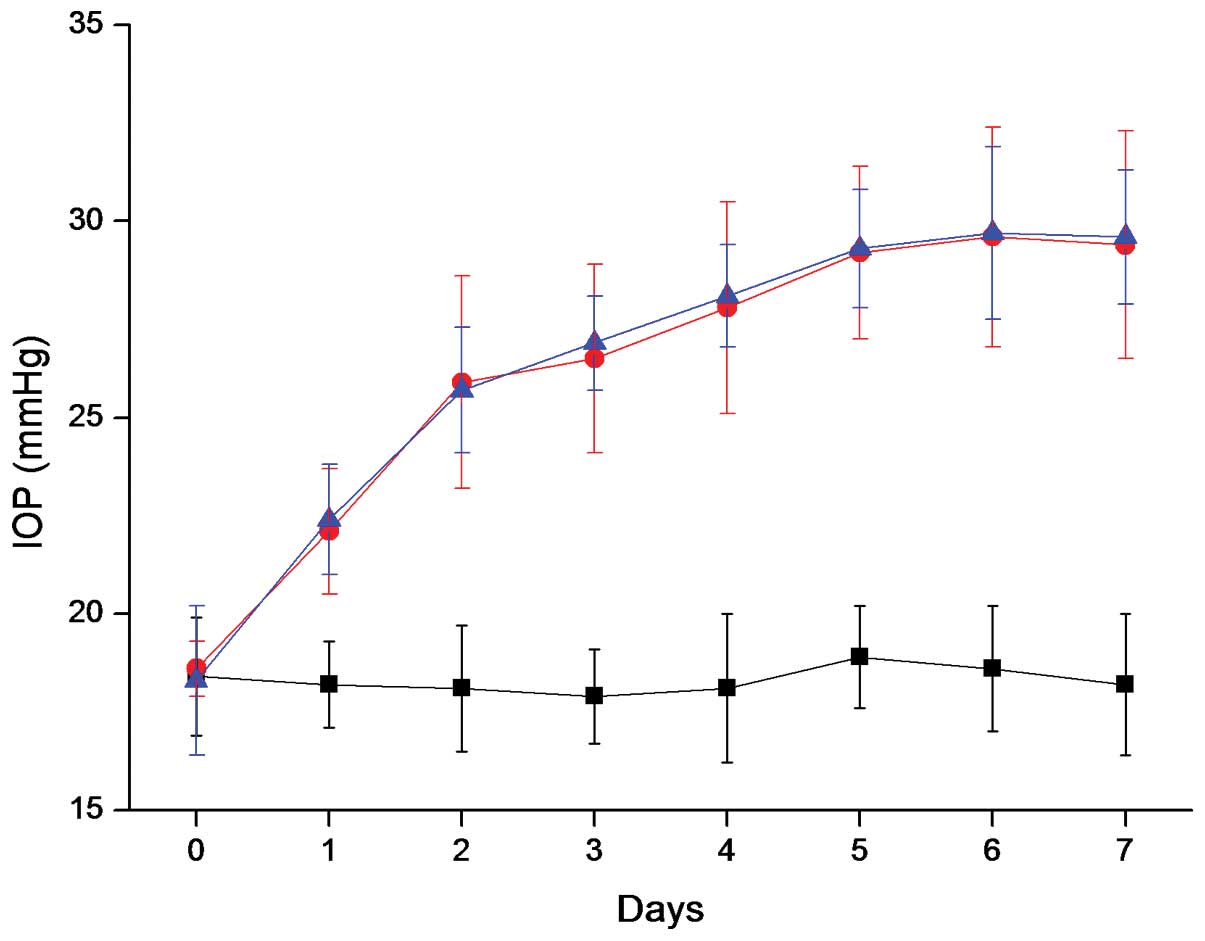
Results following surgery indicated that there was a rapid and steady increase in IOP for 7 days in the left eyes of the rats subjected to aqueous outflow occlusion, demonstrating the success of the glaucoma model. However, the oral administration of Salvia miltiorrhiza extract for one week did not prevent the IOP increase in the treatment group (Fig. 1). This indicates that Salvia miltiorrhiza extract does not change the physiological circulation properties of the aqueous outflow and is unable to decrease the IOP.

Figure 1

IOP changes in rats subjected to glaucoma-inducing surgery. There were no significant differences in IOP between the glaucoma and treatment groups, but these two groups showed a significant increase in IOP compared with that in the control group. Black, control; red, glaucoma group; blue, treatment group; IOP, intraocular pressure.

Salvia miltiorrhiza extract protects RGCs

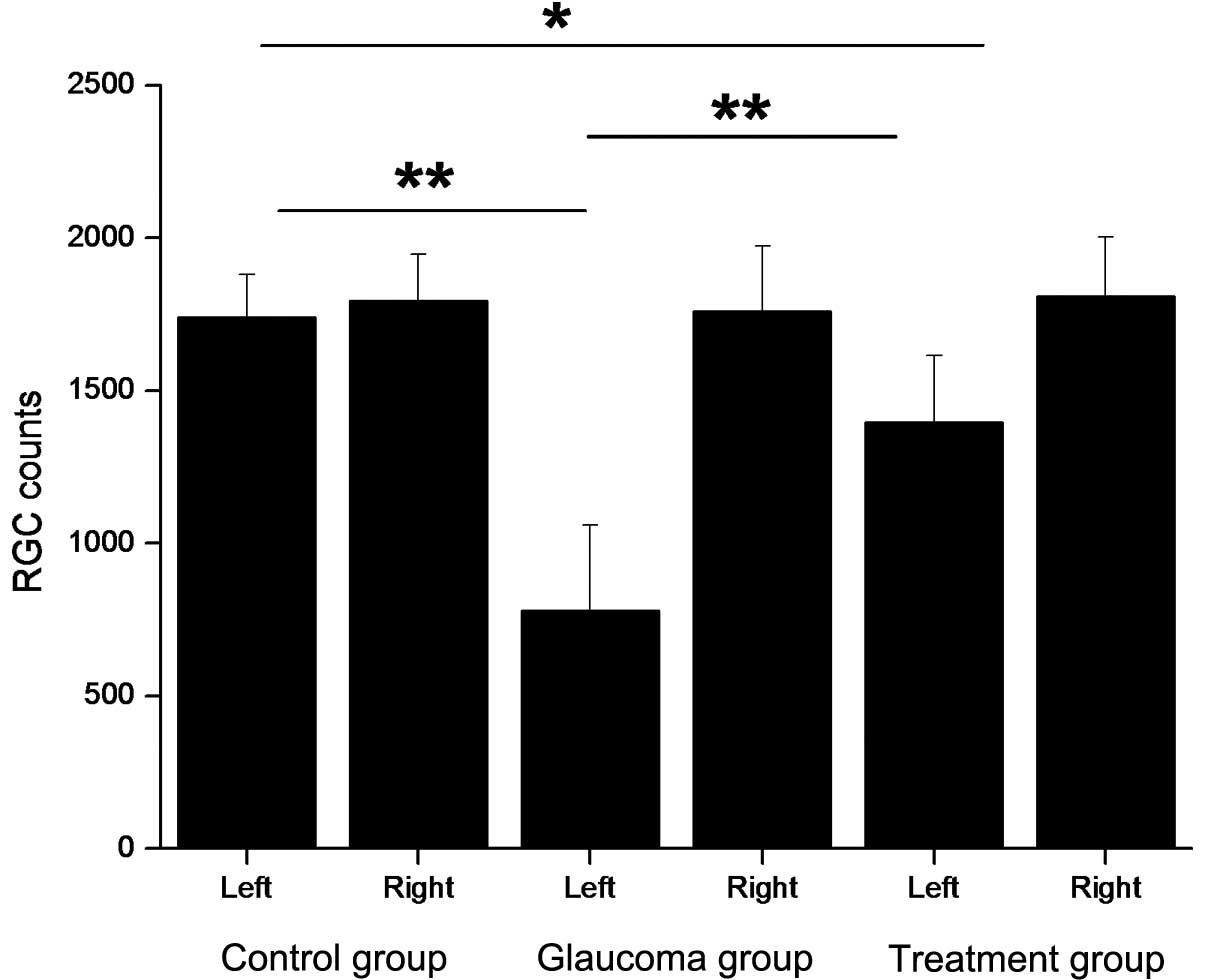
The results indicated that even with a rapid increase in IOP, orally administered Salvia miltiorrhiza extract protected against RGC loss 30 days following the IOP increase. In the glaucoma group, the loss of RGCs in the left eye was statistically significant (P<0.01), while in the treatment group there was mild reduction in the number of RGCs in the left eye (P<0.05), which was statistically significant from that in the glaucoma group (P<0.01; Table I and Fig. 2).

Figure 2

Oral administration of Salvia miltiorrhiza extract protects RGCs (counts per mm2). RGC loss in the left eye of the rats decreased significantly in the treatment group compared with that in the glaucoma group. *P<0.05; **P<0.01 for the difference between the left eyes indicated by the horizontal line ends. RGCs, retinal ganglion cells.

Table I

Orally administration of Salvia miltiorrhiza extract protects RGCs (counts per mm2, mean ± SEM).

Table I

Orally administration of Salvia miltiorrhiza extract protects RGCs (counts per mm2, mean ± SEM).

EyeControl groupGlaucoma groupTreatment group
Left1,740±140780±280a1,396±220b,c
Right1,794±1531,760±2141,810±195

a P<0.01 and

b P<0.05 vs. control group;

c P<0.01, vs. glaucoma group.

{ label (or @symbol) needed for fn[@id='tfn4-etm-07-06-1513'] } RGCs, retinal ganglion cells; SEM, standard error of the mean.

Discussion

Glaucoma-induced retinal degeneration and vision loss is a severe problem in Asian countries, particularly in aged populations. Various efforts have been made to improve the survival of retinal neurons following an IOP increase, including infusion of trophic factors, electrical stimulation and visual training (9–11). Extracts from traditional medicine, particularly herbal medicine, have been shown to improve the survival of RGCs in various models of neuronal injury, including glaucoma-induced cell loss (12,13). The present study employed Salvia miltiorrhiza extract feeding in a rat model of glaucoma to investigate the potential protective effects of this extract in glaucoma. The results demonstrated that the orally administered extract did not prevent the IOP from increasing, but did protect the RGCs from pressure-induced cell death.

Salvia miltiorrhiza (Danshen) has been widely used in formulations and has demonstrated anti-ageing effects, as well as neuroprotection (7,8). In addition, Salvia miltiorrhiza, as part of a formulation, has been used to reverse diabetes-induced retinopathy or glaucoma-associated retinal degeneration (7,14,15). The present study used Salvia miltiorrhiza extracts alone and further demonstrated the protective functions of these extracts on RGCs. Salvia miltiorrhiza is composed of numerous bioactive components, including danshensu (DSS), protocatechuic aldehyde, salvianolic acid B, cryptotanshinone and tanshinone. DSS is considered to be one of the most important components and may be partially responsible for the neuroprotective effects observed in the retina (16). Future studies are required to investigate the bioactive components of Salvia miltiorrhiza and determine whether purified DSS at various doses exhibits neuroprotective effects in glaucoma and other eye diseases.

In summary, the present study has demonstrated the neuroprotective effects of Salvia miltiorrhiza extracts on RGCs in a rat model of glaucoma. Thus, Salvia miltiorrhiza may be a new therapeutic agent for the clinical management of glaucoma.

References

1 

Worley A and Grimmer-Somers K: Risk factors for glaucoma: what do they really mean? Aust J Prim Health. 17:233–239. 2011. View Article : Google Scholar : PubMed/NCBI

2 

Wong VH, Bui BV and Vingrys AJ: Clinical and experimental links between diabetes and glaucoma. Clin Exp Optom. 94:4–23. 2011. View Article : Google Scholar : PubMed/NCBI

3 

Yanagi M, Kawasaki R, Wang JJ, Wong TY, Crowston J and Kiuchi Y: Vascular risk factors in glaucoma: a review. Clin Experiment Ophthalmol. 39:252–258. 2011. View Article : Google Scholar : PubMed/NCBI

4 

Hayreh SS: Neovascular glaucoma. Prog Retin Eye Res. 26:470–485. 2007. View Article : Google Scholar

5 

Chan HC, Chang RC, Koon-Ching Ip A, et al: Neuroprotective effects of Lycium barbarum Lynn on protecting retinal ganglion cells in an ocular hypertension model of glaucoma. Exp Neurol. 203:269–273. 2007.

6 

Mi XS, Zhong JX, Chang RC and So KF: Research advances on the usage of traditional Chinese medicine for neuroprotection in glaucoma. J Integr Med. 11:233–240. 2013. View Article : Google Scholar : PubMed/NCBI

7 

Cheng TO: Cardiovascular effects of Danshen. Int J Cardiol. 121:9–22. 2007. View Article : Google Scholar

8 

Qin RA, Yao XX and Huang ZY: Effects of compound danshen tablets on spatial cognition and expression of brain beta-amyloid precursor protein in a rat model of Alzheimer’s disease. J Tradit Chin Med. 32:63–66. 2012.PubMed/NCBI

9 

Jensen RJ and Rizzo JF III: Responses of ganglion cells to repetitive electrical stimulation of the retina. J Neural Eng. 4:S1–S6. 2007. View Article : Google Scholar : PubMed/NCBI

10 

Ko ML, Hu DN, Ritch R and Sharma SC: The combined effect of brain-derived neurotrophic factor and a free radical scavenger in experimental glaucoma. Invest Ophthalmol Vis Sci. 41:2967–2971. 2000.PubMed/NCBI

11 

Wilensky JT, Gieser DK, Mori MT, Langenberg PW and Zeimer RC: Self-tonometry to manage patients with glaucoma and apparently controlled intraocular pressure. Arch Ophthalmol. 105:1072–1075. 1987. View Article : Google Scholar : PubMed/NCBI

12 

Rhee DJ1, Katz LJ, Spaeth GL and Myers JS: Complementary and alternative medicine for glaucoma. Surv Ophthalmol. 46:43–55. 2001. View Article : Google Scholar : PubMed/NCBI

13 

Huynh TP1, Mann SN and Mandal NA: Botanical compounds: effects on major eye diseases. Evid Based Complement Alternat Med. 2013:5491742013.PubMed/NCBI

14 

Yue KK, Lee KW, Chan KK, Leung KS, Leung AW and Cheng CH: Danshen prevents the occurrence of oxidative stress in the eye and aorta of diabetic rats without affecting the hyperglycemic state. J Ethnopharmacol. 106:136–141. 2006. View Article : Google Scholar : PubMed/NCBI

15 

Liu Q, Zhang Y, Lin Z, et al: Danshen extract 15,16-dihydrotanshinone I functions as a potential modulator against metabolic syndrome through multi-target pathways. J Steroid Biochem Mol Biol. 120:155–163. 2010. View Article : Google Scholar : PubMed/NCBI

16 

Qi HP, Wei SQ, Zhang LQ, et al: Preventive effect of danshensu on selenite-induced cataractogenesis in cultured rat lens. Clin Experiment Ophthalmol. 41:172–179. 2013. View Article : Google Scholar : PubMed/NCBI

Related Articles

  • Abstract
  • View
  • Download
  • Twitter
Copy and paste a formatted citation
Spandidos Publications style
Zhu Q, Su G, Nie L, Wang C, He Y and Liu X: Salvia miltiorrhiza extracts protect against retinal injury in a rat glaucoma model. Exp Ther Med 7: 1513-1515, 2014.
APA
Zhu, Q., Su, G., Nie, L., Wang, C., He, Y., & Liu, X. (2014). Salvia miltiorrhiza extracts protect against retinal injury in a rat glaucoma model. Experimental and Therapeutic Medicine, 7, 1513-1515. https://doi.org/10.3892/etm.2014.1632
MLA
Zhu, Q., Su, G., Nie, L., Wang, C., He, Y., Liu, X."Salvia miltiorrhiza extracts protect against retinal injury in a rat glaucoma model". Experimental and Therapeutic Medicine 7.6 (2014): 1513-1515.
Chicago
Zhu, Q., Su, G., Nie, L., Wang, C., He, Y., Liu, X."Salvia miltiorrhiza extracts protect against retinal injury in a rat glaucoma model". Experimental and Therapeutic Medicine 7, no. 6 (2014): 1513-1515. https://doi.org/10.3892/etm.2014.1632
Copy and paste a formatted citation
x
Spandidos Publications style
Zhu Q, Su G, Nie L, Wang C, He Y and Liu X: Salvia miltiorrhiza extracts protect against retinal injury in a rat glaucoma model. Exp Ther Med 7: 1513-1515, 2014.
APA
Zhu, Q., Su, G., Nie, L., Wang, C., He, Y., & Liu, X. (2014). Salvia miltiorrhiza extracts protect against retinal injury in a rat glaucoma model. Experimental and Therapeutic Medicine, 7, 1513-1515. https://doi.org/10.3892/etm.2014.1632
MLA
Zhu, Q., Su, G., Nie, L., Wang, C., He, Y., Liu, X."Salvia miltiorrhiza extracts protect against retinal injury in a rat glaucoma model". Experimental and Therapeutic Medicine 7.6 (2014): 1513-1515.
Chicago
Zhu, Q., Su, G., Nie, L., Wang, C., He, Y., Liu, X."Salvia miltiorrhiza extracts protect against retinal injury in a rat glaucoma model". Experimental and Therapeutic Medicine 7, no. 6 (2014): 1513-1515. https://doi.org/10.3892/etm.2014.1632
Follow us
  • Twitter
  • LinkedIn
  • Facebook
About
  • Spandidos Publications
  • Careers
  • Cookie Policy
  • Privacy Policy
How can we help?
  • Help
  • Live Chat
  • Contact
  • Email to our Support Team