Int J Mol Med 35: [Related article:] 399-404, 2015; DOI:
10.3892/ijmm.2014.2015
Following the publication of the above article, an
interested reader drew to our attention a number of issues and
concerns related to the descriptions of the genes and mouse models
in the above paper. After having consulted with the authors, they
have acknowledged that their paper did indeed contain a number of
errors, and these are listed below in this Corrigendum.
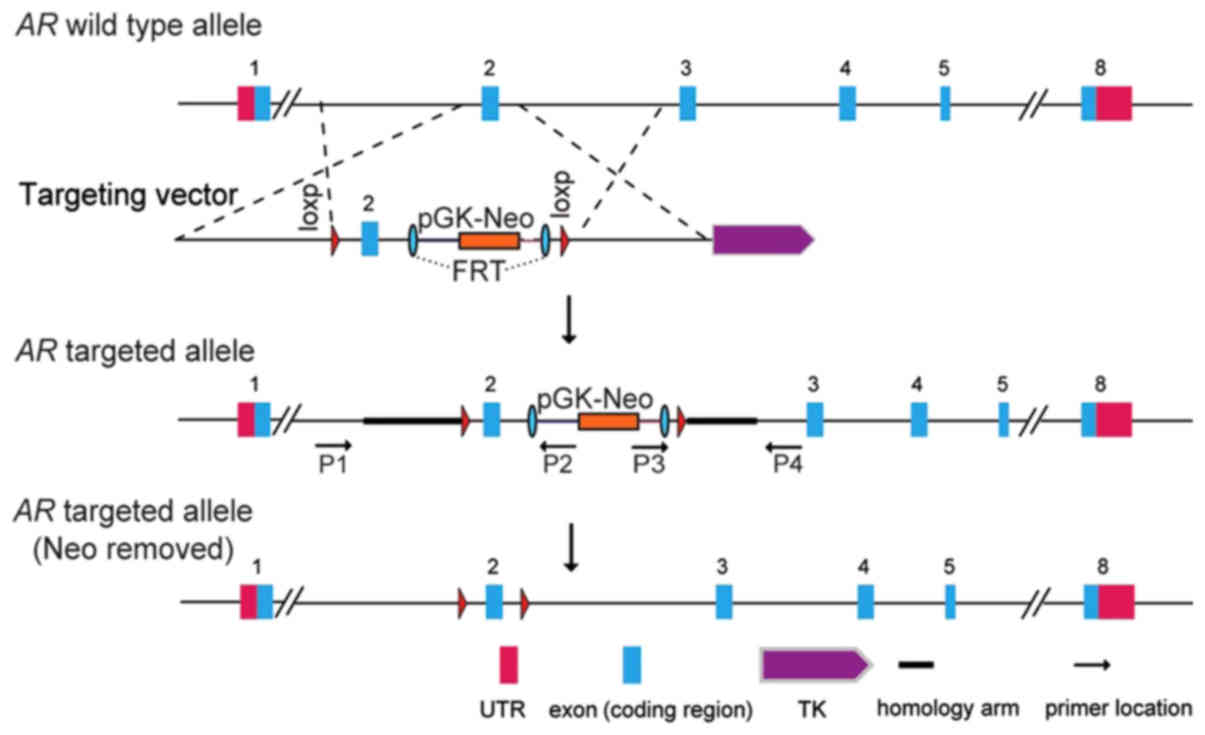
First, the authors realized that an incorrect figure
was included as Fig. 1 in the
paper. The correct (and entirely different) version of Fig. 1, together with its figure legend,
is shown opposite.
The following textual errors in the paper should
also be noted:
In the Abstract, lines 3-4 in the left-hand
column (LHC): “androgen receptor (AR)−/−,
AR+/− and AR+/+ male mice” should have been
written as “androgen receptor (AR) conditional knockout mice”; line
5 in the LHC: “flox-AR” should have been written as
“ARflox/+”; line 6 in the LHC: “AR-Cre” should have been
written as “Amhr2-Cre”; line 22 in the LHC: “AR+/−”
should have been written as “ARflox/Y”; line 1 in the
right-hand column (RHC): “heterozygous” should have been written as
“ARflox/Y”; and line 2 in the RHC, “heterozygous” should
have been written as “ARflox/Y Cre+”.
In the Introduction, paragraph 3, lines 6-7
in the LHC “or female ARKO mice” should have been deleted;
paragraph 4, line 5 in the LHC: “AR−/−”,
“AR+/−” and “AR+/+” should have been deleted;
paragraph 4, line 11 in the LHC: “AR−/−”, and
“AR+/−” should have been written as “AR−/Y”,
whereas “AR+/+” should have been written as
“AR+/Y”.
In the Materials and methods, paragraph 3,
the last sentence in the RHC {“The identification of the plasmid
containing leydig cells expressing Cre recombinant enzyme and the
specificity of the genetically modified (gm) sequence [Amhr2-Cre
(7.1)] are shown in Fig. 1}
should have been written as “The positive clones were identified by
digestion and sequencing.”
In the Results, the first subheading in the
RHC (“…transgenic mouse model (Amhr2-Cre)” should have been
written as “…AR conditional knockout targeting vector”;
paragraph 1, lines 1-3 in the RHC: The sentence “The AR gene
condition knockout plasmid was identified and confirmed by enzyme
digestion with BamHI” should have been written as “The AR
gene conditional knockout strategy is shown in Fig. 1. The gene targeting vector was
identified and confirmed by enzyme digestion with BamHI”;
paragraph 1, line 4 in the RHC: “2.7 kb” should have been written
as “7.8 kb”; Table III, in the title and in the Table heading,
“AR+/−” should have been written as “AR+/Y”,
and “AR−/−” should have been written as
“AR−/Y”; in the subheading “Comparison between
AR−/− male mice and normal mice”, “AR−/−”
should have been written as “AR−/Y”, and “normal” should
have been written as “AR+/Y”; and paragraph 4, lines 3-5
in the LHC: “AR+/−” should have been written as
“AR+/Y”, and “AR−/−” should have been written
as “AR−/Y”.
All the authors thank the interested reader for
drawing these matters to their attention, and agree to the contents
of this Corrigendum. The authors also stress that these errors did
not significantly influence either the results or the conclusions
of the paper. Furthermore, the authors apologize to the Editor of
International Journal of Molecular Medicine and to the
readership for any inconvenience caused.