Spandidos Publications Logo
  • About
    • About Spandidos
    • Aims and Scopes
    • Abstracting and Indexing
    • Editorial Policies
    • Reprints and Permissions
    • Job Opportunities
    • Terms and Conditions
    • Contact
  • Journals
    • All Journals
    • Oncology Letters
      • Oncology Letters
      • Information for Authors
      • Editorial Policies
      • Editorial Board
      • Aims and Scope
      • Abstracting and Indexing
      • Bibliographic Information
      • Archive
    • International Journal of Oncology
      • International Journal of Oncology
      • Information for Authors
      • Editorial Policies
      • Editorial Board
      • Aims and Scope
      • Abstracting and Indexing
      • Bibliographic Information
      • Archive
    • Molecular and Clinical Oncology
      • Molecular and Clinical Oncology
      • Information for Authors
      • Editorial Policies
      • Editorial Board
      • Aims and Scope
      • Abstracting and Indexing
      • Bibliographic Information
      • Archive
    • Experimental and Therapeutic Medicine
      • Experimental and Therapeutic Medicine
      • Information for Authors
      • Editorial Policies
      • Editorial Board
      • Aims and Scope
      • Abstracting and Indexing
      • Bibliographic Information
      • Archive
    • International Journal of Molecular Medicine
      • International Journal of Molecular Medicine
      • Information for Authors
      • Editorial Policies
      • Editorial Board
      • Aims and Scope
      • Abstracting and Indexing
      • Bibliographic Information
      • Archive
    • Biomedical Reports
      • Biomedical Reports
      • Information for Authors
      • Editorial Policies
      • Editorial Board
      • Aims and Scope
      • Abstracting and Indexing
      • Bibliographic Information
      • Archive
    • Oncology Reports
      • Oncology Reports
      • Information for Authors
      • Editorial Policies
      • Editorial Board
      • Aims and Scope
      • Abstracting and Indexing
      • Bibliographic Information
      • Archive
    • Molecular Medicine Reports
      • Molecular Medicine Reports
      • Information for Authors
      • Editorial Policies
      • Editorial Board
      • Aims and Scope
      • Abstracting and Indexing
      • Bibliographic Information
      • Archive
    • World Academy of Sciences Journal
      • World Academy of Sciences Journal
      • Information for Authors
      • Editorial Policies
      • Editorial Board
      • Aims and Scope
      • Abstracting and Indexing
      • Bibliographic Information
      • Archive
    • International Journal of Functional Nutrition
      • International Journal of Functional Nutrition
      • Information for Authors
      • Editorial Policies
      • Editorial Board
      • Aims and Scope
      • Abstracting and Indexing
      • Bibliographic Information
      • Archive
    • International Journal of Epigenetics
      • International Journal of Epigenetics
      • Information for Authors
      • Editorial Policies
      • Editorial Board
      • Aims and Scope
      • Abstracting and Indexing
      • Bibliographic Information
      • Archive
    • Medicine International
      • Medicine International
      • Information for Authors
      • Editorial Policies
      • Editorial Board
      • Aims and Scope
      • Abstracting and Indexing
      • Bibliographic Information
      • Archive
  • Articles
  • Information
    • Information for Authors
    • Information for Reviewers
    • Information for Librarians
    • Information for Advertisers
    • Conferences
  • Language Editing
Spandidos Publications Logo
  • About
    • About Spandidos
    • Aims and Scopes
    • Abstracting and Indexing
    • Editorial Policies
    • Reprints and Permissions
    • Job Opportunities
    • Terms and Conditions
    • Contact
  • Journals
    • All Journals
    • Biomedical Reports
      • Information for Authors
      • Editorial Policies
      • Editorial Board
      • Aims and Scope
      • Abstracting and Indexing
      • Bibliographic Information
      • Archive
    • Experimental and Therapeutic Medicine
      • Information for Authors
      • Editorial Policies
      • Editorial Board
      • Aims and Scope
      • Abstracting and Indexing
      • Bibliographic Information
      • Archive
    • International Journal of Epigenetics
      • Information for Authors
      • Editorial Policies
      • Editorial Board
      • Aims and Scope
      • Abstracting and Indexing
      • Bibliographic Information
      • Archive
    • International Journal of Functional Nutrition
      • Information for Authors
      • Editorial Policies
      • Editorial Board
      • Aims and Scope
      • Abstracting and Indexing
      • Bibliographic Information
      • Archive
    • International Journal of Molecular Medicine
      • Information for Authors
      • Editorial Policies
      • Editorial Board
      • Aims and Scope
      • Abstracting and Indexing
      • Bibliographic Information
      • Archive
    • International Journal of Oncology
      • Information for Authors
      • Editorial Policies
      • Editorial Board
      • Aims and Scope
      • Abstracting and Indexing
      • Bibliographic Information
      • Archive
    • Medicine International
      • Information for Authors
      • Editorial Policies
      • Editorial Board
      • Aims and Scope
      • Abstracting and Indexing
      • Bibliographic Information
      • Archive
    • Molecular and Clinical Oncology
      • Information for Authors
      • Editorial Policies
      • Editorial Board
      • Aims and Scope
      • Abstracting and Indexing
      • Bibliographic Information
      • Archive
    • Molecular Medicine Reports
      • Information for Authors
      • Editorial Policies
      • Editorial Board
      • Aims and Scope
      • Abstracting and Indexing
      • Bibliographic Information
      • Archive
    • Oncology Letters
      • Information for Authors
      • Editorial Policies
      • Editorial Board
      • Aims and Scope
      • Abstracting and Indexing
      • Bibliographic Information
      • Archive
    • Oncology Reports
      • Information for Authors
      • Editorial Policies
      • Editorial Board
      • Aims and Scope
      • Abstracting and Indexing
      • Bibliographic Information
      • Archive
    • World Academy of Sciences Journal
      • Information for Authors
      • Editorial Policies
      • Editorial Board
      • Aims and Scope
      • Abstracting and Indexing
      • Bibliographic Information
      • Archive
  • Articles
  • Information
    • For Authors
    • For Reviewers
    • For Librarians
    • For Advertisers
    • Conferences
  • Language Editing
Login Register Submit
  • This site uses cookies
  • You can change your cookie settings at any time by following the instructions in our Cookie Policy. To find out more, you may read our Privacy Policy.

    I agree
Search articles by DOI, keyword, author or affiliation
Search
Advanced Search
presentation
Molecular and Clinical Oncology
Join Editorial Board Propose a Special Issue
Print ISSN: 2049-9450 Online ISSN: 2049-9469
Journal Cover
November-December 2014 Volume 2 Issue 6

Full Size Image

Sign up for eToc alerts
Recommend to Library

Journals

International Journal of Molecular Medicine

International Journal of Molecular Medicine

International Journal of Molecular Medicine is an international journal devoted to molecular mechanisms of human disease.

International Journal of Oncology

International Journal of Oncology

International Journal of Oncology is an international journal devoted to oncology research and cancer treatment.

Molecular Medicine Reports

Molecular Medicine Reports

Covers molecular medicine topics such as pharmacology, pathology, genetics, neuroscience, infectious diseases, molecular cardiology, and molecular surgery.

Oncology Reports

Oncology Reports

Oncology Reports is an international journal devoted to fundamental and applied research in Oncology.

Experimental and Therapeutic Medicine

Experimental and Therapeutic Medicine

Experimental and Therapeutic Medicine is an international journal devoted to laboratory and clinical medicine.

Oncology Letters

Oncology Letters

Oncology Letters is an international journal devoted to Experimental and Clinical Oncology.

Biomedical Reports

Biomedical Reports

Explores a wide range of biological and medical fields, including pharmacology, genetics, microbiology, neuroscience, and molecular cardiology.

Molecular and Clinical Oncology

Molecular and Clinical Oncology

International journal addressing all aspects of oncology research, from tumorigenesis and oncogenes to chemotherapy and metastasis.

World Academy of Sciences Journal

World Academy of Sciences Journal

Multidisciplinary open-access journal spanning biochemistry, genetics, neuroscience, environmental health, and synthetic biology.

International Journal of Functional Nutrition

International Journal of Functional Nutrition

Open-access journal combining biochemistry, pharmacology, immunology, and genetics to advance health through functional nutrition.

International Journal of Epigenetics

International Journal of Epigenetics

Publishes open-access research on using epigenetics to advance understanding and treatment of human disease.

Medicine International

Medicine International

An International Open Access Journal Devoted to General Medicine.

Journal Cover
November-December 2014 Volume 2 Issue 6

Full Size Image

Sign up for eToc alerts
Recommend to Library

  • Article
  • Citations
    • Cite This Article
    • Download Citation
    • Create Citation Alert
    • Remove Citation Alert
    • Cited By
  • Similar Articles
    • Related Articles (in Spandidos Publications)
    • Similar Articles (Google Scholar)
    • Similar Articles (PubMed)
  • Download PDF
  • Download XML
  • View XML
Article

Lymph node spread of gallbladder cancer from the perspective of embryologically‑based anatomy and significance of the lymphatic basin along the embryonic right hepatic artery

  • Authors:
    • Hisatoshi Nakagawara
    • Hidehiro Tajima
    • Tomoharu Miyashita
    • Hirohisa Kitagawa
    • Isamu Makino
    • Seisho Sakai
    • Hironori Hayashi
    • Shinichi Nakanuma
    • Katsunobu Oyama
    • Hiroyuki Takamura
    • Sachio Fushida
    • Takashi Fujimura
    • Tetsuo Ohta
  • View Affiliations / Copyright

    Affiliations: Division of Cancer Medicine, Department of Gastroenterologic Surgery, Graduate School of Medicine Science, Kanazawa University, Kanazawa, Ishikawa 920‑0934, Japan
  • Pages: 963-967
    |
    Published online on: July 9, 2014
       https://doi.org/10.3892/mco.2014.342
  • Expand metrics +
Metrics: Total Views: 0 (Spandidos Publications: | PMC Statistics: )
Metrics: Total PDF Downloads: 0 (Spandidos Publications: | PMC Statistics: )
Cited By (CrossRef): 0 citations Loading Articles...

This article is mentioned in:


Abstract

Lymph node metastasis from gallbladder cancer is often found in the pericholedochal area; however, these regional lymph nodes are not typically accompanied by arteries. We hypothesized that the artery accompanying pericholedochal lymph nodes was either the regressed embryonic right hepatic artery (eRHA) or an aberrant right hepatic artery (aRHA) remaining without regression. This study aimed to determine the artery supplying pericholedochal lymph nodes. We obtained serial tissue sections of resected specimens from 10 patients who underwent pancreaticoduodenectomy with combined resection of the superior mesenteric artery and vein and investigated the association between the distribution of enlarged lymph nodes and the course of blood vessels in each section. In 2 cases with aRHA, enlarged lymph nodes were distributed in the posterosuperior area, pancreaticoduodenal region and retroportal area along this artery. By contrast, no blood vessels accompanied enlarged lymph nodes in 8 patients exhibiting a normal hepatic artery branching pattern, although these nodes exhibited a distribution pattern similar to that of patients with the aRHA. Thus, the artery supplying pericholedochal lymph nodes appears to be either the regressed eRHA or an aRHA persisting without regression.

Introduction

The prognosis of gallbladder cancer (GBC) with lymph node metastases is poor. The 5-year survival rate following surgical resection has been reported to be 65% for patients with no lymph node metastases and <30% for those with regional lymph node metastases (pN1) (1). In the pN1 group, lymph node metastases characteristically arise in the pericholedochal area or the posterosuperior pancreaticoduodenal region, rather than around the hepatic artery (2,3). However, no feeding arteries are present around the pericholedochal lymph nodes and posterosuperior pancreaticoduodenal lymph nodes (PPLNs), although lymph nodes and lymphatic vessels generally exist along a feeding artery (4–7).

We previously performed pancreaticoduodenectomy (PD) for pancreatic cancer in patients with an aberrant right hepatic artery (aRHA). In such cases, PPLNs were distributed along the aRHA. This artery is considered to represent an embryonic right hepatic artery (eRHA) that has not regressed. We hypothesized that the artery responsible for PPLNs would be the eRHA. If this hypothesis is accurate, lymphadenectomy for GBC should be performed based on the course of the eRHA (8). The aim of this study was to determine the artery supplying the PPLNs.

Materials and methods

Patients

Between 1997 and 2005, a total of 58 patients underwent PD for invasive pancreatic ductal cancer in the Department of Gastroenterologic Surgery at Kanazawa University. Among these cases, radical PD with major vessel resection [superior mesenteric artery (SMA) and superior mesenteric vein (SMV) resection] was performed in 18 patients for complete clearance of the soft tissues around these arteries (9). This study was approved by the Ethics Committee at our institution and was conducted in accordance with the Declaration of Helsinki.

Specimens

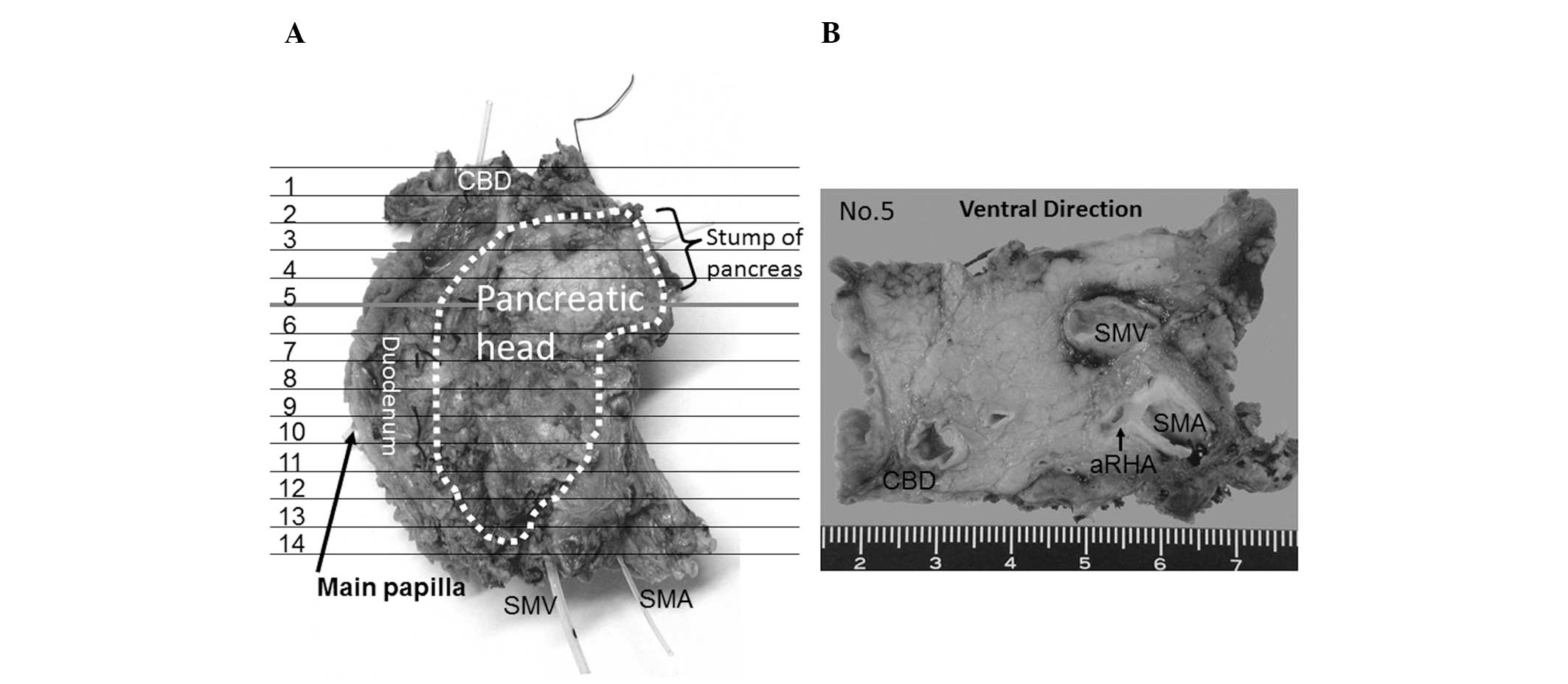
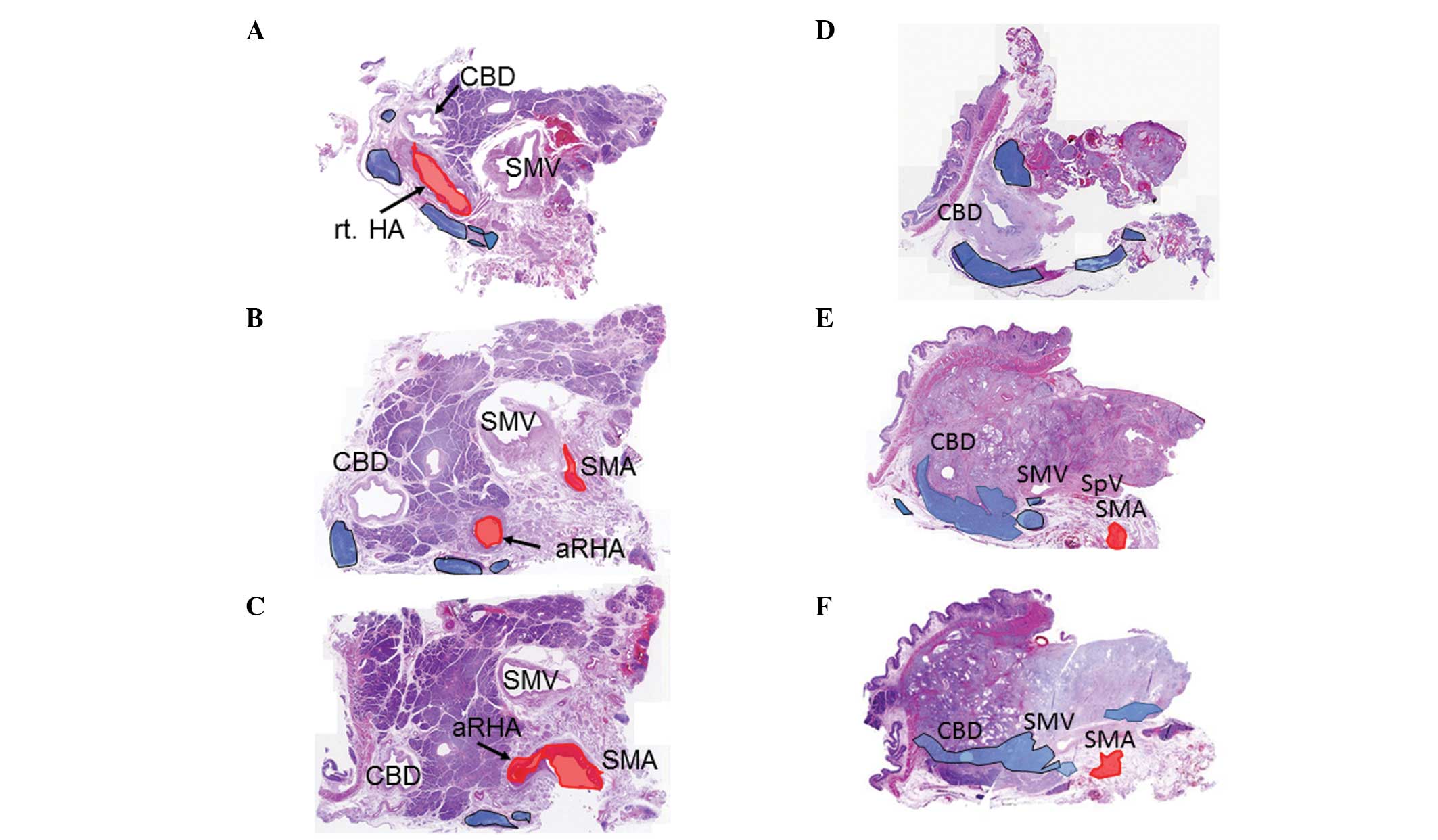
The resected specimens were immediately fixed in 10% neutral-buffered formaldehyde solution, then cut horizontally into 5-mm tissue blocks corresponding to computed tomography images, dehydrated and fixed in paraffin (Fig. 1). Finally, the specimens were cut into 5-μm sections and stained with hematoxylin and eosin. Eight cases in which evaluation of the lymphatic route was difficult, due to failed fixation of specimens or development of pancreatic cancer lesions, were excluded from our study. For the evaluation, the patients were divided into 2 groups, those with an aRHA and those with a normal hepatic artery and no aRHA. Each section was carefully examined under a light microscope to determine the presence of lymph nodes around the blood vessels and their distribution (Fig. 2).

Figure 1

(A) Resected specimen of pancreaticoduodenectomy with combined resection of the superior mesenteric artery (SMA) and superior mesenteric vein (SMV). The resected specimens were cut horizontally into 5-mm tissue blocks corresponding to computed tomography images. Silicone catheters were inserted into the portal vein/SMV and the SMA. (B) One of the resected specimens, in which removal of the duodenum, pancreatic head, bile duct, SMV, SMA and surrounding connective tissue by en bloc resection allowed for the determination of the lymphatic route between the area surrounding the SMA and the pericholedochal area. CBD, common bile duct; aRHA, aberrant right hepatic artery.

Figure 2

(A–C) Photographs of a resected specimen with an aberrant right hepatic artery (aRHA) [hematoxylin and eosin (H&E) stain; original magnification, ×1]. (C) The aRHA branched from the right side of the superior mesenteric artery (SMA) and (B) crossed dorsal to the pancreatic head, then (A) proceeded to the right of the common bile duct (CBD). (A–C) The purple regions denote enlarged lymph nodes distributed along the aRHA. The red regions denote the arteries. (D–F) Photographs of a resected specimen with normal arterial branching (H&E stain; original magnification, ×1). (D–F) The distribution of lymph nodes resembles that in cases with an aRHA. SMV, superior mesenteric vein; rt. HA; right hepatic artery; SpV, splenic vein.

Results

Cases

Among the 18 cases, 10 met the inclusion criteria and were examined for the pattern of lymphatic spread. Among these, 2 patients had an aRHA and 8 exhibited normal arterial branching. Representative examples of cases with typical distribution of lymph nodes are shown in Fig. 2. In these specimens, removal of the duodenum, pancreatic head, bile duct, SMV, SMA and surrounding connective tissue by en bloc resection allowed for the determination of the lymphatic route between the area surrounding the SMA and the pericholedochal area (9).

Arterial pattern

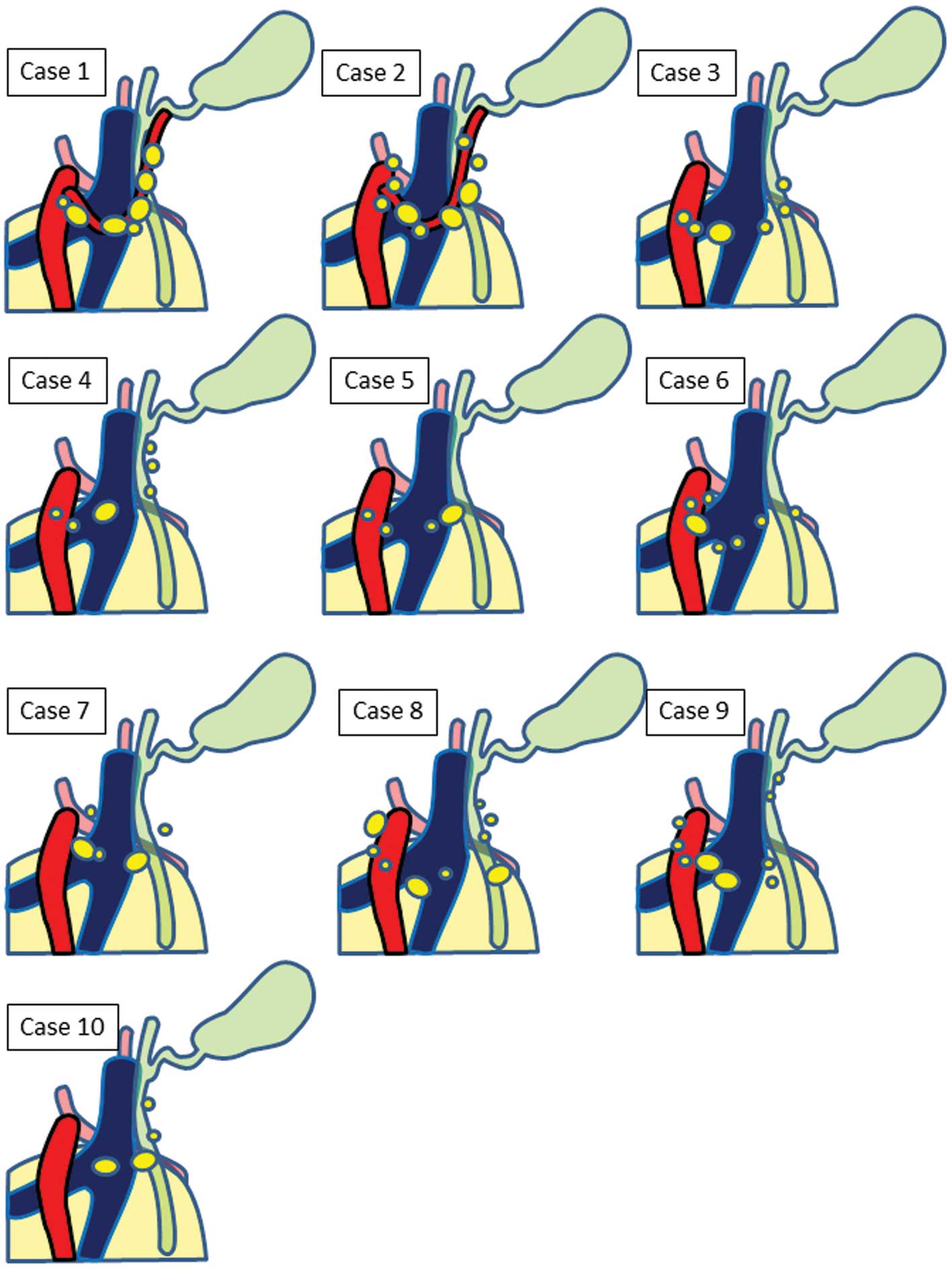
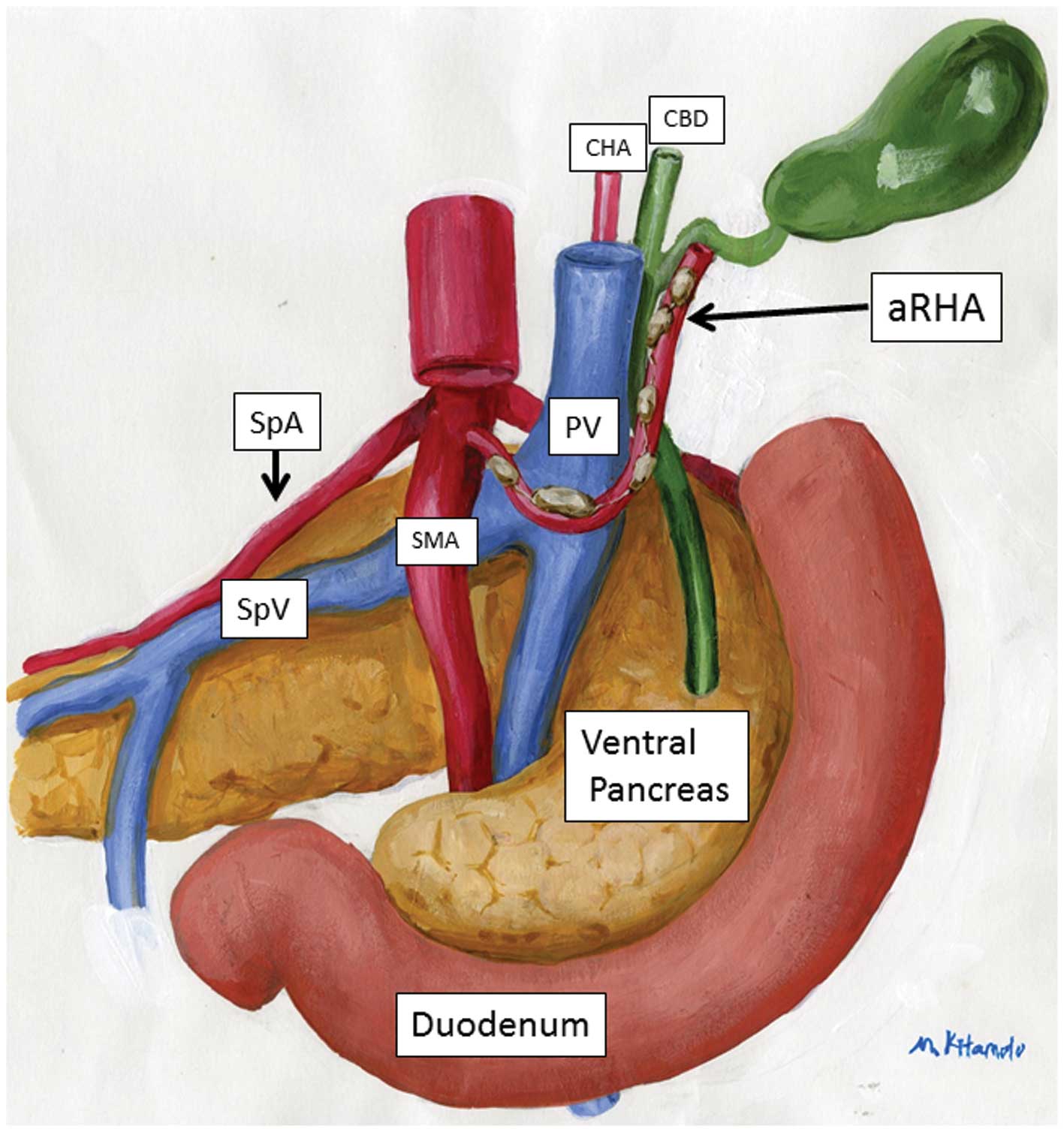
Examination of the course of the arteries in the 2 cases with an aRHA revealed that the vessel branched from the right side of the SMA (Fig. 2C) and crossed dorsal to the SMV and pancreatic head (Fig. 2B), then proceeded to the right side of the bile duct (Fig. 2A). Observation of the lymph node distribution revealed enlarged PPLNs along the aRHA in both patients (Fig. 3). In the 8 patients with normal hepatic artery branching, enlarged lymph nodes were observed in the pericholedochal area, dorsal to the pancreatic head, in the retroportal area and on the right side of the SMA (Fig. 3). Interestingly, the lymph node distribution closely resembled that of cases with an aRHA, appearing with a similar distribution, but where a regressed eRHA would have passed (Fig. 4).

Figure 3

Schematic diagram of enlarged lymph nodes mapped to the resected specimens. The yellow regions represent enlarged lymph nodes. Cases 1 and 2 show an aberrant right hepatic artery. The remaining cases exhibit normal arterial branching.

Figure 4

Schematic diagram of the distribution of lymph nodes from the gallbladder along the right aberrant hepatic artery (aRHA). Schematic diagram showing the course of lymph node distribution in the pericholedochal region dorsal to the portal vein (PV) along an aRHA. SMA, superior mesenteric artery; SpA, splenic artery; SpV, splenic vein; CHA, common hepatic artery; CBD, common bile duct.

Discussion

Radical lymph node dissection for GBC is crucial (10) and understanding the pattern of lymph node metastatic spread from GBC is mandatory for surgeons (11,12). This study demonstrated that PPLNs were distributed along the aRHA. In patients with a normal right hepatic artery, these lymph nodes were also distributed in a similar manner, suggesting distribution along the regressed eRHA.

During early human fetal life, 3 vessels exist, the embryonic left, middle and right hepatic arteries (13). During the developmental process, the embryonic left and right hepatic arteries regress and the middle hepatic artery persists. By adulthood, the embryonic middle hepatic artery has differentiated into the right, middle and left hepatic arteries. However, in some cases the eRHA persists without regression, representing an aRHA. The lymphatics travel primarily with blood vessels (6,7). Even if the artery completely regresses, the accompanying lymphatic vessels, lymph nodes and nerves presumably remain (4). We therefore considered that the enlarged lymph nodes observed in cases with normal hepatic arterial branching were compatible with lymph nodes along a regressed eRHA.

An understanding of this concept may contribute to lymphadenectomy for GBC. As the standard surgical treatment in colorectal cancer, intestinal resection and regional lymphadenectomy, including feeding arteries, is considered essential (13,14). In GBC up to stage IIa, the frequency of lymph node metastasis in the pericholedochal area has been reported to be higher compared to that of lymph node metastasis around the hepatic artery (2,3). The lymphatic pathway of PPLNs has been called ‘the right route of lymphatic drainage of the gallbladder’ in Japan and has been considered as the main lymphatic route requiring resection in the treatment of GBC (12,15,16). From the present study, the right route is considered part of the route of the eRHA. To completely remove the lymphatic basin in the eRHA route, resection of the nodes in the pericholedochal area, posterosuperior pancreaticoduodenal area and retroportal area should also be performed (14). This consideration is undoubtedly a key reason as to why the addition of PD is associated with improved prognosis for patients with GBC (17–19). We hypothesize that PD allows en bloc resection of the lymphatic basin along the eRHA. However, performing the surgery with awareness of the fetal pathway of lymphatic vessels may enable surgery with appropriate lymphadenectomy, without PD, for GBC.

Clearly, this hypothesis requires confirmation by further embryological studies; however, we suggest that surgery with an awareness of lymph node metastasis along the eRHA may lead to improved prognosis for patients with GBC and we suggest that the feeding artery for PPLNs is either the regressed eRHA or an aRHA persisting without regression.

References

1 

Miyakawa S, Ishihara S, Horiguchi A, Takada T, Miyazaki M and Nagakawa T: Biliary tract cancer treatment: 5,584 results from the Biliary Tract Cancer Statistics Registry from 1998 to 2004 in Japan. J Hepatobiliary Pancreat Surg. 16:1–7. 2009. View Article : Google Scholar : PubMed/NCBI

2 

Tsukada K, Kurosaki I, Uchida K, et al: Lymph node spread from carcinoma of the gallbladder. Cancer. 80:661–667. 1997. View Article : Google Scholar : PubMed/NCBI

3 

Nagakawa T, Kayahara M, Ikeda S, et al: Biliary tract cancer treatment: results from the Biliary Tract Cancer Statistics Registry in Japan. J Hepatobiliary Pancreat Surg. 9:569–575. 2002. View Article : Google Scholar : PubMed/NCBI

4 

Yi SQ, Shimokawa T, Akita K, Ohta T, Kayahara M, Miwa K and Tanaka S: Anatomical study of the pancreas in the house musk shrew (Suncus murinus), with special reference to the blood supply and innervation. Anat Rec A Discov Mol Cell Evol Biol. 273:630–635. 2003.PubMed/NCBI

5 

Cha YR, Fujita M, Butler M, Isogai S, Kochhan E, Siekmann AF and Weinstein BM: Chemokine signaling directs trunk lymphatic network formation along the preexisting blood vasculature. Dev Cell. 22:824–836. 2012. View Article : Google Scholar : PubMed/NCBI

6 

Geudens I, Herpers R, Hermans K, et al: Role of delta-like-4/Notch in the formation and wiring of the lymphatic network in zebrafish. Arterioscler Thromb Vasc Biol. 30:1695–1702. 2010. View Article : Google Scholar : PubMed/NCBI

7 

Liao S, Padera TP and Jain RK: Notch leads lymphatics and links them to blood vessels. Arterioscler Thromb Vasc Biol. 30:1682–1683. 2010. View Article : Google Scholar : PubMed/NCBI

8 

Miwa K, Kinami S, Taniguchi K, Fushida S, Fujimura T and Nonomura A: Mapping sentinel nodes in patients with early-stage gastric carcinoma. Br J Surg. 90:178–182. 2003. View Article : Google Scholar : PubMed/NCBI

9 

Kitagawa H, Ohta T, Makino I, et al: Carcinomas of the ventral and dorsal pancreas exhibit different patterns of lymphatic spread. Front Biosci. 13:2728–2735. 2008. View Article : Google Scholar : PubMed/NCBI

10 

Wang JD, Liu YB, Quan ZW, Li SG, Wang XF and Shen J: Role of regional lymphadenectomy in different stage of gallbladder carcinoma. Hepatogastroenterology. 56:593–596. 2009.PubMed/NCBI

11 

Uesaka K, Yasui K, Morimoto T, et al: Visualization of routes of lymphatic drainage of the gallbladder with a carbon particle suspension. J Am Coll Surg. 183:345–350. 1996.PubMed/NCBI

12 

Shirai Y, Yoshida K, Tsukada K, Ohtani T and Muto T: Identification of the regional lymphatic system of the gallbladder by vital staining. Br J Surg. 79:659–662. 1992. View Article : Google Scholar : PubMed/NCBI

13 

Chen SL and Bilchik AJ: Resecting lymph nodes in colon cancer: more than a staging operation? Ann Surg Oncol. 14:2175–2176. 2007. View Article : Google Scholar : PubMed/NCBI

14 

Takeuchi H and Kitagawa Y: Sentinel node navigation surgery in patients with early gastric cancer. Dig Surg. 30:104–111. 2013. View Article : Google Scholar : PubMed/NCBI

15 

Ito M, Mishima Y and Sato T: An anatomical study of the lymphatic drainage of the gallbladder. Surg Radiol Anat. 13:89–104. 1991. View Article : Google Scholar : PubMed/NCBI

16 

Deki H and Sato T: An anatomic study of the peripancreatic lymphatics. Surg Radiol Anat. 10:121–135. 1988. View Article : Google Scholar : PubMed/NCBI

17 

Shirai Y, Ohtani T, Tsukada K and Hatakeyama K: Pancreaticoduodenectomy for gallbladder cancer with peripancreatic nodal metastases. Hepatogastroenterology. 44:376–377. 1997.PubMed/NCBI

18 

Doty JR, Cameron JL, Yeo CJ, Campbell K, Coleman J and Hruban RH: Cholecystectomy, liver resection, and pylorus-preserving pancreaticoduodenectomy for gallbladder cancer: report of five cases. J Gastrointest Surg. 6:776–780. 2002. View Article : Google Scholar : PubMed/NCBI

19 

Shirai Y, Wakai T and Hatakeyama K: Radical lymph node dissection for gallbladder cancer: indications and limitations. Surg Oncol Clin N Am. 16:221–232. 2007. View Article : Google Scholar : PubMed/NCBI

Related Articles

  • Abstract
  • View
  • Download
  • Twitter
Copy and paste a formatted citation
Spandidos Publications style
Nakagawara H, Tajima H, Miyashita T, Kitagawa H, Makino I, Sakai S, Hayashi H, Nakanuma S, Oyama K, Takamura H, Takamura H, et al: Lymph node spread of gallbladder cancer from the perspective of embryologically‑based anatomy and significance of the lymphatic basin along the embryonic right hepatic artery. Mol Clin Oncol 2: 963-967, 2014.
APA
Nakagawara, H., Tajima, H., Miyashita, T., Kitagawa, H., Makino, I., Sakai, S. ... Ohta, T. (2014). Lymph node spread of gallbladder cancer from the perspective of embryologically‑based anatomy and significance of the lymphatic basin along the embryonic right hepatic artery. Molecular and Clinical Oncology, 2, 963-967. https://doi.org/10.3892/mco.2014.342
MLA
Nakagawara, H., Tajima, H., Miyashita, T., Kitagawa, H., Makino, I., Sakai, S., Hayashi, H., Nakanuma, S., Oyama, K., Takamura, H., Fushida, S., Fujimura, T., Ohta, T."Lymph node spread of gallbladder cancer from the perspective of embryologically‑based anatomy and significance of the lymphatic basin along the embryonic right hepatic artery". Molecular and Clinical Oncology 2.6 (2014): 963-967.
Chicago
Nakagawara, H., Tajima, H., Miyashita, T., Kitagawa, H., Makino, I., Sakai, S., Hayashi, H., Nakanuma, S., Oyama, K., Takamura, H., Fushida, S., Fujimura, T., Ohta, T."Lymph node spread of gallbladder cancer from the perspective of embryologically‑based anatomy and significance of the lymphatic basin along the embryonic right hepatic artery". Molecular and Clinical Oncology 2, no. 6 (2014): 963-967. https://doi.org/10.3892/mco.2014.342
Copy and paste a formatted citation
x
Spandidos Publications style
Nakagawara H, Tajima H, Miyashita T, Kitagawa H, Makino I, Sakai S, Hayashi H, Nakanuma S, Oyama K, Takamura H, Takamura H, et al: Lymph node spread of gallbladder cancer from the perspective of embryologically‑based anatomy and significance of the lymphatic basin along the embryonic right hepatic artery. Mol Clin Oncol 2: 963-967, 2014.
APA
Nakagawara, H., Tajima, H., Miyashita, T., Kitagawa, H., Makino, I., Sakai, S. ... Ohta, T. (2014). Lymph node spread of gallbladder cancer from the perspective of embryologically‑based anatomy and significance of the lymphatic basin along the embryonic right hepatic artery. Molecular and Clinical Oncology, 2, 963-967. https://doi.org/10.3892/mco.2014.342
MLA
Nakagawara, H., Tajima, H., Miyashita, T., Kitagawa, H., Makino, I., Sakai, S., Hayashi, H., Nakanuma, S., Oyama, K., Takamura, H., Fushida, S., Fujimura, T., Ohta, T."Lymph node spread of gallbladder cancer from the perspective of embryologically‑based anatomy and significance of the lymphatic basin along the embryonic right hepatic artery". Molecular and Clinical Oncology 2.6 (2014): 963-967.
Chicago
Nakagawara, H., Tajima, H., Miyashita, T., Kitagawa, H., Makino, I., Sakai, S., Hayashi, H., Nakanuma, S., Oyama, K., Takamura, H., Fushida, S., Fujimura, T., Ohta, T."Lymph node spread of gallbladder cancer from the perspective of embryologically‑based anatomy and significance of the lymphatic basin along the embryonic right hepatic artery". Molecular and Clinical Oncology 2, no. 6 (2014): 963-967. https://doi.org/10.3892/mco.2014.342
Follow us
  • Twitter
  • LinkedIn
  • Facebook
About
  • Spandidos Publications
  • Careers
  • Cookie Policy
  • Privacy Policy
How can we help?
  • Help
  • Live Chat
  • Contact
  • Email to our Support Team