Introduction
Breast cancer is the second leading cause of
cancer-related mortality among females worldwide. Although improved
screening techniques have aided the detection of breast cancer at
the early stages and advanced treatments have markedly improved
patient survival, tumor invasion and metastasis still contribute to
the majority of breast cancer-associated mortalities (1).
Metastasis is a series of events that involves the
detachment of tumor cells from the primary tumor site, their
adhesion, migration and invasion into blood or lymphatic vessels
and their interaction with target tissues. The invasion of tumor
cells into target tissues results in the formation of secondary
tumors (2,3). These events occur repeatedly during
tumor invasion, and perturbation of the adhesiveness and motility
of tumor cells and their invasion into target tissues has been
proposed as a method of preventing cancer progression (4,5).
Plants are valuable sources of natural therapeutic
compounds. Research into oriental medicines has increased over the
past decade, with the aim of identifying novel drugs, including
anti-cancer agents (6–8). Several herb-based constituents and
extracts have been found to reduce tumor growth and inhibit the
metastasis of human cancer cells in in vitro and in
vivo models (9,10). Therefore, such compounds may be
valuable tools in cancer therapy.
Smilax china L. (SCL), a member of the
Smilacaceae family, is used in Traditional Chinese Medicine as a
diuretic and detoxification agent and to treat various conditions,
including rheumatic arthritis, lumbago, gout, tumors and
inflammatory diseases (11).
Pharmacological investigations indicate that SCL exhibits
anti-tumor (12) and
anti-inflammatory (13) effects.
However, the effect of SCL ethanol extract (SCLE) treatment on the
highly metastatic MDA-MB-231 human breast cancer cell line is yet
to be elucidated. Therefore, in the present study, the
anti-metastatic effect of SCLE on MDA-MB-231 cells was
investigated.
Materials and methods
Materials
All plastic materials were purchased from Falcon
Labware (Becton Dickinson and Company, Franklin Lakes, NJ, USA).
Fetal bovine serum (FBS), phosphate-buffered saline and penicillin
G/streptomycin were obtained from Gibco-BRL (Grand Island, NY,
USA). RPMI-1640 medium was purchased from Welgene, Inc. (Daegu,
Korea). The Cell Counting Kit-8 (CCK-8) was obtained from Dojindo
Molecular Technologies, Inc. (Gaithersburg, MD, USA).
Preparation of plant extracts
SCL was purchased as a dried herb from Omniherb Co.
(Yeoungcheon, Korea). The dried bark of SCL (200 g) was extracted
twice using 70% ethanol with 2 h reflux, and the extract was
concentrated under reduced pressure. The decoction was filtered,
lyophilized and stored at 4°C. The yield of dried extract from the
starting crude material was ~12.7% (w/w). The SCLE was diluted in
culture media to the final concentrations indicated for each
experiment.
Cell culture
MDA-MB-231 cells were obtained from the American
Type Culture Collection (Rockville, MD, USA) and cultured in
RPMI-1640 medium supplemented with 10% FBS, 100 U/ml penicillin and
100 μg/ml streptomycin. The culture was performed at 37°C in 5%
CO2. Subsequent to reaching 80% confluence, the cells
were detached using 0.25% trypsin-EDTA. Cells were then subcultured
further.
Cell viability assay
Water-soluble tetrazolium salt-8, which is reduced
to yellow water-soluble formazan by the dehydrogenase released from
mitochondria, was the effective constituent of the CCK-8.
Absorbance was measured at 450 nm using a Benchmark Plus Microplate
Spectrophotometer (Bio-Rad, Hercules, CA, USA). Cytotoxicity was
expressed as a percentage of the absorbance measured in the control
and SCLE-treated cells.
Wound healing assay
MDA-MB-231 cells were plated in a 12-well plate at a
concentration of 5×10⁵ cells/well and allowed to form a
confluent monolayer for 24 h. Cells were wounded using a yellow
pipette tip and cellular debris was removed by washing with
RPMI-1640 medium. The wounded monolayer was incubated in the
presence or absence of SCLE (25 and 50 μg/ml) for 24 h in either
RPMI-1640 plus 10% FBS as a positive control or RPMI-1640 plus 1%
FBS (CON). Images were captured of the cell migration into the
wounded area using phase-contrast microscopy.
Quantitative polymerase chain reaction
(qPCR)
qPCR was performed using the Rotor-Gene 3000
(Corbett Research, Sydney, Australia) system using SYBR®
Green Master Mix (Qiagen, Tokyo, Japan). The percentage of target
gene expression relative to the control was normalized using the
GAPDH internal control according to the 2−ΔΔCt analysis.
Primers for the target genes were designed using Primer3 software
(Table I) (14).
 | Table IPrimer sequences used in quantitative
polymerase chain reaction analysis. |
Table I
Primer sequences used in quantitative
polymerase chain reaction analysis.
| Genes | Forward | Reverse | Accession number | Length (bp) |
|---|
| uPA |
ACCCAAAGAAGGAGGACTAC |
GTGTAGGATGAGGTTTTCCA | NM_002658 | 101 |
| uPAR |
GGTTGTGTGTGGGTTAGACT |
CTCTCACAGCTCATGTCTGA | NM_002659 | 117 |
| TIMP1 |
TGGACTCTTGCACATCACTA |
GATGGATAAACAGGGAAACA | NM_003254 | 133 |
| TIMP2 |
GCTCTGTTGATTTTGTTTCC |
CTGCTTGTCAACTTTCAACA | NM_003255 | 125 |
| GAPDH |
TCAAGCTCATTTCCTGGTAT |
GTGAGGGTCTCTCTCTTCCT | NM_002046 | 141 |
Statistical analysis
Statistical analyses were performed using the Prism
5 software (GraphPad Software, Inc., San Diego, CA, USA). Analysis
of variance followed by a Dunett’s test were performed. A value of
P<0.05 was considered to indicate a statistically significant
difference.
Results
Effect of SCLE on MDA-MB-231 cell
viability
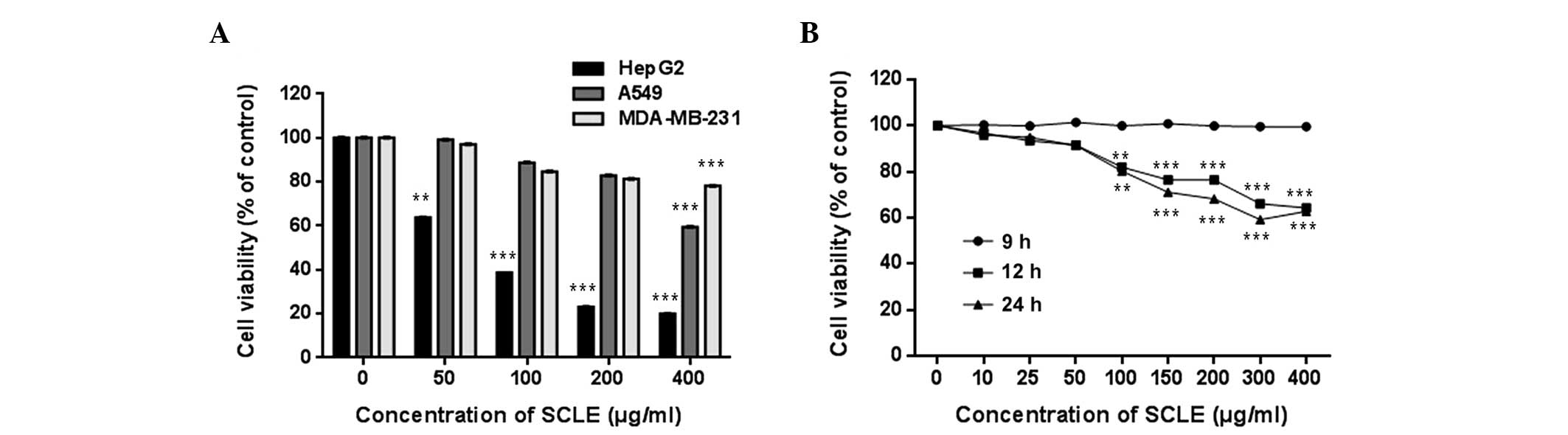
The cytotoxic effect of SCLE was investigated in
three cancer cell lines (HepG2, A549 and MDA-MB-231) using the
CCK-8. SCLE was observed to reduce the viability of each of these
cell lines in a concentration-dependent manner (Fig. 1A). However, SCLE was found to have
a weaker effect on the viability of A549 and MDA-MB-231 cells than
that of HepG2 cells. SCLE was observed to reduce the viability of
MDA-MB-231 cells from 100 to 60% in a concentration- and
time-dependent manner (Fig. 1B).
The viability of MDA-MB-231 cells was significantly reduced
following treatment with 100–400 μg/ml SCLE for 12 or 24 h
(P<0.01) (Fig. 1B). Based on
these results, non-cytotoxic concentrations of SCLE (25 and 50
μg/ml) were used in further experiments.
Effect of SCLE on the metastatic
potential of MDA-MB-231 cells
Due to the highly invasive nature of triple-negative
breast cancers, the present study investigated the effect of SCLE
on the invasive potential of MDA-MB-231 cells in vitro. A
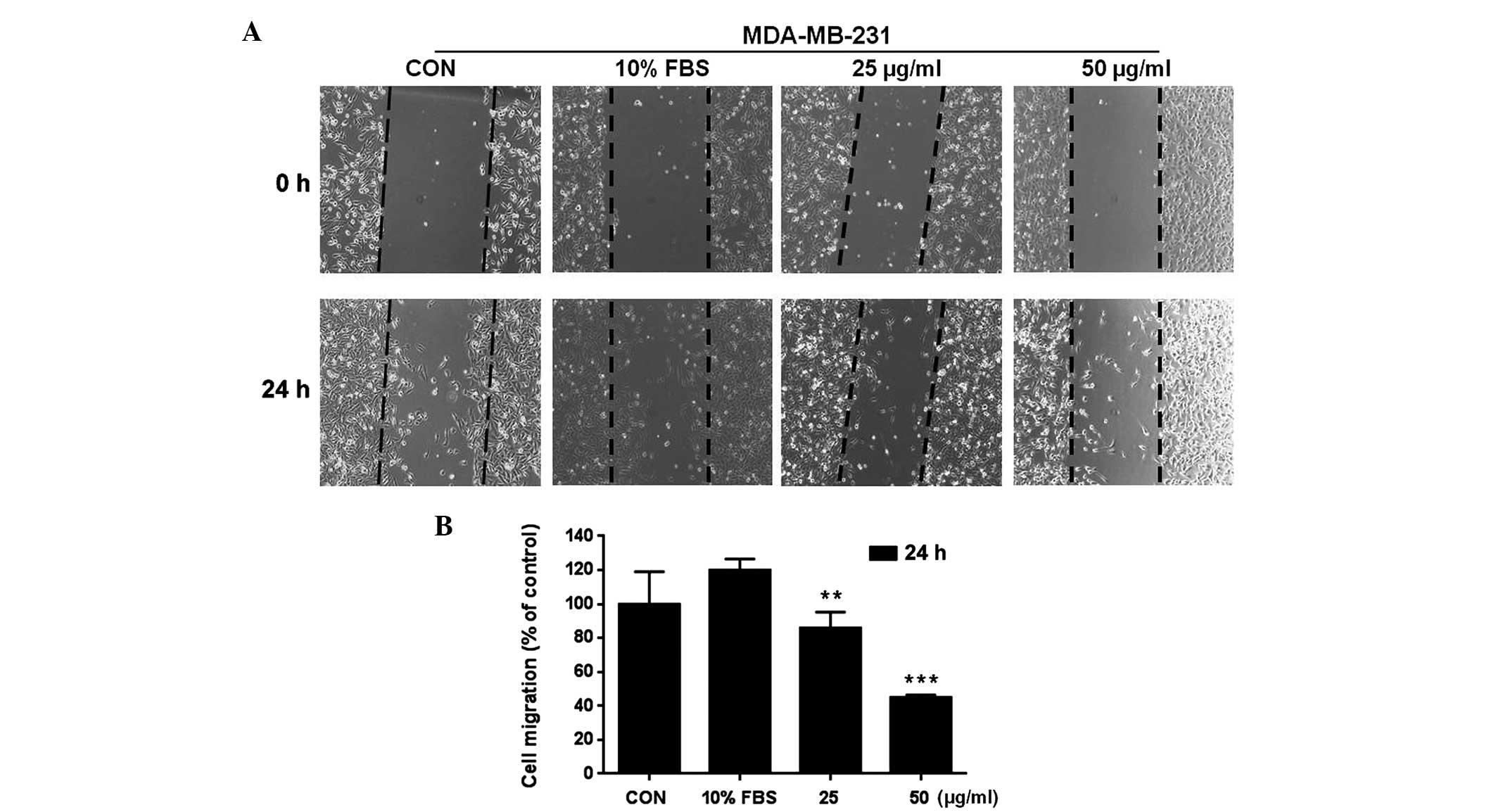
wound healing assay was performed to determine the effect of SCLE
on the inhibition of MDA-MB-231 cell migration. Twenty-four hours
after cell monolayers were wounded, control cell monolayers
(RPMI-1640 plus 1% FBS) had completely filled the wounded area.
SCLE treatment was observed to inhibit the migration of MDA-MB-231
cells in a concentration-dependent manner (Fig. 2A). Densitometric analysis showed
that treatment with 50 μg/ml SCLE reduced the migration of
MDA-MB-231 cells by ~50% (Fig.
2B). These results suggest that SCLE effectively inhibits the
migration of the highly invasive MDA-MB-231 breast cancer cell
line.
Effect of SCLE on the expression of
extracellular matrix (ECM) degradation-associated molecules
The overexpression and activation of urokinase
plasminogen activator (uPA) and the uPA receptor (uPAR) play an
important role in the invasion of breast cancer cells by
stimulating ECM degradation and thereby promoting cell migration.
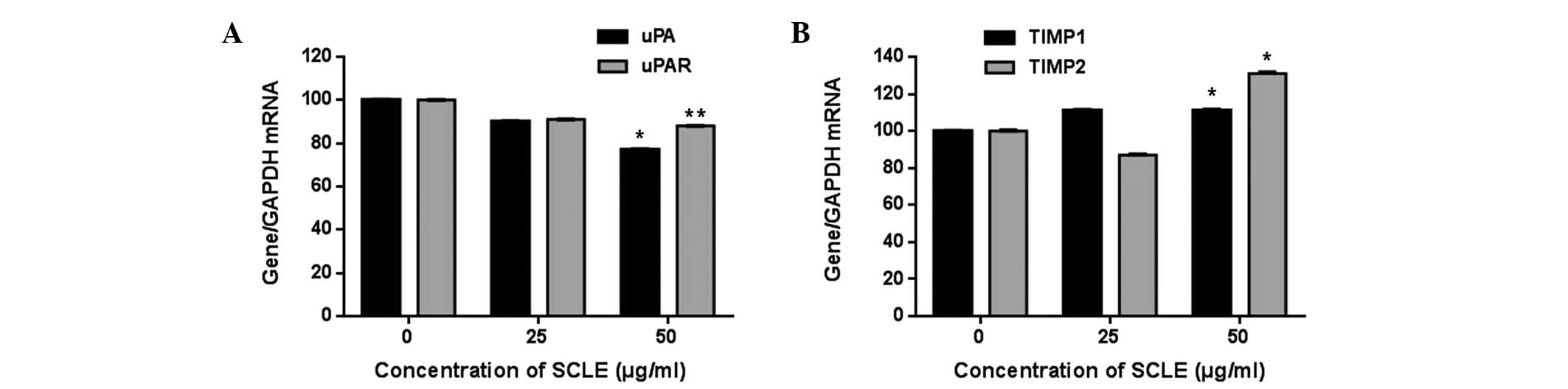
Therefore, the present study aimed to investigate whether the
SCLE-induced inhibition of migration in MDA-MB-231 cells correlated
with modulation of uPA and uPAR. SCLE treatment was found to reduce
the mRNA levels of uPA and uPAR in a concentration-dependent manner
(Fig. 3). By contrast, the mRNA
levels of tissue inhibitor of metalloproteinase (TIMP) 1 and 2 were
significantly increased following SLCE treatment (P<0.05). These
data suggest that the SCLE-mediated inhibition of MDA-MB-231 cell
migration and metastasis may be dependent on the degradation of the
ECM.
Discussion
In patients with cancer, mortality is rarely a
direct consequence of the growth of the primary tumor, but of
primary tumor metastasis. Therefore, the prevention and suppression
of tumor invasion and metastasis may be a promising strategy for
improving the survival of patients with malignant tumors. The
present study aimed to investigate the anti-metastatic effects of
SCLE, a Chinese herbal medicine, and the mechanisms underlying
these effects. SCLE was found to have an anti-metastatic effect on
human breast cancer cells. SCLE reduced MDA-MB-21 cell migration in
a concentration-dependent manner in vitro (Fig. 2), indicating that SCLE has potent
anti-metastatic activity in vitro.
Metastasis is the major cause of mortality in
patients with cancer, and is a multifaceted process that results
from coordinated events, including cancer cell invasion, migration
and adhesion (15). Proteolytic
enzyme-induced degradation of the ECM and basement membrane and the
subsequent invasion of cancerous cells are essential early steps in
metastasis (16). uPA is an
important proteolytic enzyme that degrades the ECM, and the
expression of uPA and uPAR is associated with increased tumor cell
invasion and metastasis in breast cancer (17,18).
It is well established that overexpression of uPA in breast cancer
is a strong indicator of poor prognosis. uPA binds uPAR on the cell
membrane and subsequently degrades cell surface-associated
plasminogen (19). Therefore, the
present study investigated whether the anti-invasive effect of SCLE
in MDA-MB-21 cells correlated with the inhibition of uPA and uPAR
activity. SCLE treatment was observed to reduce the mRNA levels of
uPA and uPAR (Fig. 3A). Matrix
metalloproteinases are a large group of proteolytic enzymes that
are involved in degrading and remodeling the ECM in response to a
number of pathological stimuli (20). These enzymes are controlled by
their endogenous inhibitors TIMP1 and TIMP2 (21). Therefore, increased TIMP activity
can inhibit cancer cell invasion and metastasis (22,23).
SCLE treatment increased the mRNA levels of TIMP1 and TIMP2 in
MDA-MB-231 cells (Fig. 3B). These
effects correlated with the inhibition of MDA-MB-231 cell invasion
by SCLE.
The present study has demonstrated that SCLE
effectively suppresses invasiveness in the MDA-MB-231 human breast
cancer cell line. The mechanism underlying this effect may involve
modulation of uPA, uPAR and TIMP expression. The results of this
study indicate that SCLE may be a potential agent for the treatment
of cancer metastasis.
Acknowledgements
This study was supported by the Construction of the
Basis for Practical Application of Herbal Resources (no. K12020)
from the Korea Institute of Oriental Medicine.
References
|
1
|
Kundu N, Campbell P, Hampton B, Lin CY, Ma
X, Ambulos N, Zhao XF, Goloubeva O, Holt D and Fulton AM:
Antimetastatic activity isolated from Colocasia esculenta
(taro). Anti-cancer Drugs. 23:200–211. 2012. View Article : Google Scholar
|
|
2
|
Song G, Ohashi T, Sakamoto N and Sato M:
Adhesive force of human hepatoma HepG2 cells to endothelial cells
and expression of E-selectin. Mol Cell Biomech. 3:61–68.
2006.PubMed/NCBI
|
|
3
|
Weber GF: Molecular mechanisms of
metastasis. Cancer Lett. 270:181–190. 2008. View Article : Google Scholar
|
|
4
|
Festuccia C, Bologna M, Gravina GL, Guerra
F, Angelucci A, Villanova I, Millimaggi D and Teti A: Osteoblast
conditioned media contain TGF-beta1 and modulate the migration of
prostate tumor cells and their interactions with extracellular
matrix components. Int J Cancer. 81:395–403. 1999. View Article : Google Scholar
|
|
5
|
Festuccia C, Guerra F, D’Ascenzo S,
Giunciuglio D, Albini A and Bologna M: In vitro regulation of
pericellular proteolysis in prostatic tumor cells treated with
bombesin. Int J Cancer. 75:418–431. 1998. View Article : Google Scholar : PubMed/NCBI
|
|
6
|
Hu H, Ahn NS, Yang X, Lee YS and Kang KS:
Ganoderma lucidum extract induces cell cycle arrest and
apoptosis in MCF-7 human breast cancer cell. Int J Cancer.
102:250–253. 2002. View Article : Google Scholar
|
|
7
|
Lee SM, Li ML, Tse YC, et al: Paeoniae
Radix, a Chinese herbal extract, inhibit hepatoma cells growth by
inducing apoptosis in a p53 independent pathway. Life Sci.
71:2267–2277. 2002. View Article : Google Scholar : PubMed/NCBI
|
|
8
|
Cheng YL, Lee SC, Lin SZ, Chang WL, Chen
YL, Tsai NM, Liu YC, Tzao C, Yu DS and Harn HJ: Anti-proliferative
activity of Bupleurum scrozonerifolium in A549 human lung
cancer cells in vitro and in vivo. Cancer Lett. 222:183–193.
2005.PubMed/NCBI
|
|
9
|
Wang XF, Du J, Zhang TL, Zhou QM, Lu YY,
Zhang H and Su SB: Inhibitory effects of PC-SPESII herbal extract
on human breast cancer metastasis. Evid Based Complement Alternat
Med. 2013:8943862013.PubMed/NCBI
|
|
10
|
Shimizu T, Torres MP, Chakraborty S,
Souchek JJ, Rachagani S, Kaur S, Macha M, Ganti AK, Hauke RJ and
Batra SK: Holy Basil leaf extract decreases tumorigenicity and
metastasis of aggressive human pancreatic cancer cells in vitro and
in vivo: potential role in therapy. Cancer Lett. 336:270–280. 2013.
View Article : Google Scholar : PubMed/NCBI
|
|
11
|
Health Department and National Chinese
Medicine Management Office. State Administration of Traditional
Chinese Medicine of People’s Republic of China. Zhong-hua-ben-cao,
Shanghai Science and Technology Publisher; Shanghai, China: pp.
157–160. 1999
|
|
12
|
Li YL, Gan GP, Zhang HZ, Wu HZ, Li CL,
Huang YP, Liu YW and Liu JW: A flavonoid glycoside isolated from
Smilax china L. rhizome in vitro anticancer effects on human
cancer cell lines. J Ethnopharmacol. 113:115–124. 2007.
|
|
13
|
Shu XS, Gao ZH and Yang XL:
Anti-inflammatory and anti-nociceptive activities of Smilax
china L. aqueous extract. J Ethnopharmacol. 103:327–332. 2006.
View Article : Google Scholar
|
|
14
|
Koressaar T and Remm M: Enhancements and
modifications of primer design program Primer3. Bioinformatics.
23:1289–1291. 2007. View Article : Google Scholar : PubMed/NCBI
|
|
15
|
Kim MS, You MK, Rhuy DY, Kim YJ, Baek HY
and Kim HA: Loquat (Eriobotrya japonica) extracts suppress
the adhesion, migration and invasion of human breast cancer cell
line. Nutr Res Pract. 3:259–264. 2009.
|
|
16
|
Bogenrieder T and Herlyn M: Axis of evil:
molecular mechanisms of cancer metastasis. Oncogene. 22:6524–6536.
2003. View Article : Google Scholar : PubMed/NCBI
|
|
17
|
Du J, Wang XF, Zhou QM, Zhang TL, Lu YY,
Zhang H and Su SB: Evodiamine induces apoptosis and inhibits
metastasis in MDA-MB-231 human breast cancer cells in vitro
and in vivo. Oncol Rep. 30:685–694. 2013.PubMed/NCBI
|
|
18
|
Andres SA, Edwards AB and Wittliff JL:
Expression of urokinase-type plasminogen activator (uPA), its
receptor (uPAR), and inhibitor (PAI-1) in human breast carcinomas
and their clinical relevance. J Clin Lab Anal. 26:93–103. 2012.
View Article : Google Scholar : PubMed/NCBI
|
|
19
|
Dan K, Behrendt N, Brunner N, Ellis V,
Ploug M and Pyke C: The urokinase receptor. Protein structure and
role in plasminogen activation and cancer invasion. Fibrinolysis.
8(Suppl 1): 189–203. 1994. View Article : Google Scholar
|
|
20
|
Brinckerhoff CE and Matrisian LM: Matrix
metalloproteinases: a tail of a frog that became a prince. Nat Rev
Mol Cell Biol. 3:207–214. 2002. View
Article : Google Scholar : PubMed/NCBI
|
|
21
|
Figueira RC, Gomes LR, Neto JS, Silva FC,
Silva ID and Sogayar MC: Correlation between MMPs and their
inhibitors in breast cancer tumor tissue specimens and in cell
lines with different metastatic potential. BMC Cancer. 9:202009.
View Article : Google Scholar
|
|
22
|
Liotta LA and Stetler-Stevenson WG: Tumor
invasion and metastasis: an imbalance of positive and negative
regulation. Cancer Res. 51(18 Suppl): 5054s–5059s. 1991.PubMed/NCBI
|
|
23
|
Albini A, Melchiori A, Santi L, Liotta LA,
Brown PD and Stetler-Stevenson WG: Tumor cell invasion inhibited by
TIMP-2. J Natl Cancer Inst. 83:775–779. 1991. View Article : Google Scholar : PubMed/NCBI
|