Spandidos Publications Logo
  • About
    • About Spandidos
    • Aims and Scopes
    • Abstracting and Indexing
    • Editorial Policies
    • Reprints and Permissions
    • Job Opportunities
    • Terms and Conditions
    • Contact
  • Journals
    • All Journals
    • Oncology Letters
      • Oncology Letters
      • Information for Authors
      • Editorial Policies
      • Editorial Board
      • Aims and Scope
      • Abstracting and Indexing
      • Bibliographic Information
      • Archive
    • International Journal of Oncology
      • International Journal of Oncology
      • Information for Authors
      • Editorial Policies
      • Editorial Board
      • Aims and Scope
      • Abstracting and Indexing
      • Bibliographic Information
      • Archive
    • Molecular and Clinical Oncology
      • Molecular and Clinical Oncology
      • Information for Authors
      • Editorial Policies
      • Editorial Board
      • Aims and Scope
      • Abstracting and Indexing
      • Bibliographic Information
      • Archive
    • Experimental and Therapeutic Medicine
      • Experimental and Therapeutic Medicine
      • Information for Authors
      • Editorial Policies
      • Editorial Board
      • Aims and Scope
      • Abstracting and Indexing
      • Bibliographic Information
      • Archive
    • International Journal of Molecular Medicine
      • International Journal of Molecular Medicine
      • Information for Authors
      • Editorial Policies
      • Editorial Board
      • Aims and Scope
      • Abstracting and Indexing
      • Bibliographic Information
      • Archive
    • Biomedical Reports
      • Biomedical Reports
      • Information for Authors
      • Editorial Policies
      • Editorial Board
      • Aims and Scope
      • Abstracting and Indexing
      • Bibliographic Information
      • Archive
    • Oncology Reports
      • Oncology Reports
      • Information for Authors
      • Editorial Policies
      • Editorial Board
      • Aims and Scope
      • Abstracting and Indexing
      • Bibliographic Information
      • Archive
    • Molecular Medicine Reports
      • Molecular Medicine Reports
      • Information for Authors
      • Editorial Policies
      • Editorial Board
      • Aims and Scope
      • Abstracting and Indexing
      • Bibliographic Information
      • Archive
    • World Academy of Sciences Journal
      • World Academy of Sciences Journal
      • Information for Authors
      • Editorial Policies
      • Editorial Board
      • Aims and Scope
      • Abstracting and Indexing
      • Bibliographic Information
      • Archive
    • International Journal of Functional Nutrition
      • International Journal of Functional Nutrition
      • Information for Authors
      • Editorial Policies
      • Editorial Board
      • Aims and Scope
      • Abstracting and Indexing
      • Bibliographic Information
      • Archive
    • International Journal of Epigenetics
      • International Journal of Epigenetics
      • Information for Authors
      • Editorial Policies
      • Editorial Board
      • Aims and Scope
      • Abstracting and Indexing
      • Bibliographic Information
      • Archive
    • Medicine International
      • Medicine International
      • Information for Authors
      • Editorial Policies
      • Editorial Board
      • Aims and Scope
      • Abstracting and Indexing
      • Bibliographic Information
      • Archive
  • Articles
  • Information
    • Information for Authors
    • Information for Reviewers
    • Information for Librarians
    • Information for Advertisers
    • Conferences
  • Language Editing
Spandidos Publications Logo
  • About
    • About Spandidos
    • Aims and Scopes
    • Abstracting and Indexing
    • Editorial Policies
    • Reprints and Permissions
    • Job Opportunities
    • Terms and Conditions
    • Contact
  • Journals
    • All Journals
    • Biomedical Reports
      • Information for Authors
      • Editorial Policies
      • Editorial Board
      • Aims and Scope
      • Abstracting and Indexing
      • Bibliographic Information
      • Archive
    • Experimental and Therapeutic Medicine
      • Information for Authors
      • Editorial Policies
      • Editorial Board
      • Aims and Scope
      • Abstracting and Indexing
      • Bibliographic Information
      • Archive
    • International Journal of Epigenetics
      • Information for Authors
      • Editorial Policies
      • Editorial Board
      • Aims and Scope
      • Abstracting and Indexing
      • Bibliographic Information
      • Archive
    • International Journal of Functional Nutrition
      • Information for Authors
      • Editorial Policies
      • Editorial Board
      • Aims and Scope
      • Abstracting and Indexing
      • Bibliographic Information
      • Archive
    • International Journal of Molecular Medicine
      • Information for Authors
      • Editorial Policies
      • Editorial Board
      • Aims and Scope
      • Abstracting and Indexing
      • Bibliographic Information
      • Archive
    • International Journal of Oncology
      • Information for Authors
      • Editorial Policies
      • Editorial Board
      • Aims and Scope
      • Abstracting and Indexing
      • Bibliographic Information
      • Archive
    • Medicine International
      • Information for Authors
      • Editorial Policies
      • Editorial Board
      • Aims and Scope
      • Abstracting and Indexing
      • Bibliographic Information
      • Archive
    • Molecular and Clinical Oncology
      • Information for Authors
      • Editorial Policies
      • Editorial Board
      • Aims and Scope
      • Abstracting and Indexing
      • Bibliographic Information
      • Archive
    • Molecular Medicine Reports
      • Information for Authors
      • Editorial Policies
      • Editorial Board
      • Aims and Scope
      • Abstracting and Indexing
      • Bibliographic Information
      • Archive
    • Oncology Letters
      • Information for Authors
      • Editorial Policies
      • Editorial Board
      • Aims and Scope
      • Abstracting and Indexing
      • Bibliographic Information
      • Archive
    • Oncology Reports
      • Information for Authors
      • Editorial Policies
      • Editorial Board
      • Aims and Scope
      • Abstracting and Indexing
      • Bibliographic Information
      • Archive
    • World Academy of Sciences Journal
      • Information for Authors
      • Editorial Policies
      • Editorial Board
      • Aims and Scope
      • Abstracting and Indexing
      • Bibliographic Information
      • Archive
  • Articles
  • Information
    • For Authors
    • For Reviewers
    • For Librarians
    • For Advertisers
    • Conferences
  • Language Editing
Login Register Submit
  • This site uses cookies
  • You can change your cookie settings at any time by following the instructions in our Cookie Policy. To find out more, you may read our Privacy Policy.

    I agree
Search articles by DOI, keyword, author or affiliation
Search
Advanced Search
presentation
Oncology Letters
Join Editorial Board Propose a Special Issue
Print ISSN: 1792-1074 Online ISSN: 1792-1082
Journal Cover
June-2016 Volume 11 Issue 6

Full Size Image

Sign up for eToc alerts
Recommend to Library

Journals

International Journal of Molecular Medicine

International Journal of Molecular Medicine

International Journal of Molecular Medicine is an international journal devoted to molecular mechanisms of human disease.

International Journal of Oncology

International Journal of Oncology

International Journal of Oncology is an international journal devoted to oncology research and cancer treatment.

Molecular Medicine Reports

Molecular Medicine Reports

Covers molecular medicine topics such as pharmacology, pathology, genetics, neuroscience, infectious diseases, molecular cardiology, and molecular surgery.

Oncology Reports

Oncology Reports

Oncology Reports is an international journal devoted to fundamental and applied research in Oncology.

Experimental and Therapeutic Medicine

Experimental and Therapeutic Medicine

Experimental and Therapeutic Medicine is an international journal devoted to laboratory and clinical medicine.

Oncology Letters

Oncology Letters

Oncology Letters is an international journal devoted to Experimental and Clinical Oncology.

Biomedical Reports

Biomedical Reports

Explores a wide range of biological and medical fields, including pharmacology, genetics, microbiology, neuroscience, and molecular cardiology.

Molecular and Clinical Oncology

Molecular and Clinical Oncology

International journal addressing all aspects of oncology research, from tumorigenesis and oncogenes to chemotherapy and metastasis.

World Academy of Sciences Journal

World Academy of Sciences Journal

Multidisciplinary open-access journal spanning biochemistry, genetics, neuroscience, environmental health, and synthetic biology.

International Journal of Functional Nutrition

International Journal of Functional Nutrition

Open-access journal combining biochemistry, pharmacology, immunology, and genetics to advance health through functional nutrition.

International Journal of Epigenetics

International Journal of Epigenetics

Publishes open-access research on using epigenetics to advance understanding and treatment of human disease.

Medicine International

Medicine International

An International Open Access Journal Devoted to General Medicine.

Journal Cover
June-2016 Volume 11 Issue 6

Full Size Image

Sign up for eToc alerts
Recommend to Library

  • Article
  • Citations
    • Cite This Article
    • Download Citation
    • Create Citation Alert
    • Remove Citation Alert
    • Cited By
  • Similar Articles
    • Related Articles (in Spandidos Publications)
    • Similar Articles (Google Scholar)
    • Similar Articles (PubMed)
  • Download PDF
  • Download XML
  • View XML
Case Report

Primary peritoneal serous carcinoma, an extremely rare malignancy: A case report and review of the literature

  • Authors:
    • Woo‑Sung Yun
    • Jung‑Min Bae
  • View Affiliations / Copyright

    Affiliations: Department of Surgery, Yeungnam University College of Medicine, Daegu 705‑717, Republic of Korea
  • Pages: 4063-4065
    |
    Published online on: May 5, 2016
       https://doi.org/10.3892/ol.2016.4525
  • Expand metrics +
Metrics: Total Views: 0 (Spandidos Publications: | PMC Statistics: )
Metrics: Total PDF Downloads: 0 (Spandidos Publications: | PMC Statistics: )
Cited By (CrossRef): 0 citations Loading Articles...

This article is mentioned in:


Abstract

Primary peritoneal serous carcinoma (PPSC) is an extremely rare malignancy that was first described in 1959. This type of cancer arises from the peritoneal epithelium and is similar to serous ovarian carcinoma. A diagnosis of PPSC is typically made based on the Gynecology Oncology Group criteria; however, a correct differential diagnosis of PPSC is difficult preoperatively. The current study describes the case of a 66 year-old female patient presenting with abdomen distension. A computed tomography (CT) scan revealed abundant ascites in the abdominal cavity and omental infiltration. The results of positron emission tomography/CT showed hot uptake in the greater omentum. Furthermore, preoperative serum cancer antigen‑125 levels were 1,032 U/ml. Upon surgical exploration, a whitish mass and nodule were found in the greater omentum. Therefore, omentectomy was performed. Pathological examination of the resected specimen revealed a diagnosis of PPSC. PPSC is extremely rare with few cases cited in the current literature. The present study describes a rare case of PPSC with a review of the literature.

Introduction

Primary peritoneal serous carcinoma (PPSC) is an extremely rare malignancy that was first described in 1959 (1). The estimated incidence of PPSC in the United States is 6.78 cases per 1,000,000 individuals (2). This type of cancer arises from the peritoneal epithelium and is similar to serous ovarian carcinoma. A diagnosis of PPSC is typically made based on the Gynecology Oncology Group criteria (3). However, a correct differential diagnosis of PPSC is difficult preoperatively. The median overall survival time of PPSC is 11–17 months (4) and the optimal treatments for PPSC are surgical resection and platinum based chemotherapy (5).

The current study presents the case of a 66 year-old female patient diagnosed with PPSC mimicking omental metastasis and peritoneal carcinomatosis from the gastrointestinal tract or ovarian malignancy. PPSC is extremely rare with few cases cited in the current literature. The present study describes a rare case of PPSC with a review of the literature. Written informed consent was obtained from the patient.

Case report

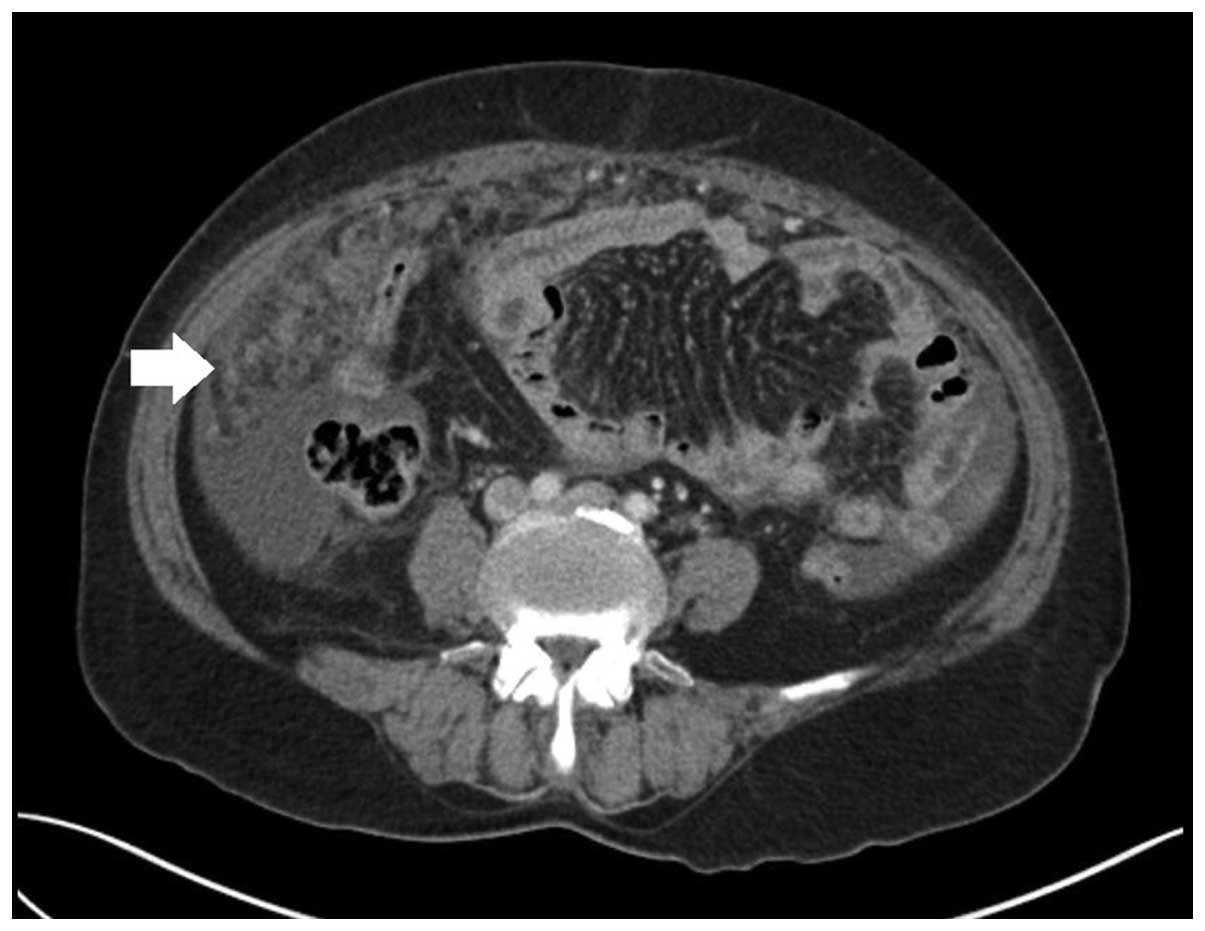
In September 2014, a 66-year-old woman presented to Yeungnam University College of Medicine (Daegu, Korea) with abdomen distension for 3 weeks. Otherwise, the patient was in good health with intermittent abdominal discomfort. Findings upon physical examination were unremarkable. Furthermore, the initial laboratory tests were all within normal ranges. Chest and abdominal radiographs were also unremarkable. The patient underwent a contrast-enhanced abdominal computed tomography (CT) scan (SOMATOM Definition AS; Siemens AG, Munich, Germany) to evaluate the cause of the abdominal distension. The CT scan revealed abundant ascites in the abdominal cavity and omental infiltration (Fig. 1). Other abdominal organs, including the liver, spleen, kidney and both ovaries, appeared normal upon CT. Ascitic cytology was then performed; evaluation of the cytological characteristics of the ascites suggested the presence of malignant cells.

Figure 1.

Computed tomography scan revealing abundant ascites and omental infiltration. The white arrow indicates omental infiltration.

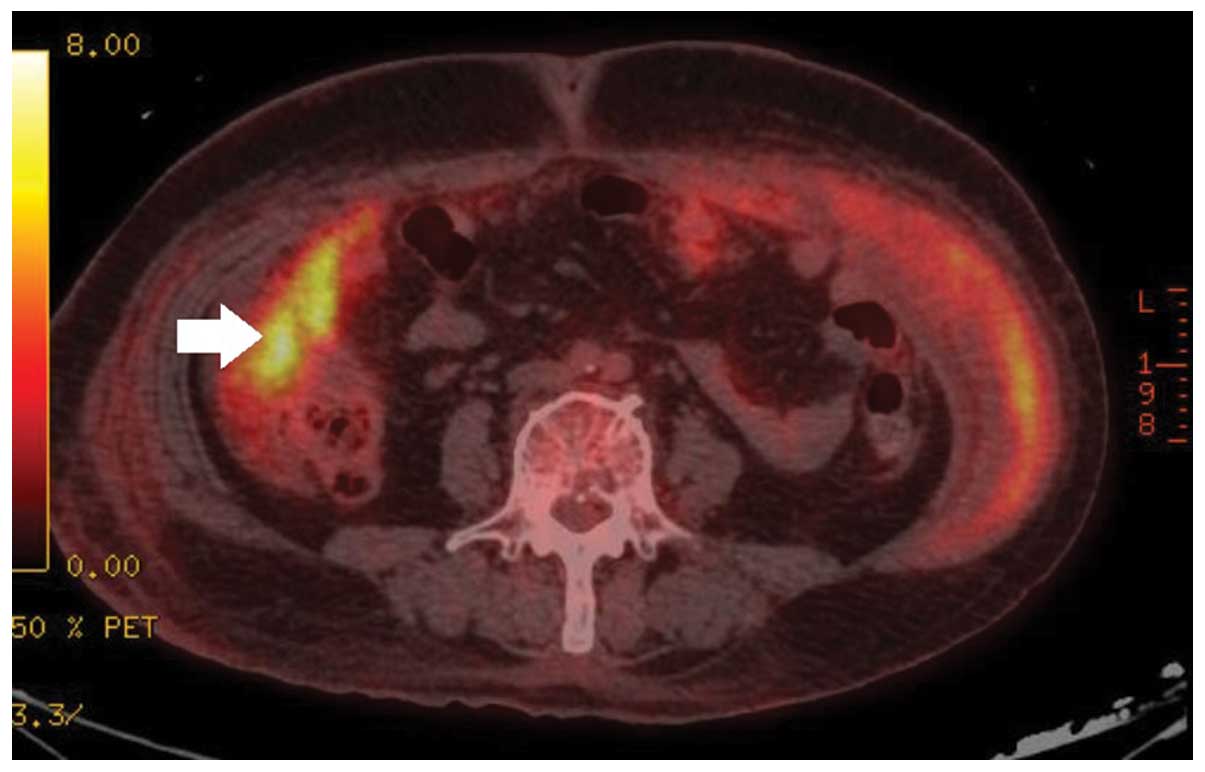
18F-fluorodeoxyglucose positron emission tomography (PET)/CT (Discovery DVCT; GE Healthcare Bio-Sciences, Pittsburgh, PA, USA) was then performed to evaluate the primary origin of the malignancy. The result of PET/CT revealed hot uptake in the greater omentum (Fig. 2). Other abdominal organs, including the stomach, colon, pancreas, uterus and both ovaries, were within the normal range of uptake. Furthermore, the patient's preoperative serum cancer antigen-125 (CA-125) levels were elevated to 1,032 U/ml (normal range, 0–35 U/ml).

Figure 2.

Positron emission tomography/computed tomography findings. The white arrow indicates hot uptake in greater omentum.

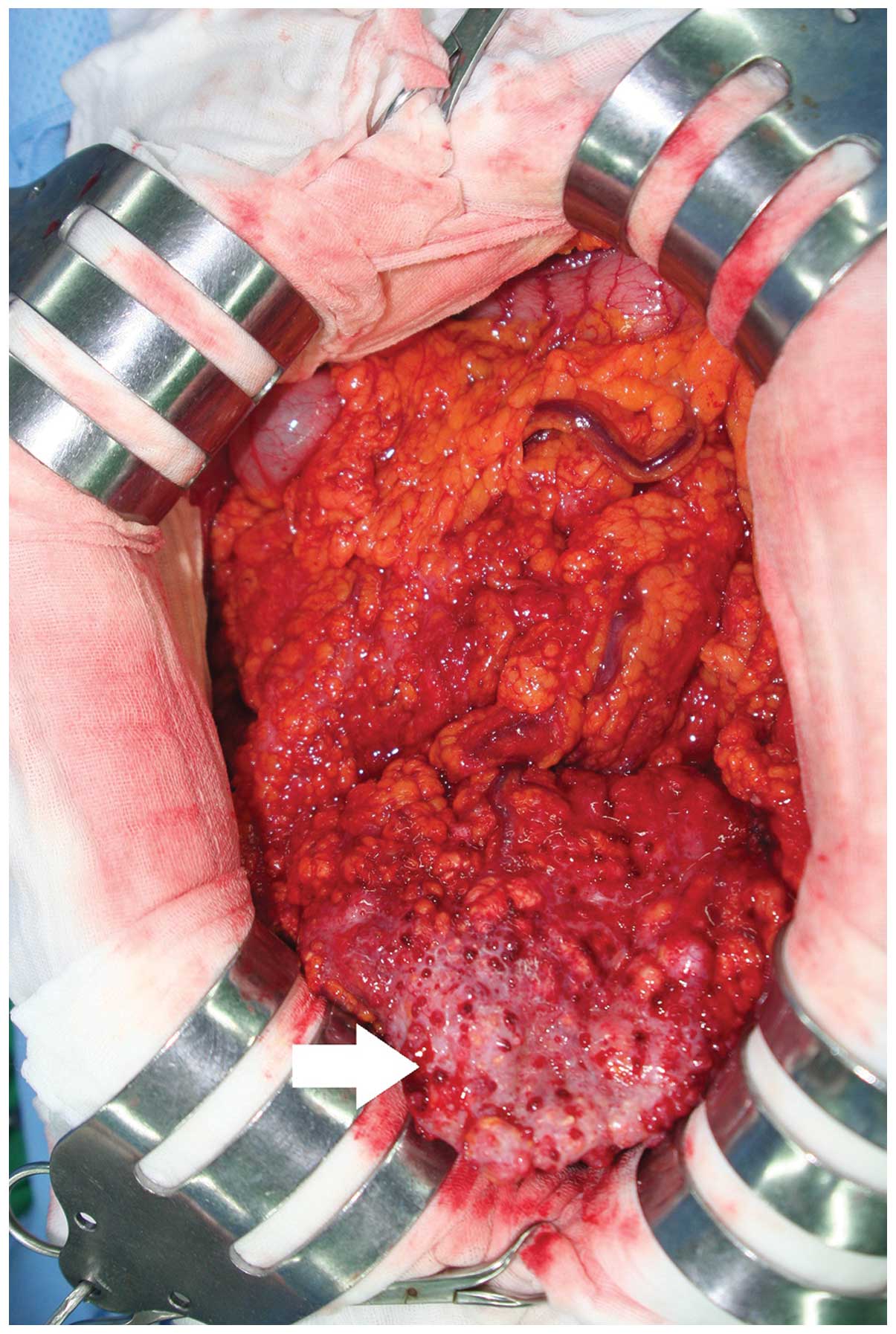
Based on the aforementioned results, a diagnosis of primary peritoneal malignancy was determined. Surgery was identified as the most appropriate treatment strategy, therefore, surgical exploration was performed in December 2014. Upon surgical exploration, ~1,000 cm3 ascites, a whitish mass (measuring 16×10×2.4 cm) and a nodule were found in the greater omentum (Fig. 3). The uterus and both adnexa were unremarkable without tumor involvement. The stomach, liver, small bowel, large bowel and pancreas were also unremarkable. Inspection of the abdominal cavity revealed a rice-sized nodule in the mesentery, peritoneum and pelvic cavity. Thus, omentectomy was performed. Resected tissue was fixed in 10% buffered-formalin, paraffin-embedded and cut into 4 µm sections, and subsequently stained with hematoxylin and eosin. For immunohistochemical analysis, the specimens were incubated with monoclonal mouse anti-human cytokeratin 7 (cat. no. M7018; 1:200; Dako, Glostrup, Denmark), monoclonal mouse anti-human WT-1 (cat. no. 348M-94; 1:100; Cell Marque™; Sigma-Aldrich, St. Louis, MO, USA) and monoclonal mouse anti-human CA-125 (cat. no. M3519; 1:40; Dako) antibodies. The results revealed positivity for cytokeratin-7, WT-1 and CA-125. Pathological examination of the resected specimen further indicated a diagnosis of PPSC. In the current case, both ovaries were of normal size with no observed abnormalities, and the main tumor was identified in the omentum. Therefore, according to the Gynecology Oncology Group criteria (3), surgical and pathological findings, a diagnosis of PPSC was determined. The patient was treated with regular chemotherapy [7 cycles of 175 mg/m2 paclitaxel and carboplatin (AUC, 4–7.5) every 3 weeks], which was initiated in December 2014, and was followed up every month. The patient had an uneventful postoperative course, and is currently alive and well.

Figure 3.

Intraoperative finding. The white arrow indicates whitish mass in the greater omentum.

Discussion

Peritoneal malignancies may be classified as primary or secondary, depending on the site of origin of the cancer. Primary peritoneal malignancies, which include malignant mesothelioma, serous carcinoma and sarcomas, are rare (6). Among these primary peritoneal malignancies, PPSC, is an extremely rare subtype that was first described in 1959 (1). In the United States, the incidence of PPSC is 6.78 cases per 1,000,000 individuals (2). However, the worldwide incidence rate is unknown and publications concerning PPSC are only case reports or case series.

The common presenting symptoms of PPSC are abdominal distension, abdominal pain and discomfort. Therefore, symptoms of PPSC are similar to those of peritoneal carcinomatosis. Furthermore, the majority patients described in case reports to date were diagnosed in the advanced stages of the disease (7,8). Traditionally, a diagnosis of PPSC is based on the Gynecology Oncology Group criteria, as follows: i) The ovaries are either absent or normal in size; ii) the involvement of the extraovarian sites is greater than the involvement of the surface of either ovary; iii) the absence of a deep-seated invasive ovarian carcinoma or invasive disease in the ovarian cortical stroma with tumors that measuring <5×5 mm2; and iv) histopathological and cytological characteristics of the tumors similar to those for epithelial ovarian cancer (3). Preoperatively, a correct diagnosis of PPSC is difficult. The current case was preoperatively diagnosed with omental metastasis and peritoneal carcinomatosis from the gastrointestinal tract or ovarian malignancy. However, PET/CT is beneficial due to its ability to define the extent of metabolically active disease and its ability to detect distant metastasis. Therefore, PET/CT is beneficial for the differentiation of PPSC from ovarian cancer (9).

In postoperative immunohistochemical examinations, PPSC is typically positive for cytokeratin-7, CA-125, estrogen receptor and Wilms' tumor-1 (WT-1) (5). In the current case, cytokeratin-7, WT-1 and CA-125 were positive.

The optimal treatment of PPSC is surgical resection and chemotherapy, with platinum-based chemotherapy used most commonly (10). Intraperitoneal chemotherapy has recently demonstrated a survival benefit in patients with PPSC when compared to those treated with surgery alone or surgery in combination with systemic chemotherapy (11).

Although it is difficult to generalize, as some published survival data were from small size studies, the median survival time of patients with PPSC is 11–17 months (4), which is similar to the present case with a current survival time of 15 months.

In conclusion, the current study presented a case of PPSC treated with debulking surgery. Although PPSC is considered extremely rare, its recognition is important for accurate evaluation and management. Due to its significant rarity, multicenter studies are required to further understand prognosis and identify an effective treatment approach.

Acknowledgements

The present study was supported by the 2015 Yeungnam University Research Grant.

References

1 

Swerdlow M: Mesothelioma of the pelvic peritoneum resembling papillary cystadenocarcinoma of the ovary; case report. Am J Obstet Gynecol. 77:197–200. 1959. View Article : Google Scholar : PubMed/NCBI

2 

Goodman MT and Shvetsov YB: Incidence of ovarian, peritoneal and fallopian tube carcinomas in the United States, 1995–2004. Cancer Epidemiol Biomarkers Prev. 18:132–139. 2009. View Article : Google Scholar : PubMed/NCBI

3 

Bloss JD, Liao SY, Buller RE, Manetta A, Berman ML, McMeekin S, Bloss LP and DiSaia PJ: Extraovarian peritoneal serous papillary carcinoma: A case-control retrospective comparison to papillary adenocarcinoma of the ovary. Gynecol Oncol. 50:347–351. 1993. View Article : Google Scholar : PubMed/NCBI

4 

Roh SY, Hong SH, Ko YH, Kim TH, Lee MA, Shim BY, Byun JH, Woo IS, Kang JH, Hong YS and Lee KS: Clinical characteristics of primary peritoneal carcinoma. Cancer Res Treat. 39:65–68. 2007. View Article : Google Scholar : PubMed/NCBI

5 

Turnage RH and Badgwell B: Abdominal wall, umbilicus, peritoenum, mesentery, omentum and retroperitoneum. Townsend CM Jr, Beauchamp RD, Evers BM and Mattox KL: Sabiston Textbook of Surgery (19th). Saunders Elsevier. (Philadelphia, PA). 11022012.

6 

Bhanvadia VM, Parmar JK, Madan YG and Sheikh SS: Primary peritoneal serous carcinoma: A rare case and palliative approach. Indian J Palliat Care. 20:157–159. 2014. View Article : Google Scholar : PubMed/NCBI

7 

Hou T, Liang D, He J, Chen X and Zhang Y: Primary peritoneal serous carcinoma: A clinicopathological and immunohistochemical study of six cases. Int J Clin Exp Pathol. 5:762–769. 2012.PubMed/NCBI

8 

Rakheja R, Makis W and Hickeson M: Extraovarian primary peritoneal carcinoma: Staging with 18F-FDG PET/CT. Abdom Imaging. 37:304–308. 2012. View Article : Google Scholar : PubMed/NCBI

9 

von Riedenauer WB, Janjua SA, Kwon DS, Zhang Z and Velanovich V: Immunohistochemical identification of primary peritoneal serous cystadenocarcinoma mimicking advanced colorectal carcinoma: A case report. J Med Case Rep. 1:1502007. View Article : Google Scholar : PubMed/NCBI

10 

Unal OU, Oztop I, Yazici O, Ozatli T, Inal A, Günaydın Y, Alici S, Demirci U, Cinkir HY, Aktas B, et al: Treatment and prognostic factors in primary peritoneal carcinoma: A multicenter study of the Anatolian society of medical oncology (ASMO). Oncol Res Treat. 37:332–338. 2014. View Article : Google Scholar : PubMed/NCBI

11 

Bakrin N, Gilly FN, Baratti D, Bereder JM, Quenet F, Lorimier G, Mohamed F, Elias D and Glehen O: Association Française de Chirurgie: Primary peritoneal serous carcinoma treated by cytoreductive surgery combined with hyperthermic intraperitoneal chemotherapy. A multi-institutional study of 36 patients. Eur J Surg Oncol. 39:742–747. 2013. View Article : Google Scholar : PubMed/NCBI

Related Articles

  • Abstract
  • View
  • Download
  • Twitter
Copy and paste a formatted citation
Spandidos Publications style
Yun WS and Bae JM: Primary peritoneal serous carcinoma, an extremely rare malignancy: A case report and review of the literature. Oncol Lett 11: 4063-4065, 2016.
APA
Yun, W., & Bae, J. (2016). Primary peritoneal serous carcinoma, an extremely rare malignancy: A case report and review of the literature. Oncology Letters, 11, 4063-4065. https://doi.org/10.3892/ol.2016.4525
MLA
Yun, W., Bae, J."Primary peritoneal serous carcinoma, an extremely rare malignancy: A case report and review of the literature". Oncology Letters 11.6 (2016): 4063-4065.
Chicago
Yun, W., Bae, J."Primary peritoneal serous carcinoma, an extremely rare malignancy: A case report and review of the literature". Oncology Letters 11, no. 6 (2016): 4063-4065. https://doi.org/10.3892/ol.2016.4525
Copy and paste a formatted citation
x
Spandidos Publications style
Yun WS and Bae JM: Primary peritoneal serous carcinoma, an extremely rare malignancy: A case report and review of the literature. Oncol Lett 11: 4063-4065, 2016.
APA
Yun, W., & Bae, J. (2016). Primary peritoneal serous carcinoma, an extremely rare malignancy: A case report and review of the literature. Oncology Letters, 11, 4063-4065. https://doi.org/10.3892/ol.2016.4525
MLA
Yun, W., Bae, J."Primary peritoneal serous carcinoma, an extremely rare malignancy: A case report and review of the literature". Oncology Letters 11.6 (2016): 4063-4065.
Chicago
Yun, W., Bae, J."Primary peritoneal serous carcinoma, an extremely rare malignancy: A case report and review of the literature". Oncology Letters 11, no. 6 (2016): 4063-4065. https://doi.org/10.3892/ol.2016.4525
Follow us
  • Twitter
  • LinkedIn
  • Facebook
About
  • Spandidos Publications
  • Careers
  • Cookie Policy
  • Privacy Policy
How can we help?
  • Help
  • Live Chat
  • Contact
  • Email to our Support Team