Spandidos Publications Logo
  • About
    • About Spandidos
    • Aims and Scopes
    • Abstracting and Indexing
    • Editorial Policies
    • Reprints and Permissions
    • Job Opportunities
    • Terms and Conditions
    • Contact
  • Journals
    • All Journals
    • Oncology Letters
      • Oncology Letters
      • Information for Authors
      • Editorial Policies
      • Editorial Board
      • Aims and Scope
      • Abstracting and Indexing
      • Bibliographic Information
      • Archive
    • International Journal of Oncology
      • International Journal of Oncology
      • Information for Authors
      • Editorial Policies
      • Editorial Board
      • Aims and Scope
      • Abstracting and Indexing
      • Bibliographic Information
      • Archive
    • Molecular and Clinical Oncology
      • Molecular and Clinical Oncology
      • Information for Authors
      • Editorial Policies
      • Editorial Board
      • Aims and Scope
      • Abstracting and Indexing
      • Bibliographic Information
      • Archive
    • Experimental and Therapeutic Medicine
      • Experimental and Therapeutic Medicine
      • Information for Authors
      • Editorial Policies
      • Editorial Board
      • Aims and Scope
      • Abstracting and Indexing
      • Bibliographic Information
      • Archive
    • International Journal of Molecular Medicine
      • International Journal of Molecular Medicine
      • Information for Authors
      • Editorial Policies
      • Editorial Board
      • Aims and Scope
      • Abstracting and Indexing
      • Bibliographic Information
      • Archive
    • Biomedical Reports
      • Biomedical Reports
      • Information for Authors
      • Editorial Policies
      • Editorial Board
      • Aims and Scope
      • Abstracting and Indexing
      • Bibliographic Information
      • Archive
    • Oncology Reports
      • Oncology Reports
      • Information for Authors
      • Editorial Policies
      • Editorial Board
      • Aims and Scope
      • Abstracting and Indexing
      • Bibliographic Information
      • Archive
    • Molecular Medicine Reports
      • Molecular Medicine Reports
      • Information for Authors
      • Editorial Policies
      • Editorial Board
      • Aims and Scope
      • Abstracting and Indexing
      • Bibliographic Information
      • Archive
    • World Academy of Sciences Journal
      • World Academy of Sciences Journal
      • Information for Authors
      • Editorial Policies
      • Editorial Board
      • Aims and Scope
      • Abstracting and Indexing
      • Bibliographic Information
      • Archive
    • International Journal of Functional Nutrition
      • International Journal of Functional Nutrition
      • Information for Authors
      • Editorial Policies
      • Editorial Board
      • Aims and Scope
      • Abstracting and Indexing
      • Bibliographic Information
      • Archive
    • International Journal of Epigenetics
      • International Journal of Epigenetics
      • Information for Authors
      • Editorial Policies
      • Editorial Board
      • Aims and Scope
      • Abstracting and Indexing
      • Bibliographic Information
      • Archive
    • Medicine International
      • Medicine International
      • Information for Authors
      • Editorial Policies
      • Editorial Board
      • Aims and Scope
      • Abstracting and Indexing
      • Bibliographic Information
      • Archive
  • Articles
  • Information
    • Information for Authors
    • Information for Reviewers
    • Information for Librarians
    • Information for Advertisers
    • Conferences
  • Language Editing
Spandidos Publications Logo
  • About
    • About Spandidos
    • Aims and Scopes
    • Abstracting and Indexing
    • Editorial Policies
    • Reprints and Permissions
    • Job Opportunities
    • Terms and Conditions
    • Contact
  • Journals
    • All Journals
    • Biomedical Reports
      • Information for Authors
      • Editorial Policies
      • Editorial Board
      • Aims and Scope
      • Abstracting and Indexing
      • Bibliographic Information
      • Archive
    • Experimental and Therapeutic Medicine
      • Information for Authors
      • Editorial Policies
      • Editorial Board
      • Aims and Scope
      • Abstracting and Indexing
      • Bibliographic Information
      • Archive
    • International Journal of Epigenetics
      • Information for Authors
      • Editorial Policies
      • Editorial Board
      • Aims and Scope
      • Abstracting and Indexing
      • Bibliographic Information
      • Archive
    • International Journal of Functional Nutrition
      • Information for Authors
      • Editorial Policies
      • Editorial Board
      • Aims and Scope
      • Abstracting and Indexing
      • Bibliographic Information
      • Archive
    • International Journal of Molecular Medicine
      • Information for Authors
      • Editorial Policies
      • Editorial Board
      • Aims and Scope
      • Abstracting and Indexing
      • Bibliographic Information
      • Archive
    • International Journal of Oncology
      • Information for Authors
      • Editorial Policies
      • Editorial Board
      • Aims and Scope
      • Abstracting and Indexing
      • Bibliographic Information
      • Archive
    • Medicine International
      • Information for Authors
      • Editorial Policies
      • Editorial Board
      • Aims and Scope
      • Abstracting and Indexing
      • Bibliographic Information
      • Archive
    • Molecular and Clinical Oncology
      • Information for Authors
      • Editorial Policies
      • Editorial Board
      • Aims and Scope
      • Abstracting and Indexing
      • Bibliographic Information
      • Archive
    • Molecular Medicine Reports
      • Information for Authors
      • Editorial Policies
      • Editorial Board
      • Aims and Scope
      • Abstracting and Indexing
      • Bibliographic Information
      • Archive
    • Oncology Letters
      • Information for Authors
      • Editorial Policies
      • Editorial Board
      • Aims and Scope
      • Abstracting and Indexing
      • Bibliographic Information
      • Archive
    • Oncology Reports
      • Information for Authors
      • Editorial Policies
      • Editorial Board
      • Aims and Scope
      • Abstracting and Indexing
      • Bibliographic Information
      • Archive
    • World Academy of Sciences Journal
      • Information for Authors
      • Editorial Policies
      • Editorial Board
      • Aims and Scope
      • Abstracting and Indexing
      • Bibliographic Information
      • Archive
  • Articles
  • Information
    • For Authors
    • For Reviewers
    • For Librarians
    • For Advertisers
    • Conferences
  • Language Editing
Login Register Submit
  • This site uses cookies
  • You can change your cookie settings at any time by following the instructions in our Cookie Policy. To find out more, you may read our Privacy Policy.

    I agree
Search articles by DOI, keyword, author or affiliation
Search
Advanced Search
presentation
World Academy of Sciences Journal
Join Editorial Board Propose a Special Issue
Print ISSN: 2632-2900 Online ISSN: 2632-2919
Journal Cover
March-April 2024 Volume 6 Issue 2

Full Size Image

Sign up for eToc alerts
Recommend to Library

Journals

International Journal of Molecular Medicine

International Journal of Molecular Medicine

International Journal of Molecular Medicine is an international journal devoted to molecular mechanisms of human disease.

International Journal of Oncology

International Journal of Oncology

International Journal of Oncology is an international journal devoted to oncology research and cancer treatment.

Molecular Medicine Reports

Molecular Medicine Reports

Covers molecular medicine topics such as pharmacology, pathology, genetics, neuroscience, infectious diseases, molecular cardiology, and molecular surgery.

Oncology Reports

Oncology Reports

Oncology Reports is an international journal devoted to fundamental and applied research in Oncology.

Experimental and Therapeutic Medicine

Experimental and Therapeutic Medicine

Experimental and Therapeutic Medicine is an international journal devoted to laboratory and clinical medicine.

Oncology Letters

Oncology Letters

Oncology Letters is an international journal devoted to Experimental and Clinical Oncology.

Biomedical Reports

Biomedical Reports

Explores a wide range of biological and medical fields, including pharmacology, genetics, microbiology, neuroscience, and molecular cardiology.

Molecular and Clinical Oncology

Molecular and Clinical Oncology

International journal addressing all aspects of oncology research, from tumorigenesis and oncogenes to chemotherapy and metastasis.

World Academy of Sciences Journal

World Academy of Sciences Journal

Multidisciplinary open-access journal spanning biochemistry, genetics, neuroscience, environmental health, and synthetic biology.

International Journal of Functional Nutrition

International Journal of Functional Nutrition

Open-access journal combining biochemistry, pharmacology, immunology, and genetics to advance health through functional nutrition.

International Journal of Epigenetics

International Journal of Epigenetics

Publishes open-access research on using epigenetics to advance understanding and treatment of human disease.

Medicine International

Medicine International

An International Open Access Journal Devoted to General Medicine.

Journal Cover
March-April 2024 Volume 6 Issue 2

Full Size Image

Sign up for eToc alerts
Recommend to Library

  • Article
  • Citations
    • Cite This Article
    • Download Citation
    • Create Citation Alert
    • Remove Citation Alert
    • Cited By
  • Similar Articles
    • Related Articles (in Spandidos Publications)
    • Similar Articles (Google Scholar)
    • Similar Articles (PubMed)
  • Download PDF
  • Download XML
  • View XML
Case Report Open Access

Testicular cholesterol granuloma mimicking a testicular tumor: A case report

  • Authors:
    • Rawa Bapir
    • Ari M. Abdullah
    • Soran H. Tahir
    • Nali H. Hama
    • Jihad Ibrahim Hama
    • Ayoob Asaad Mohammed Abid
    • Fahmi H. Kakamad
    • Berun A. Abdalla
    • Ismaeel Aghaways
  • View Affiliations / Copyright

    Affiliations: Department of Scientific Affairs, Smart Health Tower, Sulaimani, Kurdistan 46001, Iraq, Research Center, University of Halabja, Halabja, Kurdistan 46018, Iraq, College of Medicine, University of Sulaimani, Sulaimani, Kurdistan 46001, Iraq
    Copyright: © Bapir et al. This is an open access article distributed under the terms of Creative Commons Attribution License [CC BY 4.0].
  • Article Number: 17
    |
    Published online on: February 21, 2024
       https://doi.org/10.3892/wasj.2024.232
  • Expand metrics +
Metrics: Total Views: 0 (Spandidos Publications: | PMC Statistics: )
Metrics: Total PDF Downloads: 0 (Spandidos Publications: | PMC Statistics: )
Cited By (CrossRef): 0 citations Loading Articles...

This article is mentioned in:


Abstract

Cholesterol granulomas (ChGs) are benign fibro‑granulomatous lesions that develop following trauma and inflammation. The most common sites of presentation are the middle ear, paranasal sinuses and petrous apex; however, they can present in any area of the body where cholesterol deposition can occur. The present study describes the case of a 62‑year‑old male who presented with a painless right scrotal mass that had been there for the past 6 years. Upon a physical examination, a hard non‑tender mass at the lower pole of the right testis with normal overlying scrotal skin was detected. Blood analyses revealed normal levels of tumor markers (β‑human chorionic gonadotropin, alpha‑fetoprotein and lactate dehydrogenase) and a normal lipid profile. A right scrotal color Doppler ultrasound revealed a well‑defined hypoechoic 13x14 mm lower pole testicular mass. Scrotal magnetic resonance imaging revealed a well‑defined nodule (13x11x12 mm) at the lower pole of the right testis near the epididymis. Under spinal anesthesia, via inguinal incision, a right partial orchiectomy was performed. The post‑operative period was uneventful. The results of the histopathological examination were consistent with testicular ChG. ChG of the testis is extremely rare, and only one other case has been recorded in the literature to date, at least to the best of our knowledge. Differentiating between ChGs of the testis and testicular tumors before surgery can be relatively challenging. This should be regarded as a differential diagnosis in cases of testicular masses.

Introduction

Cholesterol granulomas (ChGs) are chronic inflammatory lesions that develop due to the body's reaction to cholesterol crystals. They may be found in any part of the body where cholesterol crystals can accumulate (1). The ChGs lack an epithelial lining; for this reason, they are usually known as pseudotumors or not true tumors. These lesions are most commonly found in the middle ear, paranasal sinuses, or temporal bones, specifically the petrous apex. Less common reports of ChGs in the breasts, liver, spleen, kidney, lymph nodes and peritoneum have also been recorded (2). Although the etiopathogenesis of these pseudotumors is unknown, they are considered to be caused by trauma and inflammation (2). ChGs in testicular and paratesticular tissues are rare, and pose a significant challenge in their differentiation from intrascrotal tumors. This difficulty persists during physical examinations, ultrasonography and even surgery, as ChGs may mimic the appearance of intrascrotal tumors (3-5).

The present study describes the second recorded case, to the best of our knowledge, of a ChG of the testis mimicking a testicular tumor.

Case report

Patient information

A 62-year-old male presented with a painless right scrotal mass which had been present for 6 years. There was no history of trauma to the testis. The patient had a positive medical history for hypertension, diabetes and two percutaneous coronary interventions a few years prior. Previous surgical history included a left-side scrotal exploration for an abscess in 2017 that proved to be tuberculosis. He received a 6-month course of anti-tuberculosis medication. Since then, no recurrence has been detected. He was receiving amlodipine (10 mg, single daily dose), metformin (500 mg, twice daily), atorvastatin (40 mg, single daily dose) and aspirin (100 mg, single daily dose).

Clinical findings

A physical examination revealed a hard non-tender mass at the lower pole of the testis with normal overlying scrotal skin and transillumination was negative. His vital signs were normal.

Diagnostic assessment

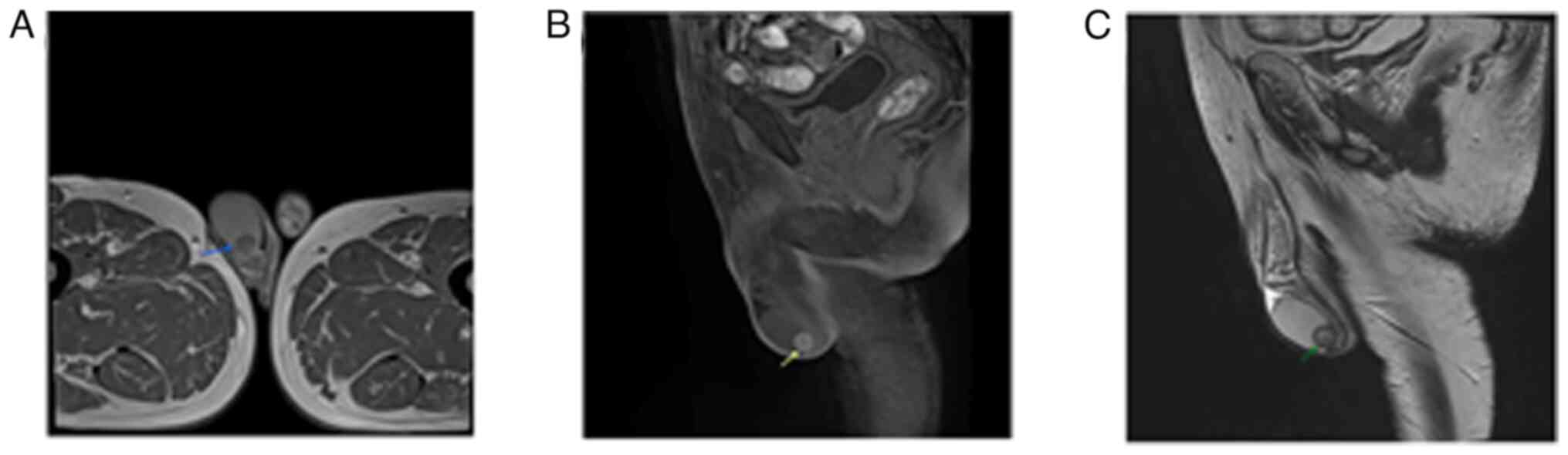
A complete blood count yielded normal results. C-reactive protein levels (0.78 mg/l; normal range, <5 mg/l) and the erythrocyte sedimentation rate (17 mm/h; normal range, 0-20 mm/h for males >50 years old) were both within normal limits. Lipid profile analysis revealed normal levels of total cholesterol (138.9 mg/dl; normal range, <200 mg/dl), triglycerides (147.8 mg/dl; normal range, <170 mg/dl), low-density lipoprotein (82.8 mg/dl; normal range, <130 mg/dl) and high-density lipoprotein (48.5 mg/dl; normal range, 35-55 mg/dl). Other analyses revealed normal levels of tumor markers [β-human chorionic gonadotropin (0.03 IU/l; normal range, 0.02-0.8 IU/l), alpha-fetoprotein (8.2 ng/ml; normal range, 0-40 ng/ml) and lactate dehydrogenase (174 IU/l; normal range, 105-233 IU/l)]. A scrotal color Doppler ultrasound revealed that the right testis was normal in size (39x18 mm), shape and echo texture, apart from a well-defined hypoechoic 13x14 mm lower pole testicular mass with surrounding hypervascularity, suggesting a tumor. Scrotal magnetic resonance imaging revealed a well-defined nodule (13x11x12 mm) (in transverse x anteroposterior x craniocaudal dimensions) at the lower pole of the right testis near the epididymis (Fig. 1). The lesion elicited a slightly hyperintense signal in the T1-weighted image and a heterogenous hypointense signal in the T2-weighted image. There was no post-contrast enhancement.

Figure 1

Testicular magnetic resonance imaging illustrating a well-defined round lesion in the lower part of the right testis. (A) Axial section T1WI post-contrast illustrating no intralesional enhancement (blue arrow). (B) Sagittal section T1WI fat suppression image illustrating a hyperintense signal (yellow arrow). (C) Sagittal section T2WI illustrating a low signal (green arrow).

Therapeutic intervention and follow-up

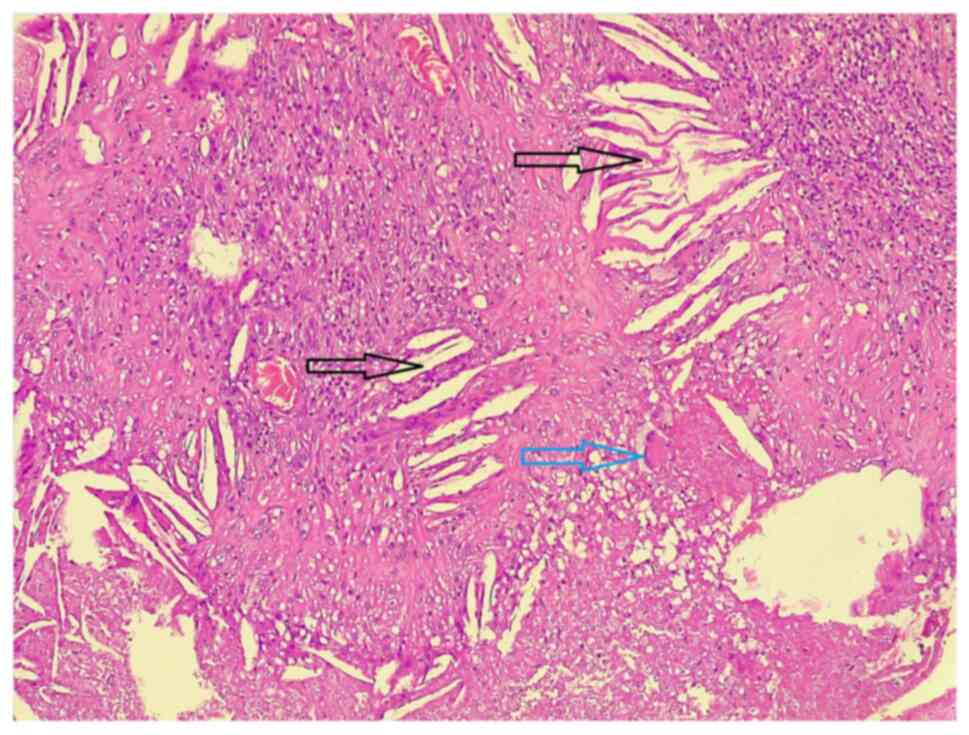
The case was discussed with a multidisciplinary team, and based on these findings, the surgeon decided to perform an inguinal orchiectomy. However, the patient gave his consent to a partial orchiectomy. Under spinal anesthesia, via inguinal incision, a right partial orchiectomy was performed. A histopathological examination was performed on 5-µm-thick paraffin-embedded sections. The sections were fixed in 10% neutral-buffered formalin at room temperature for 24 h and stained with hematoxylin and eosin (Bio Optica Co.) for 1-2 min at room temperature. The sections were then examined under a light microscope (Leica Microsystems GmbH). The results of the histopathological examination were consistent with testicular ChG (Fig. 2). The post-operative period was uneventful.

Figure 2

Section illustrating cholesterol cleft formations (dark arrows) with mixed inflammatory cell infiltration and multinucleated giant cell reaction (blue arrow). Magnification, x40.

Discussion

ChGs are benign masses that develop due to the reaction of a foreign body to cholesterol crystals. They are characterized by fibrous tissue, granulomatous inflammation and the accumulation of foreign body giant cells (6,7).

The pathophysiology of ChG development remains unknown and the suggested cause of development may differ depending on the location. Hemorrhage, drainage obstruction and the disruption of ventilation are factors that may be associated with the development of the condition (8). Trauma leading to inflammation and ischemia results in the extravasation of blood containing cholesterol, fibrin and hemosiderin. The extravasated cholesterol evokes a foreign body reaction, causing the formation of a fibrogranulomatous lesion, which is the ChG (1). Although rare, there are reported cases of ChGs in the kidneys (9), mediastinum (10), breast (11) and femur (12) in the literature. In the breasts, duct ectasia leads to cholesterol crystal formation, and the leakage of these crystals through the ducts then initiates an inflammatory response (11).

Testicular ChGs are very rare and there has been only one other recorded case in the literature to date, at least to the best of our knowledge (4). Cases of ChGs in the tunica vaginalis (13,14), hydrocele sac (2,14), epididymis (6,15) and tunica albuginea (5,16) have also been recorded in the literature.

Lowenthal et al (13) reported a case of a 52-year-old male patient with a left testicular mass that caused testis enlargement for >25 years due to a trauma that was found to be ChG of the tunica vaginalis. Another study reported a case of a 38-year-old male who presented with a right scrotal mass for 7 years, without having infections, such as tuberculosis or any history of trauma (6). In that study, the results of the histopathological analysis revealed a paratesticular ChG, and they suggested that the condition should be a differential diagnosis in cases with large and non-tender scrotal masses (6). Gupta et al (2) also reported a case of ChG of the left hydrocele sac presenting as a testicular tumor. ChG mimicking the clinical signs of an acute scrotum has also been reported (15). Doi et al (16) reported the first case of ChG associated with hematoma of the tunica albuginea. The case described in the present study, unlike that in the study by Lowenthal et al (13), did not have any history of trauma and had no infectious diseases in the same testis as the other mentioned studies (2,6,15,16).

ChG of the testes and paratesticular tissue most commonly occurs after the age of 30, while Saeki et al (5) recorded a case of ChG of the tunica albuginea in a child aged 6 years. The only other recorded case of ChG of the testis was that of a 76-year-old male (4), further supporting that ChGs of the testes and paratesticular tissue occur in older age groups.

The case report of testicular ChG by Lin et al (4) described a patient who was admitted to the hospital for fever and shortness of breath. He had a history of squamous cell carcinoma of the tongue and radiation therapy. The condition of the patient deteriorated and the patient passed away on the 12th day of hospitalization. A genitourinary examination revealed a firm enlargement in the right testis. Initially, it presented as a caseating tuberculous granuloma, and a microscopic examination was necessary to establish the diagnosis of ChG (4). The patient described herein was vitally stable and had no history of cancer or radiation therapy.

The clinical presentation of testicular and paratesticular ChG is variable and may be encountered incidentally during a physical examination or may present as mild scrotal discomfort and a painless lump (6,13). The case of testicular ChG recorded in the study by Lin et al (4) presented for reasons other than the scrotal swelling and the swelling was noted during a physical examination.

Although patients reported with testicular and paratesticular ChG did not have hypercholesterolemia (15), Albakheet et al (17) suggested an association between familial hypercholesterolemia and ChG. The patient in the present study had a normal lipid profile, but was on atorvastatin. Unal et al (6) reported a case with a mild elevation in serum cholesterol levels, but did not assume this to be a direct cause of the ChG.

The diagnosis of testicular ChG can be challenging without a histopathological examination (2,5). In the present study, the pre-operative investigations of the patient suggested a testicular tumor and the diagnosis of ChG was confirmed by a histopathological examination.

The treatment of choice for the patient described herein was inguinal orchiectomy; however, he only gave consent to a partial orchiectomy. A right partial orchiectomy was performed via an inguinal incision. In their report of testicular ChG, Lin et al (4) performed an autopsy. In the study by Unal et al (6), a radical inguinal orchiectomy was performed for their case of ChG of the paratesticular tissue. Saeki et al (5) performed a surgical enucleation via a scrotal approach for their case of paratesticular ChG, and were able to preserve the testis and epididymis. All the cited references in the present case report have been confirmed to be reliable (18).

In conclusion, ChG of the testis is an extremely rare condition. Upon presentation, ChGs may be non-tender and may only cause mild discomfort. Differentiating between the condition and testicular tumors prior to surgery can be relatively challenging and should be regarded as a differential diagnosis in cases of testicular masses.

Acknowledgements

Not applicable.

Funding

Funding: No funding was received.

Availability of data and materials

The datasets used and/or analyzed during the current study are available from the corresponding author on reasonable request.

Authors' contributions

RB was a major contributor to the conception of the study, as well as to the literature search for related studies. NHH and FHK were involved in the design of the study, in the literature review and in the writing of the manuscript. JIH, AMA, BAA and IA were involved in the literature review, in the design of the study, in the critical revision of the manuscript and the processing of the figures. AMA was the pathologist who performed the histopathological diagnosis. SHT and AAMA were the radiologists who performed the radiological assessments of the case. FHK and RB confirm the authenticity of all the raw data. All authors have read and approved the final manuscript.

Ethics approval and consent to participate

Written informed consent was obtained from the patient for this participation in the present study.

Patient consent for publication

Written informed consent was obtained from the patient for the publication of the present case report and any accompanying images.

Competing interests

The authors declare that they have no competing interests.

References

1 

Nikolaidis V, Malliari H, Psifidis D and Metaxas S: Cholesterol granuloma presenting as a mass obstructing the external ear canal. BMC Ear Nose Throat Disord. 10(4)2010.PubMed/NCBI View Article : Google Scholar

2 

Gupta SC, Kumar V and Gupta NN: Cholesterol granuloma of left-sided hydrocele sac mimicking testicular tumor. RUHS J Health Sci. 4:163–165. 2019.

3 

Mahmood ZH, Mohemed FM, Fatih BN, Qadir AA and Abdalla SH: Cancer publications in one year (2022); a cross-sectional study. Barw Med J. 1:2023.

4 

Lin JI, Tseng CH, Marsidi PJ and Bais VC: Cholesterol granuloma of right testis. Urology. 14:522–523. 1979.PubMed/NCBI View Article : Google Scholar

5 

Saeki I, Kurihara S, Kojima M, Imaji R and Hiyama E: Paratesticular cholesterol granuloma. J Pediatric Sur Case Rep. 61(101630)2020.

6 

Unal D, Kilic M, Oner S, Erkinuresin T, Demirbas M, Coban S and Aydos MM: Cholesterol granuloma of the paratesticular tissue: A case report. Can Urol Assoc J. 9:E390–E392. 2015.PubMed/NCBI View Article : Google Scholar

7 

Nager GT and Vanderveen TS: Cholesterol granuloma involving the temporal bone. Ann Otol Rhinol Laryngol. 85:204–209. 1976.PubMed/NCBI View Article : Google Scholar

8 

Ahmetgjekaj I, Harizi E, Rahman A, Hyseni F, Nasir F, Decka A, Rahman M, Shemsi K, Saliaj K, Akram S, et al: Giant cholesterol granuloma of petrous apex. Radiol Case Rep. 17:1220–1224. 2022.PubMed/NCBI View Article : Google Scholar

9 

Okamoto K, Hatori M, Tomita K, Yokoyama Y, Makino T, Hirono M, Muramatsu K, Arai S, Morikawa Y, Miyakubo M, et al: Cholesterol granuloma of the kidney: A case report. Nihon Hinyokika Gakkai Zasshi. 102:586–590. 2011.PubMed/NCBI View Article : Google Scholar : (In Japanese).

10 

Luckraz H, Coulston J and Azzu A: Cholesterol granuloma of the superior mediastinum. Ann Thorac Surg. 81:1509–1510. 2006.PubMed/NCBI View Article : Google Scholar

11 

Letter H, Komforti M, Maxwell R and Maimone S: Cholesterol granuloma of the breast: A case report. Radiol Case Rep. 18:3009–3013. 2023.PubMed/NCBI View Article : Google Scholar

12 

Hao S, Dong S, Li H, Liu S, Chen H and Zhang Z: Case report: Cholesterol granuloma of femur. Front Surg. 9(944499)2022.PubMed/NCBI View Article : Google Scholar

13 

Lowenthal SB, Goldstein AM and Terry R: Cholesterol granuloma of tunica vaginalis simulating testicular tumor. Urology. 18:89–90. 1981.PubMed/NCBI View Article : Google Scholar

14 

Farina Perez LA, Menendez P and Macho V: Hydrocele and cholesterol granuloma of the tunica vaginalis simulating a tumor in echography. Actas Urol Esp. 22:70–73. 1998.PubMed/NCBI(In Spanish).

15 

Spajic B, Cupic H, Stimac G, Brigic I, Kruslin B and Kraus O: Cholesterol granuloma of the right epididymis mimicking an acute scrotum. Asian J Androl. 8:749–750. 2006.PubMed/NCBI View Article : Google Scholar

16 

Doi H, Naka Y, Matsuda T, Harada T and Komatz Y: A case of cholesterol granuloma with hematoma of tunica albuginea. Hinyokika Kiyo. 39:193–195. 1993.PubMed/NCBI(In Japanese).

17 

Albakheet N, Al-Shawi Y, Bafaqeeh M, Fatani H, Orz Y and Shami I: Familial hypercholesterolemia with bilateral cholesterol granuloma: A case series. Int J Surg Case Rep. 62:135–159. 2019.PubMed/NCBI View Article : Google Scholar

18 

Muhialdeen AS, Ahmed JO, Baba HO, Abdullah IY, Hassan HA, Najar KA, Mikael TM, Mustafa MQ, Mohammed DA, Omer DA, et al: Kscien's List; A New Strategy to Discourage Predatory Journals and Publishers (Second Version). Barw Med J. 1:24–26. 2023.

Related Articles

  • Abstract
  • View
  • Download
Copy and paste a formatted citation
Spandidos Publications style
Bapir R, Abdullah AM, Tahir SH, Hama NH, Hama JI, Abid AA, Kakamad FH, Abdalla BA and Aghaways I: Testicular cholesterol granuloma mimicking a testicular tumor: A case report. World Acad Sci J 6: 17, 2024.
APA
Bapir, R., Abdullah, A.M., Tahir, S.H., Hama, N.H., Hama, J.I., Abid, A.A. ... Aghaways, I. (2024). Testicular cholesterol granuloma mimicking a testicular tumor: A case report. World Academy of Sciences Journal, 6, 17. https://doi.org/10.3892/wasj.2024.232
MLA
Bapir, R., Abdullah, A. M., Tahir, S. H., Hama, N. H., Hama, J. I., Abid, A. A., Kakamad, F. H., Abdalla, B. A., Aghaways, I."Testicular cholesterol granuloma mimicking a testicular tumor: A case report". World Academy of Sciences Journal 6.2 (2024): 17.
Chicago
Bapir, R., Abdullah, A. M., Tahir, S. H., Hama, N. H., Hama, J. I., Abid, A. A., Kakamad, F. H., Abdalla, B. A., Aghaways, I."Testicular cholesterol granuloma mimicking a testicular tumor: A case report". World Academy of Sciences Journal 6, no. 2 (2024): 17. https://doi.org/10.3892/wasj.2024.232
Copy and paste a formatted citation
x
Spandidos Publications style
Bapir R, Abdullah AM, Tahir SH, Hama NH, Hama JI, Abid AA, Kakamad FH, Abdalla BA and Aghaways I: Testicular cholesterol granuloma mimicking a testicular tumor: A case report. World Acad Sci J 6: 17, 2024.
APA
Bapir, R., Abdullah, A.M., Tahir, S.H., Hama, N.H., Hama, J.I., Abid, A.A. ... Aghaways, I. (2024). Testicular cholesterol granuloma mimicking a testicular tumor: A case report. World Academy of Sciences Journal, 6, 17. https://doi.org/10.3892/wasj.2024.232
MLA
Bapir, R., Abdullah, A. M., Tahir, S. H., Hama, N. H., Hama, J. I., Abid, A. A., Kakamad, F. H., Abdalla, B. A., Aghaways, I."Testicular cholesterol granuloma mimicking a testicular tumor: A case report". World Academy of Sciences Journal 6.2 (2024): 17.
Chicago
Bapir, R., Abdullah, A. M., Tahir, S. H., Hama, N. H., Hama, J. I., Abid, A. A., Kakamad, F. H., Abdalla, B. A., Aghaways, I."Testicular cholesterol granuloma mimicking a testicular tumor: A case report". World Academy of Sciences Journal 6, no. 2 (2024): 17. https://doi.org/10.3892/wasj.2024.232
Follow us
  • Twitter
  • LinkedIn
  • Facebook
About
  • Spandidos Publications
  • Careers
  • Cookie Policy
  • Privacy Policy
How can we help?
  • Help
  • Live Chat
  • Contact
  • Email to our Support Team