Spandidos Publications Logo
  • About
    • About Spandidos
    • Aims and Scopes
    • Abstracting and Indexing
    • Editorial Policies
    • Reprints and Permissions
    • Job Opportunities
    • Terms and Conditions
    • Contact
  • Journals
    • All Journals
    • Oncology Letters
      • Oncology Letters
      • Information for Authors
      • Editorial Policies
      • Editorial Board
      • Aims and Scope
      • Abstracting and Indexing
      • Bibliographic Information
      • Archive
    • International Journal of Oncology
      • International Journal of Oncology
      • Information for Authors
      • Editorial Policies
      • Editorial Board
      • Aims and Scope
      • Abstracting and Indexing
      • Bibliographic Information
      • Archive
    • Molecular and Clinical Oncology
      • Molecular and Clinical Oncology
      • Information for Authors
      • Editorial Policies
      • Editorial Board
      • Aims and Scope
      • Abstracting and Indexing
      • Bibliographic Information
      • Archive
    • Experimental and Therapeutic Medicine
      • Experimental and Therapeutic Medicine
      • Information for Authors
      • Editorial Policies
      • Editorial Board
      • Aims and Scope
      • Abstracting and Indexing
      • Bibliographic Information
      • Archive
    • International Journal of Molecular Medicine
      • International Journal of Molecular Medicine
      • Information for Authors
      • Editorial Policies
      • Editorial Board
      • Aims and Scope
      • Abstracting and Indexing
      • Bibliographic Information
      • Archive
    • Biomedical Reports
      • Biomedical Reports
      • Information for Authors
      • Editorial Policies
      • Editorial Board
      • Aims and Scope
      • Abstracting and Indexing
      • Bibliographic Information
      • Archive
    • Oncology Reports
      • Oncology Reports
      • Information for Authors
      • Editorial Policies
      • Editorial Board
      • Aims and Scope
      • Abstracting and Indexing
      • Bibliographic Information
      • Archive
    • Molecular Medicine Reports
      • Molecular Medicine Reports
      • Information for Authors
      • Editorial Policies
      • Editorial Board
      • Aims and Scope
      • Abstracting and Indexing
      • Bibliographic Information
      • Archive
    • World Academy of Sciences Journal
      • World Academy of Sciences Journal
      • Information for Authors
      • Editorial Policies
      • Editorial Board
      • Aims and Scope
      • Abstracting and Indexing
      • Bibliographic Information
      • Archive
    • International Journal of Functional Nutrition
      • International Journal of Functional Nutrition
      • Information for Authors
      • Editorial Policies
      • Editorial Board
      • Aims and Scope
      • Abstracting and Indexing
      • Bibliographic Information
      • Archive
    • International Journal of Epigenetics
      • International Journal of Epigenetics
      • Information for Authors
      • Editorial Policies
      • Editorial Board
      • Aims and Scope
      • Abstracting and Indexing
      • Bibliographic Information
      • Archive
    • Medicine International
      • Medicine International
      • Information for Authors
      • Editorial Policies
      • Editorial Board
      • Aims and Scope
      • Abstracting and Indexing
      • Bibliographic Information
      • Archive
  • Articles
  • Information
    • Information for Authors
    • Information for Reviewers
    • Information for Librarians
    • Information for Advertisers
    • Conferences
  • Language Editing
Spandidos Publications Logo
  • About
    • About Spandidos
    • Aims and Scopes
    • Abstracting and Indexing
    • Editorial Policies
    • Reprints and Permissions
    • Job Opportunities
    • Terms and Conditions
    • Contact
  • Journals
    • All Journals
    • Biomedical Reports
      • Information for Authors
      • Editorial Policies
      • Editorial Board
      • Aims and Scope
      • Abstracting and Indexing
      • Bibliographic Information
      • Archive
    • Experimental and Therapeutic Medicine
      • Information for Authors
      • Editorial Policies
      • Editorial Board
      • Aims and Scope
      • Abstracting and Indexing
      • Bibliographic Information
      • Archive
    • International Journal of Epigenetics
      • Information for Authors
      • Editorial Policies
      • Editorial Board
      • Aims and Scope
      • Abstracting and Indexing
      • Bibliographic Information
      • Archive
    • International Journal of Functional Nutrition
      • Information for Authors
      • Editorial Policies
      • Editorial Board
      • Aims and Scope
      • Abstracting and Indexing
      • Bibliographic Information
      • Archive
    • International Journal of Molecular Medicine
      • Information for Authors
      • Editorial Policies
      • Editorial Board
      • Aims and Scope
      • Abstracting and Indexing
      • Bibliographic Information
      • Archive
    • International Journal of Oncology
      • Information for Authors
      • Editorial Policies
      • Editorial Board
      • Aims and Scope
      • Abstracting and Indexing
      • Bibliographic Information
      • Archive
    • Medicine International
      • Information for Authors
      • Editorial Policies
      • Editorial Board
      • Aims and Scope
      • Abstracting and Indexing
      • Bibliographic Information
      • Archive
    • Molecular and Clinical Oncology
      • Information for Authors
      • Editorial Policies
      • Editorial Board
      • Aims and Scope
      • Abstracting and Indexing
      • Bibliographic Information
      • Archive
    • Molecular Medicine Reports
      • Information for Authors
      • Editorial Policies
      • Editorial Board
      • Aims and Scope
      • Abstracting and Indexing
      • Bibliographic Information
      • Archive
    • Oncology Letters
      • Information for Authors
      • Editorial Policies
      • Editorial Board
      • Aims and Scope
      • Abstracting and Indexing
      • Bibliographic Information
      • Archive
    • Oncology Reports
      • Information for Authors
      • Editorial Policies
      • Editorial Board
      • Aims and Scope
      • Abstracting and Indexing
      • Bibliographic Information
      • Archive
    • World Academy of Sciences Journal
      • Information for Authors
      • Editorial Policies
      • Editorial Board
      • Aims and Scope
      • Abstracting and Indexing
      • Bibliographic Information
      • Archive
  • Articles
  • Information
    • For Authors
    • For Reviewers
    • For Librarians
    • For Advertisers
    • Conferences
  • Language Editing
Login Register Submit
  • This site uses cookies
  • You can change your cookie settings at any time by following the instructions in our Cookie Policy. To find out more, you may read our Privacy Policy.

    I agree
Search articles by DOI, keyword, author or affiliation
Search
Advanced Search
presentation
Biomedical Reports
Join Editorial Board Propose a Special Issue
Print ISSN: 2049-9434 Online ISSN: 2049-9442
Journal Cover
February-2016 Volume 4 Issue 2

Full Size Image

Sign up for eToc alerts
Recommend to Library

Journals

International Journal of Molecular Medicine

International Journal of Molecular Medicine

International Journal of Molecular Medicine is an international journal devoted to molecular mechanisms of human disease.

International Journal of Oncology

International Journal of Oncology

International Journal of Oncology is an international journal devoted to oncology research and cancer treatment.

Molecular Medicine Reports

Molecular Medicine Reports

Covers molecular medicine topics such as pharmacology, pathology, genetics, neuroscience, infectious diseases, molecular cardiology, and molecular surgery.

Oncology Reports

Oncology Reports

Oncology Reports is an international journal devoted to fundamental and applied research in Oncology.

Experimental and Therapeutic Medicine

Experimental and Therapeutic Medicine

Experimental and Therapeutic Medicine is an international journal devoted to laboratory and clinical medicine.

Oncology Letters

Oncology Letters

Oncology Letters is an international journal devoted to Experimental and Clinical Oncology.

Biomedical Reports

Biomedical Reports

Explores a wide range of biological and medical fields, including pharmacology, genetics, microbiology, neuroscience, and molecular cardiology.

Molecular and Clinical Oncology

Molecular and Clinical Oncology

International journal addressing all aspects of oncology research, from tumorigenesis and oncogenes to chemotherapy and metastasis.

World Academy of Sciences Journal

World Academy of Sciences Journal

Multidisciplinary open-access journal spanning biochemistry, genetics, neuroscience, environmental health, and synthetic biology.

International Journal of Functional Nutrition

International Journal of Functional Nutrition

Open-access journal combining biochemistry, pharmacology, immunology, and genetics to advance health through functional nutrition.

International Journal of Epigenetics

International Journal of Epigenetics

Publishes open-access research on using epigenetics to advance understanding and treatment of human disease.

Medicine International

Medicine International

An International Open Access Journal Devoted to General Medicine.

Journal Cover
February-2016 Volume 4 Issue 2

Full Size Image

Sign up for eToc alerts
Recommend to Library

  • Article
  • Citations
    • Cite This Article
    • Download Citation
    • Create Citation Alert
    • Remove Citation Alert
    • Cited By
  • Similar Articles
    • Related Articles (in Spandidos Publications)
    • Similar Articles (Google Scholar)
    • Similar Articles (PubMed)
  • Download PDF
  • Download XML
  • View XML
Article Open Access

Fas‑670A>G polymorphism is not associated with an increased risk of acute myeloid leukemia development

  • Authors:
    • Ying Huang
    • Donghong Deng
    • Hongying Li
    • Qiang Xiao
    • Lulu Huang
    • Bing Zhang
    • Fanghui Ye
    • Bingbing Ye
    • Zengnan Mo
    • Xiaobo Yang
    • Zhenfang Liu
  • View Affiliations / Copyright

    Affiliations: Department of Hematology, The First Affiliated Hospital of Guangxi Medical University, Nanning, Guangxi 530021, P.R. China, Center for Genomic and Personalized Medicine, Guangxi Medical University, Nanning, Guangxi 530021, P.R. China, Institute of Urology and Nephrology, The First Affiliated Hospital of Guangxi Medical University, Nanning, Guangxi 530021, P.R. China
    Copyright: © Huang et al. This is an open access article distributed under the terms of Creative Commons Attribution License.
  • Pages: 153-160
    |
    Published online on: December 31, 2015
       https://doi.org/10.3892/br.2015.564
  • Expand metrics +
Metrics: Total Views: 0 (Spandidos Publications: | PMC Statistics: )
Metrics: Total PDF Downloads: 0 (Spandidos Publications: | PMC Statistics: )
Cited By (CrossRef): 0 citations Loading Articles...

This article is mentioned in:


Abstract

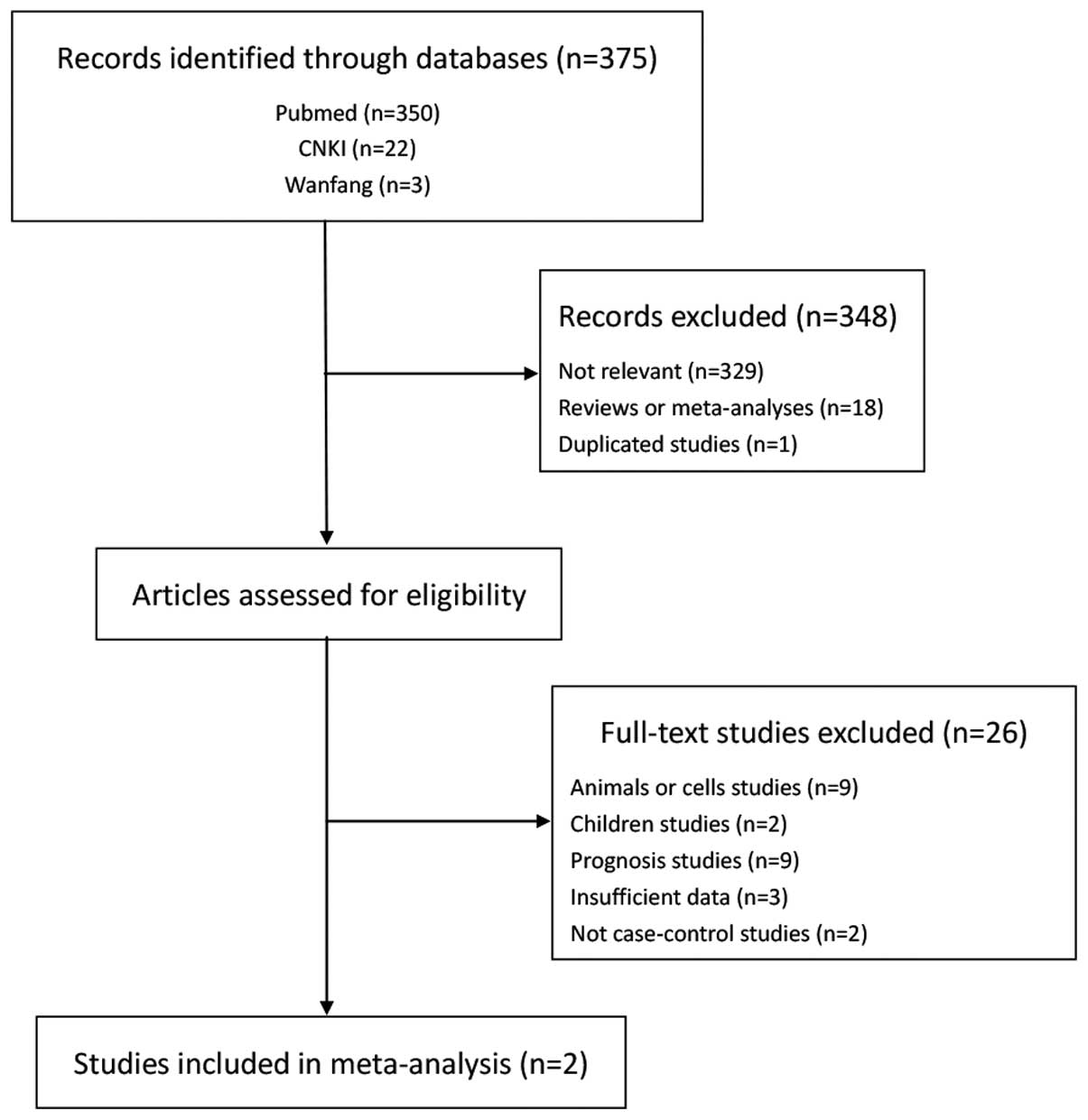
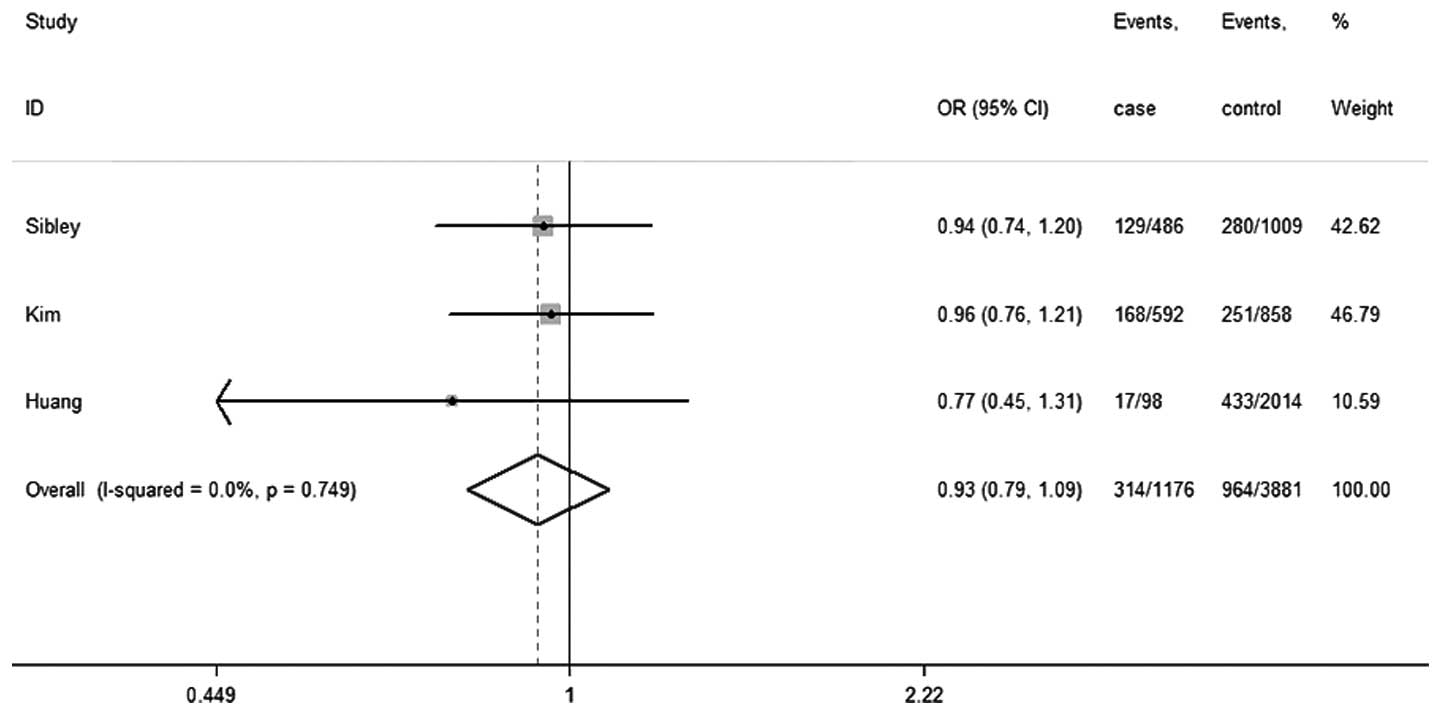
The association between the increased risk of acute myeloid leukemia (AML) and Fas promoter polymorphisms has been reported previously; however, the results are inconclusive. The present study performed one case‑control study to investigate the association, and a total of 98 AML patients and 2,014 healthy controls were genotyped. The data showed that the distribution of Fas‑670AA, GA and GG genotypes among the AML patients were not significantly different from those of the healthy controls, all P>0.05. Following this a sub‑study was conducted to analyze individuals who neither smoked nor drank. The results demonstrated that there was still no significant association between the Fas‑670 polymorphism and risk of AML development, all P>0.05. Furthermore, in order to address a more accurate estimation of the association, a meta‑analysis was conducted. Data were systematically collected from the Pubmed, EMBASE and the Wanfang Library. A total of 3 studies were included in this meta‑analysis, which contained 1,144 AML cases and 3,806 controls. No significant association was detected between the Fas‑670A>G polymorphism and AML risk [GA+GG vs. AA: odds ratio (OR) 0.93; 95% confidence interval (CI), 0.79‑1.09; GG vs. AA: OR, 1.01; 95% CI, 0.82‑1.24; GA vs. AA: OR, 1.12; 95% CI, 0.94‑1.32; GG vs. AA+GA: OR, 0.94; 95% CI, 0.79‑1.12; G vs. A: OR, 1.01; 95% CI, 0.91‑1.12; all P>0.05). The analysis clearly indicated that there was no significant connection between the Fas‑670A>G polymorphism and the increased risk of AML.
View Figures

Figure 1

Figure 2

View References

1 

Nagata S: Apoptosis regulated by a death factor and its receptor: Fas ligand and Fas. Philos Trans R Soc Lond B Biol Sci. 345:281–287. 1994. View Article : Google Scholar : PubMed/NCBI

2 

Nagata S: Apoptosis by death factor. Cell. 88:355–365. 1997. View Article : Google Scholar : PubMed/NCBI

3 

Itoh N, Yonehara S, Ishii A, Yonehara M, Mizushima S, Sameshima M, Hase A, Seto Y and Nagata S: The polypeptide encoded by the cDNA for human cell surface antigen Fas can mediate apoptosis. Cell. 66:233–243. 1991. View Article : Google Scholar : PubMed/NCBI

4 

Zornig M, Hueber A, Baum W and Evan G: Apoptosis regulators and their role in tumorigenesis. Biochim Biophys Acta. 1551:F1–F37. 2001.PubMed/NCBI

5 

Li Y, Hao YL, Kang S, Zhou RM, Wang N and Qi BL: Genetic polymorphisms in the Fas and FasL genes are associated with epithelial ovarian cancer risk and clinical outcomes. Gynecol Oncol. 128:584–589. 2013. View Article : Google Scholar : PubMed/NCBI

6 

Wang W, Zheng Z, Yu W, Lin H, Cui B and Cao F: Polymorphisms of the FAS and FASL genes and risk of breast cancer. Oncol Lett. 3:625–628. 2012.PubMed/NCBI

7 

Han W, Zhou Y, Zhong R, Wu C, Song R, Liu L, Zou L, Qiao Y, Zhai K, Chang J, et al: Functional polymorphisms in FAS/FASL system increase the risk of neuroblastoma in Chinese population. PloS One. 8:e716562013. View Article : Google Scholar : PubMed/NCBI

8 

Westendorf JJ, Lammert JM and Jelinek DF: Expression and function of Fas (APO-1/CD95) in patient myeloma cells and myeloma cell lines. Blood. 85:3566–3576. 1995.PubMed/NCBI

9 

Shima Y, Nishimoto N, Ogata A, Fujii Y, Yoshizaki K and Kishimoto T: Myeloma cells express Fas antigen/APO-1 (CD95) but only some are sensitive to anti-Fas antibody resulting in apoptosis. Blood. 85:757–764. 1995.PubMed/NCBI

10 

Gutierrez MI, Cherney B, Hussain A, Mostowski H, Tosato G, Magrath I and Bhatia K: Bax is frequently compromised in Burkitt's lymphomas with irreversible resistance to Fas-induced apoptosis. Cancer Res. 59:696–703. 1999.PubMed/NCBI

11 

Pordzik S, Petrovici K, Schmid C, Kroell T, Schweiger C, Köhne CH and Schmetzer H: Expression and prognostic value of FAS receptor/FAS ligand and TrailR1/TrailR2 in acute myeloid leukemia. Hematology. 16:341–350. 2011. View Article : Google Scholar : PubMed/NCBI

12 

Chongli Y and Xiaobo Z: Anemia CESGoLaA: Incidence Survey of Leukemia in China in 1986. Chinese Journal of Hematology. 10:618–621. 1986.

13 

Kasim K, Levallois P, Abdous B, Auger P and Johnson KC: Lifestyle factors and the risk of adult leukemia in Canada. Cancer Causes Control. 16:489–500. 2005. View Article : Google Scholar : PubMed/NCBI

14 

Wong O, Harris F, Yiying W and Hua F: A hospital-based case-control study of acute myeloid leukemia in Shanghai: Analysis of personal characteristics, lifestyle and environmental risk factors by subtypes of the WHO classification. Regul Toxicol Pharmacol. 55:340–352. 2009. View Article : Google Scholar : PubMed/NCBI

15 

Filippini T, Heck JE, Malagoli C, Del Giovane C and Vinceti M: A review and meta-analysis of outdoor air pollution and risk of childhood leukemia. J Environ Sci Health C Environ Carcinog Ecotoxicol Rev. 33:36–66. 2015. View Article : Google Scholar : PubMed/NCBI

16 

Min YJ, Lee JH, Choi SJ, Chi HS, Lee JS, Kim WK and Lee KH: Prognostic significance of Fas (CD95) and TRAIL receptors (DR4/DR5) expression in acute myelogenous leukemia. Leuk Res. 28:359–365. 2004. View Article : Google Scholar : PubMed/NCBI

17 

Iijima N, Miyamura K, Itou T, Tanimoto M, Sobue R and Saito H: Functional expression of Fas (CD95) in acute myeloid leukemia cells in the context of CD34 and CD38 expression: Possible correlation with sensitivity to chemotherapy. Blood. 90:4901–4909. 1997.PubMed/NCBI

18 

Komada Y, Zhou YW, Zhang XL, Xue HL, Sakai H, Tanaka S, Sakatoku H and Sakurai M: Fas receptor (CD95)-mediated apoptosis is induced in leukemic cells entering G1B compartment of the cell cycle. Blood. 86:3848–3860. 1995.PubMed/NCBI

19 

Nunobiki O, Ueda M, Toji E, Yamamoto M, Akashi K, Sato N, Izuma S, Torii K, Tanaka I, Okamoto Y and Noda S: Genetic polymorphism of cancer susceptibility genes and HPV infection in cervical carcinogenesis. Patholog Res Int. 2011:3640692011.PubMed/NCBI

20 

Huang QR, Morris D and Manolios N: Identification and characterization of polymorphisms in the promoter region of the human Apo-1/Fas (CD95) gene. Mol Immunol. 34:577–582. 1997. View Article : Google Scholar : PubMed/NCBI

21 

Sibley K, Rollinson S, Allan JM, Smith AG, Law GR, Roddam PL, Skibola CF, Smith MT and Morgan GJ: Functional FAS promoter polymorphisms are associated with increased risk of acute myeloid leukemia. Cancer Res. 63:4327–4330. 2003.PubMed/NCBI

22 

Sun T, Zhou Y, Li H, Han X, Shi Y, Wang L, Miao X, Tan W, Zhao D, Zhang X, et al: FASL-844C polymorphism is associated with increased activation-induced T cell death and risk of cervical cancer. J Exp Med. 202:967–974. 2005. View Article : Google Scholar : PubMed/NCBI

23 

Kordi Tamandani DM, Sobti RC and Shekari M: Association of Fas-670 gene polymorphism with risk of cervical cancer in North Indian population. Clin Exp Obstet Gynecol. 35:183–186. 2008.PubMed/NCBI

24 

Kim HJ, Jin XM, Kim HN, Lee IK, Park KS, Park MR, Jo DY, Won JH, Kwak JY, Kim HJ, et al: Fas and FasL polymorphisms are not associated with acute myeloid leukemia risk in Koreans. DNA Cell Biol. 29:619–624. 2010. View Article : Google Scholar : PubMed/NCBI

25 

Lai HC, Lin WY, Lin YW, Chang CC, Yu MH, Chen CC and Chu TY: Genetic polymorphisms of FAS and FASL (CD95/CD95L) genes in cervical carcinogenesis: An analysis of haplotype and gene-gene interaction. Gynecol Oncol. 99:113–118. 2005. View Article : Google Scholar : PubMed/NCBI

26 

Park SH, Choi JE, Kim EJ, Jang JS, Lee WK, Cha SI, Kim CH, Kam S, Kim DS, Park RW, et al: Polymorphisms in the FAS and FASL genes and risk of lung cancer in a Korean population. Lung Cancer. 54:303–308. 2006. View Article : Google Scholar : PubMed/NCBI

27 

Tan A, Gao Y, Yang X, Zhang H, Qin X, Mo L, Peng T, Xia N and Mo Z: Low serum osteocalcin level is a potential marker for metabolic syndrome: Results from a Chinese male population survey. Metabolism. 60:1186–1192. 2011. View Article : Google Scholar : PubMed/NCBI

28 

Yang X, Sun J, Gao Y, Tan A, Zhang H, Hu Y, Feng J, Qin X, Tao S, Chen Z, et al: Genome-wide association study for serum complement C3 and C4 levels in healthy Chinese subjects. PLoS Genet. 8:e10029162012. View Article : Google Scholar : PubMed/NCBI

29 

Tian J, Pan F, Li J, Ma Y, Cen H, Pan HF, Pan YY and Ye DQ: Association between the FAS/FASL polymorphisms and gastric cancer risk: A meta-analysis. Asian Pac J Cancer Prev. 13:945–951. 2012. View Article : Google Scholar : PubMed/NCBI

30 

Higgins JP, Thompson SG, Deeks JJ and Altman DG: Measuring inconsistency in meta-analyses. BMJ. 327:557–560. 2003. View Article : Google Scholar : PubMed/NCBI

31 

William GC: The combination of estimates from different experiments. Biometrics. 10:101–129. 1954. View Article : Google Scholar

32 

DerSimonian R and Laird N: Meta-analysis in clinical trials. Control Clin Trials. 7:177–188. 1986. View Article : Google Scholar : PubMed/NCBI

33 

Mantel N and Haenszel W: Statistical aspects of the analysis of data from retrospective studies of disease. J Natl Cancer Inst. 22:719–748. 1959.PubMed/NCBI

34 

Begg CB and Mazumdar M: Operating characteristics of a rank correlation test for publication bias. Biometrics. 50:1088–1101. 1994. View Article : Google Scholar : PubMed/NCBI

35 

Behrmann I, Walczak H and Krammer PH: Structure of the human APO-1 gene. Eur J Immunol. 24:3057–3062. 1994. View Article : Google Scholar : PubMed/NCBI

36 

Wang J, Gao J, Li Y, Zhao X, Gao W, Peng L, Yan D, Liu L, Li D, Wei L, et al: Functional polymorphisms in FAS and FASL contribute to risk of squamous cell carcinoma of the larynx and hypopharynx in a Chinese population. Gene. 524:193–196. 2013. View Article : Google Scholar : PubMed/NCBI

37 

Xu Y, He B, Li R, Pan Y, Gao T, Deng Q, Sun H, Song G and Wang S: Association of the polymorphisms in the Fas/FasL promoter regions with cancer susceptibility: A systematic review and meta-analysis of 52 studies. PloS One. 9:e900902014. View Article : Google Scholar : PubMed/NCBI

38 

Chen Y, He Y, Lu X, Zeng Z, Tang C, Xue T and Li Y: Association between Fas/FasL polymorphism and susceptibility to leukemia: A meta-analysis. Int J Clin Exp Med. 8:3817–3824. 2015.PubMed/NCBI

39 

Gianni M, Terao M, Fortino I, LiCalzi M, Viggiano V, Barbui T, Rambaldi A and Garattini E: Stat1 is induced and activated by all-trans retinoic acid in acute promyelocytic leukemia cells. Blood. 89:1001–1012. 1997.PubMed/NCBI

40 

Battle TE and Frank DA: STAT1 mediates differentiation of chronic lymphocytic leukemia cells in response to Bryostatin 1. Blood. 102:3016–3024. 2003. View Article : Google Scholar : PubMed/NCBI

41 

Kanemitsu S, Ihara K, Saifddin A, Otsuka T, Takeuchi T, Nagayama J, Kuwano M and Hara T: A functional polymorphism in fas (CD95/APO-1) gene promoter associated with systemic lupus erythematosus. J Rheumatol. 29:1183–1188. 2002.PubMed/NCBI

42 

Farre L, Bittencourt AL, Silva-Santos G, Almeida A, Silva AC, Decanine D, Soares GM, Alcantara LC Jr, Van Dooren S, Galvão-Castro B, et al: Fas 670 promoter polymorphism is associated to susceptibility, clinical presentation and survival in adult T cell leukemia. J Leukoc Biol. 83:220–222. 2008. View Article : Google Scholar : PubMed/NCBI

43 

Fang Y, Zhong L, Lin M, Zhou X, Jing H, Ying M, Luo P, Yang B and He Q: MEK/ERK dependent activation of STAT1 mediates dasatinib-induced differentiation of acute myeloid leukemia. PloS One. 8:e669152013. View Article : Google Scholar : PubMed/NCBI

44 

Wu J, Wilson J, He J, Xiang L, Schur PH and Mountz JD: Fas ligand mutation in a patient with systemic lupus erythematosus and lymphoproliferative disease. J Clin Invest. 98:1107–1113. 1996. View Article : Google Scholar : PubMed/NCBI

45 

Wang J, Zheng L, Lobito A, Chan FK, Dale J, Sneller M, Yao X, Puck JM, Straus SE and Lenardo MJ: Inherited human caspase 10 mutations underlie defective lymphocyte and dendritic cell apoptosis in autoimmune lymphoproliferative syndrome type II. Cell. 98:47–58. 1999. View Article : Google Scholar : PubMed/NCBI

46 

Chun HJ, Zheng L, Ahmad M, Wang J, Speirs CK, Siegel RM, Dale JK, Puck J, Davis J, Hall CG, et al: Pleiotropic defects in lymphocyte activation caused by caspase-8 mutations lead to human immunodeficiency. Nature. 419:395–399. 2002. View Article : Google Scholar : PubMed/NCBI

47 

Kennedy NJ, Kataoka T, Tschopp J and Budd RC: Caspase activation is required for T cell proliferation. J Exp Med. 190:1891–1896. 1999. View Article : Google Scholar : PubMed/NCBI

48 

Alam A, Cohen LY, Aouad S and Sékaly RP: Early activation of caspases during T lymphocyte stimulation results in selective substrate cleavage in nonapoptotic cells. J Exp Med. 190:1879–1890. 1999. View Article : Google Scholar : PubMed/NCBI

49 

Su H, Bidère N, Zheng L, Cubre A, Sakai K, Dale J, Salmena L, Hakem R, Straus S and Lenardo M: Requirement for caspase-8 in NF-kappaB activation by antigen receptor. Science. 307:1465–1468. 2005. View Article : Google Scholar : PubMed/NCBI

50 

Newton K, Harris AW, Bath ML, Smith KG and Strasser A: A dominant interfering mutant of FADD/MORT1 enhances deletion of autoreactive thymocytes and inhibits proliferation of mature T lymphocytes. EMBO J. 17:706–718. 1998. View Article : Google Scholar : PubMed/NCBI

51 

Rouvier E, Luciani MF and Golstein P: Fas involvement in Ca(2+)-independent T cell-mediated cytotoxicity. J Exp Med. 177:195–200. 1993. View Article : Google Scholar : PubMed/NCBI

52 

Suda T and Nagata S: Purification and characterization of the Fas-ligand that induces apoptosis. J Exp Med. 179:873–879. 1994. View Article : Google Scholar : PubMed/NCBI

53 

Kagi D, Vignaux F, Ledermann B, Bürki K, Depraetere V, Nagata S, Hengartner H and Golstein P: Fas and perforin pathways as major mechanisms of T cell-mediated cytotoxicity. Science. 265:528–530. 1994. View Article : Google Scholar : PubMed/NCBI

54 

Szczepanski MJ, Szajnik M, Czystowska M, Mandapathil M, Strauss L, Welsh A, Foon KA, Whiteside TL and Boyiadzis M: Increased frequency and suppression by regulatory T cells in patients with acute myelogenous leukemia. Clin Cancer Res. 15:3325–3332. 2009. View Article : Google Scholar : PubMed/NCBI

55 

Ustun C, Miller JS, Munn DH, Weisdorf DJ and Blazar BR: Regulatory T cells in acute myelogenous leukemia: Is it time for immunomodulation? Blood. 118:5084–5095. 2011. View Article : Google Scholar : PubMed/NCBI

56 

Yang W and Xu Y: Clinical significance of Treg cell frequency in acute myeloid leukemia. Int J Hematol. 98:558–562. 2013. View Article : Google Scholar : PubMed/NCBI

57 

Zhou Q, Munger ME, Highfill SL, Tolar J, Weigel BJ, Riddle M, Sharpe AH, Vallera DA, Azuma M, Levine BL, et al: Program death-1 signaling and regulatory T cells collaborate to resist the function of adoptively transferred cytotoxic T lymphocytes in advanced acute myeloid leukemia. Blood. 116:2484–2493. 2010. View Article : Google Scholar : PubMed/NCBI

58 

Look DC, Pelletier MR, Tidwell RM, Roswit WT and Holtzman MJ: Stat1 depends on transcriptional synergy with Sp1. J Biol Chem. 270:30264–30267. 1995. View Article : Google Scholar : PubMed/NCBI

Related Articles

  • Abstract
  • View
  • Download
  • Twitter
Copy and paste a formatted citation
Spandidos Publications style
Huang Y, Deng D, Li H, Xiao Q, Huang L, Zhang B, Ye F, Ye B, Mo Z, Yang X, Yang X, et al: Fas‑670A>G polymorphism is not associated with an increased risk of acute myeloid leukemia development. Biomed Rep 4: 153-160, 2016.
APA
Huang, Y., Deng, D., Li, H., Xiao, Q., Huang, L., Zhang, B. ... Liu, Z. (2016). Fas‑670A>G polymorphism is not associated with an increased risk of acute myeloid leukemia development. Biomedical Reports, 4, 153-160. https://doi.org/10.3892/br.2015.564
MLA
Huang, Y., Deng, D., Li, H., Xiao, Q., Huang, L., Zhang, B., Ye, F., Ye, B., Mo, Z., Yang, X., Liu, Z."Fas‑670A>G polymorphism is not associated with an increased risk of acute myeloid leukemia development". Biomedical Reports 4.2 (2016): 153-160.
Chicago
Huang, Y., Deng, D., Li, H., Xiao, Q., Huang, L., Zhang, B., Ye, F., Ye, B., Mo, Z., Yang, X., Liu, Z."Fas‑670A>G polymorphism is not associated with an increased risk of acute myeloid leukemia development". Biomedical Reports 4, no. 2 (2016): 153-160. https://doi.org/10.3892/br.2015.564
Copy and paste a formatted citation
x
Spandidos Publications style
Huang Y, Deng D, Li H, Xiao Q, Huang L, Zhang B, Ye F, Ye B, Mo Z, Yang X, Yang X, et al: Fas‑670A>G polymorphism is not associated with an increased risk of acute myeloid leukemia development. Biomed Rep 4: 153-160, 2016.
APA
Huang, Y., Deng, D., Li, H., Xiao, Q., Huang, L., Zhang, B. ... Liu, Z. (2016). Fas‑670A>G polymorphism is not associated with an increased risk of acute myeloid leukemia development. Biomedical Reports, 4, 153-160. https://doi.org/10.3892/br.2015.564
MLA
Huang, Y., Deng, D., Li, H., Xiao, Q., Huang, L., Zhang, B., Ye, F., Ye, B., Mo, Z., Yang, X., Liu, Z."Fas‑670A>G polymorphism is not associated with an increased risk of acute myeloid leukemia development". Biomedical Reports 4.2 (2016): 153-160.
Chicago
Huang, Y., Deng, D., Li, H., Xiao, Q., Huang, L., Zhang, B., Ye, F., Ye, B., Mo, Z., Yang, X., Liu, Z."Fas‑670A>G polymorphism is not associated with an increased risk of acute myeloid leukemia development". Biomedical Reports 4, no. 2 (2016): 153-160. https://doi.org/10.3892/br.2015.564
Follow us
  • Twitter
  • LinkedIn
  • Facebook
About
  • Spandidos Publications
  • Careers
  • Cookie Policy
  • Privacy Policy
How can we help?
  • Help
  • Live Chat
  • Contact
  • Email to our Support Team