Introduction
The combined test [maternal serum markers, including
α-fetoprotein (AFP), free-β-human chorionic gonadotropin
(free-β-hCG) and unconjugated estriol (uE3) or inhibin
A, combined with gestational age and maternal weight or age] for
Down's syndrome (DS) is now well established for singleton pregnant
women (1). Although serum markers for
triple DS screening are also available in twin pregnancies, the
screening of the DS risk in twin pregnancies is according to the
singleton pregnant woman database. Therefore, the screening of the
DS risk in twins has a higher false-positive rate (2,3).
There is a significant difference in the biochemical
marker distribution between twin and singleton pregnancies.
Therefore, the present study aimed to compare the serum markers
levels (including AFP, free-β-hCG and uE3) in normal
twin and singleton pregnancies during the second trimester in
Chinese patients. The distribution of the serum markers and
possible differences between singleton and twin pregnancies were
investigated to provide more available information for triple
screening in twin pregnancies. The aim of the present study is to
provide information to establish the maternal serum screening tests
specific for twin pregnancies in a Chinese population based on the
local twin pregnant women database.
Materials and methods
Pregnant women
The study was conducted in the Fourth People's
Hospital of Wuxi (The Affiliated Hospital of Jiangnan University,
Wuxi, Jiangsu, China), between June 2008 and November 2013. In
total, 33,394 pregnant women from the Wuxi region checked into the
hospital in gestational weeks 15–20 and were enrolled in the study.
A total of 36 cases were proved to have chromosome abnormalities,
of which there were 27 cases of 21-trisomy syndrome, 5 cases of
neural tube defect (NTD) and 4 cases of trisomy 18 (Edwards
syndrome) excluded. There were 166 women with normal twin
pregnancies and 33,192 women with normal singleton pregnancies,
which were recorded as spontaneous pregnancies and received care in
the antenatal clinics. The estimated gestational ages were
determined by ultrasonic B-mode measurement of the fetal crown-rump
length. In the twin pregnancies, the longest axis of the fetus was
used to estimate the gestational age of the pregnancy. In addition,
the fetal number was confirmed by ultrasound and validated
following delivery. The study protocol was approved by the Ethics
Committee of the Fourth People's Hospital of Wuxi, and all the
women provided informed consent.
Sampling and analysis
Peripheral venous blood (2 ml) was obtained from
each pregnant woman and drawn into blood collection tubes
containing coagulant. All the serum samples were separated by
centrifugation for 10 min at 1,000 × g. Blood to be used for
assessment of the serum markers levels was analyzed at the Medical
Examination Center of the Fourth People's Hospital and measured
immediately. AFP, free-β-HCG and uE3 were measured using
a magnetic microparticle chemiluminescence immunoassay (Unicel
DXI800; Beckman Coulter, Brea, CA, USA). The inter- and intra-assay
precision were all <3.0% for AFP, free-β-hCG and uE3.
Shanghai Tianchen Computer Software Co., Ltd. (TCSoft, Shanghai,
China) was used for prenatal screening for DS. Serum markers levels
were compared between the twin and singleton pregnancies using the
gestational age-specific model.
Statistical analysis
Statistical evaluation was performed using the SPSS
software version 17.0 (SPSS, Inc., Chicago, IL, USA). Serum marker
levels are shown as the median. The Mann-Whitney test was used to
compare the levels of serum AFP or free-β-HCG or uE3 in
twin and singleton pregnancies at different gestational ages. The
correlations between the levels of maternal serum AFP or free-β-hCG
or uE3 and maternal weight were evaluated using
regressive analysis. P<0.05 was considered to indicate a
statistically significant difference.
Results
Pregnant women characteristics
Pregnant women were followed up for 6 months after
childbirth. No childbirth with DS was identified except for one
abnormal twin pregnancy with fetus trisomy 18 and 35 singleton
pregnancies including 27 cases of trisomy 21, 4 cases of trisomy 18
and 5 cases of NTD. DS cases were excluded. The mean age of 166
pregnant women with twin pregnancy was 27.2 years old (range, 20–40
years), significantly higher than that of the 33,192 singleton
controls (26.4 years, range 19–40 years) (P<0.05) (Table I). The mean weight of the twin
pregnancy women was 58.8 kg, significantly higher than that of the
singleton pregnancy (56.6 kg, P<0.05) (Table I).
 | Table I.Distributions of maternal age and
maternal weight. |
Table I.
Distributions of maternal age and
maternal weight.
|
| Singleton
pregnancy | Twin pregnancy |
|---|
|
|
|
|
|---|
| Gestational ages
weeks | Cases, n | Median age,
years | Median weight,
kg | Cases, n | Median age,
years | Median weight,
kg |
|---|
| 15 |
2,475 | 25.5 | 54.9 | 12 | 24.8 | 58.8 |
| 16 |
4,932 | 26.4 | 56.0 | 21 | 26.8 | 53.9 |
| 17 | 10,237 | 26.5 | 56.3 | 41 | 27.1 | 59.6 |
| 18 |
6,380 | 26.5 | 56.7 | 32 | 27.0 | 60.3 |
| 19 |
5,398 | 26.6 | 58.1 | 31 | 27.0 | 59.9 |
| 20 |
2,919 | 26.5 | 57.3 | 25 | 30.0 | 58.2 |
| Total | 33,192 | 26.4 | 56.6 | 166 | 27.2 | 58.8 |
Serum levels of AFP, free-β-hCG and
uE3 in the second trimester maternal serum
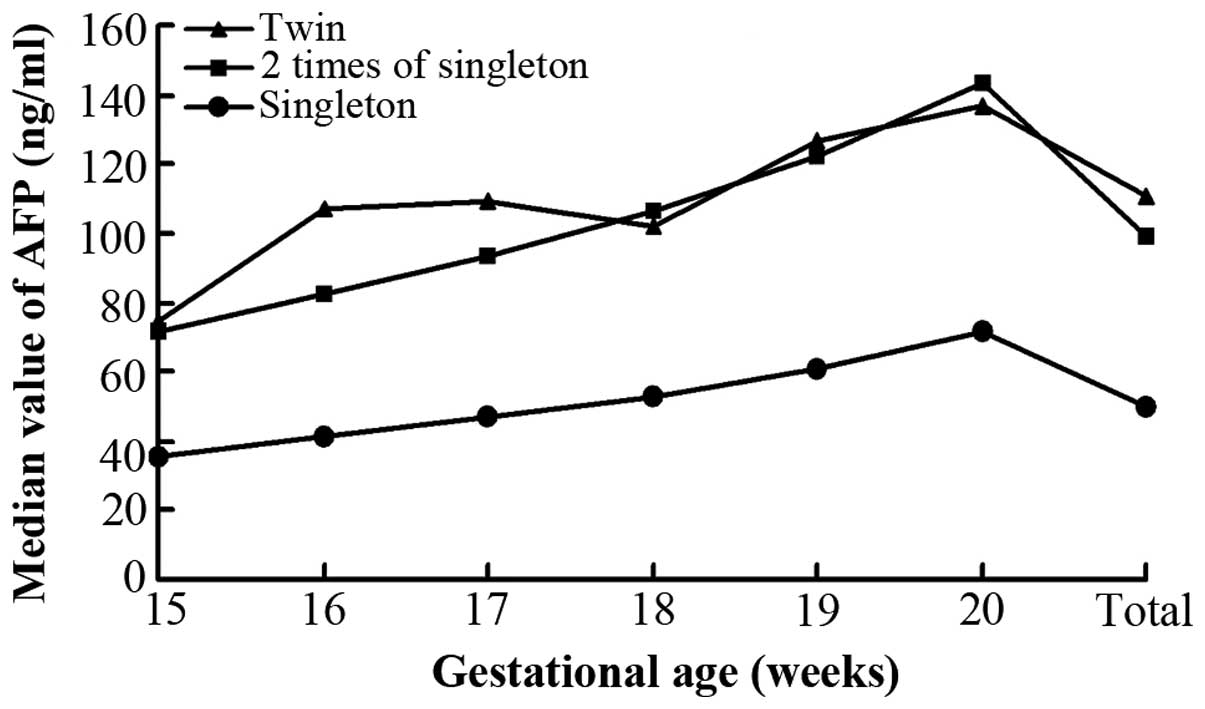
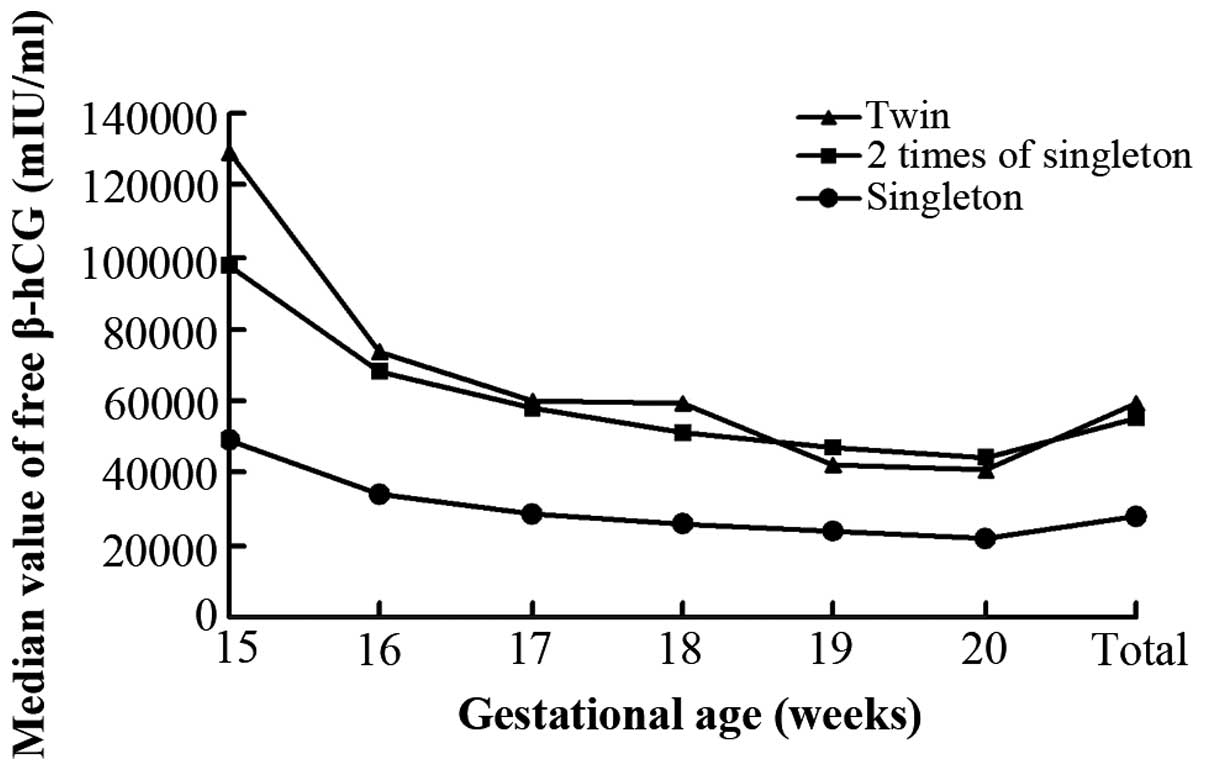
Table II shows the
median of the maternal serum markers levels. Compared with the
normal singleton pregnancies, the medians of the
gestational-specific maternal serum marker levels were higher in
the twin pregnancies at 15–20 weeks of gestation (P<0.05 for
all) (Table II). There were similar
fluctuations of serum AFP, free-β-hCG and uE3 in the
twins and singletons during normal pregnancy. From 15–20
gestational weeks, the concentrations of maternal serum AFP and
uE3 increased, except for the AFP levels at 18
gestational weeks, which were 102.4 ng/ml in the twin pregnancies
and <108.3 ng/ml at 17 weeks, whereas free-β-hCG levels were
reduced in the singleton and twin pregnancies. The levels of
gestational age-specific maternal serum AFP and β-hCG in twins were
almost 2-fold compared to those in the singleton pregnancies,
except for at 16, 17 and total gestational weeks for AFP and 15 and
18 gestational weeks for free-β-hCG (Figs.
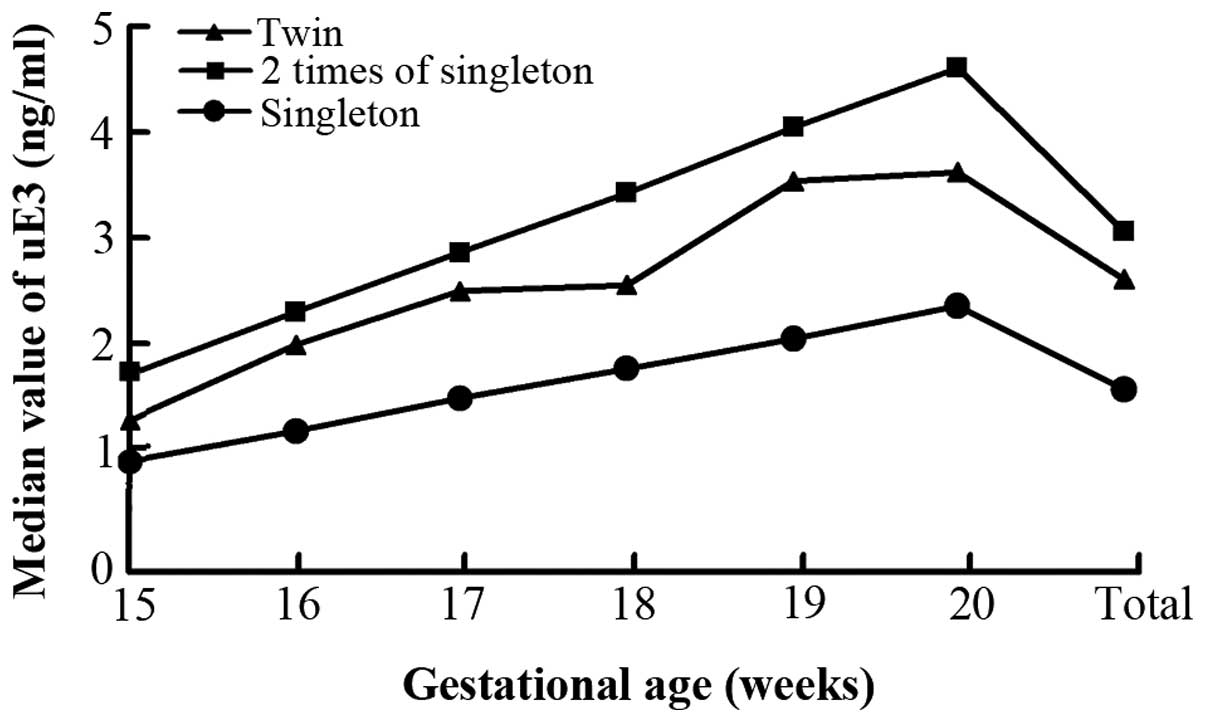
1 and 2). However, uE3
was not 2-fold higher than those in the singleton pregnancies
(Fig. 3).
| Table II.Gestational age-specific medians of
AFP, free-β-hCG and uE3. |
Table II.
Gestational age-specific medians of
AFP, free-β-hCG and uE3.
|
| AFP, ng/ml | Free-β-hCG,
mIU/ml | uE3,
ng/ml | Cases, n |
|---|
| Gestational ages
weeks | Twin | Singleton | Twin | Singleton | Twin | Singleton | Twin | Singleton |
|---|
| 15 | 74.4 | 35.7 | 129,281 | 48,979 | 1.28 | 0.86 | 12 | 2,475 |
| 16 | 107.4 | 41.1 | 74,046 | 34,292 | 2.03 | 1.17 | 21 | 4,932 |
| 17 | 109.3 | 46.8 | 60,164 | 28,938 | 2.55 | 1.47 | 41 | 10,237 |
| 18 | 102.4 | 53.1 | 59,711 | 25,758 | 2.62 | 1.78 | 32 | 6,380 |
| 19 | 126.8 | 61.1 | 42,202 | 23,589 | 3.65 | 2.10 | 31 | 5,398 |
| 20 | 136.8 | 71.6 | 41,172 | 22,119 | 3.76 | 2.40 | 25 | 2,919 |
| Total | 110.7 | 49.7 | 59,218 | 27,695 | 2.67 | 1.58 | 166 | 33,192 |
Correlation between the levels of
markers and weight or age in second trimester maternal
The level of maternal serum markers in the singleton
pregnancies showed a positive correlation with the maternal weights
for AFP and uE3, and a negative correlation for
free-β-hCG, except in 20 weeks of gestation. However, in the twin
pregnancies, the maternal serum marker levels were not correlated
with weight, except for AFP in 16 and 17 weeks, free-β-hCG in 18–19
weeks and uE3 in 16–18 weeks. In addition, there were no
significant correlations between the levels of markers and age
throughout the second trimester. According to a previous study, the
risk of gestational diabetes mellitus may be similar between
pregnant women with singleton and twin pregnancies, thus the data
of diabetes was not assessed in the present analysis (4).
Discussion
Currently, the basic premise for clinical management
of DS in pregnancy is an accurate laboratory measurement of
maternal serum markers. Due to different serum marker levels and
body parameters between twins and singleton pregnant women,
establishing an age-specific mid-trimester normal median of the
serum markers according to local region in a twin pregnant women
database for DS screening in twin pregnancies is required.
Recently, several studies have already investigated
the maternal serum AFP and free-β-hCG levels in normal twin and
singleton pregnancies. However, the majority of the studies were
based on the singleton gestational age-specific model for DS
screening. The association of maternal serum markers between normal
twin and singleton pregnancies remains controversial (3,5). The aim of
the present study was to evaluate the distributions of AFP,
free-β-hCG and uE3 during the second trimester of
gestation and investigate whether these markers in normal twins
were 2-fold those in singletons and whether the singleton
gestational age-specific model for DS screening was feasible for
twin pregnancies.
Huang et al (6)
reported that maternal serum screening for DS in twin pregnancies
was feasible based on the software designed for singletons
(7,8).
However, there was a lower sensitivity of screening in twins
compared to singletons. Partially, there was a high false-positive
rate in DS screening for twin pregnancies (9). Therefore, there is an increasing
awareness of the importance of establishing a feasible evaluation
standard for utilizing these markers in DS screening for twin
pregnancy. Due to the high false-positive rate in DS screening for
twin pregnancies, a number of normal twin pregnant women could
undergo amniocentesis for gene diagnosis.
In the present study, the median of the
gestational-specific maternal serum marker levels in the singleton
pregnancies were significantly lower compared to those in the twin
pregnancies at each week from 15–20 gestational weeks (P<0.05
for all) (Table II). From 15–20
gestational weeks, the concentrations of maternal serum AFP and
uE3 were increased, except for the AFP levels in twin
pregnancies were 102.4 ng/ml at 18 gestational weeks, and <108.3
ng/ml at 17 weeks, whereas free-β-hCG declined in the twin and
singleton pregnancies. The ratios of AFP levels in twins to those
in singletons were from 1.91 to 2.61, the ratios of free-β-hCG
levels were from 1.79 to 2.64, and uE3 levels were from
1.47 to 1.74 during 15–20 weeks of gestation. Xie et al
(2) also reported a similar
conclusion. Notably, there were significant differences of 2-fold
in several gestational weeks between the values of maternal markers
in twin pregnancies to those in singleton pregnancies. These
findings suggest that the current maternal serum-screening
programs, which are based on the data collected from singleton
pregnancies, appear to not be acceptable for DS screening in twin
pregnancies. Therefore, it is necessary to establish a maternal
serum screening program for Chinese twin pregnancies based on the
local twin pregnant woman database.
A multiple of the median (MoM) is a measure of how
far an individual study result deviates from the median. In theory,
all MoMs of maternal serum AFP, free-β-hCG and uE3 in
normal singleton pregnancies were ~1 and 2 MoMs in normal twin
pregnancies (10,11). The present data also showed a similar
conclusion. However, a bias of the markers during 15–20 gestational
weeks in twin pregnancies was observed. The screening of the DS
risk in twin pregnancies based on the software designed for
singletons may be one of the reasons. Similarly, if screening for
DS in twin pregnancies based on the software designed for twins,
the medians of maternal serum AFP, free-β-hCG and uE3 in
normal twin pregnancies should be close to 1 MoM and normal
distribution. In this way, it will provide an effective screening
method for the DS risk in twin pregnancies.
It is well known that numerous maternal factors,
such as weight and age, significantly influence the result of DS
screening (12,13). A woman who is older at the time of
delivery has a higher risk of having a child with DS. In the
present study, the mean age of the twin pregnancy women was
significantly higher than that of the singleton controls. A number
of maternal and fetal factors significantly influence the weight.
This is likely to be as a result of the more complicated changes of
the amniotic fluid and fetus weight in twin pregnancies compared to
those in singleton pregnancies (14,15).
However, there were no associations between the maternal weights
and maternal serum markers in twin pregnancies in the majority of
gestational weeks according to the present data. This may be due to
the smaller number of cases for the twin data.
In conclusion, the median levels of maternal serum
AFP, free-β-hCG and uE3 were higher in the twin
pregnancies compared to those in the singleton pregnancies in
gestation weeks 15–20. The median levels of the maternal serum AFP,
free-β-hCG and uE3 in normal twins were not all twice as
high as those in singletons. In such circumstances, DS screening in
the second trimester for twin pregnancies based on the software
designed for singletons may lead to a higher false-negative or
false-positive in the risk estimation. It may be advisable to
establish a twin gestational age-specific model for DS screening
according to a local Chinese twin pregnant women database for DS
screening in twin pregnancies.
Acknowledgements
The present study was partially supported by grants
from the Medical Science Foundation of Wuxi, Jiangsu province (nos.
YGZXZ1521 and YGZXH1402).
References
|
1
|
Prats P, Rodríguez I, Nicolau J and Comas
C: Early first-trimester free-β-hCG and PAPP-A serum distributions
in monochorionic and dichorionic twins. Prenat Diagn. 32:64–69.
2012. View
Article : Google Scholar : PubMed/NCBI
|
|
2
|
Xie Z, Lu S, Zhu Y, Sun Y and Jin Y:
Second-trimester maternal serum free-beta-human chorionic
gonadotropin and alpha-fetoprotein levels in normal twin and
singleton pregnancies: A report of local Chinese population. Prenat
Diagn. 28:735–738. 2008. View
Article : Google Scholar : PubMed/NCBI
|
|
3
|
Zheng MM, Hu YL, Zhang CY, Ru T, Liu QL,
Xu BY, Chen QG, Xu ZF, Zhang Y and Zhong XL: Comparison of
second-trimester maternal serum free-beta-human chorionic
gonadotropin and alpha-fetoprotein between normal singleton and
twin pregnancies: A population-based study. Chin Med J (Engl).
123:555–558. 2010.PubMed/NCBI
|
|
4
|
Morikawa M, Yamada T, Akaishi R, Kojima T,
Nishida R, Koyama T, Cho K and Minakami H: Prevalence of
hyperglycaemia in singleton versus twin pregnancy. Diabetes Metab
Res Rev. 31:198–203. 2015. View Article : Google Scholar : PubMed/NCBI
|
|
5
|
Lambert-Messerlian G, Pinar H, Rubin LP,
De Paepe ME, Tantravahi U, Steinhoff MM, Russell M and Canick JA:
Second-trimester maternal serum markers in twin pregnancy with
complete mole: Report of 2 cases. Pediatr Dev Pathol. 8:230–234.
2005. View Article : Google Scholar : PubMed/NCBI
|
|
6
|
Huang T, Boucher K, Aul R, Rashid S and
Meschino WS: First and second trimester maternal serum markers in
pregnancies with a vanishing twin. Prenat Diagn. 35:90–96. 2015.
View Article : Google Scholar : PubMed/NCBI
|
|
7
|
Muller F, Dreux S, Dupoizat H, Uzan S,
Dubin MF, Oury JF, Dingeon B and Dommergues M: Second-trimester
Down syndrome maternal serum screening in twin pregnancies: Impact
of chorionicity. Prenat Diagn. 23:331–335. 2003. View Article : Google Scholar : PubMed/NCBI
|
|
8
|
Svirsky R, Levinsohn-Tavor O, Feldman N,
Klog E, Cuckle H and Maymon R: Early pregnancy maternal serum
markers of pre-eclampsia in twins. Ultrasound Obstet Gynecol. Apr
9–2015.(Epub ahead of print). doi: 10.1002/uog.14873. View Article : Google Scholar : PubMed/NCBI
|
|
9
|
Yan J, Ayer T, Keskinocak P and Caughey
AB: Preference-sensitive risk-cutoff values for prenatal-integrated
screening test for Down syndrome. Prenat Diagn. 35:645–651. 2015.
View Article : Google Scholar : PubMed/NCBI
|
|
10
|
Knight GJ: Quality assessment of a
prenatal screening program. Early Hum Dev. 47:S49–S53. 1996.
View Article : Google Scholar : PubMed/NCBI
|
|
11
|
Yuan W, Chen L and Bernal AL: Is elevated
maternal serum alpha-fetoprotein in the second trimester of
pregnancy associated with increased preterm birth risk? A
systematic review and meta-analysis. Eur J Obstet Gynecol Reprod
Biol. 145:57–64. 2009. View Article : Google Scholar : PubMed/NCBI
|
|
12
|
Boyle B, Morris JK, McConkey R, Garne E,
Loane M, Addor MC, Gatt M, Haeusler M, Latos-Bielenska A, Lelong N,
et al: Prevalence and risk of Down syndrome in monozygotic and
dizygotic multiple pregnancies in Europe: Implications for prenatal
screening. BJOG. 121:809–820. 2014. View Article : Google Scholar : PubMed/NCBI
|
|
13
|
Souka AP and Nicolaides KH: Diagnosis of
fetal abnormalities at the 10–14-week scan. Ultrasound Obstet
Gynecol. 10:429–442. 1997. View Article : Google Scholar : PubMed/NCBI
|
|
14
|
Barel O, Maymon R, Vaknin Z, Tovbin J and
Smorgick N: Sonographic fetal weight estimation - is there more to
it than just fetal measurements? Prenat Diagn. 34:50–55. 2014.
View Article : Google Scholar : PubMed/NCBI
|
|
15
|
Faschingbauer F, Dammer U, Raabe E,
Schneider M, Faschingbauer C, Schmid M, Mayr A, Schild RL, Beckmann
MW and Kehl S: Sonographic weight estimation in fetal macrosomia:
Influence of the time interval between estimation and delivery.
Arch Gynecol Obstet. 292:59–67. 2015. View Article : Google Scholar : PubMed/NCBI
|