Spandidos Publications Logo
  • About
    • About Spandidos
    • Aims and Scopes
    • Abstracting and Indexing
    • Editorial Policies
    • Reprints and Permissions
    • Job Opportunities
    • Terms and Conditions
    • Contact
  • Journals
    • All Journals
    • Oncology Letters
      • Oncology Letters
      • Information for Authors
      • Editorial Policies
      • Editorial Board
      • Aims and Scope
      • Abstracting and Indexing
      • Bibliographic Information
      • Archive
    • International Journal of Oncology
      • International Journal of Oncology
      • Information for Authors
      • Editorial Policies
      • Editorial Board
      • Aims and Scope
      • Abstracting and Indexing
      • Bibliographic Information
      • Archive
    • Molecular and Clinical Oncology
      • Molecular and Clinical Oncology
      • Information for Authors
      • Editorial Policies
      • Editorial Board
      • Aims and Scope
      • Abstracting and Indexing
      • Bibliographic Information
      • Archive
    • Experimental and Therapeutic Medicine
      • Experimental and Therapeutic Medicine
      • Information for Authors
      • Editorial Policies
      • Editorial Board
      • Aims and Scope
      • Abstracting and Indexing
      • Bibliographic Information
      • Archive
    • International Journal of Molecular Medicine
      • International Journal of Molecular Medicine
      • Information for Authors
      • Editorial Policies
      • Editorial Board
      • Aims and Scope
      • Abstracting and Indexing
      • Bibliographic Information
      • Archive
    • Biomedical Reports
      • Biomedical Reports
      • Information for Authors
      • Editorial Policies
      • Editorial Board
      • Aims and Scope
      • Abstracting and Indexing
      • Bibliographic Information
      • Archive
    • Oncology Reports
      • Oncology Reports
      • Information for Authors
      • Editorial Policies
      • Editorial Board
      • Aims and Scope
      • Abstracting and Indexing
      • Bibliographic Information
      • Archive
    • Molecular Medicine Reports
      • Molecular Medicine Reports
      • Information for Authors
      • Editorial Policies
      • Editorial Board
      • Aims and Scope
      • Abstracting and Indexing
      • Bibliographic Information
      • Archive
    • World Academy of Sciences Journal
      • World Academy of Sciences Journal
      • Information for Authors
      • Editorial Policies
      • Editorial Board
      • Aims and Scope
      • Abstracting and Indexing
      • Bibliographic Information
      • Archive
    • International Journal of Functional Nutrition
      • International Journal of Functional Nutrition
      • Information for Authors
      • Editorial Policies
      • Editorial Board
      • Aims and Scope
      • Abstracting and Indexing
      • Bibliographic Information
      • Archive
    • International Journal of Epigenetics
      • International Journal of Epigenetics
      • Information for Authors
      • Editorial Policies
      • Editorial Board
      • Aims and Scope
      • Abstracting and Indexing
      • Bibliographic Information
      • Archive
    • Medicine International
      • Medicine International
      • Information for Authors
      • Editorial Policies
      • Editorial Board
      • Aims and Scope
      • Abstracting and Indexing
      • Bibliographic Information
      • Archive
  • Articles
  • Information
    • Information for Authors
    • Information for Reviewers
    • Information for Librarians
    • Information for Advertisers
    • Conferences
  • Language Editing
Spandidos Publications Logo
  • About
    • About Spandidos
    • Aims and Scopes
    • Abstracting and Indexing
    • Editorial Policies
    • Reprints and Permissions
    • Job Opportunities
    • Terms and Conditions
    • Contact
  • Journals
    • All Journals
    • Biomedical Reports
      • Information for Authors
      • Editorial Policies
      • Editorial Board
      • Aims and Scope
      • Abstracting and Indexing
      • Bibliographic Information
      • Archive
    • Experimental and Therapeutic Medicine
      • Information for Authors
      • Editorial Policies
      • Editorial Board
      • Aims and Scope
      • Abstracting and Indexing
      • Bibliographic Information
      • Archive
    • International Journal of Epigenetics
      • Information for Authors
      • Editorial Policies
      • Editorial Board
      • Aims and Scope
      • Abstracting and Indexing
      • Bibliographic Information
      • Archive
    • International Journal of Functional Nutrition
      • Information for Authors
      • Editorial Policies
      • Editorial Board
      • Aims and Scope
      • Abstracting and Indexing
      • Bibliographic Information
      • Archive
    • International Journal of Molecular Medicine
      • Information for Authors
      • Editorial Policies
      • Editorial Board
      • Aims and Scope
      • Abstracting and Indexing
      • Bibliographic Information
      • Archive
    • International Journal of Oncology
      • Information for Authors
      • Editorial Policies
      • Editorial Board
      • Aims and Scope
      • Abstracting and Indexing
      • Bibliographic Information
      • Archive
    • Medicine International
      • Information for Authors
      • Editorial Policies
      • Editorial Board
      • Aims and Scope
      • Abstracting and Indexing
      • Bibliographic Information
      • Archive
    • Molecular and Clinical Oncology
      • Information for Authors
      • Editorial Policies
      • Editorial Board
      • Aims and Scope
      • Abstracting and Indexing
      • Bibliographic Information
      • Archive
    • Molecular Medicine Reports
      • Information for Authors
      • Editorial Policies
      • Editorial Board
      • Aims and Scope
      • Abstracting and Indexing
      • Bibliographic Information
      • Archive
    • Oncology Letters
      • Information for Authors
      • Editorial Policies
      • Editorial Board
      • Aims and Scope
      • Abstracting and Indexing
      • Bibliographic Information
      • Archive
    • Oncology Reports
      • Information for Authors
      • Editorial Policies
      • Editorial Board
      • Aims and Scope
      • Abstracting and Indexing
      • Bibliographic Information
      • Archive
    • World Academy of Sciences Journal
      • Information for Authors
      • Editorial Policies
      • Editorial Board
      • Aims and Scope
      • Abstracting and Indexing
      • Bibliographic Information
      • Archive
  • Articles
  • Information
    • For Authors
    • For Reviewers
    • For Librarians
    • For Advertisers
    • Conferences
  • Language Editing
Login Register Submit
  • This site uses cookies
  • You can change your cookie settings at any time by following the instructions in our Cookie Policy. To find out more, you may read our Privacy Policy.

    I agree
Search articles by DOI, keyword, author or affiliation
Search
Advanced Search
presentation
Biomedical Reports
Join Editorial Board Propose a Special Issue
Print ISSN: 2049-9434 Online ISSN: 2049-9442
Journal Cover
September-2016 Volume 5 Issue 3

Full Size Image

Sign up for eToc alerts
Recommend to Library

Journals

International Journal of Molecular Medicine

International Journal of Molecular Medicine

International Journal of Molecular Medicine is an international journal devoted to molecular mechanisms of human disease.

International Journal of Oncology

International Journal of Oncology

International Journal of Oncology is an international journal devoted to oncology research and cancer treatment.

Molecular Medicine Reports

Molecular Medicine Reports

Covers molecular medicine topics such as pharmacology, pathology, genetics, neuroscience, infectious diseases, molecular cardiology, and molecular surgery.

Oncology Reports

Oncology Reports

Oncology Reports is an international journal devoted to fundamental and applied research in Oncology.

Experimental and Therapeutic Medicine

Experimental and Therapeutic Medicine

Experimental and Therapeutic Medicine is an international journal devoted to laboratory and clinical medicine.

Oncology Letters

Oncology Letters

Oncology Letters is an international journal devoted to Experimental and Clinical Oncology.

Biomedical Reports

Biomedical Reports

Explores a wide range of biological and medical fields, including pharmacology, genetics, microbiology, neuroscience, and molecular cardiology.

Molecular and Clinical Oncology

Molecular and Clinical Oncology

International journal addressing all aspects of oncology research, from tumorigenesis and oncogenes to chemotherapy and metastasis.

World Academy of Sciences Journal

World Academy of Sciences Journal

Multidisciplinary open-access journal spanning biochemistry, genetics, neuroscience, environmental health, and synthetic biology.

International Journal of Functional Nutrition

International Journal of Functional Nutrition

Open-access journal combining biochemistry, pharmacology, immunology, and genetics to advance health through functional nutrition.

International Journal of Epigenetics

International Journal of Epigenetics

Publishes open-access research on using epigenetics to advance understanding and treatment of human disease.

Medicine International

Medicine International

An International Open Access Journal Devoted to General Medicine.

Journal Cover
September-2016 Volume 5 Issue 3

Full Size Image

Sign up for eToc alerts
Recommend to Library

  • Article
  • Citations
    • Cite This Article
    • Download Citation
    • Create Citation Alert
    • Remove Citation Alert
    • Cited By
  • Similar Articles
    • Related Articles (in Spandidos Publications)
    • Similar Articles (Google Scholar)
    • Similar Articles (PubMed)
  • Download PDF
  • Download XML
  • View XML
Article

Low hemoglobin levels are associated with upper gastrointestinal bleeding

  • Authors:
    • Minoru Tomizawa
    • Fuminobu Shinozaki
    • Rumiko Hasegawa
    • Yoshinori Shirai
    • Yasufumi Motoyoshi
    • Takao Sugiyama
    • Shigenori Yamamoto
    • Naoki Ishige
  • View Affiliations / Copyright

    Affiliations: Department of Gastroenterology, National Hospital Organization Shimoshizu Hospital, Yotsukaido, Chiba 284‑0003, Japan, Department of Radiology, National Hospital Organization Shimoshizu Hospital, Yotsukaido, Chiba 284‑0003, Japan, Department of Surgery, National Hospital Organization Shimoshizu Hospital, Yotsukaido, Chiba 284‑0003, Japan, Department of Neurology, National Hospital Organization Shimoshizu Hospital, Yotsukaido, Chiba 284‑0003, Japan, Department of Rheumatology, National Hospital Organization Shimoshizu Hospital, Yotsukaido, Chiba 284‑0003, Japan, Department of Pediatrics, National Hospital Organization Shimoshizu Hospital, Yotsukaido, Chiba 284‑0003, Japan, Department of Neurosurgery, National Hospital Organization Shimoshizu Hospital, Yotsukaido, Chiba 284‑0003, Japan
  • Pages: 349-352
    |
    Published online on: July 27, 2016
       https://doi.org/10.3892/br.2016.727
  • Expand metrics +
Metrics: Total Views: 0 (Spandidos Publications: | PMC Statistics: )
Metrics: Total PDF Downloads: 0 (Spandidos Publications: | PMC Statistics: )
Cited By (CrossRef): 0 citations Loading Articles...

This article is mentioned in:


Abstract

Upper gastrointestinal (GI) bleeding can be fatal. Blood test variables were reviewed in search of threshold values to detect the presence of occult upper GI bleeding. The records of 1,023 patients who underwent endoscopy at the National Hospital Organization Shimoshizu Hospital from October 2014, to September 2015, were retrospectively reviewed. Of those, 95 had upper GI bleeding. One‑way analysis of variance was applied to blood test variables comparing patients with and without upper GI bleeding. Logistic regression analysis was applied to detect the association of blood test parameters with upper GI bleeding, and receiver‑operator characteristics were applied to establish threshold values. White blood cell count (WBC), platelet (Plt) count, and blood urea nitrogen (BUN) levels were higher, and hemoglobin (Hb) and albumin (Alb) levels were lower in patients with upper GI bleeding. Logistic regression analysis showed that low Hb was significantly associated with upper GI bleeding and a Hb value of 10.8 g/dl was established as the threshold for the diagnosis. In patients with upper GI bleeding, WBC, Plt count, and BUN levels were higher and Hb and Alb levels were reduced. Hb at 10.8 g/dl was established as a threshold value to detect upper GI bleeding.

Introduction

Upper gastrointestinal (GI) bleeding is defined as mucosal bleeding from the proximal portion of the esophagus to the ligament of Treitz. Upper GI bleeding is caused by gastric ulcers, duodenal ulcers, and gastric cancer (1) and can be fatal, with a mortality rate of 3.5–7.4% (2,3). Currently, patients with upper GI bleeding are diagnosed and treated with endoscopy (4), and embolization with angiography is performed on refractory patients (5,6). When patients develop hemodynamic instability, the mortality rate rises to 40% (7). It is pivotal that patients with upper GI bleeding are identified and treated promptly to avoid hemodynamic crisis.

Identification of upper GI bleeding is essential to its management. Glasgow Batchford Scores, Modified Early Waning Score, and pre-endoscopic Rockall scores contribute to the stratification of patients at risk for hemodynamic crisis, the need for transfusion, and hospitalization (8). However, scoring systems can fail to detect patients who are hemodynamically stable despite upper GI bleeding. Not only is it important to identify acute bleeding, but also to identify bleeding caused by gastric cancer and other less acute conditions that require intervention. Blood tests are non-invasive, rapid and inexpensive and offer a group of parameters in which thresholds might suggest the presence of occult but significant upper GI bleeding.

Thus, the aim of the present study was to establish threshold values of screening blood tests to detect upper GI bleeding. A retrospective investigation was conducted to compare blood test variables between patients with or without upper GI bleeding.

Materials and methods

Patients

Patients were selected from all of those who had endoscopy at the National Hospital Organization Shimoshizu Hospital, Yotsukaido, Chiba, Japan from October 2014, to September 2015. Endoscopy was performed in 1,023 patients, 431 men (mean age 68.1±12.9 years), and 592 women (66.4±12.3 years). Indications for endoscopy included anemia, abdominal pain, and melena but also included some screening procedures. The present study was approved by the National Hospital Organization Shimoshizu Hospital Ethics Committee. Since the procedures were performed as part of our routine clinical care, written informed consent for inclusion in the study was waived. Patient records were depersonalized and retrospectively analyzed. Written informed consent was obtained for the endoscopy from all the patients.

Endoscopy

The endoscopes used included Olympus models GIF-N260H, GIF-XP260NS, GIF-PG260, GIF-XQ260, and GIF-Q260 (Olympus Corp., Tokyo, Japan). Bleeding from a gastric or duodenal ulcer was classified as a spurting vessel (1a), an oozing vessel (1b), a visible vessel (2a), or a clot (2b), according to the Forrest classification system (9). Table I shows the diagnosis of patients.

Table I.

Number of patients with upper gastrointestinal bleeding.

Table I.

Number of patients with upper gastrointestinal bleeding.

TypePatients (no.)
Gastric ulcer58
Gastric cancer  9
Hemorrhagic gastritis  9
Reflux esophagitis  7
Duodenal ulcer  8
Acute gastric mucosal lesion  2
Esophageal varix  2
Total95
Blood test variables

Screening blood tests included white blood cell count (WBC), hemoglobin (Hb), platelet (Plt), C-reactive protein (CRP), total protein, albumin (Alb), alkaline phosphatase, aspartate aminotransferase, alanine aminotransferase (ALT), γ-glutamyl transpeptidase, lactate dehydrogenase, uric acid, blood urea nitrogen (BUN), creatinine (Cre), triglycerides, high-density lipoprotein cholesterol, low-density lipoprotein cholesterol, blood glucose, and HbA1c.

Statistical analysis

One-way analysis of variance was applied to identify an association between blood test variables and the presence of upper GI bleeding. Logistic regression analysis was then used to correlate values linked to upper GI bleeding. Receiver-operator characteristics analysis was finally applied to establish threshold values. JMP software, version 10.0.2 (SAS Institute, Cary, NC, USA) was used for statistical analysis.

Results

To identify blood test variables associated with upper GI bleeding, one-way analysis of variance was performed. WBC (P=0.02), Plt (P=0.005), and BUN (P=0.04) were elevated and Hb (P<0.001) and Alb (P=0.005) were reduced in patients with upper GI bleeding (Table II).

Table II.

Comparison of blood test variables between patients with or without upper gastrointestinal bleeding.

Table II.

Comparison of blood test variables between patients with or without upper gastrointestinal bleeding.

Upper gastrointestinal bleeding (mean ± SD)

VariablesNormal rangeAbsentPresentP-value
Age, years 69.3±13.969.3±12.90.983
Gender, m/f 459/81253/42
WBC, 103/µl3.5–8.56.6±2.28.4±6.20.020
Hb, g/dl13.5–17.012.8±2.09.7±3.1<0.001
Plt, 104/µl15.0–35.023.9±6.730.0±15.90.005
CRP, mg/dl0.0–0.31.0±2.52.4±3.80.074
TP, g/dl6.7–8.36.8±0.68.0±9.60.298
Alb, g/dl3.9–4.93.9±0.83.3±1.00.005
ALP, IU/l115–359267±263275±1910.899
AST, IU/l13–3327±32140±5850.083
ALT, IU/l8–4223±25122±5160.089
γ-GTP, IU/l10–4751.4±89.8108±2610.213
LDH, IU/l119–229209±83243±1720.242
UA, mg/dl2.3–7.05.17±1.524.46±1.590.090
BUN, mg/dl8.0–22.014.7±5.018.8±12.90.043
Cre, mg/dl0.40–0.701.78±2.020.77±0.260.490
TG, mg/dl30–150115±6291±270.163
HDL, mg/dl49–7562.5±18.956.7±26.70.392
LDL (mg/dl0–139112±2999±480.214
BG, mg/dl69–104111±52118±350.669
HbA1c, %4.7–6.25.8±0.77.1±3.50.107

[i] SD, standard deviation; m, male; f, female; WBC, white blood cell count; Hb, hemoglobin; Plt, platelet; CRP, C-reactive protein; TP, total protein; Alb, albumin; ALP, alkaline phosphatase; AST, aspartate aminotransferase; ALT, alanine aminotransferase; γ-GTP, γ-glutamyl transpeptidase; LDH, lactate dehydrogenase; UA, uric acid; BUN, blood urea nitrogen; Cre, creatinine; TG, triglyceride; HDL, high-density lipoprotein cholesterol; LDL, low-density lipoprotein cholesterol; BG, blood glucose; HbA1c, hemoglobin A1c.

Logistic regression analysis was performed to reveal blood test variables associated with upper GI bleeding (Table III). Hb had a significant association with upper GI bleeding (P=0.049) with an odds ratio of 45.9 (95% confidence interval, 0.007–6.229).

Table III.

Results of logistic regression analysis.

Table III.

Results of logistic regression analysis.

VariablesOdds ratio95% CIP-value
WBC     2.67   0.000–33500.801
Hb49.5   1.007–62290.049
Plt       0.2120.0032–9.5920.432
Alb     2.26   0.535–122.40.670
BUN       0.118   0.000–16.120.420

[i] CI, confidence interval; WBC, white blood cell count; Hb, hemoglobin; Plt, platelet; Alb, albumin; BUN, blood urea nitrogen.

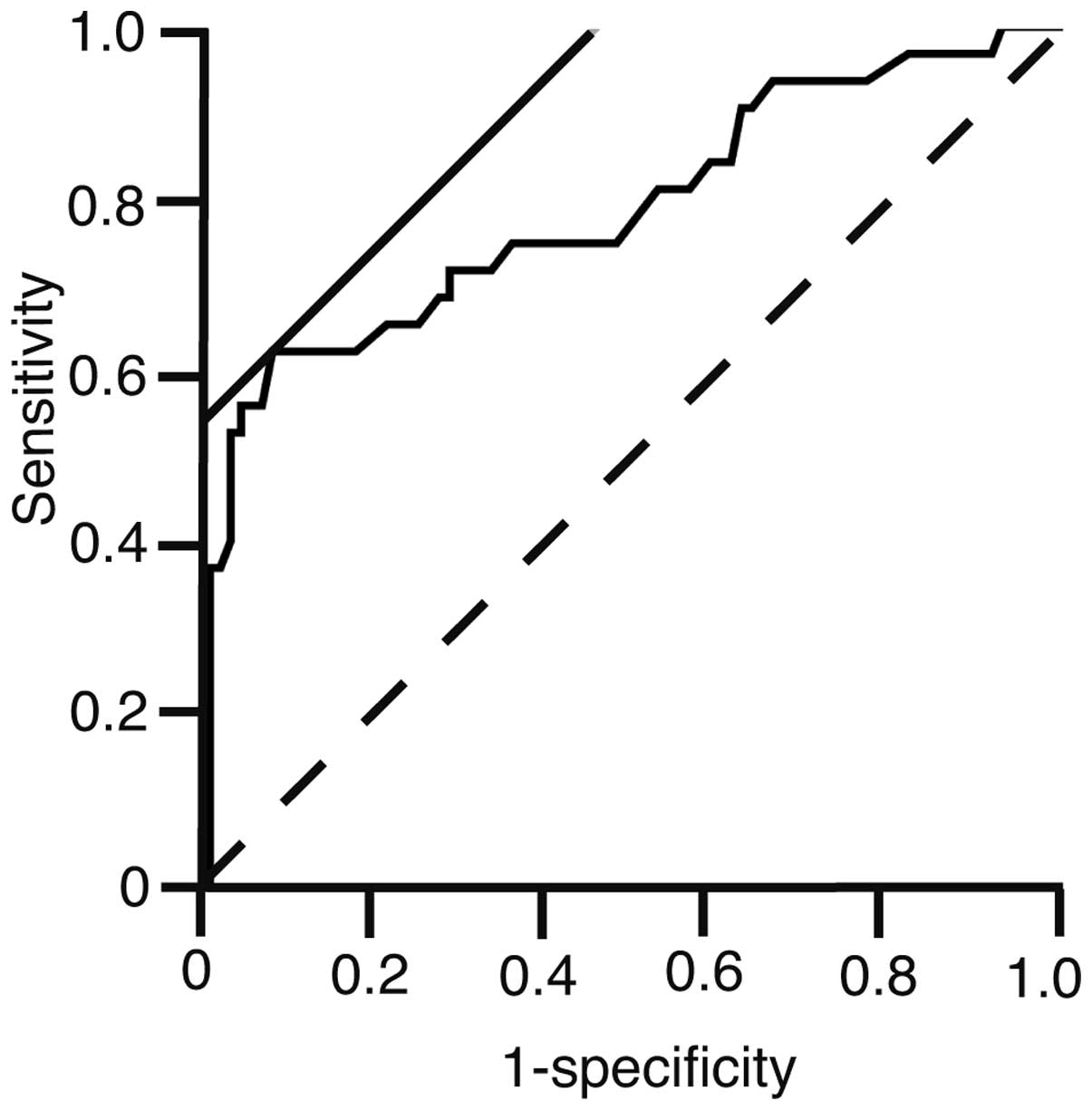
Since these results indicated that Hb might be a strong discriminatory parameter, receiver-operator characteristics were utilized to establish a threshold value for the existence of upper GI bleeding (Fig. 1). The area under the curve was 0.7867 and the threshold value calculated was 10.8 g/dl, with a sensitivity of 62.5% and specificity of 91.6% (Table IV).

Figure 1.

Receiver-operator characteristics analysis. Receiver-operator characteristics analysis was performed in search of a threshold value for the identification of upper gastrointestinal bleeding. Solid straight line, a line with a slope of 45° to calculate threshold using JMP 10.0.2 software; broken line, reference.

Table IV.

Discriminatory threshold value for Hb.

Table IV.

Discriminatory threshold value for Hb.

VariableArea under curveThreshold value (g/dl)Sensitivity (%)Specificity (%)
Hb0.786710.862.591.6

[i] Hb, hemoglobin.

Discussion

Blood test variables are easy to evaluate. Hoffmann et al (10) investigated a number of blood test variables and demonstrated that changes in WBC, Hb, Plt, CRP, ALT, and Cre levels are associated with upper GI bleeding. In the present study, WBC, Plt, and BUN were elevated, and Hb and Alb were reduced in patients with upper GI bleeding. Elevated BUN and low Alb have not been reported previously. BUN is known to be produced through protein metabolism (11,12). Blood in the GI tract is digested to protein, and is eventually metabolized to urea (13,14). It is therefore reasonable to conclude that BUN was elevated in patients with upper GI bleeding. Higher BUN levels indicate more severe upper GI bleeding (15), and elevated BUN can also discriminate upper from lower GI bleeding (16). Furthermore, Alb is a marker of nutritional state (17) and can reflect a severe state of upper GI bleeding (18). The results of the present study were consistent with these observations.

Upper GI bleeding is sometimes fatal, and the European Society of Gastrointestinal Endoscopy recommends maintaining Hb levels between 7.0–9.0 g/dl using blood transfusion in order to reduce mortality (19). In the present study, the threshold value calculated to select patients at risk for ongoing upper GI bleeding was 10.8 g/dl. Previously we calculated the threshold value of Hb to be 11.7 g/dl. Our threshold values were higher than the recommendation (19). It is possible the present study included patients with mild upper GI bleeding. Dahlerup et al (20) reported that mild upper GI bleeding includes patients with malignancy. Patients should be subjected to endoscopy before they develop hemodynamic instability, and those who are hemodynamically stable but with a Hb <10.8 g/dl may be recommended for endoscopy, since diagnosis would improve management and treatment would reduce the risk of further or delayed bleeding. One limitation of the present study was that it was based on a small number of patients with upper GI bleeding. Future studies with a greater number of recruited patients should be undertaken.

In conclusion, WBC, Plt, and BUN were elevated and Hb and Alb were lower in patients with upper GI bleeding. We established that a threshold value of 10.8 g/dl of Hb suggests the presence of upper GI bleeding and identifies patients at risk for hemodynamic crisis.

References

1 

Theocharis GJ, Thomopoulos KC, Sakellaropoulos G, Katsakoulis E and Nikolopoulou V: Changing trends in the epidemiology and clinical outcome of acute upper gastrointestinal bleeding in a defined geographical area in Greece. J Clin Gastroenterol. 42:128–133. 2008. View Article : Google Scholar : PubMed/NCBI

2 

Hearnshaw SA, Logan RF, Lowe D, Travis SP, Murphy MF and Palmer KR: Acute upper gastrointestinal bleeding in the UK: Patient characteristics, diagnoses and outcomes in the 2007 UK audit. Gut. 60:1327–1335. 2011. View Article : Google Scholar : PubMed/NCBI

3 

Leontiadis GI, Molloy-Bland M, Moayyedi P and Howden CW: Effect of comorbidity on mortality in patients with peptic ulcer bleeding: Systematic review and meta-analysis. Am J Gastroenterol. 108:331–345; quiz 346. 2013. View Article : Google Scholar : PubMed/NCBI

4 

Kim SY, Hyun JJ, Jung SW and Lee SW: Management of non-variceal upper gastrointestinal bleeding. Clin Endosc. 45:220–223. 2012. View Article : Google Scholar : PubMed/NCBI

5 

Wilkins T, Khan N, Nabh A and Schade RR: Diagnosis and management of upper gastrointestinal bleeding. Am Fam Physician. 85:469–476. 2012.PubMed/NCBI

6 

Katano T, Mizoshita T, Senoo K, Sobue S, Takada H, Sakamoto T, Mochiduki H, Ozeki T, Kato A, Matsunami K, et al: The efficacy of transcatheter arterial embolization as the first-choice treatment after failure of endoscopic hemostasis and endoscopic treatment resistance factors. Dig Endosc. 24:364–369. 2012. View Article : Google Scholar : PubMed/NCBI

7 

Walsh RM, Anain P, Geisinger M, Vogt D, Mayes J, Grundfest-Broniatowski S and Henderson JM: Role of angiography and embolization for massive gastroduodenal hemorrhage. J Gastrointest Surg. 3:61–65; discussion 66. 1999. View Article : Google Scholar : PubMed/NCBI

8 

Bozkurt S, Köse A, Arslan ED, Erdoğan S, Üçbilek E, Çevik İ, Ayrık C and Sezgin O: Validity of modified early warning, Glasgow Blatchford, and pre-endoscopic Rockall scores in predicting prognosis of patients presenting to emergency department with upper gastrointestinal bleeding. Scand J Trauma Resusc Emerg Med. 23:1092015. View Article : Google Scholar : PubMed/NCBI

9 

Forrest JA, Finlayson ND and Shearman DJ: Endoscopy in gastrointestinal bleeding. Lancet. 2:394–397. 1974. View Article : Google Scholar : PubMed/NCBI

10 

Hoffmann V, Neubauer H, Heinzler J, Smarczyk A, Hellmich M, Bowe A, Kuetting F, Demir M, Pelc A, Schulte S, et al: A novel easy-to-use prediction scheme for upper gastrointestinal bleeding: Cologne-WATCH (C-WATCH) risk score. Medicine (Baltimore). 94:e16142015. View Article : Google Scholar : PubMed/NCBI

11 

Schutz Y: Protein turnover, ureagenesis and gluconeogenesis. Int J Vitam Nutr Res. 81:101–107. 2011. View Article : Google Scholar : PubMed/NCBI

12 

Adeva MM, Souto G, Blanco N and Donapetry C: Ammonium metabolism in humans. Metabolism. 61:1495–1511. 2012. View Article : Google Scholar : PubMed/NCBI

13 

Mardini H and Record C: Pathogenesis of hepatic encephalopathy: Lessons from nitrogen challenges in man. Metab Brain Dis. 28:201–207. 2013. View Article : Google Scholar : PubMed/NCBI

14 

Häberle J: Clinical and biochemical aspects of primary and secondary hyperammonemic disorders. Arch Biochem Biophys. 536:101–108. 2013. View Article : Google Scholar : PubMed/NCBI

15 

Tomizawa M, Shinozaki F, Hasegawa R, Shirai Y, Motoyoshi Y, Sugiyama T, Yamamoto S and Ishige N: Patient characteristics with high or low blood urea nitrogen in upper gastrointestinal bleeding. World J Gastroenterol. 21:7500–7505. 2015. View Article : Google Scholar : PubMed/NCBI

16 

Tomizawa M, Shinozaki F, Hasegawa R, Shirai Y, Motoyoshi Y, Sugiyama T, Yamamoto S and Ishige N: Laboratory test variables useful for distinguishing upper from lower gastrointestinal bleeding. World J Gastroenterol. 21:6246–6251. 2015. View Article : Google Scholar : PubMed/NCBI

17 

Lee JL, Oh ES, Lee RW and Finucane TE: Serum albumin and prealbumin in calorically restricted, nondiseased individuals: A systematic review. Am J Med. 128(1023): e1–22. 2015. View Article : Google Scholar : PubMed/NCBI

18 

Tung CF, Chow WK, Chang CS, Peng YC and Hu WH: The prevalence and significance of hypoalbuminemia in non-variceal upper gastrointestinal bleeding. Hepatogastroenterology. 54:1153–1156. 2007.PubMed/NCBI

19 

Gralnek IM, Dumonceau JM, Kuipers EJ, Lanas A, Sanders DS, Kurien M, Rotondano G, Hucl T, Dinis-Ribeiro M, Marmo R, et al: Diagnosis and management of nonvariceal upper gastrointestinal hemorrhage: European Society of Gastrointestinal Endoscopy (ESGE) Guideline. Endoscopy. 47:a1–a46. 2015. View Article : Google Scholar : PubMed/NCBI

20 

Dahlerup JF, Eivindson M, Jacobsen BA, Jensen NM, Jørgensen SP, Laursen SB, Rasmussen M and Nathan T: Diagnosis and treatment of unexplained anemia with iron deficiency without overt bleeding. Dan Med J. 62:C50722015.PubMed/NCBI

Related Articles

  • Abstract
  • View
  • Download
  • Twitter
Copy and paste a formatted citation
Spandidos Publications style
Tomizawa M, Shinozaki F, Hasegawa R, Shirai Y, Motoyoshi Y, Sugiyama T, Yamamoto S and Ishige N: Low hemoglobin levels are associated with upper gastrointestinal bleeding. Biomed Rep 5: 349-352, 2016.
APA
Tomizawa, M., Shinozaki, F., Hasegawa, R., Shirai, Y., Motoyoshi, Y., Sugiyama, T. ... Ishige, N. (2016). Low hemoglobin levels are associated with upper gastrointestinal bleeding. Biomedical Reports, 5, 349-352. https://doi.org/10.3892/br.2016.727
MLA
Tomizawa, M., Shinozaki, F., Hasegawa, R., Shirai, Y., Motoyoshi, Y., Sugiyama, T., Yamamoto, S., Ishige, N."Low hemoglobin levels are associated with upper gastrointestinal bleeding". Biomedical Reports 5.3 (2016): 349-352.
Chicago
Tomizawa, M., Shinozaki, F., Hasegawa, R., Shirai, Y., Motoyoshi, Y., Sugiyama, T., Yamamoto, S., Ishige, N."Low hemoglobin levels are associated with upper gastrointestinal bleeding". Biomedical Reports 5, no. 3 (2016): 349-352. https://doi.org/10.3892/br.2016.727
Copy and paste a formatted citation
x
Spandidos Publications style
Tomizawa M, Shinozaki F, Hasegawa R, Shirai Y, Motoyoshi Y, Sugiyama T, Yamamoto S and Ishige N: Low hemoglobin levels are associated with upper gastrointestinal bleeding. Biomed Rep 5: 349-352, 2016.
APA
Tomizawa, M., Shinozaki, F., Hasegawa, R., Shirai, Y., Motoyoshi, Y., Sugiyama, T. ... Ishige, N. (2016). Low hemoglobin levels are associated with upper gastrointestinal bleeding. Biomedical Reports, 5, 349-352. https://doi.org/10.3892/br.2016.727
MLA
Tomizawa, M., Shinozaki, F., Hasegawa, R., Shirai, Y., Motoyoshi, Y., Sugiyama, T., Yamamoto, S., Ishige, N."Low hemoglobin levels are associated with upper gastrointestinal bleeding". Biomedical Reports 5.3 (2016): 349-352.
Chicago
Tomizawa, M., Shinozaki, F., Hasegawa, R., Shirai, Y., Motoyoshi, Y., Sugiyama, T., Yamamoto, S., Ishige, N."Low hemoglobin levels are associated with upper gastrointestinal bleeding". Biomedical Reports 5, no. 3 (2016): 349-352. https://doi.org/10.3892/br.2016.727
Follow us
  • Twitter
  • LinkedIn
  • Facebook
About
  • Spandidos Publications
  • Careers
  • Cookie Policy
  • Privacy Policy
How can we help?
  • Help
  • Live Chat
  • Contact
  • Email to our Support Team