Spandidos Publications Logo
  • About
    • About Spandidos
    • Aims and Scopes
    • Abstracting and Indexing
    • Editorial Policies
    • Reprints and Permissions
    • Job Opportunities
    • Terms and Conditions
    • Contact
  • Journals
    • All Journals
    • Oncology Letters
      • Oncology Letters
      • Information for Authors
      • Editorial Policies
      • Editorial Board
      • Aims and Scope
      • Abstracting and Indexing
      • Bibliographic Information
      • Archive
    • International Journal of Oncology
      • International Journal of Oncology
      • Information for Authors
      • Editorial Policies
      • Editorial Board
      • Aims and Scope
      • Abstracting and Indexing
      • Bibliographic Information
      • Archive
    • Molecular and Clinical Oncology
      • Molecular and Clinical Oncology
      • Information for Authors
      • Editorial Policies
      • Editorial Board
      • Aims and Scope
      • Abstracting and Indexing
      • Bibliographic Information
      • Archive
    • Experimental and Therapeutic Medicine
      • Experimental and Therapeutic Medicine
      • Information for Authors
      • Editorial Policies
      • Editorial Board
      • Aims and Scope
      • Abstracting and Indexing
      • Bibliographic Information
      • Archive
    • International Journal of Molecular Medicine
      • International Journal of Molecular Medicine
      • Information for Authors
      • Editorial Policies
      • Editorial Board
      • Aims and Scope
      • Abstracting and Indexing
      • Bibliographic Information
      • Archive
    • Biomedical Reports
      • Biomedical Reports
      • Information for Authors
      • Editorial Policies
      • Editorial Board
      • Aims and Scope
      • Abstracting and Indexing
      • Bibliographic Information
      • Archive
    • Oncology Reports
      • Oncology Reports
      • Information for Authors
      • Editorial Policies
      • Editorial Board
      • Aims and Scope
      • Abstracting and Indexing
      • Bibliographic Information
      • Archive
    • Molecular Medicine Reports
      • Molecular Medicine Reports
      • Information for Authors
      • Editorial Policies
      • Editorial Board
      • Aims and Scope
      • Abstracting and Indexing
      • Bibliographic Information
      • Archive
    • World Academy of Sciences Journal
      • World Academy of Sciences Journal
      • Information for Authors
      • Editorial Policies
      • Editorial Board
      • Aims and Scope
      • Abstracting and Indexing
      • Bibliographic Information
      • Archive
    • International Journal of Functional Nutrition
      • International Journal of Functional Nutrition
      • Information for Authors
      • Editorial Policies
      • Editorial Board
      • Aims and Scope
      • Abstracting and Indexing
      • Bibliographic Information
      • Archive
    • International Journal of Epigenetics
      • International Journal of Epigenetics
      • Information for Authors
      • Editorial Policies
      • Editorial Board
      • Aims and Scope
      • Abstracting and Indexing
      • Bibliographic Information
      • Archive
    • Medicine International
      • Medicine International
      • Information for Authors
      • Editorial Policies
      • Editorial Board
      • Aims and Scope
      • Abstracting and Indexing
      • Bibliographic Information
      • Archive
  • Articles
  • Information
    • Information for Authors
    • Information for Reviewers
    • Information for Librarians
    • Information for Advertisers
    • Conferences
  • Language Editing
Spandidos Publications Logo
  • About
    • About Spandidos
    • Aims and Scopes
    • Abstracting and Indexing
    • Editorial Policies
    • Reprints and Permissions
    • Job Opportunities
    • Terms and Conditions
    • Contact
  • Journals
    • All Journals
    • Biomedical Reports
      • Information for Authors
      • Editorial Policies
      • Editorial Board
      • Aims and Scope
      • Abstracting and Indexing
      • Bibliographic Information
      • Archive
    • Experimental and Therapeutic Medicine
      • Information for Authors
      • Editorial Policies
      • Editorial Board
      • Aims and Scope
      • Abstracting and Indexing
      • Bibliographic Information
      • Archive
    • International Journal of Epigenetics
      • Information for Authors
      • Editorial Policies
      • Editorial Board
      • Aims and Scope
      • Abstracting and Indexing
      • Bibliographic Information
      • Archive
    • International Journal of Functional Nutrition
      • Information for Authors
      • Editorial Policies
      • Editorial Board
      • Aims and Scope
      • Abstracting and Indexing
      • Bibliographic Information
      • Archive
    • International Journal of Molecular Medicine
      • Information for Authors
      • Editorial Policies
      • Editorial Board
      • Aims and Scope
      • Abstracting and Indexing
      • Bibliographic Information
      • Archive
    • International Journal of Oncology
      • Information for Authors
      • Editorial Policies
      • Editorial Board
      • Aims and Scope
      • Abstracting and Indexing
      • Bibliographic Information
      • Archive
    • Medicine International
      • Information for Authors
      • Editorial Policies
      • Editorial Board
      • Aims and Scope
      • Abstracting and Indexing
      • Bibliographic Information
      • Archive
    • Molecular and Clinical Oncology
      • Information for Authors
      • Editorial Policies
      • Editorial Board
      • Aims and Scope
      • Abstracting and Indexing
      • Bibliographic Information
      • Archive
    • Molecular Medicine Reports
      • Information for Authors
      • Editorial Policies
      • Editorial Board
      • Aims and Scope
      • Abstracting and Indexing
      • Bibliographic Information
      • Archive
    • Oncology Letters
      • Information for Authors
      • Editorial Policies
      • Editorial Board
      • Aims and Scope
      • Abstracting and Indexing
      • Bibliographic Information
      • Archive
    • Oncology Reports
      • Information for Authors
      • Editorial Policies
      • Editorial Board
      • Aims and Scope
      • Abstracting and Indexing
      • Bibliographic Information
      • Archive
    • World Academy of Sciences Journal
      • Information for Authors
      • Editorial Policies
      • Editorial Board
      • Aims and Scope
      • Abstracting and Indexing
      • Bibliographic Information
      • Archive
  • Articles
  • Information
    • For Authors
    • For Reviewers
    • For Librarians
    • For Advertisers
    • Conferences
  • Language Editing
Login Register Submit
  • This site uses cookies
  • You can change your cookie settings at any time by following the instructions in our Cookie Policy. To find out more, you may read our Privacy Policy.

    I agree
Search articles by DOI, keyword, author or affiliation
Search
Advanced Search
presentation
Biomedical Reports
Join Editorial Board Propose a Special Issue
Print ISSN: 2049-9434 Online ISSN: 2049-9442
Journal Cover
October-2016 Volume 5 Issue 4

Full Size Image

Sign up for eToc alerts
Recommend to Library

Journals

International Journal of Molecular Medicine

International Journal of Molecular Medicine

International Journal of Molecular Medicine is an international journal devoted to molecular mechanisms of human disease.

International Journal of Oncology

International Journal of Oncology

International Journal of Oncology is an international journal devoted to oncology research and cancer treatment.

Molecular Medicine Reports

Molecular Medicine Reports

Covers molecular medicine topics such as pharmacology, pathology, genetics, neuroscience, infectious diseases, molecular cardiology, and molecular surgery.

Oncology Reports

Oncology Reports

Oncology Reports is an international journal devoted to fundamental and applied research in Oncology.

Experimental and Therapeutic Medicine

Experimental and Therapeutic Medicine

Experimental and Therapeutic Medicine is an international journal devoted to laboratory and clinical medicine.

Oncology Letters

Oncology Letters

Oncology Letters is an international journal devoted to Experimental and Clinical Oncology.

Biomedical Reports

Biomedical Reports

Explores a wide range of biological and medical fields, including pharmacology, genetics, microbiology, neuroscience, and molecular cardiology.

Molecular and Clinical Oncology

Molecular and Clinical Oncology

International journal addressing all aspects of oncology research, from tumorigenesis and oncogenes to chemotherapy and metastasis.

World Academy of Sciences Journal

World Academy of Sciences Journal

Multidisciplinary open-access journal spanning biochemistry, genetics, neuroscience, environmental health, and synthetic biology.

International Journal of Functional Nutrition

International Journal of Functional Nutrition

Open-access journal combining biochemistry, pharmacology, immunology, and genetics to advance health through functional nutrition.

International Journal of Epigenetics

International Journal of Epigenetics

Publishes open-access research on using epigenetics to advance understanding and treatment of human disease.

Medicine International

Medicine International

An International Open Access Journal Devoted to General Medicine.

Journal Cover
October-2016 Volume 5 Issue 4

Full Size Image

Sign up for eToc alerts
Recommend to Library

  • Article
  • Citations
    • Cite This Article
    • Download Citation
    • Create Citation Alert
    • Remove Citation Alert
    • Cited By
  • Similar Articles
    • Related Articles (in Spandidos Publications)
    • Similar Articles (Google Scholar)
    • Similar Articles (PubMed)
  • Download PDF
  • Download XML
  • View XML
Article

Efficacy of daiokanzoto in chronic constipation refractory to first-line laxatives

  • Authors:
    • Tatsuya Hirose
    • Yasutaka Shinoda
    • Aya Yoshida
    • Machiko Kurimoto
    • Kouki Mori
    • Yuki Kawachi
    • Kouji Tanaka
    • Atsuko Takeda
    • Tomoaki Yoshimura
    • Tadashi Sugiyama
  • View Affiliations / Copyright

    Affiliations: Department of Pharmacy, Ogaki Municipal Hospital, Ogaki‑shi, Gifu 503‑8502, Japan, Laboratory of Pharmacy Practice and Social Science, Gifu Pharmaceutical University, Gifu‑shi, Gifu 501‑1196, Japan
  • Pages: 497-500
    |
    Published online on: September 8, 2016
       https://doi.org/10.3892/br.2016.754
  • Expand metrics +
Metrics: Total Views: 0 (Spandidos Publications: | PMC Statistics: )
Metrics: Total PDF Downloads: 0 (Spandidos Publications: | PMC Statistics: )
Cited By (CrossRef): 0 citations Loading Articles...

This article is mentioned in:


Abstract

There are only a few treatment options for constipation and limited evidence of suitable treatments.Daiokanzoto (DKT) is a Kampo medicine often used clincally to treat constipation. DKT is a laxative used predominantly in Japan; however, clinical data on its efficacy and safety is lacking. Patients who used DKT, but were intolerant to either magnesium oxide (MgO; MgO group; n=16) or senna extract (Senna group; n=26) were included in the present study. The frequencies of their bowel movements were compared during the 1 week prior to and following DKT administration. Within 24 hours after DKT administration, 93.8% of the patients in the MgO group evacuated their bowels. The median bowel movement frequency 1 week prior to DKT administration was 2.5 and 1 week after DKT administration was significantly increased to 7.5. In the Senna group, within 24 h of DKT administration, 80.8% of the patients evacuated their bowels. The median bowel movement frequency 1 week prior to the DKT treatment was 2.0, which significantly increased to 8.5 1 week after the administration of DKT. The adverse events from DKT treatment were mild and controllable.

Introduction

Constipation can contribute to health care costs and cause a decline in work productivity and the quality of life, as well as result in disability (1). Therefore, an effective treatment for constipation is important; however, only a few treatment options exist for constipation and there is limited evidence of suitable treatments.

Daiokanzoto (DKT) is a Kampo medicine often used clinically to treat constipation. DKT is composed of rhubarb and glycyrrhiza. Sennoside A is the active ingredient in DKT responsible for its effects in constipation. However, DKT has demonstrated efficacy in patients with constipation who were intolerant to treatment with senna extract. According to the guidelines set by Lindberg et al (2), senna extract is recommended for the treatment of constipation. Magnesium oxide (MgO) is commonly used as an osmotic laxative (3). Senna extract and MgO are therefore used as first-line treatments in numerous cases of constipation; however, patients who were intolerant to these two common laxatives were encountered. Since there is limited information on other laxatives, it is difficult to effectively treat such patients. Therefore, the present study examined the laxative effects of DKT in patients intolerant to the first-line treatments.

Materials and methods

Background

The present study was approved by the Ogaki Civilian Hospital Ethics Committee and was performed at Ogaki Municipal Hospital (Ogaki, Japan) between 1st May 2012 and 30th April 2015. Patients who used DKT, but were intolerant to either MgO (MgO group) or senna extract (Senna group) were included in the present study. Patients were administered either MgO tablets or senna extract tablets for 1 week prior to the initiation of DKT treatment.

The present study retrospectively reviewed the following details of the patients from the electronic medical records: Age, height, weight, dose of DKT, concomitant medications and medical history. The increased total bilirubin (T-Bil) and blood urea nitrogen (BUN) levels were also recorded, as well as the serum levels of aspartate aminotransferase (AST), alanine transaminase (ALT), creatinine (Cre), Na, K and Cl. Other data that was deemed relevant was also recorded.

Comparison of the effects of DKT in the MgO and Senna groups

From the medical records of the patients, the present study obtained and compared the frequencies of their bowel movements during the 1 week prior to and following DKT administration.

Adverse events from DKT administration

The present study investigated the incidence of adverse events following treatment with DKT. The predominant adverse events were diarrhea and abdominal pain, which were evaluated using the Common Terminology Criteria for Adverse Events (version 4.0; http://evs.nci.nih.gov/ftp1/CTCAE/About.html). In addition, the presents study also compared the changes in clinical laboratory data prior to, 3 days and 1 week after DKT administration.

Statistical analysis

Statistical analyses were performed using EZR software v1.26 (4). The effects of DKT in the groups were compared using Wilcoxon signed-rank test at a significance level of 5%. Differences in the laboratory test results, 3 days and 1 week after DKT administration, were evaluated using the Friedman test. The significance level was also set at 5%.

Results

Background

A total of 16 patients (11 male and 5 female) were enrolled into the MgO group and their median age was 71 years (interquartile range, 65–77 years). A total of 26 patients (14 male and 12 female) were enrolled in the Senna group and their median age was 72 years (interquartile range, 68–78 years). In both the MgO and Senna groups, the last bowel movements were 3.5 (interquartile range, 2–6 days) and 4.0 days (interquartile range, 2–6 days), respectively, prior to DKT administration. Baseline characteristics of the patients are shown in Table I.

Table I.

Baseline characteristics of the patients.

Table I.

Baseline characteristics of the patients.

CharacteristicsMgO resistance group (n=16)Senna resistance group (n=26)
Median age, years (interquartile range)           71 (65–77)           72 (68–78)
No. of males1114
No. of females  512
Median eight, kg (interquartile range)           53 (49–64)           51 (42–60)
Median height, cm (interquartile range)             160 (154–166)             157 (151–163)
Median days since last bowel movement (interquartile range)     3.5 (2–6)     4.0 (2–6)
Effect of DKT in the MgO group

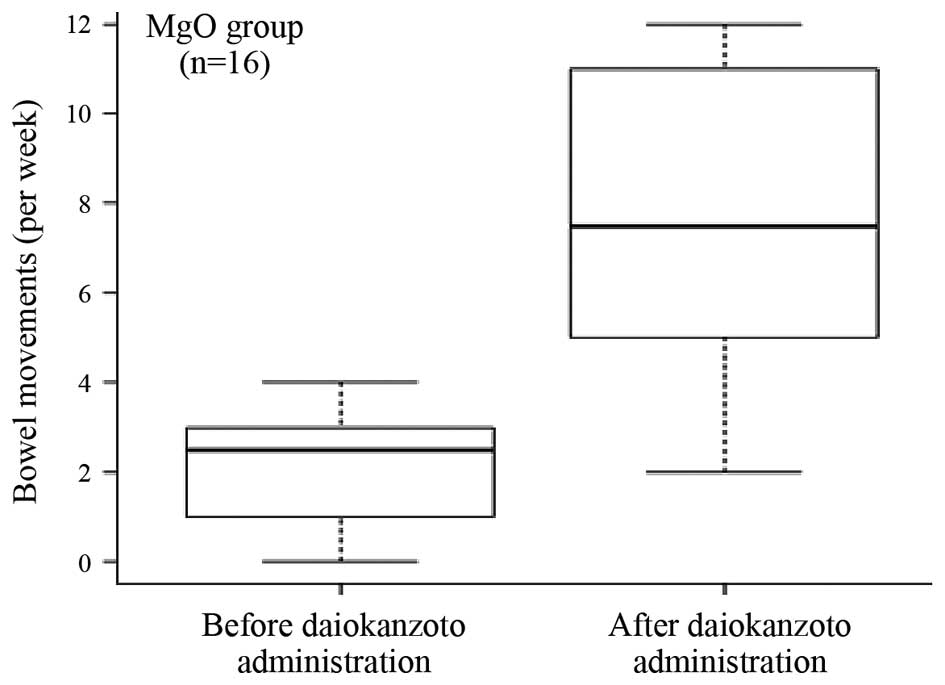
Following the administration of DKT, 93.8% of patients in the MgO group evacuated their bowels within 24 h. The median bowel movement frequency 1 week prior to DKT administration was 2.5 (interquartile range, 1–3). However, 1 week after DKT administration, the frequency significantly (P<0.001) increased to 7.5 (interquartile range, 5–11), as shown in Fig. 1.

Figure 1.

Number of bowel movements per week in the MgO group. The median bowel movement frequency 1 week prior to DKT administration was 2.5 (interquartile range, 1–3). However, 1 week after DKT administration, the frequency significantly (P<0.001) increased to 7.5 (interquartile range, 5–11). DKT, daiokanzoto.

Effect of DKT in the Senna group

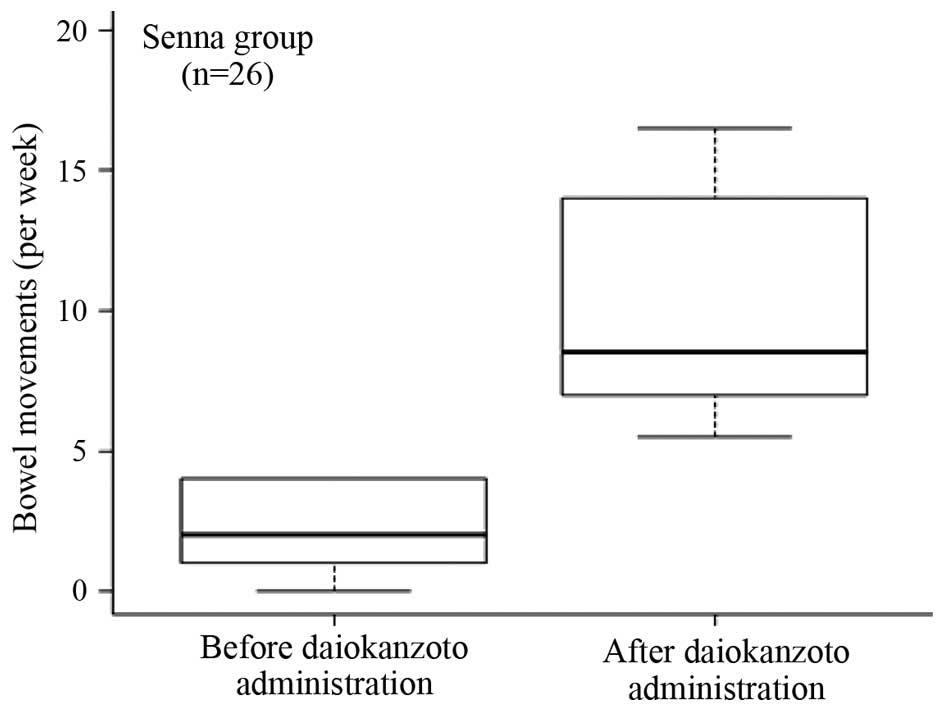
Following the administration of DKT, 80.8% of the patients in the Senna group evacuated their bowels within 24 h. The median bowel movement frequency 1 week prior to DKT treatment was 2.0 (interquartile range, 1–4), which significantly (P<0.001) increased to 8.5 (interquartile range, 7–14) 1 week after the administration of DKT (Fig. 2).

Figure 2.

Number of bowel movements per week in the Senna group. The median bowel movement frequency 1 week prior to the DKT treatment was 2.0 (interquartile range, 1–4), which significantly (P<0.001) increased to 8.5 (interquartile range, 7–14) 1 week after the administration of DKT. DKT, daiokanzoto.

Adverse events from DKT administration

In the Senna group, there were four cases of diarrhea (15.4%) and one case of abdominal pain (3.8%). Both adverse events were mild (Grade 1) in each group of patients.

In the MgO group, no statistically significant differences were observed among the clinical laboratory data obtained prior to, 3 days and 1 week after DKT administration (Table II). By contrast, in the Senna group, the differences among the levels of ALT prior to, 3 days and 1 week after DKT administration were statistically significant (P<0.05 for each pair compared) (Table III). It was observed that ALT decreased with increasing duration following treatment with DKT.

Table II.

Clinical laboratory data in the MgO group.

Table II.

Clinical laboratory data in the MgO group.

MgO resistance group

Median levelsPrior to administrationAdministered 3 days afterAdministered 1 week afterP-value
Na, mEq/l (interquartile range)136.5 (135.75–139.25)136 (135.5–139)137 (136.5–138)0.618
K, mEq/l (interquartile range)4.25 (4.075–4.5)4.4 (4.1–4.55)4.3 (4.1–4.45)0.846
Cl, mEq/l (interquartile range)102.5 (99.75–106)104 (100.5–106)104 (102–105.5)0.88
AST, IU/l (interquartile range)20.5 (14.75–26.75)18.5 (12.5–26.75)18 (13.5–25)0.782
ALT, IU/l (interquartile range)19 (13.75–26)18 (15.5–32.5)15 (11–30)0.607
T-Bil, mg/dl (interquartile range)0.6 (0.525–0.775)0.6 (0.5–0.8)0.5 (0.4–0.6)0.0861
BUN, mg/dl (interquartile range)17.1 (14.225–19.725)16.7 (14.625–22.1)14.5 (12.8–18.35)0.119
Cre, mg/dl (interquartile range)0.625 (0.59–0.9325)0.705 (0.6125–0.9925)0.72 (0.64–0.92)0.185

Table III.

Clinical laboratory data of the Senna group.

Table III.

Clinical laboratory data of the Senna group.

Senna resistance group

Median levelsPrior to administrationAdministered 3 days afterAdministered 1 week afterP-value
Na, mEq/l (interquartile range)138 (135.25–140)138 (134–140)138.5 (137.75–141)0.127
K, mEq/l (interquartile range)4.1 (3.725–4.475)4.1 (3.8–4.6)4.1 (3.575–4.55)0.565
Cl, mEq/l (interquartile range)101.5 (100–105.75)102 (99–106)103.5 (101.5–105.25)0.558
AST, IU/l (interquartile range)23 (19–33.75)20 (15–34)20 (13–30)0.0739
ALT, IU/l (interquartile range)21 (12.75–32.75)18 (12–28)15 (11–34)<0.05
T-Bil, mg/dl (interquartile range)0.5 (0.4–0.8)0.5 (0.375–0.625)0.4 (0.3–0.7)0.984
BUN, mg/dl (interquartile range)18.6 (14.7–23)15.3 (10.9–22.4)15 (9.7–19.2)0.148
Cre, mg/dl (interquartile range)0.72 (0.5525–0.945)0.64 (0.53–0.86)0.62 (0.51–0.88)0.952

Discussion

It is known that ~14% of the global adult population suffer from chronic constipation (5). In a previous systematic review, it was stated that chronic constipation lowers the quality of life (5). In addition, individuals with chronic constipation have an increased risk of developing colon cancer. The risk increases with an increasing degree of constipation (6).

In a previous study, it was observed that preventing constipation improved multi-organ failure in critically ill patients (7). Therefore, it is important that evidence of the clinical effects of the treatment of constipation are accumulated to improve the care of patients. Usually, clinical treatment of constipation with a single laxative is ineffective. DKT is a laxative predominantly used in Japan; however, clinical data on its efficacy and safety is lacking.

In the present study, DKT was considered beneficial in constipation refractory to MgO treatment. Although MgO is often prescribed for constipation, it is not effective in certain individuals, particularly elderly patients. MgO is an osmotic laxative; it is converted into magnesium carbonate in the intestine, which inhibits water reabsorption from the intestine. As a result, the volume of intestinal contents increases, which stimulates motility of the intestinal tract, thereby facilitating defecation. Elderly patients have reduced intestinal motility, which results in reduced bowel movements. Therefore, MgO has minimal efficacy in treating constipation in the elderly.

The mechanism by which sennoside A in DKT improves constipation is via enhanced peristalsis. A senna extract tablet contains 6.8 mg sennoside A. In the present study, two senna extract tablets (13.6 mg sennoside A) were administered to the patients. By contrast, one package of DKT contains 2.9 mg sennoside A. In the present study, patients were administered three packages of DKT (8.7 mg sennoside A). Although the administered DKT contained a lesser quantity of sennoside A, it was observed that DKT was more effective compared with the senna extract tablets, regarding the frequency of bowel movements.

The predominant components of rhubarb and glycyrrhiza are sennoside A and glycyrrhizin, respectively. Sennoside A is metabolically activated to rheinanthrone, which is responsible for the laxative action of sennoside A (8–10). Glycyrrhiza contains liquiritin, which has been reported to promote the metabolic activation sennoside A into rheinanthrone (11,12). In addition, Takayama et al (13) reported that rhein in rhubarb promotes the metabolic activation sennoside A to rheinanthrone.

Although patients exhibited inadequate bowel movements after taking senna extract tablets, switching from the senna extract tablets to DKT was effective in relieving constipation. It was therefore hypothesized that reason for this was the presence of glycyrrhiza and rhubarb in the DKT.

The adverse events from DKT treatment were mild and controllable. Therefore, properly adjusting the doses of DKT according to patients' requirements may suitably reduce the occurrence of adverse events.

The results from the present study indicated that DKT may be a suitable second-line treatment for chronic constipation, particularly in elderly patients.

References

1 

Sun SX, Dibonaventura M, Purayidathil FW, Wagner JS, Dabbous O and Mody R: Impact of chronic constipation on health-related quality of life, work productivity, and healthcare resource use: An analysis of the National Health and Wellness Survey. Dig Dis Sci. 56:2688–2695. 2011. View Article : Google Scholar : PubMed/NCBI

2 

Lindberg G, Hamid SS, Malfertheiner P, Thomsen OO, Fernandez LB, Garisch J, Thomson A, Goh KL, Tandon R, Fedail S, et al: World Gastroenterology Organisation: World Gastroenterology Organisation global guideline: Constipation - a global perspective. J Clin Gastroenterol. 45:483–487. 2011. View Article : Google Scholar : PubMed/NCBI

3 

Roque M Vazquez and Bouras EP: Epidemiology and management of chronic constipation in elderly patients. Clin Interv Aging. 10:919–930. 2015.PubMed/NCBI

4 

Kanda Y: Investigation of the freely available easy-to-use software ‘EZR’ for medical statistics. Bone Marrow Transplant. 48:452–458. 2013. View Article : Google Scholar : PubMed/NCBI

5 

Gürsen C, Günel M Kerem, Kaya S, Kav T and Akbayrak T: Effect of connective tissue manipulation on symptoms and quality of life in patients with chronic constipation: A randomized controlled trial. J Manipulative Physiol Ther. 38:335–343. 2015. View Article : Google Scholar : PubMed/NCBI

6 

Guérin A, Mody R, Fok B, Lasch KL, Zhou Z, Wu EQ, Zhou W and Talley NJ: Risk of developing colorectal cancer and benign colorectal neoplasm in patients with chronic constipation. Aliment Pharmacol Ther. 40:83–92. 2014. View Article : Google Scholar : PubMed/NCBI

7 

de Azevedo RP, Freitas FG, Ferreira EM, de Azevedo LC Pontes and Machado FR: Daily laxative therapy reduces organ dysfunction in mechanically ventilated patients: A phase II randomized controlled trial. Crit Care. 19:3292015. View Article : Google Scholar : PubMed/NCBI

8 

Sasaki K, Yamauchi K and Kuwano S: Metabolic activation of sennoside A in mice. Planta Med. 37:370–378. 1979. View Article : Google Scholar : PubMed/NCBI

9 

Kobashi K, Nishimura T, Kusaka M, Hattori M and Namba T: Metabolism of sennosides by human intestinal bacteria. Planta Med. 40:225–236. 1980. View Article : Google Scholar : PubMed/NCBI

10 

Lemli J and Lemmens L: Metabolism of sennosides and rhein in the rat. Pharmacology. 20 Suppl 1:50–57. 1980. View Article : Google Scholar : PubMed/NCBI

11 

Matsui E, Takayama K, Sato E and Okamura N: The influence of glycyrrhiza and antibiotics on the purgative action of sennoside a from Daiokanzoto in mice. Biol Pharm Bull. 34:1438–1442. 2011. View Article : Google Scholar : PubMed/NCBI

12 

Takayama K, Matsui E, Kobayashi T, Inoue H, Tsuruta Y and Okamura N: High-performance liquid chromatographic determination and metabolic study of sennoside a in daiokanzoto by mouse intestinal bacteria. Chem Pharm Bull (Tokyo). 59:1106–1109. 2011. View Article : Google Scholar : PubMed/NCBI

13 

Takayama K, Morita T, Tabuchi N, Fukunaga M and Okamura N: The effect of anthraquinones in daiokanzoto on increasing the synthesis of sennoside A-metabolic enzyme derived from bifidobacteria. J Trad Med. 30:215–220. 2013.

Related Articles

  • Abstract
  • View
  • Download
  • Twitter
Copy and paste a formatted citation
Spandidos Publications style
Hirose T, Shinoda Y, Yoshida A, Kurimoto M, Mori K, Kawachi Y, Tanaka K, Takeda A, Yoshimura T, Sugiyama T, Sugiyama T, et al: Efficacy of daiokanzoto in chronic constipation refractory to first-line laxatives. Biomed Rep 5: 497-500, 2016.
APA
Hirose, T., Shinoda, Y., Yoshida, A., Kurimoto, M., Mori, K., Kawachi, Y. ... Sugiyama, T. (2016). Efficacy of daiokanzoto in chronic constipation refractory to first-line laxatives. Biomedical Reports, 5, 497-500. https://doi.org/10.3892/br.2016.754
MLA
Hirose, T., Shinoda, Y., Yoshida, A., Kurimoto, M., Mori, K., Kawachi, Y., Tanaka, K., Takeda, A., Yoshimura, T., Sugiyama, T."Efficacy of daiokanzoto in chronic constipation refractory to first-line laxatives". Biomedical Reports 5.4 (2016): 497-500.
Chicago
Hirose, T., Shinoda, Y., Yoshida, A., Kurimoto, M., Mori, K., Kawachi, Y., Tanaka, K., Takeda, A., Yoshimura, T., Sugiyama, T."Efficacy of daiokanzoto in chronic constipation refractory to first-line laxatives". Biomedical Reports 5, no. 4 (2016): 497-500. https://doi.org/10.3892/br.2016.754
Copy and paste a formatted citation
x
Spandidos Publications style
Hirose T, Shinoda Y, Yoshida A, Kurimoto M, Mori K, Kawachi Y, Tanaka K, Takeda A, Yoshimura T, Sugiyama T, Sugiyama T, et al: Efficacy of daiokanzoto in chronic constipation refractory to first-line laxatives. Biomed Rep 5: 497-500, 2016.
APA
Hirose, T., Shinoda, Y., Yoshida, A., Kurimoto, M., Mori, K., Kawachi, Y. ... Sugiyama, T. (2016). Efficacy of daiokanzoto in chronic constipation refractory to first-line laxatives. Biomedical Reports, 5, 497-500. https://doi.org/10.3892/br.2016.754
MLA
Hirose, T., Shinoda, Y., Yoshida, A., Kurimoto, M., Mori, K., Kawachi, Y., Tanaka, K., Takeda, A., Yoshimura, T., Sugiyama, T."Efficacy of daiokanzoto in chronic constipation refractory to first-line laxatives". Biomedical Reports 5.4 (2016): 497-500.
Chicago
Hirose, T., Shinoda, Y., Yoshida, A., Kurimoto, M., Mori, K., Kawachi, Y., Tanaka, K., Takeda, A., Yoshimura, T., Sugiyama, T."Efficacy of daiokanzoto in chronic constipation refractory to first-line laxatives". Biomedical Reports 5, no. 4 (2016): 497-500. https://doi.org/10.3892/br.2016.754
Follow us
  • Twitter
  • LinkedIn
  • Facebook
About
  • Spandidos Publications
  • Careers
  • Cookie Policy
  • Privacy Policy
How can we help?
  • Help
  • Live Chat
  • Contact
  • Email to our Support Team