Spandidos Publications Logo
  • About
    • About Spandidos
    • Aims and Scopes
    • Abstracting and Indexing
    • Editorial Policies
    • Reprints and Permissions
    • Job Opportunities
    • Terms and Conditions
    • Contact
  • Journals
    • All Journals
    • Oncology Letters
      • Oncology Letters
      • Information for Authors
      • Editorial Policies
      • Editorial Board
      • Aims and Scope
      • Abstracting and Indexing
      • Bibliographic Information
      • Archive
    • International Journal of Oncology
      • International Journal of Oncology
      • Information for Authors
      • Editorial Policies
      • Editorial Board
      • Aims and Scope
      • Abstracting and Indexing
      • Bibliographic Information
      • Archive
    • Molecular and Clinical Oncology
      • Molecular and Clinical Oncology
      • Information for Authors
      • Editorial Policies
      • Editorial Board
      • Aims and Scope
      • Abstracting and Indexing
      • Bibliographic Information
      • Archive
    • Experimental and Therapeutic Medicine
      • Experimental and Therapeutic Medicine
      • Information for Authors
      • Editorial Policies
      • Editorial Board
      • Aims and Scope
      • Abstracting and Indexing
      • Bibliographic Information
      • Archive
    • International Journal of Molecular Medicine
      • International Journal of Molecular Medicine
      • Information for Authors
      • Editorial Policies
      • Editorial Board
      • Aims and Scope
      • Abstracting and Indexing
      • Bibliographic Information
      • Archive
    • Biomedical Reports
      • Biomedical Reports
      • Information for Authors
      • Editorial Policies
      • Editorial Board
      • Aims and Scope
      • Abstracting and Indexing
      • Bibliographic Information
      • Archive
    • Oncology Reports
      • Oncology Reports
      • Information for Authors
      • Editorial Policies
      • Editorial Board
      • Aims and Scope
      • Abstracting and Indexing
      • Bibliographic Information
      • Archive
    • Molecular Medicine Reports
      • Molecular Medicine Reports
      • Information for Authors
      • Editorial Policies
      • Editorial Board
      • Aims and Scope
      • Abstracting and Indexing
      • Bibliographic Information
      • Archive
    • World Academy of Sciences Journal
      • World Academy of Sciences Journal
      • Information for Authors
      • Editorial Policies
      • Editorial Board
      • Aims and Scope
      • Abstracting and Indexing
      • Bibliographic Information
      • Archive
    • International Journal of Functional Nutrition
      • International Journal of Functional Nutrition
      • Information for Authors
      • Editorial Policies
      • Editorial Board
      • Aims and Scope
      • Abstracting and Indexing
      • Bibliographic Information
      • Archive
    • International Journal of Epigenetics
      • International Journal of Epigenetics
      • Information for Authors
      • Editorial Policies
      • Editorial Board
      • Aims and Scope
      • Abstracting and Indexing
      • Bibliographic Information
      • Archive
    • Medicine International
      • Medicine International
      • Information for Authors
      • Editorial Policies
      • Editorial Board
      • Aims and Scope
      • Abstracting and Indexing
      • Bibliographic Information
      • Archive
  • Articles
  • Information
    • Information for Authors
    • Information for Reviewers
    • Information for Librarians
    • Information for Advertisers
    • Conferences
  • Language Editing
Spandidos Publications Logo
  • About
    • About Spandidos
    • Aims and Scopes
    • Abstracting and Indexing
    • Editorial Policies
    • Reprints and Permissions
    • Job Opportunities
    • Terms and Conditions
    • Contact
  • Journals
    • All Journals
    • Biomedical Reports
      • Information for Authors
      • Editorial Policies
      • Editorial Board
      • Aims and Scope
      • Abstracting and Indexing
      • Bibliographic Information
      • Archive
    • Experimental and Therapeutic Medicine
      • Information for Authors
      • Editorial Policies
      • Editorial Board
      • Aims and Scope
      • Abstracting and Indexing
      • Bibliographic Information
      • Archive
    • International Journal of Epigenetics
      • Information for Authors
      • Editorial Policies
      • Editorial Board
      • Aims and Scope
      • Abstracting and Indexing
      • Bibliographic Information
      • Archive
    • International Journal of Functional Nutrition
      • Information for Authors
      • Editorial Policies
      • Editorial Board
      • Aims and Scope
      • Abstracting and Indexing
      • Bibliographic Information
      • Archive
    • International Journal of Molecular Medicine
      • Information for Authors
      • Editorial Policies
      • Editorial Board
      • Aims and Scope
      • Abstracting and Indexing
      • Bibliographic Information
      • Archive
    • International Journal of Oncology
      • Information for Authors
      • Editorial Policies
      • Editorial Board
      • Aims and Scope
      • Abstracting and Indexing
      • Bibliographic Information
      • Archive
    • Medicine International
      • Information for Authors
      • Editorial Policies
      • Editorial Board
      • Aims and Scope
      • Abstracting and Indexing
      • Bibliographic Information
      • Archive
    • Molecular and Clinical Oncology
      • Information for Authors
      • Editorial Policies
      • Editorial Board
      • Aims and Scope
      • Abstracting and Indexing
      • Bibliographic Information
      • Archive
    • Molecular Medicine Reports
      • Information for Authors
      • Editorial Policies
      • Editorial Board
      • Aims and Scope
      • Abstracting and Indexing
      • Bibliographic Information
      • Archive
    • Oncology Letters
      • Information for Authors
      • Editorial Policies
      • Editorial Board
      • Aims and Scope
      • Abstracting and Indexing
      • Bibliographic Information
      • Archive
    • Oncology Reports
      • Information for Authors
      • Editorial Policies
      • Editorial Board
      • Aims and Scope
      • Abstracting and Indexing
      • Bibliographic Information
      • Archive
    • World Academy of Sciences Journal
      • Information for Authors
      • Editorial Policies
      • Editorial Board
      • Aims and Scope
      • Abstracting and Indexing
      • Bibliographic Information
      • Archive
  • Articles
  • Information
    • For Authors
    • For Reviewers
    • For Librarians
    • For Advertisers
    • Conferences
  • Language Editing
Login Register Submit
  • This site uses cookies
  • You can change your cookie settings at any time by following the instructions in our Cookie Policy. To find out more, you may read our Privacy Policy.

    I agree
Search articles by DOI, keyword, author or affiliation
Search
Advanced Search
presentation
Biomedical Reports
Join Editorial Board Propose a Special Issue
Print ISSN: 2049-9434 Online ISSN: 2049-9442
Journal Cover
October-2017 Volume 7 Issue 4

Full Size Image

Sign up for eToc alerts
Recommend to Library

Journals

International Journal of Molecular Medicine

International Journal of Molecular Medicine

International Journal of Molecular Medicine is an international journal devoted to molecular mechanisms of human disease.

International Journal of Oncology

International Journal of Oncology

International Journal of Oncology is an international journal devoted to oncology research and cancer treatment.

Molecular Medicine Reports

Molecular Medicine Reports

Covers molecular medicine topics such as pharmacology, pathology, genetics, neuroscience, infectious diseases, molecular cardiology, and molecular surgery.

Oncology Reports

Oncology Reports

Oncology Reports is an international journal devoted to fundamental and applied research in Oncology.

Experimental and Therapeutic Medicine

Experimental and Therapeutic Medicine

Experimental and Therapeutic Medicine is an international journal devoted to laboratory and clinical medicine.

Oncology Letters

Oncology Letters

Oncology Letters is an international journal devoted to Experimental and Clinical Oncology.

Biomedical Reports

Biomedical Reports

Explores a wide range of biological and medical fields, including pharmacology, genetics, microbiology, neuroscience, and molecular cardiology.

Molecular and Clinical Oncology

Molecular and Clinical Oncology

International journal addressing all aspects of oncology research, from tumorigenesis and oncogenes to chemotherapy and metastasis.

World Academy of Sciences Journal

World Academy of Sciences Journal

Multidisciplinary open-access journal spanning biochemistry, genetics, neuroscience, environmental health, and synthetic biology.

International Journal of Functional Nutrition

International Journal of Functional Nutrition

Open-access journal combining biochemistry, pharmacology, immunology, and genetics to advance health through functional nutrition.

International Journal of Epigenetics

International Journal of Epigenetics

Publishes open-access research on using epigenetics to advance understanding and treatment of human disease.

Medicine International

Medicine International

An International Open Access Journal Devoted to General Medicine.

Journal Cover
October-2017 Volume 7 Issue 4

Full Size Image

Sign up for eToc alerts
Recommend to Library

  • Article
  • Citations
    • Cite This Article
    • Download Citation
    • Create Citation Alert
    • Remove Citation Alert
    • Cited By
  • Similar Articles
    • Related Articles (in Spandidos Publications)
    • Similar Articles (Google Scholar)
    • Similar Articles (PubMed)
  • Download PDF
  • Download XML
  • View XML
Case Report

Aspergillus in liquid‑based cervicovaginal cytology in a postmenopausal patient: A case report

  • Authors:
    • Raquel Garza‑Guajardo
    • Luis Carlos Canales‑Martínez
    • Irám Pablo Rodríguez‑Sánchez
    • María Marisela Sánchez‑Chaparro
    • Gabriela Sofía Gómez-Macías
    • Natalia Vilches-Cisneros
    • Oralia Barboza-Quintana
  • View Affiliations / Copyright

    Affiliations: Department of Pathological Anatomy and Cytopathology, Universidad Autonoma de Nuevo Leon, Hospital Universitario ‘Dr José Eleuterio González’, Monterrey, Nuevo León 64460, Mexico, Department of Genetics, Universidad Autonoma de Nuevo Leon, College of Medicine, Monterrey, Nuevo León 64460, Mexico, Laboratory of Immunology and Virology, Universidad Autonoma de Nuevo Leon, College of Biological Sciences, San Nicolás de los Garza, Nuevo León 66450, Mexico
  • Pages: 306-308
    |
    Published online on: August 25, 2017
       https://doi.org/10.3892/br.2017.974
  • Expand metrics +
Metrics: Total Views: 0 (Spandidos Publications: | PMC Statistics: )
Metrics: Total PDF Downloads: 0 (Spandidos Publications: | PMC Statistics: )
Cited By (CrossRef): 0 citations Loading Articles...

This article is mentioned in:


Abstract

Aspergillus is an opportunistic fungus present in humid environments, whose natural environment is in soil, hay and compost. It is a frequent contaminant in the clinical laboratory. Because of this, the fungus is often inhaled, affecting those with an underlying pulmonary disease or immune deficiency. Fungal genitourinary tract infections are relatively common. A rare Aspergillus spp cervical infection diagnosed via liquid‑based cytology is presented in the current study. The 57‑year‑old woman attended her annual check‑up without any relevant medical history. The result of a gynecological examination by Papanicolaou smear was normal and routine liquid‑based cytology was performed. The specimen exhibited fungal organisms characterized by septate hyphae branching at acute angles, most consistent with the Aspergillus species. Subsequent cytology demonstrated the same results. Antifungal treatment was initiated and a second post‑treatment smear only exhibited atrophy. The cytomorphological features of Aspergillus spp. are discussed in the current study and a brief review of the few reported cases of a primary cervical infection in the literature is provided. In addition, the liquid‑based cytology was established as a tool to diagnose the rare Aspergillus infection.

Introduction

The most relevant of the Aspergillus species are fumigatus, flavus and niger. These grow in the natural environment, and in tissues and cultures in the form of hyphae that produce conidia upon exposure to air. Conidia consist of a conidiophore with a terminal vesicle in which one or two layers of phialides are developed. The prevalence of genitourinary tract infections has been reported to be as high as 52% in the female population, with the most common cause being Candida albicans in 28% (1). With the exception of Candida, other fungi are rarely observed in Papanicolaou (Pap) smears or biopsies, with isolated reports of opportunistic infections, such as Blastomyces dermatitidis, Coccidioides immitis, Cryptococcus neoformans and mucor being published (2,3). To the best of our knowledge, this is one of few Aspergillus infection cases reported regarding infection by Aspergillus as diagnosed via liquid-based gynecologic cytology, including a clinical and cytological follow-up.

Case report

The patient was a 57-year-old Mexican woman who had been through the menopause five years previously and she had no relevant medical history. During an annual medical checkup in July 2015, the patient went to the gynecology service at the Hospital Universitario ‘Dr José Eleuterio González’ (Monterrey, Mexico). She presented without any signs, symptoms or concerns. Furthermore, previous checkups revealed no anomalies. However, the physical examination revealed an atrophic state in the vagina and cervix.

Previous patient authorization, a routine liquid-based cervical cytology was performed and demonstrated atrophy with a predominance of parabasal cells and scarce endocervical cells. Of note, multiple fungal structures with uniform and homogeneous forms, and a parallel contour were identified; septate hyphae, and acute-angle branching (45°) consistent with Aspergillus spp. were observed too. Terminal vesicles were identified, but there were no phialides. The Aspergillus' morphology was accompanied by features of severe chronic and acute inflammation, foreign body giant cells and numerous benign squamous cells. The squamous cells and fungal structures were situated in the same plane.

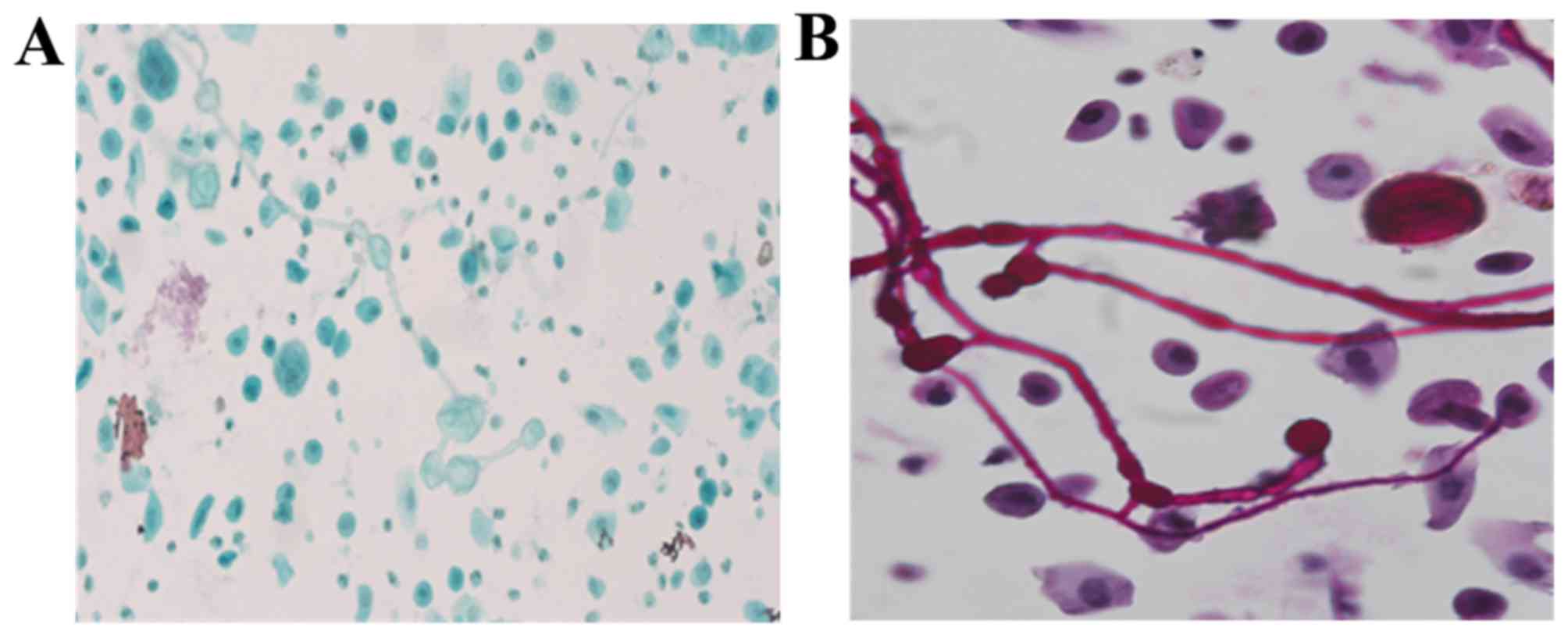
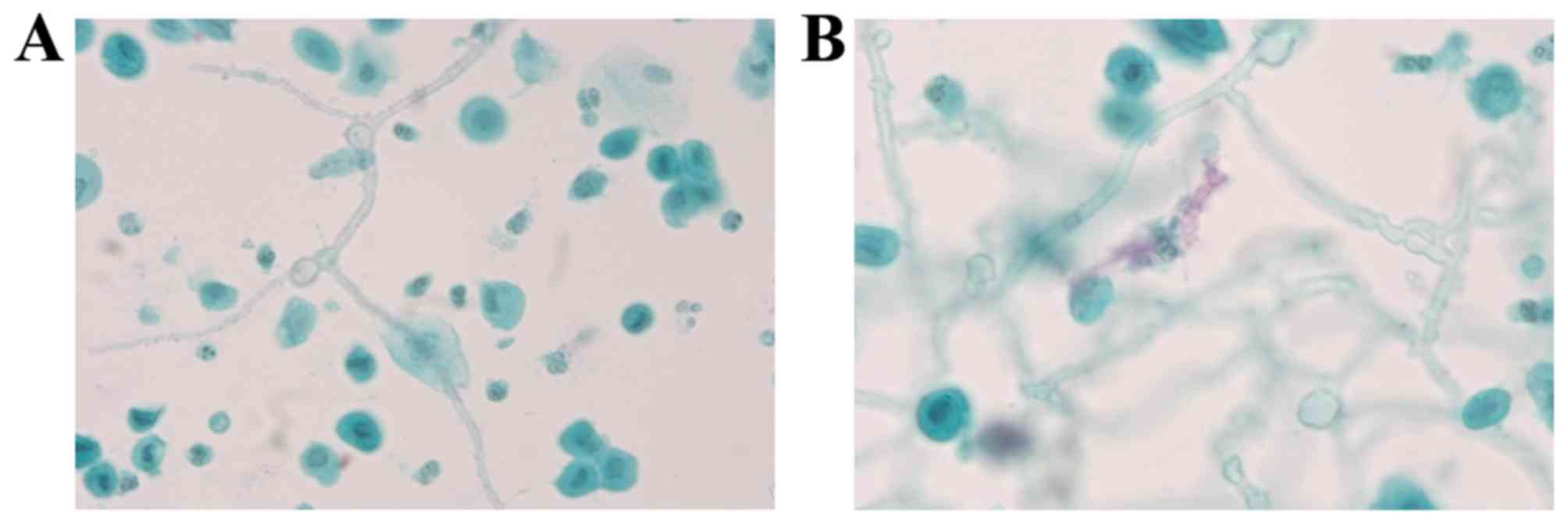
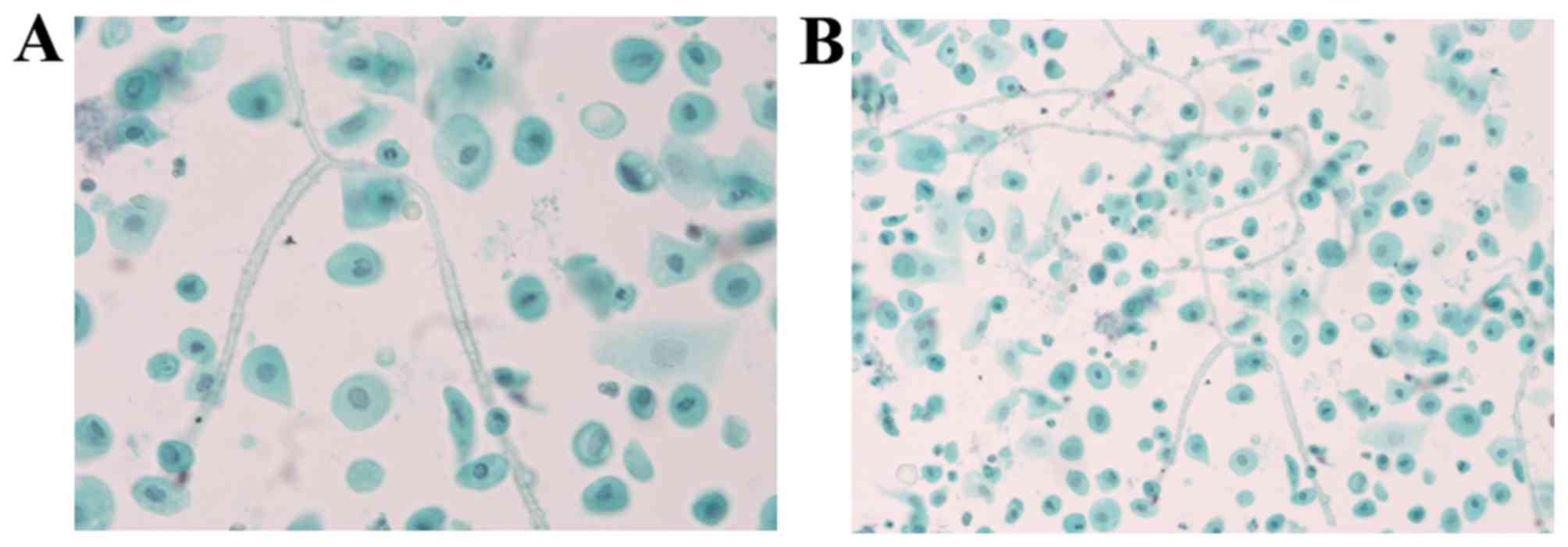
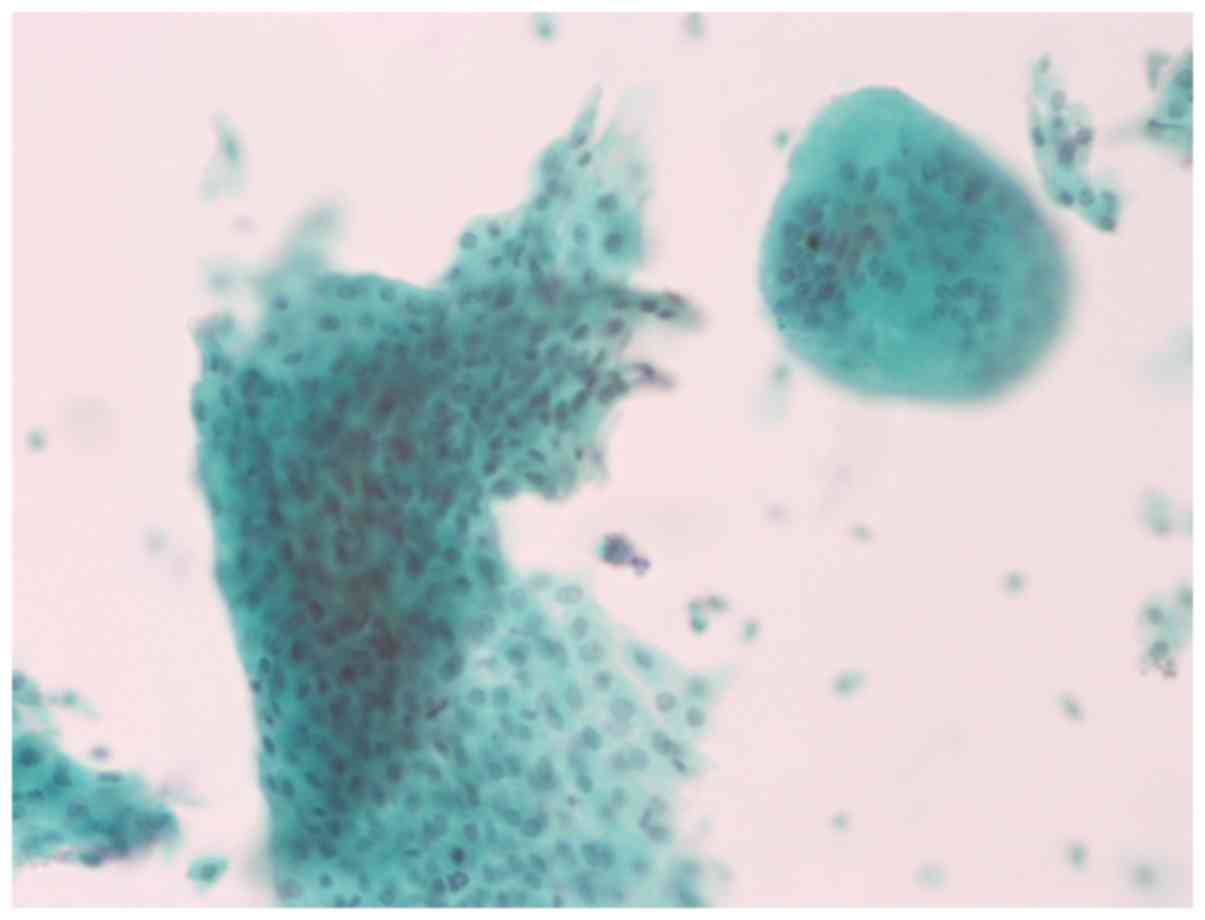
As laboratory contamination is a diagnostic challenge, and even though fungal structures were observed in the same plane as cells, a novel aliquot was created from the same sample (Fig. 1). The second slide demonstrated the same findings and Periodic acid-Schiff (PAS) staining was used to highlight the microorganisms (Fig. 2). As the patient was asymptomatic it was decided to obtain a novel sample 10 days later to rule out cross-contamination. This second sample again presented numerous hyphae and vesicles consistent with Aspergillus (Fig. 3). Post-treatment cytology, also liquid-based, exhibited large numbers of parabasal cells, a cleaner background, multinucleated giant cells and an absence of fungi (Fig. 4). Treatment was initiated with vaginal itraconazole for seven days, although the patient was asymptomatic. The only risk factor that was established was occasional cleansing of the genital area after cleansing of the nostrils, using the same handkerchief.

Figure 1.

Liquid-based cytology. (A) Dichotomous branching of septate hyphae in Aspergillus (Papanicolaou staining using the PAS technique; magnification, ×4). (B) PAS staining highlights these characteristics (magnification, ×40). PAS, Periodic Acid-Schiff.

Figure 2.

Verification of the presence of Aspergillus. The sample was further analyzed by PAS staining. These correspond to the Aspergillus structures previously observed in Fig. 1. (A) Magnification, ×4. (B) Magnification, ×40.

Figure 3.

Sample obtained 10 days after the first stains. PAS technique of the progressive acute angle dichotomous branching of Aspergillus. The possibility of previous cross-contamination was discarded. (A) Magnification, ×40. (B) Magnification, ×4.

Figure 4.

Post-treatment smear test (third sample). Atrophic smear, exhibiting an increased number of basal and parabasal cells in sheets with a clean background. PAS technique; magnification, ×4.

The fruiting bodies of Aspergillus provide information about this fungus and its species. Identification of the length and size of the conidiophore, as well as the shape of the vesicles of the conidia, are important. In histological sections and smears, thick and uniform septate hyphae (3–6 µm) are observed. In addition, a dichotomy division at an angle of 45° is characteristic (4). These findings correlate with the fungus that was observed in multiple smears in the present study. The fungus is easily observed using a Pap smear; however, stains for fungi, such as PAS and Grocott, highlight the morphology. Conidia are rarely observed in tissue samples in human infections, as these forms when the fungus is exposed to air.

Conidia are observed in conditions, such as fungus ball/aspergillomas. The observation of Aspergillus in a Pap smear is rare. It can represent a symptomatic infection in immunosuppressed patients or patients undergoing prolonged antibiotic treatment or in patients with a contamination. Previous studies have reported that equipment used for the Pap test (vaginal mirrors, foil and spray attachments) may be contaminated (5–8). In the current case, the quantity of pseudo-hyphae and the presence of a significant chronic inflammatory infiltrate, in addition to its position in the same plane as the epithelial cells, indicated that this was a genuine infection.

Discussion

There are previous reports on the presence of Aspergillus in smear tests. Certain reports describe cervical smears where the authors conclude that the results could be due to contamination, as the other five slides exhibited the same hyphae (5,6). Additional case reports exhibited a smear test result with a description of a fruiting body in a patient (6,7). Deb and Srivastava (3) and Gupta et al (5) reported concomitant Aspergillus in patients with high-grade intraepithelial lesions, which could be explained by their immunocompromised state (3,5,9). To the best of our knowledge, Hoda et al (10) are the only other authors to report on liquid-based Aspergillus, identifying only one fruiting body; however, they do not report any inflammatory infiltrate or hyphae that could clarify whether the finding was due to contamination (10).

Identification of a fungus that tends to cause systemic infection alerts the attending physician to look for and identify risk factors, specifically factors that lead to immunocompromise. In the current case, all the necessary precautions were taken to identify whether this was truly an infection rather than a contamination. Initially, all slides that were processed immediately were evaluated to observe any pseudo-hyphae, in addition to repeating the liquid-based cytology to rule out equipment contamination in the cytology department. Finally, a second cytology specimen was performed with completely different equipment from that which was used during the first sample. Once the diagnosis of Aspergillus was confirmed, adequate treatment was administered. All appropriate measures were taken to confirm that the observation of cervicovaginal Aspergillus infection from liquid-based cytology and a Pap smear was not due to contamination.

Acknowledgements

The authors would like to thank Dr Sergio Lozano-Rodríguez for the critical reading of the manuscript.

References

1 

Sullam SA, Mahfouz AA, Dabbous NI, el-Barrawy M and el-Said MM: Reproductive tract infections among married women in Upper Egypt. East Mediterr Health J. 7:139–146. 2001.PubMed/NCBI

2 

Sheyn I, Mira JL and Thompson MB: Paracoccidioides brasiliensis in a postpartum Pap smear. A case report. Acta Cytol. 45:79–81. 2001. View Article : Google Scholar : PubMed/NCBI

3 

Deb P and Srivastava A: Aspergillus in a cervico-vaginal smear of an adult postmenopausal female: An unusual case. J Cytol. 26:123–124. 2009. View Article : Google Scholar : PubMed/NCBI

4 

Donta B, Naik DD, Mali BN, Bandiwadekar A, Ramnath K and Rao M: ‘Fruiting body’ Penicillium species: Papanicolaou stained conventional cervical smear findings. Diagn Cytopathol. 38:34–35. 2010.PubMed/NCBI

5 

Gupta P, Goyal S and Kaushal M: Concomitant aspergillus species infection and squamous cell carcinoma diagnosed on Pap smear. Turk Patoloji Derg. 32:54–56. 2016.PubMed/NCBI

6 

Brimo F, Ouad L, Brodeur J, Charbonneau M and Auger M: Unusual microbial organisms seen in two cervical smears. Diagn Cytopathol. 37:836–838. 2009. View Article : Google Scholar : PubMed/NCBI

7 

Martínez-Girón R and Fernández-García C: Aspergillus/Penicillium sp. spores as a contaminant on conventional Pap smear. Diagn Cytopathol. 37:899–900. 2009. View Article : Google Scholar : PubMed/NCBI

8 

Policarpio-Nicolas ML, Covell J, Moore K and Stelow EB: ‘Paintbrush’ appearance of Penicillium species in Thin-Prep cervico-vaginal (Pap) test. Diagn Cytopathol. 36:721–722. 2008. View Article : Google Scholar : PubMed/NCBI

9 

Chandra S, Gaur D, Harsh M, Chaturvedi J and Kishore S: An unusual presentation of Aspergillus species in a routine cervicovaginal pap smear: A case report. Acta Cytol. 53:229–231. 2009. View Article : Google Scholar : PubMed/NCBI

10 

Hoda RS, Colello C, Roddy M and Houser PM: ‘Fruiting body’ of Aspergillus species in a routine cervico-vaginal smear (Pap test). Diagn Cytopathol. 33:244–245. 2005. View Article : Google Scholar : PubMed/NCBI

Related Articles

  • Abstract
  • View
  • Download
  • Twitter
Copy and paste a formatted citation
Spandidos Publications style
Garza‑Guajardo R, Canales‑Martínez LC, Rodríguez‑Sánchez IP, Sánchez‑Chaparro MM, Gómez-Macías GS, Vilches-Cisneros N and Barboza-Quintana O: Aspergillus in liquid‑based cervicovaginal cytology in a postmenopausal patient: A case report. Biomed Rep 7: 306-308, 2017.
APA
Garza‑Guajardo, R., Canales‑Martínez, L.C., Rodríguez‑Sánchez, I.P., Sánchez‑Chaparro, M.M., Gómez-Macías, G.S., Vilches-Cisneros, N., & Barboza-Quintana, O. (2017). Aspergillus in liquid‑based cervicovaginal cytology in a postmenopausal patient: A case report. Biomedical Reports, 7, 306-308. https://doi.org/10.3892/br.2017.974
MLA
Garza‑Guajardo, R., Canales‑Martínez, L. C., Rodríguez‑Sánchez, I. P., Sánchez‑Chaparro, M. M., Gómez-Macías, G. S., Vilches-Cisneros, N., Barboza-Quintana, O."Aspergillus in liquid‑based cervicovaginal cytology in a postmenopausal patient: A case report". Biomedical Reports 7.4 (2017): 306-308.
Chicago
Garza‑Guajardo, R., Canales‑Martínez, L. C., Rodríguez‑Sánchez, I. P., Sánchez‑Chaparro, M. M., Gómez-Macías, G. S., Vilches-Cisneros, N., Barboza-Quintana, O."Aspergillus in liquid‑based cervicovaginal cytology in a postmenopausal patient: A case report". Biomedical Reports 7, no. 4 (2017): 306-308. https://doi.org/10.3892/br.2017.974
Copy and paste a formatted citation
x
Spandidos Publications style
Garza‑Guajardo R, Canales‑Martínez LC, Rodríguez‑Sánchez IP, Sánchez‑Chaparro MM, Gómez-Macías GS, Vilches-Cisneros N and Barboza-Quintana O: Aspergillus in liquid‑based cervicovaginal cytology in a postmenopausal patient: A case report. Biomed Rep 7: 306-308, 2017.
APA
Garza‑Guajardo, R., Canales‑Martínez, L.C., Rodríguez‑Sánchez, I.P., Sánchez‑Chaparro, M.M., Gómez-Macías, G.S., Vilches-Cisneros, N., & Barboza-Quintana, O. (2017). Aspergillus in liquid‑based cervicovaginal cytology in a postmenopausal patient: A case report. Biomedical Reports, 7, 306-308. https://doi.org/10.3892/br.2017.974
MLA
Garza‑Guajardo, R., Canales‑Martínez, L. C., Rodríguez‑Sánchez, I. P., Sánchez‑Chaparro, M. M., Gómez-Macías, G. S., Vilches-Cisneros, N., Barboza-Quintana, O."Aspergillus in liquid‑based cervicovaginal cytology in a postmenopausal patient: A case report". Biomedical Reports 7.4 (2017): 306-308.
Chicago
Garza‑Guajardo, R., Canales‑Martínez, L. C., Rodríguez‑Sánchez, I. P., Sánchez‑Chaparro, M. M., Gómez-Macías, G. S., Vilches-Cisneros, N., Barboza-Quintana, O."Aspergillus in liquid‑based cervicovaginal cytology in a postmenopausal patient: A case report". Biomedical Reports 7, no. 4 (2017): 306-308. https://doi.org/10.3892/br.2017.974
Follow us
  • Twitter
  • LinkedIn
  • Facebook
About
  • Spandidos Publications
  • Careers
  • Cookie Policy
  • Privacy Policy
How can we help?
  • Help
  • Live Chat
  • Contact
  • Email to our Support Team