Spandidos Publications Logo
  • About
    • About Spandidos
    • Aims and Scopes
    • Abstracting and Indexing
    • Editorial Policies
    • Reprints and Permissions
    • Job Opportunities
    • Terms and Conditions
    • Contact
  • Journals
    • All Journals
    • Oncology Letters
      • Oncology Letters
      • Information for Authors
      • Editorial Policies
      • Editorial Board
      • Aims and Scope
      • Abstracting and Indexing
      • Bibliographic Information
      • Archive
    • International Journal of Oncology
      • International Journal of Oncology
      • Information for Authors
      • Editorial Policies
      • Editorial Board
      • Aims and Scope
      • Abstracting and Indexing
      • Bibliographic Information
      • Archive
    • Molecular and Clinical Oncology
      • Molecular and Clinical Oncology
      • Information for Authors
      • Editorial Policies
      • Editorial Board
      • Aims and Scope
      • Abstracting and Indexing
      • Bibliographic Information
      • Archive
    • Experimental and Therapeutic Medicine
      • Experimental and Therapeutic Medicine
      • Information for Authors
      • Editorial Policies
      • Editorial Board
      • Aims and Scope
      • Abstracting and Indexing
      • Bibliographic Information
      • Archive
    • International Journal of Molecular Medicine
      • International Journal of Molecular Medicine
      • Information for Authors
      • Editorial Policies
      • Editorial Board
      • Aims and Scope
      • Abstracting and Indexing
      • Bibliographic Information
      • Archive
    • Biomedical Reports
      • Biomedical Reports
      • Information for Authors
      • Editorial Policies
      • Editorial Board
      • Aims and Scope
      • Abstracting and Indexing
      • Bibliographic Information
      • Archive
    • Oncology Reports
      • Oncology Reports
      • Information for Authors
      • Editorial Policies
      • Editorial Board
      • Aims and Scope
      • Abstracting and Indexing
      • Bibliographic Information
      • Archive
    • Molecular Medicine Reports
      • Molecular Medicine Reports
      • Information for Authors
      • Editorial Policies
      • Editorial Board
      • Aims and Scope
      • Abstracting and Indexing
      • Bibliographic Information
      • Archive
    • World Academy of Sciences Journal
      • World Academy of Sciences Journal
      • Information for Authors
      • Editorial Policies
      • Editorial Board
      • Aims and Scope
      • Abstracting and Indexing
      • Bibliographic Information
      • Archive
    • International Journal of Functional Nutrition
      • International Journal of Functional Nutrition
      • Information for Authors
      • Editorial Policies
      • Editorial Board
      • Aims and Scope
      • Abstracting and Indexing
      • Bibliographic Information
      • Archive
    • International Journal of Epigenetics
      • International Journal of Epigenetics
      • Information for Authors
      • Editorial Policies
      • Editorial Board
      • Aims and Scope
      • Abstracting and Indexing
      • Bibliographic Information
      • Archive
    • Medicine International
      • Medicine International
      • Information for Authors
      • Editorial Policies
      • Editorial Board
      • Aims and Scope
      • Abstracting and Indexing
      • Bibliographic Information
      • Archive
  • Articles
  • Information
    • Information for Authors
    • Information for Reviewers
    • Information for Librarians
    • Information for Advertisers
    • Conferences
  • Language Editing
Spandidos Publications Logo
  • About
    • About Spandidos
    • Aims and Scopes
    • Abstracting and Indexing
    • Editorial Policies
    • Reprints and Permissions
    • Job Opportunities
    • Terms and Conditions
    • Contact
  • Journals
    • All Journals
    • Biomedical Reports
      • Information for Authors
      • Editorial Policies
      • Editorial Board
      • Aims and Scope
      • Abstracting and Indexing
      • Bibliographic Information
      • Archive
    • Experimental and Therapeutic Medicine
      • Information for Authors
      • Editorial Policies
      • Editorial Board
      • Aims and Scope
      • Abstracting and Indexing
      • Bibliographic Information
      • Archive
    • International Journal of Epigenetics
      • Information for Authors
      • Editorial Policies
      • Editorial Board
      • Aims and Scope
      • Abstracting and Indexing
      • Bibliographic Information
      • Archive
    • International Journal of Functional Nutrition
      • Information for Authors
      • Editorial Policies
      • Editorial Board
      • Aims and Scope
      • Abstracting and Indexing
      • Bibliographic Information
      • Archive
    • International Journal of Molecular Medicine
      • Information for Authors
      • Editorial Policies
      • Editorial Board
      • Aims and Scope
      • Abstracting and Indexing
      • Bibliographic Information
      • Archive
    • International Journal of Oncology
      • Information for Authors
      • Editorial Policies
      • Editorial Board
      • Aims and Scope
      • Abstracting and Indexing
      • Bibliographic Information
      • Archive
    • Medicine International
      • Information for Authors
      • Editorial Policies
      • Editorial Board
      • Aims and Scope
      • Abstracting and Indexing
      • Bibliographic Information
      • Archive
    • Molecular and Clinical Oncology
      • Information for Authors
      • Editorial Policies
      • Editorial Board
      • Aims and Scope
      • Abstracting and Indexing
      • Bibliographic Information
      • Archive
    • Molecular Medicine Reports
      • Information for Authors
      • Editorial Policies
      • Editorial Board
      • Aims and Scope
      • Abstracting and Indexing
      • Bibliographic Information
      • Archive
    • Oncology Letters
      • Information for Authors
      • Editorial Policies
      • Editorial Board
      • Aims and Scope
      • Abstracting and Indexing
      • Bibliographic Information
      • Archive
    • Oncology Reports
      • Information for Authors
      • Editorial Policies
      • Editorial Board
      • Aims and Scope
      • Abstracting and Indexing
      • Bibliographic Information
      • Archive
    • World Academy of Sciences Journal
      • Information for Authors
      • Editorial Policies
      • Editorial Board
      • Aims and Scope
      • Abstracting and Indexing
      • Bibliographic Information
      • Archive
  • Articles
  • Information
    • For Authors
    • For Reviewers
    • For Librarians
    • For Advertisers
    • Conferences
  • Language Editing
Login Register Submit
  • This site uses cookies
  • You can change your cookie settings at any time by following the instructions in our Cookie Policy. To find out more, you may read our Privacy Policy.

    I agree
Search articles by DOI, keyword, author or affiliation
Search
Advanced Search
presentation
Biomedical Reports
Join Editorial Board Propose a Special Issue
Print ISSN: 2049-9434 Online ISSN: 2049-9442
Journal Cover
February-2019 Volume 10 Issue 2

Full Size Image

Sign up for eToc alerts
Recommend to Library

Journals

International Journal of Molecular Medicine

International Journal of Molecular Medicine

International Journal of Molecular Medicine is an international journal devoted to molecular mechanisms of human disease.

International Journal of Oncology

International Journal of Oncology

International Journal of Oncology is an international journal devoted to oncology research and cancer treatment.

Molecular Medicine Reports

Molecular Medicine Reports

Covers molecular medicine topics such as pharmacology, pathology, genetics, neuroscience, infectious diseases, molecular cardiology, and molecular surgery.

Oncology Reports

Oncology Reports

Oncology Reports is an international journal devoted to fundamental and applied research in Oncology.

Experimental and Therapeutic Medicine

Experimental and Therapeutic Medicine

Experimental and Therapeutic Medicine is an international journal devoted to laboratory and clinical medicine.

Oncology Letters

Oncology Letters

Oncology Letters is an international journal devoted to Experimental and Clinical Oncology.

Biomedical Reports

Biomedical Reports

Explores a wide range of biological and medical fields, including pharmacology, genetics, microbiology, neuroscience, and molecular cardiology.

Molecular and Clinical Oncology

Molecular and Clinical Oncology

International journal addressing all aspects of oncology research, from tumorigenesis and oncogenes to chemotherapy and metastasis.

World Academy of Sciences Journal

World Academy of Sciences Journal

Multidisciplinary open-access journal spanning biochemistry, genetics, neuroscience, environmental health, and synthetic biology.

International Journal of Functional Nutrition

International Journal of Functional Nutrition

Open-access journal combining biochemistry, pharmacology, immunology, and genetics to advance health through functional nutrition.

International Journal of Epigenetics

International Journal of Epigenetics

Publishes open-access research on using epigenetics to advance understanding and treatment of human disease.

Medicine International

Medicine International

An International Open Access Journal Devoted to General Medicine.

Journal Cover
February-2019 Volume 10 Issue 2

Full Size Image

Sign up for eToc alerts
Recommend to Library

  • Article
  • Citations
    • Cite This Article
    • Download Citation
    • Create Citation Alert
    • Remove Citation Alert
    • Cited By
  • Similar Articles
    • Related Articles (in Spandidos Publications)
    • Similar Articles (Google Scholar)
    • Similar Articles (PubMed)
  • Download PDF
  • Download XML
  • View XML
Article Open Access

Alteration in cardiac PI3K/Akt/mTOR and ERK signaling pathways with the use of growth hormone and swimming, and the roles of miR21 and miR133

  • Authors:
    • Orkide Palabiyik
    • Ebru Tastekin
    • Zeynep Banu Doganlar
    • Pinar Tayfur
    • Ayten Dogan
    • Selma Arzu Vardar
  • View Affiliations / Copyright

    Affiliations: Department of Medical Services and Techniques, Trakya University Health Services Vocational College, Edirne 22030, Turkey, Department of Pathology, Trakya University Faculty of Medicine, Edirne 22030, Turkey, Department of Medical Biology, Trakya University Faculty of Medicine, Edirne 22030, Turkey, Department of Physiology, Trakya University Faculty of Medicine, Edirne 22030, Turkey
    Copyright: © Palabiyik et al. This is an open access article distributed under the terms of Creative Commons Attribution License.
  • Pages: 97-106
    |
    Published online on: December 13, 2018
       https://doi.org/10.3892/br.2018.1179
  • Expand metrics +
Metrics: Total Views: 0 (Spandidos Publications: | PMC Statistics: )
Metrics: Total PDF Downloads: 0 (Spandidos Publications: | PMC Statistics: )
Cited By (CrossRef): 0 citations Loading Articles...

This article is mentioned in:


Abstract

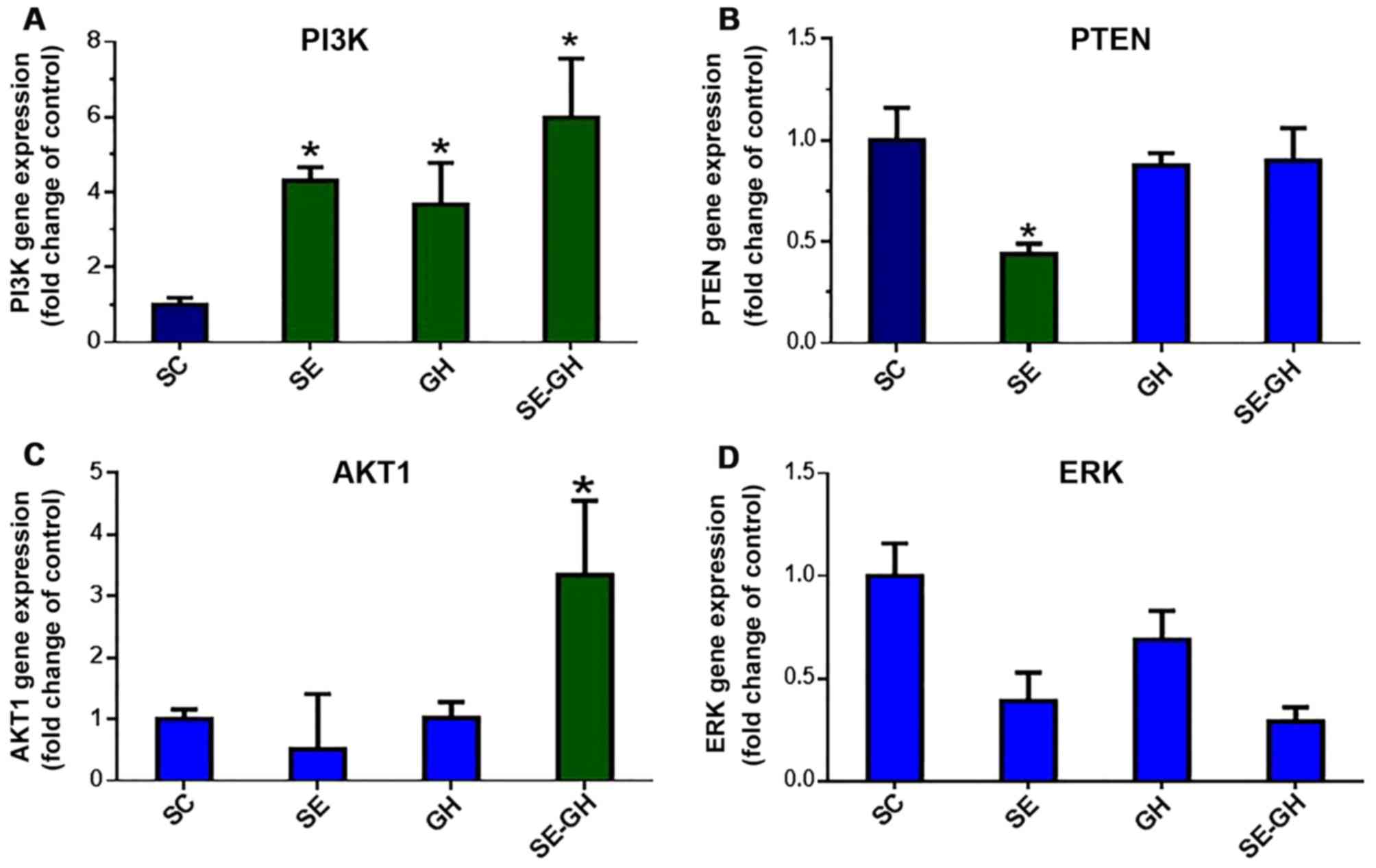
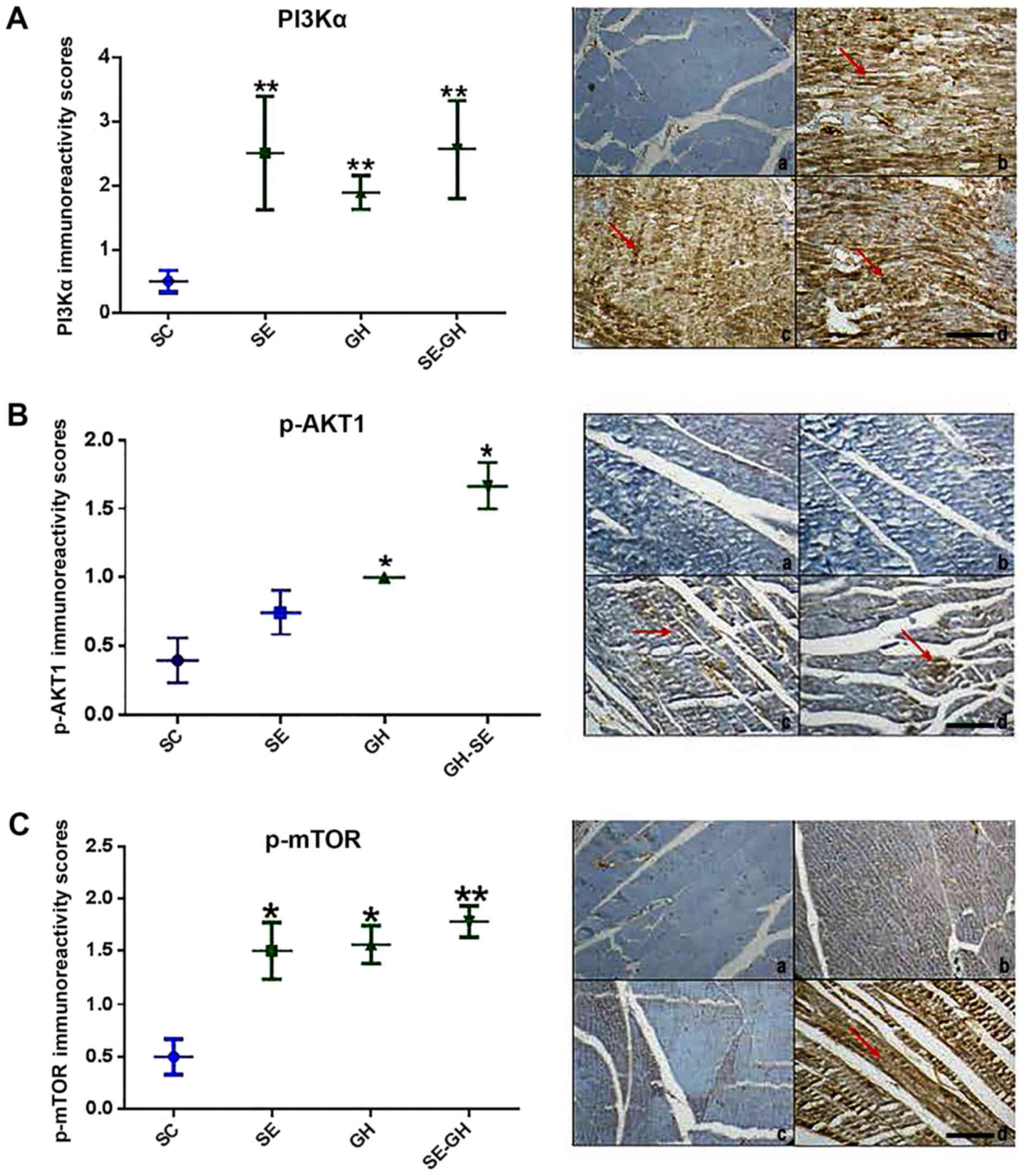
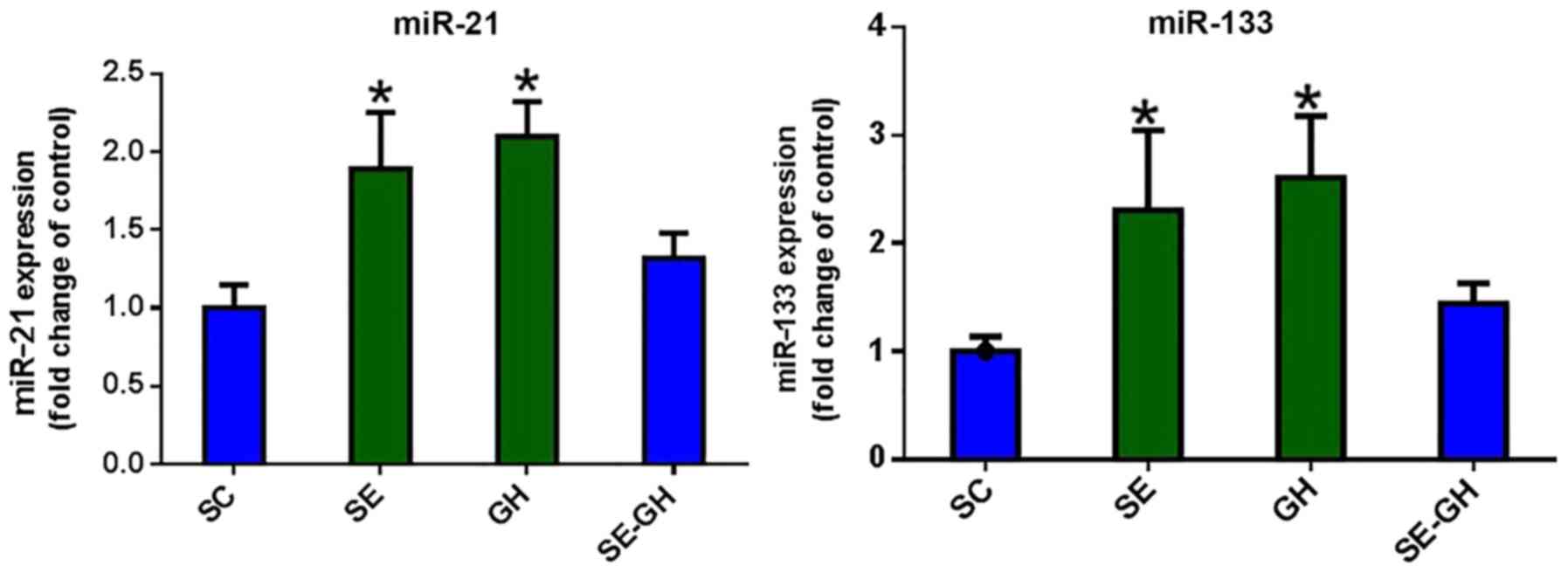
Athletes misuse recombinant human growth hormone (r‑hGH) to enhance their performance. Although r‑hGH is known to increase cardiac hypertrophy, the underlying molecular mechanism remains unclear. The aim of the present study was to investigate the role of r‑hGH in cardiac intracellular signaling pathways and of miR‑21 and miR‑133 expression in rat hearts during exercise. A total of 36 adult male Sprague‑Dawley rats were divided into sedentary control (SC, n=9), swimming exercise (SE, n=8), r‑hGH (GH, n=10) and swimming exercise plus r‑hGH (SE‑GH, n=9) groups. The exercise groups completed a 1‑h swimming exercise 5 times a week for 8 weeks. Subcutaneous r‑hGH was administered as 0.3 mg/kg/day. Phosphoinositide‑3‑kinase (PI3K), serine/threonine protein kinase 1 (AKT1), extracellular signal‑regulated kinase (ERK), microRNA (miR)‑21 and miR‑133 expression was evaluated in ventricular muscle by real‑time quantitative polymerase chain reaction. Protein expression of PI3K, AKT1, ERK and mechanistic target of rapamycin (mTOR) was also assessed by immunohistochemistry. Statistical differences were analyzed by two‑way ANOVA. PI3K and AKT1 expression and the gene and protein levels was notably increased in the SE‑GH group compared with in SC ventricular tissues (P<0.05). mTOR protein expression was higher in the GH, SE and SE‑GH groups compared with in the SC group (P<0.05, <0.05 and <0.001, respectively). ERK gene/protein expression was similar across all groups. miR‑21 and miR‑133 levels in ventricular muscle were higher in the SE and GH groups than those in the SC group. In summary, growth hormone application coupled with swimming exercise appeared to affect the PI3K/AKT/mTOR signaling pathway in the left ventricular tissue of rats; however, ERK signaling pathway appeared inactive in physiological left ventricular hypertrophy caused by swimming and GH administration over 8 weeks. Furthermore, GH treatment resulted in increased miR‑21 and miR‑133 expression. Future study by our group will aim to assess the effects of higher dose GH treatment.
View Figures

Figure 1

Figure 2

Figure 3

Figure 4

View References

1 

Graham MR, Baker JS, Evans P, Kicman A, Cowan D, Hullin D, Thomas N and Davies B: Physical effects of short-term recombinant human growth hormone administration in abstinent steroid dependency. Horm Res. 69:343–354. 2008.PubMed/NCBI View Article : Google Scholar

2 

Jenkins PJ: Growth hormone and exercise. Clin Endocrinol (Oxf). 50:683–689. 1999.PubMed/NCBI View Article : Google Scholar

3 

Castellano G, Affuso F, Conza PD and Fazio S: The GH/IGF-1 Axis and Heart Failure. Curr Cardiol Rev. 5:203–215. 2009.PubMed/NCBI View Article : Google Scholar

4 

Colao A, Marzullo P, Di Somma C and Lombardi G: Growth hormone and the heart. Clin Endocrinol (Oxf). 54:137–154. 2001.PubMed/NCBI View Article : Google Scholar

5 

World Anti-Doping Agency: The 2010 Prohibited List. International Standard. https://www.wada-ama.org/sites/default/files/resources/files/WADA_Prohibited_List_2010_EN.pdf. Accessed September 19. 2009.

6 

Voss SC, Giraud S, Alsayrafi M, Bourdon PC, Schumacher YO, Saugy M and Robinson N: The effect of a period of intensive exercise on the isoform test to detect growth hormone doping in sports. Growth Horm IGF Res. 23:105–108. 2013.PubMed/NCBI View Article : Google Scholar

7 

Ma Z, Qi J, Meng S, Wen B and Zhang J: Swimming exercise training-induced left ventricular hypertrophy involves microRNAs and synergistic regulation of the PI3K/AKT/mTOR signaling pathway. Eur J Appl Physiol. 113:2473–2486. 2013.PubMed/NCBI View Article : Google Scholar

8 

Heineke J and Molkentin JD: Regulation of cardiac hypertrophy by intracellular signalling pathways. Nat Rev Mol Cell Biol. 7:589–600. 2006.PubMed/NCBI View Article : Google Scholar

9 

Guertin DA and Sabatini DM: Defining the role of mTOR in cancer. Cancer Cell. 12:9–22. 2007.PubMed/NCBI View Article : Google Scholar

10 

Sugden PH and Clerk A: ‘Stress-responsive’ mitogen-activated protein kinases (c-Jun N-terminal kinases and p38 mitogen-activated protein kinases) in the myocardium. Circ Res. 83:345–352. 1998.PubMed/NCBI

11 

Purcell NH, Wilkins BJ, York A, Saba-El-Leil MK, Meloche S, Robbins J and Molkentin JD: Genetic inhibition of cardiac ERK1/2 promotes stress-induced apoptosis and heart failure but has no effect on hypertrophy in vivo. Proc Natl Acad Sci USA. 104:14074–14079. 2007.PubMed/NCBI View Article : Google Scholar

12 

Hutvágner G and Zamore PD: A microRNA in a multiple-turnover RNAi enzyme complex. Science. 297:2056–2060. 2002.PubMed/NCBI View Article : Google Scholar

13 

Bartel DP: MicroRNAs: genomics, biogenesis, mechanism, and function. Cell. 116:281–297. 2004.PubMed/NCBI View Article : Google Scholar

14 

Bao H, Hu S, Zhang C, Shi S, Qin W, Zeng C, Zen K and Liu Z: Inhibition of miRNA-21 prevents fibrogenic activation in podocytes and tubular cells in IgA nephropathy. Biochem Biophys Res Commun. 444:455–460. 2014.PubMed/NCBI View Article : Google Scholar

15 

Da Costa Martins PA and De Windt LJ: Targeting microRNA targets. Circ Res. 111:506–508. 2012.PubMed/NCBI View Article : Google Scholar

16 

Cheng YS, Tang YQ, Dai DZ and Dai Y: AQP4 knockout mice manifest abnormal expressions of calcium handling proteins possibly due to exacerbating pro-inflammatory factors in the heart. Biochem Pharmacol. 83:97–105. 2012.PubMed/NCBI View Article : Google Scholar

17 

Da Costa Martins PA and De Windt LJ: MicroRNAs in control of cardiac hypertrophy. Cardiovasc Res. 93:563–572. 2012.PubMed/NCBI View Article : Google Scholar

18 

Wang L, Li X, Zhou Y, Shi H, Xu C, He H, Wang S, Xiong X, Zhang Y, Du Z and et al: Downregulation of miR-133 via MAPK/ERK signaling pathway involved in nicotine-induced cardiomyocyte apoptosis. Naunyn Schmiedebergs Arch Pharmacol. 387:197–206. 2014.PubMed/NCBI View Article : Google Scholar

19 

Dong DL, Chen C, Huo R, Wang N, Li Z, Tu YJ, Hu JT, Chu X, Huang W and Yang BF: Reciprocal repression between microRNA-133 and calcineurin regulates cardiac hypertrophy: A novel mechanism for progressive cardiac hypertrophy. Hypertension. 55:946–952. 2010.PubMed/NCBI View Article : Google Scholar

20 

Dong S, Ma W, Hao B, Hu F, Yan L, Yan X, Wang Y, Chen Z and Wang Z: microRNA-21 promotes cardiac fibrosis and development of heart failure with preserved left ventricular ejection fraction by up-regulating Bcl-2. Int J Clin Exp Pathol. 7:565–574. 2014.PubMed/NCBI

21 

DA Silva ND Jr, Fernandes T, Soci UP, Monteiro AW and Phillips MI and DE Oliveira EM: Swimming training in rats increases cardiac MicroRNA-126 expression and angiogenesis. Med Sci Sports Exerc. 44:1453–1462. 2012.PubMed/NCBI View Article : Google Scholar

22 

Oliveira EM, Sasaki MS, Cerêncio M, Baraúna VG and Krieger JE: Local renin-angiotensin system regulates left ventricular hypertrophy induced by swimming training independent of circulating renin: A pharmacological study. J Renin Angiotensin Aldosterone Syst. 10:15–23. 2009.PubMed/NCBI View Article : Google Scholar

23 

Livak KJ and Schmittgen TD: Analysis of relative gene expression data using real-time quantitative PCR and the 2(-Delta Delta C(T)) method. Methods. 25:402–408. 2001.PubMed/NCBI View Article : Google Scholar

24 

Hirata Y, Murai N, Yanaihara N, Saito M, Saito M, Urashima M, Murakami Y, Matsufuji S and Okamoto A: MicroRNA-21 is a candidate driver gene for 17q23-25 amplification in ovarian clear cell carcinoma. BMC Cancer. 14(799)2014.PubMed/NCBI View Article : Google Scholar

25 

Iijima Y, Seike M, Noro R, Ibi T, Takeuchi S, Mikami I, Koizumi K, Usuda J and Gemma A: Prognostic significance of PIK3CA and SOX2 in Asian patients with lung squamous cell carcinoma. Int J Oncol. 46:505–512. 2015.PubMed/NCBI View Article : Google Scholar

26 

Zhou X, Tan M, Stone Hawthorne V, Klos KS, Lan KH, Yang Y, Yang W, Smith TL, Shi D and Yu D: Activation of the Akt/mammalian target of rapamycin/4E-BP1 pathway by ErbB2 overexpression predicts tumor progression in breast cancers. Clin Cancer Res. 10:6779–6788. 2004.PubMed/NCBI View Article : Google Scholar

27 

Domenighetti AA, Danes VR, Curl CL, Favaloro JM, Proietto J and Delbridge LM: Targeted GLUT-4 deficiency in the heart induces cardiomyocyte hypertrophy and impaired contractility linked with Ca(2+) and proton flux dysregulation. J Mol Cell Cardiol. 48:663–672. 2010.PubMed/NCBI View Article : Google Scholar

28 

Chung E and Diffee GM: Effect of aging on power output properties in rat skinned cardiac myocytes. J Gerontol A Biol Sci Med Sci. 66:1267–1273. 2011.PubMed/NCBI View Article : Google Scholar

29 

Vikstrom KL, Bohlmeyer T, Factor SM and Leinwand LA: Hypertrophy, pathology, and molecular markers of cardiac pathogenesis. Circ Res. 82:773–778. 1998.PubMed/NCBI

30 

Saugy M, Robinson N, Saudan C, Baume N, Avois L and Mangin P: Human growth hormone doping in sport. Br J Sports Med. 40((Suppl 1)): i35–i39. 2006.PubMed/NCBI View Article : Google Scholar

31 

Cheng Y, Ji R, Yue J, Yang J, Liu X, Chen H, Dean DB and Zhang C: MicroRNAs are aberrantly expressed in hypertrophic heart: Do they play a role in cardiac hypertrophy? Am J Pathol. 170:1831–1840. 2007.PubMed/NCBI View Article : Google Scholar

32 

Soci UP, Fernandes T, Hashimoto NY, Mota GF, Amadeu MA, Rosa KT, Irigoyen MC, Phillips MI and Oliveira EM: MicroRNAs 29 are involved in the improvement of ventricular compliance promoted by aerobic exercise training in rats. Physiol Genomics. 43:665–673. 2011.PubMed/NCBI View Article : Google Scholar

33 

McMullen JR and Jennings GL: Differences between pathological and physiological cardiac hypertrophy: Novel therapeutic strategies to treat heart failure. Clin Exp Pharmacol Physiol. 34:255–262. 2007.PubMed/NCBI View Article : Google Scholar

34 

McMullen JR, Shioi T, Zhang L, Tarnavski O, Sherwood MC, Kang PM and Izumo S: Phosphoinositide 3-kinase(p110alpha) plays a critical role for the induction of physiological, but not pathological, cardiac hypertrophy. Proc Natl Acad Sci USA. 100:12355–12360. 2003.PubMed/NCBI View Article : Google Scholar

35 

Maehama T and Dixon JE: PTEN: A tumour suppressor that functions as a phospholipid phosphatase. Trends Cell Biol. 9:125–128. 1999.PubMed/NCBI View Article : Google Scholar

36 

Crackower MA, Oudit GY, Kozieradzki I, Sarao R, Sun H, Sasaki T, Hirsch E, Suzuki A, Shioi T, Irie-Sasaki J and et al: Regulation of myocardial contractility and cell size by distinct PI3K-PTEN signaling pathways. Cell. 110:737–749. 2002.PubMed/NCBI View Article : Google Scholar

37 

Bai L, Liang R, Yang Y, Hou X, Wang Z, Zhu S, Wang C, Tang Z and Li K: MicroRNA-21 Regulates PI3K/Akt/mTOR Signaling by Targeting TGFβI during Skeletal Muscle Development in Pigs. PLoS One. 10(e0119396)2015.PubMed/NCBI View Article : Google Scholar

38 

DeBosch B, Treskov I, Lupu TS, Weinheimer C, Kovacs A, Courtois M and Muslin AJ: Akt1 is required for physiological cardiac growth. Circulation. 113:2097–2104. 2006.PubMed/NCBI View Article : Google Scholar

39 

Cho H, Thorvaldsen JL, Chu Q, Feng F and Birnbaum MJ: Akt1/PKBalpha is required for normal growth but dispensable for maintenance of glucose homeostasis in mice. J Biol Chem. 276:38349–38352. 2001.PubMed/NCBI View Article : Google Scholar

40 

Shioi T, McMullen JR, Tarnavski O, Converso K, Sherwood MC, Manning WJ and Izumo S: Rapamycin attenuates load-induced cardiac hypertrophy in mice. Circulation. 107:1664–1670. 2003.PubMed/NCBI View Article : Google Scholar

41 

Leontieva OV, Paszkiewicz GM and Blagosklonny MV: Mechanistic or mammalian target of rapamycin (mTOR) may determine robustness in young male mice at the cost of accelerated aging. Aging (Albany NY). 4:899–916. 2012.PubMed/NCBI View Article : Google Scholar

42 

Chen JF, Mandel EM, Thomson JM, Wu Q, Callis TE, Hammond SM, Conlon FL and Wang DZ: The role of microRNA-1 and microRNA-133 in skeletal muscle proliferation and differentiation. Nat Genet. 38:228–233. 2006.PubMed/NCBI View Article : Google Scholar

43 

Horie T, Ono K, Nishi H, Iwanaga Y, Nagao K, Kinoshita M, Kuwabara Y, Takanabe R, Hasegawa K, Kita T and et al: MicroRNA-133 regulates the expression of GLUT4 by targeting KLF15 and is involved in metabolic control in cardiac myocytes. Biochem Biophys Res Commun. 389:315–320. 2009.PubMed/NCBI View Article : Google Scholar

44 

van Rooij E, Sutherland LB, Liu N, Williams AH, McAnally J, Gerard RD, Richardson JA and Olson EN: A signature pattern of stress-responsive microRNAs that can evoke cardiac hypertrophy and heart failure. Proc Natl Acad Sci USA. 103:18255–18260. 2006.PubMed/NCBI View Article : Google Scholar

45 

Abdellatif M: The role of microRNA-133 in cardiac hypertrophy uncovered. Circ Res. 106:16–18. 2010.PubMed/NCBI View Article : Google Scholar

Related Articles

  • Abstract
  • View
  • Download
  • Twitter
Copy and paste a formatted citation
Spandidos Publications style
Palabiyik O, Tastekin E, Doganlar ZB, Tayfur P, Dogan A and Vardar SA: Alteration in cardiac PI3K/Akt/mTOR and ERK signaling pathways with the use of growth hormone and swimming, and the roles of miR21 and miR133. Biomed Rep 10: 97-106, 2019.
APA
Palabiyik, O., Tastekin, E., Doganlar, Z.B., Tayfur, P., Dogan, A., & Vardar, S.A. (2019). Alteration in cardiac PI3K/Akt/mTOR and ERK signaling pathways with the use of growth hormone and swimming, and the roles of miR21 and miR133. Biomedical Reports, 10, 97-106. https://doi.org/10.3892/br.2018.1179
MLA
Palabiyik, O., Tastekin, E., Doganlar, Z. B., Tayfur, P., Dogan, A., Vardar, S. A."Alteration in cardiac PI3K/Akt/mTOR and ERK signaling pathways with the use of growth hormone and swimming, and the roles of miR21 and miR133". Biomedical Reports 10.2 (2019): 97-106.
Chicago
Palabiyik, O., Tastekin, E., Doganlar, Z. B., Tayfur, P., Dogan, A., Vardar, S. A."Alteration in cardiac PI3K/Akt/mTOR and ERK signaling pathways with the use of growth hormone and swimming, and the roles of miR21 and miR133". Biomedical Reports 10, no. 2 (2019): 97-106. https://doi.org/10.3892/br.2018.1179
Copy and paste a formatted citation
x
Spandidos Publications style
Palabiyik O, Tastekin E, Doganlar ZB, Tayfur P, Dogan A and Vardar SA: Alteration in cardiac PI3K/Akt/mTOR and ERK signaling pathways with the use of growth hormone and swimming, and the roles of miR21 and miR133. Biomed Rep 10: 97-106, 2019.
APA
Palabiyik, O., Tastekin, E., Doganlar, Z.B., Tayfur, P., Dogan, A., & Vardar, S.A. (2019). Alteration in cardiac PI3K/Akt/mTOR and ERK signaling pathways with the use of growth hormone and swimming, and the roles of miR21 and miR133. Biomedical Reports, 10, 97-106. https://doi.org/10.3892/br.2018.1179
MLA
Palabiyik, O., Tastekin, E., Doganlar, Z. B., Tayfur, P., Dogan, A., Vardar, S. A."Alteration in cardiac PI3K/Akt/mTOR and ERK signaling pathways with the use of growth hormone and swimming, and the roles of miR21 and miR133". Biomedical Reports 10.2 (2019): 97-106.
Chicago
Palabiyik, O., Tastekin, E., Doganlar, Z. B., Tayfur, P., Dogan, A., Vardar, S. A."Alteration in cardiac PI3K/Akt/mTOR and ERK signaling pathways with the use of growth hormone and swimming, and the roles of miR21 and miR133". Biomedical Reports 10, no. 2 (2019): 97-106. https://doi.org/10.3892/br.2018.1179
Follow us
  • Twitter
  • LinkedIn
  • Facebook
About
  • Spandidos Publications
  • Careers
  • Cookie Policy
  • Privacy Policy
How can we help?
  • Help
  • Live Chat
  • Contact
  • Email to our Support Team