Spandidos Publications Logo
  • About
    • About Spandidos
    • Aims and Scopes
    • Abstracting and Indexing
    • Editorial Policies
    • Reprints and Permissions
    • Job Opportunities
    • Terms and Conditions
    • Contact
  • Journals
    • All Journals
    • Oncology Letters
      • Oncology Letters
      • Information for Authors
      • Editorial Policies
      • Editorial Board
      • Aims and Scope
      • Abstracting and Indexing
      • Bibliographic Information
      • Archive
    • International Journal of Oncology
      • International Journal of Oncology
      • Information for Authors
      • Editorial Policies
      • Editorial Board
      • Aims and Scope
      • Abstracting and Indexing
      • Bibliographic Information
      • Archive
    • Molecular and Clinical Oncology
      • Molecular and Clinical Oncology
      • Information for Authors
      • Editorial Policies
      • Editorial Board
      • Aims and Scope
      • Abstracting and Indexing
      • Bibliographic Information
      • Archive
    • Experimental and Therapeutic Medicine
      • Experimental and Therapeutic Medicine
      • Information for Authors
      • Editorial Policies
      • Editorial Board
      • Aims and Scope
      • Abstracting and Indexing
      • Bibliographic Information
      • Archive
    • International Journal of Molecular Medicine
      • International Journal of Molecular Medicine
      • Information for Authors
      • Editorial Policies
      • Editorial Board
      • Aims and Scope
      • Abstracting and Indexing
      • Bibliographic Information
      • Archive
    • Biomedical Reports
      • Biomedical Reports
      • Information for Authors
      • Editorial Policies
      • Editorial Board
      • Aims and Scope
      • Abstracting and Indexing
      • Bibliographic Information
      • Archive
    • Oncology Reports
      • Oncology Reports
      • Information for Authors
      • Editorial Policies
      • Editorial Board
      • Aims and Scope
      • Abstracting and Indexing
      • Bibliographic Information
      • Archive
    • Molecular Medicine Reports
      • Molecular Medicine Reports
      • Information for Authors
      • Editorial Policies
      • Editorial Board
      • Aims and Scope
      • Abstracting and Indexing
      • Bibliographic Information
      • Archive
    • World Academy of Sciences Journal
      • World Academy of Sciences Journal
      • Information for Authors
      • Editorial Policies
      • Editorial Board
      • Aims and Scope
      • Abstracting and Indexing
      • Bibliographic Information
      • Archive
    • International Journal of Functional Nutrition
      • International Journal of Functional Nutrition
      • Information for Authors
      • Editorial Policies
      • Editorial Board
      • Aims and Scope
      • Abstracting and Indexing
      • Bibliographic Information
      • Archive
    • International Journal of Epigenetics
      • International Journal of Epigenetics
      • Information for Authors
      • Editorial Policies
      • Editorial Board
      • Aims and Scope
      • Abstracting and Indexing
      • Bibliographic Information
      • Archive
    • Medicine International
      • Medicine International
      • Information for Authors
      • Editorial Policies
      • Editorial Board
      • Aims and Scope
      • Abstracting and Indexing
      • Bibliographic Information
      • Archive
  • Articles
  • Information
    • Information for Authors
    • Information for Reviewers
    • Information for Librarians
    • Information for Advertisers
    • Conferences
  • Language Editing
Spandidos Publications Logo
  • About
    • About Spandidos
    • Aims and Scopes
    • Abstracting and Indexing
    • Editorial Policies
    • Reprints and Permissions
    • Job Opportunities
    • Terms and Conditions
    • Contact
  • Journals
    • All Journals
    • Biomedical Reports
      • Information for Authors
      • Editorial Policies
      • Editorial Board
      • Aims and Scope
      • Abstracting and Indexing
      • Bibliographic Information
      • Archive
    • Experimental and Therapeutic Medicine
      • Information for Authors
      • Editorial Policies
      • Editorial Board
      • Aims and Scope
      • Abstracting and Indexing
      • Bibliographic Information
      • Archive
    • International Journal of Epigenetics
      • Information for Authors
      • Editorial Policies
      • Editorial Board
      • Aims and Scope
      • Abstracting and Indexing
      • Bibliographic Information
      • Archive
    • International Journal of Functional Nutrition
      • Information for Authors
      • Editorial Policies
      • Editorial Board
      • Aims and Scope
      • Abstracting and Indexing
      • Bibliographic Information
      • Archive
    • International Journal of Molecular Medicine
      • Information for Authors
      • Editorial Policies
      • Editorial Board
      • Aims and Scope
      • Abstracting and Indexing
      • Bibliographic Information
      • Archive
    • International Journal of Oncology
      • Information for Authors
      • Editorial Policies
      • Editorial Board
      • Aims and Scope
      • Abstracting and Indexing
      • Bibliographic Information
      • Archive
    • Medicine International
      • Information for Authors
      • Editorial Policies
      • Editorial Board
      • Aims and Scope
      • Abstracting and Indexing
      • Bibliographic Information
      • Archive
    • Molecular and Clinical Oncology
      • Information for Authors
      • Editorial Policies
      • Editorial Board
      • Aims and Scope
      • Abstracting and Indexing
      • Bibliographic Information
      • Archive
    • Molecular Medicine Reports
      • Information for Authors
      • Editorial Policies
      • Editorial Board
      • Aims and Scope
      • Abstracting and Indexing
      • Bibliographic Information
      • Archive
    • Oncology Letters
      • Information for Authors
      • Editorial Policies
      • Editorial Board
      • Aims and Scope
      • Abstracting and Indexing
      • Bibliographic Information
      • Archive
    • Oncology Reports
      • Information for Authors
      • Editorial Policies
      • Editorial Board
      • Aims and Scope
      • Abstracting and Indexing
      • Bibliographic Information
      • Archive
    • World Academy of Sciences Journal
      • Information for Authors
      • Editorial Policies
      • Editorial Board
      • Aims and Scope
      • Abstracting and Indexing
      • Bibliographic Information
      • Archive
  • Articles
  • Information
    • For Authors
    • For Reviewers
    • For Librarians
    • For Advertisers
    • Conferences
  • Language Editing
Login Register Submit
  • This site uses cookies
  • You can change your cookie settings at any time by following the instructions in our Cookie Policy. To find out more, you may read our Privacy Policy.

    I agree
Search articles by DOI, keyword, author or affiliation
Search
Advanced Search
presentation
Experimental and Therapeutic Medicine
Join Editorial Board Propose a Special Issue
Print ISSN: 1792-0981 Online ISSN: 1792-1015
Journal Cover
November-December 2011 Volume 2 Issue 6

Full Size Image

Sign up for eToc alerts
Recommend to Library

Journals

International Journal of Molecular Medicine

International Journal of Molecular Medicine

International Journal of Molecular Medicine is an international journal devoted to molecular mechanisms of human disease.

International Journal of Oncology

International Journal of Oncology

International Journal of Oncology is an international journal devoted to oncology research and cancer treatment.

Molecular Medicine Reports

Molecular Medicine Reports

Covers molecular medicine topics such as pharmacology, pathology, genetics, neuroscience, infectious diseases, molecular cardiology, and molecular surgery.

Oncology Reports

Oncology Reports

Oncology Reports is an international journal devoted to fundamental and applied research in Oncology.

Experimental and Therapeutic Medicine

Experimental and Therapeutic Medicine

Experimental and Therapeutic Medicine is an international journal devoted to laboratory and clinical medicine.

Oncology Letters

Oncology Letters

Oncology Letters is an international journal devoted to Experimental and Clinical Oncology.

Biomedical Reports

Biomedical Reports

Explores a wide range of biological and medical fields, including pharmacology, genetics, microbiology, neuroscience, and molecular cardiology.

Molecular and Clinical Oncology

Molecular and Clinical Oncology

International journal addressing all aspects of oncology research, from tumorigenesis and oncogenes to chemotherapy and metastasis.

World Academy of Sciences Journal

World Academy of Sciences Journal

Multidisciplinary open-access journal spanning biochemistry, genetics, neuroscience, environmental health, and synthetic biology.

International Journal of Functional Nutrition

International Journal of Functional Nutrition

Open-access journal combining biochemistry, pharmacology, immunology, and genetics to advance health through functional nutrition.

International Journal of Epigenetics

International Journal of Epigenetics

Publishes open-access research on using epigenetics to advance understanding and treatment of human disease.

Medicine International

Medicine International

An International Open Access Journal Devoted to General Medicine.

Journal Cover
November-December 2011 Volume 2 Issue 6

Full Size Image

Sign up for eToc alerts
Recommend to Library

  • Article
  • Citations
    • Cite This Article
    • Download Citation
    • Create Citation Alert
    • Remove Citation Alert
    • Cited By
  • Similar Articles
    • Related Articles (in Spandidos Publications)
    • Similar Articles (Google Scholar)
    • Similar Articles (PubMed)
  • Download PDF
  • Download XML
  • View XML
Article

Prediction of postoperative exacerbation of interstitial pneumonia in patients with lung cancer and interstitial lung disease

  • Authors:
    • Akira Iyoda
    • Shi-Xu Jiang
    • Hideki Amano
    • Fumihiro Ogawa
    • Yoshio Matui
    • Naomi Kurouzu
    • Hidenori Hara
    • Kenji Nezu
    • Tetsuo Mikami
    • Makoto Saegusa
    • Yukitoshi Satoh
  • View Affiliations / Copyright

    Affiliations: Department of Thoracic Surgery, Kitasato University, School of Medicine, Sagamihara, Kanagawa 252-0374, Japan, Department of Pathology, Kitasato University, School of Medicine, Sagamihara, Kanagawa 252-0374, Japan
  • Pages: 1073-1076
    |
    Published online on: August 24, 2011
       https://doi.org/10.3892/etm.2011.342
  • Expand metrics +
Metrics: Total Views: 0 (Spandidos Publications: | PMC Statistics: )
Metrics: Total PDF Downloads: 0 (Spandidos Publications: | PMC Statistics: )
Cited By (CrossRef): 0 citations Loading Articles...

This article is mentioned in:


Abstract

Postoperative exacerbation of interstitial pneumonia in patients with lung cancer and interstitial lung disease has emerged as a serious problem. Therefore, the risk factors for postoperative exacerbation of interstitial pneumonia in patients with interstitial lung disease must be identified. We analyzed 22 patients diagnosed as having lung cancer with interstitial lung disease who underwent surgical treatment at the Kitasato University Hospital. Among the patients with lung cancer and interstitial lung disease, 5 patients (22.7%) had postoperative exacerbation of interstitial pneumonia. The prognosis of the patients with postoperative exacerbation was significantly poorer than that of patients without. Patients with postoperative exacerbation had a significantly higher age (≥75 years) and a significantly lower frequency of postoperative administration of steroid than patients without postoperative exacerbation. Almost all patients with postoperative exacerbation underwent lobectomy, had elevated KL-6 levels in the serum pre-operatively, and had significantly advanced stages of disease. Of the 5 patients with postoperative exacerbation, 2 had a history of inflammation prior to their exacerbation: 1 had a common cold and the other pyothorax. In patients with lung cancer and interstitial lung disease, advanced age, advanced stage disease, no postoperative administration of steroid and a pre-operative episode of inflammation are all risk factors for postoperative exacerbation of interstitial pneumonia.

Introduction

Postoperative exacerbation of interstitial pneumonia in patients with lung cancer and interstitial lung disease has emerged as a serious problem. Postoperative interstitial pneumonia is a life-threatening complication with a high rate of mortality following surgery (1–3). Since it is difficult for patients with interstitial lung disease to undergo chemotherapy, radiation therapy or both, for their lung cancers, due to a high rate of exacerbation of interstitial pneumonia after treatment, surgical resection is sometimes the sole method of treatment for these patients. Moreover, performing surgical resection for patients with interstitial lung disease cannot be avoided when they have perquisite clinical stages and no other limitations. However, special care must be taken in the surgical management of patients with lung cancer and interstitial lung disease, as patients with interstitial lung disease have a high risk of postoperative exacerbation of interstitial pneumonia (4). Therefore, the risk factors for postoperative exacerbation of interstitial pneumonia in patients with interstitial lung disease must be identified. However, there are relatively few reports regarding the postoperative exacerbation of interstitial pneumonia. In this study, the predictive markers of postoperative exacerbation of interstitial pneumonia were investigated in patients with lung cancer and interstitial lung disease.

Patients and methods

We analyzed 22 patients diagnosed with lung cancer with interstitial lung disease who underwent surgical treatment at the Kitasato University Hospital between 1990 and 2009. Pre-operatively, interstitial lung diseases were detected by prior patient history, pre-operative chest X-ray or pre-operative computed tomography (CT) based on the ATS/ERS statement (5), and confirmed by pathological diagnoses from the resected specimens. Acute exacerbation of interstitial pneumonia was diagnosed when patients had intensified dyspnea, a decrease in arterial oxygen tension or an increased fine crackle on auscultation with an increased interstitial shadow on chest CT. Patients with collagen diseases were excluded from this study, as patients with these diseases may manifest different clinical features.

The following patient parameters were investigated from the medical records: gender, age, smoking history, clinical staging, pre-operative symptoms, site of tumors, pre-operative serum marker levels of Krebs von den Lungen-6 (KL-6), surgical procedure, pathological findings, including tumor size, time of death, latest follow-up day, postoperative interstitial pneumonia, administration of steroid and outcome.

Statistical analysis

Fisher’s exact test was used to compare binomial proportions. The χ2 test was used to assess differences in treatment. A P-value of <0.05 was considered statistically significant.

Results

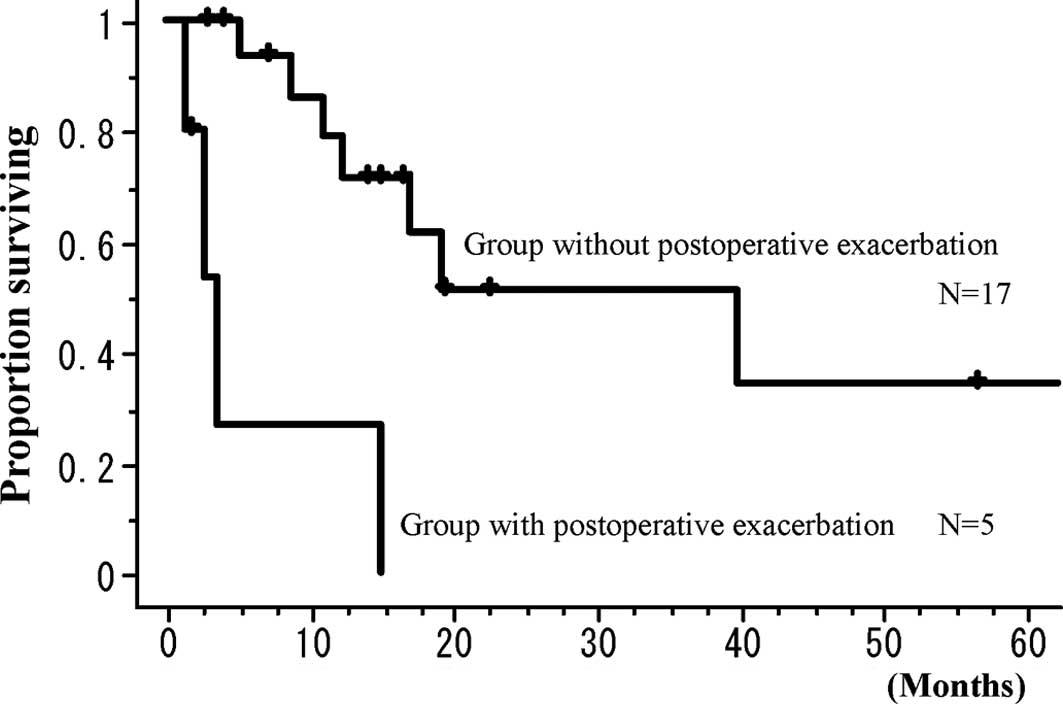
The characteristics of the patients are listed in Table I. All 22 patients had a history of smoking. Five patients (22.7%) had postoperative exacerbation of interstitial pneumonia. There were no significant differences in gender, sites of lung cancers, pre-operative lung function, smoking history or the levels of lymph node dissection between the group with postoperative exacerbation of interstitial pneumonia and the group without. Among the patients with postoperative exacerbation, 4 patients were aged ≥75 years; there was a significantly higher rate of patients ≥75 years of age than among those without postoperative exacerbation. Patients with postoperative exacerbation presented with significantly advanced clinical stages compared to patients without postoperative exacerbation, and most patients with postoperative exacerbation underwent lobectomy. All patients with postoperative exacerbation had elevated serum KL-6 levels (Table II). Moreover, only 2 patients with postoperative exacerbation had prophylactic administration of steroid postoperatively, which was a significantly lower rate compared to patients without postoperative exacerbation. In 5 patients with postoperative exacerbation, 2 had a history of inflammation just prior to the exacerbation: 1 had a common cold and the other had pyothorax. The prognosis of patients with postoperative exacerbation was significantly poorer than that of patients without postoperative exacerbation (P=0.0252, Fig. 1).

Figure 1.

Overall survival curves for patients with postoperative acute exacerbation and patients without. Patients with postoperative exacerbation had a significantly poorer prognosis than patients without (P=0.0252).

Table I

Patient characteristics (n=22).

Table I

Patient characteristics (n=22).

FactorNo. (%)
Age
  Mean ± SD69.9±6.9
Gender
  Male19 (86.4)
  Female3 (13.6)
Site
  Right14 (63.6)
  Left8 (36.4)
Clinical stage
  IA7 (31.8)
  IB12 (54.5)
  IIB2 (9.0)
  IIIA1 (4.5)
Smoking
  Smoker16 (72.7)
  Ex-smoker6 (27.3)
Surgery
  Lobectomy17 (77.3)
  Wedge resection5 (22.7)
Postoperative exacerbation
  +5 (22.7)
  −17 (77.3)

Table II

Comparison between patients with and without postoperative exacerbation.

Table II

Comparison between patients with and without postoperative exacerbation.

FactorPostoperative exacerbation (+) (n=5)Postoperative exacerbation (−) (n=17)P-value
Age (years)0.0207
  ≥7543
  <75114
Gender>0.9999
  Male415
  Female12
Site>0.9999
  Right311
  Left26
Clinical stage0.0344
  IA25
  IB111
  IIB20
  IIIA01
Lung function
  VC (ml)2,7533,0810.3522
  FEV1.0 (ml)2,1582,3060.5360
  PaO2 (torr)77.181.60.4828
Smoking>0.9999
  Smoker412
  Ex-smoker15
Surgery>0.9999
  Lobectomy413
  Wedge resection14
Lymph node dissection0.6980
  ND027
  ND138
  ND202
KL-60.5165
  High48
  Low04
Postoperative steroid0.0239
  Yes216
  No31

[i] VC, vital capacity; FEV1.0, forced expiratory volume in one second; PaO2, arterial gas tension of O2.

Discussion

At present, patients with various complications must undergo resection for lung cancer. Nakajima et al (6) reported that patients with lung cancer and collagen disease were not contraindicated to undergo surgical resection for lung carcinoma, although they frequently had interstitial pneumonia as pointed out in the resected specimens. Kutlu et al (1) investigated the frequency and mortality of acute lung injury and acute respiratory distress syndrome in patients after pulmonary resection, and reported that 45 (3.9%) of 1,139 resected cases had postoperative acute lung injury or acute respiratory distress syndrome, while 29 (64.4%) of these 45 patients died. Ruffini et al (2) reported that 27 (2.2%) of 1,221 cases had postoperative acute lung injury or acute respiratory distress syndrome, and that 14 (51.9%) of those 27 patients died. Muraoka et al (7) reported that 9 (56.3%) of 16 patients died due to respiratory failure.

Therefore, postoperative exacerbation of interstitial pneumonia is a serious problem after pulmonary resection. However, little is known regarding postoperative exacerbation of interstitial pneumonia; in particular, the cause and the risk factors for interstitial pneumonia remain unknown (7). In various surgical approaches for lung cancers, Koizumi et al (8) compared the use of video-assisted thoracoscopic surgery to posterolateral thoracotomy or muscle-sparing thoracotomy and reported that the use of video-assisted thoracoscopic surgery did not prevent acute exacerbation of postoperative interstitial pneumonia. Therefore, postoperative acute interstitial pneumonia may be related to factors other than the surgical approach.

Takeda et al (3) reported that the measurement of serum KL-6 levels is useful to assess the activity of interstitial pneumonia. Moreover, Muraoka et al (7) reported that factors including a tumor located on the right side, pre-operative radiation or chemotherapy, pneumonectomy, blood transfusion and intraoperative complications were independent risk factors for the incidence of acute interstitial pneumonia. Koizumi et al (8) reported that exertion dyspnea (Hugh-Jones classification), serum C-reactive protein, serum lactate dehydrogenase and total lung capacity were considered to be pre-operative risk factors of acute exacerbation. Chida et al (9) reported that 11 of 15 patients with postoperative interstitial pneumonia were found to have interstitial pneumonia in pre-operative CT scans, and patients with findings of interstitial pneumonia in pre-operative CT scans had a significantly higher rate of postoperative acute respiratory distress syndrome (ARDS) than did patients with no such findings. They also reported that induction chemotherapy or chemoradiotherapy was a risk factor of postoperative ARDS (9).

In the present study, we selected patients with interstitial pneumonia pre-operatively and examined risk factors of postoperative exacerbation. The limitations of this study were that it was retrospective and that the number of patients was limited. However, the rate of postoperative exacerbation was high and, therefore, patients with pre-operative interstitial lung disease have a severe risk for postoperative exacerbation of interstitial pneumonia. In the present study, patients with postoperative exacerbation included patients with advanced age, those with a high rate of elevated serum KL-6, those who underwent lobectomy, and patients who did not receive steroid administration. Thus, special attention should be paid to postoperative exacerbation of interstitial pneumonia for patients with the above factors. Despite the limitation of the relatively small patient population, the occurrence of inflammation just prior to the postoperative exacerbation in the 2 patients with postoperative exacerbation was evaluated. Consequently the existence of inflammation may likely be one of the risk factors for postoperative exacerbation.

Acknowledgments

This study was supported in part by a Grant-in-aid for Scientific research (C) 21591822 of the Japanese Ministry of Education, Culture, Sports, Science, and Technology. The authors thank Mr. Robert E. Brandt, CEO, MedEd Japan, for the editorial assistance in the preparation of the manuscript.

References

1 

Kutlu CA, Williams EA, Evans TW, Pastorino U and Goldstraw P: Acute lung injury and acute respiratory distress syndrome after pulmonary resection. Ann Thorac Surg. 69:376–380. 2000. View Article : Google Scholar

2 

Ruffini E, Parola A, Papalia E, Filosso PL, Mancuso M, Oliaro A, Actis-Dato G and Maggi G: Frequency and mortality of acute lung injury and acute respiratory distress syndrome after pulmonary resection for bronchogenic carcinoma. Eur J Cardiothorac Surg. 20:30–36. 2001. View Article : Google Scholar : PubMed/NCBI

3 

Takeda S, Maeda H, Sawabata N, Kitada S, Mori M, Takashima S and Matsubara Y: Clinical impact of interstitial pneumonia following surgery for lung cancer. Thorac Cardiovasc Surg. 54:268–272. 2006. View Article : Google Scholar : PubMed/NCBI

4 

Chiyo M, Sekine Y, Iwata T, Tatsumi K, Yasufuku K, Iyoda A, Otsuji M, Yoshida S, Shibuya K, Iizasa T, Saitoh Y and Fujisawa T: Impact of interstitial lung disease on surgical morbidity and mortality for lung cancer: analyses of short-term and long-term outcomes. J Thorac Cardiovasc Surg. 126:1141–1146. 2003. View Article : Google Scholar : PubMed/NCBI

5 

American Thoracic Society; European Respiratory Society: American Thoracic Society/European Respiratory Society International Multidisciplinary Consensus Classification of the Idiopathic Interstitial Pneumonias. This joint statement of the American Thoracic Society (ATS), and the European Respiratory Society (ERS) was adopted by the ATS board of directors, June 2001 and by the ERS Executive Committee, June 2001. Am J Respir Crit Care Med. 165:277–304. 2002.

6 

Nakajima J, Takamoto S, Murakawa T, Fukami T and Sano A: Is interstitial pneumonia in patients with collagen diseases a contraindication to lung cancer surgery? Surg Today. 37:14–18. 2007. View Article : Google Scholar : PubMed/NCBI

7 

Muraoka M, Tagawa T, Akamine S, Oka T, Tsuchiya T, Araki M, Hayashi T and Nagayasu T: Acute interstitial pneumonia following surgery for primary lung cancer. Eur J Cardiothorac Surg. 30:657–662. 2006. View Article : Google Scholar : PubMed/NCBI

8 

Koizumi K, Hirata T, Hirai K, Mikami I, Okada D, Yamagishi S, Kawashima T, Nakajima Y and Shimizu K: Surgical treatment of lung cancer combined with interstitial pneumonia: the effect of surgical approach on postoperative acute exacerbation. Ann Thorac Cardiovasc Surg. 10:340–346. 2004.PubMed/NCBI

9 

Chida M, Ono S, Hoshikawa Y and Kondo T: Subclinical idiopathic pulmonary fibrosis is also a risk factor of postoperative acute respiratory distress syndrome following thoracic surgery. Eur J Cardiothorac Surg. 34:878–881. 2008. View Article : Google Scholar

Related Articles

  • Abstract
  • View
  • Download
  • Twitter
Copy and paste a formatted citation
Spandidos Publications style
Iyoda A, Jiang S, Amano H, Ogawa F, Matui Y, Kurouzu N, Hara H, Nezu K, Mikami T, Saegusa M, Saegusa M, et al: Prediction of postoperative exacerbation of interstitial pneumonia in patients with lung cancer and interstitial lung disease. Exp Ther Med 2: 1073-1076, 2011.
APA
Iyoda, A., Jiang, S., Amano, H., Ogawa, F., Matui, Y., Kurouzu, N. ... Satoh, Y. (2011). Prediction of postoperative exacerbation of interstitial pneumonia in patients with lung cancer and interstitial lung disease. Experimental and Therapeutic Medicine, 2, 1073-1076. https://doi.org/10.3892/etm.2011.342
MLA
Iyoda, A., Jiang, S., Amano, H., Ogawa, F., Matui, Y., Kurouzu, N., Hara, H., Nezu, K., Mikami, T., Saegusa, M., Satoh, Y."Prediction of postoperative exacerbation of interstitial pneumonia in patients with lung cancer and interstitial lung disease". Experimental and Therapeutic Medicine 2.6 (2011): 1073-1076.
Chicago
Iyoda, A., Jiang, S., Amano, H., Ogawa, F., Matui, Y., Kurouzu, N., Hara, H., Nezu, K., Mikami, T., Saegusa, M., Satoh, Y."Prediction of postoperative exacerbation of interstitial pneumonia in patients with lung cancer and interstitial lung disease". Experimental and Therapeutic Medicine 2, no. 6 (2011): 1073-1076. https://doi.org/10.3892/etm.2011.342
Copy and paste a formatted citation
x
Spandidos Publications style
Iyoda A, Jiang S, Amano H, Ogawa F, Matui Y, Kurouzu N, Hara H, Nezu K, Mikami T, Saegusa M, Saegusa M, et al: Prediction of postoperative exacerbation of interstitial pneumonia in patients with lung cancer and interstitial lung disease. Exp Ther Med 2: 1073-1076, 2011.
APA
Iyoda, A., Jiang, S., Amano, H., Ogawa, F., Matui, Y., Kurouzu, N. ... Satoh, Y. (2011). Prediction of postoperative exacerbation of interstitial pneumonia in patients with lung cancer and interstitial lung disease. Experimental and Therapeutic Medicine, 2, 1073-1076. https://doi.org/10.3892/etm.2011.342
MLA
Iyoda, A., Jiang, S., Amano, H., Ogawa, F., Matui, Y., Kurouzu, N., Hara, H., Nezu, K., Mikami, T., Saegusa, M., Satoh, Y."Prediction of postoperative exacerbation of interstitial pneumonia in patients with lung cancer and interstitial lung disease". Experimental and Therapeutic Medicine 2.6 (2011): 1073-1076.
Chicago
Iyoda, A., Jiang, S., Amano, H., Ogawa, F., Matui, Y., Kurouzu, N., Hara, H., Nezu, K., Mikami, T., Saegusa, M., Satoh, Y."Prediction of postoperative exacerbation of interstitial pneumonia in patients with lung cancer and interstitial lung disease". Experimental and Therapeutic Medicine 2, no. 6 (2011): 1073-1076. https://doi.org/10.3892/etm.2011.342
Follow us
  • Twitter
  • LinkedIn
  • Facebook
About
  • Spandidos Publications
  • Careers
  • Cookie Policy
  • Privacy Policy
How can we help?
  • Help
  • Live Chat
  • Contact
  • Email to our Support Team