Introduction
Limb salvage is beneficial for patients with
osteosarcoma when complete tumor anatomical resection is possible
and neoadjuvant or adjuvant chemotherapy is used, not only for the
function of the limb itself, but also for the psychology of the
patient (1). The presence of a
pathologic fracture in osteosarcoma is often difficult to treat and
has been historically associated with a poor outcome (2,3). The
incidence of pathological fractures, either at diagnosis or during
preoperative treatment, is between 5 and 10% (4–6).
Limb salvage has been regarded as an absolute contraindication when
a pathological fracture is present for two main reasons (7,8):
first, the fracture often causes local hematoma formation, which is
conducive for the spreading of tumor cells to adjacent tissues and
subsidiary joints; and second, microcirculation damage can promote
transfer of the tumor.
It is generally accepted that limb salvage treatment
is indicated for primary malignant degree and localized
osteosarcoma (such as Enneking stage I osteosarcoma), and surgical
amputation is warranted in cases of high malignancy osteosarcoma
(such as Enneking stage III osteosarcoma). In addition, most
clinicians accept limb salvage treatment for high-grade and
localized osteosarcoma (such as Enneking stage II osteosarcoma),
but the presence of a pathologic fracture makes the surgical
decision difficult. Some surgeons believe that immediate and
aggressive removal of the tumor may halt fracture-induced disease
progression and that early amputation is a surgical option for all
osteosarcoma patients with a pathologic fracture (4,8–10).
However, other surgeons believe that limb salvage has recently
become an alternative for treating high-grade and localized
osteosarcoma with pathological fracture due to the acceptable
clinical outcome (7,11–13).
However, only a few studies have specifically compared the outcome
of limb salvage with that of amputation in osteosarcoma patients
with a pathologic fracture (7–14).
Moreover, it has not been determined whether limb salvage has a
negative influence on survival or local recurrence, since the
studies have produced contradictory results.
In the present study, we performed a meta-analysis
to determine the local recurrence, 5-year overall survival rate,
and metastatic occurrence after limb salvage compared to amputation
in order to provide a clear approach for clinicians when choosing a
surgical option, especially for high-grade and localized
osteosarcoma patients with a pathologic fracture.
Materials and methods
Search strategy
We performed a systematic search of Medline, Embase
and the Cochrane Database in November, 2011 to identify published
studies related to osteosarcoma and fracture. The medical search
terms ‘osteosarcoma’, ‘pathologic fracture’, ‘limb salvage’ and
‘amputation’ were combined. No language or other restrictions were
placed on the search. Furthermore, references cited in published
original and review articles were examined until no further study
could be identified. Authors of the retrieved articles were
contacted when necessary and were asked to provide additional
information.
Inclusion and exclusion criteria
Articles were included if they reported on studies
that included ‘limb salvage’ or ‘amputation’ groups in ‘high-grade
and localized osteosarcoma’ in patients with pathological fracture
and provided sufficient data to calculate an odds ratio (OR) and
corresponding 95% confidence interval (CI). Articles were excluded
if the only reported outcome measurements related to ‘limb salvage’
or ‘amputation’ groups without a control group. Case report
articles were also excluded due to the small patient numbers.
Articles reporting on the same cohort group from the same
institution were limited to the most recent publication.
Quality assessment
Eligible articles were assessed for quality by 2
independent reviewers. The quality of studies in this meta-analysis
was assessed using the Newcastle-Ottawa scale quality assessment as
recommended by the Cochrane Non-Randomized Studies Methods Working
Group. This scale allocates a maximum of 9 points for quality of
selection, comparability, exposure, and outcome of study
participants. Given the variability in the quality of the
observational studies found in our initial literature search, we
considered studies that met 5 or more of the Newcastle-Ottawa scale
scores criteria as good quality and therefore included only these
studies in our meta-analysis.
Data extraction
Data were extracted from each article by two authors
of this study using a structured sheet and then entered into a
database. Study characteristics extracted from each manuscript
included the country, year of publication, number of cases and
controls, study period, age, gender and follow-up. Any disagreement
between researchers was resolved by continuing discussions until a
consensus was reached.
Outcome measures
The primary outcome measurement used for analysis
was local recurrence. The secondary outcome measurement was the
5-year overall survival rate. In addition, the occurrence of
metastasis was assessed as a third outcome measurement.
Statistical analysis
Pooled OR and 95% CI for dichotomous data were
estimated according to the inverse of variance method available
through the Review Manager Software (version 5.0 for Windows),
which forms the Cochrane Information Management System (IMS). We
assessed the heterogeneity of trial results by inspecting graphical
presentations and by calculating an I2 statistic of
inconsistency. We also reported the Z statistic for the
overall effect. Statistically significant heterogeneity was defined
as an I2 value >0.05. We used a fixed-effect model to
pool the OR, except in the event of statistically significant
heterogeneity, in which case a random-effects model was used.
Results
Literature search
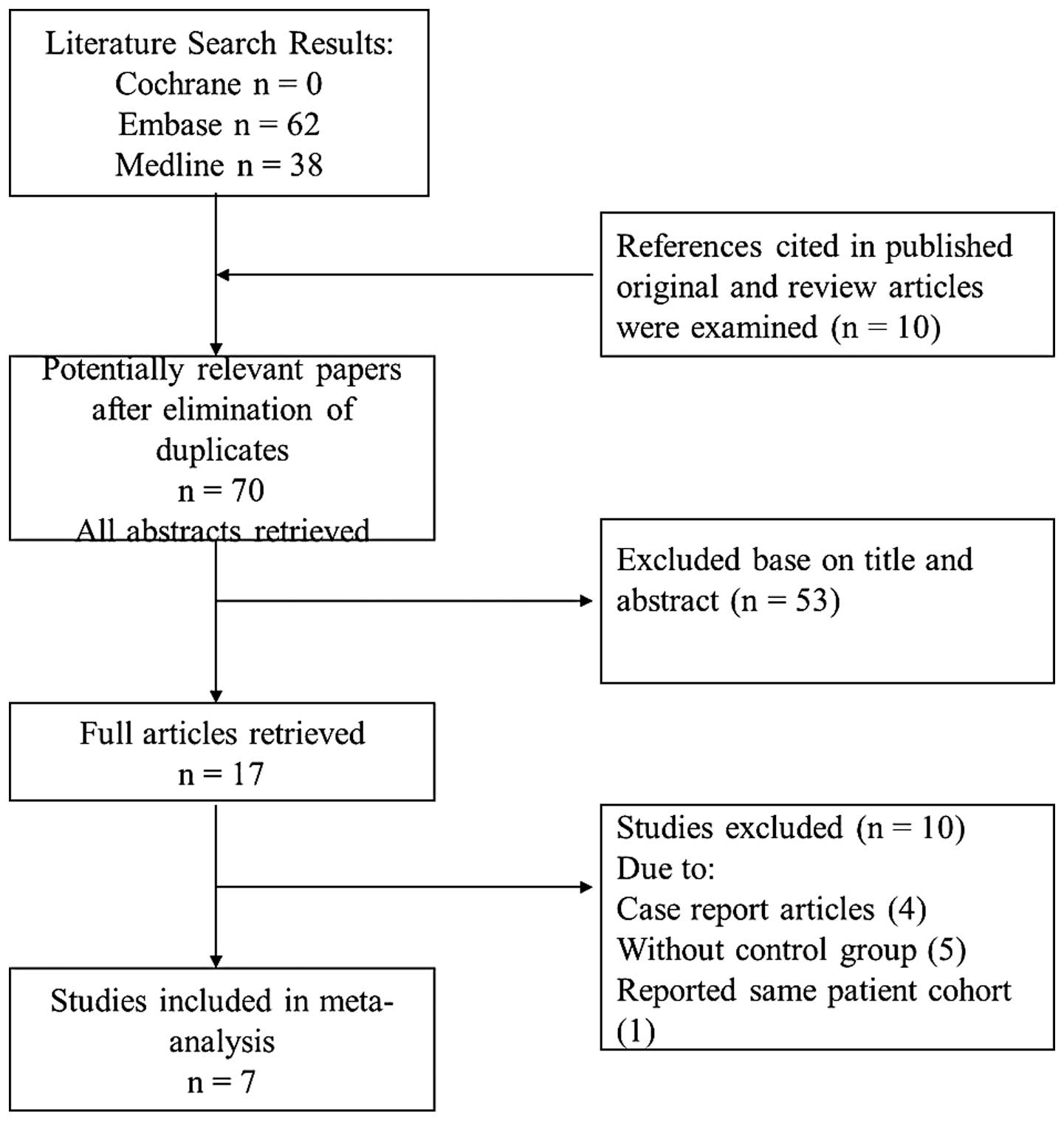
We identified 70 potentially relevant articles in
the primary literature search (Fig.
1), of which 7 articles (8,15–20)
met the inclusion criteria. No randomized controlled trials were
identified. Two articles reported on the same patient cohort, and
as result the more recent article was included (14,20).
Study characteristics and quality
assessment
All of the 7 studies included were retrospective
cohort studies. The publication dates ranged from 1996 to 2010. A
total of 284 patients were included in the studies, 200 of whom
underwent limb salvage and 84 of whom underwent amputation. The
patient demographics, follow-up, and normal characteristics are
listed in Table I. There were 5
high-quality studies, as determined by a Newcastle-Ottawa scale
score of 6 or higher (71%) (Table
II).
 | Table ICharacteristics of the seven included
studies. Author/(Ref.) |
Table I
Characteristics of the seven included
studies. Author/(Ref.)
| Author/(Ref.) | Abudu et al
(8) | Bacci et al
(15) | Bramer et al
(16) | Ferguson et al
(17) | Kim et al
(18) | Niu et al
(19) | Scully et al
(20) |
|---|
| Country | England | Italy | UK | Canada | Korea | China | USA |
| No. of patients | 40 | 46 | 56 | 31 | 37 | 22 | 52 |
| Limb salvage, n
(%) | 27 (68) | 35 (76) | 44 (79) | 19 (61) | 33 (89) | 12 (55) | 30 (58) |
| Amputation, n
(%) | 13 (32) | 11 (24) | 12 (21) | 12 (39) | 4 (11) | 10 (45) | 22 (52) |
| Study period | 1975–1994 | 1983–1999 | 1983–2003 | 1989–2006 | - | 1992–2001 | 1977–1996 |
| Male, n (%) | 26 (65) | 24 (52) | 36 (64) | 14 (45) | 26 (70) | 15 (68) | 28 (54) |
| Female, n (%) | 14 (35) | 22 (48) | 20 (36) | 17 (55) | 11 (30) | 7 (32) | 24 (46) |
| Median age (range),
years | 18 (2–46) | 11 (3–20) | 16 (4–57) | 30 (11-8) | - | 18 (3–36) | 23.5±17.4a |
| Enneking stage | Stage-IIB | Stage-IIB | - | - | Stage-II | Stage-IIB | Stage-IIB |
| Follow-up (range),
months | 55 (8–175) | 132 (36–240) | 117 (7–252) | - | 43 (10–228) | 54.7 (8–146) | 54 (6-152.4) |
| Proximal tumor, n
(%) | 18 (45) | 21 (45) | 23 (41) | 19 (61) | 20 (54) | 12 (55) | 25 (48) |
| Adequate margin, n
(%) | 7 (18) | 6 (13) | 35 (63) | - | 8 (22) | - | 2 (4) |
| Poor chemotherapy
responseb, n (%) | - | 12 (26) | 43 (78) | - | 23 (62) | - | 29 (64) |
| Displaced fracture,
n (%) | - | 8 (17) | - | 22 (71) | 9 (24) | 4 (18) | 16 (31) |
| Local recurrence, n
(%) | | | | | | | |
| Limb salvage | 5 (19) | 1 (3) | 6 (14) | 2 (6) | 4 (11) | 2 (9) | 7 (23) |
| Amputation | 0 (0) | 1 (9) | 2 (17) | 0 (0) | 0 (0) | 1 (10) | 4 (18) |
| 5-year survival, n
(%) | | | | | | | |
| Limb salvage | 17 (63) | - | - | - | - | 8 (66) | 19 (63) |
| Amputation | 6 (46) | - | - | - | - | 4 (40) | 12 (55) |
| Metastatic
occurence, n (%) | | | | | | | |
| Limb salvage | 12 (44) | - | - | - | - | 3 (25) | - |
| Amputation | 9 (69) | - | - | - | - | 6 (60) | - |
| Table IIQuality assessment for the seven
included studies using the Newcastle-Ottawa quality assessment
scale. |
Table II
Quality assessment for the seven
included studies using the Newcastle-Ottawa quality assessment
scale.
| Selection
| Comparability
| Exposure
| |
|---|
| Author/(Refs.) | 1 | 2 | 3 | 4 | 5 | 6 | 7 | 8 | 9 | NOS |
|---|
| Abudu et al
(8) | * | - | * | * | * | * | * | * | * | 8* |
| Bacci et al
(15) | * | - | * | * | * | * | * | - | - | 6* |
| Bramer et al
(16) | * | * | * | * | - | * | * | - | - | 6* |
| Ferguson et
al (17) | * | - | * | * | - | * | * | - | - | 5* |
| Kim et al
(18) | * | - | * | * | - | * | * | - | - | 5* |
| Niu et al
(19) | * | - | * | * | * | * | * | * | * | 8* |
| Scully et al
(20) | * | * | * | * | * | * | * | * | - | 8* |
Meta-analysis of local recurrence
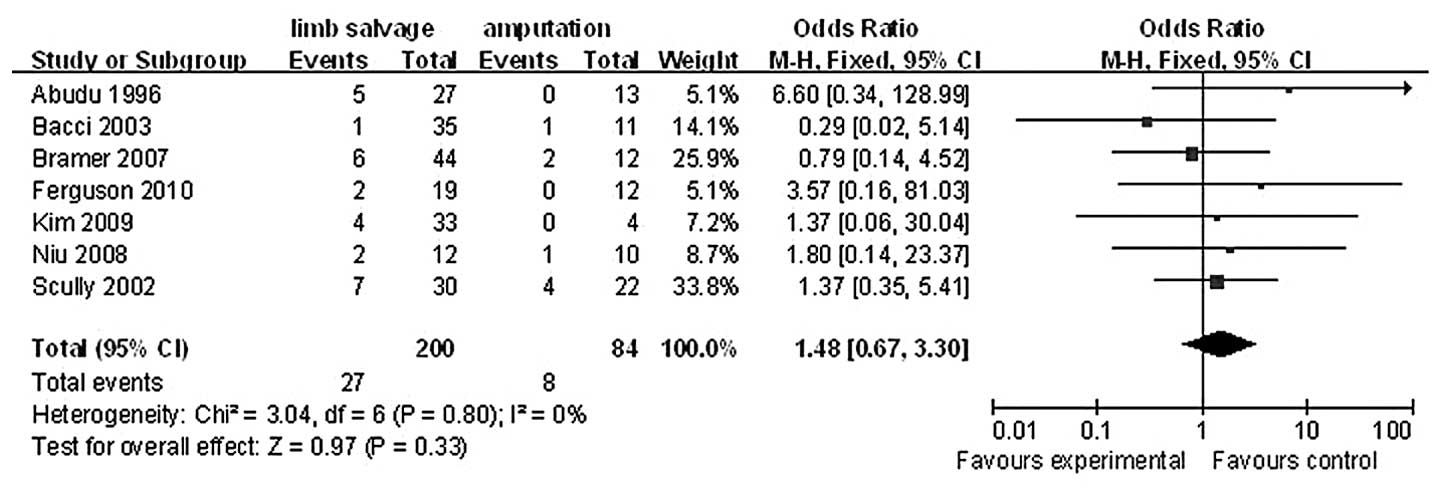
A total of 284 patients from the 7 trials were
classified as having been analyzed for local recurrence. In a
meta-analysis of these 7 trials, there were no significant
differences (P>0.05) between patients in the limb salvage group
and the amputation group (OR, 1.48; 95% CI, 0.67–3.30;
Z=0.97; P=0.33), and there was no heterogeneity among these
trials with respect to overall survival (P=0.80; I2=0%)
(Fig. 2).
Meta-analysis of 5-year overall
survival
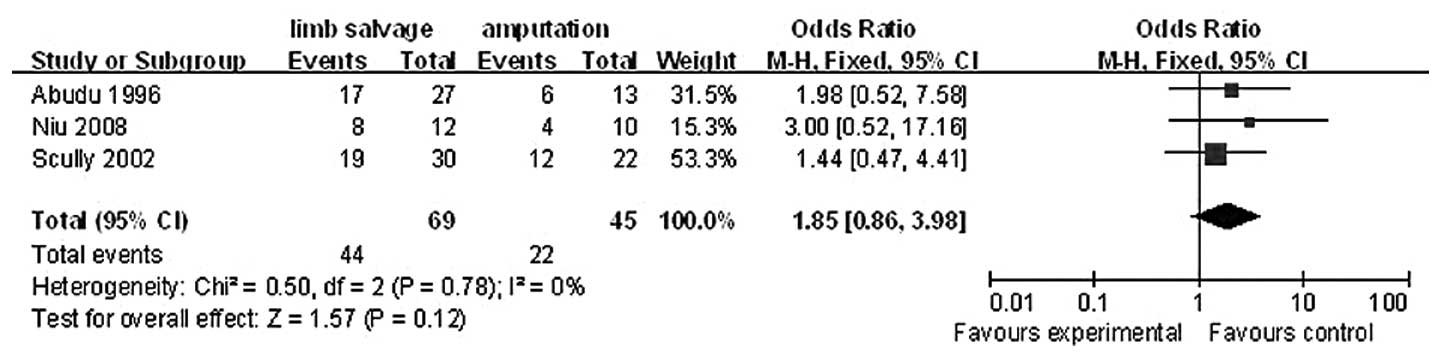
A total of 114 patients from 3 trials were
classified as having been analyzed for 5-year overall survival. The
meta-analysis of these patients showed no significant differences
(P>0.05) between the limb salvage group and the amputation group
(OR, 1.85; 95% CI, 0.86–3.98; Z=1.57; P=0.12), and there was
no heterogeneity among these trials with respect to overall
survival (P=0.78; I2=0%) (Fig. 3).
Meta-analysis of metastatic
occurrence
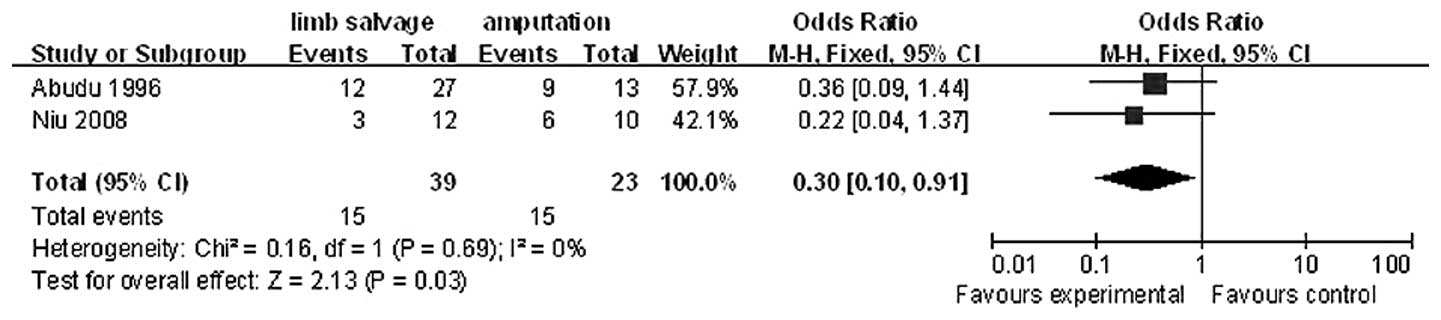
A total of 62 patients from 3 trials were classified
as having been analyzed for metastatic occurrence. The
meta-analysis of these patients showed significant differences
(P<0.05) between the limb salvage group and the amputation group
(OR, 0.30; 95% CI, 0.10–0.91; Z=2.13; P=0.03), and there was
no heterogeneity among these trials with respect to overall
survival (P=0.69; I2=0%) (Fig. 4).
Study heterogeneity and publication
bias
The P-value for heterogeneity was 3.04 and the
variability (I2) in results across all studies as a
result of the true differences in treatment effect was 0%, which
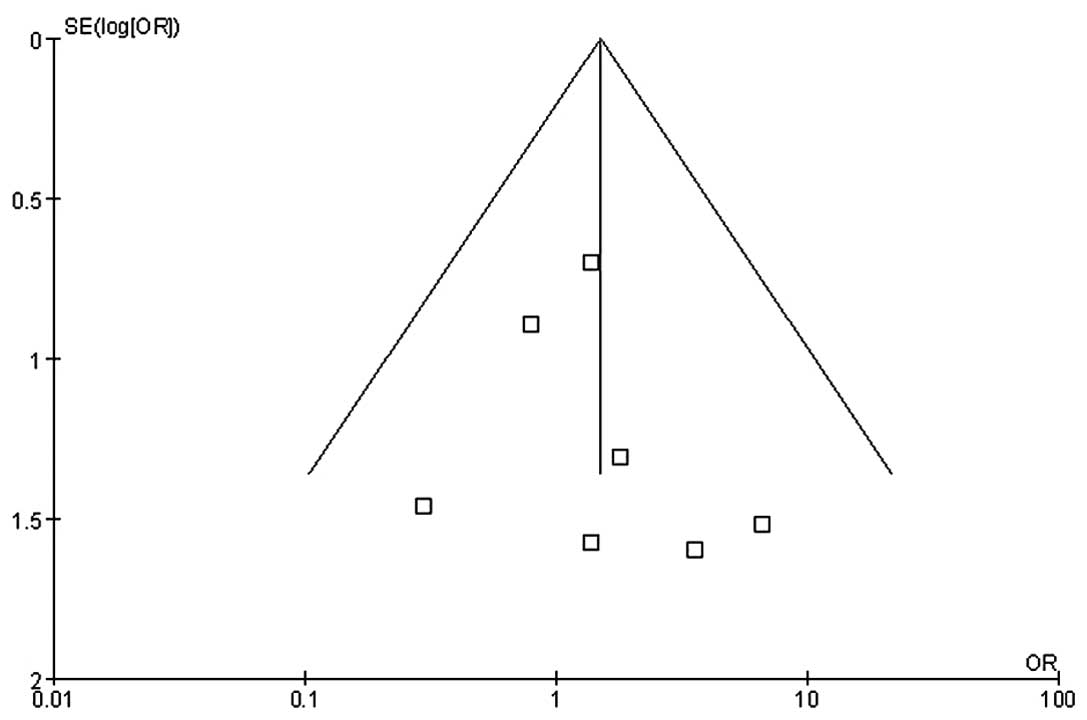
indicated no heterogeneity. In addition, the funnel plot for all
studies was symmetrical (Fig. 5),
indicating that the results of all of the studies were expected, as
all studies fell evenly within the top of the inverted funnel. This
funnel plot pattern also indicated that there was no publication
bias.
Discussion
The benefit of limb salvage treatment for
osteosarcoma is clear, not only for primary malignancy and
localized osteosarcoma cases, but also for high-grade and localized
osteosarcoma cases, since previous studies have shown promising
results (7,11,21,22).
However, when a pathological fracture is present in cases of
high-grade and localized osteosarcoma, the choice of limb salvage
over amputation becomes more complicated. First, does the presence
of a pathological fracture make limb salvage treatment too
complicated and risky to attempt? Second, are the rates of local
recurrence and metastasis higher after limb salvage compared to
amputation? Third, do these patients have a lower survival rate
after limb salvage compared to amputation?
The meta-analysis in this study found no significant
difference in local recurrence (OR, 1.48; 95% CI, 0.67–3.30;
P=0.33) between limb salvage and amputation methods for treating
osteosarcoma with pathologic fracture. Niu et al (19) found local recurrence rates of 16
and 10% in a group of 22 patients with osteosarcoma in the
extremities and pathologic fracture who received limb salvage or
amputation, respectively. The authors concluded that pathologic
fractures can be safely managed by limb salvage treatment with an
acceptable rate of local recurrence. Another study reported only
two recurrences in a group of 46 patients, with one occurring after
limb salvage and one after amputation (15). In contrast to these studies, Scully
et al (14) reviewed 18
patients with pathologic fractures in osteosarcoma and found that
the local recurrence rate in patients undergoing limb salvage
surgery was markedly higher than in patients undergoing
amputation.
The meta-analysis in this study found no significant
difference in 5-year overall survival (OR, 1.85; 95% CI, 0.86–3.98;
P=0.12) between limb salvage and amputation methods for treating
osteosarcoma patients with a pathologic fracture. Abudu et
al (8) reported that the
amputation provided better eradication of local tumor than limb
salvage in a group of 40 patients with localized osteosarcoma
presenting with pathologic fracture who had been treated with
neo-adjuvant chemotherapy and surgery; however, the authors found
that amputation did not prolong the 5-year overall survival. In
addition, a retrospective analysis of approximately 30 osteosarcoma
patients with pathological fracture out of 336 treated patients
found that limb salvage treatment did not affect the survival rate
(23).
The meta-analysis in this study found a significant
difference in metastatic occurrence (OR, 0.30; 95% CI, 0.10–0.91;
P=0.03) between limb salvage and amputation methods for treating
osteosarcoma patients with a pathological fracture. Niu et
al (19) found metastasis
occurred in 25% (3/12) and 60% (6/10) of cases in a group of 22
patients with osteosarcoma in the extremities and pathological
fracture who received limb salvage or amputation, respectively.
Abudu et al (8) reported
that treatment by limb salvage or amputation did not significantly
influence the development of metastases, which were noted in 12 of
the 27 patients with limb salvage and 9 of the 13 who had
amputation. Although the meta-analysis showed a significant
difference, only two studies can be incorporated, which included 66
patients. Therefore, it is possible that objectivity could be lost
due to the low number of incorporated studies or patients analyzed.
Another possible reason is that the occurrence of metastases in
patients receiving limb salvage treatment was markedly lower than
that in patients receiving an amputation. Thus, additional
high-quality, randomized controlled studies are needed to confirm
these findings.
It has been previously shown that factors other than
the surgical choice of limb salvage or amputation can have an
impact on patient outcome in these cases, including tumor size
(24), poor response to
chemotherapy (25), serum lactate
dehydrogenase levels (26,27), anatomical location (9), unstable fracture without healing, age
(28), histologic subtype
(26), and the timing of the
fracture. For high-grade and localized osteosarcoma, the occurrence
of a pathological fracture is not regarded as an absolute
contraindication to limb salvage.
Limitations and strengths
Some limitations existed for this meta-analysis that
were inherent to the nature of the available data. First, we were
only able to include a few studies in the analysis. In addition,
all of the included studies had retrospective designs with small
sample sizes that were subject to systematic and random biases.
With respect to possible selection bias, the included studies had
patients with poor response to chemotherapy and larger tumors who
were more likely to undergo amputation. This was likely due to the
tendency to protect limb function in patients with smaller tumors
and the concern for local recurrence in patients treated with
chemotherapy. However, verification of this selection bias was not
possible in a retrospective manner, and therefore these biases were
not found across all studies. The small sample sizes and the small
number of included studies is more likely the reason for the
failure to detect heterogeneity if it did exist, since the test for
heterogeneity is powered low in this type of situation. In
addition, the number of events for both primary outcomes was very
low. Therefore, the findings of this meta-analysis should be
interpreted with caution despite representing the best available
evidence to date.
In summary, based on the findings of our
meta-analysis, we conclude that limb salvage treatment can be
safely used in high-grade and localized osteosarcoma patients with
pathological fracture without increasing the risk for local
recurrence or decreasing the 5-year overall survival rate. In
addition, the development of metastases may be lower in patients
receiving limb salvage treatment compared to patients receiving an
amputation. Importantly, the occurrence of a pathological fracture
is not regarded as an absolute contraindication to limb salvage in
patients with high-grade and localized osteosarcoma. Therefore, in
the absence of randomized data, this meta-analysis provides the
best available evidence to support the use of limb salvage as a
surgical alternative for treating osteosarcoma patients with
pathological fracture.
References
|
1
|
Ferrari S and Palmerini E: Adjuvant and
neoadjuvant combination chemotherapy for osteogenic sarcoma. Curr
Opin Oncol. 19:341–346. 2007. View Article : Google Scholar : PubMed/NCBI
|
|
2
|
Coley BL and Pool JL: Factors influencing
the prognosis in osteogenic sarcoma. Ann Surg. 112:1114–1128. 1940.
View Article : Google Scholar : PubMed/NCBI
|
|
3
|
O’Hara JM, Hutter RV, Foote FW Jr, Miller
T and Woodard HQ: An analysis of thirty patients surviving longer
than ten years after treatment for osteogenic sarcoma. J Bone Joint
Surg Am. 50:335–354. 1968.PubMed/NCBI
|
|
4
|
Jaffe N, Spears R, Eftekhari F, Robertson
R, Cangir A, Takaue Y, Carrasco H, Wallace S, Ayala A, Raymond K
and Wang YM: Pathologic fracture in osteosarcoma. Impact of
chemotherapy on primary tumor and survival. Cancer. 59:701–709.
1987. View Article : Google Scholar : PubMed/NCBI
|
|
5
|
Papagelopoulos PJ, Mavrogenis AF, Savvidou
OD, Benetos IS, Galanis EC and Soucacos PN: Pathological fractures
in primary bone sarcomas. Injury. 39:395–403. 2008. View Article : Google Scholar : PubMed/NCBI
|
|
6
|
Simon MA, Aschliman MA, Thomas N and
Mankin HJ: Limb-salvage treatment versus amputation for
osteosarcoma of the distal end of the femur. J Bone Joint Surg Am.
68:1331–1337. 1986.PubMed/NCBI
|
|
7
|
Ebeid W, Amin S and Abdelmegid A: Limb
salvage management of pathologic fractures of primary malignant
bone tumors. Cancer Control. 12:57–61. 2005.PubMed/NCBI
|
|
8
|
Abudu A, Sferopoulos NK, Tillman RM,
Carter SR and Grimer RJ: The surgical treatment and outcome of
pathological fractures in localised osteosarcoma. J Bone Joint Surg
Br. 78:694–698. 1996.PubMed/NCBI
|
|
9
|
Longhi A, Errani C, De Paolis M, Mercuri M
and Bacci G: Primary bone osteosarcoma in the pediatric age: state
of the art. Cancer Treat Rev. 32:423–436. 2006. View Article : Google Scholar : PubMed/NCBI
|
|
10
|
Jeon DG, Lee SY and Kim JW: Bone primary
sarcomas undergone unplanned intralesional procedures - the
possibility of limb salvage and their oncologic results. J Surg
Oncol. 94:592–598. 2006. View Article : Google Scholar : PubMed/NCBI
|
|
11
|
Natarajan MV, Govardhan RH, Williams S and
Raja GTS: Limb salvage surgery for pathological fractures in
osteosarcoma. Int Orthop. 24:170–172. 2000. View Article : Google Scholar : PubMed/NCBI
|
|
12
|
Cui Q, Li DF, Liu C, Guo J, Liu SB, Liu
YS, Zhai JM and Zeng Y: Two case-reports of the limb salvage
treatment of osteosarcoma consolidated with obvious pathological
fractures. Pathol Oncol Res. 17:973–979. 2011. View Article : Google Scholar : PubMed/NCBI
|
|
13
|
Godley K, Watts AC and Robb JE:
Pathological femoral fracture caused by primary bone tumour: a
population-based study. Scott Med J. 56:5–9. 2011. View Article : Google Scholar : PubMed/NCBI
|
|
14
|
Scully SP, Temple HT, O’Keefe RJ, Mankin
HJ and Gebhardt M: The surgical treatment of patients with
osteosarcoma who sustain a pathologic fracture. Clin Orthop Relat
Res. 324:227–232. 1996. View Article : Google Scholar : PubMed/NCBI
|
|
15
|
Bacci G, Ferrari S, Longhi A, Donati D,
Manfrini M, Giacomini S, Briccoli A, Forni C and Galletti S:
Nonmetastatic osteosarcoma of the extremity with pathologic
fracture at presentation: local and systemic control by amputation
or limb salvage after preoperative chemotherapy. Acta Orthop Scand.
74:449–454. 2003. View Article : Google Scholar
|
|
16
|
Bramer JA, Abudu AA, Grimer RJ, Carter SR
and Tillman RM: Do pathological fractures influence survival and
local recurrence rate in bony sarcomas? Eur J Cancer. 43:1944–1951.
2007. View Article : Google Scholar : PubMed/NCBI
|
|
17
|
Ferguson PC, McLaughlin CE, Griffin AM,
Bell RS, Deheshi BM and Wunder JS: Clinical and functional outcomes
of patients with a pathologic fracture in high-grade osteosarcoma.
J Surg Oncol. 102:120–124. 2010. View Article : Google Scholar : PubMed/NCBI
|
|
18
|
Kim MS, Lee SY, Lee TR, Cho WH, Song WS,
Cho SH, Lee JA, Yoo JY, Jung ST and Jeon DG: Prognostic effect of
pathologic fracture in localized osteosarcoma: a cohort/case
controlled study at a single institute. J Surg Oncol. 100:233–239.
2009. View Article : Google Scholar : PubMed/NCBI
|
|
19
|
Niu XH and Ding Y: The surgical treatment
and outcome of nonmetastatic osteosarcoma of the extremity with
pathologic fractures. Zhonghua Wai Ke Za Zhi. 46:1730–1733.
2008.(In Chinese).
|
|
20
|
Scully SP, Ghert MA, Zurakowski D,
Thompson RC and Gebhardt MC: Pathologic fracture in osteosarcoma:
prognostic importance and treatment implications. J Bone Joint Surg
Am. 84-A:49–57. 2002.PubMed/NCBI
|
|
21
|
Finn HA and Simon MA: Limb-salvage surgery
in the treatment of osteosarcoma in skeletally immature
individuals. Clin Orthop Relat Res. 262:108–118. 1991.PubMed/NCBI
|
|
22
|
Frassica FJ, Chao EY and Sim FH: Special
problems in limb-salvage surgery. Semin Surg Oncol. 13:55–63. 1997.
View Article : Google Scholar : PubMed/NCBI
|
|
23
|
Zeifang F, Sabo D and Ewerbeck V:
Pathological fracture in primary malignant bone tumors. Chirurg.
71:1121–1125. 2000.(In German).
|
|
24
|
Rehan N, Bieling P, Winkler P, Helmke K,
Maas R, Baldini N, Heise U, Fuchs N and Winkler K: The prognostic
significance of tumor volume in osteosarcoma with neoadjuvant
chemotherapy. Klin Padiatr. 205:200–209. 1993.(In German).
|
|
25
|
Bielack SS, Kempf-Bielack B, Delling G,
Exner GU, Flege S, Helmke K, Kotz R, Salzer-Kuntschik M, Werner M,
Winkelmann W, et al: Prognostic factors in high-grade osteosarcoma
of the extremities or trunk: an analysis of 1,702 patients treated
on neoadjuvant cooperative osteosarcoma study group protocols. J
Clin Oncol. 20:776–790. 2002. View Article : Google Scholar
|
|
26
|
Ferrari S, Bertoni F, Mercuri M, Picci P,
Giacomini S, Longhi A and Bacci G: Predictive factors of
disease-free survival for nonmetastatic osteosarcoma of the
extremity: an analysis of 300 patients treated at the Rizzoli
Institute. Ann Oncol. 12:1145–1150. 2001. View Article : Google Scholar : PubMed/NCBI
|
|
27
|
Pochanugool L, Subhadharaphandou T,
Dhanachai M, Hathirat P, Sangthawan D, Pirabul R, Onsanit S and
Pornpipatpong N: Prognostic factors among 130 patients with
osteosarcoma. Clin Orthop Relat Res. 345:206–214. 1997. View Article : Google Scholar : PubMed/NCBI
|
|
28
|
Bacci G, Longhi A, Bertoni F, Bacchini P,
Ruggeri P, Versari M and Picci P: Primary high-grade osteosarcoma:
comparison between preadolescent and older patients. J Pediatr
Hematol Oncol. 27:129–134. 2005. View Article : Google Scholar : PubMed/NCBI
|