Spandidos Publications Logo
  • About
    • About Spandidos
    • Aims and Scopes
    • Abstracting and Indexing
    • Editorial Policies
    • Reprints and Permissions
    • Job Opportunities
    • Terms and Conditions
    • Contact
  • Journals
    • All Journals
    • Oncology Letters
      • Oncology Letters
      • Information for Authors
      • Editorial Policies
      • Editorial Board
      • Aims and Scope
      • Abstracting and Indexing
      • Bibliographic Information
      • Archive
    • International Journal of Oncology
      • International Journal of Oncology
      • Information for Authors
      • Editorial Policies
      • Editorial Board
      • Aims and Scope
      • Abstracting and Indexing
      • Bibliographic Information
      • Archive
    • Molecular and Clinical Oncology
      • Molecular and Clinical Oncology
      • Information for Authors
      • Editorial Policies
      • Editorial Board
      • Aims and Scope
      • Abstracting and Indexing
      • Bibliographic Information
      • Archive
    • Experimental and Therapeutic Medicine
      • Experimental and Therapeutic Medicine
      • Information for Authors
      • Editorial Policies
      • Editorial Board
      • Aims and Scope
      • Abstracting and Indexing
      • Bibliographic Information
      • Archive
    • International Journal of Molecular Medicine
      • International Journal of Molecular Medicine
      • Information for Authors
      • Editorial Policies
      • Editorial Board
      • Aims and Scope
      • Abstracting and Indexing
      • Bibliographic Information
      • Archive
    • Biomedical Reports
      • Biomedical Reports
      • Information for Authors
      • Editorial Policies
      • Editorial Board
      • Aims and Scope
      • Abstracting and Indexing
      • Bibliographic Information
      • Archive
    • Oncology Reports
      • Oncology Reports
      • Information for Authors
      • Editorial Policies
      • Editorial Board
      • Aims and Scope
      • Abstracting and Indexing
      • Bibliographic Information
      • Archive
    • Molecular Medicine Reports
      • Molecular Medicine Reports
      • Information for Authors
      • Editorial Policies
      • Editorial Board
      • Aims and Scope
      • Abstracting and Indexing
      • Bibliographic Information
      • Archive
    • World Academy of Sciences Journal
      • World Academy of Sciences Journal
      • Information for Authors
      • Editorial Policies
      • Editorial Board
      • Aims and Scope
      • Abstracting and Indexing
      • Bibliographic Information
      • Archive
    • International Journal of Functional Nutrition
      • International Journal of Functional Nutrition
      • Information for Authors
      • Editorial Policies
      • Editorial Board
      • Aims and Scope
      • Abstracting and Indexing
      • Bibliographic Information
      • Archive
    • International Journal of Epigenetics
      • International Journal of Epigenetics
      • Information for Authors
      • Editorial Policies
      • Editorial Board
      • Aims and Scope
      • Abstracting and Indexing
      • Bibliographic Information
      • Archive
    • Medicine International
      • Medicine International
      • Information for Authors
      • Editorial Policies
      • Editorial Board
      • Aims and Scope
      • Abstracting and Indexing
      • Bibliographic Information
      • Archive
  • Articles
  • Information
    • Information for Authors
    • Information for Reviewers
    • Information for Librarians
    • Information for Advertisers
    • Conferences
  • Language Editing
Spandidos Publications Logo
  • About
    • About Spandidos
    • Aims and Scopes
    • Abstracting and Indexing
    • Editorial Policies
    • Reprints and Permissions
    • Job Opportunities
    • Terms and Conditions
    • Contact
  • Journals
    • All Journals
    • Biomedical Reports
      • Information for Authors
      • Editorial Policies
      • Editorial Board
      • Aims and Scope
      • Abstracting and Indexing
      • Bibliographic Information
      • Archive
    • Experimental and Therapeutic Medicine
      • Information for Authors
      • Editorial Policies
      • Editorial Board
      • Aims and Scope
      • Abstracting and Indexing
      • Bibliographic Information
      • Archive
    • International Journal of Epigenetics
      • Information for Authors
      • Editorial Policies
      • Editorial Board
      • Aims and Scope
      • Abstracting and Indexing
      • Bibliographic Information
      • Archive
    • International Journal of Functional Nutrition
      • Information for Authors
      • Editorial Policies
      • Editorial Board
      • Aims and Scope
      • Abstracting and Indexing
      • Bibliographic Information
      • Archive
    • International Journal of Molecular Medicine
      • Information for Authors
      • Editorial Policies
      • Editorial Board
      • Aims and Scope
      • Abstracting and Indexing
      • Bibliographic Information
      • Archive
    • International Journal of Oncology
      • Information for Authors
      • Editorial Policies
      • Editorial Board
      • Aims and Scope
      • Abstracting and Indexing
      • Bibliographic Information
      • Archive
    • Medicine International
      • Information for Authors
      • Editorial Policies
      • Editorial Board
      • Aims and Scope
      • Abstracting and Indexing
      • Bibliographic Information
      • Archive
    • Molecular and Clinical Oncology
      • Information for Authors
      • Editorial Policies
      • Editorial Board
      • Aims and Scope
      • Abstracting and Indexing
      • Bibliographic Information
      • Archive
    • Molecular Medicine Reports
      • Information for Authors
      • Editorial Policies
      • Editorial Board
      • Aims and Scope
      • Abstracting and Indexing
      • Bibliographic Information
      • Archive
    • Oncology Letters
      • Information for Authors
      • Editorial Policies
      • Editorial Board
      • Aims and Scope
      • Abstracting and Indexing
      • Bibliographic Information
      • Archive
    • Oncology Reports
      • Information for Authors
      • Editorial Policies
      • Editorial Board
      • Aims and Scope
      • Abstracting and Indexing
      • Bibliographic Information
      • Archive
    • World Academy of Sciences Journal
      • Information for Authors
      • Editorial Policies
      • Editorial Board
      • Aims and Scope
      • Abstracting and Indexing
      • Bibliographic Information
      • Archive
  • Articles
  • Information
    • For Authors
    • For Reviewers
    • For Librarians
    • For Advertisers
    • Conferences
  • Language Editing
Login Register Submit
  • This site uses cookies
  • You can change your cookie settings at any time by following the instructions in our Cookie Policy. To find out more, you may read our Privacy Policy.

    I agree
Search articles by DOI, keyword, author or affiliation
Search
Advanced Search
presentation
Experimental and Therapeutic Medicine
Join Editorial Board Propose a Special Issue
Print ISSN: 1792-0981 Online ISSN: 1792-1015
Journal Cover
2014-March Volume 7 Issue 3

Full Size Image

Sign up for eToc alerts
Recommend to Library

Journals

International Journal of Molecular Medicine

International Journal of Molecular Medicine

International Journal of Molecular Medicine is an international journal devoted to molecular mechanisms of human disease.

International Journal of Oncology

International Journal of Oncology

International Journal of Oncology is an international journal devoted to oncology research and cancer treatment.

Molecular Medicine Reports

Molecular Medicine Reports

Covers molecular medicine topics such as pharmacology, pathology, genetics, neuroscience, infectious diseases, molecular cardiology, and molecular surgery.

Oncology Reports

Oncology Reports

Oncology Reports is an international journal devoted to fundamental and applied research in Oncology.

Experimental and Therapeutic Medicine

Experimental and Therapeutic Medicine

Experimental and Therapeutic Medicine is an international journal devoted to laboratory and clinical medicine.

Oncology Letters

Oncology Letters

Oncology Letters is an international journal devoted to Experimental and Clinical Oncology.

Biomedical Reports

Biomedical Reports

Explores a wide range of biological and medical fields, including pharmacology, genetics, microbiology, neuroscience, and molecular cardiology.

Molecular and Clinical Oncology

Molecular and Clinical Oncology

International journal addressing all aspects of oncology research, from tumorigenesis and oncogenes to chemotherapy and metastasis.

World Academy of Sciences Journal

World Academy of Sciences Journal

Multidisciplinary open-access journal spanning biochemistry, genetics, neuroscience, environmental health, and synthetic biology.

International Journal of Functional Nutrition

International Journal of Functional Nutrition

Open-access journal combining biochemistry, pharmacology, immunology, and genetics to advance health through functional nutrition.

International Journal of Epigenetics

International Journal of Epigenetics

Publishes open-access research on using epigenetics to advance understanding and treatment of human disease.

Medicine International

Medicine International

An International Open Access Journal Devoted to General Medicine.

Journal Cover
2014-March Volume 7 Issue 3

Full Size Image

Sign up for eToc alerts
Recommend to Library

  • Article
  • Citations
    • Cite This Article
    • Download Citation
    • Create Citation Alert
    • Remove Citation Alert
    • Cited By
  • Similar Articles
    • Related Articles (in Spandidos Publications)
    • Similar Articles (Google Scholar)
    • Similar Articles (PubMed)
  • Download PDF
  • Download XML
  • View XML
Article

Cardiac inotropic rebound effect after washout of acetylcholine is associated with electrophysiological heterogeneity in Langendorff-perfused rabbit heart

  • Authors:
    • Haijian Luo
    • Junqiang Si
    • Fengjie Zhang
    • Zhenyu Yang
    • Ruxing Wang
  • View Affiliations / Copyright

    Affiliations: Department of Physiology, Shihezi University School of Medicine, Shihezi, Xinjiang 832003, P.R. China, Department of Cardiology, Wuxi People's Hospital Affiliated to Nanjing Medical University, Wuxi, Jiangsu 214023, P.R. China
  • Pages: 755-757
    |
    Published online on: January 15, 2014
       https://doi.org/10.3892/etm.2014.1486
  • Expand metrics +
Metrics: Total Views: 0 (Spandidos Publications: | PMC Statistics: )
Metrics: Total PDF Downloads: 0 (Spandidos Publications: | PMC Statistics: )
Cited By (CrossRef): 0 citations Loading Articles...

This article is mentioned in:


Abstract

Cardiac electrophysiological heterogeneity related to the washout of acetylcholine (ACh) remains incompletely characterized. The aim of this study was to examine whether positive cardiac inotropic action is associated with electrophysiological heterogeneity between the atrium and the ventricle after ACh perfusion and washout. Epicardial monophasic action potentials (MAPs) from the right ventricle and right atrium, as well as cardiac contractility, were recorded from isolated Langendorff-perfused rabbit hearts using MAP electrodes and a force transducer. The results indicated that rebound positive inotropic actions were induced by ACh washout with adrenaline preconditioning. This effect was accompanied by an increase in MAP amplitude (MAPA) in the right ventricle but not the right atrium. These findings indicate that cholinergic muscarinic stimulation may lead to positive cardiac inotropic action followed by changes in regional electrophysiological heterogeneity between the atrial and ventricular myocardium. Therefore, we hypothesize that electrophysiological heterogeneity is an underlying cause of arrhythmogenesis as well as hemodynamic disturbance elicited by sudden termination of vagus stimulation.

Introduction

Cardiac responses to the continuous infusion of acetylcholine (ACh) or direct vagal nerve stimulation at a constant intensity diminish over time, a phenomenon known as desensitization (1–4). However, rapid washout of ACh or sudden withdrawal of muscarinic cholinergic stimulation has a positive effect that is opposite to the inhibitory actions of ACh, a phenomenon known as rebound, which may induce cardiac hemodynamic disturbances and arrhythmias (5–7).

The existence of complex regional differences in the electro-mechanical properties of the healthy adult heart has been confirmed (8–10). Several published studies describe the role of cardiac electrical heterogeneity in the re-entry and triggered activities that are responsible for atrial fibrillation, and in ventricular tachycardia and inherited ion channelopathies. However, the impact of ACh washout on regional electrophysiological heterogeneity in the isolated perfused heart remains unclear (9–11).

The present study was conducted to determine whether the washout of ACh is associated with regional electrophysiological heterogeneity accompanied by positive inotropic rebound action. As ACh washout mimics the sudden withdrawal of vagus stimulation, a factor that may trigger arrhythmia, electrophysiological characterization of ACh-induced inotropic effects may improve the understanding of arrhythmogenesis.

Materials and methods

Langendorff perfusion

All experiments were performed according to ethical guidelines approved by the Shihezi University Institutional Animal Care and Use Committee. Isolated Langendorff-perfused rabbit hearts were prepared as previously described (12,13). Briefly, male New Zealand white rabbits (n=7; mean weight, 2.6±0.3 kg) were anaesthetized with sodium pentobarbital (70 mg/kg i.v.) delivered with heparin (1000 U/kg i.v.). The hearts were excised, aortae were cannulated rapidly, and the hearts were perfused with modified Krebs-Henseleit (K-H) solution (composition in mM: 118 NaCl, 4.5 KCl, 11.0 glucose, 24.9 NaHCO3, 1.1 MgSO4, 2.5 CaCl2 and 1.1 KH2PO4). The temperature was held at 37°C and the pH was maintained at 7.4 by continuously bubbling with a mixture of 95% O2 and 5% CO2. For experiments performed in the Langendorff mode, the heart was perfused retrogradely with a modified K-H solution in a constant perfusion pressure mode (75 cm H2O).

Monophasic action potential (MAP) recording

Two Ag-AgCl pressure-contact MAP electrodes were positioned in the apical epicardial region of the right atrium (RA) and right ventricle (RV). MAP data and cardiac contraction curves were recorded using an amplifier, an A/D-converter, and a computer with the BL-420E Biological Experimental System (Taimeng Technology Co., Ltd., Chengdu, China) (13,14).

Drug infusion

Isolated rabbit hearts were subjected to retrograde aortic perfusion of ACh solution (10−5 mol/l) followed by rapid washing out with modified K-H solution. Subsequently, adrenaline (10−4 mmol/l) was infused to force recovery of contraction to baseline. ACh perfusion followed by rapid washout was repeated when the contraction curve recovered to baseline. For all drugs, the infusion velocity was 0.05 ml/sec.

Statistical analysis

Only stable MAPs prior to drug infusion with constant amplitude (>4.5 mV) were accepted for analysis (n=7). MAP amplitude (MAPA) was defined as the distance from the diastolic baseline to the crest of the MAP plateau phase. The duration of MAP was measured manually at the time of 90% repolarization (MAPD90) and the mean value was calculated from three consecutive signals. MAPA, and the inotropic amplitude, onset and duration time are presented as the means ± standard deviation (SD). Results were analyzed using the Student’s t-test with P<0.05 denoting statistically significant differences.

Results

ACh-induced positive inotropic action

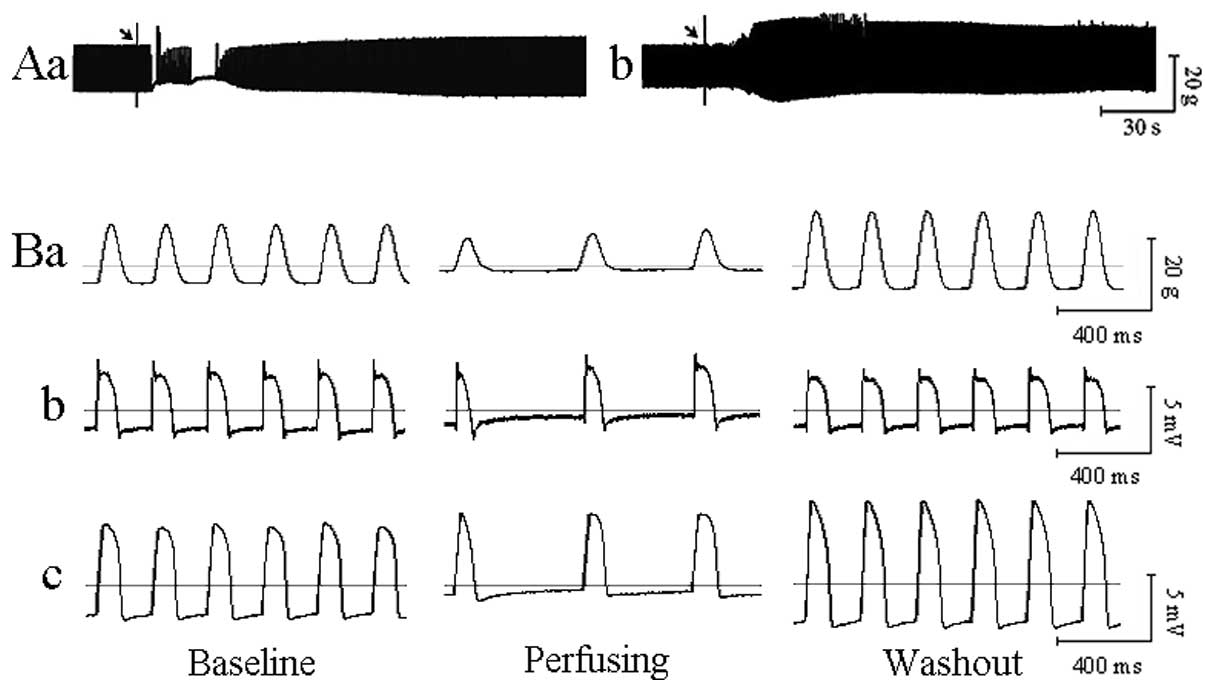
Maximum rebound effects were observed between 100 and 460 sec and recovery to baseline was observed following the infusion of ACh (760±51 sec). The maximum rebound rate was 78.53±27.86% (Fig. 1Aa and b and Bc).

Figure 1

Positive inotropic action and MAP curves induced by ACh. (Aa and b) and (Ba) show the changes in myocardial contractility prior to and following ACh washout. The arrowheads in (A) denote the initiation of ACh perfusion and rapid washout. (Bb and Bc) show ACh-induced changes on the MAPs of the right atrium and right ventricle, respectively.

Changes in MAPs following ACh washout

Washout of ACh induced higher MAPA in the RV (Fig. 1Bc) but not in the RA (Fig. 1Bb). This effect was accompanied by positive inotropic action (Fig. 1Ba) and changes in MAPs. Only the change of MAPA in RV was statistically significant after the washout of ACh (Table I).

Table I

Effects of ACh (10−5 mol/l) on epicardial MAPs in isolated perfused rabbit hearts (n=7).

Table I

Effects of ACh (10−5 mol/l) on epicardial MAPs in isolated perfused rabbit hearts (n=7).

VariableBaselinePerfusionWashout
RA
 MAPA (mV)6.3±1.55.0±1.4a5.8±1.9
 MAPD90 (ms)128.4±17.689.6±16.8135.6±12.5
RV
 MAPA (mV)8.5±2.86.1±2.3a10.6±3.7a
 MAPD90 (ms)139.8±13.592.7±12.5a143.2±15.6

{ label (or @symbol) needed for fn[@id='tfn1-etm-07-03-0755'] } Results are expressed as the means ± SD. RA, right atrium; RV, right ventricle; MAPA, monophasic action potential amplitude; MAPD90, monophasic action potential duration at 90% repolarization.

a P<0.05 vs. baseline.

Discussion

Previous studies have demonstrated that the ACh-induced enhancement of myocardial contractility is related to the following mechanisms, the majority of which act at the cell and tissue level: i) following ACh washout, inhibition of adenylate cyclase is abolished, which increases the sensitivity of the myocardial cells to adrenaline (15,16); ii) as ACh increases the levels of nitric oxide and cGMP, resulting in the activation of phosphodiesterase II, which downregulates intracellular cAMP levels, a phenomenon involving the rebound of the cAMP level and an increase in the number of opened Ca2+-channels occurs after the elution of ACh (13,17,18); iii) ACh activates Ca2+-channels in myocardial cells via the muscarinic M1-receptor (19,20); iv) ACh acts on M2-receptors to facilitate Ca2+ influx via Na+/Ca2+ exchangers, but fails to affect the contractility of the rabbit heart (21,22); v) ACh activates adenylate cyclase via the G-protein βγ-subunit to increase intracellular cAMP levels (13,15) and vi) the sensitivity of myocardial myofibrils to Ca2+ increases following ACh washout (23).

Complex regional differences in the electro-mechanical properties of the healthy adult heart, particularly in the ventricle, have been confirmed. Electro-mechanical features are affected by different pathological conditions, including myocardial ischaemia and cardiac hypertrophy (8). In the present study, ACh washout following adrenaline pretreatment resulted in a higher MAPA accompanied by positive inotropic action in the RV (Fig. 1Bb) but not in the RA (Fig. 1Ba), as assessed by the MAP technique.

ACh-induced positive inotropic actions have been documented in previous studies by using individual myocardial cells or muscle strips, ventricular muscle and other isolated tissue blocks; however, it is necessary to perform integrated confirmative studies at both the organ and body level. The atrium and ventricle, as two functional components, may electrically and mechanically differ. Consequently, integrated and in vivo research methods should be the basic means of investigating these actions. In the present study, regional electrophysiological heterogeneity was exhibited as the rebound positive inotropic action induced by the washout of ACh, which may be a factor leading to cardiac arrhythmia (24,25).

References

1 

Bender K, Wellner-Kienitz MC, Bosche LI, Rinne A, Beckmann C and Pott L: Acute desensitization of GIRK current in rat atrial myocytes is related to K+ current flow. J Physiol. 561:471–483. 2004.PubMed/NCBI

2 

Choisy SC, James AF and Hancox JC: Acute desensitization of acetylcholine and endothelin-1 activated inward rectifier K+ current in myocytes from the cardiac atrioventricular node. Biochem Biophys Res Commun. 423:496–502. 2012. View Article : Google Scholar : PubMed/NCBI

3 

Shui Z, Yamanushi TT and Boyett MR: Evidence of involvement of GIRK1/GIRK4 in long-term desensitization of cardiac muscarinic K+ channels. Am J Physiol Heart Circ Physiol. 280:H2554–H2562. 2001.PubMed/NCBI

4 

Yamanushi TT, Shui Z, Leach RN, Dobrzynski H, Claydon TW and Boyett MR: Role of internalization of M2 muscarinic receptor via clathrin-coated vesicles in desensitization of the muscarinic K+ current in heart. Am J Physiol Heart Circ Physiol. 292:H1737–H1746. 2007. View Article : Google Scholar : PubMed/NCBI

5 

Belevych AE, Sims C and Harvey RD: ACh-induced rebound stimulation of L-type Ca(2+) current in guinea-pig ventricular myocytes, mediated by Gbetagamma-dependent activation of adenylyl cyclase. J Physiol. 536:677–692. 2001.PubMed/NCBI

6 

Godecke A, Heinicke T, Kamkin A, et al: Inotropic response to beta-adrenergic receptor stimulation and anti-adrenergic effect of ACh in endothelial NO synthase-deficient mouse hearts. J Physiol. 532:195–204. 2001. View Article : Google Scholar : PubMed/NCBI

7 

Maruyama M, Lin SF, Xie Y, et al: Genesis of phase 3 early afterdepolarizations and triggered activity in acquired long-QT syndrome. Circ Arrhythm Electrophysiol. 4:103–111. 2011. View Article : Google Scholar : PubMed/NCBI

8 

Bryant SM, Shipsey SJ and Hart G: Regional differences in electrical and mechanical properties of myocytes from guinea-pig hearts with mild left ventricular hypertrophy. Cardiovasc Res. 35:315–323. 1997. View Article : Google Scholar : PubMed/NCBI

9 

Bishop MJ, Vigmond EJ and Plank G: The functional role of electrophysiological heterogeneity in the rabbit ventricle during rapid pacing and arrhythmias. Am J Physiol Heart Circ Physiol. 304:H1240–H1252. 2013. View Article : Google Scholar : PubMed/NCBI

10 

Ravelli F: Mechano-electric feedback and atrial arrhythmias. Mechanosensitivity in Cells and Tissues. Kamkin A and Kiseleva I: Academia Publishing House Ltd; Moscow: 2005

11 

Wyse DG and Gersh BJ: Atrial fibrillation: a perspective: thinking inside and outside the box. Circulation. 109:3089–3095. 2004. View Article : Google Scholar : PubMed/NCBI

12 

Brack KE, Coote JH and Ng GA: The effect of direct autonomic nerve stimulation on left ventricular force in the isolated innervated Langendorff perfused rabbit heart. Auton Neurosci. 124:69–80. 2006. View Article : Google Scholar

13 

Aydin O, Becker R, Kraft P, et al: Effects of protein kinase C activation on cardiac repolarization and arrhythmogenesis in Langendorff-perfused rabbit hearts. Europace. 9:1094–1098. 2007. View Article : Google Scholar : PubMed/NCBI

14 

Cheng J, Ma X, Zhang J and Su D: Diverse modulating effects of estradiol and progesterone on the monophasic action potential duration in Langendorff-perfused female rabbit hearts. Fundam Clin Pharmacol. 26:219–226. 2012. View Article : Google Scholar

15 

Okada M, Mizuno W, Nakarai R, Matada T, Yamawaki H and Hara Y: Benzodiazepines inhibit the acetylcholine receptor-operated potassium current (IK.ACh) by different mechanisms in guinea-pig atrial myocytes. J Vet Med Sci. 74:879–884. 2012. View Article : Google Scholar

16 

Brodde OE and Michel MC: Adrenergic and muscarinic receptors in the human heart. Pharmacol Rev. 51:651–690. 1999.PubMed/NCBI

17 

Guiraudou P, Pucheu SC, Gayraud R, et al: Involvement of nitric oxide in amiodarone- and dronedarone-induced coronary vasodilation in guinea pig heart. Eur J Pharmacol. 496:119–127. 2004. View Article : Google Scholar : PubMed/NCBI

18 

Cheng H, Smith GL, Orchard CH, Hancox JC and Burton FL: Inhibition of sarcoplasmic reticulum Ca(2+)-ATPase decreases atrioventricular node-paced heart rate in rabbits. Exp Physiol. 97:1131–1139. 2012.

19 

Link S, Meissner M, Held B, et al: Diversity and developmental expression of L-type calcium channel beta2 proteins and their influence on calcium current in murine heart. J Biol Chem. 284:30129–30137. 2009. View Article : Google Scholar : PubMed/NCBI

20 

Bodi I, Mikala G, Koch SE, Akhter SA and Schwartz A: The L-type calcium channel in the heart: the beat goes on. J Clin Invest. 115:3306–3317. 2005. View Article : Google Scholar : PubMed/NCBI

21 

Lee YS, Maruyama M, Chang PC, et al: Ryanodine receptor inhibition potentiates the activity of Na channel blockers against spontaneous calcium elevations and delayed afterdepolarizations in Langendorff-perfused rabbit ventricles. Heart Rhythm. 9:1125–1132. 2012. View Article : Google Scholar

22 

Farkas AS, Acsai K, Nagy N, et al: Na(+)/Ca(2+) exchanger inhibition exerts a positive inotropic effect in the rat heart, but fails to influence the contractility of the rabbit heart. Br J Pharmacol. 154:93–104. 2008.

23 

Hayashi H, Kamanu SD, Ono N, et al: Calcium transient dynamics and the mechanisms of ventricular vulnerability to single premature electrical stimulation in Langendorff-perfused rabbit ventricles. Heart Rhythm. 5:116–123. 2008. View Article : Google Scholar

24 

Aslanidi OV, Robinson R, Cheverton D, Boyett MR and Zhang H: Electrophysiological substrate for a dominant reentrant source during atrial fibrillation. Conf Proc IEEE Eng Med Biol Soc. 2009:2819–2822. 2009.PubMed/NCBI

25 

Smith RM, Velamakanni SS and Tolkacheva EG: Interventricular heterogeneity as a substrate for arrhythmogenesis of decoupled mitochondria during ischemia in the whole heart. Am J Physiol Heart Circ Physiol. 303:H224–H233. 2012. View Article : Google Scholar : PubMed/NCBI

Related Articles

  • Abstract
  • View
  • Download
  • Twitter
Copy and paste a formatted citation
Spandidos Publications style
Luo H, Si J, Zhang F, Yang Z and Wang R: Cardiac inotropic rebound effect after washout of acetylcholine is associated with electrophysiological heterogeneity in Langendorff-perfused rabbit heart. Exp Ther Med 7: 755-757, 2014.
APA
Luo, H., Si, J., Zhang, F., Yang, Z., & Wang, R. (2014). Cardiac inotropic rebound effect after washout of acetylcholine is associated with electrophysiological heterogeneity in Langendorff-perfused rabbit heart. Experimental and Therapeutic Medicine, 7, 755-757. https://doi.org/10.3892/etm.2014.1486
MLA
Luo, H., Si, J., Zhang, F., Yang, Z., Wang, R."Cardiac inotropic rebound effect after washout of acetylcholine is associated with electrophysiological heterogeneity in Langendorff-perfused rabbit heart". Experimental and Therapeutic Medicine 7.3 (2014): 755-757.
Chicago
Luo, H., Si, J., Zhang, F., Yang, Z., Wang, R."Cardiac inotropic rebound effect after washout of acetylcholine is associated with electrophysiological heterogeneity in Langendorff-perfused rabbit heart". Experimental and Therapeutic Medicine 7, no. 3 (2014): 755-757. https://doi.org/10.3892/etm.2014.1486
Copy and paste a formatted citation
x
Spandidos Publications style
Luo H, Si J, Zhang F, Yang Z and Wang R: Cardiac inotropic rebound effect after washout of acetylcholine is associated with electrophysiological heterogeneity in Langendorff-perfused rabbit heart. Exp Ther Med 7: 755-757, 2014.
APA
Luo, H., Si, J., Zhang, F., Yang, Z., & Wang, R. (2014). Cardiac inotropic rebound effect after washout of acetylcholine is associated with electrophysiological heterogeneity in Langendorff-perfused rabbit heart. Experimental and Therapeutic Medicine, 7, 755-757. https://doi.org/10.3892/etm.2014.1486
MLA
Luo, H., Si, J., Zhang, F., Yang, Z., Wang, R."Cardiac inotropic rebound effect after washout of acetylcholine is associated with electrophysiological heterogeneity in Langendorff-perfused rabbit heart". Experimental and Therapeutic Medicine 7.3 (2014): 755-757.
Chicago
Luo, H., Si, J., Zhang, F., Yang, Z., Wang, R."Cardiac inotropic rebound effect after washout of acetylcholine is associated with electrophysiological heterogeneity in Langendorff-perfused rabbit heart". Experimental and Therapeutic Medicine 7, no. 3 (2014): 755-757. https://doi.org/10.3892/etm.2014.1486
Follow us
  • Twitter
  • LinkedIn
  • Facebook
About
  • Spandidos Publications
  • Careers
  • Cookie Policy
  • Privacy Policy
How can we help?
  • Help
  • Live Chat
  • Contact
  • Email to our Support Team