Spandidos Publications Logo
  • About
    • About Spandidos
    • Aims and Scopes
    • Abstracting and Indexing
    • Editorial Policies
    • Reprints and Permissions
    • Job Opportunities
    • Terms and Conditions
    • Contact
  • Journals
    • All Journals
    • Oncology Letters
      • Oncology Letters
      • Information for Authors
      • Editorial Policies
      • Editorial Board
      • Aims and Scope
      • Abstracting and Indexing
      • Bibliographic Information
      • Archive
    • International Journal of Oncology
      • International Journal of Oncology
      • Information for Authors
      • Editorial Policies
      • Editorial Board
      • Aims and Scope
      • Abstracting and Indexing
      • Bibliographic Information
      • Archive
    • Molecular and Clinical Oncology
      • Molecular and Clinical Oncology
      • Information for Authors
      • Editorial Policies
      • Editorial Board
      • Aims and Scope
      • Abstracting and Indexing
      • Bibliographic Information
      • Archive
    • Experimental and Therapeutic Medicine
      • Experimental and Therapeutic Medicine
      • Information for Authors
      • Editorial Policies
      • Editorial Board
      • Aims and Scope
      • Abstracting and Indexing
      • Bibliographic Information
      • Archive
    • International Journal of Molecular Medicine
      • International Journal of Molecular Medicine
      • Information for Authors
      • Editorial Policies
      • Editorial Board
      • Aims and Scope
      • Abstracting and Indexing
      • Bibliographic Information
      • Archive
    • Biomedical Reports
      • Biomedical Reports
      • Information for Authors
      • Editorial Policies
      • Editorial Board
      • Aims and Scope
      • Abstracting and Indexing
      • Bibliographic Information
      • Archive
    • Oncology Reports
      • Oncology Reports
      • Information for Authors
      • Editorial Policies
      • Editorial Board
      • Aims and Scope
      • Abstracting and Indexing
      • Bibliographic Information
      • Archive
    • Molecular Medicine Reports
      • Molecular Medicine Reports
      • Information for Authors
      • Editorial Policies
      • Editorial Board
      • Aims and Scope
      • Abstracting and Indexing
      • Bibliographic Information
      • Archive
    • World Academy of Sciences Journal
      • World Academy of Sciences Journal
      • Information for Authors
      • Editorial Policies
      • Editorial Board
      • Aims and Scope
      • Abstracting and Indexing
      • Bibliographic Information
      • Archive
    • International Journal of Functional Nutrition
      • International Journal of Functional Nutrition
      • Information for Authors
      • Editorial Policies
      • Editorial Board
      • Aims and Scope
      • Abstracting and Indexing
      • Bibliographic Information
      • Archive
    • International Journal of Epigenetics
      • International Journal of Epigenetics
      • Information for Authors
      • Editorial Policies
      • Editorial Board
      • Aims and Scope
      • Abstracting and Indexing
      • Bibliographic Information
      • Archive
    • Medicine International
      • Medicine International
      • Information for Authors
      • Editorial Policies
      • Editorial Board
      • Aims and Scope
      • Abstracting and Indexing
      • Bibliographic Information
      • Archive
  • Articles
  • Information
    • Information for Authors
    • Information for Reviewers
    • Information for Librarians
    • Information for Advertisers
    • Conferences
  • Language Editing
Spandidos Publications Logo
  • About
    • About Spandidos
    • Aims and Scopes
    • Abstracting and Indexing
    • Editorial Policies
    • Reprints and Permissions
    • Job Opportunities
    • Terms and Conditions
    • Contact
  • Journals
    • All Journals
    • Biomedical Reports
      • Information for Authors
      • Editorial Policies
      • Editorial Board
      • Aims and Scope
      • Abstracting and Indexing
      • Bibliographic Information
      • Archive
    • Experimental and Therapeutic Medicine
      • Information for Authors
      • Editorial Policies
      • Editorial Board
      • Aims and Scope
      • Abstracting and Indexing
      • Bibliographic Information
      • Archive
    • International Journal of Epigenetics
      • Information for Authors
      • Editorial Policies
      • Editorial Board
      • Aims and Scope
      • Abstracting and Indexing
      • Bibliographic Information
      • Archive
    • International Journal of Functional Nutrition
      • Information for Authors
      • Editorial Policies
      • Editorial Board
      • Aims and Scope
      • Abstracting and Indexing
      • Bibliographic Information
      • Archive
    • International Journal of Molecular Medicine
      • Information for Authors
      • Editorial Policies
      • Editorial Board
      • Aims and Scope
      • Abstracting and Indexing
      • Bibliographic Information
      • Archive
    • International Journal of Oncology
      • Information for Authors
      • Editorial Policies
      • Editorial Board
      • Aims and Scope
      • Abstracting and Indexing
      • Bibliographic Information
      • Archive
    • Medicine International
      • Information for Authors
      • Editorial Policies
      • Editorial Board
      • Aims and Scope
      • Abstracting and Indexing
      • Bibliographic Information
      • Archive
    • Molecular and Clinical Oncology
      • Information for Authors
      • Editorial Policies
      • Editorial Board
      • Aims and Scope
      • Abstracting and Indexing
      • Bibliographic Information
      • Archive
    • Molecular Medicine Reports
      • Information for Authors
      • Editorial Policies
      • Editorial Board
      • Aims and Scope
      • Abstracting and Indexing
      • Bibliographic Information
      • Archive
    • Oncology Letters
      • Information for Authors
      • Editorial Policies
      • Editorial Board
      • Aims and Scope
      • Abstracting and Indexing
      • Bibliographic Information
      • Archive
    • Oncology Reports
      • Information for Authors
      • Editorial Policies
      • Editorial Board
      • Aims and Scope
      • Abstracting and Indexing
      • Bibliographic Information
      • Archive
    • World Academy of Sciences Journal
      • Information for Authors
      • Editorial Policies
      • Editorial Board
      • Aims and Scope
      • Abstracting and Indexing
      • Bibliographic Information
      • Archive
  • Articles
  • Information
    • For Authors
    • For Reviewers
    • For Librarians
    • For Advertisers
    • Conferences
  • Language Editing
Login Register Submit
  • This site uses cookies
  • You can change your cookie settings at any time by following the instructions in our Cookie Policy. To find out more, you may read our Privacy Policy.

    I agree
Search articles by DOI, keyword, author or affiliation
Search
Advanced Search
presentation
Experimental and Therapeutic Medicine
Join Editorial Board Propose a Special Issue
Print ISSN: 1792-0981 Online ISSN: 1792-1015
Journal Cover
2014-April Volume 7 Issue 4

Full Size Image

Sign up for eToc alerts
Recommend to Library

Journals

International Journal of Molecular Medicine

International Journal of Molecular Medicine

International Journal of Molecular Medicine is an international journal devoted to molecular mechanisms of human disease.

International Journal of Oncology

International Journal of Oncology

International Journal of Oncology is an international journal devoted to oncology research and cancer treatment.

Molecular Medicine Reports

Molecular Medicine Reports

Covers molecular medicine topics such as pharmacology, pathology, genetics, neuroscience, infectious diseases, molecular cardiology, and molecular surgery.

Oncology Reports

Oncology Reports

Oncology Reports is an international journal devoted to fundamental and applied research in Oncology.

Experimental and Therapeutic Medicine

Experimental and Therapeutic Medicine

Experimental and Therapeutic Medicine is an international journal devoted to laboratory and clinical medicine.

Oncology Letters

Oncology Letters

Oncology Letters is an international journal devoted to Experimental and Clinical Oncology.

Biomedical Reports

Biomedical Reports

Explores a wide range of biological and medical fields, including pharmacology, genetics, microbiology, neuroscience, and molecular cardiology.

Molecular and Clinical Oncology

Molecular and Clinical Oncology

International journal addressing all aspects of oncology research, from tumorigenesis and oncogenes to chemotherapy and metastasis.

World Academy of Sciences Journal

World Academy of Sciences Journal

Multidisciplinary open-access journal spanning biochemistry, genetics, neuroscience, environmental health, and synthetic biology.

International Journal of Functional Nutrition

International Journal of Functional Nutrition

Open-access journal combining biochemistry, pharmacology, immunology, and genetics to advance health through functional nutrition.

International Journal of Epigenetics

International Journal of Epigenetics

Publishes open-access research on using epigenetics to advance understanding and treatment of human disease.

Medicine International

Medicine International

An International Open Access Journal Devoted to General Medicine.

Journal Cover
2014-April Volume 7 Issue 4

Full Size Image

Sign up for eToc alerts
Recommend to Library

  • Article
  • Citations
    • Cite This Article
    • Download Citation
    • Create Citation Alert
    • Remove Citation Alert
    • Cited By
  • Similar Articles
    • Related Articles (in Spandidos Publications)
    • Similar Articles (Google Scholar)
    • Similar Articles (PubMed)
  • Download PDF
  • Download XML
  • View XML
Article

A modified HPLC method improves the simultaneous determination of plasma kynurenine and tryptophan concentrations in patients following maintenance hemodialysis

  • Authors:
    • Chenggen Xiao
    • Yuanhan Chen
    • Xinling Liang
    • Zhen Xie
    • Min Zhang
    • Ruizhao Li
    • Zhilian Li
    • Xia Fu
    • Xiyong Yu
    • Wei Shi
  • View Affiliations / Copyright

    Affiliations: Nanfang Medical University, Guangzhou, Guandong 510080, P.R. China, Division of Nephrology, Guangdong General Hospital, Guangdong Academy of Medical Sciences, Guangzhou, Guandong 510080, P.R. China, Department of Dermatology, Sichuan Academy of Medical Sciences and Sichuan Provincial People's Hospital, Chengdu, Sichuan 610000, P.R. China, Department of Gastroenterology, The Sixth Affiliated Hospital, Sun Yat‑Sen University, Guangzhou, Guangdong 510081, P.R. China, Medical Research Center, Guangdong General Hospital, Guangdong Academy of Medical Sciences, Guangzhou, Guangdong 510081, P.R. China
  • Pages: 907-910
    |
    Published online on: January 29, 2014
       https://doi.org/10.3892/etm.2014.1512
  • Expand metrics +
Metrics: Total Views: 0 (Spandidos Publications: | PMC Statistics: )
Metrics: Total PDF Downloads: 0 (Spandidos Publications: | PMC Statistics: )
Cited By (CrossRef): 0 citations Loading Articles...

This article is mentioned in:


Abstract

The ratio between plasma kynurenine (Kyn) and tryptophan (Trp) serves as a marker of indoleamine 2,3‑dioxygenase, a critical immunomodulatory molecule. Simultaneous detection of the two markers may be performed using high‑pressure liquid chromatography (HPLC). However, for uremic patients, the conventional detection method may be affected by a range of accumulated toxins. The current study aimed to establish a method for the simultaneous measurement of Kyn and Trp in patients following maintenance hemodialysis via HPLC‑ultraviolet detection. The procedure involved the use of a SinoChrom ODS‑BP C18 column (4.6x150 mm; inner diameter, 4.5 µm) and a mobile phase of 15 mmol/l sodium acetate acetic acid solution (containing 5% acetonitrile, pH 4.8). The modified method was verified using plasma samples from 10 healthy controls and 91 maintenance hemodialysis patients. The results demonstrated that the modified method was successful in simultaneously detecting the concentrations of Trp and Kyn in the healthy controls and maintenance hemodialysis patients. The method is simple, fast, accurate and suitable for clinical and research purposes in maintenance hemodialysis patients.

Introduction

End-stage renal disease seriously affects human health and maintenance hemodialysis is the primary therapy for this condition. Although the technology for maintenance hemodialysis is continually being developed, malnutrition and inflammation significantly affect patient prognosis (1). Previous studies have shown that tryptophan (Trp) is an important regulator of immune homeostasis and inflammation (2). Trp is one of the essential amino acids in the human body and has a critical role in effective T cell function. Depletion of Trp activates effector T lymphocytes, thereby mediating immune tolerance. Furthermore, a metabolite of Trp, kynurenine (Kyn), promotes the generation of regulatory T lymphocytes, which further promote immune tolerance (3). Indoleamine 2,3-dioxygenase (IDO) is an intercellular rate-limiting enzyme that catalyzes the conversion of Trp to Kyn and plays a key role in immune homeostasis in uremic patients (2,4–6). IDO is also an immunoregulatory signal transduction molecule (7). Therefore, Kyn functions as a new potential marker in patients with end-stage renal disease.

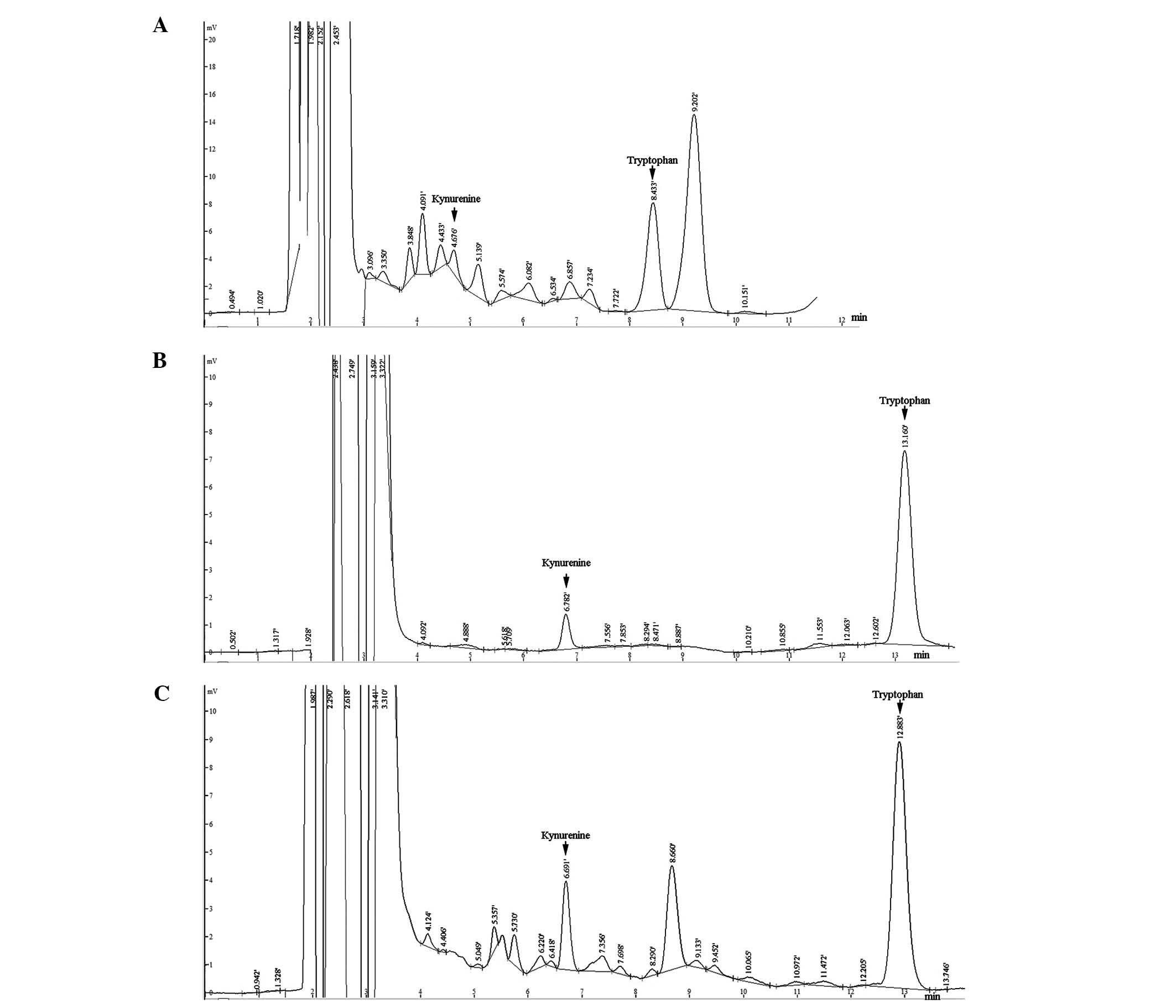
IDO activity can be estimated by the concentration ratio of Kyn to Trp (5,8). The Kyn/Trp ratio correlates with inflammatory markers, including high-sensitivity C-reactive protein and soluble tumor necrosis factor-receptor-1, and has been recognized as a promising biomarker for evaluating immune homeostasis and inflammation (4,5). High-pressure liquid chromatography (HPLC) is a traditional method for measuring plasma amino acids levels. However, simultaneous measurement of Trp and Kyn is difficult using HPLC (9). Schefold et al reported a costly electrospray-tandem mass spectrometry assay for measuring Trp and Kyn simultaneously (5). With regard to clinical practice, several previous approaches to simultaneously measuring Trp and Kyn using HPLC have been reported (10,11). However, these methods were limited to isolating Kyn in uremic patients due to an interference of unknown uremic toxin (Fig. 1A). Additional HPLC methods have been used for uremic patients, but these methods have tedious and time-consuming procedures (12,13).

Figure 1

High-pressure chromatograms using the referenced and modified methods. Typical high-pressure chromatogram results using the (A) reference method for patients undergoing hemodialysis, (B) modified method for standard samples and (C) modified method for patients undergoing hemodialysis. Arrows indicate the peak positions of Trp and Kyn. Kyn, kynurenine; Trp, tryptophan.

The present study aimed to develop a modified method to measure Trp and Kyn simultaneously in uremic patients for the evaluation of IDO activity.

Materials and methods

Reference method

The conventional method for simultaneous Trp and Kyn detection was used as the reference. A SymmetryShield RP-C18 column (150×3.9 mm; inner diameter, 5 μm) was purchased from Waters Corporation (Milford, MA, USA). The column had a mobile phase of 2.7% acetonitrile and pH 3.6 (11).

Instruments

An LC-3A high-pressure liquid chromatograph (Shimadzu, Kyoto, Japan), SCI 100 UV-Vis detector (Daniel Elite Analytical Industries, Inc., Houston, TX, USA), YH-300 data processing system (Easeatech, Guangzhou, China) and VICILC 25-μl manual injector (Shimadzu, Kyoto, Japan) were used in the procedure.

Reagents

Standard samples of Kyn and L-Trp were purchased from Sigma-Aldrich (St. Louis, MO, USA). Chromatographic pure acetonitrile, potassium dihydrogen phosphate, sodium acetate, analytical-grade acetic acid, 36% perchloric acid and ultra-pure water were treated with a Milli-Q Pure water device (Millipore Corporation, Billerica, MA, USA).

Protein precipitant preparation

Perchloric acid solution at a volume fraction of 5.0% was prepared using ultra-pure water.

Mobile phase

Acetic acid (36%) and acetonitrile solutions were used in the mobile phase. Sodium acetate crystals were weighed and sodium acetate-acetic acid solution (containing 5% acetonitrile) was prepared. Prior to use, the solution was ultrasonically degassed for 40 min, incubated overnight and filtered using a precolumn (KJO-4282; Phenomenex, Torrance, CA, USA).

Preparation of the stock solution

Trp and Kyn stock solutions, at a concentration of 20 mmol/l, were prepared using 2.5% perchloric acid solution. Aliquotted stock solutions were then stored at −4°C. Standard working solutions were prepared using ultra-pure water prior to each use.

Sample collection and processing

In total, 91 patients that were undergoing hemodialysis three times a week (single pool Kt/V, >1.2) were recruited from the Blood Purification Center at Guangdong General Hospital (Guangzhou, China). An additional 10 healthy volunteers were also recruited (Table I). Blood samples (2 ml) were collected from the arteriovenous fistulas of patients who had undergone maintenance hemodialysis and were placed into 4-ml EDTA tubes. After 1 h, the blood was centrifuged at room temperature at 2,200 × g for 10 min to separate the plasma. Blood sample collection was approved by the Ethics Committee of Guangdong General Hospital (2013069H) and all patients provided informed consent.

Table I

Characteristics of the control individuals and patients undergoing hemodialysis.

Table I

Characteristics of the control individuals and patients undergoing hemodialysis.

CharacteristicsControlsPatients
Age, years34±1053–77
Gender, male/female, n5/551/40
Plasma Kyn concentration, μmol/l0.8–0.41.07±0.10
Plasma Trp concentration, μmol/l31.3±21.25.62±0.98
Plasma albumin, g/l31.1±3.5
Hemodialysis time, days1326.9±317.2
Single pool Kt/V*1.5±0.3

[i] Kyn, kynurenine; Trp, tryptophan.

Plasma samples (50 μl) were placed into a centrifugal tube and the same volume of 5% perchloric acid solution was added. Next, the samples were placed in a vortex mixer for 30 sec and then maintained at room temperature for 15 min to allow plasma protein precipitation (11). Finally, the samples were centrifuged at 12,000 × g for 5 min and 20-μl samples of supernatant were collected for analysis.

Chromatographic requirements

The procedure involved a SinoChrom ODS-BP C18 column (4.6×150 mm; inner diameter, 4.5 μm; Dalian Elite Analytical Instruments Co., Ltd., Dalian, China) and a mobile phase of 15 mmol/l sodium acetate acetic acid solution (containing 5% acetonitrile, pH 4.8) at a flow rate of 1.0 ml/min. The SC100-UV-visible detector was operated at 225 nm and the injection volume was 20 μl. Concentrations were measured at room temperature.

Preparation of mixed plasma

In total, 20 plasma samples were selected randomly from the 91 patients undergoing maintenance hemodialysis. The samples were mixed well and stored in a −20°C freezer for later precision and recovery measurements (10).

Qualitative and quantitative analyses for Kyn and Trp

Qualitative analyses for Kyn and Trp were performed using the peak retention value comparison and superposition methods, while quantitative analysis was performed using the external standard method. Data processing was conducted using a YH-300 Chromatograph workstation (Easeatech). Quantitative results are expressed as mean ± SD.

Results

Trp and Kyn concentrations

Concentrations of Trp and Kyn were detectable in all 10 healthy volunteers and in 90 of the 91 patients who underwent maintenance hemodialysis under the modified conditions (Table I). By contrast, the reference method only detected the concentrations of Trp and Kyn in 14 of the 91 patients undergoing maintenance hemodialysis. Failure of the reference method primarily arose from peak interference (Fig. 1A).

Standard curve and equation

Standard working solutions were prepared by combining 2.5% perchloric acid solution with Trp and Kyn (Kyn, 0.004–100 μmol/l; Trp, 0.01–1,000 μmol/l). Each sample was injected three times and the average result was used for analysis. The results are shown in Table II, where y represents the peak area (μV.sec) and x is the sample concentration (μmol/l). A marked linear correlation was observed between the peak area and the sample concentrations of Kyn and Trp, with a wide linear range and a low detection limit, indicating good sensitivity.

Table II

Regression analysis and detection limits for Kyn and Trp.

Table II

Regression analysis and detection limits for Kyn and Trp.

SubstanceRegression equationR2Linear range, μmol/lDetection limit
Kyny = 28007x + 3843.91.00.08–500.02
Trpy = 27331x + 855881.00.8–5000.2

[i] x, concentration (μmol/l). y, peak area (μV.sec). Kyn, kynurenine; Trp, tryptophan.

Precision test

Chromatographic columns and precolumns were washed daily with formaldehyde and the standard curves were corrected every two days (10). Intra- and inter-day precision tests were performed on mixed plasma samples (Table III).

Table III

Precision of the intra- and inter-day measurements of Kyn and Trp (n=20).

Table III

Precision of the intra- and inter-day measurements of Kyn and Trp (n=20).

SubstanceIntra-day, mol/lRSD, %Inter-day, mol/lRSD, %
Kyn0.7301±0.09102.600.7415±0.02503.38
Trp3.0280±0.04031.332.9184±0.12792.38

[i] Values are expressed as mean ± SD. Kyn, kynurenine; Trp, tryptophan; RSD, relative standard deviation.

Discussion

Kyn/Trp ratio is a marker that reflects immune homeostasis and inflammation. Although existing HPLC methods are able to rapidly and simultaneously detect Trp and Kyn in non-uremic patients, they fail to do so for uremic patients due to the presence of unknown uremic substances that have absorption profiles similar to that of Kyn (Fig. 1). In the present study, the column diameter, pH value of the mobile phase and the content of acetonitrile were adjusted to isolate Trp and Kyn from these interfering components (Fig. 1C). The results indicated that the modified method was able to simultaneously detect the concentrations of plasma Trp and Kyn in uremic patients.

The method used in the present study differs from previously reported HPLC methods. Zhen et al and Koening et al used a 5-μm C18 column and adjusted the wavelength of the ultraviolet detector during detection (12,13). In the current study, a 4.5-μm C18 column was used. Furthermore, the composition of the mobile phase was adjusted, which allowed for the detection of Kyn and Trp simultaneously at a fixed wavelength and with a shortened detection time. In addition, the current method has a wider detection range which completely covers the levels of human plasma Trp and Kyn under normal and pathological states. The modified method is also applicable for in vitro detection. However, in the present study, Trp and Kyn levels remained undetected in one sample. The reason for this detection failure remains to be explored.

In conclusion, the modified HPLC method is able to detect Trp and Kyn simultaneously in uremic patients, satisfying the requirements for IDO determination in clinical practice.

Acknowledgements

The authors thank the Medical Research Center (Guangdong General Hospital, Guangzhou, China) core facilities for assistance and Tie-feng Chen for technical assistance. The study was supported by a grant from the National Key Technology R&D Program (no. 2011BAI10B08) and the National Clinical Key Specialty Construction Preparatory Projects.

References

1 

Stenvinkel P, Heimbürger O, Paultre F, Diczfalusy U, Wang T, Berglund L and Jogestrand T: Strong association between malnutrition, inflammation, and atherosclerosis in chronic renal failure. Kidney Int. 55:1899–1911. 1999. View Article : Google Scholar : PubMed/NCBI

2 

Medzhitov R, Shevach EM, Trinchieri G, et al: Highlights of 10 years of immunology in Nature Reviews Immunology. Nat Rev Immunol. 11:693–702. 2011.PubMed/NCBI

3 

Mellor AL and Munn DH: IDO expression by dendritic cells: tolerance and tryptophan catabolism. Nat Rev Immunol. 4:762–774. 2004. View Article : Google Scholar : PubMed/NCBI

4 

Eleftheriadis T, Liakopoulos V, Antoniadi G, Stefanidis I and Galaktidou G: Indoleamine 2,3-dioxygenase is increased in hemodialysis patients and affects immune response to hepatitis B vaccination. Vaccine. 29:2242–2247. 2011. View Article : Google Scholar : PubMed/NCBI

5 

Schefold JC, Zeden JP, Fotopoulou C, et al: Increased indoleamine 2,3-dioxygenase (IDO) activity and elevated serum levels of tryptophan catabolites in patients with chronic kidney disease: a possible link between chronic inflammation and uraemic symptoms. Nephrol Dial Transplant. 24:1901–1908. 2009. View Article : Google Scholar

6 

Eleftheriadis T, Antoniadi G, Liakopoulos V, Stefanidis I and Galaktidou G: Plasma indoleamine 2,3-dioxygenase concentration is increased in hemodialysis patients and may contribute to the pathogenesis of coronary heart disease. Ren Fail. 34:68–72. 2012. View Article : Google Scholar

7 

Pallotta MT, Orabona C, Volpi C, et al: Indoleamine 2,3-dioxygenase is a signaling protein in long-term tolerance by dendritic cells. Nat Immunol. 12:870–878. 2011. View Article : Google Scholar : PubMed/NCBI

8 

Brandacher G, Cakar F, Winkler C, et al: Non-invasive monitoring of kidney allograft rejection through IDO metabolism evaluation. Kidney Int. 71:60–67. 2007. View Article : Google Scholar : PubMed/NCBI

9 

Pawlak D, Tankiewicz A, Mysliwiec P and Buczko W: Tryptophan metabolism via the kynurenine pathway in experimental chronic renal failure. Nephron. 90:328–335. 2002. View Article : Google Scholar : PubMed/NCBI

10 

Liu L, Chen Y, Zhang Y, Wang F and Chen Z: Determination of tryptophan and kynurenine in human plasma by liquid chromatography-electrochemical detection with multi-wall carbon nanotube-modified glassy carbon electrode. Biomed Chromatogr. 25:938–942. 2011. View Article : Google Scholar

11 

Wang R and Tang A: Simultaneous determination of kynurenine and tryptophan in serum by high performance liquid chromatography. Se Pu. 24:140–143. 2006.(In Chinese).

12 

Zhen Q, Xu B, Ma L, Tian G, Tang X and Ding M: Simultaneous determination of tryptophan, kynurenine and 5-hydroxytryptamine by HPLC: Application in uremic patients undergoing hemodialysis. Clin Biochem. 44:226–230. 2011. View Article : Google Scholar : PubMed/NCBI

13 

Koenig P, Nagl C, Neurauter G, Schennach H, Brandacher G and Fuchs D: Enhanced degradation of tryptophan in patients on hemodialysis. Clin Nephrol. 74:465–470. 2010. View Article : Google Scholar : PubMed/NCBI

Related Articles

  • Abstract
  • View
  • Download
  • Twitter
Copy and paste a formatted citation
Spandidos Publications style
Xiao C, Chen Y, Liang X, Xie Z, Zhang M, Li R, Li Z, Fu X, Yu X, Shi W, Shi W, et al: A modified HPLC method improves the simultaneous determination of plasma kynurenine and tryptophan concentrations in patients following maintenance hemodialysis. Exp Ther Med 7: 907-910, 2014.
APA
Xiao, C., Chen, Y., Liang, X., Xie, Z., Zhang, M., Li, R. ... Shi, W. (2014). A modified HPLC method improves the simultaneous determination of plasma kynurenine and tryptophan concentrations in patients following maintenance hemodialysis. Experimental and Therapeutic Medicine, 7, 907-910. https://doi.org/10.3892/etm.2014.1512
MLA
Xiao, C., Chen, Y., Liang, X., Xie, Z., Zhang, M., Li, R., Li, Z., Fu, X., Yu, X., Shi, W."A modified HPLC method improves the simultaneous determination of plasma kynurenine and tryptophan concentrations in patients following maintenance hemodialysis". Experimental and Therapeutic Medicine 7.4 (2014): 907-910.
Chicago
Xiao, C., Chen, Y., Liang, X., Xie, Z., Zhang, M., Li, R., Li, Z., Fu, X., Yu, X., Shi, W."A modified HPLC method improves the simultaneous determination of plasma kynurenine and tryptophan concentrations in patients following maintenance hemodialysis". Experimental and Therapeutic Medicine 7, no. 4 (2014): 907-910. https://doi.org/10.3892/etm.2014.1512
Copy and paste a formatted citation
x
Spandidos Publications style
Xiao C, Chen Y, Liang X, Xie Z, Zhang M, Li R, Li Z, Fu X, Yu X, Shi W, Shi W, et al: A modified HPLC method improves the simultaneous determination of plasma kynurenine and tryptophan concentrations in patients following maintenance hemodialysis. Exp Ther Med 7: 907-910, 2014.
APA
Xiao, C., Chen, Y., Liang, X., Xie, Z., Zhang, M., Li, R. ... Shi, W. (2014). A modified HPLC method improves the simultaneous determination of plasma kynurenine and tryptophan concentrations in patients following maintenance hemodialysis. Experimental and Therapeutic Medicine, 7, 907-910. https://doi.org/10.3892/etm.2014.1512
MLA
Xiao, C., Chen, Y., Liang, X., Xie, Z., Zhang, M., Li, R., Li, Z., Fu, X., Yu, X., Shi, W."A modified HPLC method improves the simultaneous determination of plasma kynurenine and tryptophan concentrations in patients following maintenance hemodialysis". Experimental and Therapeutic Medicine 7.4 (2014): 907-910.
Chicago
Xiao, C., Chen, Y., Liang, X., Xie, Z., Zhang, M., Li, R., Li, Z., Fu, X., Yu, X., Shi, W."A modified HPLC method improves the simultaneous determination of plasma kynurenine and tryptophan concentrations in patients following maintenance hemodialysis". Experimental and Therapeutic Medicine 7, no. 4 (2014): 907-910. https://doi.org/10.3892/etm.2014.1512
Follow us
  • Twitter
  • LinkedIn
  • Facebook
About
  • Spandidos Publications
  • Careers
  • Cookie Policy
  • Privacy Policy
How can we help?
  • Help
  • Live Chat
  • Contact
  • Email to our Support Team