Introduction
It has been reported that approximately one-third of
patients who are actively receiving treatment for cancer, and
two-thirds of those with advanced malignant disease experience pain
(1). Cancer pain, particularly bone
cancer pain, which is one of the most frequent symptoms in bone
cancer patients (2), affects their
quality of life, and current treatments are limited (3). Carcinomas and sarcomas of various types
metastasize to bone, resulting in spontaneous bone pain,
hyperalgesia (exaggerated pain) and allodynia (pain in response to
a normally innocuous stimulus), in addition to the degradation of
bone and remodeling of peripheral nerves (4). Although opiates, particularly the
opioid receptor agonist morphine, have been used as conventionally
prescribed analgesic drugs for the treatment of advanced bone
cancer pain, patients often undergo tolerance to analgesics as well
as dose-limiting side-effects, which limit their long-term clinical
application (5). Thus, new drugs
that are effective and have minimal side-effects are urgently
required.
The efficacy of traditional Chinese medicine (TCM)
is recognized in numerous countries (6,7).
Confirmed by clinical trials and experimental studies, certain TCMs
possess remarkable efficacies in pain treatment, including
Tou-Feng-Yu pill (8) and
Tong-Luo-San-Jie gel (9). Moreover,
surveys have revealed that TCMs are used as important auxiliary
therapeutics among 41–62% of cancer patients (9,10).
Following traditional Chinese prescriptions, Porcellio
laevis Latreille, Corydalis Rhizoma and Radix Cynanchi
Paniculati have been combined at a ratio of 9:7:7 to provide a
novel formulation named Jia-Yuan-Qing pill (JYQP). A patent for the
JYQP formula has been authorized in China (Patent No.
201110147689.7) (11). As reported
previously, Porcellio laevis Latreille (12), Corydalis Rhizoma (13) and Radix Cynanchi Paniculati (14) have been used as analgesic drugs for
many years. Our study performed in mice has demonstrated that JYQP
exerts its analgesic activity via the participation of peripheral
nerve (15).
Although TCMs are generally accepted to be safe and
efficacious for long-term use, pharmacological and toxicological
evaluations for TCMs are necessary (16). There have been no previous studies
demonstrating the safety of the three herbal components
(Porcelain laevis Latreille, Corydalis Rhizoma and Radix
Cynanchi Paniculati) of JYQP and no chronic toxicity tests on rats
have been reported.
The aim of the present study was to evaluate the
safety, addictive potential and analgesic effect on cancer pain of
JYQP in rats. After 6 months of JYQP administration, bodyweight
changes, blood biochemical parameters and organ coefficients were
monitored. The activity of JYQP on cancer pain was assessed in a
rat model of bone cancer pain induced by the Walker 256 cell line.
The withdrawal behavior was also assessed in comparison with
morphine.
Materials and methods
Materials
The Porcellio laevis Latreille, Corydalis
Rhizoma and Radix Cynanchi Paniculati components of JYQP were
supplied by the College of Pharmaceutical Science, Jilin University
(Changchun, China). As recommended in the Chinese Pharmacopoeia
(17), JYQP was prepared as follows:
Porcellio laevis Latreille (90 g) and Radix Cynanchi
Paniculati (70 g) powders were immersed and boiled in a 10-fold
volume of distilled water for 1.5 h. 70 g Corydalis Rhizoma powder
was boiled in 0.4 l 70% (v/v) ethanol for 1.0 h. These processes
were repeated twice. All the extracts were filtered, mixed,
concentrated and finally spray-dried. The dry powder (yield of
21.1%, w/w) was used for bioactivity determination.
Animals
Wistar rats were obtained from the Experimental
Animal Center of Jilin University, and were housed in a regulated
environment (20±2°C), with a 12 h light/dark cycle (08:00 a.m. to
08:00 p.m., light). The animals were deprived of food for 12 h
prior to the experiment, with free access to drinking water. Each
animal was used only once in the experiment. All animal treatments
were strictly in accordance with international ethical guidelines
concerning the care and use of laboratory animals, and all the
experiments were carried out under the approval of the Committee of
Experimental Animal Administration of Jilin University [License
NO.: SCXK-(JI) 2011–0004]. Each experimental group consisted of 10
animals.
Long-term toxicity study
Healthy male and female rats (70–90 g) were randomly
divided into four pairs of groups (10 males and 10 females,
respectively, in each pair). Rats were orally administered JYQP (0,
0.5, 2.5 or 5.0 g/kg per day) for six months. All animals were
monitored daily for mortality and clinical signs including general
condition, skin and fur, bodyweight, dietary and water intake,
defecation and behavioral patterns.
Blood biochemical analysis
At the last day of the experiment, rat blood samples
were collected and 13 biochemical parameters listed as follows were
detected using an automatic biochemical analyzer (Cobas 8000; Roche
Diagnostics GmbH, Mannheim, Germany): alanine transaminase,
aspartate transaminase, total protein, albumin, total bilirubin,
γ-glutamyltranspeptidase, alkaline phosphatase, blood urea
nitrogen, creatinine, creatine kinase, glucose, triglycerides and
total cholesterol. Plasma was used for GLU determination, while
serum was used for analysis of other parameters.
Histopathological assessment
The rats were sacrificed at the end of the
experiment by the administration of 200 mg/kg pentobarbital. The
organs including brain, heart, lungs, liver, spleen, kidneys,
adrenal glands, thymus, prostate gland, epididymis, testis, uterus
and ovary were collected, weighed and fixed in 10% buffered
formalin solution. After paraffin-embedding and sectioning,
hematoxylin and eosin staining was performed to analyze the
pathological alterations of the organs. Paired organs were weighed
together.
Bone cancer pain test
Bone cancer pain model establishment
Walker 256 carcinoma cells [1×10⁷
cells/ml; American Type Culture Collection (ATCC), Manassas, VA,
USA; passage <10] were intraperitoneally injected into 80 male
and female rats (150–170 g). After 6–7 days, the cells in the
ascitic fluid were collected, and resuspended at a concentration of
3.5×10⁵ cells/6 µl in phosphate-buffered saline (PBS).
The bone cancer pain model was established according to the method
previously described (9). In brief,
following anesthetization with pentobarbital (50 mg/kg), under
aseptic conditions, right lateral superficial incisions were made
in the skin covering the patella of rats. A 23-gauge needle was
inserted into the tibia medullary cavity through the intercondylar
eminence (7 mm below the knee joint). Either Walker 256 carcinoma
cells (3.5×10⁵) in 6 µl PBS or 6 µl PBS alone was
injected through the hole using a 10-µl micro injection syringe.
The injection site was closed using bone wax. After recovery, the
animals were returned to their cages.
Rat foot-supporting force test
This test was carried out using a rat foot-holding
power instrument (YLS-11A; Yi Yan Technology Development Co., Ltd.,
Jinan, China). A total of 50 bone cancer model rats were randomly
divided into five groups (n=10/group). They were orally treated
with vehicle (10 ml/kg), JYQP (0.5, 1.2 or 2.4 g/kg) or Tramadol
(20 mg/kg). Then, 60 min later, the rats were transferred onto the
footboards of the supporting force instrument. The angle between
the rat body and the footboard surface was kept constant. The tail
of the rat was placed between the two support plates, while the
head and the body of the rat were kept in alignment. The anchorage
forces of the left and right legs were read respectively and the
difference between them was calculated.
Mechanical threshold
The same drug administration protocol as mentioned
above was performed. At 60 min, the sensitivity to mechanical
stimuli of each rat was examined. The right foot paw of the rat was
placed on the electronic instrument (YLS-3E; Yi Yan Technology
Development Co., Ltd.) to measure tenderness, and then another paw
was tested. The pyramidal indenter was allowed to slowly fall down,
and the indenter vertex was aimed at the center of the paw. When
the rat began to struggle, the pyramidal indenter was stopped and
data were recorded.
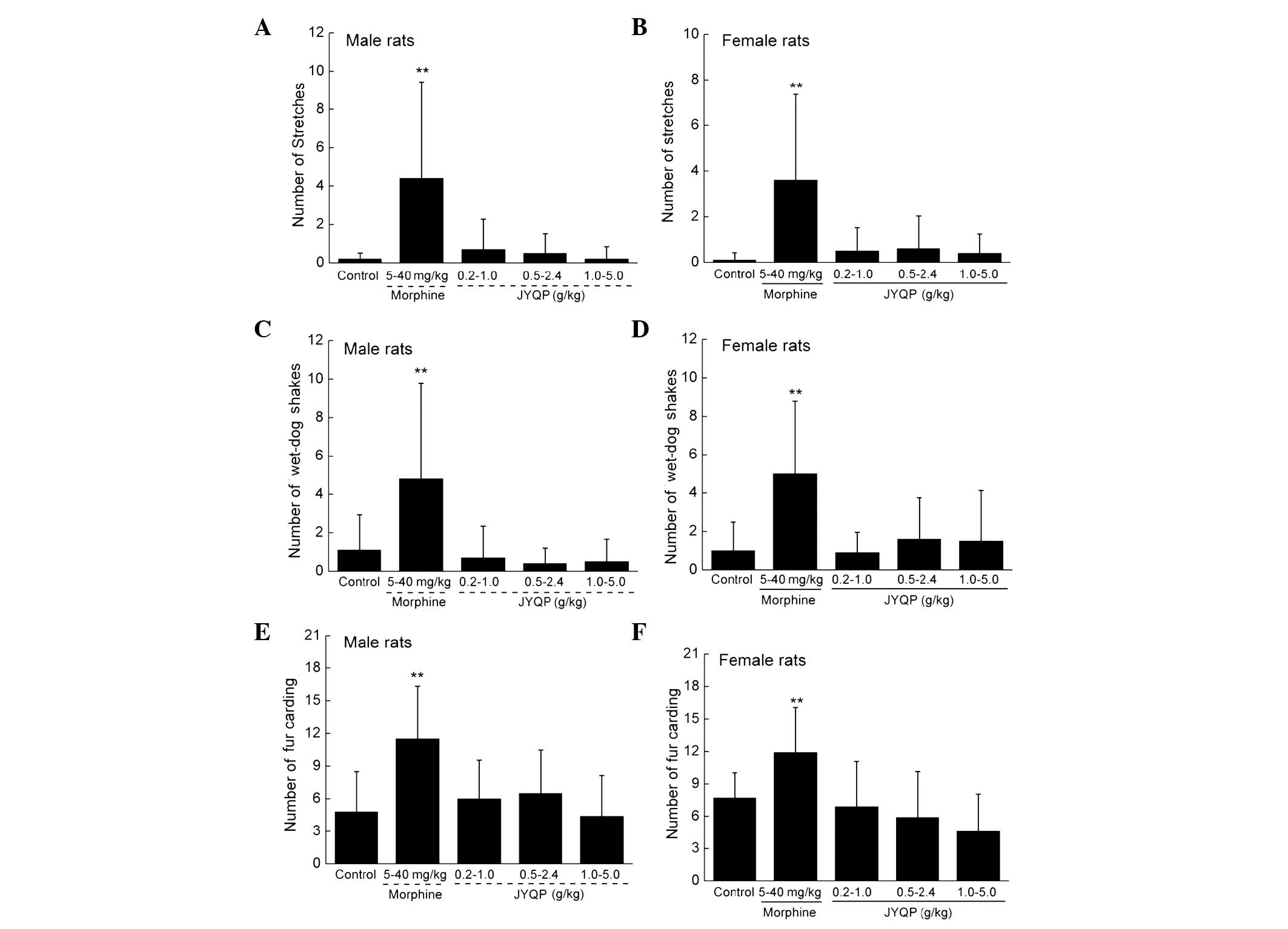
Physical dependence
Rats were assessed for physical dependence on
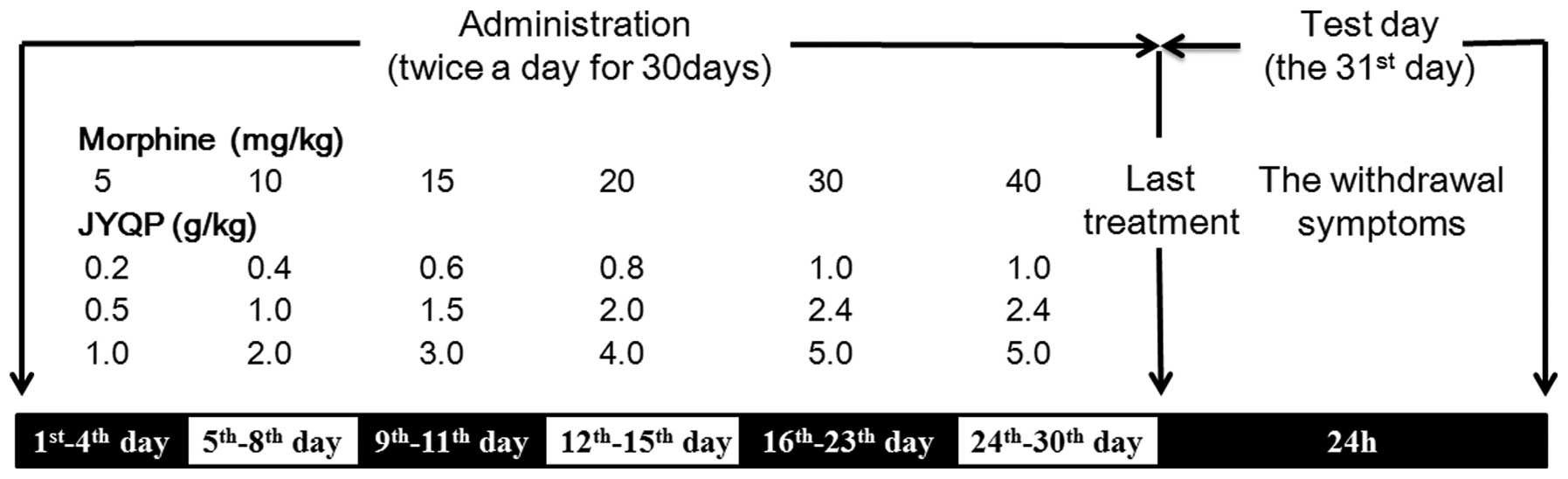
morphine and JYQP. The experimental process is shown in (Fig. 1). Healthy rats (180–200 g) were
randomly divided into five pairs of groups (10 males and 10
females, respectively, in each pair). The rats were treated with
morphine and JYQP twice a day for 30 days. Bodyweight was measured
weekly. On day 31, the administration of morphine and JYQP was
terminated to assess physical dependence. The rats were placed in
separate transparent cages (25 cm diameter × 30 cm height) and the
number of precipitated withdrawal scratches, wet-dog shakes, fur
caring, and physical characteristics were measured within 24 h.
Statistical analysis
Statistical analysis was performed using SPSS 16.0
software (SPSS, Inc., Chicago, IL, USA). One-way variance analysis
(ANOVA) was used to determine statistical significance, followed by
post-hoc multiple comparisons (Dunn's test). Data are expressed as
mean ± standard deviation (SD). Statistical significance was
defined as P<0.05.
Results
Long-term toxicity examination
No deaths were observed among the rats during the
6-month administration of JYQP at the doses of 0.5, 2.5 and 5.0
g/kg. However, salivation was noted in male and female rats treated
with 2.5 and 5.0 g/kg JYQP from week three. No further changes in
general behaviors or physiological activities were observed in the
JYQP-treated rats.
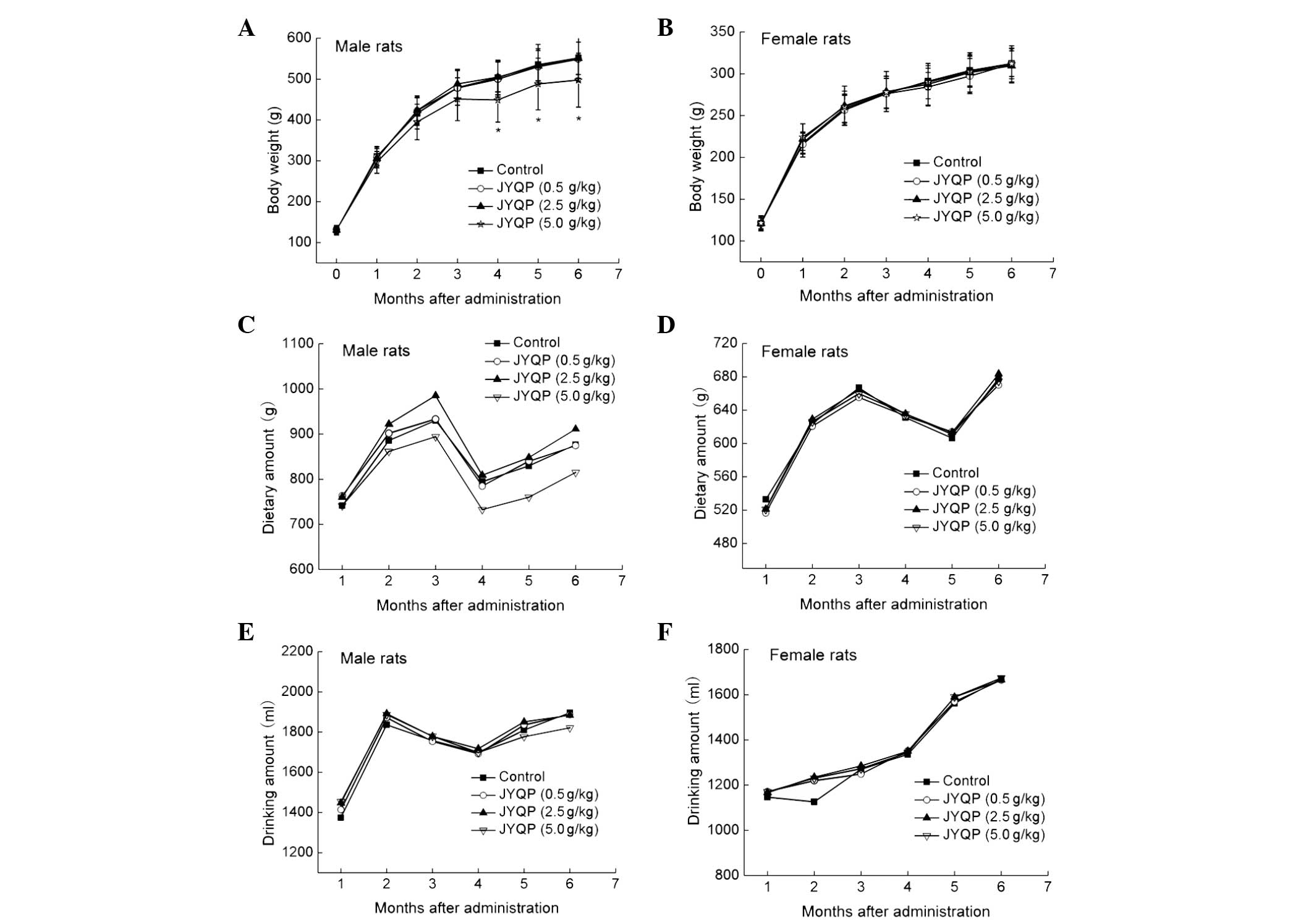
Compared with the control rats, from week 4, a loss
of bodyweight in 5.0 g/kg JYQP-treated male rats was noted
(P<0.05; Fig. 2A). No significant
differences among the groups in dietary and water intakes were
observed (Fig. 2).
As shown in Table I,
the organ coefficients in the control and JYQP-treated rats were
analyzed. The weights of the liver, spleen and kidneys were
increased in male and female rats after 6 months of JYQP
administration at a dose of 5.0 g/kg compared with those in control
rats (P<0.05; Table I). However,
hematoxylin and eosin staining revealed that no pathologic changes
had occurred in the organs (data not shown). Furthermore, in
comparison with the control group, the blood biochemical parameters
in all JYQP treated rats exhibited no significant changes
(P>0.05; Table II).
 | Table I.Organ coefficient results after
6-month Jia-Yuan-Qing pill (JYQP) administration in rats. |
Table I.
Organ coefficient results after
6-month Jia-Yuan-Qing pill (JYQP) administration in rats.
|
|
| JYQP (g/kg) |
|---|
|
|---|
| Organs | Control | 0.5 | 2.5 | 5.0 |
|---|
| Male |
|
|
|
|
| Heart
(g) | 0.32±0.049 | 0.30±0.055 | 0.30±0.022 | 0.30±0.022 |
| Liver
(g) | 2.49±0.552 | 2.41±0.371 | 2.47±0.242 |
3.03±0.493a |
| Spleen
(g) | 0.17±0.038 | 0.18±0.052 | 0.19±0.086 |
0.21±0.051a |
| Lung
(g) | 0.41±0.046 | 0.41±0.049 | 0.39±0.044 | 0.40±0.070 |
| Kidneys
(g) | 0.56±0.098 | 0.61±0.158 | 0.61±0.050 |
0.66±0.103a |
| Adrenals
(mg) | 14.73±1.905 | 13.96±4.443 | 14.59±3.215 | 16.63±2.585 |
| Thymus
(g) | 0.07±0.019 | 0.08±0.029 | 0.08±0.015 | 0.07±0.018 |
| Prostate
(g) | 0.17±0.047 | 0.18±0.030 | 0.18±0.030 | 0.17±0.041 |
| Testis
(g) | 0.68±0.088 | 0.70±0.138 | 0.69±0.074 | 0.69±0.071 |
|
Epididymis (g) | 0.38±0.081 | 0.42±0.090 | 0.38±0.075 | 0.42±0.059 |
| Brain
(g) | 0.39±0.025 | 0.37±0.059 | 0.37±0.042 | 0.40±0.065 |
| Female |
|
|
|
|
| Heart
(g) | 0.32±0.023 | 0.34±0.033 | 0.32±0.045 | 0.32±0.028 |
| Liver
(g) | 2.26±0.219 | 2.39±0.169 | 2.37±0.325 |
2.49±0.252a |
| Spleen
(g) | 0.16±0.021 | 0.18±0.019 | 0.18±0.031 |
0.21±0.026b |
| Lung
(g) | 0.46±0.059 | 0.46±0.084 | 0.49±0.081 | 0.47±0.063 |
| Kidneys
(g) | 0.55±0.062 | 0.58±0.034 | 0.56±0.051 |
0.67±0.064b |
|
Adrenals (mg) | 36.11±3.868 | 34.86±5.832 | 35.12±4.561 | 35.53±7.702 |
| Thymus
(g) | 0.10±0.019 | 0.11±0.016 | 0.11±0.034 | 0.11±0.023 |
| Ovary
(g) | 0.069±0.021 | 0.064±0.014 | 0.070±0.023 | 0.069±0.018 |
| Uterus
(g) | 0.236±0.063 | 0.267±0.064 | 0.270±0.070 | 0.264±0.082 |
| Brain
(g) | 0.56±0.060 | 0.57±0.120 | 0.57±0.053 | 0.56±0.039 |
Bone cancer pain test
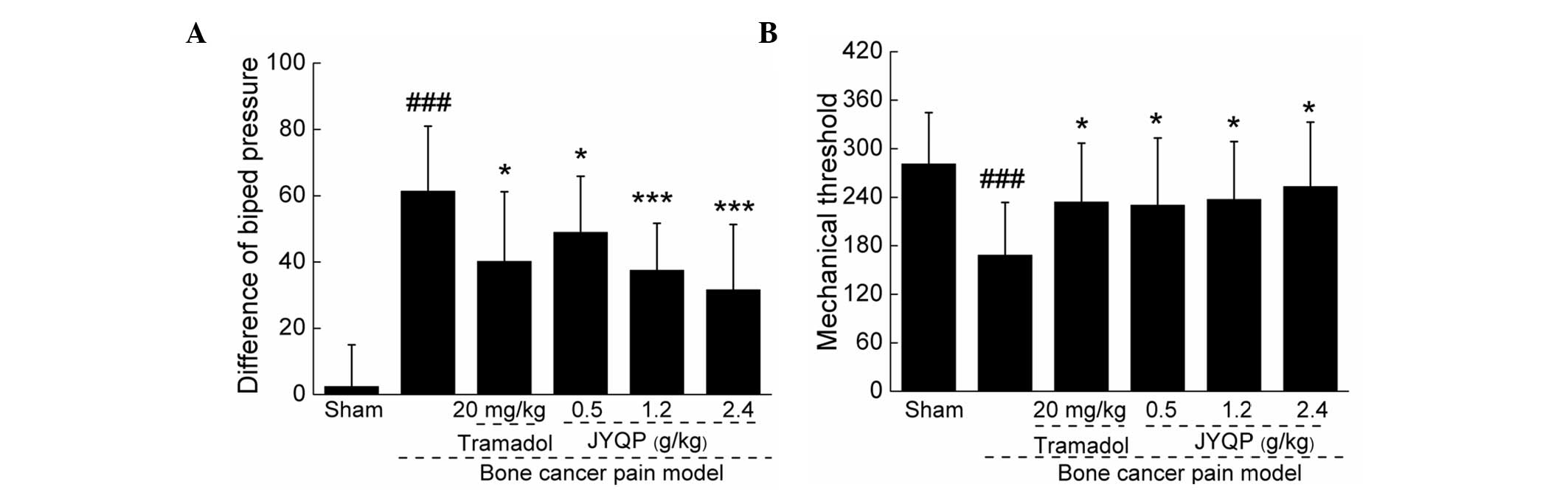
In the foot-supporting force test, the differences
of bipedal pressure were notably higher in the rats from the bone
cancer model group than in the vehicle-treated rats. Tramadol (20
mg/kg) and JYQP (0.5, 1.2 and 2.4 g/kg) produced a significant
antinociceptive effect on bone cancer pain, indicated by the
reduction of the bipedal pressure difference (P<0.05; Fig. 3A).
In the analysis of mechanical allodynia, the
vehicle-treated rats with bone cancer pain displayed a profound
reduction of mechanical threshold compared with that of the sham
group (P<0.01; Fig. 3B).
Treatment with Tramadol (20 mg/kg) or JYQP (0.5, 1.2, 2.4 g/kg)
strongly increased the mechanical threshold in the model rats
compared with that in the vehicle-treated group (Fig. 3B).
Physical dependence
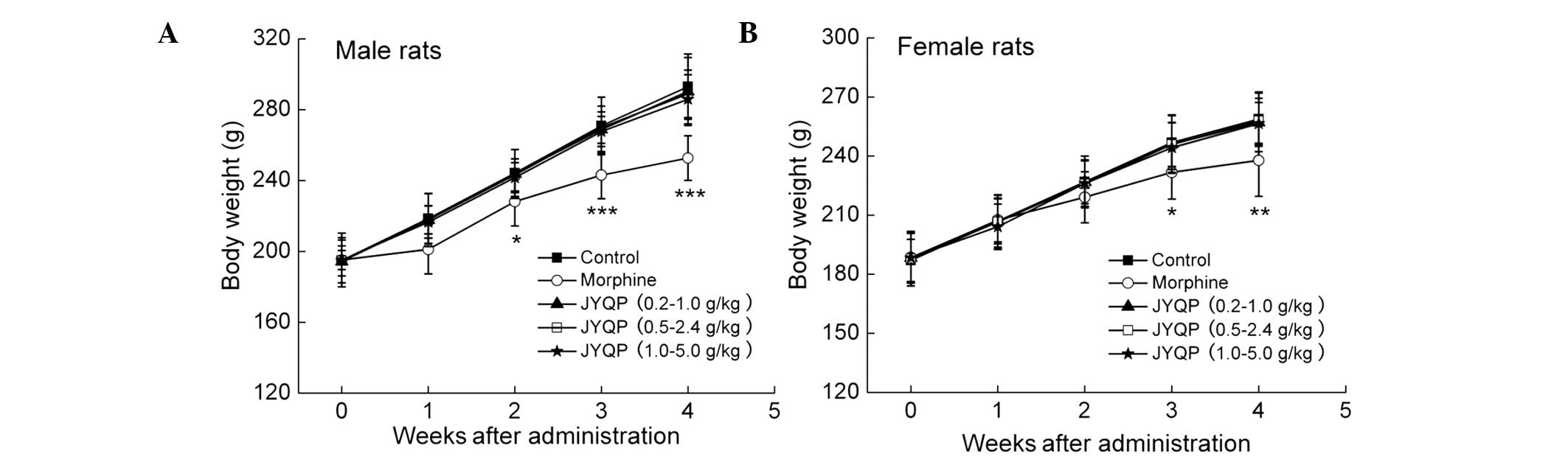
When the JYQP-treated rats were compared with
non-treated rats, JYQP exhibited no significant influence on
bodyweight; however, 30 days of morphine administration resulted
>9% bodyweight loss in male (P<0.05; Fig. 4A) and female rats (P<0.05;
Fig. 4B). Withdrawal behaviors such
as stretching, wet-dog shakes and fur carding were quantified to
assess the physical dependence on morphine and JYQP.
Morphine-dependent rats displayed extremely high withdrawal
behaviors; however, in the JYQP-treated rats, no withdrawal
symptoms were noted, indicating that JYQP is a reliable and safe
agent without addictive properties (Fig.
5).
Discussion
The present study aimed to investigate the safety,
addictive potential and analgesic effect on cancer pain of JYQP.
Toxicity assessment is the most important data for new drug
registration, and the safety of herbal products is of concern to
the medical community and public (18). In the present study, a chronic
toxicity test in Wistar rats was performed to examine the safety of
JYQP. The rats were treated with JYQP at dose of 0, 0.5, 2.5 or 5.0
g/kg for 6 months, and no significant changes on general behavior,
defecation, postural abnormalities, dietary or water intake, and
blood biochemical parameters were observed in male and female rats.
Changes in bodyweight have served as an indicator for drug toxicity
(19). Although 5 g/kg JYQP caused
bodyweight loss after 4 weeks of administration to male rats, this
dose was nearly 10-fold higher than the effective dose. Moreover,
following the administration of 5 g/kg JYQP for 6 months, swelling
of the liver, spleen and kidney were observed in male and female
rats; however, no pathological changes were observed in any of the
organs via hematoxylin and eosin staining (data not shown). The
weight changes of the liver, spleen and kidney caused by the high
dose of JYQP require further investigation.
More than 30% of cancer patients will develop
chronic pain associated with tumor growth and/or treatment, the
majority of whom do not received adequate treatment (20). Opioids are the main pharmacological
therapy for inhibiting cancer pain (21); however, adverse effects including
nausea, constipation, urinary retention, dizziness and dysphoria
are observed (22,23). Porcellio laevis Latreille, the
major component of JYQP, has been applied to ease liver cancer pain
in clinical trials (12). In the
present study, a significant analgesic effect of JYQP on rats with
bone cancer pain was noted, indicated by an extension of the
reaction time in a mechanical allodynia test and a reduction of the
difference of bipedal pressure in a foot-supporting force test.
Although previous data suggest that JYQP-mediated analgesic
activity is associated with peripheral mediation (15), a further study will be performed to
investigate the underlying mechanisms in detail.
As one of the most potent types of analgesics,
opioids display a rapid onset of action and therapeutic effect on
pain. Nevertheless, physical dependence has been noted following
long-term drug administration (24).
Physical dependence is a chronically relapsing disorder, which is
characterized by a compulsion to seek and take the drug, loss of
control in limiting intake, and the emergence of a negative
emotional state, for example dysphoria, anxiety or irritability
when the drug is not available (25). Addiction results in significant
changes in mood and affective behavior, while withdrawal syndrome
consists of severe somatic alterations (26). Morphine, a clear example, has
significant inhibitory effects on numerous types of intense pain;
however, the use of morphine is strictly controlled (27). In the present study, morphine caused
a significant bodyweight loss after 30 days of administration in
rats, and extremely high withdrawal behaviors were observed in
morphine-dependent rats compared with non-treated animals. In
JYQP-treated rats, no withdrawal symptoms were noted, indicating
that JYQP is a reliable and safe agent for the alleviation of pain
without addiction.
In conclusion, JYQP, a formulation composed of
Porcellio laevis Latreille, Corydalis Rhizoma and Radix
Cynanchi Paniculati, exhibited a significant analgesic effect in a
rat model of bone cancer pain, as indicated by the positive results
obtained in the foot-supporting force test and mechanical allodynia
analysis. The chronic toxicity test and physical dependence
assessment indicated that JYQP is a safe analgesic agent with no
physical dependence following long-term administration. The JYQP
formulation is patent-protected in China, and the data from the
present study provide experimental support for the forthcoming
clinical research.
Acknowledgements
This study was supported by the twelfth Five-Year
National Key Technology R&D Program of China (Grant no.
2012BAL29B00), the Pharmaceutical Industry Development Special Fund
of Jilin province, China (Grant no. 20130727013YY) and by funding
from the Administration of Traditional Medicine of Jilin province,
China (Grant no. 2011-zd18).
References
|
1
|
Bali KK, Selvaraj D, Satagopam VP, Lu J,
Schneider R and Kuner R: Genome-wide identification and functional
analyses of microRNA signatures associated with cancer pain. Embo
Mol Med. 5:1740–1758. 2013. View Article : Google Scholar : PubMed/NCBI
|
|
2
|
Coleman RE: Clinical features of
metastatic bone disease and risk of skeletal morbidity. Clin Cancer
Res. 12:6243s–6249s. 2006. View Article : Google Scholar : PubMed/NCBI
|
|
3
|
Suh SY, Choi YS, Oh SC, et al: Caffeine as
an adjuvant therapy to opioids in cancer pain: A randomized,
double-blind, placebo-controlled trial. J Pain Symptom Manag.
46:474–482. 2013. View Article : Google Scholar
|
|
4
|
Mantyh PW: A mechanism-based understanding
of bone cancer pain. Novartis Found Symp. 261:194–219; discussion
256–161. 2004. View Article : Google Scholar : PubMed/NCBI
|
|
5
|
Ali S, Mohs A, Thomas M, et al: The dual
function cytokine IL-33 interacts with the transcription factor
NF-kappaB to dampen NF-kappaB-stimulated gene transcription. J
Immunol. 187:1609–1616. 2011. View Article : Google Scholar : PubMed/NCBI
|
|
6
|
Lai JN, Tang JL and Wang JD: Observational
studies on evaluating the safety and adverse effects of traditional
chinese medicine. Evid Based Complement Alternat Med.
2013:6978932013. View Article : Google Scholar : PubMed/NCBI
|
|
7
|
Yuan HW, Ma LX, Qi DD, Zhang P, Li CH and
Zhu J: The historical development of deqi concept from classics of
traditional chinese medicine to modern research: Exploitation of
the connotation of deqi in Chinese medicine. Evid Based Complement
Alternat Med. 2013:6393022013. View Article : Google Scholar : PubMed/NCBI
|
|
8
|
Li JC, Shen XF, Meng XL, Zhang Y and Lai
XR: Analgesic effect and mechanism of the three TCM-herbal
drug-combination Tou Feng Yu pill on treatment of migraine.
Phytomedicine. 18:788–794. 2011. View Article : Google Scholar : PubMed/NCBI
|
|
9
|
Wang J, Zhang R, Dong C, et al: Topical
treatment with Tong-Luo-San-Jie gel alleviates bone cancer pain in
rats. J Ethnopharmacol. 143:905–913. 2012. View Article : Google Scholar : PubMed/NCBI
|
|
10
|
Gozum S, Tezel A and Koc M: Complementary
alternative treatments used by patients with cancer in eastern
Turkey. Cancer Nurs. 26:230–236. 2003. View Article : Google Scholar : PubMed/NCBI
|
|
11
|
Teng LR, Wang ZZ, Tian Y, et al: The
preparation method of Armadillidium formula extract and the
application of which in analgesic drugs. CN Patent 201110147689.7.
Filed June 2, 2011; issued. December 19–2012
|
|
12
|
Liang CY and Sun Z: The analgesic effect
of Porcellio preparation on moderate to severe cancer pain.
Shandong Zhongyi Zazhi. 13:1591601994.(In Chinese).
|
|
13
|
Zhang XH, Lu TL and Mao CQ: Analgesic and
anti-inflammatory effects of different kinds of Corydalis yanhusuo.
Lishizhen Medicine and Materia Medica Research. 20:4494502009.(In
Chinese).
|
|
14
|
Xu QS, Zhang HY, Li YJ and Li D: Effect of
the extract of Cynanchum paniculatum on anti-inflammation and
analgesic in mice. Lishizhen Medicine and Materia Medica Research.
18:140714082007.(In Chinese).
|
|
15
|
Tian Y, Teng LR, Song JJ, et al: Studies
on the analgesic activities of Jia-Yuan-Qing pill and its safety
evaluation in mice. Protoplasma. 251:1245–1253. 2014. View Article : Google Scholar : PubMed/NCBI
|
|
16
|
Lbarrola DA, Hellion-lbarrola MC,
Montalbetti Y, et al: Isolation of hypotensive compounds from
Solanum sisymbriifolium Lam. J Ethnopharmacol. 70:301–307. 2000.
View Article : Google Scholar : PubMed/NCBI
|
|
17
|
Chinese Pharmacopoeia Commision (eds), .
Pharmacopoeia Of The People's Republic Of China. Chinese Medical
Science and Technology Press; Beijing, China: 2010
|
|
18
|
Gao L, Liu G, Kang J, et al: Paclitaxel
nanosuspensions coated with P-gp inhibitory surfactants: I. Acute
toxicity and pharmacokinetics studies. Colloids Surf B
Biointerfaces. 111:277–281. 2013. View Article : Google Scholar : PubMed/NCBI
|
|
19
|
El Hilaly J, Israili ZH and Lyoussi B:
Acute and chronic toxicological studies of Ajuga iva in
experimental animals. J Ethnopharmacol. 91:43–50. 2004. View Article : Google Scholar : PubMed/NCBI
|
|
20
|
Wilson KG, Chochinov HM, McPherson CJ, et
al: Suffering with advanced cancer. J Clin Oncol. 25:1691–1697.
2007. View Article : Google Scholar : PubMed/NCBI
|
|
21
|
Krishna LK, Poulose JV, Tan BS and Goh C:
Opioid use amongst cancer patients at the end of life. Ann Acad Med
Singap. 39:790–797. 2010.PubMed/NCBI
|
|
22
|
Bowdle TA: Adverse effects of opioid
agonists and agonist-antagonists in anaesthesia. Drug Saf.
19:173–189. 1998. View Article : Google Scholar : PubMed/NCBI
|
|
23
|
Stiefel F, Die Trill M, Berney A, Olarte
JM and Razavi A: Depression in palliative care: a pragmatic report
from the Expert Working Group of the European Association for
Palliative Care. Support Care Cancer. 9:477–488. 2001. View Article : Google Scholar : PubMed/NCBI
|
|
24
|
Lewis J, Mansour A, Khachaturian H, Watson
SJ and Akil H: Opioids and pain regulation. Pain Headache.
9:129–159. 1987.PubMed/NCBI
|
|
25
|
Koob GF: Neurobiological substrates for
the dark side of compulsivity in addiction. Neuropharmacology.
561:18–31. 2009. View Article : Google Scholar
|
|
26
|
Crews FT and Boettiger CA: Impulsivity,
frontal lobes and risk for addiction. Pharmacol Biochem Behav.
93:237–247. 2009. View Article : Google Scholar : PubMed/NCBI
|
|
27
|
Williams JT, Ingram SL, Henderson G, et
al: Regulation of μ-opioid receptors: desensitization,
phosphorylation, internalization, and tolerance. Pharmacol Rev.
65:223–254. 2013. View Article : Google Scholar : PubMed/NCBI
|