Spandidos Publications Logo
  • About
    • About Spandidos
    • Aims and Scopes
    • Abstracting and Indexing
    • Editorial Policies
    • Reprints and Permissions
    • Job Opportunities
    • Terms and Conditions
    • Contact
  • Journals
    • All Journals
    • Oncology Letters
      • Oncology Letters
      • Information for Authors
      • Editorial Policies
      • Editorial Board
      • Aims and Scope
      • Abstracting and Indexing
      • Bibliographic Information
      • Archive
    • International Journal of Oncology
      • International Journal of Oncology
      • Information for Authors
      • Editorial Policies
      • Editorial Board
      • Aims and Scope
      • Abstracting and Indexing
      • Bibliographic Information
      • Archive
    • Molecular and Clinical Oncology
      • Molecular and Clinical Oncology
      • Information for Authors
      • Editorial Policies
      • Editorial Board
      • Aims and Scope
      • Abstracting and Indexing
      • Bibliographic Information
      • Archive
    • Experimental and Therapeutic Medicine
      • Experimental and Therapeutic Medicine
      • Information for Authors
      • Editorial Policies
      • Editorial Board
      • Aims and Scope
      • Abstracting and Indexing
      • Bibliographic Information
      • Archive
    • International Journal of Molecular Medicine
      • International Journal of Molecular Medicine
      • Information for Authors
      • Editorial Policies
      • Editorial Board
      • Aims and Scope
      • Abstracting and Indexing
      • Bibliographic Information
      • Archive
    • Biomedical Reports
      • Biomedical Reports
      • Information for Authors
      • Editorial Policies
      • Editorial Board
      • Aims and Scope
      • Abstracting and Indexing
      • Bibliographic Information
      • Archive
    • Oncology Reports
      • Oncology Reports
      • Information for Authors
      • Editorial Policies
      • Editorial Board
      • Aims and Scope
      • Abstracting and Indexing
      • Bibliographic Information
      • Archive
    • Molecular Medicine Reports
      • Molecular Medicine Reports
      • Information for Authors
      • Editorial Policies
      • Editorial Board
      • Aims and Scope
      • Abstracting and Indexing
      • Bibliographic Information
      • Archive
    • World Academy of Sciences Journal
      • World Academy of Sciences Journal
      • Information for Authors
      • Editorial Policies
      • Editorial Board
      • Aims and Scope
      • Abstracting and Indexing
      • Bibliographic Information
      • Archive
    • International Journal of Functional Nutrition
      • International Journal of Functional Nutrition
      • Information for Authors
      • Editorial Policies
      • Editorial Board
      • Aims and Scope
      • Abstracting and Indexing
      • Bibliographic Information
      • Archive
    • International Journal of Epigenetics
      • International Journal of Epigenetics
      • Information for Authors
      • Editorial Policies
      • Editorial Board
      • Aims and Scope
      • Abstracting and Indexing
      • Bibliographic Information
      • Archive
    • Medicine International
      • Medicine International
      • Information for Authors
      • Editorial Policies
      • Editorial Board
      • Aims and Scope
      • Abstracting and Indexing
      • Bibliographic Information
      • Archive
  • Articles
  • Information
    • Information for Authors
    • Information for Reviewers
    • Information for Librarians
    • Information for Advertisers
    • Conferences
  • Language Editing
Spandidos Publications Logo
  • About
    • About Spandidos
    • Aims and Scopes
    • Abstracting and Indexing
    • Editorial Policies
    • Reprints and Permissions
    • Job Opportunities
    • Terms and Conditions
    • Contact
  • Journals
    • All Journals
    • Biomedical Reports
      • Information for Authors
      • Editorial Policies
      • Editorial Board
      • Aims and Scope
      • Abstracting and Indexing
      • Bibliographic Information
      • Archive
    • Experimental and Therapeutic Medicine
      • Information for Authors
      • Editorial Policies
      • Editorial Board
      • Aims and Scope
      • Abstracting and Indexing
      • Bibliographic Information
      • Archive
    • International Journal of Epigenetics
      • Information for Authors
      • Editorial Policies
      • Editorial Board
      • Aims and Scope
      • Abstracting and Indexing
      • Bibliographic Information
      • Archive
    • International Journal of Functional Nutrition
      • Information for Authors
      • Editorial Policies
      • Editorial Board
      • Aims and Scope
      • Abstracting and Indexing
      • Bibliographic Information
      • Archive
    • International Journal of Molecular Medicine
      • Information for Authors
      • Editorial Policies
      • Editorial Board
      • Aims and Scope
      • Abstracting and Indexing
      • Bibliographic Information
      • Archive
    • International Journal of Oncology
      • Information for Authors
      • Editorial Policies
      • Editorial Board
      • Aims and Scope
      • Abstracting and Indexing
      • Bibliographic Information
      • Archive
    • Medicine International
      • Information for Authors
      • Editorial Policies
      • Editorial Board
      • Aims and Scope
      • Abstracting and Indexing
      • Bibliographic Information
      • Archive
    • Molecular and Clinical Oncology
      • Information for Authors
      • Editorial Policies
      • Editorial Board
      • Aims and Scope
      • Abstracting and Indexing
      • Bibliographic Information
      • Archive
    • Molecular Medicine Reports
      • Information for Authors
      • Editorial Policies
      • Editorial Board
      • Aims and Scope
      • Abstracting and Indexing
      • Bibliographic Information
      • Archive
    • Oncology Letters
      • Information for Authors
      • Editorial Policies
      • Editorial Board
      • Aims and Scope
      • Abstracting and Indexing
      • Bibliographic Information
      • Archive
    • Oncology Reports
      • Information for Authors
      • Editorial Policies
      • Editorial Board
      • Aims and Scope
      • Abstracting and Indexing
      • Bibliographic Information
      • Archive
    • World Academy of Sciences Journal
      • Information for Authors
      • Editorial Policies
      • Editorial Board
      • Aims and Scope
      • Abstracting and Indexing
      • Bibliographic Information
      • Archive
  • Articles
  • Information
    • For Authors
    • For Reviewers
    • For Librarians
    • For Advertisers
    • Conferences
  • Language Editing
Login Register Submit
  • This site uses cookies
  • You can change your cookie settings at any time by following the instructions in our Cookie Policy. To find out more, you may read our Privacy Policy.

    I agree
Search articles by DOI, keyword, author or affiliation
Search
Advanced Search
presentation
Experimental and Therapeutic Medicine
Join Editorial Board Propose a Special Issue
Print ISSN: 1792-0981 Online ISSN: 1792-1015
Journal Cover
May-2017 Volume 13 Issue 5

Full Size Image

Sign up for eToc alerts
Recommend to Library

Journals

International Journal of Molecular Medicine

International Journal of Molecular Medicine

International Journal of Molecular Medicine is an international journal devoted to molecular mechanisms of human disease.

International Journal of Oncology

International Journal of Oncology

International Journal of Oncology is an international journal devoted to oncology research and cancer treatment.

Molecular Medicine Reports

Molecular Medicine Reports

Covers molecular medicine topics such as pharmacology, pathology, genetics, neuroscience, infectious diseases, molecular cardiology, and molecular surgery.

Oncology Reports

Oncology Reports

Oncology Reports is an international journal devoted to fundamental and applied research in Oncology.

Experimental and Therapeutic Medicine

Experimental and Therapeutic Medicine

Experimental and Therapeutic Medicine is an international journal devoted to laboratory and clinical medicine.

Oncology Letters

Oncology Letters

Oncology Letters is an international journal devoted to Experimental and Clinical Oncology.

Biomedical Reports

Biomedical Reports

Explores a wide range of biological and medical fields, including pharmacology, genetics, microbiology, neuroscience, and molecular cardiology.

Molecular and Clinical Oncology

Molecular and Clinical Oncology

International journal addressing all aspects of oncology research, from tumorigenesis and oncogenes to chemotherapy and metastasis.

World Academy of Sciences Journal

World Academy of Sciences Journal

Multidisciplinary open-access journal spanning biochemistry, genetics, neuroscience, environmental health, and synthetic biology.

International Journal of Functional Nutrition

International Journal of Functional Nutrition

Open-access journal combining biochemistry, pharmacology, immunology, and genetics to advance health through functional nutrition.

International Journal of Epigenetics

International Journal of Epigenetics

Publishes open-access research on using epigenetics to advance understanding and treatment of human disease.

Medicine International

Medicine International

An International Open Access Journal Devoted to General Medicine.

Journal Cover
May-2017 Volume 13 Issue 5

Full Size Image

Sign up for eToc alerts
Recommend to Library

  • Article
  • Citations
    • Cite This Article
    • Download Citation
    • Create Citation Alert
    • Remove Citation Alert
    • Cited By
  • Similar Articles
    • Related Articles (in Spandidos Publications)
    • Similar Articles (Google Scholar)
    • Similar Articles (PubMed)
  • Download PDF
  • Download XML
  • View XML
Article Open Access

Intravenous infusion umbilical cord-derived mesenchymal stem cell in primary immune thrombocytopenia: A two-year follow-up

  • Authors:
    • Xiaohua Wang
    • Xiaoguang Yin
    • Wei Sun
    • Jin Bai
    • Yawen Shen
    • Qiang Ao
    • Yongquan Gu
    • Ying Liu
  • View Affiliations / Copyright

    Affiliations: Department of Hematology, Siping Hospital of China Medical University, Siping, Jilin 136000, P.R. China, Jilin Tuhua Bioengineering Company Ltd., Siping, Jilin 136000, P.R. China, Department of Tissue Engineering, China Medical University, Shenyang, Liaoning 110122, P.R. China, Department of Vascular Surgery, Xuanwu Hospital of Capital Medical University, Beijing 100053, P.R. China
    Copyright: © Wang et al. This is an open access article distributed under the terms of Creative Commons Attribution License.
  • Pages: 2255-2258
    |
    Published online on: March 14, 2017
       https://doi.org/10.3892/etm.2017.4229
  • Expand metrics +
Metrics: Total Views: 0 (Spandidos Publications: | PMC Statistics: )
Metrics: Total PDF Downloads: 0 (Spandidos Publications: | PMC Statistics: )
Cited By (CrossRef): 0 citations Loading Articles...

This article is mentioned in:


Abstract

Four patients with chronic refractory immune thrombocytopenic purpura (ITP) received human umbilical cord-derived mesenchymal stem cells (hUC-MSCs). The hUC-MSC dose was 5x10⁷ to 1x10⁸. Complete remission (CR) was achieved in three patients in 12 months and one patient in 24 months. Three patients received the second hUC-MSC transplantation with the same dose. The median time between hUC-MSC transplantation and response was 12.5 days (range, 7-16). There were no severe adverse events during and post hUC-MSC transplantation. During follow-up (median, 17 months; range, 13-24) no other immuno­suppressive drugs were used post‑first hUC-MSCs transplantation. In conclusion, hUC-MSC transplantation is a reasonable salvage treatment in chronic refractory ITP. Prospective randomized large-scale clinical trials are needed to further elucidate the efficacy of hUC-MSCs transplantation therapy on ITP.

Introduction

Chronic immune thrombocytopenic purpura (ITP) is an autoimmune disorder characterized by an elevated rate of platelet destruction and persistent thrombocytopenia (1,2). Patients with chronic refractory ITP have the highest risk of death and disease-related or therapy-related complications (3,4). Despite intense research efforts and large multicenter clinical trials, the optimal treatment for patients with chronic ITP in clinical practice remains to be determined (5).

The number of studies focusing on the therapeutic potentials of mesenchymal stem cells (MSCs) in experimental models and clinic trials are growing. One of the reasons for this growing interest can be explained by the fact that MSCs are assumed to be effective biological tools to treat degenerative diseases. In previous studies, we grafted MSCs derived from human umbilical cord-derived MSCs (hUC-MSCs) to treat non-union in rats and humans (6–8). Our results demonstrated the safety as well as the efficiency of osteoblastic differentiation of hUC-MSCs. In the present study, we describe our experience using hUC-MSCs to treat patients with chronic refractory ITP.

Materials and methods

Basic principles and ethical considerations

The protocol of the present study was approved by the Institutional Review Board and the Ethics Committee of Siping Hospital of China Medical University (Beijing, China). The trial was conducted in compliance with current Good Clinical Practice standards and in accordance with the principles set forth under the Declaration of Helsinki in 1989.

Confirmation of isolation and propagation of hUC-MSC

hUC-MSCs used in this trial were derived from two donated umbilical cords (UC) obtained from healthy mothers during routine term elective caesarean section births. Fully informed consent was obtained several weeks prior to delivery. hUC-MSCs were isolated and propagated, as previously described (6–8).

Patients

ITP was diagnosed in accordance with standard criteria and other causes of thrombocytopenia were excluded. Three adult patients with ITP having a platelet count <30×109/l that persisted for at least 3 months with an inadequate or transient response to multiple therapies were treated with hUC-MSCs. The patients were willing to sign an informed consent form where they agreed to be treated in the Siping Hospital of China Medical University. The general characteristics of the patients are presented in Table I.

Table I.

Patient characteristics before and post hUC-MSC transplantation.

Table I.

Patient characteristics before and post hUC-MSC transplantation.

CharacteristicsPatient 1Patient 2Patient 3Patient 4
Age (years)26495450
GenderMFFF
Duration of disease (months)437162120
Previous treatmentsP, V, C, IVIg, SP, V, C, IVIgP, IVIg, C, De, SP, IVIg, V
HUC-MSC transplantation times1222
Platelet counts (x109/l)a
  Before therapy8953
  After therapya (2 weeks)569410356
  After therapya (3 months)809610559
  After therapya (6 months)8210111861
  After therapya (12 months)18984234116
  After therapya (24 months)134
Bleedingb
  Before therapy bleedingSkin, genitourinarySkinEpistaxisSkin, genitourinary bleeding
  After therapyNoNoMucosalSkin
  Time to response (days)7131614
  Time to maximum response (days)31534258
  Overall responseYesYesYesYes
  Response duration (months)cYes, 24Yes, 18Yes, 13Yes, 13

a Platelet count measurements were carried out at the end of the following time points post hUC-MSC transplantation.

b Major skin indicates diffuse ecchymosis; mucosal, intrabuccal hemorrhagic vesicles, or prolonged epistaxis; and intestinal and menorrhagia, gastrointestinal, and genitourinary bleeding, respectively.

c These four patients had a relapse within 13 months after the first hUC-MSC administration but responded to the second hUC-MSC treatment, and they all sustained response for >8 months. hUC-MSCs, human umbilical cord-derived mesenchymal stem cells; M, male; F, female; P, prednisone; V, vincristine; C, cyclosporin; IVIg, intravenous immunoglobulins; S, splenectomy; De, dexamethasone.

Intravenous infusion of hUC-MSCs

hUC-MSCs (10 ml) with a cell density of 5×10⁶ to 1×10⁷/ml was given intravenously at a rate up to 12.5×10⁶/min and flushed with 20 ml saline to ensure full cell dose delivery. Once the needle was fully withdrawn, the puncture site was wrapped with sterile dressing. Patients remained in the supine decubitus on the operation bed for another 30 min before off-bed activities and antibiotics were given to prevent infection. Patients' conditions were monitored (temperature, blood pressure, pulse and oxygen saturation) at 15, 30, 45 and 60 min, and then once every hour for a minimum of 4 h.

Measurement of patelet related parameters

Platelet-related parameters were analyzed before the operation and at several time points post-transplantation using an automated blood cell counter model LH-750 (Beckman Coulter, Inc., Brea, CA, USA).

Clinical and functional assessment

i) Primary safety assessments included monitoring and recording of all the adverse events as well as the serious adverse events. The patients were monitored (temperature, blood pressure, pulse and oxygen saturation) at 15, 30, 45 and 60 min, and then once every hour for a minimum of 4 h. They were discharged 24 h post-transplantation if they were not febrile and hemodynamically stable, with no signs of infection or any type of allergic reaction. Any abnormal reactions within 3 months were considered to be linked to transplantation.

ii) As exploratory secondary end-points we investigated the efficacy of hUC-MSC infusion as assessed by platelet-related parameters, at baseline and at a series of time-points (2 weeks and 3, 6, 12 and 24 months post-first hUC-MSC administration). Initial response evaluation was made at the end of the second week after treatment initiation. Complete remission (CR) was considered when the platelet count was >1×10¹¹/l, partial remission (PR) if platelets were >5×10¹⁰/l, and minimal response (MR) if the platelet count was between 3×10¹⁰/l and 5×10¹⁰/l. No response was platelet count that remained unchanged. Response was classified as sustained (SR) when it was stable for a minimum of 6 months. Relapse was defined as a decline in platelet count to <30×109/l and/or the need for ITP rescue treatments.

Pharmacological therapy protocol

Pharmacological therapy consisted of: i) inhaling high doses of steroids and prednisone (1 mg/kg, p.o., once daily); ii) vincristine (2 mg, once per month, i.v.); iii) intravenous immunoglobulins (γ globulin), 0.4 g/kg, once daily, i.p.; and iv) cyclosporine (3 mg/kg, p.o., once daily).

Statistical analysis

Statistical analyses were performed using SPSS 16.0 software (Chicago, IL, USA). Safety and exploratory efficacy secondary endpoints were observed for each patient against the baseline values. P<0.05 was considered statistically significant.

Results

Evaluation of hUC-MSCs

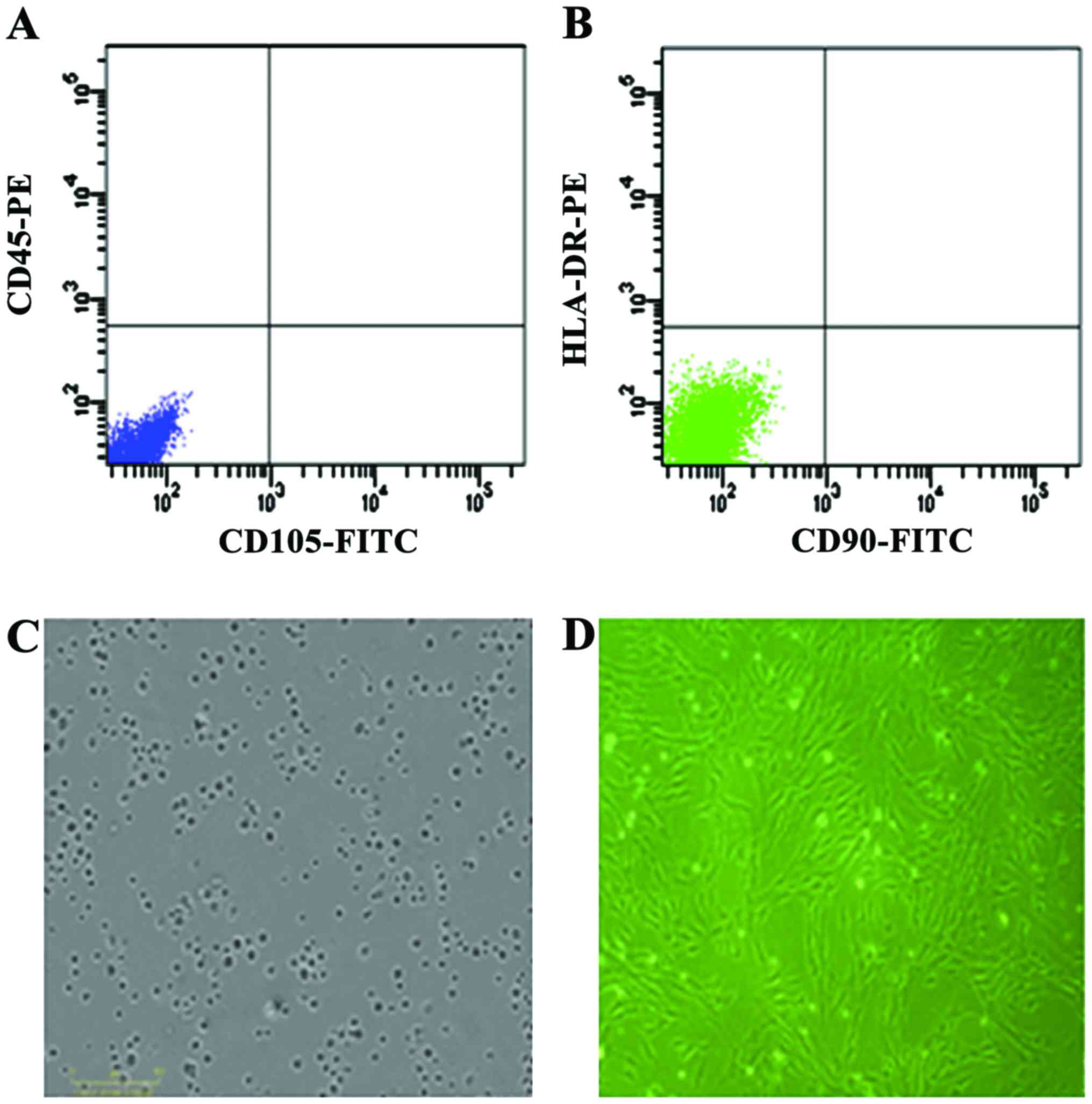
Cells derived from UC were observed 24 h after they were seeded (Fig. 1A), during the time that part of the round mononuclear cells was adherent. Three days after inoculation, small colonies of the adherent cells with typical fibroblast-shaped morphology were obtained (Fig. 1B). These primary cells reached monolayer confluence, after planting for 5–6 days, when they were passaged for the first time. Fifth passage cells were analyzed by flow cytometry and were strongly positive for CD105 and CD90, but negative for CD45 and HLA-DR (Fig. 1C and D).

Figure 1.

Evaluation of hUC-MSCs. (A) The cells derived from UC were observed at 24 h after they were seeded; (B) three days after inoculation; (C) hUC-MSC surface markers: CD105 and CD45, (D) hUC-MSC surface markers, HLA-DR and CD90. hUC-MSCs, human umbilical cord-derived mesenchymal stem cells; UC, umbilical cord.

Patient characteristics

Clinical characteristics of patients who participated in the present study are summarized in Table I. The patients were 3 females and 1 male, with an age range of 26–54 years (median, 44.75 years). Median duration of ITP before hUC-MSC transplantation was 74 months (range, 13–120 months) and the median number of prior treatments was 2 months (range, 1–3 months), which included splenectomy, prednisone, intravenous immune globulin, cyclosporine and vincristine. All the patients had a history of major bleeding and those episodes were often transient but recurrent. Major hemorrhagic events included genitourinary bleeding, diffuse ecchymosis and prolonged epistaxis.

Clinical therapeutic effect of hUC-MSCs

Results of hUC-MSC treatment are shown in Table I. Overall responses were reached in all the patients at the end of the second week after the hUC-MSCs had been administered. The patients achieved a platelet count of >50×109/l and 2 patients achieved a platelet count of >90×109/l. The median platelet count on treatment was 77.25×10⁹/l (range, 56×109 to 10.3×10¹⁰/l). The median time to response and the median time to maximum response were 12.5 days (range, 7–16 days) and 46 days (range, 31–53 days), respectively. One patient sustained response after a single course of hUC-MSCs without any further therapy during the follow-up. Major bleeding episodes did not occur. The remaining 3 patients (patients 2–4) had a relapse within 12 months after the first hUC-MSC administration but responded to the second hUC-MSC treatment. The time to the second response for patients 2, 3 and 4, was 13, 16 and 18 days, respectively, whereas the time to the second maximum response was 34, 38 and 43 days, respectively. All the patients achieved a sustained response of >10 months.

Safety outcomes

No serious or clinically significant side effects were observed during the entire study period. During the whole follow-up period, neither ectopic tissue formation nor other illnesses related to the hUC-MSCs treatment were recorded in the patients.

Discussion

In the present study, we evaluated the response rate achieved in 4 patients with chronic and refractory ITP after hUC-MSC intravenous infusion in 24 months. The clinical median relieved time of symptoms after one transplant was 17 months. To the best of our knowledge, this is the first study on the efficiency of hUC-MSC transplantation treatment for ITP patients. Our experimental results supported cell therapy for ITP.

The hUC-MSCs used in the present study met the criteria of the International Society for Cell Therapy (9–11). In this experiment, we observed three favorable responses (100%) in 12 months after one hUC-MSC transplantation. Patient 1 recurrence occurred in 29 months, while the other three patients had a recurrence in almost 13 months. Our data suggested that symptom alleviation was not complete. Based on the characteristics of the evolution of our group of patients, we may emphasize a few important points: i) hUC-MSC transplantation is beneficial for the recovery of bone marrow megakaryocytes, in order that patients can achieve long-term relief; and ii) some cytokines are reduced in this reaction, and the effect of hUC-MSC transplantation is decreased. Thus, the underlying mechanisms of hUC-MSC therapy on ITP need further exploration.

In addition, the pathophysiology of ITP is complex and abnormalities of the B- and T-cell compartments have been identified. Furthermore, MSCs in ITP patients have a reduced proliferative capacity and a lower inhibitory effect on activated T-cell proliferation compared with MSC from healthy donors (12). These abnormalities indicate a possible role for MSC malfunction in the physiopathology of the disease and may have therapeutic implications. In the present study, we did not monitor changes in B-cell counts and platelet autoantibodies, which may influence the response as observed in other trials (13,14), therefore we cannot confirm the effect of hUC-MSC transplantation on the immune regulation. Future large-scale trials are likely to be designed to investigate the immunomodulatory characteristics of hUC-MSCs on treating ITP.

In conclusion, hUC-MSC transplantation is safe and effective for treating ITP. Our data suggest that MSC therapy may be a reasonable salvage treatment in severe, potentially life-threatening, refractory ITP. The optimal period of hUC-MSC transplantation for treating ITP is once a year. Prospective randomized clinical trials are needed to elucidate the efficacy of hUC-MSC transplantation therapy on ITP in the future.

Acknowledgements

The present study has been supported by the National High Technology Research and Development Program, 863 Program, nos. 2011AA020101 and 2012A020905.

References

1 

Berchtold P and McMillan R: Therapy of chronic idiopathic thrombocytopenic purpura in adults. Blood. 74:2309–2317. 1989.PubMed/NCBI

2 

Imbach P: Treatment of immune thrombocytopenia with intravenous immunoglobulin and insights for other diseases. A historical review. Swiss Med Wkly. 142:w135932012.PubMed/NCBI

3 

McMillan R and Durette C: Long-term outcomes in adults with chronic ITP after splenectomy failure. Blood. 104:956–960. 2004. View Article : Google Scholar : PubMed/NCBI

4 

Portielje JE, Westendorp RG, Kluin-Nelemans HC and Brand A: Morbidity and mortality in adults with idiopathic thrombocytopenic purpura. Blood. 97:2549–2554. 2001. View Article : Google Scholar : PubMed/NCBI

5 

Saeidi S, Jaseb K, Asnafi AA, Rahim F, Pourmotahari F, Mardaniyan S, Yousefi H, Alghasi A, Shahjahani M and Saki N: Immune thrombocytopenic purpura in children and adults: a comparative retrospective study in IRAN. Int J Hematol Oncol Stem Cell Res. 8:30–36. 2014.PubMed/NCBI

6 

Qu Z, Guo S, Fang G, Cui Z and Liu Y: AKT pathway affects bone regeneration in nonunion treated with umbilical cord-derived mesenchymal stem cells. Cell Biochem Biophys. 71:1543–1551. 2015. View Article : Google Scholar : PubMed/NCBI

7 

Qu Z, Guo L, Fang G, Cui Z, Guo S and Liu Y: Biological characteristics and effect of human umbilical cord mesenchymal stem cells (hUC-MSCs) grafting with blood plasma on bone regeneration in rats. Cell Biochem Biophys. 63:171–181. 2012. View Article : Google Scholar : PubMed/NCBI

8 

Qu Z, Fang G, Cui Z and Liu Y: Cell therapy for bone nonunion: a retrospective study. Minerva Med. 106:315–321. 2015.PubMed/NCBI

9 

Fang B, Mai L, Li N and Song Y: Favorable response of chronic refractory immune thrombocytopenic purpura to mesenchymal stem cells. Stem Cells Dev. 21:497–502. 2012. View Article : Google Scholar : PubMed/NCBI

10 

Rodeghiero F, Stasi R, Gernsheimer T, Michel M, Provan D, Arnold DM, Bussel JB, Cines DB, Chong BH, Cooper N, et al: Standardization of terminology, definitions and outcome criteria in immune thrombocytopenic purpura of adults and children: report from an international working group. Blood. 113:2386–2393. 2009. View Article : Google Scholar : PubMed/NCBI

11 

Dominici M, Le Blanc K, Mueller I, Slaper-Cortenbach I, Marini F, Krause D, Deans R, Keating A, Prockop Dj and Horwitz E: Minimal criteria for defining multipotent mesenchymal stromal cells. The International Society for Cellular Therapy position statement. Cytotherapy. 8:315–317. 2006. View Article : Google Scholar : PubMed/NCBI

12 

Pérez-Simón JA, Tabera S, Sarasquete ME, Díez-Campelo M, Canchado J, Sánchez-Abarca LI, Blanco B, Alberca I, Herrero-Sánchez C, Cañizo C, et al: Mesenchymal stem cells are functionally abnormal in patients with immune thrombocytopenic purpura. Cytotherapy. 11:698–705. 2009. View Article : Google Scholar : PubMed/NCBI

13 

Li X, Zhong H, Bao W, Boulad N, Evangelista J, Haider MA, Bussel J and Yazdanbakhsh K: Defective regulatory B-cell compartment in patients with immune thrombocytopenia. Blood. 120:3318–3325. 2012. View Article : Google Scholar : PubMed/NCBI

14 

Cines DB, Bussel JB, Liebman HA and Prak Luning ET: The ITP syndrome: pathogenic and clinical diversity. Blood. 113:6511–6521. 2009. View Article : Google Scholar : PubMed/NCBI

Related Articles

  • Abstract
  • View
  • Download
  • Twitter
Copy and paste a formatted citation
Spandidos Publications style
Wang X, Yin X, Sun W, Bai J, Shen Y, Ao Q, Gu Y and Liu Y: Intravenous infusion umbilical cord-derived mesenchymal stem cell in primary immune thrombocytopenia: A two-year follow-up. Exp Ther Med 13: 2255-2258, 2017.
APA
Wang, X., Yin, X., Sun, W., Bai, J., Shen, Y., Ao, Q. ... Liu, Y. (2017). Intravenous infusion umbilical cord-derived mesenchymal stem cell in primary immune thrombocytopenia: A two-year follow-up. Experimental and Therapeutic Medicine, 13, 2255-2258. https://doi.org/10.3892/etm.2017.4229
MLA
Wang, X., Yin, X., Sun, W., Bai, J., Shen, Y., Ao, Q., Gu, Y., Liu, Y."Intravenous infusion umbilical cord-derived mesenchymal stem cell in primary immune thrombocytopenia: A two-year follow-up". Experimental and Therapeutic Medicine 13.5 (2017): 2255-2258.
Chicago
Wang, X., Yin, X., Sun, W., Bai, J., Shen, Y., Ao, Q., Gu, Y., Liu, Y."Intravenous infusion umbilical cord-derived mesenchymal stem cell in primary immune thrombocytopenia: A two-year follow-up". Experimental and Therapeutic Medicine 13, no. 5 (2017): 2255-2258. https://doi.org/10.3892/etm.2017.4229
Copy and paste a formatted citation
x
Spandidos Publications style
Wang X, Yin X, Sun W, Bai J, Shen Y, Ao Q, Gu Y and Liu Y: Intravenous infusion umbilical cord-derived mesenchymal stem cell in primary immune thrombocytopenia: A two-year follow-up. Exp Ther Med 13: 2255-2258, 2017.
APA
Wang, X., Yin, X., Sun, W., Bai, J., Shen, Y., Ao, Q. ... Liu, Y. (2017). Intravenous infusion umbilical cord-derived mesenchymal stem cell in primary immune thrombocytopenia: A two-year follow-up. Experimental and Therapeutic Medicine, 13, 2255-2258. https://doi.org/10.3892/etm.2017.4229
MLA
Wang, X., Yin, X., Sun, W., Bai, J., Shen, Y., Ao, Q., Gu, Y., Liu, Y."Intravenous infusion umbilical cord-derived mesenchymal stem cell in primary immune thrombocytopenia: A two-year follow-up". Experimental and Therapeutic Medicine 13.5 (2017): 2255-2258.
Chicago
Wang, X., Yin, X., Sun, W., Bai, J., Shen, Y., Ao, Q., Gu, Y., Liu, Y."Intravenous infusion umbilical cord-derived mesenchymal stem cell in primary immune thrombocytopenia: A two-year follow-up". Experimental and Therapeutic Medicine 13, no. 5 (2017): 2255-2258. https://doi.org/10.3892/etm.2017.4229
Follow us
  • Twitter
  • LinkedIn
  • Facebook
About
  • Spandidos Publications
  • Careers
  • Cookie Policy
  • Privacy Policy
How can we help?
  • Help
  • Live Chat
  • Contact
  • Email to our Support Team