Introduction
The 8p11 myeloproliferative syndrome (EMS) is an
infrequent, aggressive hematological disease. At the molecular
level, EMS is defined as chromosomal rearrangements of the
fibroblast growth factor receptor 1 (FGFR1) gene. Among these
karyotypes, there are distinct fusion partners, including the
breakpoint cluster region (BCR) gene on chromosome 22. The FGFR1
fusion pattern is correlated with the phenotype and prognosis of
the disease (1–3).
EMS presenting with t(8;22)(p11;q11) is infrequent
in clinical practice, with only 14 cases reported to date, as
presented in Table I. This type of
disease may rapidly progress to acute myeloid leukemia (AML) or,
less commonly, to acute lymphoblastic leukemia (ALL) (4–6).
 | Table I.Previous case studies reporting on
t(8;22)/breakpoint cluster region-fibroblast growth factor receptor
1 rearrangements. |
Table I.
Previous case studies reporting on
t(8;22)/breakpoint cluster region-fibroblast growth factor receptor
1 rearrangements.
| Author, year | Age (years), sex | Clinical
manifestation prior to EMS diagnosis | Chromosomal
abnormalities | Treatment | Outcome | (Refs.) |
|---|
| Fioretos, 2001 | 75, male | AML |
46,XY,t(8;22)(p11;q11)
t(9;21)(q34;q22) | Not reported | Not reported | (3) |
| Demiroglou, 2001 | 65, female | CML-CP | Not reported | Hydroxyurea,
IFNα | Alive on
publication | (10) |
| Demiroglou, 2001 | 51, female | CML-CP | Not reported | Hydroxyurea,
IFNα | Alive on
publication | (10) |
| Pini, 2002 | 74, female | CML-CP | Not reported | Not reported | Not reported | (12) |
| Murati, 2005 | Not available | CML-CP and B-cell
proliferation | Not available | Not available | Not reported | (13) |
| Agerstam, 2007 | 58, female | AML |
46,XY,t(8;22)(p11;q11) | Not reported | Not reported | (14) |
| Richebourg, 2008 | 56, female | CML, evolved to blast
crisis |
47,XX,t(3;21)(q26;q22) t(8;22)(p11;q11),
+der (22) | Hydroxyurea+IFNα,
arsenic trioxide, cytarabine, daunorubicin+cytarabine | Death 24 months after
presentation | (15) |
| Baldazzi, 2010 | 70, female | pre-ALL | 45,XX,del (3)(p11p21), del (7)(p12p15), t(8,22) (p11;q11), add (8)(p23), −9 | Induction combined
chemotherapy | Death 24 months after
presentation | (6) |
| Wakim, 2011 | 43, male | B-ALL |
45,XY,t6;11)(q11;p13), −7,
t(8;22)(p11.2;q11.2), del (9)
(p13p22) | Hyper-CVAD | Death | (5) |
| Haslam, 2012 | 21, male | B-ALL |
46,XY,t(8;22)(p12;q11)/45, idem, der
(3;9)(q10;q10), dic (7;11)(p11;q13), +r (cp3) | FLAG, HSCT | Alive on
publication | (9) |
| Morishige, 2012 | 50, male | Trilineage acute
leukemia lymphoma | Not available | Cord blood | Alive on publication
transplantation | (8) |
| Matikas, 2013 | 74, female | AML | 46,XX, del (5) q33q35, t(8;22)(p11;q11) |
Mitoxantrone+etoposide, interferon,
hydroxyurea, flutalazine | Alive on
publication | (4) |
| Dolan, 2012 | 8, male | Juvenile
myelomonocytic leukemia | 46,XY, inv (4)(p15.2q13), t(8;22)(p11;q11;q24) | Allogenic HSCT | Alive on
publication | (7) |
| Qin, 2016 | 26, female | CML |
46,XX,t(8;22)(p11;q11) | Hydroxyurea | Alive on
publication | (16) |
The present study reports on a case EMS with
t(8;22)(p11;q11), presenting as chronic myeloid leukemia (CML), as
distinguished by its slow progression, which differs from that of
other cases presenting as AML, ALL and lymphoma.
Case report
Patient information
A 41-year-old male who had been presenting with
progressive leukocytosis and thrombocytosis for 1 year was admitted
to Tongji Hospital (Wuhan, China) in October 2016. The patient was
formerly physically healthy and exhibited no obvious symptoms.
Physical examination indicated no lymph node enlargement or
hepatosplenomegaly, which was confirmed by ultrasonography and
abdominal computed tomography. The initial complete blood analysis
revealed hemoglobin levels of 139 g/l (normal range, 115-150 g/l),
a white blood cell (WBC) count of 23×109/l (normal
range, 3.5-9.5×10⁹/l) and a platelet count of
492×109/l (normal range, 125-350×109/l). For
the past year, the patient's WBC and platelet counts had been
steadily increasing. Bone marrow (BM) cytology smears and BM biopsy
indicated myelosis and granulocyte hyperplasia. BM cell
differential analysis revealed 92% granulocytes (with a
myeloid/erythroid cell ratio of 26:1). Polymerase chain reaction
analysis indicated negativity for the BCR-Abelson murine leukemia
fusion gene and the Janus kinase 2/Val617Phe mutation. Cytogenetic
analysis of the BM was performed with 10 metaphase cells, all of
which carried the 46,XY,t(8;22)(p11;q11) mutation. Fluorescence
in situ hybridization (FISH) further validated this
chromosome translocation. These results provided crucial evidence
for the diagnosis of EMS, although unlike those of other EMS cases,
the patient's clinical manifestations resembled those of CML.
EMS usually progresses rapidly and is associated
with a poor prognosis. However, one more year after the initial
diagnosis, the patient remained asymptomatic without any treatment,
while his leucocytosis and thrombocytosis did not mitigate.
According to previous studies, hematopoietic cell transplantation
remains the only effective measure to control EMS (7–11).
However, the patient refused to receive hematopoietic cell
transplantation and was only followed up and monitored WBC count
once a month for 2 years.
Examination results
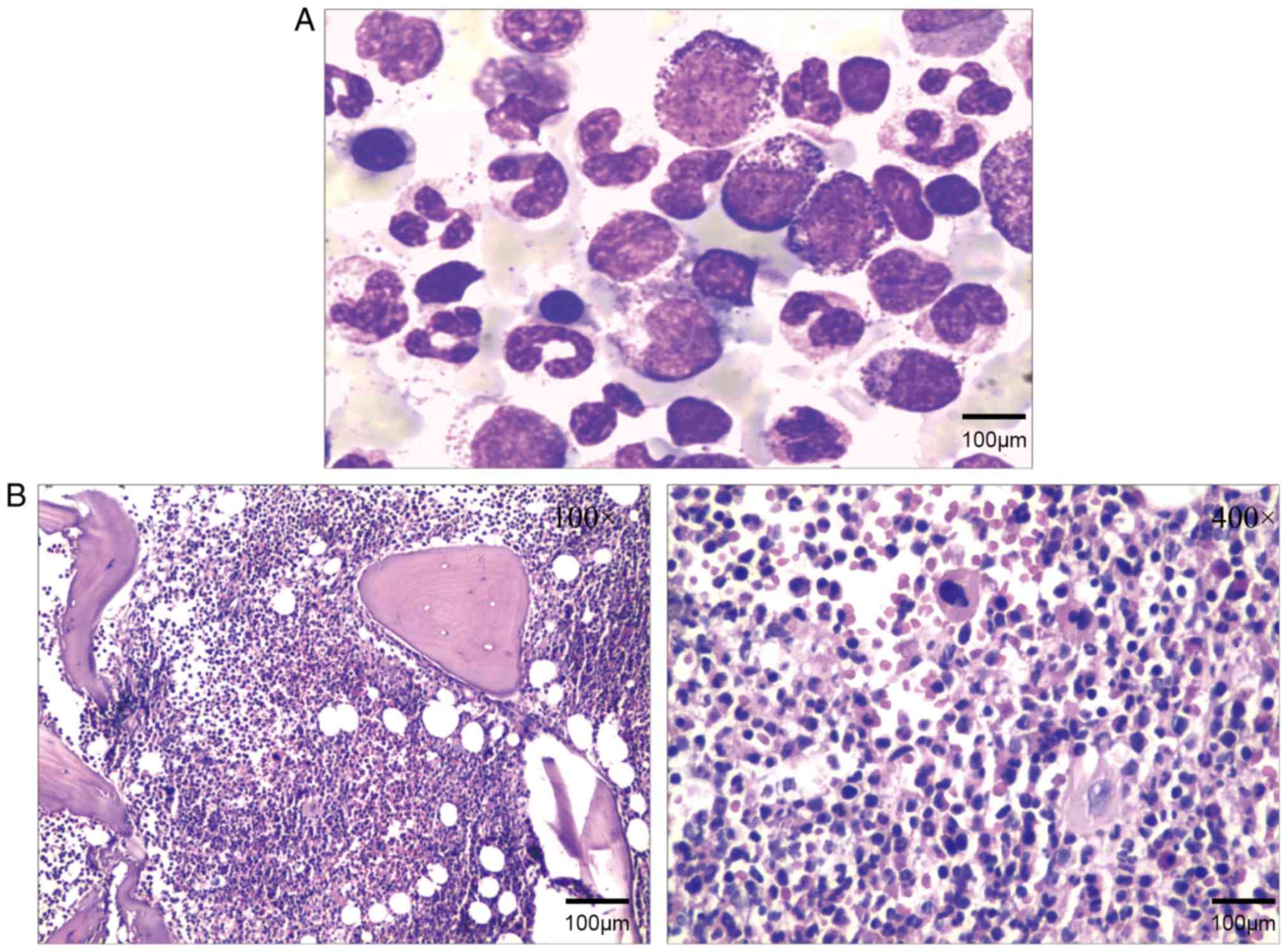
BM cytology smears and biopsy
To analyze the myeloproliferative status, BM
cytology smears and BM biopsy were performed at a hematology
laboratory. The cytology and biopsy results indicated that the BM
was hypercellular with granulocytic hyperplasia, as presented in
Fig. 1A and B.
Cytogenetics
Sufficient sample material obtained via BM
aspiration was available to examine the BCR gene, which is located
at 22q11. The initial analysis indicated that in the present case,
FGFR1 crosses the breakpoint located on chromosome 22q11. Following
initial diagnosis, 10 BM cells in metaphase were analyzed, and all
of them were clonally abnormal karyotypes, while the abnormalities
were 8 and 11 chromosomal translocations, forming a BCR/FGFR1
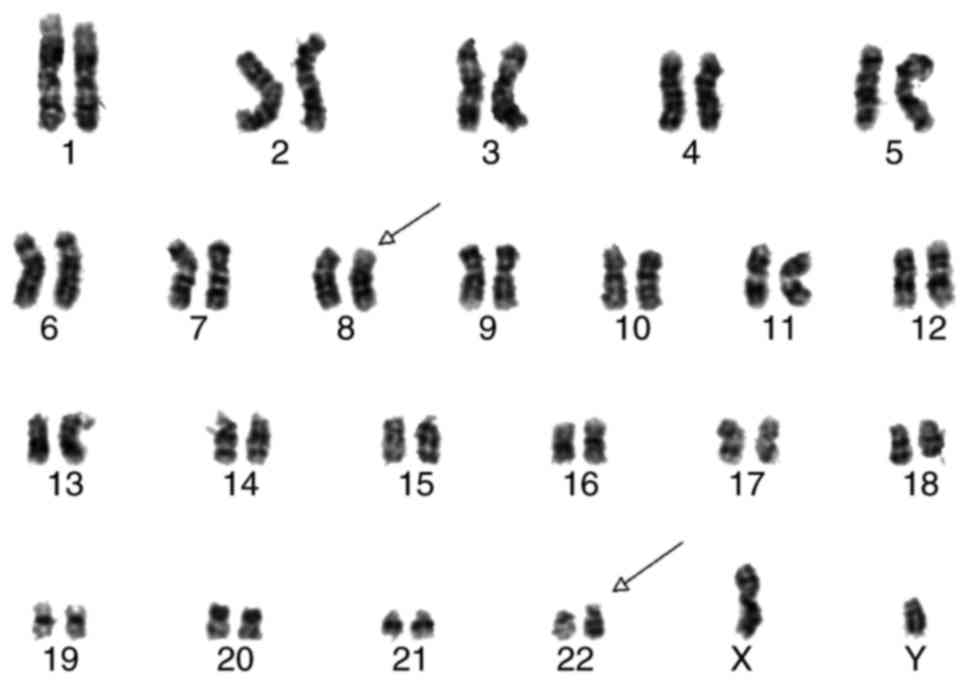
fusion gene in the patient. The abnormal karyotype
46,XY,t(8;22)(p11;q11) was observed in all of the cells, with no
other abnormal karyotypes. The BCR-FGFR1 fusion gene is the
characteristic chromosome karyotype in 8p11 myeloproliferative
syndrome. At 2 months after the initial diagnosis, the karyotype
remained identical, as indicated in Fig.
2. Although karyotype analysis is a simple and basic
technology, it is of great significance for the diagnosis of
EMS.
FISH
Once the gene has been cloned and characterized,
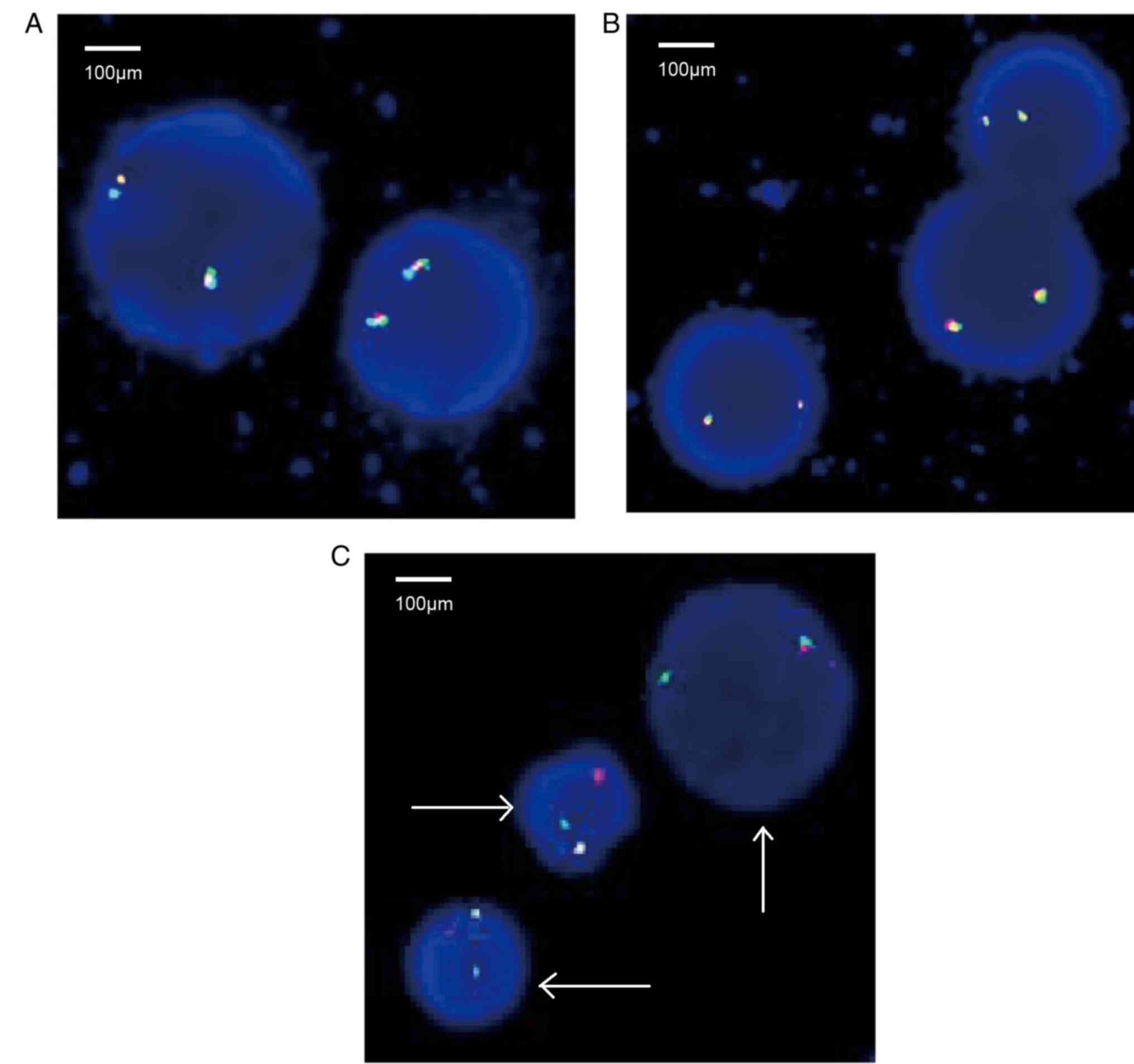
FISH analysis may be performed. In the present study, the
rearrangement of the FGFR1 gene was verified by FISH. A total of
200 interphase nuclei were examined for each probe, and no abnormal
signals regarding the platelet-derived growth factor receptor
(PDGFR)A (4q12) gene and PDGFRB (5q32) rearrangements were detected
(Fig. 3A and B, respectively).
However, ~79% of the nuclei had signals indicative of the FGFR1
(8p11) gene rearrangement (Fig. 3C).
The results further confirmed the formation of the BCR-FGFR1 fusion
gene.
Discussion
EMS is characterized by the following: i)
Myeloproliferative neoplasm associated with eosinophilia; ii)
Lymphadenopathy; iii) High tendency toward converting to AML; and
iv) Reciprocal translocations involving 8p11 (2).
To the best of the author's knowledge, the present
study reports on the 15th published case of t(8;22)/BCR-FGFR1
rearrangement. All other cases are presented in Table I. The FGFR1 gene encodes a receptor
tyrosine kinase transmembrane protein. It consists of the following
three parts: The extracellular domain, the transmembrane domain and
the intracellular domain. Under normal circumstances, FGFR1 is in
the form of oligomers, where binding of FGFR1 to its ligands, e g
BCR, results in FGFR1 homodimerization and autophosphorylation,
thus activating multiple effectors, including RAS/mitogen-activated
protein kinase/phosphoinositide-3 kinase/phosphoinositide
phospholipase C-γ, and providing proliferative and survival
signals. BCR is one of the 15 fusion partners of FGFR1. The 15
rearrangement karyotypes are as follows: Myosin XVIIIA (MYO18A;
17q23), tripartite motif containing 24 (TIF1; 7q34), FGFR1 oncogene
partner 2 (FGFR1OP2; 12p11), human endogenous retrovirus group K
member (HERV-K; 19q13), BCR (22q11), centriolin (CEP110; 9q33),
FGFR1 oncogene partner (FOP/FGFR10P; 6q27), zinc finger protein 198
(ZNF198; 13q11-12), cleavage and polyadenylation specific factor 6
(CPSF6; 12q15), tripartite motif containing 24 (TRIM24; 7q34),
nuceloporin 98 (NUP98; 11p15), cut like homeobox 1 (CUX1; 7q22),
translocated promoter region, nuclear basket protein (TPR; 1q25),
RAN binding protein 2 (RANBP2; 2q12) and LPR binding FLII
interacting protein 1 (LRRFIPI; 2q37). Among these translocations,
t(8;13) is the most common (1–3).
Unlike other cases of FGFR1 rearrangement, which
frequently manifest as eosinophilia and lymphadenopathy, the
clinical presentation of the case of the present study was as CML.
This particular clinical manifestation suggests a specific role of
BCR during the development of the disease. FGFR1 has a critical
role in the oncogenesis of EMS, and each FGFR1 fusion partner
exerts a different influence on the malignant phenotype (2,4).
In other studies reporting on cases of EMS, which
appear as leukemia or lymphoblastic lymphoma, accompanying
chromosomal abnormalities frequently exist; however, in the present
case, the only abnormal karyotype was t(8;22)(p11;q11). The unique
clinical features of this patient may be attributed to the absence
of any additional chromosomal abnormalities.
As for the treatment of EMS, numerous studies have
reported that patients benefited from allogeneic hematopoietic stem
cell transplantation (7–9). The application of FGFR1 inhibitors has
also been reported in certain cases, but the clinical outcome was
not improved (5). Therefore,
allogeneic hematopoietic stem cell transplantation remains the
primary treatment. In addition, chemotherapy is not ideal for
patients who present with acute leukemia or lymphoblastic lymphoma.
EMS has a rapidly progressing clinical course with a median
survival time of <1 year (4,5).
The present study emphasizes the importance of
accurate molecular diagnosis in FGFR1 rearrangement cases. In cases
of non-classical clinical manifestations, accurate molecular
diagnosis may avoid misdiagnoses. Conceivably, early diagnosis
provides patients with the opportunity to adopt allogeneic
hematopoietic stem cell transplantation in an early phase of the
disease and may thus improve the clinical outcome of the
patients.
Of note, EMS is a type of disease that may be
misdiagnosed. In the present case report, a 41-year-old patient
with a misdiagnosis of CML due to an increase in the number of
white blood cells was subsequently diagnosed with EMS after
undergoing a karyotype test. The present study may contribute to
the improvement of the diagnosis of EMS in patients, which may
first appear to have CML. EMS should be considered in patients with
symptoms similar to those of the case of the present study.
Acknowledgements
Not applicable.
Funding
No funding was received.
Availability of data and materials
The datasets used and/or analyzed during the current
study are available from the corresponding author on reasonable
request.
Authors' contributions
JJL analysed and interpreted the patient data. LM
analyzed the hematological data. JJL and LM drafted and revised the
manuscript. All authors read and approved the final manuscript.
Ethical approval and consent to
participate
Not applicable.
Patient consent for publication
The current case report was published with informed
consent of the patient, whose anonymity was preserved.
Competing interests
The authors declare that they have no competing
interests.
References
|
1
|
Kim WS, Park SG, Park G, Jang SJ, Moon DS
and Kang SH: 8p11 myeloproliferative syndrome with
t(1;8)(q25;p11.2): A case report and review of the literature. Acta
Haematol. 133:101–105. 2015. View Article : Google Scholar : PubMed/NCBI
|
|
2
|
Jackson CC, Medeiros LJ and Miranda RN:
8p11 myeloproliferative syndrome: A review. Hum Pathol. 41:461–476.
2010. View Article : Google Scholar : PubMed/NCBI
|
|
3
|
Fioretos T, Panagopoulos I, Lassen C,
Swedin A, Billström R, Isaksson M, Strömbeck B, Olofsson T,
Mitelman F and Johansson B: Fusion of the BCR and the Fibroblast
Growth Factor Receptor-1 (FGFR1) genes as a result of
t(8;22)(p11;q11) in a myeloproliferative disorder: The first fusion
gene involving BCR but not ABL. Genes Chromosomes Cancer.
32:302–310. 2001. View
Article : Google Scholar : PubMed/NCBI
|
|
4
|
Matikas A, Tzannou I, Oikonomopoulou D and
Bakiri M: A case of acute myelogenous leukaemia characterised by
the BCR-FGFR1 translocation. BMJ Case Rep. 20:2013.
|
|
5
|
Wakim JJ, Tirado CA, Chen W and Collins R:
t(8;22)/BCR-FGFR1 myeloproliferative disorder presenting as B acute
lymphoblastic leukemia: Report of a case treated with sorafenib and
review of the literature. Leuk Res. 35:pp. e151–153. 2011,
View Article : Google Scholar : PubMed/NCBI
|
|
6
|
Baldazzi C, Iacobucci I, Luatti S,
Ottaviani E, Marzocchi G, Paolini S, Stacchini M, Papayannidis C,
Gamberini C, Martinelli G, et al: B-cell acute lymphoblastic
leukemia as evolution of a 8p11 myeloproliferative syndrome with
t(8;22)(p11;q11) and BCRFGFR1 fusion gene. Leuk Res. 34:e282–285.
2010. View Article : Google Scholar : PubMed/NCBI
|
|
7
|
Dolan M, Cioc A, Cross NC, Neglia JP and
Tolar J: Favorable outcome of allogeneic hematopoietic cell
transplantation for 8p11 myeloproliferative syndrome associated
with BCR-FGFR1 gene fusion. Pediatr Blood Cancer. 59:194–196. 2012.
View Article : Google Scholar : PubMed/NCBI
|
|
8
|
Morishige S, Oku E, Takata Y, Kimura Y,
Arakawa F, Seki R, Imamura R, Osaki K, Hashiguchi M, Yakushiji K,
et al: A case of 8p11 myeloproliferative syndrome with BCR-FGFR1
gene fusion presenting with trilineage acute leukemia/lymphoma,
successfully treated by cord blood transplantation. Acta Haematol.
129:83–89. 2013. View Article : Google Scholar : PubMed/NCBI
|
|
9
|
Haslam K, Langabeer SE, Kelly J, Coen N,
O'Connell NM and Conneally E: Allogeneic hematopoietic stem cell
transplantation for a BCR-FGFR1 myeloproliferative neoplasm
presenting as acute lymphoblastic leukemia. Case Report Hematol.
2012:pp. 6209672012
|
|
10
|
Demiroglu A, Steer EJ, Heath C, Taylor K,
Bentley M, Allen SL, Koduru P, Brody JP, Hawson G, Rodwell R, et
al: The t(8;22) in chronic myeloid leukemia fuses BCR to FGFR1:
Transforming activity and specific inhibition of FGFR1 fusion
proteins. Blood. 98:3778–3783. 2001. View Article : Google Scholar : PubMed/NCBI
|
|
11
|
Chase A, Grand FH and Cross NC: Activity
of TKI258 against primary cells and cell lines with FGFR1 fusion
genes associated with the 8p11 myeloproliferative syndrome. Blood.
110:3729–3734. 2007. View Article : Google Scholar : PubMed/NCBI
|
|
12
|
Pini M, Gottardi E, Scaravaglio P,
Giugliano E, Libener R, Baraldi A, Muzio A, Cornaglia E, Saglio G
and Levis A: A fourth case of BCR-FGFR1 positive CML-like disease
with t(8;22) translocation showing an extensive deletion on the
derivative chromosome 8p. Hematol J. 3:315–316. 2002. View Article : Google Scholar : PubMed/NCBI
|
|
13
|
Murati A, Arnoulet C, Lafage-Pochitaloff
M, Adélaide J, Derré M, Slama B, Delaval B, Popovici C, Vey N,
Xerri L, et al: Dual lympho-myeloproliferative disorder in a
patient with t(8;22) with BCR-FGFR1 gene fusion. Int J Oncol.
26:1485–1492. 2005.PubMed/NCBI
|
|
14
|
Agerstam H, Lilljebjörn H, Lassen C,
Swedin A, Richter J, Vandenberghe P, Johansson B and Fioretos T:
Fusion gene-mediated truncation of RUNX1 as a potential mechanism
underlying disease progression in the 8p11 myeloproliferative
syndrome. Genes Chromosomes Cancer. 46:635–643. 2007. View Article : Google Scholar : PubMed/NCBI
|
|
15
|
Richebourg S, Theisen O, Plantier I, Parry
A, Soenen-Cornu V, Lepelley P, Preudhomme C, Renneville A, Laï JL
and Roche-Lestienne C: Chronic myeloproliferative disorder with
t(8;22)(p11;q11) can mime clonal cytogenetic evolution of authentic
chronic myelogeneous leukemia. Genes Chromosomes Cancer.
47:915–918. 2008. View Article : Google Scholar : PubMed/NCBI
|
|
16
|
Qin YW, Yang YN, Bai P and Wang C: Chronic
myelogenous leukemia-like hematological malignancy with t(8;22) in
a 26-year-old pregnant woman: A case report. Oncol Lett.
11:4131–4133. 2016. View Article : Google Scholar : PubMed/NCBI
|