Introduction
Colorectal carcinoma (CRC) is the third most
frequent cancer in males and the second most frequent in females
worldwide. Approximately 1.4 million cases were newly diagnosed and
~700,000 patients died from CRC in 2012 (1). Tumor progression and metastasis were
the major causes of the death of CRC patients. At present, surgery
and chemotherapy or Chinese medicine treatment are the major
clinical treatments for CRC (2).
However, although surgery is an effective method for CRC treatment,
total resection of the lesion is not possible and chemotherapeutic
treatment for CRC frequently results in drug resistance, which
currently represents a challenge in CRC treatment.
Yes-associated protein (YAP) is a key effective
factor of the Hippo signaling pathway. As a newly discovered cell
signal transduction pathway, the Hippo signaling pathway has
important roles in regulating the volume and size of organs
(3,4). YAP upregulation has been identified in
various cancer types, including ovarian, lung, liver, gastric and
prostate cancer and it has been associated with tumor progression
and sensitivity to chemotherapy, indicating that YAP participates
in tumor development (5–9). YAP has been reported to contribute to
the resistance of various cancer types to chemotherapy drugs
(10).
As one of the most effective anti-tumor agents,
taxol (TAX) has been deeply researched and widely used for cancer
treatment, particularly of ovarian and breast cancers. However, its
function is often limited by drug resistance. Studies have
indicated that the function of YAP as a transcription factor may be
suppressed by TAX and YAP upregulation reverses this suppression
(11–13).
Verteporfin (VP), a member of the porphyrin family,
is clinically used in the treatment of neovascular macular
degeneration (14). It has been
suggested that VP may suppress hepatoma cell growth without
photo-activation through suppressing the YAP-TEA domain protein
(TEAD) complex (15). Thus, the
present study hypothesized that YAP suppression caused by VP
treatment enhances the drug sensitivity of TAX-resistant colorectal
cancer cells to TAX, which may provide a novel scientific approach
for improving the clinical application of TAX.
The present study aimed to investigate whether the
sensitivity of the TAX-resistant colorectal cancer cell line LOVO
(LOVO/TAX) to TAX may be enhanced by VP treatment.
Materials and methods
Cells and cell culture
The LOVO cell line and the LOVO/TAX cell line were
purchased from Shanghai Bogoo Biotechnology Co., Ltd. (Shanghai,
China). LOVO and LOVO/TAX cells were cultured in Dulbecco's
modified Eagle's medium (DMEM; Gibco; Thermo Fisher Scientific,
Inc., Waltham, MA, USA) supplemented with 10% fetal bovine serum
(FBS; Gibco; Thermo Fisher Scientific, Inc.), 1% penicillin and
streptomycin solution and were incubated at 37°C with 5%
CO2. Cells were passaged until reaching at least 90%
confluence.
Determination of drug sensitivity by
MTT assay
Cells were seeded into a 96-well plate and cultured
in DMEM media for 24 h. The cells were then treated with various
concentrations of TAX for 48 h. Subsequently, 10 µl MTT solution (5
mg/ml) was added to each well, followed by incubation at 37°C for 4
h. The formazan crystals were subsequently dissolved with
dimethylsulfoxide. The optical absorbance was measured at 450 nm
using a spectrophotometer (Bio-Tek Instruments, Winooski, VT, USA).
Each experiment was repeated three times.
Cell transfection
To explore the association between YAP and TAX
resistance, YAP expression plasmid, YAP small interfering (si)RNA,
YAP expression control and YAP siRNA control plasmid (Vigene
Bioscience, Inc., Rockville, MD, USA) were respectively transfected
into LOVO cells or LOVO/TAX cells with 30 µl Lipofectamine 2000
transfection reagent (Invitrogen; Thermo Fisher Scientific, Inc.)
according to the manufacturer's instructions. After 24 h of
incubation, the transfected cells were subjected to the following
analyses.
Western blot analysis
For protein detection, western blot analysis was
performed. In short, radioimmunoprecipitation assay buffer (Solar
Bio, Beijing, China) supplemented with 1 mM phenylmethanesulfonyl
fluoride was used for cell protein extraction. Subsequently, the
protein concentration was determined using a bicinchoninic acid
assay. Proteins (2 µg/lane) were separated by 10% SDS-PAGE and then
transferred onto polyvinylidene difluoride membranes (EMD
Millipore, Billerica, MA, USA). Membranes were blocked at room
temperature for 1 h in PBS containing 0.1% Tween-20 and 5% fat-free
powdered milk. Membranes were then incubated overnight at 4°C with
primary antibodies [anti-β-actin (cat. no. 4970; 1:1,000); anti-YAP
(cat. no. 14074; 1:1,000); anti-B-cell lymphoma 2 (Bcl-2; cat. no.
3498; 1:1,000); anti-Bcl-2-associated × protein (Bax; cat. no.
5023; 1:1,000; all Cell Signaling Technology Inc., Danvers, MA,
USA)] followed by incubation with a secondary antibody (cat. no.
7074; 1:5,000; Cell Signaling Technology Inc.) at room temperature
for 2 h. An enhanced chemiluminescence kit (PE0010; Beijing
Solarbio Science & Technology Co., Ltd., Beijing, China) was
used to detect the protein bands and images were captured by ImageJ
(v1.4.1; National Institutes of Health, Bethesda, MD, USA).
RNA isolation and
reverse-transcription quantitative polymerase chain reaction
(RT-qPCR)
Total RNA from cells was extracted with TRIzol
reagent (Invitrogen; Thermo Fisher Scientific, Inc.) according to
the manufacturer's instructions. Complementary DNA was generated by
using the PrimeScript™ RT reagent kit (Takara Bio, Inc., Otsu,
Japan). Real-time PCR was performed by using the SYBR®
Premix Ex Taq™ II (Takara Bio, Inc.) and all reactions were
performed in triplicate under the following conditions: 95°C for 10
min, followed by 37 cycles at 95°C for 15 sec and 72°C for 30 sec.
GAPDH was used as an internal control. The 2−∆∆Cq method
was used for calculation of the relative gene expression levels
(16). The primers used for
real-time PCR are listed in Table
I.
 | Table I.Primer sequences for polymerase chain
reaction. |
Table I.
Primer sequences for polymerase chain
reaction.
| Gene/direction | Sequence (5′-3′) |
|---|
| YAP |
|
|
Forward |
ACGTTCATCTGGGACAGCAT |
|
Reverse |
GTTGGGAGATGGCAAAGACA |
| GAPDH |
|
|
Forward |
CTTTGGTATCGTGGAAGGACTC |
|
Reverse |
GTAGAGGCAGGGATGATGTTCT |
Statistical analysis
Experiments were performed for at least three times.
SPSS 17.0 statistical software (SPSS, Inc., Chicago, IL, USA) was
used for all statistical analyses. Values are expressed as the mean
± standard deviation. Statistical comparisons between groups were
made by analysis of variance with the Student-Newman-Keul post hoc
test or Student's t-test. P<0.05 was considered to indicate a
statistically significant difference.
Results
YAP expression levels are positively
associated with the drug resistance of LOVO cells to TAX
To investigate the association of YAP levels and the
resistance of LOVO cells to TAX, the expression levels of YAP were
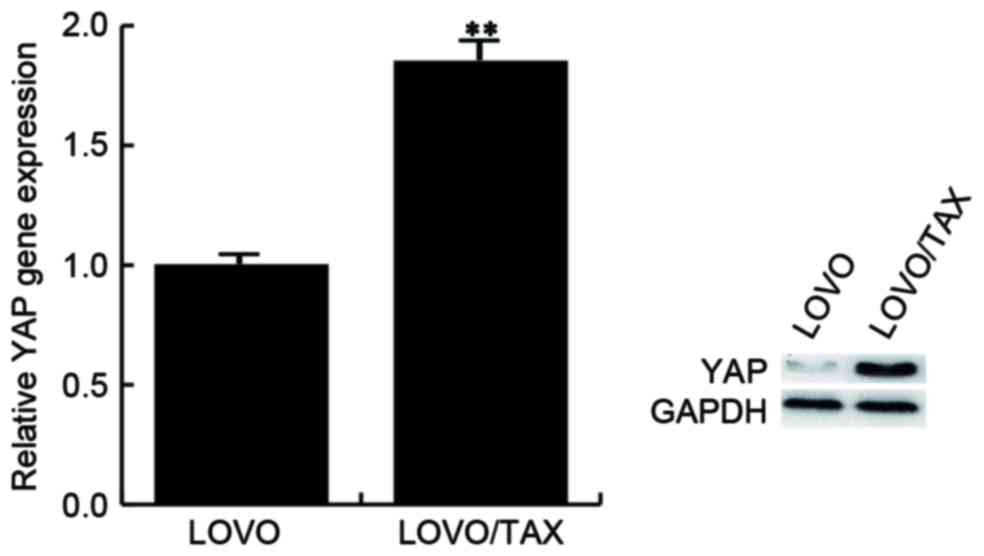
determined in LOVO cells and LOVO/TAX cells. Compared with those in
LOVO cells, the YAP expression levels were significantly higher in
LOVO/TAX cells at the mRNA and the protein level (Fig. 1).
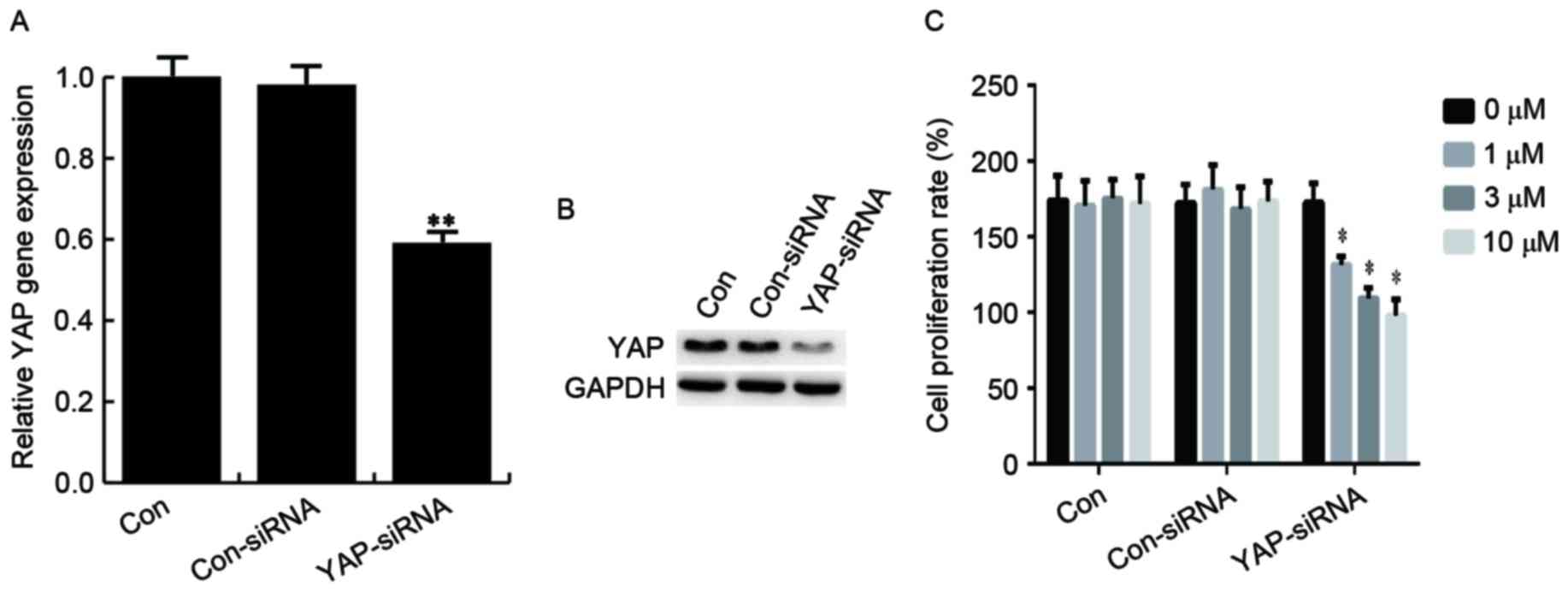
Next, in order to determine the effect of YAP
expression on the sensitivity of LOVO/TAX cells to TAX, YAP was
inhibited by YAP siRNA. The results indicated that the expression
levels of YAP were significantly inhibited in LOVO/TAX cells by YAP
siRNA at the mRNA and the protein level (Fig. 2A and B) and YAP inhibition notably
enhanced the sensitivity of LOVO/TAX cells to TAX (Fig. 2C).
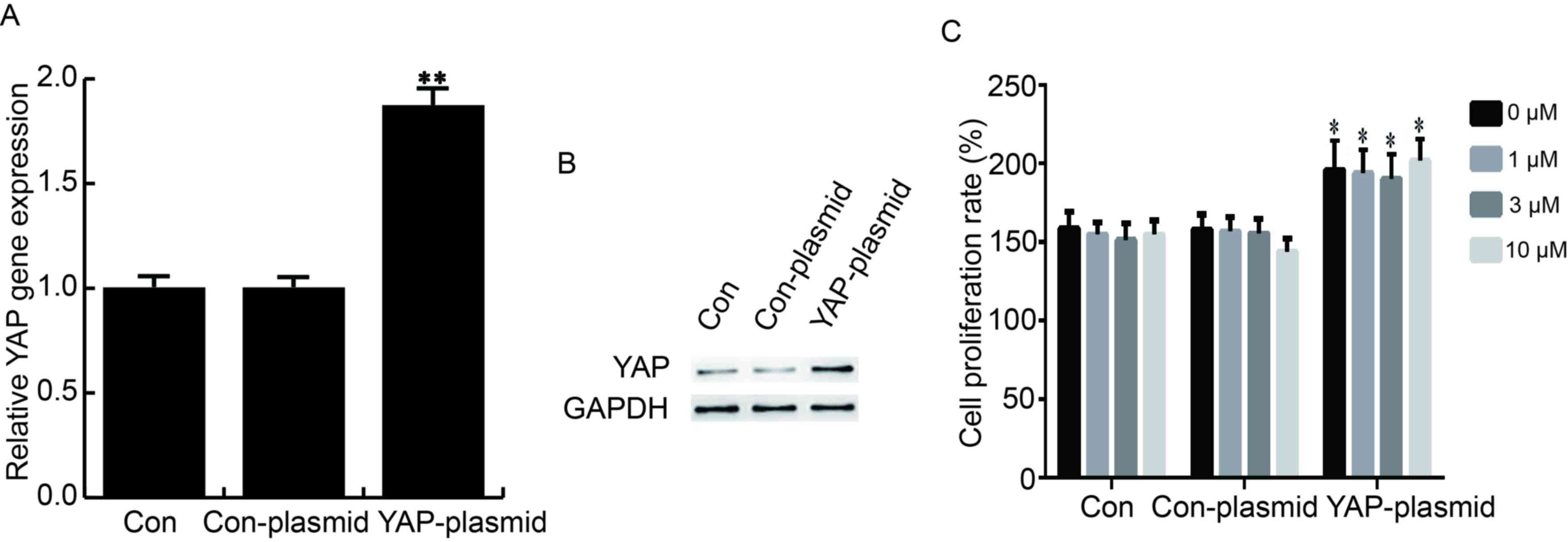
In addition, the effect of YAP overexpression on the
sensitivity of LOVO cells to TAX was examined and the results
indicated that YAP overexpression significantly reduced the
sensitivity of LOVO cells to TAX (Fig.
3).
VP increases the sensitivity of
LOVO/TAX cells to TAX by downregulating YAP expression
Since VP has been recognized as an effective YAP
inhibitor, the present study assessed whether VP increased the
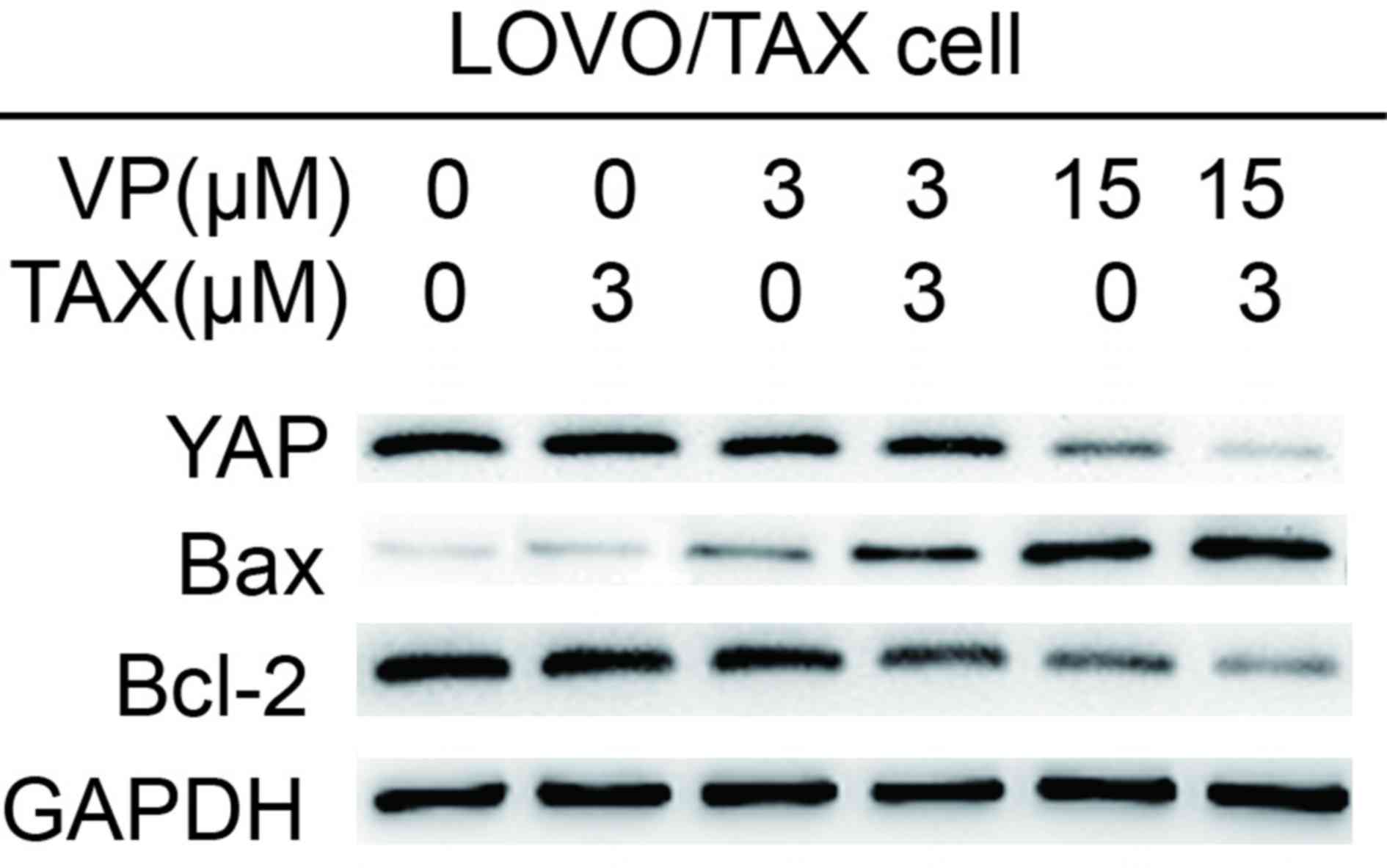
sensitivity of LOVO/TAX cells to TAX by inhibiting YAP. The results
indicated that TAX (3 µM) had no significant influence on YAP
expression, while VP inhibited YAP expression in a dose-dependent
manner and YAP expression was inhibited by VP and TAX combined.
Furthermore, at the highest concentration of VP, the expression of
YAP was further decreased by TAX addition (Fig. 4).
The results also indicated that Bcl-2 family
proteins were involved in the effect of VP on LOVO/TAX cells.
Western blot analysis suggested that TAX (3 µM) had no influence on
the Bcl-2/Bax ratio, while VP reduced the Bcl-2/Bax ratio in a
dose-dependent manner and the Bcl-2/Bax ratio was also inhibited by
VP and TAX in combination. The addition of VP enhanced the
sensitivity of LOVO/TAX cells to taxol (Fig. 4).
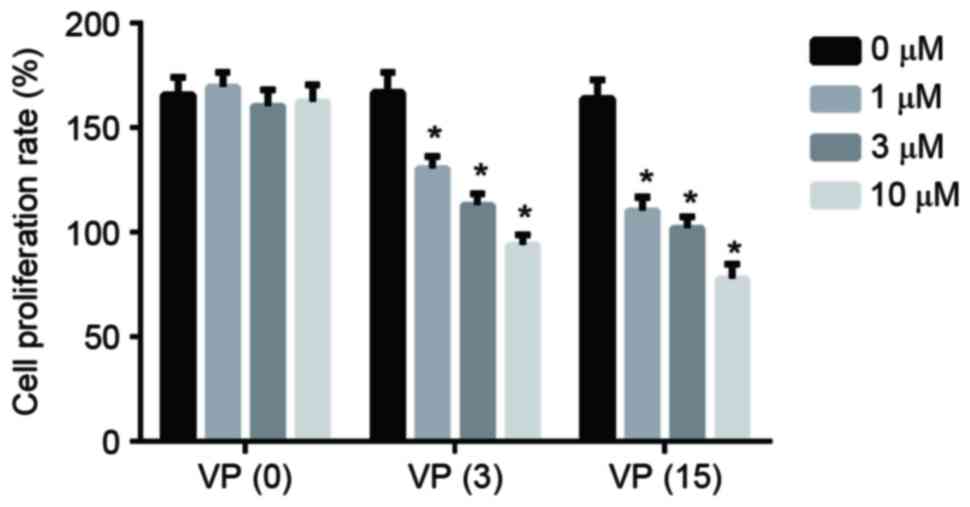
As YAP is overexpressed in the TAX-resistant cell
subline LOVO/TAX, it was tested whether YAP inhibition by VP
increased the sensitivity of LOVO/TAX cells to TAX. The MTT assay
revealed that the increased TAX concentration had no effect on cell
proliferation in the 0 µM VP group. However, decreased cell
proliferation was observed in VP (3 and 5 µM) groups. Therefore, VP
enhanced the sensitivity of LOVO/TAX cells to taxol. The results
also revealed that VP alone had no impact on cell proliferation in
the 0 µM TAX group (Fig. 5).
Discussion
TAX is an anti-microtubule drug, which may be used
in the treatment of a variety of tumors by promoting tubulin
polymerization, inhibiting depolymerization, maintaining tubulin
stability and inhibiting cell mitosis. As a novel anti-tumor drug,
TAX and other microtubule-targeting drugs, have been frequently
applied in chemotherapy in recent years. At present, TAX is used
for treating ovarian, breast, lung and gastrointestinal cancer, as
well as leukemia and has produced encouraging results (17). However, drug resistance has always
been the bottleneck of its clinical application. For instance, in
gastric cancer treatment, TAX, whether applied as a single-agent or
combination therapy, may provide a benefit for patients (18). However, ~30% of patients do not
benefit from TAX treatment. Therefore, it is critical to explore
novel strategies to reverse or mitigate drug resistance.
A previous study reported that overexpression of YAP
promotes TAX resistance in ovarian cancer cells (19). Pan et al (10) reported that YAP was more strongly
expressed in HCT-8/T than in HCT-8 cells and that TAX resistance
was correlated with the level of YAP expression. Accordingly, YAP
may have a similar role in the LOVO colon cancer cell line. The
present study revealed that, compared with the LOVO cell line, the
expression levels of YAP were significantly higher in LOVO/TAX
cells. YAP inhibition notably enhanced the sensitivity of LOVO/TAX
cells to TAX and ectopic overexpression of YAP significantly
reduced the sensitivity of LOVO cells to TAX. These results
indicated that overexpression of YAP in colon cancer LOVO cells
induces resistance to TAX and that inhibition of YAP reverses it.
This result was consistent with that of the previous study.
VP is widely and safely used in the treatment of
neovascular macular degeneration as well as certain human tumors
(15). VP represses YAP expression
without light activation by preventing the YAP-TEAD growth pathway.
Therefore, VP may reverse the drug resistance caused by YAP
overexpression. The results of the present study suggested that VP
inhibited YAP expression in a dose-dependent manner and
dose-dependently increased the sensitivity of LOVO/TAX cells to
TAX. These results revealed that VP reverses the drug resistance
caused by YAP overexpression.
In conclusion, the present study indicated that VP
treatment enhanced the sensitivity of LOVO/TAX cells to TAX and
thus reversed drug resistance, through inhibiting YAP
expression.
Acknowledgements
Not applicable.
Funding
No funding was received.
Availability of data and materials
The datasets used and/or analyzed during the current
study are available from the corresponding author on reasonable
request.
Authors' contributions
GS contributed to study design, data collection and
analysis. HaW and HH were responsible for data collection and
analysis. JG and HuW performed the literature search and analysis,
and contributed to the acquisition of data. All authors
collaborated to interpret the results and write the manuscript.
Ethics approval and consent to
participate
Not applicable.
Consent for publication
Not applicable.
Competing interests
The authors declare that they have no competing
interests.
References
|
1
|
Torre LA, Bray F, Siegel RL, Ferlay J,
Lortet-Tieulent J and Jemal A: Global cancer statistics, 2012. CA
Cancer J Clin. 65:87–108. 2015. View Article : Google Scholar : PubMed/NCBI
|
|
2
|
McCulloch M, Broffman M, van der Laan M,
Hubbard A, Kushi L, Abrams DI, Gao J and Colford JM: Colon cancer
survival with herbal medicine and vitamins combined with standard
therapy in a whole-systems approach: Ten-year follow-up data
analyzed with marginal structural models and propensity score
methods. Integr Cancer Ther. 10:240–259. 2011. View Article : Google Scholar : PubMed/NCBI
|
|
3
|
Liu AM, Xu Z and Luk JM: An update on
targeting Hippo-YAP signaling in liver cancer. Expert Opin Ther
Targets. 16:243–247. 2012. View Article : Google Scholar : PubMed/NCBI
|
|
4
|
Hong L, Cai Y, Jiang M, Zhou D and Chen L:
The Hippo signaling pathway in liver regeneration and
tumorigenesis. Acta Biochim Biophys Sin (Shanghai). 47:46–52. 2015.
View Article : Google Scholar : PubMed/NCBI
|
|
5
|
Zhang X, George J, Deb S, Degoutin JL,
Takano EA, Fox SB; AOCS Study group, ; Bowtell DD and Harvey KF:
The Hippo pathway transcriptional co-activator, YAP, is an ovarian
cancer oncogene. Oncogene. 30:2810–2822. 2011. View Article : Google Scholar : PubMed/NCBI
|
|
6
|
Su LL, Ma WX, Yuan JF, Shao Y, Xiao W and
Jiang SJ: Expression of Yes-associated protein in non-small cell
lung cancer and its relationship with clinical pathological
factors. Chin Med J (Engl). 125:4003–4008. 2012.PubMed/NCBI
|
|
7
|
Xu MZ, Yao TJ, Lee NP, Ng IO, Chan YT,
Zender L, Lowe SW, Poon RT and Luk JM: Yes-associated protein is an
independent prognostic marker in hepatocellular carcinoma. Cancer.
115:4576–4585. 2009. View Article : Google Scholar : PubMed/NCBI
|
|
8
|
Zhang J, Xu ZP, Yang YC, Zhu JS, Zhou Z
and Chen WX: Expression of Yes-associated protein in gastric
adenocarcinoma and inhibitory effects of its konckdown on gastric
cancer cell proliferation and metastasis. Int J Immunopathol
Pharmacol. 25:583–590. 2012. View Article : Google Scholar : PubMed/NCBI
|
|
9
|
Zhang L, Yang S, Chen X, Stauffer S, Yu F,
Lele SM, Fu K, Datta K, Palermo N, Chen Y and Dong J: The hippo
pathway effector YAP regulates motility, invasion, and
castration-resistant growth of prostate cancer cells. Mol Cell
Biol. 35:1350–1362. 2015. View Article : Google Scholar : PubMed/NCBI
|
|
10
|
Pan W, Wang Q, Zhang Y, Zhang N, Qin J, Li
W, Wang J, Wu F, Cao L and Xu G: Verteporfin can reverse the
paclitaxel resistance induced by YAP over-expression in HCT-8/T
cells without photoactivation through inhibiting YAP expression.
Cell Physiol Biochem. 39:481–490. 2016. View Article : Google Scholar : PubMed/NCBI
|
|
11
|
Ivery MT and Le T: Modeling the
interaction of paclitaxel with beta-tubulin. Oncol Res. 14:1–19.
2003. View Article : Google Scholar : PubMed/NCBI
|
|
12
|
Joo Y, Schumacher B, Landrieu I, Bartel M,
Smet-Nocca C, Jang A, Choi HS, Jeon NL, Chang KA, Kim HS, et al:
Involvement of 14-3-3 in tubulin instability and impaired axon
development is mediated by Tau. FASEB J. 29:4133–4144. 2015.
View Article : Google Scholar : PubMed/NCBI
|
|
13
|
Jinawath N, Vasoontara C, Yap KL,
Thiaville MM, Nakayama K, Wang TL and Shih IM: NAC-1, a potential
stem cell pluripotency factor, contributes to paclitaxel resistance
in ovarian cancer through inactivating Gadd45 pathway. Oncogene.
28:1941–1948. 2009. View Article : Google Scholar : PubMed/NCBI
|
|
14
|
Zhang H, Ramakrishnan SK, Triner D,
Centofanti B, Maitra D, Gyorffy B, Sebolt-Leopold JS, Dame MK,
Varani J, Brenner DE, et al: Tumor-selective proteotoxicity of
verteporfin inhibits colon cancer progression independently of
YAP1. Sci Signal. 8:ra982015. View Article : Google Scholar : PubMed/NCBI
|
|
15
|
Brodowska K, Al-Moujahed A, Marmalidou A,
Meyer Zu Horste M, Cichy J, Miller JW, Gragoudas E and Vavvas DG:
The clinically used photosensitizer Verteporfin (VP) inhibits
YAP-TEAD and human retinoblastoma cell growth in vitro without
light activation. Exp Eye Res. 124:67–73. 2014. View Article : Google Scholar : PubMed/NCBI
|
|
16
|
Livak KJ and Schmittgen TD: Analysis of
relative gene expression data using real-time quantitative PCR and
the 2(−Delta Delta C(T)) method. Methods. 25:402–408. 2001.
View Article : Google Scholar : PubMed/NCBI
|
|
17
|
Pei BX, Sun YS and Dong SH: Curative
effect of Abraxane in patients with non-small-cell lung cancer and
breast cancer. Chin Pharm J. 46:1851–1854. 2011.
|
|
18
|
Sakamoto J, Matsui T and Kodera Y:
Paclitaxel chemotherapy for the treatment of gastric cancer.
Gastric Cancer. 12:69–78. 2009. View Article : Google Scholar : PubMed/NCBI
|
|
19
|
Xia Y, Chang T, Wang Y, Liu Y, Li W, Li M
and Fan HY: YAP promotes ovarian cancer cell tumorigenesis and is
indicative of a poor prognosis for ovarian cancer patients. PLoS
One. 9:e917702014. View Article : Google Scholar : PubMed/NCBI
|