Introduction
Neonatal hypoxic-ischemic encephalopathy (HIE) is a
neonatal disease that is very common in perinatal period. HIE is
mainly due to neonatal brain damage caused by partial or complete
hypoxia in the brain under intrauterine distress. The pathogenesis
of the disease is still unknown, so there is no effective treatment
plan (1). Clinical studies have
revealed that approximately 20% of children with HIE die in the
neonatal period. Even if they survive, some patients will have
severe neurological dysfunction and other sequelae (2). The effective treatment of HIE has been
controversial for a long time, and the efficacy and safety of most
therapeutic drugs have yet to be verified by further animal
experiments (3).
Non-pharmaceutical hypothermia treatment is
currently the only safe treatment that has been proven to have a
good effect on neonatal HIE, and it is generally considered that
the optimal treatment time is 6 h after birth (4). However, recent studies (5) have shown that children with HIE
undergoing hypothermia within 24 hours of birth can also reduce the
risk of death within 18 months. Some studies exploring the
pathogenesis of HIE have indicated that inflammatory response also
plays an important role in neonatal HIE (6). As an anti-inflammatory cytokine,
interleukin (IL)-10 has a certain protective effect on hypoxic
ischemic encephalopathy because of its anti-inflammatory properties
(7). IL-l8 also has both
anti-inflammatory and pro-inflammatory effects. It acts as an
anti-inflammatory factor to protect brain tissue. At the same time,
it acts as a pro-inflammatory factor and may induce IL-2, IL-1B and
other inflammatory factors to cause brain damage (8,9).
However, studies on the effects of mild hypothermia
on IL-10 and IL-18 in children with HIE are rare. This study
explored the therapeutic effect of mild hypothermia on serum IL-10
and IL-18 in children with HIE. The aim was to investigate the
efficacy of hypothermia therapy in the treatment of children with
HIE.
Patients and methods
General information
A retrospective analysis of 97 children with HIE
admitted to Xuzhou Children's Hospital, Xuzhou Medical University
(Xuzhou, China) from September 2016 to August 2018 was conducted.
There were 51 male patients and 46 female patients with an average
gestational age of 37.95±1.73 weeks. Among them, 54 patients with
mild hypothermia were included in the experimental group (moderate
+ severe), and 43 patients who received conventional therapy were
included in the control group (moderate + severe). There were no
significant differences in sex and gestational age between the two
groups (P>0.05; Table I).
Inclusion criteria: Clinical diagnosis of neonatal hypoxic ischemic
encephalopathy, in line with the diagnostic criteria of the 4th
edition of Practical Neonatology, 2011, with moderate to severe
degree, hospitalized within 24 h after birth. Exclusion criteria:
children with complex congenital heart disease; children with
congenital diaphragmatics; children with refractory pneumothorax;
active bleeding, grade II and IV intracranial hemorrhage, platelet
≤100×109/l and children with bleeding tendency; parents
who gave up treatment during treatment. Family members of all the
children agreed to participate and signed the informed consent.
This experiment was approved by the Ethics Committee of Xuzhou
Children's Hospital, Xuzhou Medical University.
 | Table I.Comparison of general data between two
groups of children [n (%)]. |
Table I.
Comparison of general data between two
groups of children [n (%)].
| Items | Experimental group
(n=54) | Control group
(n=43) | t/χ2
value | P-value |
|---|
| Sex |
|
| 0.062 | 0.803 |
| Male | 29 (53.70) | 22 (51.16) |
|
|
|
Female | 25 (46.30) | 21 (48.84) |
|
|
| Gestational age
(weeks) |
|
| 0.029 | 0.866 |
| ≤37 | 21 (38.89) | 16 (37.21) |
|
|
|
>37 | 33 (61.11) | 27 (62.79) |
|
|
| Weight (kg) | 3.31±0.79 | 3.30±0. 81 | 0.061 | 0.951 |
| HIE level |
|
| 0.000 | 0.986 |
|
Moderate | 34 (62.96) | 27 (62.79) |
|
|
|
Severe | 20 (37.04) | 16 (37.21) |
|
|
Treatment
Children in the control group were treated routinely
after birth, including maintaining airway patency, maintaining
ambient temperature, keeping blood pressure and blood glucose at a
normal level, sedation treatment, intracranial pressure reduction,
anticonvulsant treatment, improving ventilation and brain function
protection. In the experimental group, the ALLon hypothermia
thermoregulatory system (MTRE, Israel) was used for systemic
hypothermia treatment. Anus temperature of the child was tested,
and the core temperature was maintained at 34.0±0.4°C for 72 h,
then the treatment was stopped and the child was rewarmed.
Detection of serum IL-10 and IL-18
concentrations in the two groups of children
Peripheral venous blood (2 ml) was taken at 0 h, 1,
2, 3 and 5 days after hypothermia treatment in the experimental
group and after admission in the control group. Blood was
centrifuged at 3,000 × g for 5 min at 4°C to collect serum and the
serum was stored at −80°C before use. Concentrations of IL-10 and
IL-18 were determined by enzyme linked immunosorbent assay
(ELISA).
Observation indicators
i) Concentrations of IL-10 and IL-18 at 0 h, 1, 2, 3
and 5 days after treatment were tested and compared. ii) Neonatal
behavioral neurological score (NB-NA) (10) was calculated at 7, 14, and 28 days
after birth. iii) Severity of disease was analyzed and its
correlation with IL-10 and IL-18 was explored.
Statistical analysis
In this study, SPSS18.0 [Bizinsight (Beijing)
Information Technology Co., Ltd.] was used for statistical
analyses. Chi-square test was used for comparisons of enumeration
data, and measurement data were expressed as mean ± standard
deviation. Comparison between the two groups was analyzed by
t-test, and comparison among multiple groups was analyzed by ANOVA
with Dunnetts post hoc test. Comparison of different time-points
was performed by repeated measures ANOVA. Pearson's correlation
analysis test was used for correlation between IL-8, IL-10 and
severity of the disease. P<0.05 was considered to indicate a
statistically significant difference.
Results
IL-10 and IL-18 concentrations at
different time-points after treatment in both groups
No significant difference was observed in the
concentration of IL-10 between the two groups at 0 h (P>0.05),
and IL-10 in the groups decreased gradually after treatment, but
the concentration of IL-10 in the experimental group was lower than
that of the control group at days 1, 2, 3 and 5 (P<0.05). There
was no significant difference in the concentration of IL-18 between
the two groups at 0 h (P>0.05). The concentration of IL-18 in
the experimental group began to decrease at day 1, and was
significantly lower than that in the control group at days 2, 3 and
5, the difference was statistically significant (P<0.05). The
concentration of IL-18 in the control group gradually increased at
days 1, 2 and 3, and peaked at day 3, then gradually decreased, and
the concentration of IL-18 at day 5 was significantly lower than
that at 0 h and days 1, 2 and 3, the difference was statistically
significant (P<0.05) (Tables II
and III).
| Table II.Changes in IL-10 concentration at
different time-points (pg/ml). |
Table II.
Changes in IL-10 concentration at
different time-points (pg/ml).
| Time points | Experimental group
(n=54) | Control group
(n=43) | t value | P-value |
|---|
| 0 h | 316.53±45.67 | 317.19±46.23 | 0.070 | 0.944 |
| 1 day | 221.43±29.36 | 305.21±31.67 | 13.48 | <0.001 |
| 2 days | 185.42±26.18 | 275.19±29.33 | 15.90 | <0.001 |
| 3 days | 143.31±16.79 | 246.27±25.82 | 23.69 | <0.001 |
| 5 days | 132.11±13.47 | 193.31±21.35 | 17.21 | <0.001 |
| F value | 373.2 | 130.5 | – | – |
| P-value | <0.001 | <0.001 | – | – |
| Table III.Changes in IL-18 concentration at
different time-points (pg/ml). |
Table III.
Changes in IL-18 concentration at
different time-points (pg/ml).
| Time points | Experimental group
(n=54) | Control group
(n=43) | t value | P-value |
|---|
| 0 h | 117.45±21.36 | 118.21±22.42 | 0.170 | 0.865 |
| 1 day | 126.39±23.11 | 131.65±27.35 | 1.026 | 0.307 |
| 2 days |
81.54±18.23 | 154.49±33.79 | 13.96 | <0.001 |
| 3 days |
69.51±24.35 | 181.47±42.36 | 16.84 | <0.001 |
| 5 days |
61.19±15.72 |
78.40±18.95 | 4.889 | <0.001 |
| F value | 105.9 | 123.8 | – | – |
| P-value | <0.001 | <0.001 | – | – |
NBNA scores of the two groups at
different time-points after birth
No significant difference in NBNA scores was
observed between the two groups at 7 days (P>0.05). With the
prolongation of birth time, the NBNA score of children increased
gradually, but the NBNA scores of the experimental group were
significantly higher than those of the control group at 14 and 28
days after birth, and the difference was statistically significant
(P<0.05) (Table IV).
| Table IV.NBNA scores of two groups at different
time-points after birth. |
Table IV.
NBNA scores of two groups at different
time-points after birth.
| Time points | Experimental group
(n=54) | Control group
(n=43) | t value | P-value |
|---|
| 7 days | 32.94±1.21 | 33.02±1.19 | 0.326 | 0.745 |
| 14 days | 38.14±1.33 | 34.95±1.31 | 11.81 | <0.001 |
| 28 days | 39.57±1.29 | 36.11±1.13 | 13.85 | <0.001 |
| F value | 402.7 | 71.28 | – | – |
| P-value | <0.001 | <0.001 | – | – |
Correlation between severity of
disease and expression of IL-10 and IL-18 in the two groups
Before treatment, the expression levels of IL-10 and
IL-18 were significantly higher in severe children than in moderate
children, the difference was statistically significant (P<0.05).
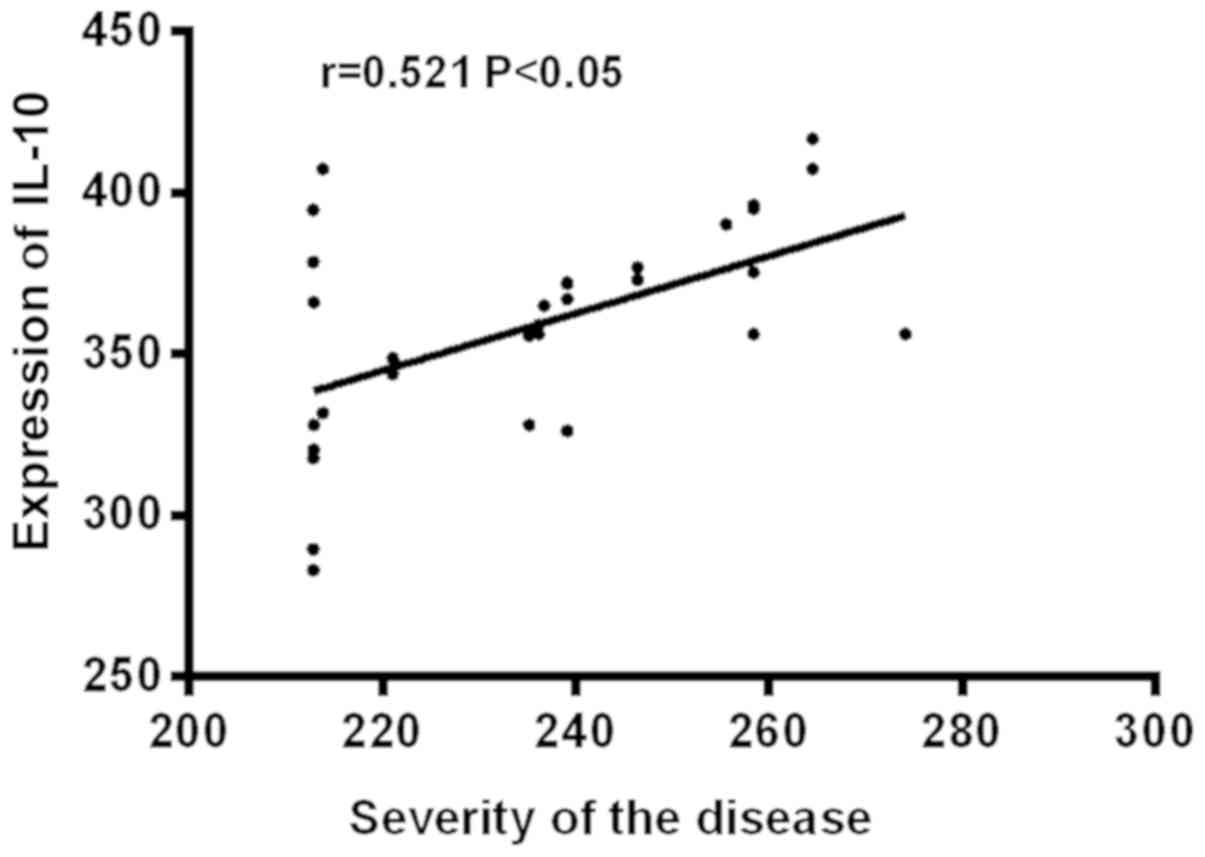
IL-10 was positively correlated with the severity of the disease
(r=0.521, P<0.05), and IL-18 was also positively correlated with
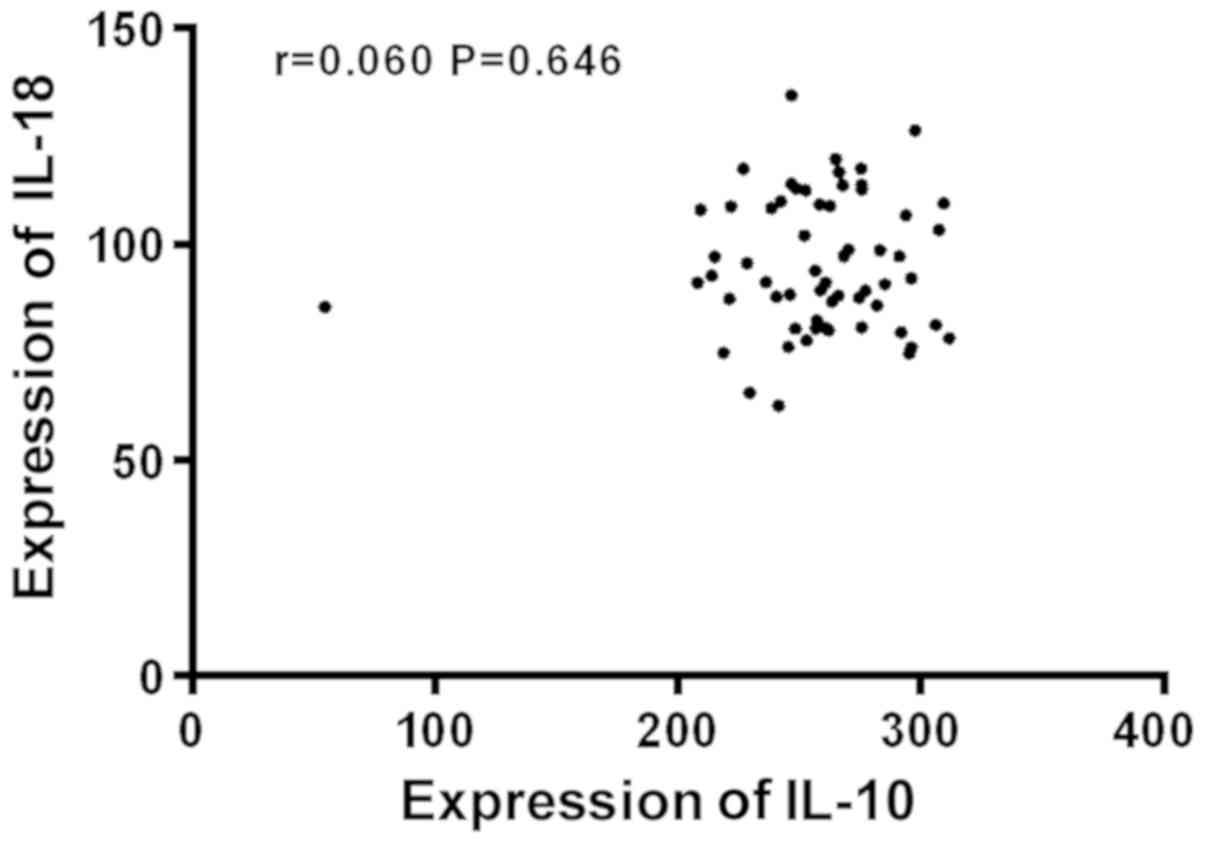
the severity of the disease (r=0.616, P<0.05), but there was no
significant correlation between IL-10 and IL-18 (P>0.05)
(Table V and Figs. 1–3).
| Table V.Expression levels of serum IL-10 and
IL-18 in children with different severity before treatment. |
Table V.
Expression levels of serum IL-10 and
IL-18 in children with different severity before treatment.
| Factors | Moderate
(n=61) | Severe (n=36) | t value | P-value |
|---|
| IL-10 | 256.15±33.92 | 357.23±23.65 | 15.75 | <0.001 |
| IL-18 |
95.23±14.49 | 129.55±19.73 | 9.829 | <0.001 |
Discussion
HIE is a neonatal brain injury disease characterized
by changes in muscle tone or hypotension, convulsions and other
clinical symptoms, and serious illness can lead to death in
children (11). As one of the most
effective methods for the treatment of HIE, sub-hypothermia
treatment reduces the temperature of the body by 2–5°C, thereby
reducing the level of adenosine triphosphate (ATP) in the brain
cells and reducing lactic acid accumulation, which in turn reduces
the levels of excitatory neurotransmitters, inflammatory mediators
and other cytotoxins, so as to protect the nerves (12). Studies have shown that the
inflammatory response plays a very important role in the
pathological process of HIE (13).
In our study, levels of IL-10 and IL-18 at different
time-points after treatment were first tested. The results showed
no significant difference in concentration of IL-10 between the two
groups at 0 h (P>0.05), but the concentration of IL-10 in the
experimental group was lower than that of the control group at 1,
2, 3 and 5 days (P<0.05). The concentration of IL-18 in the
experimental group began to decrease at 1 day, and the
concentration of IL-18 in the experimental group at the 2, 3 and 5
days was significantly lower than that in the control group
(P<0.05). The concentration of IL-18 in the control group
gradually increased at 1, 2 and 3 days, and the peak was reached at
3 days, then gradually decreased, and the concentration of IL-18 at
5 days was significantly lower than that at 0 h and 1, 2 and 3 days
(P<0.05). The data suggest that hypothermia treatment can
inhibit the inflammatory response in children with HIE. Studies
have shown that IL-18 is an inflammatory factor with diverse
biological activities, it is not only involved in the body's immune
response, but also participates in the development of anti-allergic
diseases (14). Some studies have
revealed that IL-18 is elevated at 12 h after cerebral
hypoxia-reperfusion injury in neonatal mice, which is due to the
body's immune response to ischemia and hypoxia injury (15). Some studies (16) have shown that hypothermia treatment
can inhibit the excessive initiation of IL-18 after trauma in
children with HIE, and regulate the inflammatory response of the
body, thus avoiding further aggravation of brain damage, which is
consistent with some of our results. However, to the best of our
knowledge, there is no relevant study on the effect of hypothermia
therapy on the expression of serum IL-10 in children with HIE, but
some studies (17) indicate that
IL-10 is highly expressed in HIE rats, which is also consistent
with our data.
NBNA score is a sensitive indicator of early brain
injury in children with HIE (18),
so we also compared the NBNA scores at different time-points after
birth in the two groups. No significant difference in NBNA scores
was observed between the two groups at 7 days (P>0.05). With the
prolongation of birth time, the NBNA score of children increased
gradually, but NBNA scores were significantly higher in the
experimental group than in the control group at 14 and 28 days
after birth (P<0.05). These data suggest that hypothermia
therapy can effectively protect the child's nerves and promote
brain function recovery in children. Some studies (19) have also shown that the NBNA score of
the treatment group was significantly higher than that of the
control group when investigating the efficacy of hypothermia
therapy in the treatment of children with HIE, which also confirmed
our conclusion. Finally, we also analyzed the correlation between
the severity of the disease and the expression of IL-10 and IL-18
in the two groups. It was observed that expression levels of IL-10
and IL-18 were significantly higher in severe children than in
moderate children before treatment (P<0.05). IL-10 and IL-18
were both positively correlated with the severity of the disease.
These data indicate that IL-10 and IL-18 gradually increase with
the severity of HIE, suggesting that IL-10 and IL-18 can be used as
indicators of early clinical judgement of the severity of HIE
children. Previous studies (20)
have shown that serum IL-10 levels increase with the severity of
HIE. A previous study (16) also
indicated that the expression level of IL-18 in the serum of
children with moderate to severe HIE was significantly higher than
that of children with mild HIE. The above studies were consistent
with our conclusions.
In summary, mild hypothermia treatment can
effectively improve the neurological function of children with HIE,
reduce the expression of IL-10 and IL-18 in the serum of children,
and inhibit inflammatory response. The expression of IL-10 and
IL-18 was positively correlated with the severity of the disease in
children with HIE, and could be used as a clinical indicator for
judging the severity of HIE children.
Acknowledgements
Not applicable.
Funding
This study was supported by 2016 Jiangsu Province
Maternal and Child Health Scientific Research Project (no.
F201610).
Availability of data and materials
The datasets used and/or analyzed during the present
study are available from the corresponding author on reasonable
request.
Authors' contributions
HW wrote the manuscript. HW, GL, XY and QL performed
the research. GL collected and analyzed the data of this study. ZL
was responsible for ELISA. All the authors read and approved the
final manuscript.
Ethics approval and consent to
participate
The study was approved by the Ethics Committee of
Xuzhou Children's Hospital, Xuzhou Medical University (Xuzhou,
China). Patients who participated in this research had complete
clinical data. Parents of the child patients signed an informed
consent.
Patient consent for publication
Not applicable.
Competing interests
The authors declare that they have no competing
interests.
References
|
1
|
Zalewska T, Jaworska J and Ziemka-Nalecz
M: Current and experimental pharmacological approaches in neonatal
hypoxic- ischemic encephalopathy. Curr Pharm Des. 21:1433–1439.
2015. View Article : Google Scholar : PubMed/NCBI
|
|
2
|
Wang KY, Singer HS, Crain B, Gujar S and
Lin DD: Hypoxic-ischemic encephalopathy mimicking acute necrotizing
encephalopathy. Pediatr Neurol. 52:110–114. 2015. View Article : Google Scholar : PubMed/NCBI
|
|
3
|
Nash KB, Bonifacio SL, Glass HC, Sullivan
JE, Barkovich AJ, Ferriero DM and Cilio MR: Video-EEG monitoring in
newborns with hypoxic-ischemic encephalopathy treated with
hypothermia. Neurology. 76:556–562. 2011. View Article : Google Scholar : PubMed/NCBI
|
|
4
|
International Liaison Committee on
Resuscitation, . 2005 International Consensus on Cardiopulmonary
Resuscitation and Emergency Cardiovascular Care Science with
Treatment Recommendations. Part 2: Adult basic life support.
Resuscitation. 67:187–201. 2005.PubMed/NCBI
|
|
5
|
Laptook AR, Shankaran S, Tyson JE, Munoz
B, Bell EF, Goldberg RN, Parikh NA, Ambalavanan N, Pedroza C,
Pappas A, et al Eunice Kennedy Shriver National Institute of Child
Health and Human Development Neonatal Research Network, : Effect of
therapeutic hypothermia initiated after 6 hours of age on death or
disability among newborns with hypoxic-ischemic encephalopathy: A
randomized clinical trial. JAMA. 318:1550–1560. 2017. View Article : Google Scholar : PubMed/NCBI
|
|
6
|
Lai JCY, Rocha-Ferreira E, Ek CJ, Wang X,
Hagberg H and Mallard C: Immune responses in perinatal brain
injury. Brain Behav Immun. 63:210–223. 2017. View Article : Google Scholar : PubMed/NCBI
|
|
7
|
Li SJ, Liu W, Wang JL, Zhang Y, Zhao DJ,
Wang TJ and Li YY: The role of TNF-α, IL-6, IL-10, and GDNF in
neuronal apoptosis in neonatal rat with hypoxic-ischemic
encephalopathy. Eur Rev Med Pharmacol Sci. 18:905–909.
2014.PubMed/NCBI
|
|
8
|
Tsutsumi N, Kimura T, Arita K, Ariyoshi M,
Ohnishi H, Yamamoto T, Zuo X, Maenaka K, Park EY, Kondo N, et al:
The structural basis for receptor recognition of human
interleukin-18. Nat Commun. 5:53402014. View Article : Google Scholar : PubMed/NCBI
|
|
9
|
Galasso JM, Liu Y, Szaflarski J, Warren JS
and Silverstein FS: Monocyte chemoattractant protein-1 is a
mediator of acute excitotoxic injury in neonatal rat brain.
Neuroscience. 101:737–744. 2000. View Article : Google Scholar : PubMed/NCBI
|
|
10
|
Liu L, Zheng CX, Peng SF, Zhou HY, Su ZY,
He L and Ai T: Evaluation of urinary S100B protein level and
lactate/creatinine ratio for early diagnosis and prognostic
prediction of neonatal hypoxic-ischemic encephalopathy.
Neonatology. 97:41–44. 2010. View Article : Google Scholar : PubMed/NCBI
|
|
11
|
Nespeca M, Giorgetti C, Nobile S, Ferrini
I, Simonato M, Verlato G, Cogo P and Carnielli VP: Does whole-body
hypothermia in neonates with hypoxic-ischemic encephalopathy affect
surfactant disaturated-phosphatidylcholine kinetics? PLoS One.
11:e01533282016. View Article : Google Scholar : PubMed/NCBI
|
|
12
|
Liao W, Xu H, Ding J and Huang H: Mild
hypothermia therapy for moderate or severe hypoxicischemic
encephalopathy in neonates. Iran J Public Health. 47:64–69.
2018.PubMed/NCBI
|
|
13
|
Gu Y, He M, Zhou X, Liu J, Hou N, Bin T,
Zhang Y, Li T and Chen J: Endogenous IL-6 of mesenchymal stem cell
improves behavioral outcome of hypoxic-ischemic brain damage
neonatal rats by supressing apoptosis in astrocyte. Sci Rep.
6:185872016. View Article : Google Scholar : PubMed/NCBI
|
|
14
|
Tanaka H, Narita M, Teramoto S, Saikai T,
Oashi K, Igarashi T and Abe S: Role of interleukin-18 and T-helper
type 1 cytokines in the development of Mycoplasma pneumoniae
pneumonia in adults. Chest. 121:1493–1497. 2002. View Article : Google Scholar : PubMed/NCBI
|
|
15
|
Hedtjärn M, Leverin AL, Eriksson K,
Blomgren K, Mallard C and Hagberg H: Interleukin-18 involvement in
hypoxic-ischemic brain injury. J Neurosci. 22:5910–5919. 2002.
View Article : Google Scholar : PubMed/NCBI
|
|
16
|
Liu CQ, Xia YF, Yuan YX, Li L and Qiu XL:
Effects of selective head cooling with mild hypothermia on serum
levels of caspase-3 and IL-18 in neonates with hypoxic-ischemic
encephalopathy. Zhongguo Dang Dai Er Ke Za Zhi. 12:690–692.
2010.(In Chinese). PubMed/NCBI
|
|
17
|
Youn YA, Kim SJ, Sung IK, Chung SY, Kim YH
and Lee IG: Serial examination of serum IL-8, IL-10 and IL-1Ra
levels is significant in neonatal seizures induced by
hypoxic-ischaemic encephalopathy. Scand J Immunol. 76:286–293.
2012. View Article : Google Scholar : PubMed/NCBI
|
|
18
|
Yu XD, Zhang J, Yan CH and Shen XM:
Prenatal exposure to manganese at environment relevant level and
neonatal neurobehavioral development. Environ Res. 133:232–238.
2014. View Article : Google Scholar : PubMed/NCBI
|
|
19
|
Wu H, Li Z, Yang X, Liu J, Wang W and Liu
G: SBDPs and Tau proteins for diagnosis and hypothermia therapy in
neonatal hypoxic ischemic encephalopathy. Exp Ther Med. 13:225–229.
2017. View Article : Google Scholar : PubMed/NCBI
|
|
20
|
El-Mazary AA, Nasif KA, Abdel-Hakeem GL,
Sherif T, Farouk E and El-Gezawy EM: Adiponectin, leptin and
insulin levels at birth and in early postnatal life in neonates
with hypoxic ischemic encephalopathy. J Diabetes Metab Disord.
14:872015. View Article : Google Scholar : PubMed/NCBI
|