In 1956, a Greek author named Menealos Lountemis
(1912-1977) published his book entitled ‘A child is counting the
stars’ (1). This autographic book
approaches the issue of children's rights for equal opportunities
in education and is one of the most popular children's novels in
Greece to date. The child, who ‘counts the stars’, Melios Kadras,
makes his dreams come true having as his only weapon his passion
for learning. Nevertheless, Greek folk tradition has related the
counting of the stars, a favorite habit of children in the Greek
countryside during the moonless dark summer nights, to the
development of skin warts (2,3). This
relationship is described in a very touching Greek legend, with
several forms in different geographical areas and islands in
Greece, where, when children count the stars, skin epithelial
lesions are developed usually in their fingers that point the
stars. Interestingly, these lesions are tiny and resemble the
stars' spots in the night's sky. In Crete, an island, where the
fifteen-syllable rhyming couplets, known as ‘mantinada’, express
the folk wisdom in a unique Doric manner, a relevant wise
‘mantinada’ from Pefkos, Viannos, in South Crete, states:
‘Look up in the sky, but don't count the stars,
because skin warts will suddenly appear on both of your hands!’
[Κοίτα ψηλά στον ουρανό, μα μη μετράς τ’ αστέρια, γιατί
μυρμηγκιές στα ξαφνικά θα βγουν στα δυό σου χέρια!]
To date, it is known that children's skin warts are
the result of a viral infection and the causative agents of this
infection are human papilloma viruses (HPVs). Children counting the
stars during the summer nights are vulnerable to the skin-to-skin
transmission of HPVs and their skin warts are not related to
astrometry! Research on HPV by the ‘Father of HPV Virology’,
Professor Harald zur Hausen, explained in detail the causative role
of specific types of HPVs in children's warts (4), as well as of other types of HPVs in
human cervical carcinogenesis (5).
His explanation, though, led to the unexpected end of our childhood
Greek legend.
Professor Harald zur Hausen is a great benefactor of
the Paediatric Virology Study Group (PVSG) and the newly founded
Institute of Paediatric Virology based on the island of Euboea in
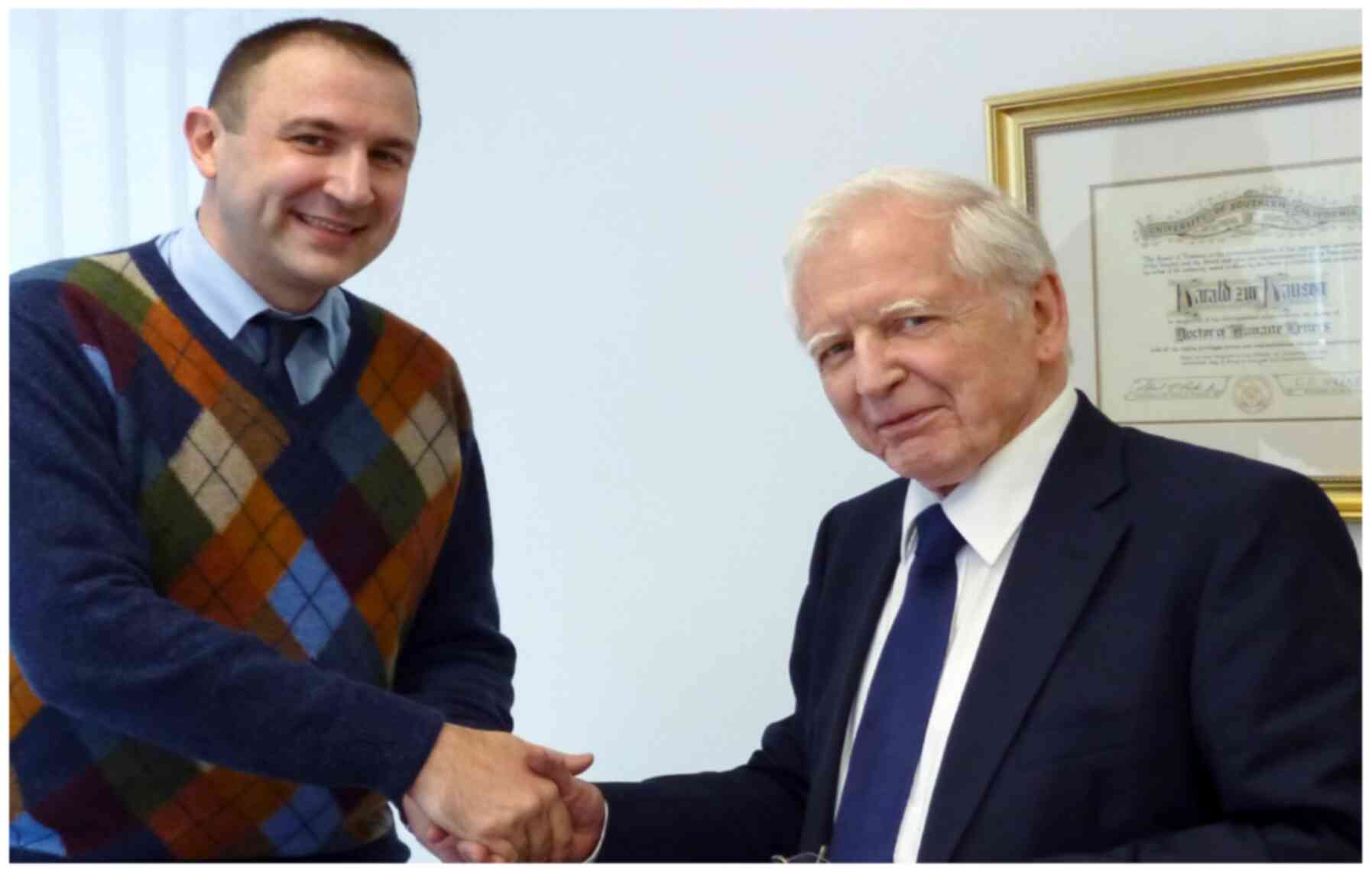
Greece (6). Our meeting in
Heidelberg in 2014 was the crucial point of the PVSG's aim to
initiate the ‘workshops on paediatric virology’, aiming to bring
together paediatric trainees and paediatricians with virologists
(Fig. 1). In October, 2017, his
clear messages in the context of the ‘3rd workshop on paediatric
virology’ on the role of human breast milk feeding in the
prevention of viral infections, as well as the necessity of male
vaccination against HPV, highlighted the great significance of his
outstanding contribution to the constantly growing educational
challenge of paediatric virology (7-9).
In September, 2018, PVSG had the opportunity to discuss the future
of medical education in paediatric virology with him. All these
years, our scientific efforts have been based on his high-level
scientific ideals related to evidence based-medicine, dedication
and humanitarianism. Professor Harald zur Hausen has received the
‘2016 George N. Papanicolaou Humanitarian Award’ and the ‘2017
Paediatric Virology Award’ for his humanitarianism and his
outstanding academic, clinical, research and publishing
contribution to medicine and paediatric virology.
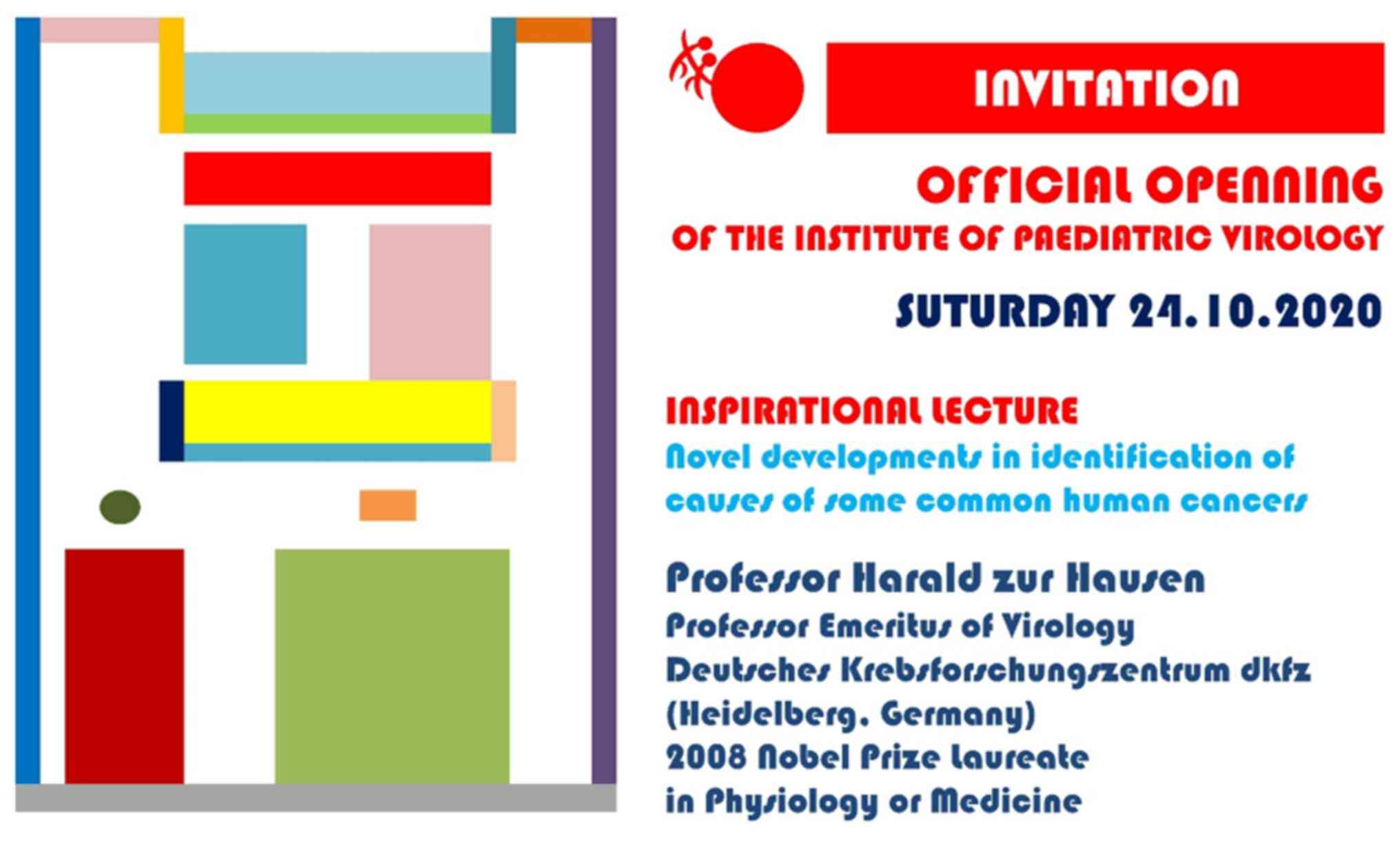
In the context of the forthcoming official opening
of the Institute of Paediatric Virology Professor Harald zur
Hausen's inspirational lecture will focus on ‘novel developments in
identification of causes of some common cancers’ (Fig. 2).
Acknowledgements
This article is published in the context of the
foundation of the Institute of Paediatric Virology (IPV; https://paediatricvirology.org) based on the
island of Euboea (Greece), under the auspices of the World Academy
of Sciences (WAS) and the support of the Department of Clinical
Virology of the University of Crete School of Medicine and the
First Department of Paediatrics of the University of Athens School
of Medicine. We would like to thank all the members of the IPV for
their valuable comments and corrections.
Funding
No funding was received.
Availability of data and materials
Not applicable.
Authors' contributions
All authors (INM, CK, AP and DAS) contributed
equally to the conception and design of this manuscript, wrote the
original draft, edited and critically revised the manuscript, read
and approved the final manuscript.
Ethics approval and consent to
participate
Not applicable.
Patient consent for publication
Not applicable.
Competing interests
INM and DAS are Co-founders of the Institute of
Paediatric Virology (IPV). CK and AP declare that they have no
competing interests. DAS is the Editor-in-Chief for the journal,
but had no personal involvement in the reviewing process, or any
influence in terms of adjudicating on the final decision, for this
article.
References
|
1
|
Lountemis M: A child is counting the
stars. Dorikos, Athens, 1956 (In Greek).
|
|
2
|
Magkoutas I: Folklore from the village
Theologos in the island of Euboea. Third Part. Arch Euboean Stud.
36:207–234. 2005-2006.
|
|
3
|
Zacharioudakis F: Precautions and
superstitions over the years in Crete. Cretan Magazine, 2017.
urihttp://www.cretanmagazine.grsimplewww.cretanmagazine.gr.
|
|
4
|
Pfister H and zur Hausen H:
Seroepidemiological studies of human papilloma virus (HPV-1)
infections. Int J Cancer. 21:161–165. 1978.PubMed/NCBI View Article : Google Scholar
|
|
5
|
zur Hausen H: Papillomaviruses and cancer:
From basic studies to clinical application. Nat Rev Cancer.
2:342–350. 2002.PubMed/NCBI View
Article : Google Scholar
|
|
6
|
Mammas IN, Greenough A, Theodoridou M and
Spandidos DA: The foundation of the Institute of Paediatric
Virology on the island of Euboea, Greece (Review). Exp Ther Med (In
Press).
|
|
7
|
Mammas IN and Spandidos DA: Athens-based
meeting to discuss the paediatric virology crossroad in October
2017. Acta Paediatr. 106(1536)2017.PubMed/NCBI View Article : Google Scholar
|
|
8
|
Mammas IN and Spandidos DA: Paediatric
Virology as a new educational initiative: An interview with
Nobelist Professor of Virology Harald zur Hausen. Exp Ther Med.
14:3329–3331. 2017.PubMed/NCBI View Article : Google Scholar
|
|
9
|
zur Hausen H, Mammas IN and Spandidos DA:
HPV vaccination in boys: Determining the clinical relevance of this
strategy. Exp Ther Med. 14:3327–3328. 2017.PubMed/NCBI View Article : Google Scholar
|