Introduction
C-reactive protein (CRP), which is an acute-phase
protein is mainly synthesized in the liver and serves important
roles in cardiovascular diseases (1-3).
Over the past several decades, several studies have found that CRP
may be an important risk factor for a number of cardiovascular
diseases, such as coronary heart disease (CHD), dilated
cardiomyopathy and atrial fibrillation (AF) (1,4). A
high-sensitivity hsCRP level >3 mg/l was independently
associated with a 60% excess risk in incident CHD as compared with
levels <1 mg/l (Relative Risk, 1.60; 95% confidence interval,
1.43-1.78) after adjustment for all Framingham risk variables
(5). One study on atrial
fibrillation found that baseline CRP levels were significantly
associated with the prevalence of AF and the risk of AF in Korean
populations (6). Similarly, Kazumi
et al (7) revealed a close
association of CRP and correct QT interval in a cohort of 174 young
healthy men from Japan. A number of studies have demonstrated that
high CRP levels was closely associated with ventricular arrhythmia
(8,9), and it has also been found that a
higher CRP level increased ventricular ectopic activity in subjects
without cardiovascular diseases (10). In addition, a positive association
between higher serum hs-CRP level and the occurrence of ventricular
arrhythmias was found in a prospective cohort study on implantable
cardioverter defibrillator recipients (11). Additionally, higher CRP levels
increasing the risk of ventricular arrhythmia has been previously
described in the literature (12-14);
however, the mechanisms underlying this association remain unclear.
In a population-based sample, Vianello et al (15) found a negative association between
CRP level and serum calcium concentration, suggesting that calcium
homeostasis imbalance induced by CRP may contribute to
arrhythmia.
The Na+/Ca2+exchanger 1 (NCX1)
is a critical protein involved in intracellular calcium regulation
in cardiomyocytes. It maintains the balance of Ca2+ flux
across the sarcolemma membrane in excitation-contraction coupling
(16). The exchanger catalyzes the
electrogenic exchange of Ca2+ and Na+ across
the membrane in either the Ca2+ influx or
Ca2+ efflux mode (16).
NCX1 transports ~28% of the cytosolic Ca2+ during a
contraction-relaxation cycle in the human heart (16). Any alteration in the activities
associated with the complex process may cause a corresponding
change in the amount of Ca2+ flux, resulting in early
afterdepolarization and arrhythmia (17,18).
Hence, calcium imbalance has been identified as a treatment target
to manage arrhythmia in the clinical setting.
Although higher CRP levels can increase the risk of
cardiac arrhythmia, the mechanisms involved in are not clear. The
present study aimed to evaluate the effects of CRP on NCX1 and
intracellular calcium concentration in cardiomyocytes and explore
the potential underlying mechanism. It is hoped that this would
assist in the development of anti-inflammatory therapies for
patients with heart disease and infection.
Materials and methods
Animal ethics
A total of 200 neonatal (1-2 days) C57BL/6J mice,
weighing 1.8±0.32 g, were used in this investigation and this was
approved by the Institutional Animal Care and Use Committee of Sun
Yat-sen Memorial Hospital of Sun Yan-Sen University (approval no.
175). Animal use and care were in accordance with the animal care
guidelines, which conformed to the Guide for the Care and Use of
Laboratory Animals published by the US National Institutes of
Health (NIH publication no. 85-23; revised 1996) (19). All animals were purchased from The
Animal Research Center Of Sun Yat-Sen University. Mice were housed
under a temperature at 22˚C and the humidity at 50-60% with 12-h
light/dark cycle and had free access to rodent chow and tap
water.
Culturing of neonatal mice
cardiomyocytes
Cardiac myocytes were prepared from the ventricles
of 1-2 day old C57BL/6J mice as described by a previous study
(18). Briefly, neonatal mice were
anesthetized with isoflurane intermittently; the induction and
maintenance dose of isoflurane were 5 and 1%, respectively, and the
hearts were extracted after cervical dislocation was performed
under anesthesia. The atrial and vascular tissues were removed and
the ventricles were enzymatically digested in 0.125% trypsin
(Gibco; Thermo Fisher Scientific Inc.) for 5 min in 37˚C, followed
by 0.06% collagenase II (MP Biomedicals, LLC) for 2 h in a
thermostat shaker at 37˚C and a speed of 62 rpm. The supernatant
was collected and the resuspended digested cardiac tissues was
centrifuged at 0.5 x g for 5 min in 4˚C. The pellet containing the
cells was collected and resuspended with Dulbecco's Modified Eagle
medium/Ham's F-12 medium (DMEM/F12) containing 10% fetal bovine
serum (FBS) and 100 U/ml penicillin/ streptomycin (all Thermo
Fisher Scientific, Inc.). The cells were plated in tissue culture
dishes and maintained at 37˚C in a 5% CO2 incubator for
30-35 min to remove non-myocytes. The supernatants were transferred
to new culture dishes and cultured in DMEM/F12 with 10% FBS, 100
U/ml penicillin/streptomycin and 1% 5-Bromo-2'-deoxyuridine (BrdU;
Sigma-Aldrich; Merck KGaA) at 37˚C which could inhibit the growth
of non-myocardial cell (20-22).
Cell viability assay
Cell viability was assessed using the MTS assay.
Cardiomyocytes seeded in 96-well plates (5x10³
cells/well) were incubated with CRP (0, 5, 10, 20, 40 and 100
µg/ml) for 24, 48 and 72 h. MTS (20 µl) was added into each well
and co-cultured for 4 h. The absorbance at 490 nm measured by the
microplate reader presented the cell viability (23).
Treatment with human CRP
Following incubation for 24 h in DMEM/F12 with 10%
fetal bovine serum and 100 U/ml penicillin/streptomycin, the
cardiomyocytes were maintained in serum-free DMEM/F12 for 24 h in
37˚C and then treated with human recombinant CRP (purity, >98%;
Merck KGaA). CRP purity was confirmed by 12% SDS-PAGE. The
endotoxin level as 0.0005 EU/µg for CRP preparation was determined
by the Limulus amebocyte lysate assay (Pyrotell®-T; cat.
no. T0051; Associates of Cape Cod, Inc.). The cardiomyocytes were
cultured with PBS and CRP at clinically relevant concentrations at
5, 10, 20, 30 and 40 µg/ml for 24 h in 37˚C. The NF-κB specific
inhibitor PDTC (10 µM; Sigma-Aldrich; Merck KGaA) was added to
cells for 1 h prior to being stimulated with CRP (40 µg/ml) for 24
h at 37˚C (20). The NF-κB pathway
was tested at 0, 10, 30 and 60 min after CRP stimulation with the
cardiomyocytes (24,25).
Reverse transcription-quantitative
(RT-q) PCR
Total RNA was extracted from cardiomyocytes by
RNAiso plus (Takara Bio, Inc.) and reverse transcribed (RT) to cDNA
at 37˚C for 15 min and 85˚C for 5 sec using the
PrimeScript™ RT Master Mix (Perfect Real Time; cat. no.
RR036B; Takara Bio, Inc.). Quantification of NCX1 transcript levels
was performed by amplification of cDNA prepared from the isolated
RNA with the TB Green® Premix Ex Taq™ (Tli
RNase H Plus; cat. no. RR420A; Takara Bio, Inc.) and primers
specific for NCX1 (forward 5'-AGGCCAGAAATAGGAGCCATC-3' and reverse,
5'-AGTGTGCCTGTCCCCCTAAA-3'); and glyceraldehyde-3-phosphate
dehydrogenase (GAPDH) as the internal control (forward,
5'-TGTGTCCGTCGTGGATCTGA-3' and reverse,
5'-TTGCTGTTGAAGTCGCAGGAG-3'). The thermocycling conditions were:
Pre-denaturation at 95˚C for 5 min, followed by 40 cycles of 95˚C
for 5 sec, annealing at 62˚C for 25 sec and extension at 72˚C for
20 sec. Results were presented as fold difference for each gene
against GAPDH by use of 2-ΔΔCq method (26). Melting curves were used to confirm
that only a single product was present.
Western blotting
Total proteins were extracted from cultured
cardiomyocytes using RIPA lysis buffer (Cell Signaling Technology
Inc.), and protein concentration was measured with a bicinchoninic
acid protein assay kit. Protein samples (25-100 µg) were separated
on 10-13% SDS-PAGE gels and transferred onto 0.22-µm PVDF
membranes. After blocking with 5% non-fat skimmed milk at room
temperature for 1 h, the membranes were incubated overnight at 4˚C
with primary antibodies (all Abcam) to NCX1 (cat. no. ab177952,
1:1,000), NF-κB (cat. no. ab32536,1:2,000) and inhibitor of NF-κBα
(IκBα; cat. no. ab32518; 1:2,000) and GAPDH (cat. no. 5174; 1,1000;
Cell Signaling Technology Inc.). After washing 5 times with TBST
which include 2% tween-20 (5 min washes each), the membranes were
incubated with a horseradish peroxidase (HRP)-conjugated secondary
antibody (cat. no. 98164; goat anti-rabbit IgG; 1:5,000; Cell
signaling technology, Inc.) for 1 h at room temperature. Membranes
were developed using the Immobilon™ Western
Chemiluminescent HRP substrate (EMD Millipore) and visualized using
the Gel Documentation and Analysis System (G-Box; Syngene, Europe).
Band intensities were quantified by scanning densitometry and the
densitometry ratios of the target proteins to GAPDH were determined
by Image J software (National Institutes of Health).
Measurement of intracellular calcium
[Ca2+]in by flow cytometry
KB-R7943 (Sigma-Aldrich; Merck KGaA), a selective
inhibitor for the reverse mode of NCX1, was co-cultured with CRP
for 24 h at 37˚C before the intracellular calcium concentration was
measured by flow cytometry (27-29).
To validate the effects of CRP on [Ca2+]in in
myocytes, flow cytometry was used. For
[Ca2+]in measurement, CRP-treated neonatal
ventricular myocytes were cultured for 24 h in 6-well plates at a
density of 1-1.5x10⁶ cells/well in 37˚C and loaded with
the selective fluorescent probe fluo-4/AM (5 µM; Thermo Fisher
Scientific Inc.) for 45 min in 37˚C. The cells were washed twice
with cold PBS without Ca2+ and Mg2+, treated
with trypsin without EGTA, washed twice with cold PBS and
re-suspended in 500 µl cold PBS. Cells were then exposed to 2 mM
extracellular Ca2+ at room temperature for 2 min and
analyzed immediately by the BD FACS Aria Cell Sorter (BD
Biosciences) with excitation and emission wavelengths of 488 nm and
525 nm, respectively. Data was collected from ~1x10⁶
labeled cells for each analysis and expressed as the median
fluorescence intensity after averaging values from ≥ three
independent experiments. The software used to process flow data was
Flow Jo, Cell Quest v.7.6.1 (BD Biosciences).
Statistical analysis
Data were expressed as mean ± SEM. All analyses were
performed using SPSS 21.0 statistical software (IBM Corp.). Each
experiment was performed three times. Differences between control
and experimental groups were analyzed by one-way analysis of
variance (ANOVA) followed by the Tukey's test. P<0.05 was
considered to indicate a statistically significant difference.
Results
CRP upregulates NCX1 expression in
cardiomyocytes
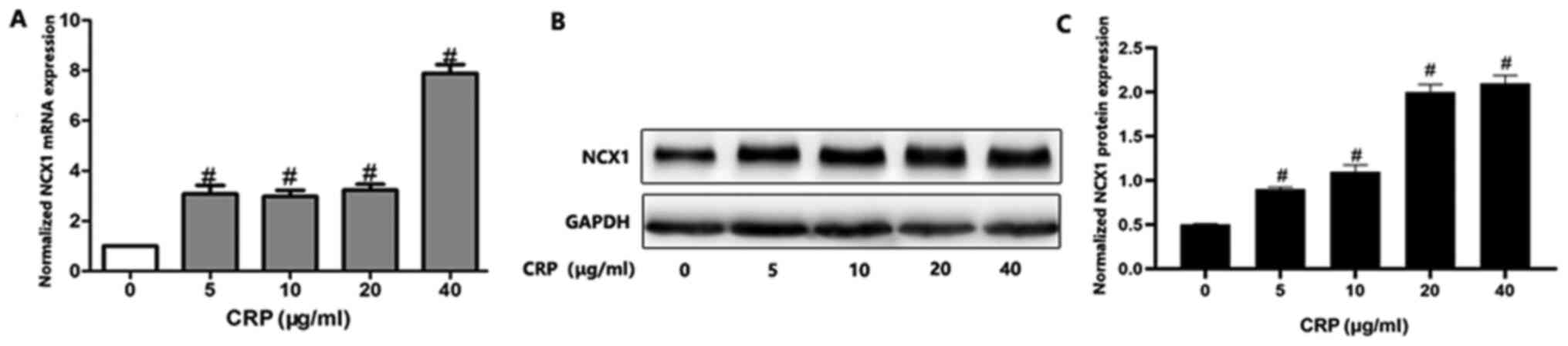
RT-qPCR and western blotting were used to elucidate
the effects of CRP on NCX1 in cardiomyocytes, cells were
serum-deprived for 24 h and treated with different concentrations
of CRP (0, 5, 10, 20 and 40 µg/ml) for 24 h in 37˚C. The cell
lysates were collected for the analysis of NCX1 mRNA and protein
expression, which were performed by RT-qPCR and western blotting,
respectively. CRP treatment increased the mRNA and protein
expression of NCX1 in cardiomyocytes compared with those in the
control group (no CRP stimulation group), especially in the
concentration of 40 µg/ml (Fig.
1).
NF-κB pathway is involved in
CRP-induced upregulation of NCX1 expression in cardiomyocytes
It was previously demonstrated that the NF-κB
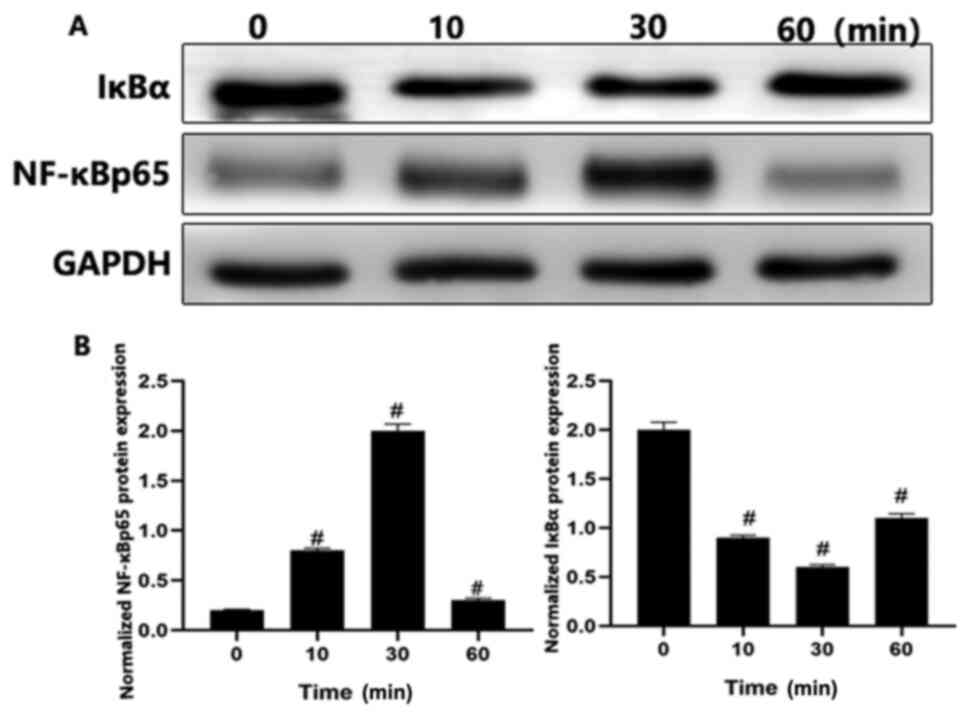
pathway can regulate the expression of NCX1 in the heart (30). There was a significant increase in
NF-κB protein expression and reduced expression of IκBα following
CRP stimulation compared with those in the 0 min group in
cardiomyocytes (Fig. 2). In
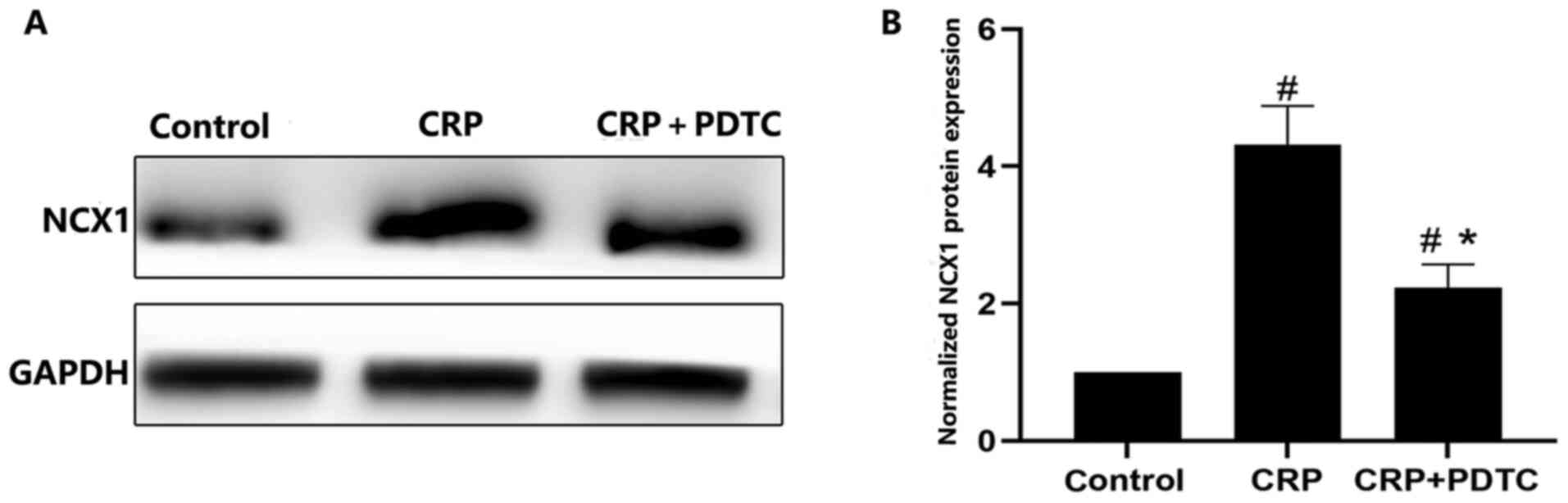
addition, the NF-κB pathway specific inhibitor PDTC attenuated the
upregulation effect of CRP on NCX1 expression compared with the CRP
and control groups (Fig. 3).
Effects of CRP on intracellular
calcium concentration [Ca2+]in of
cardiomyocytes
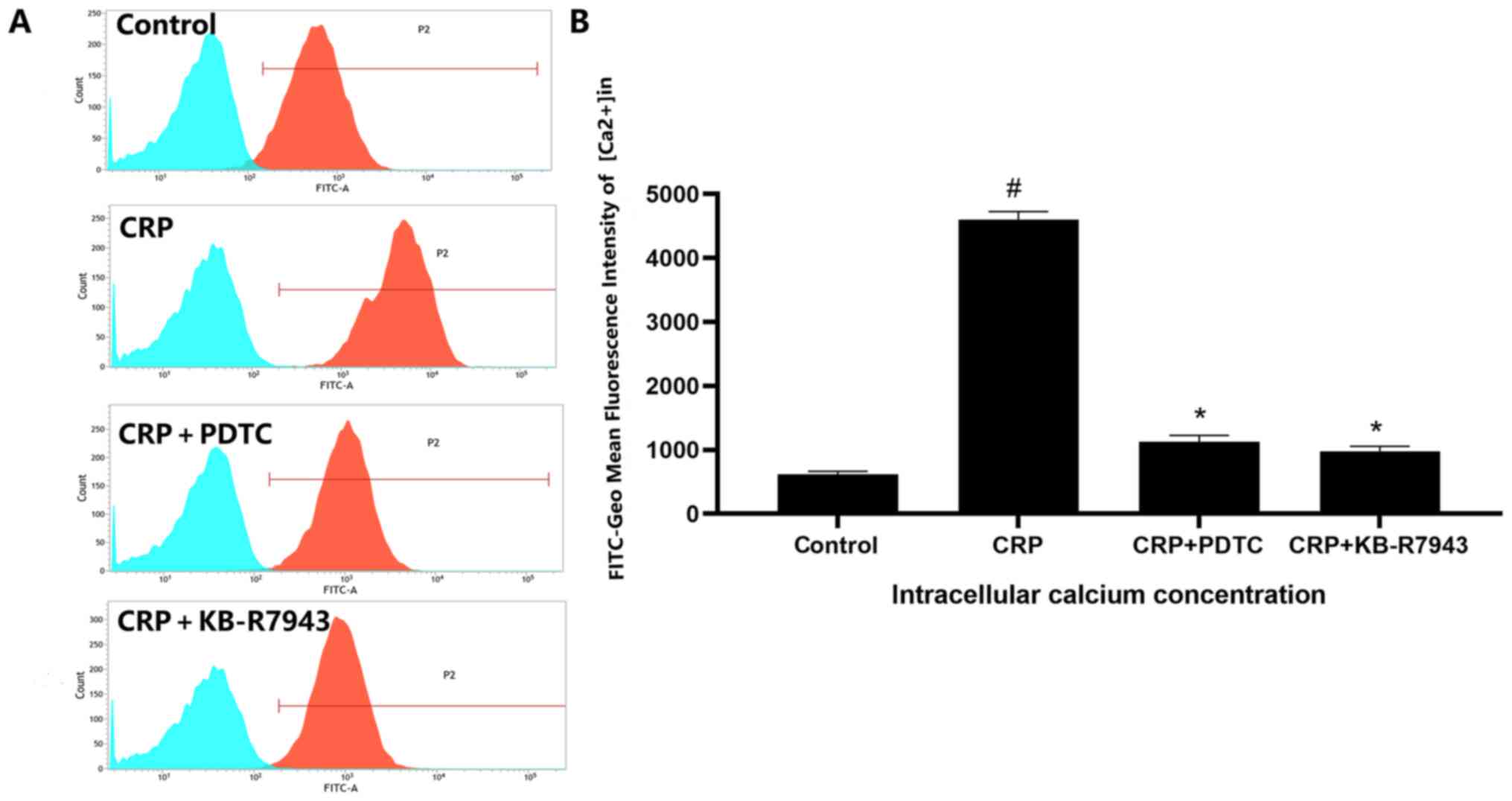
Based on the aforementioned results, the cytoplasmic
calcium fluorescence intensity was evaluated in myocytes treated
with CRP (40 µg/ml) for 24 h using Fluo 4-AM dye.
[Ca2+]in fluorescence intensity in cells
treated with CRP was markedly increased compared with the control
group (Fig. 4). KB-R7943 (5 mM), a
selective inhibitor for the reverse mode of NCX1 (27,29,31),
inhibited the CRP-induced [Ca2+]in overload
in myocytes (Fig. 4). In addition,
the NF-κB inhibitor PDTC also attenuated the effect of CRP on
[Ca2+]in compared with that in the CRP group
(Fig. 4).
Discussion
The present study, demonstrated that CRP exposure
increased the expression of NCX1 and the calcium concentration of
[Ca2+]in in cardiomycocytes via the NF-κB
pathway. The findings of the present study suggested a mechanism by
which CRP and calcium may be associated with cardiac arrhythmia. As
an important inflammatory marker, several studies have demonstrated
that CRP levels are associated with cardiac arrhythmia. For
example, Kobayashi et al (32) demonstrated that an elevated CRP
level was associated with the electrical storm in a patient with
acute myocardial infarction. In addition, a study by Nortamo et
al (33) also demonstrated a
positive association between CRP levels and new-onset AF in
patients with CHD, however the underlying mechanisms for this
remain poorly understood. The findings of the present study
suggested that higher [Ca2+]in induced by CRP
may serve an important role in this process.
It has been established that abnormal calcium
regulation contributes not only to contractile dysfunction, but
also to the development of malignant arrhythmias in heart diseases
and that NCX1 serves an important role during these processes
(34,35). One possible mechanism that has been
suggested is that the elevated cytosolic calcium (calcium overload)
can lead to oscillations in membrane potential to induce delayed
afterdepolarizations and if these are of sufficient magnitude and
reach above the threshold, extrasystoles can be triggered (32). In addition, these
afterdepolarizations have been shown to result primarily from an
inward current associated with the activation of the reverse mode
of NCX1(36). Upregulation of NCX1,
particularly in the setting of elevated cytosolic calcium as would
occur during myocardial ischemia, is arrhythmogenic (37,38).
In agreement with the present study, a previous study have reported
both increased NCX1 expression (protein and/or mRNA) and increased
lethal arrhythmia development (triggered by delayed
afterdepolarizations) in animal models of heart failure (39). In addition, KB-R7943, a selective
inhibitor for the reverse mode of NCX1(25) and the NF-κB inhibitor PDTC (18) may serve roles in the anti-arrhythmia
in patients with cardiac diseases and inflammation.
It is well-established that NCX1 is an important
player in calcium balance (16). In
the present study, it was observed that CRP upregulated the
expression of NCX1 and increased the
[Ca2+]in, which was significantly attenuated
by NF-κB specific inhibitor PDTC. In addition in the present study,
CRP also increased the expression of NF-κB and decreased the
expression of IκBα, suggesting that CRP-induced changes of NCX1 and
[Ca2+]in, were regulated by the NF-κB
pathway. It was previously reported in our previous study, that CRP
reduced the expression of K+ channel interacting
proteins 2 (KChIP2) in murine cardiomyocytes (23). KChIP2 is a member of the
Ca2+-binding protein, which is only expressed in the
heart and interacts with Kv4.2 or Kv4.3 to form transient outward
currents and participates in the regulation of the early
repolarization and the QTc interval of heart (40). The data presented herein, along with
previous studies, suggested that CRP serves a role in the KChIP2 in
the heart.
CRP has also been demonstrated to mediate
cardiovascular diseases, such as coronary heart disease (41). It has been reported that CRP is
associated with vascular and ventricular remodeling (42). Notably, it has been suggested that
the upregulation of NCX1 and higher [Ca2+]in
were involved in the structural and electronic remodeling of
ventricles in cardiac diseases, such as heart failure and
cardiomyopathy (43). Hence, the
results from the present study suggested that CRP may be a risk
factor of arrhythmia due to the myocardial remolding and electronic
remodeling. However, a limitation of the present study is a lack of
in vivo experiments.
In conclusion, the present study demonstrated that
CRP increases NCX1 expression and [Ca2+]in in
cardiomyocytes and that the NF-κB pathway is involved in the
regulation process. The findings of the present study suggested
that CRP can act as a predictor of ventricular arrhythmia due to
the activation of the reverse mode of NCX1 function and
[Ca2+]in increase.
Acknowledgements
Not applicable.
Funding
Funding: This work was supported by the National Natural Science
Foundation of China (grant nos. 81870170, 81870334, 81770229,
81570329, 81970200, 81700215 and 81703098), the Guangdong Province
Natural Science Fund-Vertical collaboration doctor initiative
program (grant no. 2017A030310446) and Science and Technology
Program of Guangdong Province of China (grant no. 2015B010131010),
the Science and Technology Program of Guangzhou City of China
(grant nos. 201803040010 and 201707010206).
Availability of data and materials
The datasets used and/or analyzed during the current
study are available from the corresponding author on reasonable
request.
Authors' contributions
JFW and YXC designed the study. YX cultured the
primary cardiomyocytes and performed the experiments to find the
suitable stimulation concentration of CRP. YX and TCH were
responsible for confirming the raw data authenticity. QL performed
the RT-qPCR and western blotting experiments. HFZ performed the
statistical analysis and drafted the manuscript. TCH, YY, QL, JTM,
ZZW and WLY revised the paper for important intellectual content.
TCH provided advice for this study and collected the experiments
data. YY,MJT, ZZW and WLY participated in the research design. All
authors have read and approved the manuscript.
Ethics approval and consent to
participate
This study was approved by the Institutional Animal
Care and Use Committee of Sun Yat-sen Memorial Hospital of Sun
Yan-Sen University (approval no. 175; Guangzhou, China). Animal use
and care were in accordance with the animal care guidelines, which
conformed to the Guide for the Care and Use of Laboratory Animals
published by the US National Institutes of Health (NIH Publication
No. 85-23, revised 1996).
Patient consent for publication
Not applicable.
Competing interests
The authors declare that they have no competing
interests.
References
|
1
|
Li Y, Zhong X, Cheng G, Zhao C, Zhang L,
Hong Y, Wan Q, He R and Wang Z: Hs-CRP and all-cause,
cardiovascular, and cancer mortality risk: A meta-analysis.
Atherosclerosis. 259:75–82. 2017.PubMed/NCBI View Article : Google Scholar
|
|
2
|
Ghazizadeh H, Rezaei M, Avan A, Fazilati
M, Pasdar A, Tavallaie S, Kazemi E, Seyedi SMR, Ferns GA,
Azimi-Nezhad M and Ghayour-Mobarhan M: Association between serum
cell adhesion molecules with hs-CRP, uric acid and VEGF genetic
polymorphisms in subjects with metabolic syndrome. Mol Biol Rep.
47:867–875. 2020.PubMed/NCBI View Article : Google Scholar
|
|
3
|
Han K, Lu Q, Zhu WJ, Wang TZ, Du Y and Bai
L: Correlations of degree of coronary artery stenosis with blood
lipid, CRP, Hcy, GGT, SCD36 and fibrinogen levels in elderly
patients with coronary heart disease. Eur Rev Med Pharmacol Sci.
23:9582–9589. 2019.PubMed/NCBI View Article : Google Scholar
|
|
4
|
Amorim S, Campelo M, Moura B, Martins E,
Rodrigues J, Barroso I, Faria M, Guimaraes T, Macedo F,
Silva-Cardoso J and Maciel MJ: The role of biomarkers in dilated
cardiomyopathy: Assessment of clinical severity and reverse
remodeling. Rev Port Cardiol. 36:709–716. 2017.PubMed/NCBI View Article : Google Scholar : (In English,
Portuguese).
|
|
5
|
Buckley DI, Fu R, Freeman M, Rogers K and
Helfand M: C-reactive protein as a risk factor for coronary heart
disease: A systematic review and meta-analyses for the U.S.
preventive services task force. Ann Intern Med. 151:483–495.
2009.PubMed/NCBI View Article : Google Scholar
|
|
6
|
Lee Y, Park HC, Shin JH, Lim YH, Shin J
and Park JK: Single and persistent elevation of C-reactive protein
levels and the risk of atrial fibrillation in a general population:
The ansan-ansung cohort of the Korean genome and epidemiology
study. Int J Cardiol. 277:240–246. 2019.PubMed/NCBI View Article : Google Scholar
|
|
7
|
Kazumi T, Kawaguchi A, Hirano T and
Yoshino G: C-reactive protein in young, apparently healthy men:
Associations with serum leptin, QTc interval, and high-density
lipoprotein-cholesterol. Metabolism. 52:1113–1116. 2003.PubMed/NCBI View Article : Google Scholar
|
|
8
|
Hodzic E, Drakovac A and Begic E: Troponin
and CRP as indicators of possible ventricular arrhythmias in
myocardial infarction of the anterior and inferior walls of the
heart. Mater Sociomed. 30:185–188. 2018.PubMed/NCBI View Article : Google Scholar
|
|
9
|
Li C, Jia L, Wang Z, Niu L and An X: The
efficacy of radiofrequency ablation in the treatment of pediatric
arrhythmia and its effects on serum IL-6 and hs-CRP. Exp Ther Med.
14:3563–3568. 2017.PubMed/NCBI View Article : Google Scholar
|
|
10
|
Nagai T, Anzai T, Kaneko H, Anzai A, Mano
Y, Nagatomo Y, Kohsaka S, Maekawa Y, Kawamura A, Yoshikawa T and
Ogawa S: Impact of systemic acidosis on the development of
malignant ventricular arrhythmias after reperfusion therapy for
ST-elevation myocardial infarction. Circ J. 74:1808–1814.
2010.PubMed/NCBI View Article : Google Scholar
|
|
11
|
Wu KC, Gerstenblith G, Guallar E, Marine
JE, Dalal D, Cheng A, Marbán E, Lima JA, Tomaselli GF and Weiss RG:
Combined cardiac magnetic resonance imaging and C-reactive protein
levels identify a cohort at low risk for defibrillator firings and
death. Circ Cardiovasc Imaging. 5:178–186. 2012.PubMed/NCBI View Article : Google Scholar
|
|
12
|
Saxon LA, Bristow MR, Boehmer J, Krueger
S, Kass DA, De Marco T, Carson P, DiCarlo L, Feldman AM, Galle E
and Ecklund F: Predictors of sudden cardiac death and appropriate
shock in the comparison of medical therapy, pacing, and
defibrillation in heart failure (COMPANION) trial. Circulation.
114:2766–2772. 2006.PubMed/NCBI View Article : Google Scholar
|
|
13
|
Theuns DA, Smith T, Szili-Torok T,
Muskens-Heemskerk A, Janse P and Jordaens L: Prognostic role of
high-sensitivity C-reactive protein and B-type natriuretic peptide
in implantable cardioverter-defibrillator patients. Pacing Clin
Electrophysiol. 35:275–282. 2012.PubMed/NCBI View Article : Google Scholar
|
|
14
|
Streitner F, Kuschyk J, Veltmann C, Ratay
D, Schoene N, Streitner I, Brueckmann M, Schumacher B, Borggrefe M
and Wolpert C: Role of proinflammatory markers and NT-proBNP in
patients with an implantable cardioverter-defibrillator and an
electrical storm. Cytokine. 47:166–172. 2009.PubMed/NCBI View Article : Google Scholar
|
|
15
|
Vianello E, Dozio E, Barassi A, Sammarco
G, Tacchini L, Marrocco-Trischitta MM, Trimarchi S and Corsi
Romanelli MM: A pilot observational study on magnesium and calcium
imbalance in elderly patients with acute aortic dissection. Immun
Ageing. 14(1)2017.PubMed/NCBI View Article : Google Scholar
|
|
16
|
Shattock MJ, Ottolia M, Bers DM, Blaustein
MP, Boguslavskyi A, Bossuyt J, Bridge JH, Chen-Izu Y, Clancy CE,
Edwards A, et al: Na+/Ca2+ exchange and
Na+/K+-ATPase in the heart. J Physiol.
593:1361–1382. 2015.PubMed/NCBI View Article : Google Scholar
|
|
17
|
Hamilton S and Terentyev D: Proarrhythmic
remodeling of calcium homeostasis in cardiac disease; implications
for diabetes and obesity. Front Physiol. 9(1517)2018.PubMed/NCBI View Article : Google Scholar
|
|
18
|
Ma HJ, Li Q, Ma HJ, Guan Y, Shi M, Yang J,
Li DP and Zhang Y: Chronic intermittent hypobaric hypoxia
ameliorates ischemia/reperfusion-induced calcium overload in heart
via Na/Ca2+ exchanger in developing rats. Cell Physiol Biochem.
34:313–324. 2014.PubMed/NCBI View Article : Google Scholar
|
|
19
|
Guide for the Care and Use of Laboratory
Animals published by the US National Institutes of Health, NIH
publication no. 85-23, revised 1996.
|
|
20
|
Battiprolu PK, Hojayev B, Jiang N, Wang
ZV, Luo X, Iglewski M, Shelton JM, Gerard RD, Rothermel BA,
Gillette TG, et al: Metabolic stress-induced activation of FoxO1
triggers diabetic cardiomyopathy in mice. J Clin Invest.
122:1109–1118. 2012.PubMed/NCBI View
Article : Google Scholar
|
|
21
|
Simpson P and Savion S: Differentiation of
rat myocytes in single cell cultures with and without proliferating
nonmyocardial cells. Cross-striations, ultrastructure, and
chronotropic response to isoproterenol. Circ Res. 50:101–116.
1982.PubMed/NCBI View Article : Google Scholar
|
|
22
|
Lokuta A, Kirby MS, Gaa ST, Lederer WJ and
Rogers TB: On establishing primary cultures of neonatal rat
ventricular myocytes for analysis over long periods. J Cardiovasc
Electrophysiol. 5:50–62. 1994.PubMed/NCBI View Article : Google Scholar
|
|
23
|
Xie Y, Mai JT, Wang F, Lin YQ, Yuan WL,
Luo NS, Fang MC, Wang JF and Chen YX: Effects of C-reactive protein
on K(+) channel interaction protein 2 in cardiomyocytes. Am J
Transl Res. 7:922–931. 2015.PubMed/NCBI
|
|
24
|
Li M, Ye J, Zhao G, Hong G, Hu X, Cao K,
Wu Y and Lu Z: Gas6 attenuates lipopolysaccharide-induced TNF-α
expression and apoptosis in H9C2 cells through NF-κB and MAPK
inhibition via the Axl/PI3K/Akt pathway. Int J Mol Med. 44:982–994.
2019.PubMed/NCBI View Article : Google Scholar
|
|
25
|
Martin TP, McCluskey C, Cunningham MR,
Beattie J, Paul A and Currie S: CaMKIIδ interacts directly with
IKKβ and modulates NF-κB signalling in adult cardiac fibroblasts.
Cell Signal. 51:166–175. 2018.PubMed/NCBI View Article : Google Scholar
|
|
26
|
Livak KJ and Schmittgen TD: Analysis of
relative gene expression data using real-time quantitative PCR and
the 2(-Delta Delta C(T)) method. Methods. 25:402–408.
2001.PubMed/NCBI View Article : Google Scholar
|
|
27
|
McElnea EM, Quill B, Docherty NG, Irnaten
M, Siah WF, Clark AF, O'Brien CJ and Wallace DM: Oxidative stress,
mitochondrial dysfunction and calcium overload in human lamina
cribrosa cells from glaucoma donors. Mol Vis. 17:1182–1191.
2011.PubMed/NCBI
|
|
28
|
Shen JB, Yang R, Pappano A and Liang BT:
Cardiac P2X purinergic receptors as a new pathway for increasing
Na+ entry in cardiac myocytes. Am J Physiol Heart Circ
Physiol. 307:H1469–H1477. 2014.PubMed/NCBI View Article : Google Scholar
|
|
29
|
Xie Y, Gu ZJ, Wu MX, Huang TC, Ou JS, Ni
HS, Lin MH, Yuan WL, Wang JF and Chen YX: Disruption of calcium
homeostasis by cardiac-specific over-expression of PPAR-γ in mice:
A role in ventricular arrhythmia. Life Sci. 167:12–21.
2016.PubMed/NCBI View Article : Google Scholar
|
|
30
|
LaRocca TJ, Fabris F, Chen J, Benhayon D,
Zhang S, McCollum L, Schecter AD, Cheung JY, Sobie EA, Hajjar RJ
and Lebeche D: Na+/Ca2+ exchanger-1 protects
against systolic failure in the Akitains2 model of diabetic
cardiomyopathy via a CXCR4/NF-κB pathway. Am J Physiol Heart Circ
Physiol. 303:H353–H367. 2012.PubMed/NCBI View Article : Google Scholar
|
|
31
|
Balasubramaniam SL, Gopalakrishnapillai A,
Gangadharan V, Duncan RL and Barwe SP: Sodium-calcium exchanger 1
regulates epithelial cell migration via calcium-dependent
extracellular signal-regulated kinase signaling. J Biol Chem.
290:12463–12473. 2015.PubMed/NCBI View Article : Google Scholar
|
|
32
|
Kobayashi Y, Tanno K, Ueno A, Fukamizu S,
Murata H, Watanabe N, Sasaki T, Yamamoto T, Takayama M and Nagao K:
In-hospital electrical storm in acute myocardial
infarction-clinical background and mechanism of the electrical
instability. Circ J. 83:91–100. 2018.PubMed/NCBI View Article : Google Scholar
|
|
33
|
Nortamo S, Ukkola O, Lepojärvi S, Kenttä
T, Kiviniemi A, Junttila J, Huikuri H and Perkiömäki J: Association
of sST2 and hs-CRP levels with new-onset atrial fibrillation in
coronary artery disease. Int J Cardiol. 248:173–178.
2017.PubMed/NCBI View Article : Google Scholar
|
|
34
|
Hamilton S and Terentyev D: Altered
intracellular calcium homeostasis and arrhythmogenesis in the aged
heart. Int J Mol Sci. 20(2386)2019.PubMed/NCBI View Article : Google Scholar
|
|
35
|
Davlouros PA, Gkizas V, Vogiatzi C,
Giannopoulos G, Alexopoulos D and Deftereos S: Calcium homeostasis
and kinetics in heart failure. Med Chem. 12:151–161.
2016.PubMed/NCBI View Article : Google Scholar
|
|
36
|
Kim JJ, Němec J, Papp R, Strongin R,
Abramson JJ and Salama G: Bradycardia alters Ca(2+) dynamics
enhancing dispersion of repolarization and arrhythmia risk. Am J
Physiol Heart Circ Physiol. 304:H848–H860. 2013.PubMed/NCBI View Article : Google Scholar
|
|
37
|
Song J, Gao E, Wang J, Zhang XQ, Chan TO,
Koch WJ, Shang X, Joseph JI, Peterson BZ, Feldman AM and Cheung JY:
Constitutive overexpression of phosphomimetic phospholemman S68E
mutant results in arrhythmias, early mortality, and heart failure:
Potential involvement of Na+/Ca2+ exchanger.
Am J Physiol Heart Circ Physiol. 302:H770–H781. 2012.PubMed/NCBI View Article : Google Scholar
|
|
38
|
Javidanpour S, Dianat M, Badavi M and Mard
SA: The inhibitory effect of rosmarinic acid on overexpression of
NCX1 and stretch-induced arrhythmias after acute myocardial
infarction in rats. Biomed Pharmacother. 102:884–893.
2018.PubMed/NCBI View Article : Google Scholar
|
|
39
|
Jordan MC, Henderson SA, Han T, Fishbein
MC, Philipson KD and Roos KP: Myocardial function with reduced
expression of the sodium-calcium exchanger. J Card Fail.
16:786–796. 2010.PubMed/NCBI View Article : Google Scholar
|
|
40
|
Murthy A, Workman SW, Jiang M, Hu J, Sifa
I, Bernas T, Tang W, Deschenes I and Tseng GN: Dynamic
palmitoylation regulates trafficking of K channel interacting
protein 2 (KChIP2) across multiple subcellular compartments in
cardiac myocytes. J Mol Cell Cardiol. 135:1–9. 2019.PubMed/NCBI View Article : Google Scholar
|
|
41
|
Liu J, Yuen J and Kang S: Sleep duration,
C-reactive protein and risk of incident coronary heart
disease-results from the Framingham offspring study. Nutr Metab
Cardiovasc Dis. 24:600–605. 2014.PubMed/NCBI View Article : Google Scholar
|
|
42
|
Anzai T: Inflammatory mechanisms of
cardiovascular remodeling. Circ J. 82:629–635. 2018.PubMed/NCBI View Article : Google Scholar
|
|
43
|
Ujihara Y, Iwasaki K, Takatsu S, Hashimoto
K, Naruse K, Mohri S and Katanosaka Y: Induced NCX1 overexpression
attenuates pressure overload-induced pathological cardiac
remodelling. Cardiovasc Res. 111:348–361. 2016.PubMed/NCBI View Article : Google Scholar
|