Introduction
Cataracts are the leading cause of blindness caused
by the opacification of the lens. A total of ~95 million
individuals are affected by cataracts worldwide (1). According to the etiology, cataracts
can be divided into age-related cataracts, pediatric cataracts and
cataracts secondary to other causes. Age related cataracts is the
most common type in adults (2).
The loss of lens crystal transparency may be associated with an
increase of light scattering or light absorption. It is mainly
affected by two main factors. First, the lens is mainly composed of
fiber cells with inactive metabolism. These cells have a high
concentration of structural protein e crystallin, which is evenly
distributed in the cells. This provides a high refractive index
lens required to focus incident light on the retina. Second, the
lens has no vascular system (3,4); it
supplies nutrients, such as a variety of metabolites, through the
aqueous humor around the lens (5,6). The
drawback of this design is that the crystallins in the lens core do
not turnover (5,6). With age, it accumulates a large
number of post-translational modifications, resulting in protein
insolubility, aggregation and coloring (5,6).
Finally, these processes lead to the formation of insoluble protein
aggregates and the occurrence of age-related nuclear cataracts
(5,6). The long-term integrity of the
crystallin network is provided by metabolites, which are
synthesized in the lens epithelium or enter the lens from the
aqueous humor through the lens epithelium (5,6).
However, the mechanism of metabolite transport in crystals remains
to be elucidated.
Metabonomics is a widely used technology, which is
often used to understand the pathophysiological processes leading
to disease occurrence and progression and to provide molecular
information about disease phenotype (7-9).
In ophthalmic diseases, metabonomics has been successfully used to
determine the metabolic characteristics of diabetic retinopathy
(10). However, few studies have
focused on cataracts. It is reported that the structural component
of the lens is a specific protein in the aqueous humor of cataracts
patients (11,12). The lens does not have its own blood
supply. It is nourished by aqueous humor. Aqueous humor is secreted
by ciliary epithelium and enters the posterior chamber. Then it
flows around the lens, enters the anterior chamber through the
pupil and finally exits through the ciliary sclera. In addition to
proteins, human aqueous humor is also composed of small molecules.
It contains electrolytes, oxygen, carbon dioxide, glucose, urea,
antioxidants, organic solutes, amino acids, fatty acids and lipids
(11,12). The actual composition and level of
small molecules can be considered as the chemical reflection of the
phenotype of a specific biological system. Metabonomics extends our
understanding of the metabolic components of aqueous humor
(13,14). It is often used in disease
diagnosis, new therapeutic targets or prognostic markers (15). However, studies on changes in human
aqueous humor metabolism associated with specific eye diseases are
limited (16).
Materials and methods
Study participants and sample
collection
The present study included 13 participants recruited
between 1 December 2021 and 1 March 2022. All procedures of this
study were in accordance with the tenets of the Declaration of
Helsinki. The current study was approved by the Research Ethics
Committee of the Tong Ren Hospital affiliated with Shanghai Jiao
Tong University School of Medicine, Shanghai, China (approval no.
2021-078-01; 17 November 2021). Samples were collected following
the patients' written informed consent to participate in the study.
The process of collecting aqueous humor is to puncture the anterior
chamber with a 30 g needle and inhale ~50-100 µl aqueous humor,
transferred to Eppendorf tube and stored at -80˚C.
The present study was conducted on aqueous humor
samples from 3 patients with ocular rupture and 20 patients with
cataracts surgery. Aqueous humor was collected after topical
anesthesia with promecaine hydrochloride eye drops. The patients
were divided into three groups: 3 patients with ocular rupture as
the control group, 10 patients with mild age-related cataracts as
the mild group and 10 patients with severe age-related cataracts as
the severe group.
Patients were considered to be mild age-related
cataracts of cataracts if the nuclear opalescence or nuclear color
was < grade 3, the cortical cataracts score was < grade 3 and
the posterior subcapsular cataracts score was < grade 3 in the
affected eye based on the Lens Opacities Classification System
(LOCS) III (17). Patients were
considered to be severe age-related cataracts of cataracts if the
nuclear opalescence or nuclear color was ≥ grade 3, the cortical
cataracts score was ≥ grade 3 and the posterior subcapsular
cataracts score was ≥ grade 3 in the affected eye based on the LOCS
III.
Liquid chromatography-mass
spectrometry (LC-MS) measurements
The sample was slowly thawed on ice and 1.5 ml of
chloroform/methanol (2:1) solution directly added to the sample.
Subsequently, 0.5 ml pure water was added, vortexed for 1 min and
centrifuged (1,006.2 x g, 10 min, 4˚C). The organic phase was
placed into a clean test tube and blown dry with nitrogen.
Following drying, 100 µl isopropanol/methanol (1:1) and 4 µl
internal standard LPC (0.14 mg/ml) were redissolved, vortex mixed
and centrifuged (16,099.2 x g, 10 min, 4˚C). The supernatant was
placed into the injection bottle. Extracted samples were randomly
analyzed by an LC-MS system (Waters Corp.). The chromatographic
separation conditions were as follows: Column temperature, 40˚C;
flow rate, 0.3 ml/min; injection volume, 1 µl (positive mode) and 3
µl (negative mode); and autosampler temperature, 4˚C. The detection
parameters of mass spectrometry were divided into ESI+ and ESI-.
ESI+: Heater temperature, 300˚C; sheath gas flow rate, 45 arb; aux
gas flow rate, 15 arb; sweep gas flow rate, 1 arb; spray voltage,
3.0 KV; capillary temperature, 350˚C; S-lens RF level, 30%. ESI-:
Heater temperature, 300˚C; sheath gas flow rate, 45 arb; aux gas
flow rate, 15 arb; sweep gas flow rate, 1 arb; spray voltage, 3.2
KV; capillary temperature, 350˚C; S-lens RF level, 60%.
Statistical analysis
Peak alignment and extraction were performed using
Compound Discoverer software (Thermo Fisher Scientific, Inc.). An
unsupervised model of principal component analysis (PCA) was used
to assess the overall trend of segregation between these samples. A
supervised model of orthogonal projections to latent
structures-discriminate analysis (OPLS-DA) was used to screen for
significantly different metabolites between the groups. In order to
improve the analysis, the variable importance in the projection
(VIP) was obtained. VIP values >1 were first selected as changed
metabolites. In addition, at a critical P-value of 0.05, these
selected metabolites were further verified using two sided
student's t-test. The area under the receiver operating
characteristic curve (AUC) was calculated to evaluate the
recognition ability of each metabolite marker. The pathways of
metabolites was performed using the Kyoto Encyclopedia of Genes and
Genomes (KEGG; http://www.genome.jp/kegg/) and MetaboAnalyst
(http://www.metaboanalyst.ca/) (18,19).
P<0.05 was considered to indicate a statistically significant
difference.
Results
Characteristics of the
participants
A total of three groups of patients underwent
surgery and provided written informed consent to obtain aqueous
humor samples for research purposes. All participants had no
systemic diseases such as hypertension and diabetes. The average
age of the control group was 40.67 years (range, 34-42 years), the
average age of patients with mild cataracts was 70 years (range,
60-79 years) and the average age of patients with severe cataracts
was 75.90 years (range, 66-87 years). In the control group, females
accounted for 33 and 67% of the study samples, respectively;
females in the mild cataracts group accounted for 20 and 80% of the
study samples, respectively; females in the severe cataracts group
accounted for 50 and 60% of the study samples, respectively. None
of the participants was administered any preoperative drugs.
Aqueous humor metabolic profiles
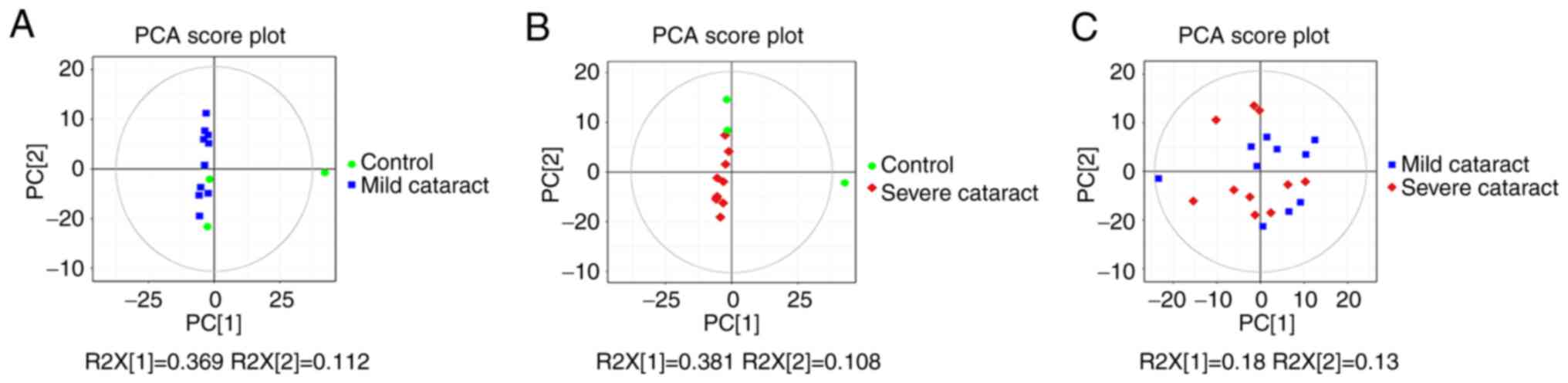
The results of the PCA (Fig. 1) showed one sample was separated in
the control group and the other samples were closely clustered. The
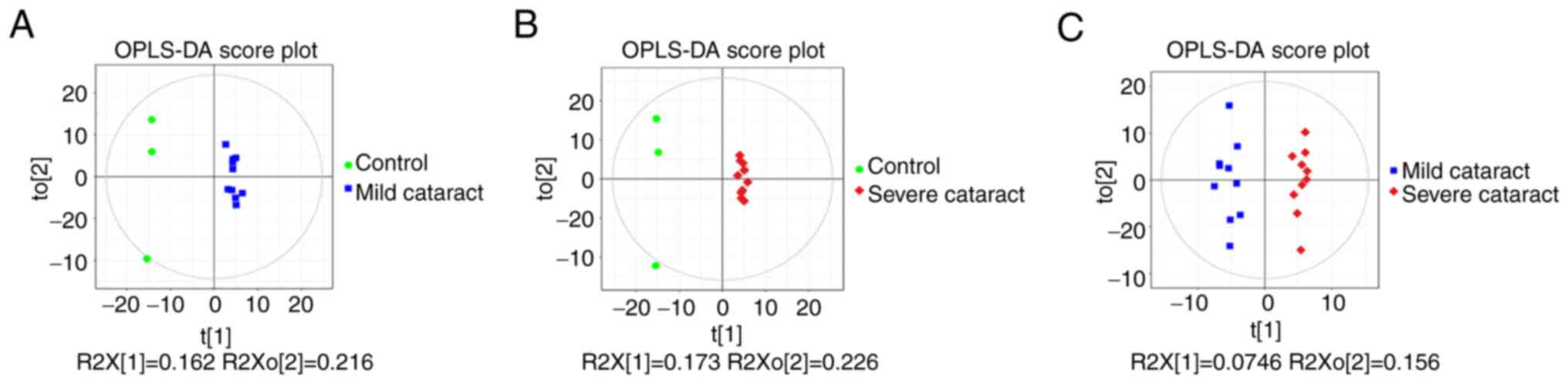
supervised OPLS-DA model was established to understand the holistic
metabolic differences among the three groups. As shown in the
OPLS-DA score plot, good separation between cataracts patients and
controls could be achieved (Fig.
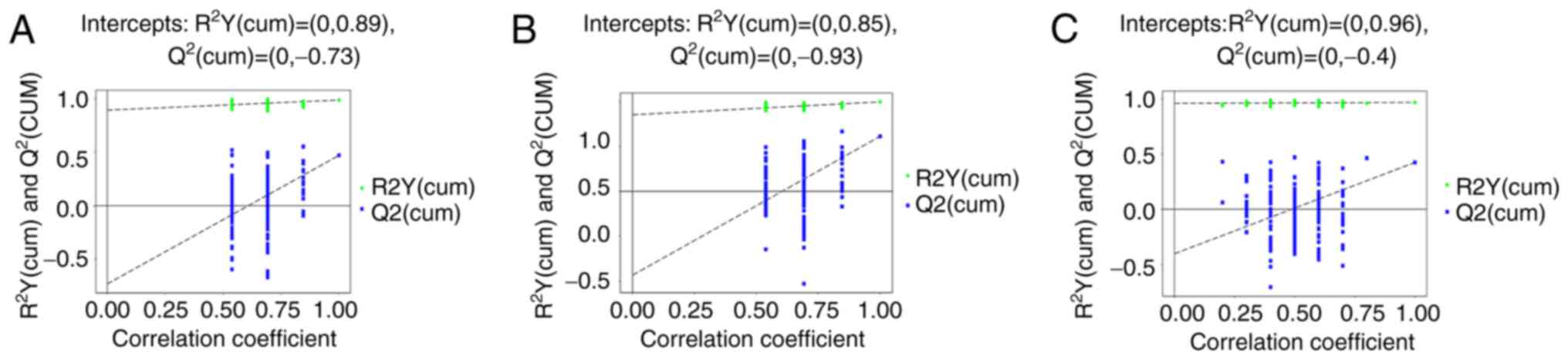
2). The validation plot strongly supported the validity of the
model, as all permuted R2 and Q2 values on the left were lower than
the original points on the right (Fig.
3).
Identification of potential
biomarkers
Following the successful establishment of the
OPLS-DA model, potential metabolic biomarkers were selected using
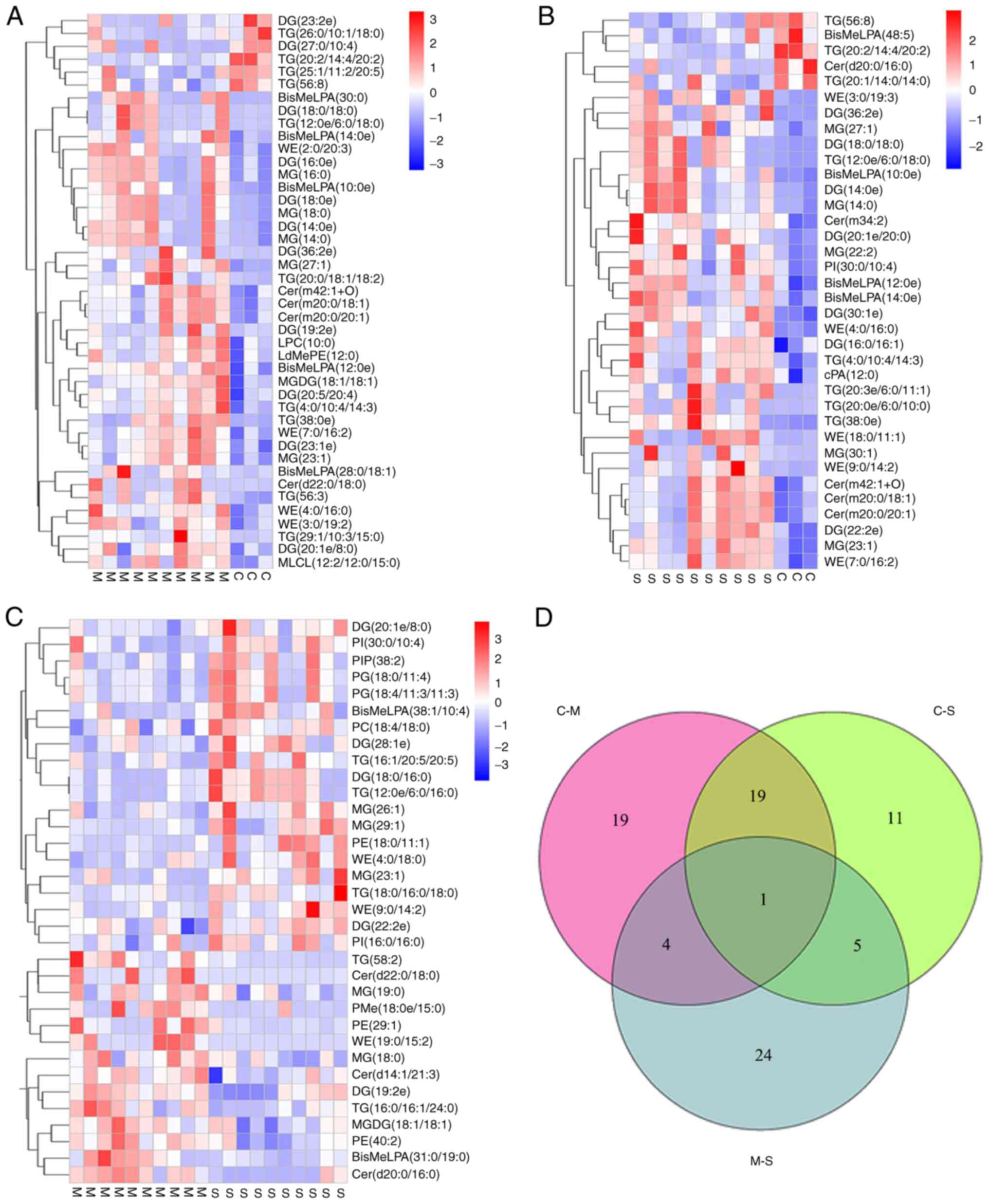
the criteria of VIP >1.0 and P<0.05. Finally, 43 metabolites
were successfully selected and identified as potential biomarkers
of mild age-related cataracts compared with controls. Compared with
controls, six metabolites were found to be decreased in those with
mild age-related cataracts. By contrast, 37 metabolites were found
to be increased in participants with mild age-related cataracts
compared with controls (Fig. 4A).
A total of 36 metabolites were successfully selected and identified
as potential biomarkers of severe age-related cataracts compared
with controls. Compared with controls, five metabolites were found
to be decreased in those with mild age-related cataracts. By
contrast, 31 metabolites were found to be increased in participants
with severe age-related cataracts compared with controls (Fig. 4B). A total of 34 metabolites were
successfully selected and identified as potential biomarkers of
mild age-related cataracts compared with severe age-related
cataracts. Compared with controls, 20 metabolites were found to be
decreased in those with mild age-related cataracts. By contrast, 14
metabolites were found to be increased in participants with mild
age-related cataracts compared with severe age-related cataracts
(Fig. 4C). Among them, diglyceride
(DG; 20:1e/8:0) metabolite were commonly expressed differently in
the three groups. In severe and mild cataracts, DG(20:1e/8:0)
increased compared with the control group; The expression of
DG(20:1e/8:0) was further increased in severe cataracts compared
with mild cataracts (Fig. 4D). The
chromatography spectra of each sample is shown in Data S1 and the information of each
sample is shown in Data S2.
Pathway analysis for potential
biomarkers
Pathway analysis, including enrichment analysis and
pathway topology analysis, was further performed to understand the
metabolic pathways in which these potential biomarkers were
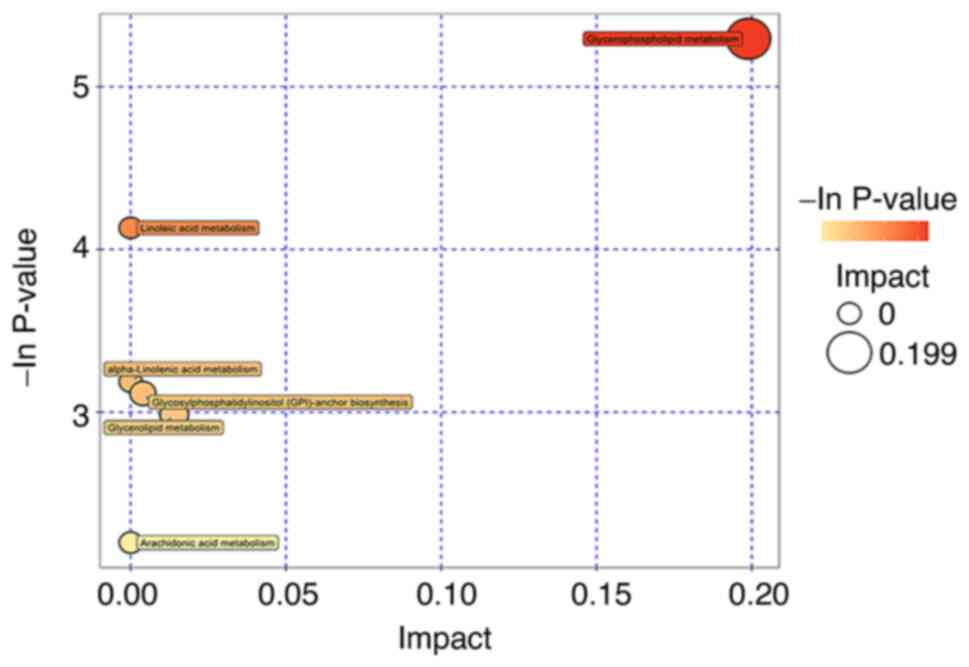
involved. A total of five pathways were significantly enriched at
the significance level of 0.10, namely glycerophospholipid
metabolism; linoleic acid metabolism; α-linolenic acid metabolism;
glycosylphosphatidylinositol (GPI)-anchor biosynthesis; and
glycerolipid metabolism (Fig. 5).
In particular, the glycerophospholipid metabolism was highly
affected, implying that these metabolic markers serve important
roles in the regulation of this pathway.
Discussion
In clinical practice, the pathogenesis of cataracts
remains to be elucidated. Therefore, there is an urgent need for
in-depth understanding. The present study systematically
investigated the metabolic differences in aqueous humor samples
from patients with cataracts of different severity and control
group. It identified 34 metabolites as possible biomarkers in
aqueous humor samples between patients with different degrees of
cataracts, 36 metabolites as possible biomarkers in aqueous humor
samples between patients with severe cataracts and control group
and 43 metabolites as possible biomarkers in aqueous humor samples
between patients with mild cataracts and control group. They may
distinguish patients with different degrees of cataracts from the
control group. DG (20:1e/8:0) metabolite was differentially
expressed in the three groups and the expression level of DG
(20:1e/8:0) metabolite increased with the increase of cataracts
severity, indicating that DG (20:1e/8:0) metabolite has marked
significance in cataracts and classification. The identification of
new metabolite markers in human cataracts aqueous humor provided
insights into the potential new pathogenic pathway of this
vision-threatening disease and may lead to new drug development and
research routes.
Studies have shown that myo-Inositol is the most
abundant lens metabolite, which mainly serves a role in maintaining
cell osmotic pressure in human lens; antioxidants (the main lens
antioxidant GSH, ergotathione and homocarnosine) protect the lens
from oxidative stress. Nucleotides NADH, AMP and ADP serve an
important role in redox reaction and participate in energy
metabolism (5,20,21).
One study found that the levels of glycosylated metabolites in
aqueous humor samples of the control group increased compared with
aqueous humor samples of cataracts (22). Most of these metabolites are
synthesized in lens epithelial cells with active metabolism. They
serve a crucial role in normal lens function (22). The present study found that
bis-methyl lysophosphatidic acid, ceramides, DG, monoglyceride,
triglyceride and wax esters metabolites were differentially
expressed in aqueous humor samples of patients with different
degrees of cataracts and control group. Public databases such as
KEGG and MetaboAnalyst and other published studies were also
searched, to attempt to find possible metabolic pathways for
cataracts observed in the present study (18,19).
In the process of cell physiology,
glycerolphospholipids form phospholipid bilayers, which are active
participants in affecting the properties of membrane related
proteins and precursors of important cell components (23). Glycerolphospholipids are the most
common and abundant phospholipids in human body (23). The two hydroxyl groups of glycerol
and fatty acids are converted into esters and the third hydroxyl
group is phosphorylated to form phosphatidylic acid (23). They are a series of key compounds
that constitute the structure of cell membrane and participate in a
number of biological regulation processes (23). Studies have indicated that glycerol
phospholipids are involved in the pathogenesis of asthma (24,25).
Other studies have shown that there are significant changes in the
metabolism of glycerophospholipid in the plasma of patients with
psoriasis (26,27). The present study found that
glycerophospholipid metabolism was highly affected in the pathway
analysis, implying that glycerophospholipid may serve major roles
in cataracts pathophysiology.
The present study had some limitations. First, the
main deficiency was the small sample size, which may prevent
significant changes in some metabolites. In the future, the authors
will continue to collect a large number of samples for further
research. In addition, the control group was patients with ocular
rupture surgery, rather than ‘healthy’ individuals, which may
distort the results of the present study. If possible, it would be
ideal to obtain aqueous humor samples from healthy individuals with
non-ophthalmic diseases. Moreover, the difference of some
metabolites between the control group and the cataracts group was
not clear. It may be that the database of biomarkers of aqueous
humor metabolism is not sufficiently accurate, or that the samples
were heterogeneous. It is hoped to further explore this in the
future. Finally, there is a difference in the age of patients
between the control group and the experimental group, which may
cause errors in the experimental results. This too will be further
discussed in the future.
The present study investigated metabolic markers
associated with cataracts patients in human aqueous humor samples.
The results showed that 34 metabolites were identified as potential
biomarkers, able to distinguish patients with different degrees of
cataracts; 36 metabolites were identified as potential biomarkers
that could distinguish patients with severe cataracts from the
control group; 34 metabolites were identified as potential
biomarkers that could distinguish patients with mild cataracts from
controls. Glycerolphospholipid metabolism was highly affected in
pathway analysis and may serve an important role in the regulation
of this pathway. Overall, the present study provided new clues for
the pathogenesis of cataracts.
Supplementary Material
Chromatography spectra for each
samssple.
Information for each sample.
Acknowledgements
Not applicable.
Funding
Funding: The present study was supported by the Hospital-level
Project Fund of Tong Ren Hospital, Shanghai Jiaotong University
School of Medicine [grant no. TRYJ(LC)05 and TRYJ2021JC02] and the
Foundation of Changning District Science and Technology Commission
(grant no. CNKW2020Y15).
Availability of data and materials
All data generated and analysed during this study
are included in this published article/supplementary material.
Furthermore, the full datasets used and/or analyzed during the
current study are available from the corresponding author on
reasonable request.
Authors' contributions
QW carried out the collection of samples and was a
major contributor in writing the manuscript. WQ completed the LC-MS
experiment and data analysis. LL, YG and YJ conceived the
experiment and revised the manuscript. QW, YG and YJ confirm the
authenticity of all the raw data. All authors read and approved the
final manuscript.
Ethics approval and consent to
participate
All procedures of the present study were in
accordance with the tenets of the Declaration of Helsinki and
approved by the Research Ethics Committee of the Tong Ren Hospital
affiliated with Shanghai Jiao Tong University School of Medicine
(Shanghai, China; approval no. 2021-078-01; 17 November 2021).
Samples were collected after obtaining the patients' written
informed consent to participate in the present study.
Patient consent for publication
Not applicable.
Competing interests
The authors declare that they have no competing
interests.
References
|
1
|
Wang W, Yan W, Fotis K, Prasad NM,
Lansingh VC, Taylor HR, Finger RP, Facciolo D and He M: Cataract
surgical rate and socioeconomics: A global study. Invest Ophthalmol
Vis Sci. 57:5872–5881. 2016.PubMed/NCBI View Article : Google Scholar
|
|
2
|
Liu YC, Wilkins M, Kim T, Malyugin B and
Mehta JS: Cataract. Lancet. 390:600–612. 2017.PubMed/NCBI View Article : Google Scholar
|
|
3
|
Vinson JA: Oxidative stress in cataract.
Pathophysiology. 13:151–162. 2006.PubMed/NCBI View Article : Google Scholar
|
|
4
|
Bloemendal H, de Jong W, Jaenicke R,
Lubsen NH, Slingsby C and Tardieu A: Ageing and vision: Structure,
stability and function of lens crystallins. Prog Biophys Mol Biol.
86:407–485. 2004.PubMed/NCBI View Article : Google Scholar
|
|
5
|
Tsentalovich YP, Verkhovod TD, Yanshole
VV, Kiryutin AS, Yanshole LV, Fursova AZ, Stepakov DA, Novoselov VP
and Sagdeev RZ: Metabolomic composition of normal aged and
cataractous human lenses. Exp Eye Res. 134:15–23. 2015.PubMed/NCBI View Article : Google Scholar
|
|
6
|
Williams DL: Oxidation, antioxidants and
cataract formation: A literature review. Vet Ophthalmol. 9:292–298.
2006.PubMed/NCBI View Article : Google Scholar
|
|
7
|
Kim YM and Heyman HM: Mass
spectrometry-based metabolomics. Methods Mol Biol. 1775:107–118.
2018.PubMed/NCBI View Article : Google Scholar
|
|
8
|
Zhao YY, Cheng XL, Vaziri ND, Liu S and
Lin RC: UPLC-based metabonomic applications for discovering
biomarkers of diseases in clinical chemistry. Clin Biochem.
47:16–26. 2014.PubMed/NCBI View Article : Google Scholar
|
|
9
|
Kell DB and Goodacre R: Metabolomics and
systems pharmacology: Why and how to model the human metabolic
network for drug discovery. Drug Discov Today. 19:171–182.
2014.PubMed/NCBI View Article : Google Scholar
|
|
10
|
Chen L, Cheng CY, Choi H, Ikram MK,
Sabanayagam C, Tan GSW, Tian D, Zhang L, Venkatesan G, Tai ES, et
al: Plasma metabonomic profiling of diabetic retinopathy. Diabetes.
65:1099–1108. 2016.PubMed/NCBI View Article : Google Scholar
|
|
11
|
Kliuchnikova AA, Samokhina NI, Ilina IY,
Karpov DS, Pyatnitskiy MA, Kuznetsova KG, Toropygin IY, Kochergin
SA, Alekseev IB, Zgoda VG, et al: Human aqueous humor proteome in
cataract, glaucoma and pseudoexfoliation syndrome. Proteomics.
16:1938–1946. 2016.PubMed/NCBI View Article : Google Scholar
|
|
12
|
Taube AB, Hardenborg E, Wetterhall M,
Artemenko K, Hanrieder J, Andersson M, Alm A and Bergquist J:
Proteins in aqueous humor from cataract patients with and without
pseudoexfoliation syndrome. Eur J Mass Spectrom (Chichester).
18:531–541. 2012.PubMed/NCBI View Article : Google Scholar
|
|
13
|
Barbas-Bernardos C, Armitage EG, Garcia A,
Mérida S, Navea A, Bosch-Morell F and Barbas C: Looking into
aqueous humor through metabolomics spectacles-exploring its
metabolic characteristics in relation to myopia. J Pharm Biomed
Anal. 127:18–25. 2016.PubMed/NCBI View Article : Google Scholar
|
|
14
|
Pietrowska K, Dmuchowska DA, Samczuk P,
Kowalczyk T, Krasnicki P, Wojnar M, Skowronska A, Mariak Z,
Kretowski A and Ciborowski M: LC-MS-based metabolic fingerprinting
of aqueous humor. J Anal Methods Chem. 2017(6745932)2017.PubMed/NCBI View Article : Google Scholar
|
|
15
|
Tan SZ, Begley P, Mullard G, Hollywood KA
and Bishop PN: Introduction to metabolomics and its applications in
ophthalmology. Eye (Lond). 30:773–783. 2016.PubMed/NCBI View Article : Google Scholar
|
|
16
|
Ji Y, Rao J, Rong X, Lou S, Zheng Z and Lu
Y: Metabolic characterization of human aqueous humor in relation to
high myopia. Exp Eye Res. 159:147–155. 2017.PubMed/NCBI View Article : Google Scholar
|
|
17
|
Chylack LT Jr, Wolfe JK, Singer DM, Leske
MC, Bullimore MA, Bailey IL, Friend J, McCarthy D and Wu SY: The
lens opacities classification system III. The longitudinal study of
cataract study group. Arch Ophthalmol. 111:831–836. 1993.PubMed/NCBI View Article : Google Scholar
|
|
18
|
Kanehisa M, Goto S, Sato Y, Kawashima M,
Furumichi M and Tanabe M: Data, information, knowledge and
principle: Back to metabolism in KEGG. Nucleic Acids Res.
42:D199–D205. 2014.PubMed/NCBI View Article : Google Scholar
|
|
19
|
Chong J, Soufan O, Li C, Caraus I, Li S,
Bourque G, Wishart DS and Xia J: MetaboAnalyst 4.0: Towards more
transparent and integrative metabolomics analysis. Nucleic Acids
Res. 46:W486–W494. 2018.PubMed/NCBI View Article : Google Scholar
|
|
20
|
Giblin FJ: Glutathione: A vital lens
antioxidant. J Ocul Pharmacol Ther. 16:121–135. 2000.PubMed/NCBI View Article : Google Scholar
|
|
21
|
Gulluni F, Prever L, Li H, Krafcikova P,
Corrado I, Lo WT, Margaria JP, Chen A, Santis MCD, Cnudde SJ, et
al: PI(3,4)P2-mediated cytokinetic abscission prevents early
senescence and cataract formation. Science.
374(eabk0410)2021.PubMed/NCBI View Article : Google Scholar
|
|
22
|
Yanshole VV, Yanshole LV, Snytnikova OA
and Tsentalovich YP: Quantitative metabolomic analysis of changes
in the lens and aqueous humor under development of age-related
nuclear cataract. Metabolomics. 15(29)2019.PubMed/NCBI View Article : Google Scholar
|
|
23
|
Yu M, Jia HM, Cui FX, Yang Y, Zhao Y, Yang
MH and Zou ZM: The effect of Chinese herbal medicine formula mKG on
allergic asthma by regulating lung and plasma metabolic
alternations. Int J Mol Sci. 18(602)2017.PubMed/NCBI View Article : Google Scholar
|
|
24
|
Wang S, Tang K, Lu Y, Tian Z, Huang Z,
Wang M, Zhao J and Xie J: Revealing the role of glycerophospholipid
metabolism in asthma through plasma lipidomics. Clin Chim Acta.
513:34–42. 2021.PubMed/NCBI View Article : Google Scholar
|
|
25
|
Yan F, Wen Z, Wang R, Luo W, Du Y, Wang W
and Chen X: Identification of the lipid biomarkers from plasma in
idiopathic pulmonary fibrosis by Lipidomics. BMC Pulm Med.
17(174)2017.PubMed/NCBI View Article : Google Scholar
|
|
26
|
Zeng C, Wen B, Hou G, Lei L, Mei Z, Jia X,
Chen X, Zhu W, Li J, Kuang Y, et al: Lipidomics profiling reveals
the role of glycerophospholipid metabolism in psoriasis.
Gigascience. 6:1–11. 2017.PubMed/NCBI View Article : Google Scholar
|
|
27
|
Łuczaj W, Gęgotek A and Skrzydlewska E:
Analytical approaches to assess metabolic changes in psoriasis. J
Pharm Biomed Anal. 205(114359)2021.PubMed/NCBI View Article : Google Scholar
|