Spandidos Publications Logo
  • About
    • About Spandidos
    • Aims and Scopes
    • Abstracting and Indexing
    • Editorial Policies
    • Reprints and Permissions
    • Job Opportunities
    • Terms and Conditions
    • Contact
  • Journals
    • All Journals
    • Oncology Letters
      • Oncology Letters
      • Information for Authors
      • Editorial Policies
      • Editorial Board
      • Aims and Scope
      • Abstracting and Indexing
      • Bibliographic Information
      • Archive
    • International Journal of Oncology
      • International Journal of Oncology
      • Information for Authors
      • Editorial Policies
      • Editorial Board
      • Aims and Scope
      • Abstracting and Indexing
      • Bibliographic Information
      • Archive
    • Molecular and Clinical Oncology
      • Molecular and Clinical Oncology
      • Information for Authors
      • Editorial Policies
      • Editorial Board
      • Aims and Scope
      • Abstracting and Indexing
      • Bibliographic Information
      • Archive
    • Experimental and Therapeutic Medicine
      • Experimental and Therapeutic Medicine
      • Information for Authors
      • Editorial Policies
      • Editorial Board
      • Aims and Scope
      • Abstracting and Indexing
      • Bibliographic Information
      • Archive
    • International Journal of Molecular Medicine
      • International Journal of Molecular Medicine
      • Information for Authors
      • Editorial Policies
      • Editorial Board
      • Aims and Scope
      • Abstracting and Indexing
      • Bibliographic Information
      • Archive
    • Biomedical Reports
      • Biomedical Reports
      • Information for Authors
      • Editorial Policies
      • Editorial Board
      • Aims and Scope
      • Abstracting and Indexing
      • Bibliographic Information
      • Archive
    • Oncology Reports
      • Oncology Reports
      • Information for Authors
      • Editorial Policies
      • Editorial Board
      • Aims and Scope
      • Abstracting and Indexing
      • Bibliographic Information
      • Archive
    • Molecular Medicine Reports
      • Molecular Medicine Reports
      • Information for Authors
      • Editorial Policies
      • Editorial Board
      • Aims and Scope
      • Abstracting and Indexing
      • Bibliographic Information
      • Archive
    • World Academy of Sciences Journal
      • World Academy of Sciences Journal
      • Information for Authors
      • Editorial Policies
      • Editorial Board
      • Aims and Scope
      • Abstracting and Indexing
      • Bibliographic Information
      • Archive
    • International Journal of Functional Nutrition
      • International Journal of Functional Nutrition
      • Information for Authors
      • Editorial Policies
      • Editorial Board
      • Aims and Scope
      • Abstracting and Indexing
      • Bibliographic Information
      • Archive
    • International Journal of Epigenetics
      • International Journal of Epigenetics
      • Information for Authors
      • Editorial Policies
      • Editorial Board
      • Aims and Scope
      • Abstracting and Indexing
      • Bibliographic Information
      • Archive
    • Medicine International
      • Medicine International
      • Information for Authors
      • Editorial Policies
      • Editorial Board
      • Aims and Scope
      • Abstracting and Indexing
      • Bibliographic Information
      • Archive
  • Articles
  • Information
    • Information for Authors
    • Information for Reviewers
    • Information for Librarians
    • Information for Advertisers
    • Conferences
  • Language Editing
Spandidos Publications Logo
  • About
    • About Spandidos
    • Aims and Scopes
    • Abstracting and Indexing
    • Editorial Policies
    • Reprints and Permissions
    • Job Opportunities
    • Terms and Conditions
    • Contact
  • Journals
    • All Journals
    • Biomedical Reports
      • Information for Authors
      • Editorial Policies
      • Editorial Board
      • Aims and Scope
      • Abstracting and Indexing
      • Bibliographic Information
      • Archive
    • Experimental and Therapeutic Medicine
      • Information for Authors
      • Editorial Policies
      • Editorial Board
      • Aims and Scope
      • Abstracting and Indexing
      • Bibliographic Information
      • Archive
    • International Journal of Epigenetics
      • Information for Authors
      • Editorial Policies
      • Editorial Board
      • Aims and Scope
      • Abstracting and Indexing
      • Bibliographic Information
      • Archive
    • International Journal of Functional Nutrition
      • Information for Authors
      • Editorial Policies
      • Editorial Board
      • Aims and Scope
      • Abstracting and Indexing
      • Bibliographic Information
      • Archive
    • International Journal of Molecular Medicine
      • Information for Authors
      • Editorial Policies
      • Editorial Board
      • Aims and Scope
      • Abstracting and Indexing
      • Bibliographic Information
      • Archive
    • International Journal of Oncology
      • Information for Authors
      • Editorial Policies
      • Editorial Board
      • Aims and Scope
      • Abstracting and Indexing
      • Bibliographic Information
      • Archive
    • Medicine International
      • Information for Authors
      • Editorial Policies
      • Editorial Board
      • Aims and Scope
      • Abstracting and Indexing
      • Bibliographic Information
      • Archive
    • Molecular and Clinical Oncology
      • Information for Authors
      • Editorial Policies
      • Editorial Board
      • Aims and Scope
      • Abstracting and Indexing
      • Bibliographic Information
      • Archive
    • Molecular Medicine Reports
      • Information for Authors
      • Editorial Policies
      • Editorial Board
      • Aims and Scope
      • Abstracting and Indexing
      • Bibliographic Information
      • Archive
    • Oncology Letters
      • Information for Authors
      • Editorial Policies
      • Editorial Board
      • Aims and Scope
      • Abstracting and Indexing
      • Bibliographic Information
      • Archive
    • Oncology Reports
      • Information for Authors
      • Editorial Policies
      • Editorial Board
      • Aims and Scope
      • Abstracting and Indexing
      • Bibliographic Information
      • Archive
    • World Academy of Sciences Journal
      • Information for Authors
      • Editorial Policies
      • Editorial Board
      • Aims and Scope
      • Abstracting and Indexing
      • Bibliographic Information
      • Archive
  • Articles
  • Information
    • For Authors
    • For Reviewers
    • For Librarians
    • For Advertisers
    • Conferences
  • Language Editing
Login Register Submit
  • This site uses cookies
  • You can change your cookie settings at any time by following the instructions in our Cookie Policy. To find out more, you may read our Privacy Policy.

    I agree
Search articles by DOI, keyword, author or affiliation
Search
Advanced Search
presentation
Experimental and Therapeutic Medicine
Join Editorial Board Propose a Special Issue
Print ISSN: 1792-0981 Online ISSN: 1792-1015
Journal Cover
November-2022 Volume 24 Issue 5

Full Size Image

Sign up for eToc alerts
Recommend to Library

Journals

International Journal of Molecular Medicine

International Journal of Molecular Medicine

International Journal of Molecular Medicine is an international journal devoted to molecular mechanisms of human disease.

International Journal of Oncology

International Journal of Oncology

International Journal of Oncology is an international journal devoted to oncology research and cancer treatment.

Molecular Medicine Reports

Molecular Medicine Reports

Covers molecular medicine topics such as pharmacology, pathology, genetics, neuroscience, infectious diseases, molecular cardiology, and molecular surgery.

Oncology Reports

Oncology Reports

Oncology Reports is an international journal devoted to fundamental and applied research in Oncology.

Experimental and Therapeutic Medicine

Experimental and Therapeutic Medicine

Experimental and Therapeutic Medicine is an international journal devoted to laboratory and clinical medicine.

Oncology Letters

Oncology Letters

Oncology Letters is an international journal devoted to Experimental and Clinical Oncology.

Biomedical Reports

Biomedical Reports

Explores a wide range of biological and medical fields, including pharmacology, genetics, microbiology, neuroscience, and molecular cardiology.

Molecular and Clinical Oncology

Molecular and Clinical Oncology

International journal addressing all aspects of oncology research, from tumorigenesis and oncogenes to chemotherapy and metastasis.

World Academy of Sciences Journal

World Academy of Sciences Journal

Multidisciplinary open-access journal spanning biochemistry, genetics, neuroscience, environmental health, and synthetic biology.

International Journal of Functional Nutrition

International Journal of Functional Nutrition

Open-access journal combining biochemistry, pharmacology, immunology, and genetics to advance health through functional nutrition.

International Journal of Epigenetics

International Journal of Epigenetics

Publishes open-access research on using epigenetics to advance understanding and treatment of human disease.

Medicine International

Medicine International

An International Open Access Journal Devoted to General Medicine.

Journal Cover
November-2022 Volume 24 Issue 5

Full Size Image

Sign up for eToc alerts
Recommend to Library

  • Article
  • Citations
    • Cite This Article
    • Download Citation
    • Create Citation Alert
    • Remove Citation Alert
    • Cited By
  • Similar Articles
    • Related Articles (in Spandidos Publications)
    • Similar Articles (Google Scholar)
    • Similar Articles (PubMed)
  • Download PDF
  • Download XML
  • View XML
Case Report Open Access

Monkeypox 2022: Dermatologists in the frontline on the edge of a new pandemic: A case report

  • Authors:
    • Ana Cutoiu
    • Daniel Boda
  • View Affiliations / Copyright

    Affiliations: Department of Dermatology, Colentina Clinical Hospital, Bucharest 020125, Romania, Department of Dermatology, Carol Davila University of Medicine and Pharmacy, Bucharest 050474, Romania
    Copyright: © Cutoiu et al. This is an open access article distributed under the terms of Creative Commons Attribution License.
  • Article Number: 677
    |
    Published online on: September 20, 2022
       https://doi.org/10.3892/etm.2022.11613
  • Expand metrics +
Metrics: Total Views: 0 (Spandidos Publications: | PMC Statistics: )
Metrics: Total PDF Downloads: 0 (Spandidos Publications: | PMC Statistics: )
Cited By (CrossRef): 0 citations Loading Articles...

This article is mentioned in:


Abstract

The world is on the edge of a new pandemic due to the monkeypox virus, an endemic virus from Africa with occurrences in the western hemisphere due to international travel. Contact with respiratory droplets, skin lesions, or bodily fluids from infected animals, direct or indirect contact with contaminated fomites can lead to transmission. A prolonged close contact is required in order for the infection to be spread. The lesions start as papules or macules, develop into pustules, umbilicated vesicles, ulcers, and, finally, into crusty scabs, similar to smallpox. No specific clinically proven treatments for monkeypox infection are currently available, although there are some preventive measures that can be taken. The present study presented the case of a homosexual man with genital monkeypox infection. Currently, there are five confirmed cases of monkeypox in Romania and its incidence is continuously rising. Therefore, dermatovenerologists all over the world should be prepared to recognize the disease, as well as take preventive measures in order to avoid another global pandemic.

Introduction

In May 2022, a quickly spreading monkeypox infection outbreak took place in more than 20 countries across the Middle East, North and South America and Europe. Cases are rising worldwide, with an increased concern that the virus could evolve into a pandemic alongside COVID-19(1). The monkeypox virus, belonging to the Orthopoxvirus genus in the Poxviridae family, causes the monkeypox infection (2). This virus is native to Central and West Africa. Person-to-person transmission takes place by close, direct contact with an individual throughout the infectious phase through contact with infected bodily fluids, droplets or via fomites (such as linens). It appears that airborne transmission is less frequent (3). Regarding the incubation period, this varies from 5-21 days (4). The lesions start as papules or macules, develop into pustules, umbilicated vesicles, ulcers and, finally, into crusty scabs (4,5). Unlike varicella, for instance, this infection's lesions usually erupt and recede in unison in a single anatomic area. Herpes simplex, syphilis, varicella zoster, chancroid, mulloscum contagiousum, cryptococcus and hand-foot-and-mouth disease, are considered for differential diagnoses. Most likely, the patients are infectious from the outbreak of the symptoms up until all of the scabs have subsided (6). Even though no specific vaccine or treatment for monkeypox is available, human populations may benefit from some protection by cross-immunity with smallpox vaccination. However, the rate of monkeypox mortality ranges from 1-10% (2). Reverse transcription PCR of samples collected via dry swabs of unroofed lesions or ulcers is used to establish diagnosis (6).

Case report

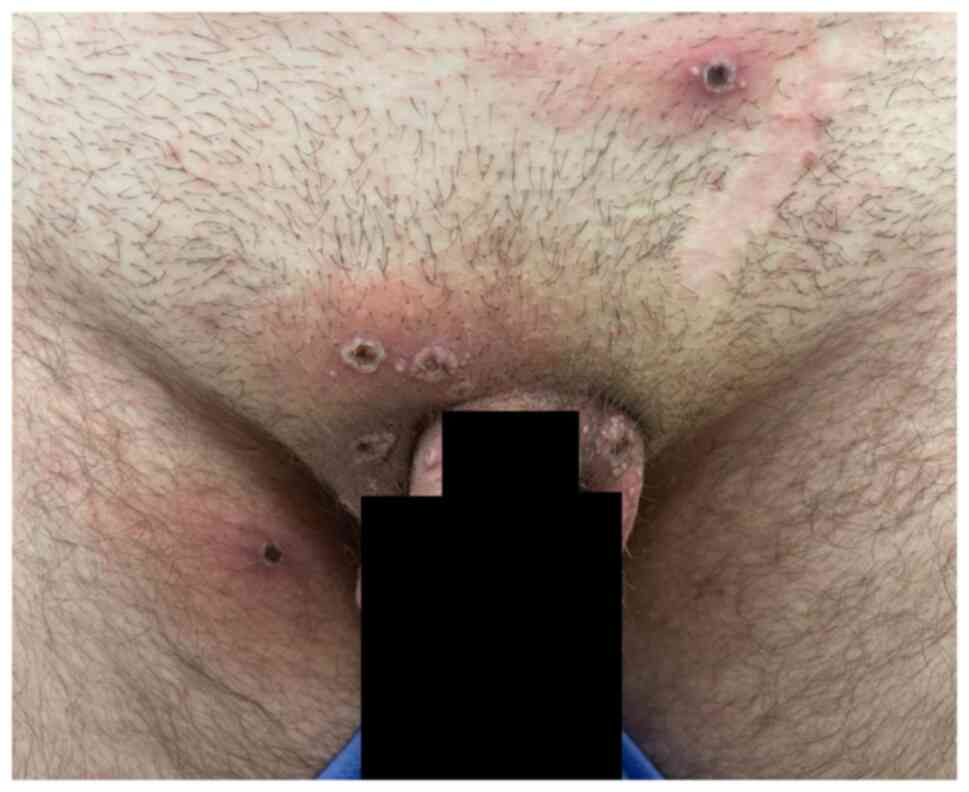
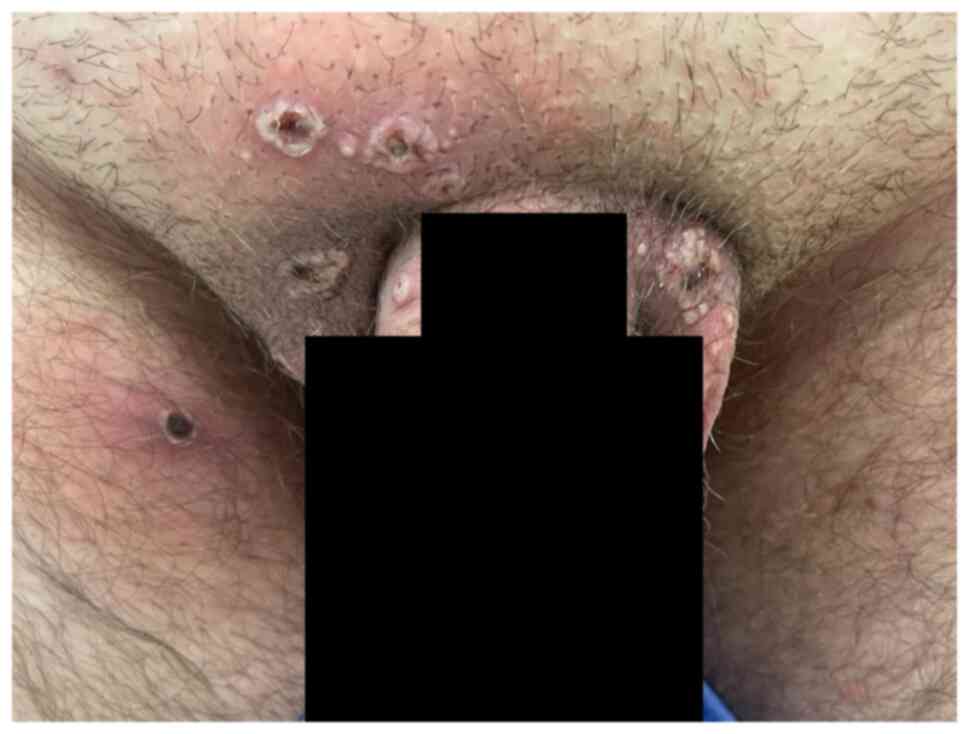
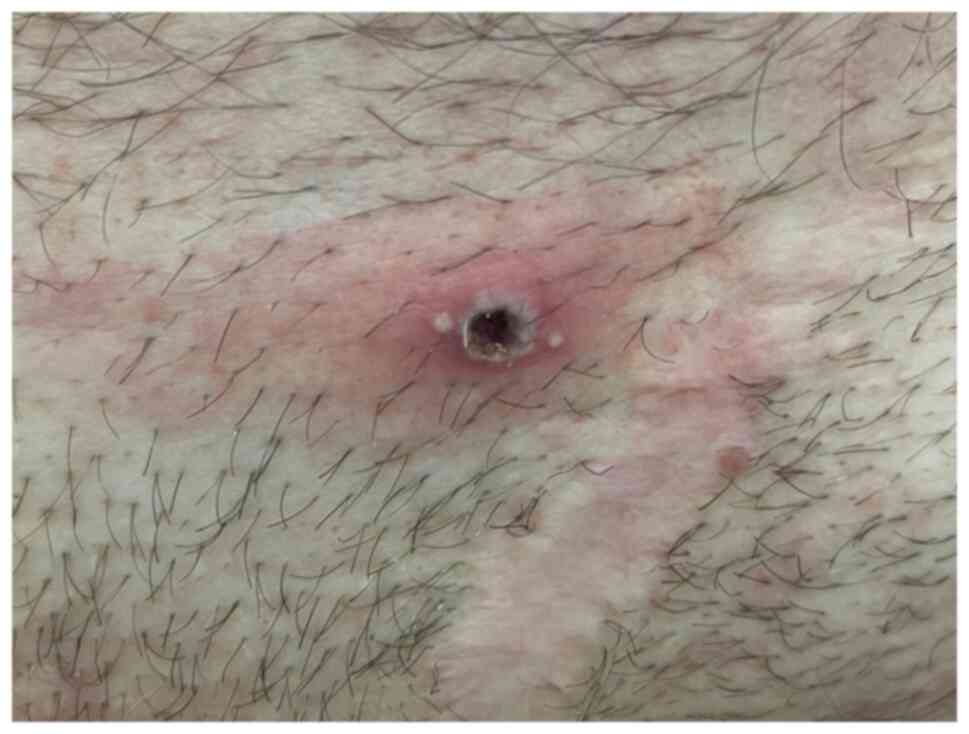
A 37-year-old homosexual man presented at the Department of Dermatology of Ponderas Academic Hospital, Bucharest, Romania in June 2022 for multiple well-circumscribed umbilicated erythemato-necrotic skin lesions located in the perigenital area and the inner part of the thighs, which appeared suddenly in the last 5 days (Fig. 1, Fig. 2 and Fig. 3). The patient reported fever 3 days prior. In addition, he disclosed having had unprotected sexual intercourse with an individual who had recently traveled from the UK, who had been diagnosed with syphilis 2 weeks before the appearance of the skin lesions. Urethral samples for the screening of sexually transmitted diseases were collected after prostatic massage. The tests included bacteriological and mycological exams from the urethral secretion and the balanopreputial sulcus and swabs for Chlamydia, Ureaplasma spp and Mycoplasma. Blood tests for syphilis [quantitative Rapid Plasma Reagin (RPR) and Treponema pallidum haemagglutination TPHA], HIV and hepatitis B and C were also collected. All the screening tests were negative for the aforementioned diseases. A PCR test for monkeypox was recommended, which came back positive. A vaccine against monkeypox virus was recommended to the patient. The present study was approved by the Ethics Committee of Ponderas Academic Hospital (approval no. 402/06.06.2022).

Figure 1

Multiple erythemato-necrotic skin lesions located in the perigenital area.

Figure 2

Close up of the well circumscribed umbilicated skin lesions.

Figure 3

Monkeypox typical lesion: Well circumscribed umbilicated with a necrotic center and erythematous base and some peripheral pustules.

Discussion

A zoonotic orthopoxvirus, monkeypox causes infections in humans in a similarly to smallpox; however, its mortality rate is markedly lower. The relevance of this virus lies in its endemicity to Central and Western Africa, with outbreaks in the western hemisphere associated with the exotic pet trade, as well as international travel. Vaccinia vaccination previously granted coincident immunity to monkeypox virus; nonetheless, smallpox eradication and consequent absence of vaccination enabled monkeypox to become clinically relevant (7).

Sexual behavior, as presented in this case report, alongside the initial appearance of the lesions particularly in the genital and anal areas point to the fact that close contact during sexual intercourse was essential in the transmission of the virus.

In the present case, the main differential diagnosis was primary syphilis since the patient reported condomless sexual activities with a syphilis positive patient. However, during a subsequent visit to the Department of Dermatology of Ponderas Academic Hospital, Bucharest, the patient reported that his partner was tested only with a nonspecific treponemal test (RPR). In order to make a certain diagnosis of syphilis, a specific treponemal test should be used. Treponemal tests represent qualitative assays performed on serum in order to detect antibodies (typically IgG, occasionally IgM) against a range of T. pallidum antigens; these antibodies are detectable 2-4 weeks after exposure. Treponemal tests are generally more sensitive in early infection; once positive, they generally remain reactive indeterminately. It is not possible to use them for monitoring treatment response or for diagnosing reinfection because of the weak correlation with disease activity. Conversely, non-treponemal tests are performed on serially diluted serum in order to detect total antibodies (IgG and IgM) directed against lipoidal antigens, like lecithin and cardiolipin, which are released from damaged host cells and bacteria. These antibodies are nonspecific; generally they are not detectable until several weeks after infection (8). Subsequently, the patient's partner was tested for monkeypox; the result was also positive. Another clinical clue that made us doubt that the patient had syphilis was the presence of multiple umbilicated lesions instead of spontaneously subsiding painless ulcer (chancre) at the inoculation site, representative for primary syphilis (Figs. 1 and 2).

A positive RPR test is the result of unspecific cytolysis and it can be modified in a number of infectious conditions, not only luetic infection. Moreover, a recent study reports a high titer of RPR in patients with monkeypox, as a result of damaged host cells that release specific antigens (9).

In case of vesicular or pustular genital rash, the differential should consider monkeypox, as it requires a swift diagnosis, as well as a public health response. Considering interventions like isolation and post-exposure prophylaxis with smallpox vaccine if indicated, as well as tracing close contacts should be among the measures taken (9). Presently, no specific clinically proven treatments for monkeypox infection are available. Supportive symptom management represents the treatment approach, as for most viral infections (7).

Acknowledgements

Professional editing, linguistic and technical assistance performed by Ms. Irina Radu, Individual Service Provider (credentials: E0048/2014; Medicine-Pharmacy; Bucharest, Romania).

Funding

Funding: No funding was received.

Availability of data and materials

All data generated or analyzed during this study are included in this published article.

Authors' contributions

AC performed a critical review of literature findings, made substantial contributions to acquisition and interpretation of data, and revised the manuscript critically for important intellectual content. DB examined the patient and collected the urethral swabs from the patient. The two authors read and approved the final manuscript. AC and DB confirm the authenticity of all the raw data.

Ethics approval and consent to participate

The present study was approved by the Ethics Committee of Ponderas Academic Hospital (approval no. 402/06.06.2022).

Patient consent for publication

Written informed consent was obtained from the patient prior to publication.

Competing interests

The authors declare that they have no competing interests.

References

1 

Le Page M: Monkeypox: Key questions answered. New Sci. 254:8–9. 2022.PubMed/NCBI View Article : Google Scholar

2 

Berthet N, Descorps-Declère S, Besombes C, Curaudeau M, Nkili Meyong AA, Selekon B, Labouba I, Gonofio EC, Ouilibona RS, Simo Tchetgna HD, et al: Genomic history of human monkey pox infections in the Central African Republic between 2001 and 2018. Sci Rep. 11(13085)2021.PubMed/NCBI View Article : Google Scholar

3 

Bunge EM, Hoet B, Chen L, Lienert F, Weidenthaler H, Baer LR and Steffen R: The changing epidemiology of human monkeypox-A potential threat? A systematic review. PLoS Negl Trop Dis. 16(e0010141)2022.PubMed/NCBI View Article : Google Scholar

4 

Monkeypox: Information for clinicians. Centres for Disease Control and Prevention, Atlanta, GA, 2019. https://www.cdc.gov/poxvirus/monkeypox/clinicians/index.html. Accessed May 24, 2022.

5 

Monkeypox: Information for healthcare providers about monkeypox. Centre for Disease Control, Vancouver, BC, 2022. http://www.bccdc.ca/health-professionals/clinical-resources/monkeypox. Accessed May 26, 2022.

6 

Halani S, Mishra S and Bogoch II: The monkeypox virus. CMAJ. 194(E844)2022.PubMed/NCBI View Article : Google Scholar

7 

Moore MJ, Rathish B and Zahra F: Monkeypox. In: StatPearls [Internet]. StatPearls Publishing, Treasure Island, FL, 2022.

8 

Satyaputra F, Hendry S, Braddick M, Sivabalan P and Norton R: The laboratory diagnosis of syphilis. J Clin Microbiol. 59(e0010021)2021.PubMed/NCBI View Article : Google Scholar

9 

Hammerschlag Y, MacLeod G, Papadakis G, Adan Sanchez A, Druce J, Taiaroa G, Savic I, Mumford J, Roberts J, Caly L, et al: Monkeypox infection presenting as genital rash, Australia, May 2022. Euro Surveill. 27(2200411)2022.PubMed/NCBI View Article : Google Scholar

Related Articles

  • Abstract
  • View
  • Download
  • Twitter
Copy and paste a formatted citation
Spandidos Publications style
Cutoiu A and Boda D: Monkeypox 2022: Dermatologists in the frontline on the edge of a new pandemic: A case report. Exp Ther Med 24: 677, 2022.
APA
Cutoiu, A., & Boda, D. (2022). Monkeypox 2022: Dermatologists in the frontline on the edge of a new pandemic: A case report. Experimental and Therapeutic Medicine, 24, 677. https://doi.org/10.3892/etm.2022.11613
MLA
Cutoiu, A., Boda, D."Monkeypox 2022: Dermatologists in the frontline on the edge of a new pandemic: A case report". Experimental and Therapeutic Medicine 24.5 (2022): 677.
Chicago
Cutoiu, A., Boda, D."Monkeypox 2022: Dermatologists in the frontline on the edge of a new pandemic: A case report". Experimental and Therapeutic Medicine 24, no. 5 (2022): 677. https://doi.org/10.3892/etm.2022.11613
Copy and paste a formatted citation
x
Spandidos Publications style
Cutoiu A and Boda D: Monkeypox 2022: Dermatologists in the frontline on the edge of a new pandemic: A case report. Exp Ther Med 24: 677, 2022.
APA
Cutoiu, A., & Boda, D. (2022). Monkeypox 2022: Dermatologists in the frontline on the edge of a new pandemic: A case report. Experimental and Therapeutic Medicine, 24, 677. https://doi.org/10.3892/etm.2022.11613
MLA
Cutoiu, A., Boda, D."Monkeypox 2022: Dermatologists in the frontline on the edge of a new pandemic: A case report". Experimental and Therapeutic Medicine 24.5 (2022): 677.
Chicago
Cutoiu, A., Boda, D."Monkeypox 2022: Dermatologists in the frontline on the edge of a new pandemic: A case report". Experimental and Therapeutic Medicine 24, no. 5 (2022): 677. https://doi.org/10.3892/etm.2022.11613
Follow us
  • Twitter
  • LinkedIn
  • Facebook
About
  • Spandidos Publications
  • Careers
  • Cookie Policy
  • Privacy Policy
How can we help?
  • Help
  • Live Chat
  • Contact
  • Email to our Support Team