Introduction
Dystrophic epidermolysis bullosa (DEB) is a rare
disease and the associated esophageal stricture has received
insufficient attention. Treatment for such an esophageal stricture
is frequently complicated by the lack of clinical experience. The
present study described a very rare case of DEB in a 37-year-old
male, who was admitted to Shenzhen Hospital (Shenzhen, China) due
to dysphagia. DEB is known for its low incidence, reported to range
from 3.3 to 5.7 per million people (1). The patient was previously diagnosed
with epidermolysis bullosa (EB). In performing a literature search,
no significant developments have been documented with respect to
the diagnosis and treatment of EB-induced esophageal stricture.
Dilation therapy was performed on this patient, which was effective
and safe. At the long-term follow-up, the esophageal stricture was
alleviated. There has been no significant development in the
diagnosis and treatment of ED-induced esophageal strictures and it
is often altered by a combination of clinical conditions. To the
best of our knowledge, this is the first case report of dilation
therapy in a very rare case of DEB with a satisfactory outcome, but
the long-term efficacy requires further observations. In addition,
the latest relevant literature was reviewed and found that this
treatment is uncommonly reported, as is the condition.
Case report
A 37-year-old male was admitted to Shenzhen Hospital
(Shenzhen, China) for 30-year dysphagia and 30-day exacerbation in
February 2020. The patient was hospitalized for 17 days. During the
stay in hospital, the patient was subjected to standard clinical
practices.
On admission, the patient reported dysphagia since
early childhood. He was not able to swallow food in one piece but
ate liquid foods daily. He did not complain of any other
discomforts. In October 2019, the patient visited the Department of
Internal Medicine, Division of Gastroenterology of Shenzhen
Hospital (Shenzhen, China). The examination results were as
follows: Height 165 cm, weight 50 kg, body mass index 28.37
kg/m2, albumin 29.0 g/l, and hemoglobin 101 g/l. The
patient suffered from malnutrition; the dysphagia level was 3.
Upper gastrointestinal radiography revealed a ~48 mm
luminal segment of stenosis in the initiation of the esophagus,
with the diameter of the narrowest portion of ~2 mm (Fig. 1A). Non-neoplastic stenosis was
considered, but no treatment was performed. A total of 3 days
before the admission, his dysphagia suddenly worsened, and the
patient was admitted to Shenzhen Hospital (Shenzhen, China) for
esophageal stenosis as the chief complaint.
The skin lesions in his lower extremities and hands
were consistent with the typical skin lesions of DEB (Fig. 1B and C). The patient was previously diagnosed
with EB with compound heterozygous mutations in the COL7A1 gene
(c.5932C>T, p.R1978*, and c.8065G>A, p.G2689R) (Fig. 1D and E).
The diagnosis of admission was esophageal stenosis
and DEB. Related examinations were performed on admission.
Preoperative gastroscopy revealed a narrowed esophageal lumen that
could not be passed by the ultrathin gastroscope and dilated
endoscopically. In February 2020, esophageal dilation under general
anesthesia was performed.
For the surgical procedure, after anesthesia by
transnasal tracheal intubation, the barrel of a 2-ml syringe was
put into the mouth of the patient and then a mouth opener was
placed given that the patient had moderate difficulty with mouth
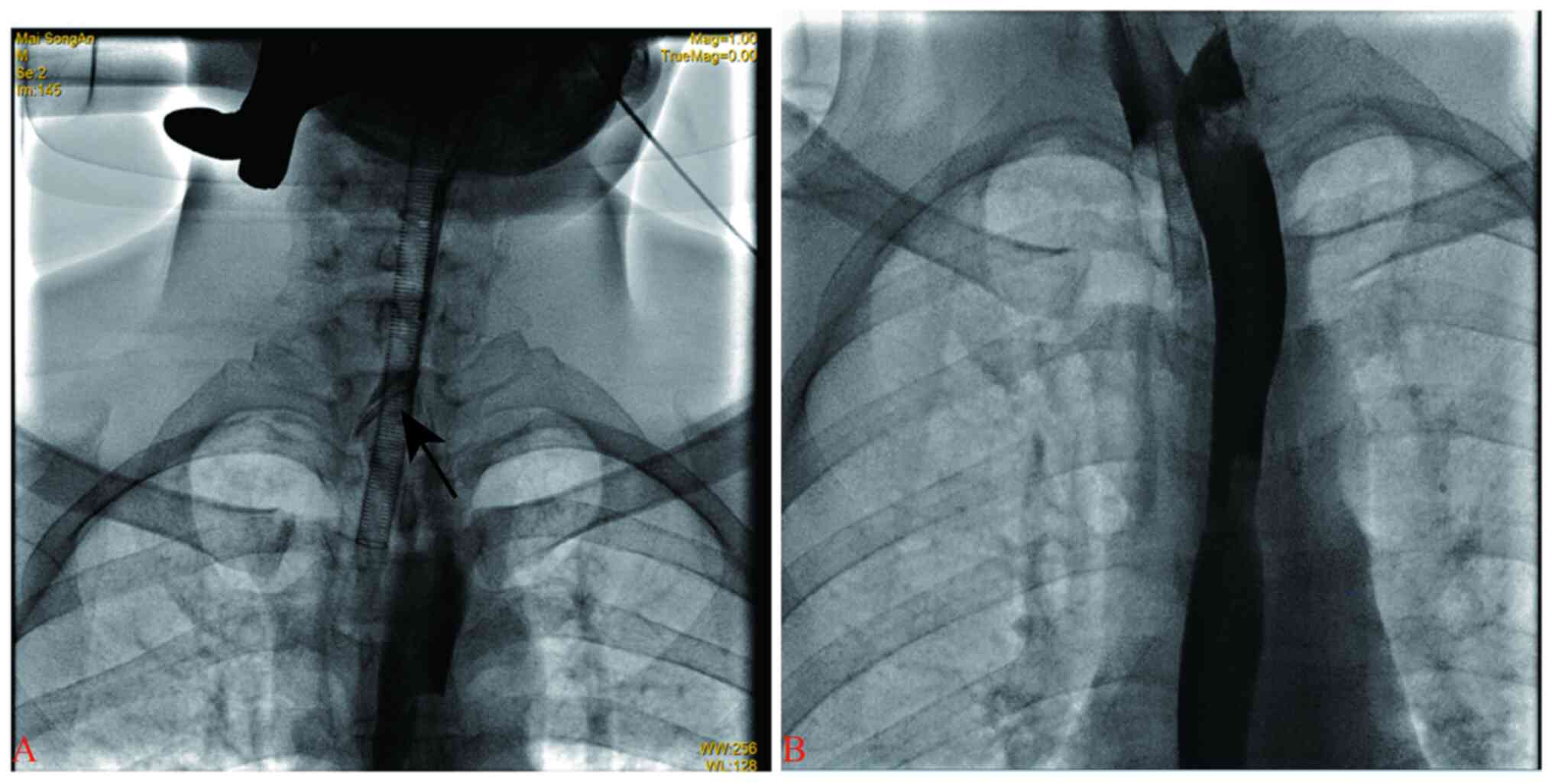
opening. A 6F catheter with lateral holes for right heart
catheterization was innovatively placed to obtain a fluoroscopic
view of the site of esophageal stenosis (Fig. 2A), followed by injection of
Iopamidol through the catheter to clearly show the major region
with stenosis. Subsequently, a hydrophilic guide wire was inserted
through the catheter, while multiple dilators (internal diameter:
5-15 mm) were sent along the guide wire one by one until successful
dilation of the esophageal lumen. A gastrostomy tube was indwelled
thereafter, with the front cut to allow for free access to the
guide wire.
After dilation, the patient could eat semiliquid
foods. Considering the favorable outcome of the dilation surgery
but recurrent stenosis, a second dilation surgery under digital
subtraction angiography (DSA) with general anesthesia was performed
5 days after the first surgery.
Esophagography showed no esophageal stricture
(Fig. 2B). The procedure was
uneventful, and the patient could consume an ordinary diet after
the surgery. The indwelling gastrostomy tube was recommended to be
retained for a long period, but the patient declined, citing
concerns about its impact on his appearance and not wanting to be
seen with the tube in place.
A total of 1 week after the second surgery, the
patient could eat ordinary soft foods normally. Ultrathin
gastroscopy showed multiple patchy mucosal congestions in his
glottis and a narrowed pharyngoesophageal segment, ~21 cm away from
the front teeth and with an ulcerated surface covered with white
fur but without bleeding, that could be passed by the gastroscope
(Fig. 3A). The pharyngoesophageal
segment 21-28 cm away from the front teeth presented with denuded
mucosa and white fur but without stenosis or active bleeding. The
remaining esophageal mucosa was normal.
Since cutaneous squamous cell carcinoma is a common
cause of death in patients with DEB, a biopsy of skin lesions in
his bilateral lower extremities was performed. Biopsy pathology
suggested EB, but no malignant tumor was found (Fig. 3B and C).
The patient's diagnosis on discharge was esophageal
stenosis and DEB. In the follow-up, the patient could eat
semiliquid foods normally within 2 years after discharge, and no
dilation surgery was required.
Discussion
EB represents a group of heterogeneous, inherited
mechanobullous diseases presenting with skin and mucosal fragility
resulting from mutations in structural proteins within human skin.
All types or subtypes of EB are rare. Statistically, as of 2002,
the estimated overall incidence and prevalence of EB in the U.S.
was 1/53,000 and 1/125,000, respectively, while similar data could
be found in certain European countries (2). There are no race or sex differences
in the prevalence of EB (3).
According to the ultrastructural level within which fissures
develop in EB-affected skin, the latest International Consensus
Meeting on Diagnosis and Classification of EB classified EB into
four major types (4):
Epidermolysis Bullosa Simplex (EBS), Junctional Epidermolysis
Bullosa, DEB, and Kindler Syndrome (Table I). In addition, EB can be
classified by features such as lesion distribution (localized or
generalized), lesion severity and extracutaneous involvement.
 | Table IInternational Consensus Meeting on
Diagnosis and Classification of EB. |
Table I
International Consensus Meeting on
Diagnosis and Classification of EB.
| Epidermolysis bullosa
type | Ultrastructural site
of skin findings |
|---|
| Epidermolysis bullosa
simplex | Intraepidermal, basal
keratinocytes, basal layer |
| Junctional
epidermolysis bullosa | Intra-lamina lucida
at the epidermal-dermal junction |
| Dystrophic
epidermolysis bullosa | Sub-lamina densa,
anchoring fibrils above the dermal papilla |
| Kindler syndrome | Intraepidermal,
intra-lamina lucida and sub-lamina densa |
EBS is the most common type of EB, although certain
cases present with a recessive inheritance pattern. Type VII
collagen gene COL7A1 is a DEB-causative gene (5). Studies have suggested that the site
and type of mutations in the COL7A1 gene can lead to DEB with
different types and medical conditions (6,7).
According to the pattern of inheritance, DEB can be subdivided into
dominant (DDEB) and recessive (RDEB). In the present report, the
patient had compound heterozygous mutations in the COL7A1 gene
(c.5932C>T, p.R1978* and c.8065G>A, p.G2689R). In addition,
it was noted that both the patient and his twin brother had RDEB,
which was moderately generalized.
In a clinical setting, it is widely considered that
RDEB is more severe than DDEB and the prognosis tends to be worse
(8). DEB infants are positive for
the Nikolsky sign shortly after birth, presenting with blistering
and erosion, with the blister wall being thin and fragile (9). In the meantime, the skin all over the
body simultaneously presents with milia, atrophy and scars, while
the devastating damage to the four limbs can lead to skin atrophy
and severe deformation (10,11).
The patient in the present report had typical skin lesions
associated with EB. In addition to whole-body skin lesions,
patients with EB may also exhibit oral damage and conjunctival
involvement concurrently with manifestations such as anemia and
growth retardation. Upon gastrointestinal involvement, 1/3
suboesophageal mucosa is usually involved, resulting in difficulty
in opening the mouth (12), which
was also observed in the present patient. Esophageal stenosis was
reported to occur in ≥80% of RDEB patients before the age of 25
years. It can further exacerbate malnutrition, and severe cases
usually require a gastrostomy tube for complementary feeding.
There have been certain reports on EB-related
esophageal stenosis; however, treatment modalities are varied
(13). According to the authors'
experience, esophageal stenosis that cannot be dilated in any case
is uncommon in the clinic. Since the patient in the present study
had difficulty in opening the mouth, a mouth opener was placed
after transnasal tracheal intubation for anesthesia and then
dilation with a conventional conical Maloney bougie under DSA was
performed. Considering that the narrow part could not be passed by
the ultrathin endoscope preoperatively, we innovatively applied
right cardiac catheterization to the narrow part followed by
placement of dilating bougies with varying inner diameters along a
hydrophilic guide wire. After the first dilation, a gastrostomy
tube was indwelled. The second dilation 5 days after the first
dilation contributed to significant improvements in the esophageal
stenosis in this patient. A previous study in 126 RDEB patients
reported an interval of 5 years between two dilation surgeries
(13). At 1-year of follow-up, no
recurrent stenosis was observed in this patient. The case presented
here has a significant impact on the clinical management of DEB
patients with esophageal stenosis. As the majority of patients
present with stenosis in 1/3 sub-esophagus, esophageal stenting may
be a viable alternative to surgery or other dilation modalities
despite certain discomforts and potential risks such as esophageal
rupture. For certain patients with recurrent stenosis after
dilation, gastrostomy tube indwelling can be performed for
complementary feeding (14).
The present case report has some limitations. First,
additional verification of similar cases and longer follow-up
periods are required to support these findings. However, the case
is very rare, and a long period of time is required to collect
additional similar cases. Second, it was not possible to perform
genetic testing on immediate family members of the patient as they
did not cooperate due to cost concerns.
At present, there is no specific therapy for DEB,
while symptomatic treatment remains the mainstay for the management
of patients when symptoms occur. Current clinical treatments for
DEB primarily focus on avoiding skin damage, reducing the risk of
complications such as infection and malnutrition, and improving the
quality of life. A variety of novel therapies, such as cell
therapy, targeted therapy and gene editing/engineering of induced
pluripotent stem cells, have emerged in recent years, which hold
promise for DEB treatment (15-18).
Given the genetic identity of DEB, prenatal diagnosis in families
with a proband is the most fundamental and effective intervention
for the management of DEB at present. To the to the best of the
authors' knowledge, this is the first case report of dilation
therapy in a very rare case of DEB with a satisfactory outcome.
These findings suggest that dilation therapy is effective and safe
to perform in the clinic for DEB treatment.
Acknowledgements
Not applicable.
Funding
Funding: The present study was supported by The Science and
Technology Project of Bao'an (grant no. 2021JD95).
Availability of data and materials
The datasets used and/or analyzed during the current
are available from the corresponding author on reasonable
request.
Authors' contributions
MW, JY and JK contributed to the conception and
design of the study, prepared the material, and collected and
analyzed the data. MW drafted the manuscript. DL, QG, XZ and JZ
analyzed patient data. All authors were involved in revising and
editing the manuscript. All authors have read and approved the
final manuscript. MW and JZ confirm the authenticity of all the raw
data.
Ethics approval and consent to
participate
Not applicable.
Patient consent for publication
Written informed consent was obtained from the
patient for the publication of this case report and any potentially
identifiable images or data included in this article.
Competing interests
The authors declare that they have no competing
interests.
References
|
1
|
Angelis A, Mellerio JE and Kanavos P:
Understanding the socioeconomic costs of dystrophic epidermolysis
bullosa in Europe: A costing and health-related quality of life
study. Orphanet J Rare Dis. 17(346)2022.PubMed/NCBI View Article : Google Scholar
|
|
2
|
Fine JD: Epidemiology of inherited
epidermolysis bullosa based on incidence and prevalence estimates
from the national epidermolysis bullosa registry. JAMA Dermatology.
152:1231–1238. 2016.PubMed/NCBI View Article : Google Scholar
|
|
3
|
Kho YC, Rhodes LM, Robertson SJ, Su J,
Varigos G, Robertson I, Hogan P, Orchard D and Murrell DF:
Epidemiology of epidermolysis bullosa in the antipodes: the
Australasian epidermolysis bullosa registry with a focus on herlitz
junctional epidermolysis bullosa. Arch Dermatol. 146:635–640.
2010.PubMed/NCBI View Article : Google Scholar
|
|
4
|
Fine JD, Bruckner-Tuderman L, Eady RA,
Bauer EA, Bauer JW, Has C, Heagerty A, Hintner H, Hovnanian A,
Jonkman MF, et al: Inherited epidermolysis bullosa: updated
recommendations on diagnosis and classification. J Am Acad
Dermatol. 70:1103–1126. 2014.PubMed/NCBI View Article : Google Scholar
|
|
5
|
Fine JD, Eady RA, Bauer EA, Bauer JW,
Bruckner-Tuderman L, Heagerty A, Hintner H, Hovnanian A, Jonkman
MF, Leigh I, et al: The classification of inherited epidermolysis
bullosa (EB): Report of the third international consensus meeting
on diagnosis and classification of EB. J Am Acad Dermatol.
58:931–950. 2008.PubMed/NCBI View Article : Google Scholar
|
|
6
|
Varki R, Sadowski S, Pfendner E and Uitto
J: Epidermolysis bullosa. I. Molecular genetics of the junctional
and hemidesmosomal variants. J Med Genet. 43:641–652.
2006.PubMed/NCBI View Article : Google Scholar
|
|
7
|
Kiritsi D, Kern JS, Schumann H, Kohlhase
J, Has C and Bruckner-Tuderman L: Molecular mechanisms of
phenotypic variability in junctional epidermolysis bullosa. J Med
Genet. 48:450–457. 2011.PubMed/NCBI View Article : Google Scholar
|
|
8
|
Tampoia M, Abbracciavento L, Morrone M and
Fumarulo R: IL-6/IL-10 ratio as a prognostic and predictive marker
of the severity of inherited epidermolysis bullosa. Iran J Immunol.
14:340–349. 2017.PubMed/NCBI
|
|
9
|
Pfendner EG and Lucky AW: Dystrophic
epidermolysis bullosa. In: GeneReviews®. Adam MP,
Feldman J, Mirzaa GM, et al (eds). University of Washington,
Seattle, WA, 1993.
|
|
10
|
García M, Escamez MJ, Cuadrado-Corrales N,
Sánchez-Jimeno C, Illera N, López-Martínez MA, Trujillo-Tiebas MJ,
Ayuso C and Del Río M: Novel human pathological mutations. Gene
symbol: COL7A1. Disease: Epidermolysis bullosa dystrophica. Hum
Genet. 127:116–117. 2010.PubMed/NCBI
|
|
11
|
van den Akker PC, van Essen AJ, Kraak MM,
Meijer R, Nijenhuis M, Meijer G, Hofstra RM, Pas HH, Scheffer H and
Jonkman MF: Long-term follow-up of patients with recessive
dystrophic epidermolysis bullosa in the Netherlands: Expansion of
the mutation database and unusual phenotype-genotype correlations.
J Dermatol Sci. 56:9–18. 2009.PubMed/NCBI View Article : Google Scholar
|
|
12
|
Fine JD and Mellerio JE: Extracutaneous
manifestations and complications of inherited epidermolysis
bullosa: Part I. Epithelial associated tissues. J Am Acad Dermatol.
61:367–384. 2009.PubMed/NCBI View Article : Google Scholar
|
|
13
|
Mortell AE and Azizkhan RG: Epidermolysis
bullosa: Management of esophageal strictures and enteric access by
gastrostomy. Dermatol Clin. 28:311–318, x. 2010.PubMed/NCBI View Article : Google Scholar
|
|
14
|
Colomb V, Bourdon-Lannoy E, Lambe C,
Sauvat F, Hadj Rabia S, Teillac D, De Prost Y and Bodemer C:
Nutritional outcome in children with severe generalized recessive
dystrophic epidermolysis bullosa: A short- and long-term evaluation
of gastrostomy and enteral feeding. Br J Dermatol. 166:354–361.
2012.PubMed/NCBI View Article : Google Scholar
|
|
15
|
Hsu CK, Wang SP, Lee JY and McGrath JA:
Treatment of hereditary epidermolysis bullosa: Updates and future
prospects. Am J Clin Dermatol. 15:1–6. 2014.PubMed/NCBI View Article : Google Scholar
|
|
16
|
Li M, Wei J, Xu G, Liu Y and Zhu J:
Surgery combined with molecular targeted therapy successfully
treated giant esophageal gastrointestinal stromal tumor. Oncologie.
24:349–356. 2022.
|
|
17
|
Zhan J, Wang W, Tang Y, Zhou N and Jiang
D: Development of a prognostic signature for esophageal cancer
based on a novel 7-DNA damage repair genes signature. Biocell.
46:2601–2613. 2022.
|
|
18
|
Nystrom A, Bruckner-Tuderman L and Kern
JS: Cell- and protein-based therapy approaches for epidermolysis
bullosa. Methods Mol Biol. 961:425–440. 2013.PubMed/NCBI View Article : Google Scholar
|