Spandidos Publications Logo
  • About
    • About Spandidos
    • Aims and Scopes
    • Abstracting and Indexing
    • Editorial Policies
    • Reprints and Permissions
    • Job Opportunities
    • Terms and Conditions
    • Contact
  • Journals
    • All Journals
    • Oncology Letters
      • Oncology Letters
      • Information for Authors
      • Editorial Policies
      • Editorial Board
      • Aims and Scope
      • Abstracting and Indexing
      • Bibliographic Information
      • Archive
    • International Journal of Oncology
      • International Journal of Oncology
      • Information for Authors
      • Editorial Policies
      • Editorial Board
      • Aims and Scope
      • Abstracting and Indexing
      • Bibliographic Information
      • Archive
    • Molecular and Clinical Oncology
      • Molecular and Clinical Oncology
      • Information for Authors
      • Editorial Policies
      • Editorial Board
      • Aims and Scope
      • Abstracting and Indexing
      • Bibliographic Information
      • Archive
    • Experimental and Therapeutic Medicine
      • Experimental and Therapeutic Medicine
      • Information for Authors
      • Editorial Policies
      • Editorial Board
      • Aims and Scope
      • Abstracting and Indexing
      • Bibliographic Information
      • Archive
    • International Journal of Molecular Medicine
      • International Journal of Molecular Medicine
      • Information for Authors
      • Editorial Policies
      • Editorial Board
      • Aims and Scope
      • Abstracting and Indexing
      • Bibliographic Information
      • Archive
    • Biomedical Reports
      • Biomedical Reports
      • Information for Authors
      • Editorial Policies
      • Editorial Board
      • Aims and Scope
      • Abstracting and Indexing
      • Bibliographic Information
      • Archive
    • Oncology Reports
      • Oncology Reports
      • Information for Authors
      • Editorial Policies
      • Editorial Board
      • Aims and Scope
      • Abstracting and Indexing
      • Bibliographic Information
      • Archive
    • Molecular Medicine Reports
      • Molecular Medicine Reports
      • Information for Authors
      • Editorial Policies
      • Editorial Board
      • Aims and Scope
      • Abstracting and Indexing
      • Bibliographic Information
      • Archive
    • World Academy of Sciences Journal
      • World Academy of Sciences Journal
      • Information for Authors
      • Editorial Policies
      • Editorial Board
      • Aims and Scope
      • Abstracting and Indexing
      • Bibliographic Information
      • Archive
    • International Journal of Functional Nutrition
      • International Journal of Functional Nutrition
      • Information for Authors
      • Editorial Policies
      • Editorial Board
      • Aims and Scope
      • Abstracting and Indexing
      • Bibliographic Information
      • Archive
    • International Journal of Epigenetics
      • International Journal of Epigenetics
      • Information for Authors
      • Editorial Policies
      • Editorial Board
      • Aims and Scope
      • Abstracting and Indexing
      • Bibliographic Information
      • Archive
    • Medicine International
      • Medicine International
      • Information for Authors
      • Editorial Policies
      • Editorial Board
      • Aims and Scope
      • Abstracting and Indexing
      • Bibliographic Information
      • Archive
  • Articles
  • Information
    • Information for Authors
    • Information for Reviewers
    • Information for Librarians
    • Information for Advertisers
    • Conferences
  • Language Editing
Spandidos Publications Logo
  • About
    • About Spandidos
    • Aims and Scopes
    • Abstracting and Indexing
    • Editorial Policies
    • Reprints and Permissions
    • Job Opportunities
    • Terms and Conditions
    • Contact
  • Journals
    • All Journals
    • Biomedical Reports
      • Information for Authors
      • Editorial Policies
      • Editorial Board
      • Aims and Scope
      • Abstracting and Indexing
      • Bibliographic Information
      • Archive
    • Experimental and Therapeutic Medicine
      • Information for Authors
      • Editorial Policies
      • Editorial Board
      • Aims and Scope
      • Abstracting and Indexing
      • Bibliographic Information
      • Archive
    • International Journal of Epigenetics
      • Information for Authors
      • Editorial Policies
      • Editorial Board
      • Aims and Scope
      • Abstracting and Indexing
      • Bibliographic Information
      • Archive
    • International Journal of Functional Nutrition
      • Information for Authors
      • Editorial Policies
      • Editorial Board
      • Aims and Scope
      • Abstracting and Indexing
      • Bibliographic Information
      • Archive
    • International Journal of Molecular Medicine
      • Information for Authors
      • Editorial Policies
      • Editorial Board
      • Aims and Scope
      • Abstracting and Indexing
      • Bibliographic Information
      • Archive
    • International Journal of Oncology
      • Information for Authors
      • Editorial Policies
      • Editorial Board
      • Aims and Scope
      • Abstracting and Indexing
      • Bibliographic Information
      • Archive
    • Medicine International
      • Information for Authors
      • Editorial Policies
      • Editorial Board
      • Aims and Scope
      • Abstracting and Indexing
      • Bibliographic Information
      • Archive
    • Molecular and Clinical Oncology
      • Information for Authors
      • Editorial Policies
      • Editorial Board
      • Aims and Scope
      • Abstracting and Indexing
      • Bibliographic Information
      • Archive
    • Molecular Medicine Reports
      • Information for Authors
      • Editorial Policies
      • Editorial Board
      • Aims and Scope
      • Abstracting and Indexing
      • Bibliographic Information
      • Archive
    • Oncology Letters
      • Information for Authors
      • Editorial Policies
      • Editorial Board
      • Aims and Scope
      • Abstracting and Indexing
      • Bibliographic Information
      • Archive
    • Oncology Reports
      • Information for Authors
      • Editorial Policies
      • Editorial Board
      • Aims and Scope
      • Abstracting and Indexing
      • Bibliographic Information
      • Archive
    • World Academy of Sciences Journal
      • Information for Authors
      • Editorial Policies
      • Editorial Board
      • Aims and Scope
      • Abstracting and Indexing
      • Bibliographic Information
      • Archive
  • Articles
  • Information
    • For Authors
    • For Reviewers
    • For Librarians
    • For Advertisers
    • Conferences
  • Language Editing
Login Register Submit
  • This site uses cookies
  • You can change your cookie settings at any time by following the instructions in our Cookie Policy. To find out more, you may read our Privacy Policy.

    I agree
Search articles by DOI, keyword, author or affiliation
Search
Advanced Search
presentation
Experimental and Therapeutic Medicine
Join Editorial Board Propose a Special Issue
Print ISSN: 1792-0981 Online ISSN: 1792-1015
Journal Cover
January-2026 Volume 31 Issue 1

Full Size Image

Sign up for eToc alerts
Recommend to Library

Journals

International Journal of Molecular Medicine

International Journal of Molecular Medicine

International Journal of Molecular Medicine is an international journal devoted to molecular mechanisms of human disease.

International Journal of Oncology

International Journal of Oncology

International Journal of Oncology is an international journal devoted to oncology research and cancer treatment.

Molecular Medicine Reports

Molecular Medicine Reports

Covers molecular medicine topics such as pharmacology, pathology, genetics, neuroscience, infectious diseases, molecular cardiology, and molecular surgery.

Oncology Reports

Oncology Reports

Oncology Reports is an international journal devoted to fundamental and applied research in Oncology.

Experimental and Therapeutic Medicine

Experimental and Therapeutic Medicine

Experimental and Therapeutic Medicine is an international journal devoted to laboratory and clinical medicine.

Oncology Letters

Oncology Letters

Oncology Letters is an international journal devoted to Experimental and Clinical Oncology.

Biomedical Reports

Biomedical Reports

Explores a wide range of biological and medical fields, including pharmacology, genetics, microbiology, neuroscience, and molecular cardiology.

Molecular and Clinical Oncology

Molecular and Clinical Oncology

International journal addressing all aspects of oncology research, from tumorigenesis and oncogenes to chemotherapy and metastasis.

World Academy of Sciences Journal

World Academy of Sciences Journal

Multidisciplinary open-access journal spanning biochemistry, genetics, neuroscience, environmental health, and synthetic biology.

International Journal of Functional Nutrition

International Journal of Functional Nutrition

Open-access journal combining biochemistry, pharmacology, immunology, and genetics to advance health through functional nutrition.

International Journal of Epigenetics

International Journal of Epigenetics

Publishes open-access research on using epigenetics to advance understanding and treatment of human disease.

Medicine International

Medicine International

An International Open Access Journal Devoted to General Medicine.

Journal Cover
January-2026 Volume 31 Issue 1

Full Size Image

Sign up for eToc alerts
Recommend to Library

  • Article
  • Citations
    • Cite This Article
    • Download Citation
    • Create Citation Alert
    • Remove Citation Alert
    • Cited By
  • Similar Articles
    • Related Articles (in Spandidos Publications)
    • Similar Articles (Google Scholar)
    • Similar Articles (PubMed)
  • Download PDF
  • Download XML
  • View XML

  • Supplementary Files
    • Supplementary_Data.xlsx
Article Open Access

Atorvastatin ameliorates chronic subdural hematomas by interrupting the ‘chronic subdural hematoma cycle’ via inhibition of the inflammatory response

  • Authors:
    • Jinqi Yan
    • Xiaohu Wang
    • Chen Liang
  • View Affiliations / Copyright

    Affiliations: Department of Critical Care Medicine, The First Affiliated Hospital of Xi'an Jiaotong University, Xi'an, Shaanxi 710061, P.R. China, Department of Neurosurgery, The First Affiliated Hospital of Xi'an Jiaotong University, Xi'an, Shaanxi 710061, P.R. China
    Copyright: © Yan et al. This is an open access article distributed under the terms of Creative Commons Attribution License.
  • Article Number: 22
    |
    Published online on: November 14, 2025
       https://doi.org/10.3892/etm.2025.13017
  • Expand metrics +
Metrics: Total Views: 0 (Spandidos Publications: | PMC Statistics: )
Metrics: Total PDF Downloads: 0 (Spandidos Publications: | PMC Statistics: )
Cited By (CrossRef): 0 citations Loading Articles...

This article is mentioned in:


Abstract

Chronic subdural hematomas (CSDHs) are prevalent neurosurgical occurrences characterized by progressive hemorrhagic expansion, which is primarily mediated by persistent inflammation, angiogenesis and fibrinolytic dysregulation. Atorvastatin, a widely used lipid‑lowering agent with known anti‑inflammatory and angiogenesis‑modulating properties, has shown therapeutic potential in CSDH management. In the present study, network pharmacology and experimental validation were combined to elucidate the underlying mechanisms of atorvastatin in CSDH treatment. Potential targets were identified through database mining and Venn analysis, followed by Gene Ontology/Kyoto Encyclopedia of Genes and Genomes enrichment, protein‑protein interaction network construction and molecular docking. In vitro experiments were performed to evaluate the effects of atorvastatin on a tumor necrosis factor‑α‑induced endothelial inflammation model, including on inflammatory cytokine secretion, target gene expression, endothelial permeability and tube formation. A total of 19 candidate therapeutic targets were identified, which were predominantly involved in the inflammatory response, coagulation, fibrinolysis and angiogenesis pathways. Core targets, including matrix metalloproteinase (MMP)‑2, MMP‑9, interleukin (IL)‑6, C‑X‑C motif chemokine ligand 8/IL‑8 and serpin family E member 1, demonstrated strong binding affinities with atorvastatin via molecular docking analyses. Furthermore, functional experiments revealed that atorvastatin significantly suppressed the expression of pro‑inflammatory cytokines and adhesion molecules, mitigated endothelial barrier dysfunction, reversed the inhibitory effect of inflammation on endothelial tube formation and downregulated key pathogenic genes. Collectively, these findings suggest that atorvastatin may disrupt the ‘CSDH cycle’ by modulating critical inflammatory, angiogenic and fibrinolytic mechanisms, providing a scientific rationale for its therapeutic application in CSDH management. Further in vivo studies are warranted to validate these preliminary observations and to explore clinical translation to the clinic.
View Figures

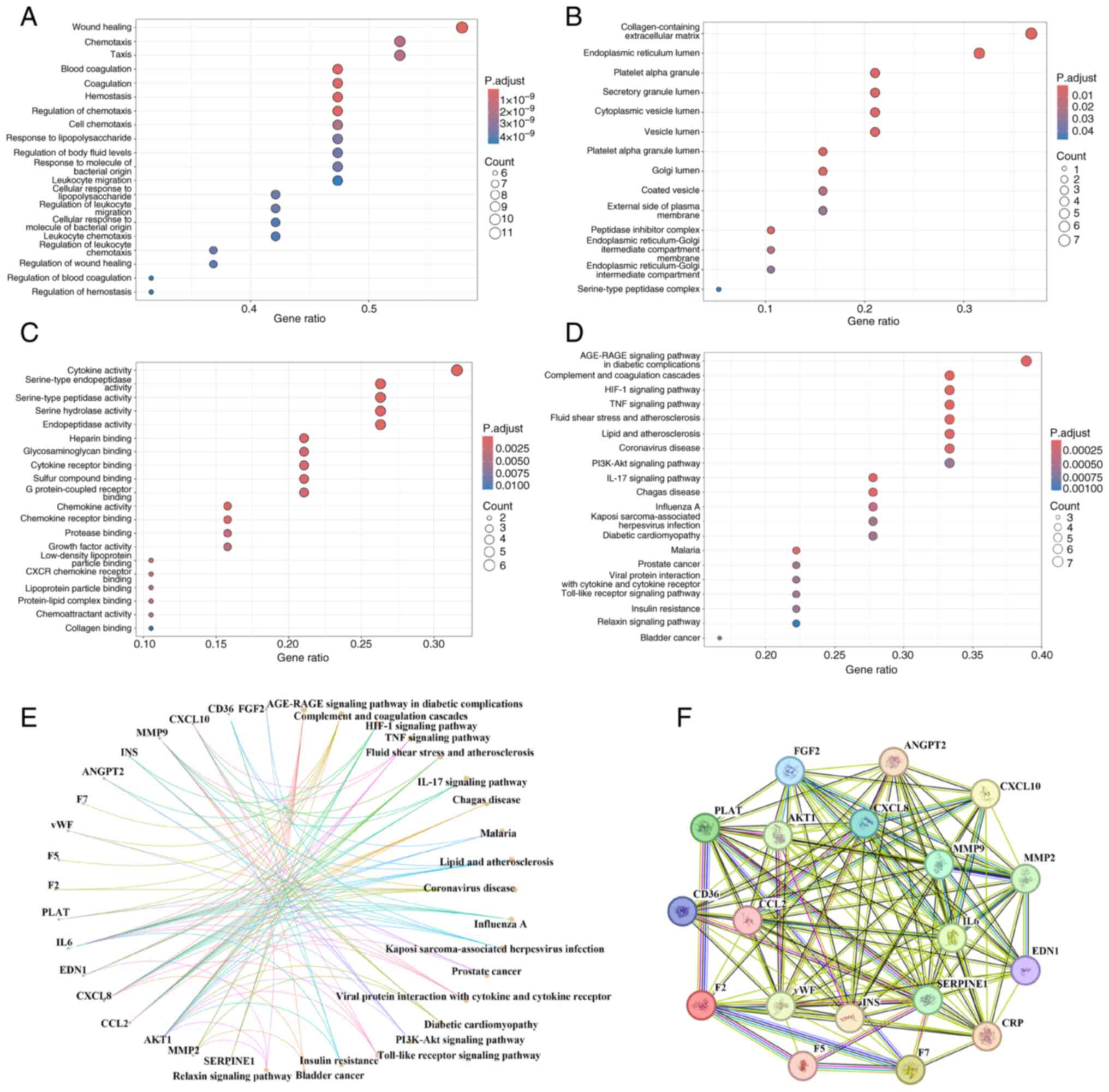
Figure 1

Enrichment analysis of the potential
therapeutic targets of atorvastatin in treating chronic subdural
hematoma. The top 20 enriched Gene Ontology terms included (A)
biological processes, (B) cellular component and (C) molecular
function. (D) The top 20 enriched pathways from the Kyoto
Encyclopedia of Genes and Genomes analysis. (E) Network diagram of
the target genes and related pathways. (F) Protein-protein
interaction network of potential the target genes.

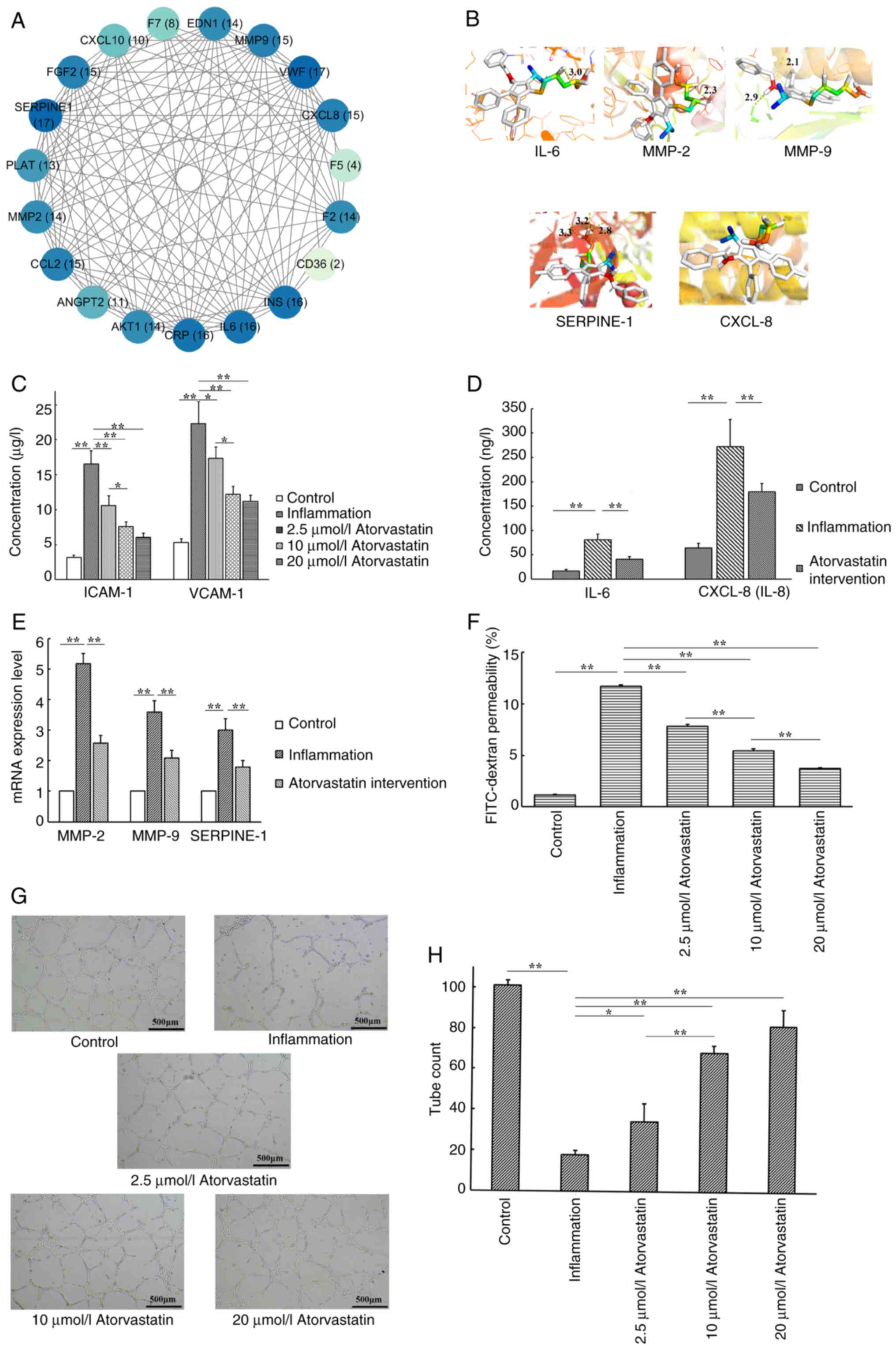
Figure 2

Molecular docking and functional
validation of potential therapeutic mechanisms of atorvastatin in
treating chronic subdural hematoma. (A) Degree values of the
protein nodes that correspond to target genes in the
protein-protein interaction network (values in parentheses indicate
node degrees). (B) Molecular docking results of atorvastatin with
proteins expressed by the core target genes. The anti-inflammatory
effects of atorvastatin in the endothelial cell inflammation model
were demonstrated. (C) Atorvastatin inhibited the TNF-α-induced
inflammatory response in HUVECs, as evidenced by decreased ICAM-1
and VCAM-1 levels in a dose-dependent manner. (D) Atorvastatin at a
concentration of 10 µmol/l reduced the secretion of inflammatory
cytokines; (E) downregulated the expression of inflammation-related
genes; and (F) protected against inflammation-induced endothelial
barrier dysfunction. Atorvastatin also reversed the inhibitory
effect of inflammation on endothelial tube formation. (G) Results
of tube formation assay for each group. Scale bars 500 µm. (H) The
tube counts in each group are shown. *P<0.05;
**P<0.01. ICAM-1, intercellular adhesion molecule 1;
VCAM-1, vascular cell adhesion molecule 1; MMP, matrix
metalloproteinase; IL, interleukin; CXCL-8, C-X-C motif chemokine
ligand 8; SERPINE-1, serpin family E member 1.
View References

1 

Nouri A, Gondar R, Schaller K and Meling T: Chronic subdural hematoma (cSDH): A review of the current state of the art. Brain Spine. 1(100300)2021.PubMed/NCBI View Article : Google Scholar

2 

Zhong D, Cheng H, Xian Z, Ren Y, Li H, Ou X and Liu P: Advances in pathogenic mechanisms, diagnostic methods, surgical and non-surgical treatment, and potential recurrence factors of Chronic Subdural Hematoma: A review. Clin Neurol Neurosurg. 242(108323)2024.PubMed/NCBI View Article : Google Scholar

3 

Feghali J, Yang W and Huang J: Updates in chronic subdural hematoma: Epidemiology, etiology, pathogenesis, treatment, and outcome. World Neurosurg. 141:339–345. 2020.PubMed/NCBI View Article : Google Scholar

4 

Liu T, Zhao Z, Liu M, An S, Nie M, Liu X, Qian Y, Tian Y, Zhang J and Jiang R: The pharmacological landscape of chronic subdural hematoma: A systematic review and network meta-analysis of randomized and non-randomized controlled studies. Burns Trauma. 12(tkae034)2024.PubMed/NCBI View Article : Google Scholar

5 

Verma Y, Abdelghaffar M, Verma O, Gajjar A, Ghozy S and Kallmes DF: Bevacizumab: The future of chronic subdural hematoma. Interv Neuroradiol: November 21, 2024 (Epub ahead of print).

6 

Morofuji Y, Nakagawa S, Ujifuku K, Fujimoto T, Otsuka K, Niwa M and Tsutsumi K: Beyond lipid-lowering: Effects of statins on cardiovascular and cerebrovascular diseases and cancer. Pharmaceuticals (Basel). 15(151)2022.PubMed/NCBI View Article : Google Scholar

7 

Araujo FA, Rocha MA, Mendes JB and Andrade SP: Atorvastatin inhibits inflammatory angiogenesis in mice through down regulation of VEGF, TNF-alpha and TGF-beta1. Biomed Pharmacother. 64:29–34. 2010.PubMed/NCBI View Article : Google Scholar

8 

Kim SK, Choe JY, Kim JW, Park KY and Kim B: Anti-Inflammatory effect of atorvastatin and rosuvastatin on monosodium urate-induced inflammation through IL-37/Smad3-complex activation in an in vitro study using THP-1 macrophages. Pharmaceuticals (Basel). 17(883)2024.PubMed/NCBI View Article : Google Scholar

9 

Chan DY, Chan DT, Sun TF, Ng SC, Wong GK and Poon WS: The use of atorvastatin for chronic subdural haematoma: A retrospective cohort comparison study. Br J Neurosurg. 31:72–77. 2017.PubMed/NCBI View Article : Google Scholar

10 

Jiang R, Zhao S, Wang R, Feng H, Zhang J, Li X, Mao Y, Yuan X, Fei Z, Zhao Y, et al: Safety and efficacy of atorvastatin for chronic subdural hematoma in chinese patients: A randomized ClinicalTrial. JAMA Neurol. 75:1338–1346. 2018.PubMed/NCBI View Article : Google Scholar

11 

Monteiro GA, Queiroz TS, Goncalves OR, Cavalcante-Neto JF, Batista S, Rabelo NN, Welling LC, Figueiredo EG, Leal PRL and Solla DJF: Efficacy and safety of atorvastatin for chronic subdural hematoma: An updated systematic review and meta-analysis. World Neurosurg. 188:177–184. 2024.PubMed/NCBI View Article : Google Scholar

12 

Quan W, Zhang Z, Li P, Tian Q, Huang J, Qian Y, Gao C, Su W, Wang Z, Zhang J, et al: Role of regulatory T cells in atorvastatin induced absorption of chronic subdural hematoma in rats. Aging Dis. 10:992–1002. 2019.PubMed/NCBI View Article : Google Scholar

13 

Yang L, Li N, Yang L, Wang D, Qiang S and Zhao Z: Atorvastatin-induced absorption of chronic subdural hematoma is partially attributed to the polarization of macrophages. J Mol Neurosci. 72:565–573. 2022.PubMed/NCBI View Article : Google Scholar

14 

Liang C, Zhang B, Li R, Guo S and Fan X: Network pharmacology -based study on the mechanism of traditional Chinese medicine in the treatment of glioblastoma multiforme. BMC Complement Med Ther. 23(342)2023.PubMed/NCBI View Article : Google Scholar

15 

Carlson M: Genome wide annotation for Human. Bioconductor, 2022. https://bioconductor.org/packages/org.Hs.eg.db.

16 

Yu G, Wang LG, Han Y and He QY: ClusterProfiler: An R package for comparing biological themes among gene clusters. OMICS. 16:284–287. 2012.PubMed/NCBI View Article : Google Scholar

17 

Yu G: enrichplot: Visualization of Functional Enrichment Result. Bioconductor, 2022. https://bioconductor.org/packages/enrichplot.

18 

Luo W and Brouwer C: Pathview: An R/Bioconductor package for pathway-based data integration and visualization. Bioinformatics. 29:1830–1831. 2013.PubMed/NCBI View Article : Google Scholar

19 

Wickham H: ggplot2: Elegant Graphics for Data Analysis. 1st Edition. Springer, New York, NY, 2009.

20 

Shannon P, Markiel A, Ozier O, Baliga NS, Wang JT, Ramage D, Amin N, Schwikowski B and Ideker T: Cytoscape: A software environment for integrated models of biomolecular interaction networks. Genome Res. 13:2498–2504. 2003.PubMed/NCBI View Article : Google Scholar

21 

Bao XM, Wu CF and Lu GP: Atorvastatin attenuates homocysteine-induced apoptosis in human umbilical vein endothelial cells via inhibiting NADPH oxidase-related oxidative stress-triggered p38MAPK signaling. Acta Pharmacol Sin. 30:1392–1398. 2009.PubMed/NCBI View Article : Google Scholar

22 

Li D, Chen H, Romeo F, Sawamura T, Saldeen T and Mehta JL: Statins modulate oxidized low-density lipoprotein-mediated adhesion molecule expression in human coronary artery endothelial cells: Role of LOX-1. J Pharmacol Exp Ther. 302:601–605. 2002.PubMed/NCBI View Article : Google Scholar

23 

Livak KJ and Schmittgen TD: . Analysis of relative gene expression data using real-time quantitative PCR and the 2(-Delta Delta C(T)) method. Methods. 25:402–408. 2001.PubMed/NCBI View Article : Google Scholar

24 

Liang C, Wei T, Zhang T and Niu C: Adipose-derived stem cell-mediated alphastatin targeting delivery system inhibits angiogenesis and tumor growth in glioma. Mol Med Rep. 28(215)2023.PubMed/NCBI View Article : Google Scholar

25 

Shityakov S and Förster C: In silico predictive model to determine vector-mediated transport properties for the blood-brain barrier choline transporter. Adv Appl Bioinform Chem. 7:23–36. 2014.PubMed/NCBI View Article : Google Scholar

26 

Hsin KY, Ghosh S and Kitano H: Combining machine learning systems and multiple docking simulation packages to improve docking prediction reliability for network pharmacology. PLoS One. 8(e83922)2013.PubMed/NCBI View Article : Google Scholar

27 

Xiong L, Chen Q and Liu H: Network pharmacology and molecular docking identified IL-6 as a critical target of Qing Yan He Ji against COVID-19. Medicine (Baltimore). 103(e40720)2024.PubMed/NCBI View Article : Google Scholar

28 

Ahmad A, Sayed A, Ginnebaugh KR, Sharma V, Suri A, Saraph A, Padhye S and Sarkar FH: Molecular docking and inhibition of matrix metalloproteinase-2 by novel difluorinatedbenzylidene curcumin analog. Am J Transl Res. 7:298–308. 2015.PubMed/NCBI

29 

Kumar NK, Geervani VS, Kumar RSM, Singh S, Abhishek M and Manimozhi M: Data-driven dentistry: Computational revelations redefining pulp capping. J Conserv Dent Endod. 27:649–653. 2024.PubMed/NCBI View Article : Google Scholar

30 

Dos Santos RV, Barrionuevo MVF, Vieira MRF, Mazoni I and Tasic L: Plasminogen activator inhibitors in thrombosis: Structural analysis and potential natural inhibitors. ACS Omega. 10:27348–27362. 2025.PubMed/NCBI View Article : Google Scholar

31 

Madej M, Halama A, Chrobak E and Gola JM: Time-dependent impact of betulin and its derivatives on IL-8 expression in colorectal cancer cells with molecular docking studies. Int J Mol Sci. 26(6186)2025.PubMed/NCBI View Article : Google Scholar

32 

Weigel R, Schilling L and Krauss JK: The pathophysiology of chronic subdural hematoma revisited: Emphasis on aging processes as key factor. Geroscience. 44:1353–1371. 2022.PubMed/NCBI View Article : Google Scholar

33 

Jensen TSR, Olsen MH, Lelkaitis G, Kjaer A, Binderup T and Fugleholm K: Urokinase plasminogen activator receptor: An important focal player in chronic subdural hematoma? Inflammation. 47:1015–1027. 2024.PubMed/NCBI View Article : Google Scholar

34 

Tamura R, Sato M, Yoshida K and Toda M: History and current progress of chronic subdural hematoma. J Neurol Sci. 429(118066)2021.PubMed/NCBI View Article : Google Scholar

35 

Katano H, Kamiya K, Mase M, Tanikawa M and Yamada K: Tissue plasminogen activator in chronic subdural hematomas as a predictor of recurrence. J Neurosurg. 104:79–84. 2006.PubMed/NCBI View Article : Google Scholar

36 

Shi Z, Yao C, Shui Y, Li S and Yan H: Research progress on the mechanism of angiogenesis in wound repair and regeneration. Front Physiol. 14(1284981)2023.PubMed/NCBI View Article : Google Scholar

37 

Costantini TW, Kornblith LZ, Pritts T and Coimbra R: The intersection of coagulation activation and inflammation after injury: What you need to know. J Trauma Acute Care Surg. 96:347–356. 2024.PubMed/NCBI View Article : Google Scholar

38 

Cambier S, Gouwy M and Proost P: The chemokines CXCL8 and CXCL12: molecular and functional properties, role in disease and efforts towards pharmacological intervention. Cell Mol Immunol. 20:217–251. 2023.PubMed/NCBI View Article : Google Scholar

39 

Adumitrachioaiei H, Sasaran MO and Marginean CO: The diagnostic and prognostic role of interleukin 6 and interleukin 8 in childhood acute gastroenteritis-a review of the literature. Int J Mol Sci. 25(7655)2024.PubMed/NCBI View Article : Google Scholar

40 

Schumertl T, Lokau J, Rose-John S and Garbers C: Function and proteolytic generation of the soluble interleukin-6 receptor in health and disease. Biochim Biophys Acta Mol Cell Res. 1869(119143)2022.PubMed/NCBI View Article : Google Scholar

41 

Matsushima K, Yang D and Oppenheim JJ: Interleukin-8: An evolving chemokine. Cytokine. 153(155828)2022.PubMed/NCBI View Article : Google Scholar

42 

Hong HJ, Kim YJ, Yi HJ, Ko Y, Oh SJ and Kim JM: Role of angiogenic growth factors and inflammatory cytokine on recurrence of chronic subdural hematoma. Surg Neurol. 71:161–165; discussion 165-166. 2009.PubMed/NCBI View Article : Google Scholar

43 

Mustafa S, Koran S and AlOmair L: Insights into the role of matrix metalloproteinases in cancer and its various therapeutic aspects: A review. Front Mol Biosci. 9(896099)2022.PubMed/NCBI View Article : Google Scholar

44 

Muneer PMA, Pfister BJ, Haorah J and Chandra N: Role of matrix metalloproteinases in the pathogenesis of traumatic brain injury. Mol Neurobiol. 53:6106–6123. 2016.PubMed/NCBI View Article : Google Scholar

45 

Hua C, Zhao G, Feng Y, Yuan H, Song H and Bie L: Role of matrix metalloproteinase-2, matrix metalloproteinase-9, and vascular endothelial growth factor in the development of chronic subdural hematoma. J Neurotrauma. 33:65–70. 2016.PubMed/NCBI View Article : Google Scholar

46 

Kwak SY, Park S, Kim H, Lee SJ, Jang WS, Kim MJ, Lee S, Jang WI, Kim AR, Kim EH, et al: Atorvastatin inhibits endothelial PAI-1-mediated monocyte migration and alleviates radiation-induced enteropathy. Int J Mol Sci. 22(1828)2021.PubMed/NCBI View Article : Google Scholar

47 

Hou X and Pei F: Estradiol inhibits cytokine-induced expression of VCAM-1 and ICAM-1 in cultured human endothelial cells via AMPK/PPARalpha activation. Cell Biochem Biophys. 72:709–717. 2015.PubMed/NCBI View Article : Google Scholar

48 

O YM, Tsang SL and Leung GK: Fibrinolytic-facilitated chronic subdural hematoma drainage-A systematic review. World Neurosurg. 150:e408–e419. 2021.PubMed/NCBI View Article : Google Scholar

49 

Wang D, Li T, Wei H, Wang Y, Yang G, Tian Y, Zhao Z, Wang L, Yu S, Zhang Y, et al: Atorvastatin enhances angiogenesis to reduce subdural hematoma in a rat model. J Neurol Sci. 362:91–99. 2016.PubMed/NCBI View Article : Google Scholar

50 

Chen M, Da L, Zhang Q, Liu J, Tang J and Zha Z: Development of a predictive model for assessing the risk factors associated with recurrence following surgical treatment of chronic subdural hematoma. Front Surg. 11(1429128)2024.PubMed/NCBI View Article : Google Scholar

51 

Jensen TSR, Thiesson EM, Fugleholm K, Wohlfahrt J and Munch TN: Inflammatory risk factors for chronic subdural hematoma in a nationwide cohort. J Inflamm Res. 17:8261–8270. 2024.PubMed/NCBI View Article : Google Scholar

52 

Hori YS, Aoi M, Oda K and Fukuhara T: Presence of a malignant tumor as a novel predictive factor for repeated recurrences of chronic subdural hematoma. World Neurosurg. 105:714–719. 2017.PubMed/NCBI View Article : Google Scholar

53 

Dubinski D, Won SY, Trnovec S, Gounko K, Baumgarten P, Warnke P, Cantre D, Behmanesh B, Bernstock JD, Freiman TM, et al: Recurrence of chronic subdural hematoma due to low-grade infection. Front Neurol. 13(1012255)2022.PubMed/NCBI View Article : Google Scholar

54 

Hermida N and Balligand JL: Low-density lipoprotein-cholesterol-induced endothelial dysfunction and oxidative stress: The role of statins. Antioxid Redox Signal. 20:1216–1237. 2014.PubMed/NCBI View Article : Google Scholar

Related Articles

  • Abstract
  • View
  • Download
  • Twitter
Copy and paste a formatted citation
Spandidos Publications style
Yan J, Wang X and Liang C: Atorvastatin ameliorates chronic subdural hematomas by interrupting the &lsquo;chronic subdural hematoma cycle&rsquo; via inhibition of the inflammatory response. Exp Ther Med 31: 22, 2026.
APA
Yan, J., Wang, X., & Liang, C. (2026). Atorvastatin ameliorates chronic subdural hematomas by interrupting the &lsquo;chronic subdural hematoma cycle&rsquo; via inhibition of the inflammatory response. Experimental and Therapeutic Medicine, 31, 22. https://doi.org/10.3892/etm.2025.13017
MLA
Yan, J., Wang, X., Liang, C."Atorvastatin ameliorates chronic subdural hematomas by interrupting the &lsquo;chronic subdural hematoma cycle&rsquo; via inhibition of the inflammatory response". Experimental and Therapeutic Medicine 31.1 (2026): 22.
Chicago
Yan, J., Wang, X., Liang, C."Atorvastatin ameliorates chronic subdural hematomas by interrupting the &lsquo;chronic subdural hematoma cycle&rsquo; via inhibition of the inflammatory response". Experimental and Therapeutic Medicine 31, no. 1 (2026): 22. https://doi.org/10.3892/etm.2025.13017
Copy and paste a formatted citation
x
Spandidos Publications style
Yan J, Wang X and Liang C: Atorvastatin ameliorates chronic subdural hematomas by interrupting the &lsquo;chronic subdural hematoma cycle&rsquo; via inhibition of the inflammatory response. Exp Ther Med 31: 22, 2026.
APA
Yan, J., Wang, X., & Liang, C. (2026). Atorvastatin ameliorates chronic subdural hematomas by interrupting the &lsquo;chronic subdural hematoma cycle&rsquo; via inhibition of the inflammatory response. Experimental and Therapeutic Medicine, 31, 22. https://doi.org/10.3892/etm.2025.13017
MLA
Yan, J., Wang, X., Liang, C."Atorvastatin ameliorates chronic subdural hematomas by interrupting the &lsquo;chronic subdural hematoma cycle&rsquo; via inhibition of the inflammatory response". Experimental and Therapeutic Medicine 31.1 (2026): 22.
Chicago
Yan, J., Wang, X., Liang, C."Atorvastatin ameliorates chronic subdural hematomas by interrupting the &lsquo;chronic subdural hematoma cycle&rsquo; via inhibition of the inflammatory response". Experimental and Therapeutic Medicine 31, no. 1 (2026): 22. https://doi.org/10.3892/etm.2025.13017
Follow us
  • Twitter
  • LinkedIn
  • Facebook
About
  • Spandidos Publications
  • Careers
  • Cookie Policy
  • Privacy Policy
How can we help?
  • Help
  • Live Chat
  • Contact
  • Email to our Support Team