Introduction
Skin warts are benign proliferative lesions caused
by human papillomavirus (HPV) infection. The present study reports
a novel type of viral wart that occurs after treatments such as
cryotherapy. In this case, the warts at the original site regress,
but new warts form and spread outward along the surrounding
disrupted skin tissue, creating doughnut-shaped, papillomatous
proliferation, termed ‘doughnut wart’. It was first described in
1959 and is considered a rare complication that arises during the
treatment of viral warts (1).
Viral warts often show resistance to cryotherapy
(2). Although cryotherapy targets
the infected tissue, the treatment may create a local skin
microenvironment at the treated site that is unfavorable for viral
survival. Paradoxically, this unfavorable environment may instead
promote the virus to spread outward to adjacent tissues, where the
relatively intact skin microenvironment is more conducive to viral
growth (3). This alteration of the
skin microenvironment forces the viral warts to spread to adjacent
tissues more favorable for their growth and may be related to the
local tissue response induced by cryotherapy, which inhibits viral
survival or proliferation in the treated area. Meanwhile, the
surrounding normal tissues are not directly affected by cryotherapy
and may still provide relatively favorable conditions for the
virus, which may lead to further viral spread (3).
5-Aminolevulinic acid photodynamic therapy (ALA-PDT)
is a modern, minimally invasive technique (4-6).
PDT has been recommended by numerous guidelines as an I-A class
(strongly recommended, with evidence level A) treatment method for
condyloma acuminatum in cavities such as the anal canal, urethral
opening, urethra and cervical canal (7). Compared to traditional treatment
methods such as electrocautery and microwave therapy, multiple
studies have shown that PDT has good effects in treating stubborn
plantar warts, with higher clearance rates and cure rates, and
lower recurrence rates. Its effects are due to the precursor
photosensitizer ALA, which, in the presence of oxygen, absorbs
light of an appropriate wavelength and converts it into the
photosensitive compound protoporphyrin IX, triggering a
photodynamic reaction. This leads to the generation of reactive
oxygen species (ROS), which induce cytotoxicity in HPV-infected
cells, provoking a local inflammatory response that attracts immune
cells to the lesion site (8,9).
Subsequently, immune cells release pro-inflammatory cytokines,
further enhancing local inflammation and promoting an antiviral
immune response through immune cell activation (10). The count of CD8+ T cells
significantly increased, and at the same time, they exhibited a
higher cytotoxic potential. These cells directly target the
infected cells, inducing apoptosis and infiltrating the lesion area
(Fig. 1). PDT also induces
immunogenic cell death (ICD), releasing damage-associated molecular
patterns that activate the immune system (11). More importantly, PDT disrupts
vascular structures and induces devascularization, limiting the
survival environment of virus-infected cells (12).
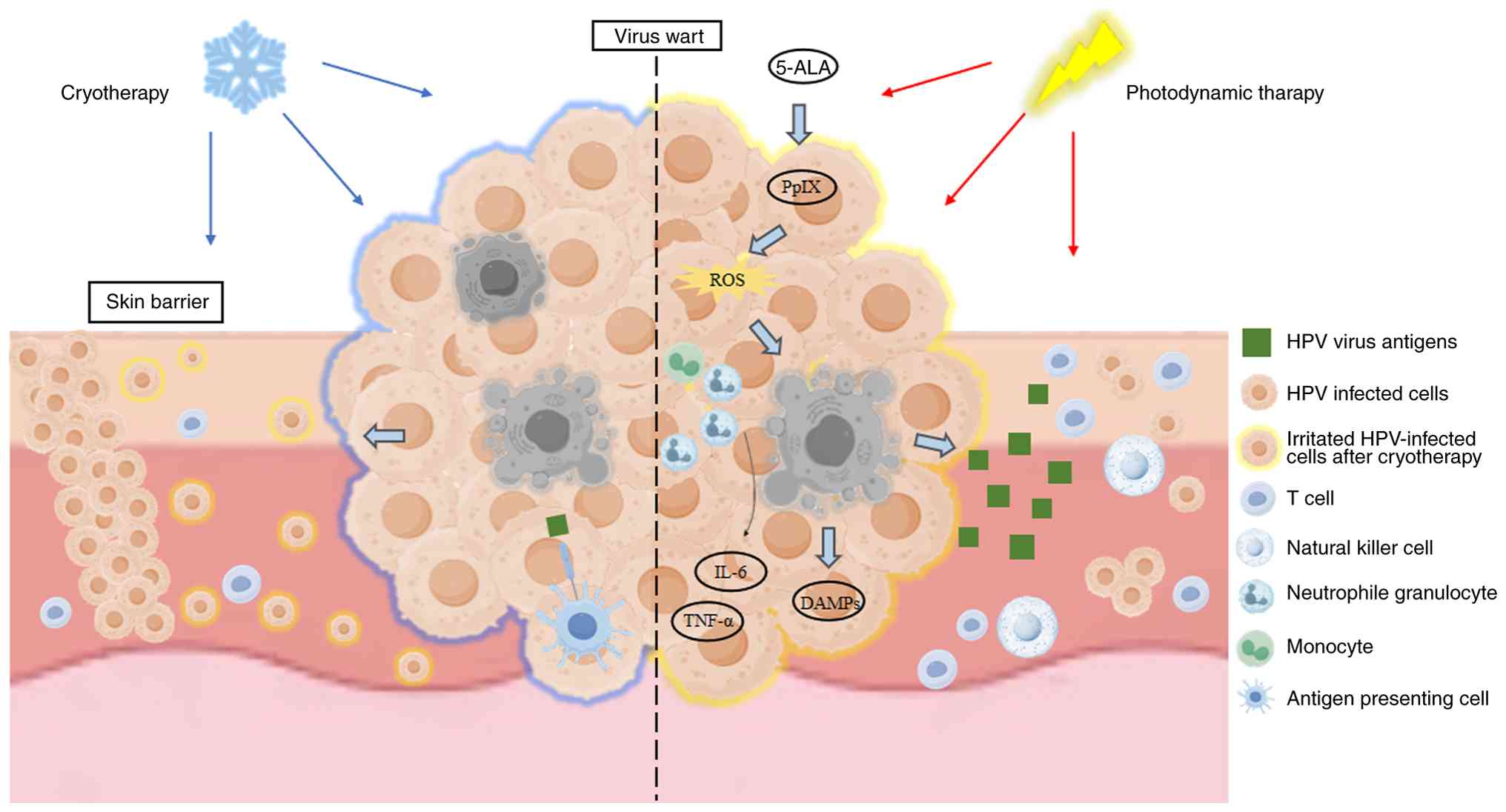 | Figure 1Comparison of the mechanistic
differences between cryotherapy and PDT for the treatment of viral
warts. The left side of the picture represents that cryotherapy
destroys HPV-infected cells using low temperatures, but it may
damage the skin barrier, weaken the local immune environment, and
induce viral escape and spread, forming a doughnut wart. In
addition, HPV may inhibit T-cell recognition by downregulating
major histocompatibility complex class I expression and further
promote viral transmission. PDT, as shown on the right side of the
schematic, used ROS produced by a photosensitizer (5-ALA) to
selectively destroy the lesional tissue and activate immune cells
(such as T cells and natural killer cells) in normal tissues around
the lesion to enhance the local immune microenvironment,
effectively eliminating potentially infected cells and preventing
further spread of the virus. It may be speculated that PDT induces
immunogenic cell death, releases DAMPs (such as high mobility group
box 1, adenosine triphosphate and calreticulin), activates
antigen-presenting cells, such as dendritic cells, promotes
specific immune responses and reduces the risk of recurrence and
transmission. PDT, photodynamic therapy; HPV, human papillomavirus;
DAMPs, damage-associated molecular patterns; ROS, reactive oxygen
species; 5-ALA, 5-aminolevulinic acid; PpIX, protoporphyrin IX. |
Case report
A 21-year-old Chinese female presented at Huadong
Hospital (Shanghai, China) in July 2021 with a history of
cryotherapy for a viral wart on the left plantar foot 3 months
earlier. The lesion had not healed. The central part of the lesion
regressed 2 months post-cryotherapy, but a larger, ring-shaped,
doughnut-like wart had gradually formed around the original site.
Upon examination, a gray-brown, 2.8x2.2 cm ring-shaped plaque with
a keratinized, rough surface was observed at the lesion site. Given
the spread of the wart following cryotherapy, PDT was selected to
enhance immune effects.
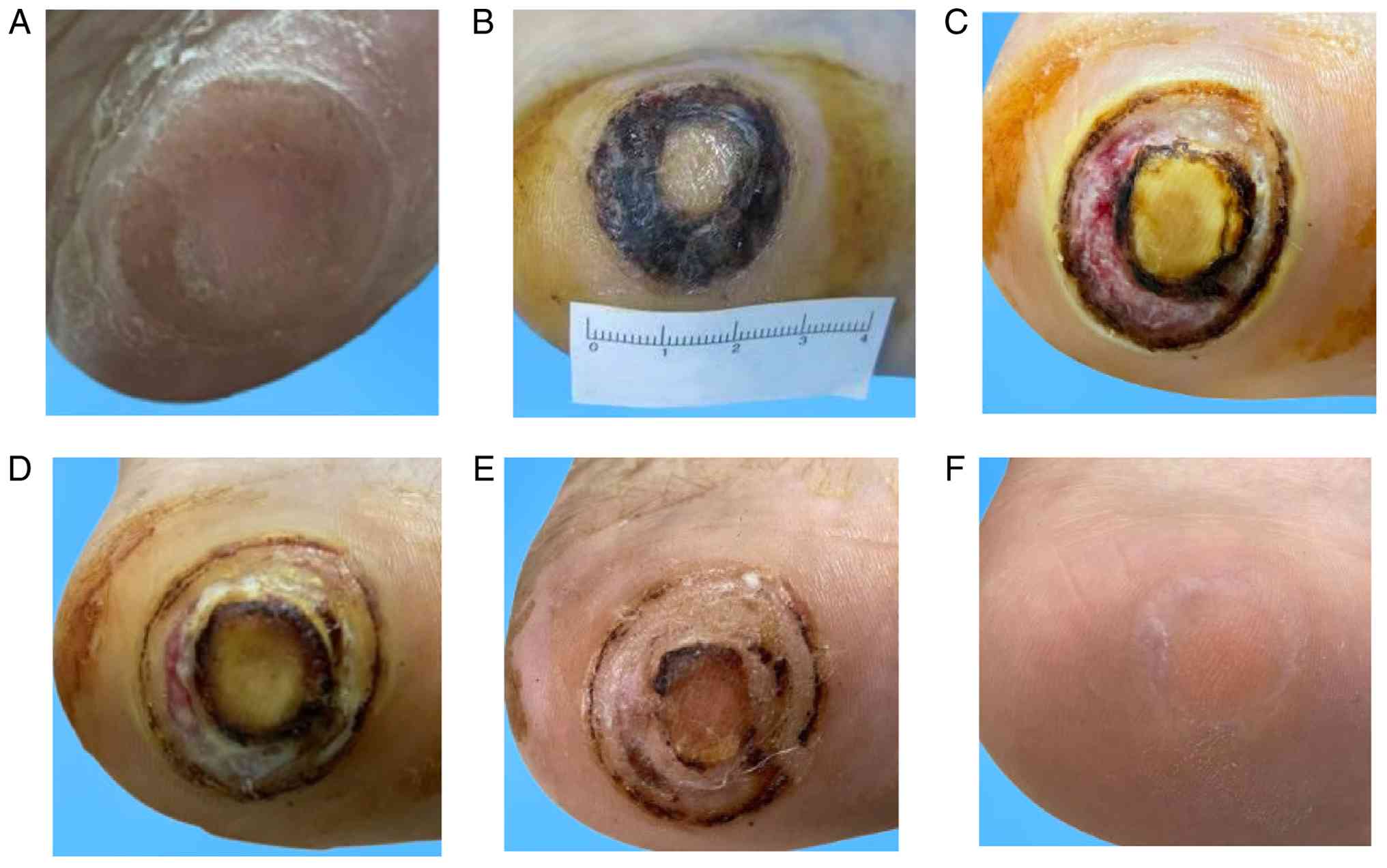
After using a CO2 laser to remove the
wart (Fig. 2A), the patient
underwent the first PDT session in August 2021 (Fig. 2B). A 20% ALA ointment was applied
and covered for 3 h, followed by LED red light (633 nm, 80
mW/cm2) irradiation for 30 min. PDT was performed once
every week for a total of three sessions. The original ulcer had
healed after 7 days, leaving behind a blood scab (Fig. 2C). One week later, the blood scab
detached, revealing fresh granulation tissue (Fig. 2D). The ulcer in the lesion area had
gradually healed 2 weeks after treatment, and by one month after
treatment, the ulcer had almost completely healed (Fig. 2E). At 1 year post-treatment, the
ulcer was fully healed, the plantar wart had completely disappeared
and only small scars remained (Fig.
2F).
A follow-up examination was conducted in June 2025
and HPV genotyping was performed. The clinical examination
confirmed that the lesion had completely healed, and no recurrence
or new warts were found. The photos taken during the follow-up
further proved the continuous clearance of the ring-shaped warts
(Fig. S1). A swab specimen was
obtained in August 2025 from the keratinous debris of a plantar
doughnut warts in the dermatology outpatient department of Huadong
Hospital (Shanghai, China). The sample was cryopreserved in liquid
nitrogen and submitted to a commercial laboratory for HPV
genotyping, including HPV1, HPV2, HPV4, HPV27 and HPV57. Specific
primers were used for each HPV subtype, as shown in Table SI; the PCR reaction system was
configured as specified in Table
SII; the thermal cycling procedure is given in Table SIII. Genotyping results indicated
that HPV1 and HPV27 were positive (Data S1). These findings indicate that
even if clinical manifestations completely disappear, certain skin
HPV subtypes may still exist in a latent form but will not cause
active lesions. These findings emphasize the importance of
continuous monitoring even after clinical cure. The clinical images
and HPV genotyping results from the follow-up are provided in
Fig. S1 and Data S1.
Discussion
Doughnut warts can form not only after cryotherapy
but also after laser treatment, topical salicylic acid and
microwave therapy, although these cases are rarely reported. For
example, a 7-year-old girl developed ring-shaped wart lesions
around two existing warts on the left index finger after one month
of treatment with 17% salicylic acid (8). In these types of cases, HPV is not
fully eradicated but instead spreads due to an altered skin
microenvironment created by the treatment (13). This environment weakens the skin's
barrier, allowing residual HPV to infect surrounding keratinocytes
and form doughnut warts. Electrocautery and microwave therapy have
also been widely employed for the management of common viral warts
(14). Electrocautery enables the
precise ablation of lesional tissue with immediate hemostasis and
minimal injury to surrounding skin, promoting rapid recovery and a
low recurrence rate. Similarly, microwave therapy induces localized
hyperthermia, which denatures viral proteins and stimulates host
immune responses. Haase et al (15) used microwave therapy to treat
plantar warts, achieving positive results. Of the 150 plantar warts
treated, 83.3% disappeared after two to three treatments. However,
no published studies have specifically evaluated electrocautery or
microwave therapy for treating doughnut warts. Both ALA-PDT and
Candida antigen are promising therapeutic options currently.
The clearance rate of plantar warts treated with local injection of
Candida antigen at the base of doughnut warts reaches 82.5%
with mild adverse reactions (16).
Candida local immunotherapy achieves the therapeutic goal by
stimulating a systemic immune response to eliminate HPV-infected
cells. By contrast, the complete cure rate of ALA-PDT for plantar
warts is 88%, with common adverse reactions including pain and
edema. ALA-PDT directly destroys HPV-infected cells through ROS
generated, recruits and activates local immune cells and reshapes
the local immune microenvironment (17). Cryotherapy may promote the
dissemination and reactivation of HPV through multiple mechanisms.
First, cryoablation can impair local immune cell function and
disrupt the cutaneous barrier within the lesion, facilitating viral
spread. Specifically, cryotherapy has been shown to stimulate HPV
DNA replication, driving basal keratinocytes to migrate toward the
epidermal surface and release infectious virions. This process
further compromises the epidermal barrier and enhances viral
dissemination (18). Second,
although cryotherapy elicits a local immune response, it may
simultaneously weaken the immune milieu in adjacent tissues,
allowing latent viruses to reactivate. Once reactivated, migrating
keratinocytes can disseminate these latent virions into untreated
surrounding areas, leading to recurrent infection and the emergence
of new lesions, which often manifest as characteristic doughnut
warts (19). Treatments like
cryotherapy can damage the skin, impairing immune cell function and
promoting viral spread. Furthermore, HPV DNA replication is
stimulated, leading to further viral activity as basal
keratinocytes move to the skin surface and release infectious
particles that damage the skin's barrier and facilitate viral
spread (18).
Unlike cryotherapy, PDT preserves the skin's natural
barrier, preventing HPV spread and reducing the risk of doughnut
wart formation (Fig. 1). PDT
generates ROS, which target and eliminate infected cells while
sparing normal tissue, reducing recurrence. The selective
photosensitizer is absorbed more by lesional tissue than by healthy
tissue, minimizing damage to surrounding skin (20).
HPV evades immune clearance by downregulating
antiviral responses, reducing major histocompatibility-I expression
and inhibiting the T-cell recognition of infected cells (20). Viral warts often exhibit
immune-suppressive features, resembling cold tumors with
insufficient T-cell infiltration, which makes them difficult to
clear. PDT induces ICD, releasing HPV antigens and activating the
immune response in surrounding tissue, promoting the recruitment
and activation of antiviral immune cells to eliminate infected
cells (Fig. 1). Chemokines
released during PDT attract immune cells to the treatment area,
effectively targeting residual HPV.
CO2 laser therapy employs a
CO2 laser to ablate wart tissue and is widely used to
remove periungual and plantar warts. This approach vaporizes the
bulk of the lesion, disrupts virus-infected keratinocytes and
liberates viral particles that can provoke a systemic immune
response (21). The mechanism of
PDT in treating viral warts lies in destroying the infected cells
within the warts through oxidation reactions, thereby reducing
viral replication (22). As
doughnut warts were observed after cryotherapy, PDT was
incorporated into the treatment regimen. ALA has limited
transdermal penetration, but the CO2 laser can remove
hyperkeratotic warts and enhance drug delivery to deeper layers,
increasing the concentration at the lesion site. The recurrence
rate of CO2 laser treatment is >30%. The effective
rate after 8 weeks of treatment is relatively low (13.04%), and its
tolerance is inferior to ALA-PDT (23). PDT has the potential to eliminate
latent viral infections, thereby reducing the recurrence rate. On
the other hand, it can recruit and activate immune cells, including
neutrophils, macrophages and dendritic cells, to enhance the local
immune response (24). By
combining CO2 laser with ALA-PDT photodynamic therapy,
the recurrence rate is significantly reduced (2%), the effective
rate after 8 weeks of treatment increases (36%), and the pain level
also shows a significant and marked reduction (25). ALA-PDT offers a more precise,
comprehensive treatment approach than physical treatments, such as
freezing or laser, which may cause the wart to spread and the
subsequent formation of doughnut warts (26). However, despite its therapeutic
potential, PDT remains considerably more expensive than alternative
modalities and is frequently associated with post-treatment
photosensitivity reactions, most commonly erythema, burning
sensation, pain or hypersensitivity. Fortunately, these adverse
responses are transient and typically resolve spontaneously within
several days of treatment (27).
The present case highlights the successful treatment
of a ‘doughnut wart’, a novel HPV-associated lesion that can arise
following treatments like cryotherapy. The combination of
CO2 laser debridement and ALA-PDT provided a highly
effective treatment regimen for this patient, leading to complete
healing with no recurrence over 1 year. The present case reinforces
the advantages of ALA-PDT in managing resistant warts,
demonstrating its potential to preserve the skin's natural barrier,
reduce recurrence, and enhance immune responses through the
induction of immunogenic cell death. Furthermore, it emphasizes the
importance of continuous monitoring for latent HPV infections even
after clinical resolution. ALA-PDT offers a promising, non-invasive
alternative to conventional wart treatments, particularly in cases
where viral spread occurs post-treatment.
Supplementary Material
Supplementary data
Clinical follow-up photograph taken 4
years after cryotherapy. No recurrence of the doughnut wart was
observed and the lesion remained completely resolved, indicating
sustained long-term therapeutic efficacy of the initial cryotherapy
combined with photodynamic therapy.
Sequences of the primers used for
PCR.
PCR amplification process
PCR thermocycling conditions.
Acknowledgements
Not applicable.
Funding
Funding: The study was supported by the National Natural Science
Foundation of China (grant no. 82473556), Huadong Hospital Elite
Talent (grant no. JYRC2204), and the Clinical Research Plan of
Shanghai Municipal Hospital Skin Clinic Clinical Capability
Promotion and Enhancement Specialized Alliance (grant no.
SHDC22025306).
Availability of data and materials
The data generated in the present study may be
requested from the corresponding author.
Authors' contributions
LS designed the study and was responsible for the
histopathological analysis. KL was responsible for collecting and
initially analyzing the medical record data. YTQ conducted a
literature review and revised and supplemented the manuscript. WJZ
was responsible for the clinical assessment of the case and the
writing of the discussion section. YTQ and WJZ have checked and
confirmed the authenticity of all the raw data. All the authors
were involved in the conception of the study and the analysis of
the data. They have all read and approved the final manuscript, and
unanimously agreed to the final version of the paper.
Ethics approval and consent to
participate
Not applicable.
Patient consent for publication
The patient provided written informed consent for
their photographs and medical information to be published in print
and online and the understanding that this information may be
publicly available.
Competing interests
The authors declare that they have no competing
interests.
References
|
1
|
Findlay GH: Wart relapses at the edges of
therapeutic cantharidin blisters. Arch Dermatol. 80:589–590.
1959.PubMed/NCBI View Article : Google Scholar
|
|
2
|
Berth-Jones J and Hutchinson PE: Modern
treatment of warts: Cure rates at 3 and 6 months. Br J Dermatol.
127:262–265. 1992.PubMed/NCBI View Article : Google Scholar
|
|
3
|
Youn SH, Kwon IH, Park EJ, Kim KH and Kim
KJ: A two-week interval is better than a three-week interval for
reducing the recurrence rate of hand-foot viral warts after
cryotherapy: A retrospective review of 560 hand-foot viral warts
patients. Ann Dermatol. 23:53–60. 2011.PubMed/NCBI View Article : Google Scholar
|
|
4
|
Xie J, Ao C, Li J, Jiang L, Liu H and Zeng
K: 5-aminolevulinic acid photodynamic therapy for condyloma
acuminatum of urethral meatus. J Dermatolog Treat. 30:714–717.
2019.PubMed/NCBI View Article : Google Scholar
|
|
5
|
Li J, Yi Y and Zhu W: Three stages of
5-aminolevulinic acid-photodynamic therapy for condyloma acuminatum
of external urethral meatus. Zhong Nan Da Xue Xue Bao Yi Xue Ban.
36:1115–1119. 2011.PubMed/NCBI View Article : Google Scholar : (In Chinese).
|
|
6
|
Ao C, Xie J, Wang L, Li S, Li J, Jiang L,
Liu H and Zeng K: 5-aminolevulinic acid photodynamic therapy for
anal canal condyloma acuminatum: A series of 19 cases and
literature review. Photodiagnosis Photodyn Ther. 23:230–234.
2018.PubMed/NCBI View Article : Google Scholar
|
|
7
|
Fehr MK, Hornung R, Degen A, Schwarz VA,
Fink D, Haller U and Wyss P: Photodynamic therapy of vulvar and
vaginal condyloma and intraepithelial neoplasia using topically
applied 5-aminolevulinic acid. Lasers Surg Med. 30:273–279.
2002.PubMed/NCBI View Article : Google Scholar
|
|
8
|
Sethy M, Srinivas CR, Krishna V and
Chadalavada P: Doughnut wart following salicylic acid application:
A rare case report. Indian Dermatol Online J. 12:451–453.
2021.PubMed/NCBI View Article : Google Scholar
|
|
9
|
Wu A, Niu J, Hong Z, Gu L, Huang Y and Qiu
L: The effects of 5-aminolevulinic acid photodynamic therapy on the
local immune response of women with cervical intraepithelial
neoplasia grade 2. Front Immunol. 14(1211114)2023.PubMed/NCBI View Article : Google Scholar
|
|
10
|
Shanazarov N, Grishacheva T, Aitkaliyev A,
Salmaganbetova Z, Smailova S, Imankulova B, Afanasiev M and Dushkin
A: Assessment of systemic reaction to inflammation induced by
photodynamic therapy in cervical intraepithelial neoplasia.
Photodiagnosis Photodyn Ther. 50(104416)2024.PubMed/NCBI View Article : Google Scholar
|
|
11
|
Xiong Y, Yong Z, Zhao Q, Hua A, Wang X,
Chen X, Yang X and Li Z: Hydroxyethyl starch-based self-reinforced
nanomedicine inhibits both glutathione and thioredoxin antioxidant
pathways to boost reactive oxygen species-powered immunotherapy.
Biomaterials. 311(122673)2024.PubMed/NCBI View Article : Google Scholar
|
|
12
|
Aebisher D, Przygórzewska A and
Bartusik-Aebisher D: The latest look at PDT and immune checkpoints.
Curr Issues Mol Biol. 46:7239–7257. 2024.PubMed/NCBI View Article : Google Scholar
|
|
13
|
Venuti A, Lohse S, Tommasino M and Smola
S: Cross-talk of cutaneous beta human papillomaviruses and the
immune system: Determinants of disease penetrance. Philos Trans R
Soc Lond B Biol Sci. 374(20180287)2019.PubMed/NCBI View Article : Google Scholar
|
|
14
|
Israr M, DeVoti JA, Lam F, Abramson AL,
Steinberg BM and Bonagura VR: Altered monocyte and langerhans cell
innate immunity in patients with recurrent respiratory
papillomatosis (RRP). Front Immunol. 11(336)2020.PubMed/NCBI View Article : Google Scholar
|
|
15
|
Haase O, Barkawi A, Mrowka P and Krengel
S: Microwave therapy for the treatment of resistant plantar warts:
A randomized, placebo-controlled clinical trial. Arch Dermatol Res.
317(208)2025.PubMed/NCBI View Article : Google Scholar
|
|
16
|
Nofal A, Adel L, Fawzy M and Elkholy BM:
Intralesional immunotherapy for multiple recalcitrant plantar
warts: Candida antigen is superior to intralesional purified
protein derivative. Dermatol Ther. 35(e15440)2022.PubMed/NCBI View Article : Google Scholar
|
|
17
|
Wang H, Xiong L, Xia Y and Wang X:
5-aminolaevulinic acid-based photodynamic therapy induces both
necrosis and apoptosis of keratinocytes in plantar warts. J Cosmet
Laser Ther. 22:165–170. 2020.PubMed/NCBI View Article : Google Scholar
|
|
18
|
Witchey DJ, Witchey NB, Roth-Kauffman MM
and Kauffman MK: Plantar warts: Epidemiology, pathophysiology, and
clinical management. J Am Osteopath Assoc. 118:92–105.
2018.PubMed/NCBI View Article : Google Scholar
|
|
19
|
García-Oreja S, Álvaro-Afonso FJ,
Tardáguila-García A, López-Moral M, García-Madrid M and
Lázaro-Martínez JL: Efficacy of cryotherapy for plantar warts: A
systematic review and meta-analysis. Dermatol Ther.
35(e15480)2022.PubMed/NCBI View Article : Google Scholar
|
|
20
|
Kim M, Jung HY and Park HJ: Topical PDT in
the treatment of benign skin diseases: Principles and new
applications. Int J Mol Sci. 16:23259–23278. 2015.PubMed/NCBI View Article : Google Scholar
|
|
21
|
Hughes PS and Hughes AP: Absence of human
papillomavirus DNA in the plume of erbium:YAG laser-treated warts.
J Am Acad Dermatol. 38:426–428. 1998.PubMed/NCBI View Article : Google Scholar
|
|
22
|
Chen Y, Mei Y, Gu L, Li X, Guo P, Chen L
and He D: A novel PDT: 5-aminolevulinic acid combined 450 nm blue
laser photodynamic therapy significantly promotes cell death of
HR-HPV infected cells. Artif Cells Nanomed Biotechnol. 51:22–32.
2023.PubMed/NCBI View Article : Google Scholar
|
|
23
|
Tu P, Zhang H, Zheng H, Gu H, Xu J, Tao J,
Wang H, Zhu X and Wang X: 5-Aminolevulinic photodynamic therapy
versus carbon dioxide laser therapy for small genital warts: A
multicenter, randomized, open-label trial. J Am Acad Dermatol.
84:779–781. 2021.PubMed/NCBI View Article : Google Scholar
|
|
24
|
Dudzik T, Domański I and Makuch S: The
impact of photodynamic therapy on immune system in cancer-an
update. Front Immunol. 15(1335920)2024.PubMed/NCBI View Article : Google Scholar
|
|
25
|
Li Y, Wang Q, Zhong W, Pan X, Zhang M and
Chi L: Clinical efficacy of CO2 laser combined with
5-aminolevulinic acid photodynamic therapy in treating periungual
and plantar warts. Am J Transl Res. 16:7364–7373. 2024.PubMed/NCBI View Article : Google Scholar
|
|
26
|
Wu C, Qiu X, He C and Ci C: Effect of
5-aminolevulinic acid photodynamic therapy with transfer factor
capsules in the treatment of multiple plantar warts. Biomed Res
Int. 2022(1220889)2022.PubMed/NCBI View Article : Google Scholar
|
|
27
|
Hu YE, Dai SF, Wang B, Qu W and Gao JL:
Therapeutic effects of topical 5-aminolevulinic acid photodynamic
therapy. Pak J Med Sci. 32:961–964. 2016.PubMed/NCBI View Article : Google Scholar
|