Spandidos Publications Logo
  • About
    • About Spandidos
    • Aims and Scopes
    • Abstracting and Indexing
    • Editorial Policies
    • Reprints and Permissions
    • Job Opportunities
    • Terms and Conditions
    • Contact
  • Journals
    • All Journals
    • Oncology Letters
      • Oncology Letters
      • Information for Authors
      • Editorial Policies
      • Editorial Board
      • Aims and Scope
      • Abstracting and Indexing
      • Bibliographic Information
      • Archive
    • International Journal of Oncology
      • International Journal of Oncology
      • Information for Authors
      • Editorial Policies
      • Editorial Board
      • Aims and Scope
      • Abstracting and Indexing
      • Bibliographic Information
      • Archive
    • Molecular and Clinical Oncology
      • Molecular and Clinical Oncology
      • Information for Authors
      • Editorial Policies
      • Editorial Board
      • Aims and Scope
      • Abstracting and Indexing
      • Bibliographic Information
      • Archive
    • Experimental and Therapeutic Medicine
      • Experimental and Therapeutic Medicine
      • Information for Authors
      • Editorial Policies
      • Editorial Board
      • Aims and Scope
      • Abstracting and Indexing
      • Bibliographic Information
      • Archive
    • International Journal of Molecular Medicine
      • International Journal of Molecular Medicine
      • Information for Authors
      • Editorial Policies
      • Editorial Board
      • Aims and Scope
      • Abstracting and Indexing
      • Bibliographic Information
      • Archive
    • Biomedical Reports
      • Biomedical Reports
      • Information for Authors
      • Editorial Policies
      • Editorial Board
      • Aims and Scope
      • Abstracting and Indexing
      • Bibliographic Information
      • Archive
    • Oncology Reports
      • Oncology Reports
      • Information for Authors
      • Editorial Policies
      • Editorial Board
      • Aims and Scope
      • Abstracting and Indexing
      • Bibliographic Information
      • Archive
    • Molecular Medicine Reports
      • Molecular Medicine Reports
      • Information for Authors
      • Editorial Policies
      • Editorial Board
      • Aims and Scope
      • Abstracting and Indexing
      • Bibliographic Information
      • Archive
    • World Academy of Sciences Journal
      • World Academy of Sciences Journal
      • Information for Authors
      • Editorial Policies
      • Editorial Board
      • Aims and Scope
      • Abstracting and Indexing
      • Bibliographic Information
      • Archive
    • International Journal of Functional Nutrition
      • International Journal of Functional Nutrition
      • Information for Authors
      • Editorial Policies
      • Editorial Board
      • Aims and Scope
      • Abstracting and Indexing
      • Bibliographic Information
      • Archive
    • International Journal of Epigenetics
      • International Journal of Epigenetics
      • Information for Authors
      • Editorial Policies
      • Editorial Board
      • Aims and Scope
      • Abstracting and Indexing
      • Bibliographic Information
      • Archive
    • Medicine International
      • Medicine International
      • Information for Authors
      • Editorial Policies
      • Editorial Board
      • Aims and Scope
      • Abstracting and Indexing
      • Bibliographic Information
      • Archive
  • Articles
  • Information
    • Information for Authors
    • Information for Reviewers
    • Information for Librarians
    • Information for Advertisers
    • Conferences
  • Language Editing
Spandidos Publications Logo
  • About
    • About Spandidos
    • Aims and Scopes
    • Abstracting and Indexing
    • Editorial Policies
    • Reprints and Permissions
    • Job Opportunities
    • Terms and Conditions
    • Contact
  • Journals
    • All Journals
    • Biomedical Reports
      • Information for Authors
      • Editorial Policies
      • Editorial Board
      • Aims and Scope
      • Abstracting and Indexing
      • Bibliographic Information
      • Archive
    • Experimental and Therapeutic Medicine
      • Information for Authors
      • Editorial Policies
      • Editorial Board
      • Aims and Scope
      • Abstracting and Indexing
      • Bibliographic Information
      • Archive
    • International Journal of Epigenetics
      • Information for Authors
      • Editorial Policies
      • Editorial Board
      • Aims and Scope
      • Abstracting and Indexing
      • Bibliographic Information
      • Archive
    • International Journal of Functional Nutrition
      • Information for Authors
      • Editorial Policies
      • Editorial Board
      • Aims and Scope
      • Abstracting and Indexing
      • Bibliographic Information
      • Archive
    • International Journal of Molecular Medicine
      • Information for Authors
      • Editorial Policies
      • Editorial Board
      • Aims and Scope
      • Abstracting and Indexing
      • Bibliographic Information
      • Archive
    • International Journal of Oncology
      • Information for Authors
      • Editorial Policies
      • Editorial Board
      • Aims and Scope
      • Abstracting and Indexing
      • Bibliographic Information
      • Archive
    • Medicine International
      • Information for Authors
      • Editorial Policies
      • Editorial Board
      • Aims and Scope
      • Abstracting and Indexing
      • Bibliographic Information
      • Archive
    • Molecular and Clinical Oncology
      • Information for Authors
      • Editorial Policies
      • Editorial Board
      • Aims and Scope
      • Abstracting and Indexing
      • Bibliographic Information
      • Archive
    • Molecular Medicine Reports
      • Information for Authors
      • Editorial Policies
      • Editorial Board
      • Aims and Scope
      • Abstracting and Indexing
      • Bibliographic Information
      • Archive
    • Oncology Letters
      • Information for Authors
      • Editorial Policies
      • Editorial Board
      • Aims and Scope
      • Abstracting and Indexing
      • Bibliographic Information
      • Archive
    • Oncology Reports
      • Information for Authors
      • Editorial Policies
      • Editorial Board
      • Aims and Scope
      • Abstracting and Indexing
      • Bibliographic Information
      • Archive
    • World Academy of Sciences Journal
      • Information for Authors
      • Editorial Policies
      • Editorial Board
      • Aims and Scope
      • Abstracting and Indexing
      • Bibliographic Information
      • Archive
  • Articles
  • Information
    • For Authors
    • For Reviewers
    • For Librarians
    • For Advertisers
    • Conferences
  • Language Editing
Login Register Submit
  • This site uses cookies
  • You can change your cookie settings at any time by following the instructions in our Cookie Policy. To find out more, you may read our Privacy Policy.

    I agree
Search articles by DOI, keyword, author or affiliation
Search
Advanced Search
presentation
Experimental and Therapeutic Medicine
Join Editorial Board Propose a Special Issue
Print ISSN: 1792-0981 Online ISSN: 1792-1015
Journal Cover
April-2026 Volume 31 Issue 4

Full Size Image

Sign up for eToc alerts
Recommend to Library

Journals

International Journal of Molecular Medicine

International Journal of Molecular Medicine

International Journal of Molecular Medicine is an international journal devoted to molecular mechanisms of human disease.

International Journal of Oncology

International Journal of Oncology

International Journal of Oncology is an international journal devoted to oncology research and cancer treatment.

Molecular Medicine Reports

Molecular Medicine Reports

Covers molecular medicine topics such as pharmacology, pathology, genetics, neuroscience, infectious diseases, molecular cardiology, and molecular surgery.

Oncology Reports

Oncology Reports

Oncology Reports is an international journal devoted to fundamental and applied research in Oncology.

Experimental and Therapeutic Medicine

Experimental and Therapeutic Medicine

Experimental and Therapeutic Medicine is an international journal devoted to laboratory and clinical medicine.

Oncology Letters

Oncology Letters

Oncology Letters is an international journal devoted to Experimental and Clinical Oncology.

Biomedical Reports

Biomedical Reports

Explores a wide range of biological and medical fields, including pharmacology, genetics, microbiology, neuroscience, and molecular cardiology.

Molecular and Clinical Oncology

Molecular and Clinical Oncology

International journal addressing all aspects of oncology research, from tumorigenesis and oncogenes to chemotherapy and metastasis.

World Academy of Sciences Journal

World Academy of Sciences Journal

Multidisciplinary open-access journal spanning biochemistry, genetics, neuroscience, environmental health, and synthetic biology.

International Journal of Functional Nutrition

International Journal of Functional Nutrition

Open-access journal combining biochemistry, pharmacology, immunology, and genetics to advance health through functional nutrition.

International Journal of Epigenetics

International Journal of Epigenetics

Publishes open-access research on using epigenetics to advance understanding and treatment of human disease.

Medicine International

Medicine International

An International Open Access Journal Devoted to General Medicine.

Journal Cover
April-2026 Volume 31 Issue 4

Full Size Image

Sign up for eToc alerts
Recommend to Library

  • Article
  • Citations
    • Cite This Article
    • Download Citation
    • Create Citation Alert
    • Remove Citation Alert
    • Cited By
  • Similar Articles
    • Related Articles (in Spandidos Publications)
    • Similar Articles (Google Scholar)
    • Similar Articles (PubMed)
  • Download PDF
  • Download XML
  • View XML

  • Supplementary Files
    • Supplementary_Data1.pdf
    • Supplementary_Data2.pdf
Article

IGFBP1 as a metabolic‑neurodegenerative biomarker in spinocerebellar ataxia type 3

  • Authors:
    • Chungmin Chiu
    • Wenling Cheng
    • Tatsung Lin
    • Huiju Chang
    • Yujun Chang
    • Shihli Su
    • Chiaju Lee
    • Henhong Chang
    • Chinsan Liu
  • View Affiliations / Copyright

    Affiliations: Department of Chinese Medicine, Changhua Christian Hospital, Changhua 50006, Taiwan, R.O.C., Vascular and Genomic Center, Institute of ATP, Changhua Christian Hospital, Changhua 50006, Taiwan, R.O.C., Center of Regenerative Medicine and Tissue Repair, Institute of ATP, Changhua Christian Hospital, Changhua 50006, Taiwan, R.O.C., Big Data Center, Changhua Christian Hospital, Changhua 50006, Taiwan, R.O.C., Vascular Medicine and Diabetes Research Center, Institute of ATP, Changhua Christian Hospital, Changhua 50006, Taiwan, R.O.C., Department of Neurology, Changhua Christian Hospital, Changhua 50006, Taiwan, R.O.C., Graduate Institute of Integrated Medicine, College of Chinese Medicine, China Medical University, Taichung 40447, Taiwan, R.O.C.
  • Article Number: 105
    |
    Published online on: February 10, 2026
       https://doi.org/10.3892/etm.2026.13100
  • Expand metrics +
Metrics: Total Views: 0 (Spandidos Publications: | PMC Statistics: )
Metrics: Total PDF Downloads: 0 (Spandidos Publications: | PMC Statistics: )
Cited By (CrossRef): 0 citations Loading Articles...

This article is mentioned in:


Abstract

Spinocerebellar ataxia type 3 (SCA3) is a progressive neurodegenerative disorder for which reliable metabolic biomarkers are lacking. Insulin‑like growth factor binding protein 1 (IGFBP1), a stress‑responsive protein regulated by insulin signaling, serves as an indicator of neurodegenerative burden. The present study aimed to measure the plasma levels of insulin, glucose, IGF1, IGF2, IGFBP1, IGFBP3 and neurofilament light chain (NfL) in patients with genetically confirmed SCA3 and age‑matched controls. In addition, the association between the above molecules and clinical severity were assessed using the scale for the Assessment and Rating of Ataxia score, body mass index (BMI) and NfL levels, whereas metabolic‑neurodegenerative interactions were assessed by stratifying patients by insulin tertiles. A total of 32 individuals with SCA3 and 36 age‑ and sex‑matched controls were enrolled in the current study. The results demonstrated that patients with SCA3 exhibited markedly elevated IGFBP1, IGF2 and free IGF1 levels, as well as reduced insulin and higher glucose‑to‑insulin ratios, thus indicating disrupted insulin signaling. IGFBP1 was positively associated with SARA score and NfL levels and negatively associated with BMI. Notably, patients in the lowest insulin tertile (<3.65 µIU/ml) showed significantly higher IGFBP1 and NfL levels compared with the remaining groups, thus suggesting that the insulin/IGFBP1/NfL axis was associated with ataxia severity. Collectively, IGFBP1 could be a promising peripheral biomarker reflecting both metabolic and neurodegenerative processes in SCA3 and could facilitate monitoring of disease stages.
View Figures

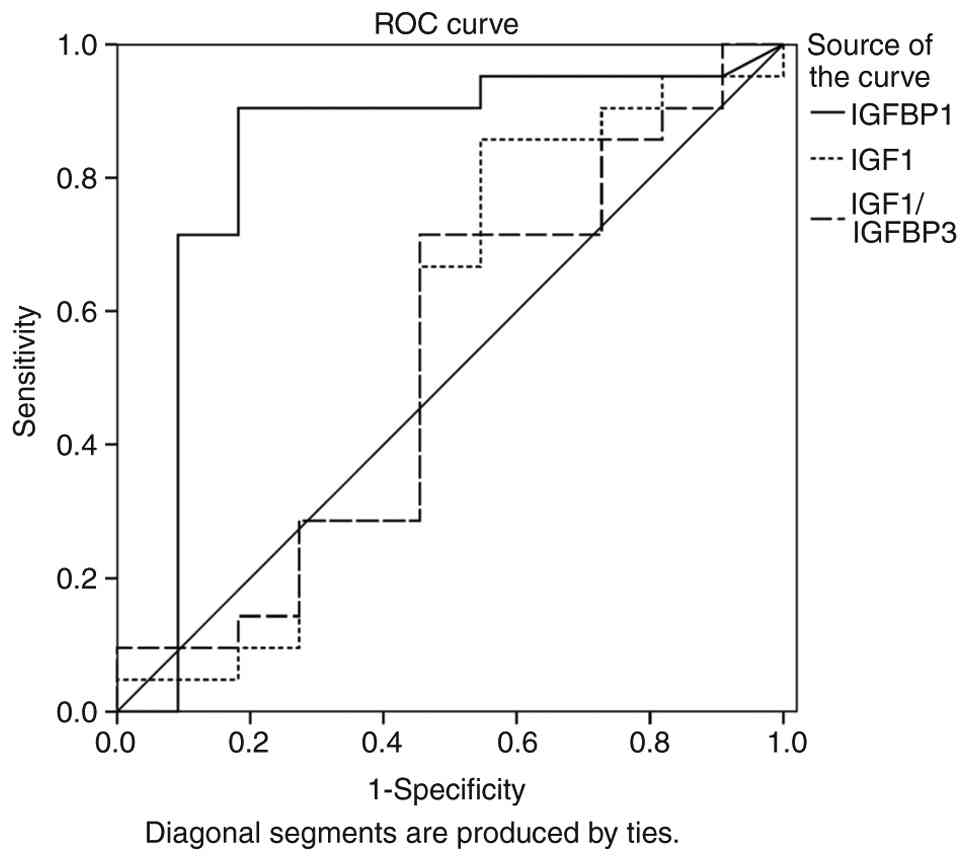
Figure 1

ROC curve analysis of IGFBP1 and
other insulin/IGF1 signaling-associated markers for distinguishing
early- and advanced-stage spinocerebellar ataxia type 3. ROC,
receiver operating characteristic; IGF, insulin-like growth factor;
IGFBP, IGF binding protein.

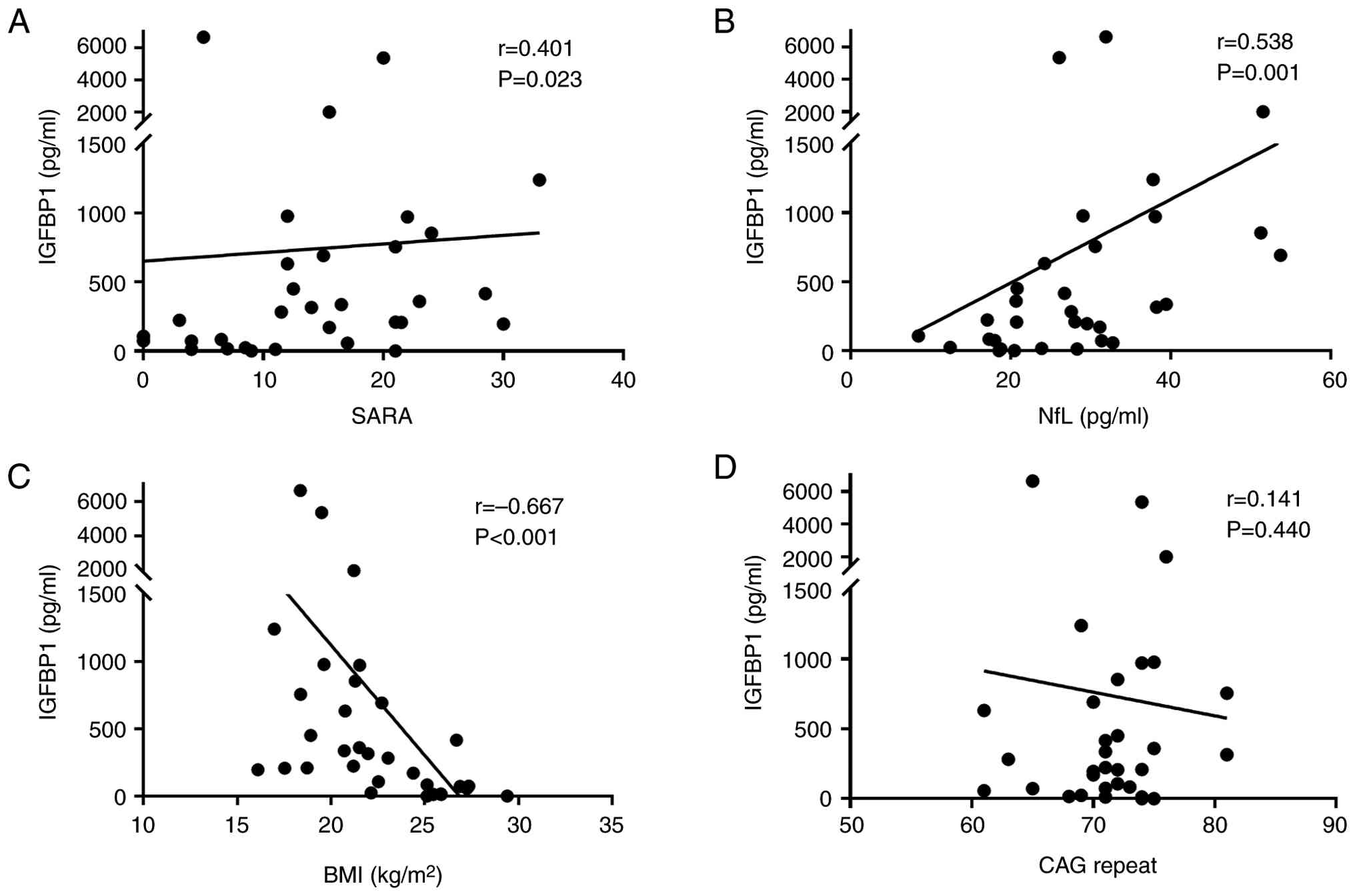
Figure 2

Correlation between plasma IGFBP1 and
clinical parameters. Spearman's correlation analyses between IGFBP1
and (A) scale for the assessment and rating of ataxia, (B)
neurofilament light chain, (C) body mass index and (D) CAG repeat
length in patients with spinocerebellar ataxia type 3. IGFBP1,
insulin-like growth factor binding protein 1; SARA, scale for the
assessment and rating of ataxia; NFL, neurofilament light chain;
BMI, body mass index.

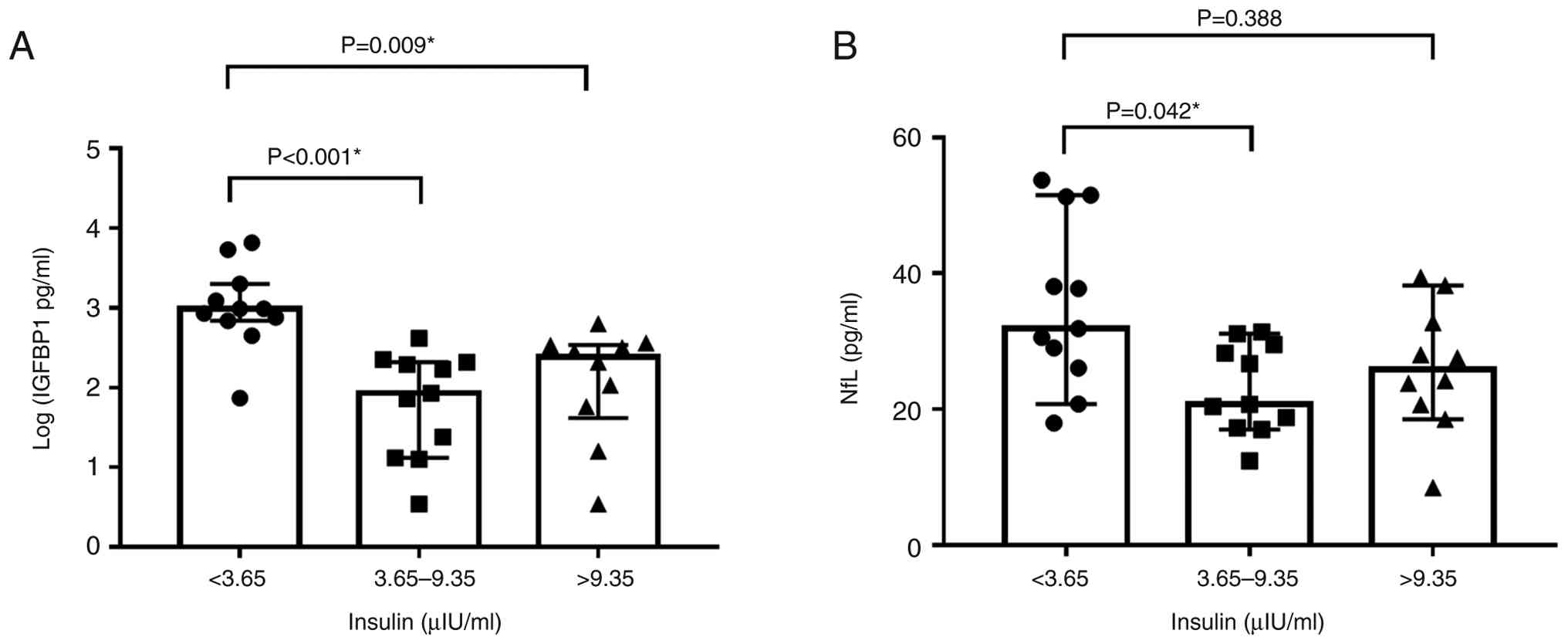
Figure 3

Associations between insulin levels,
NfL and IGFBP1 in the spinocerebellar ataxia type 3 cohort.
Participants were stratified into tertiles based on plasma insulin
concentrations: First tertile (n=11; <3.65 µIU/ml), second
tertile (n=11; 3.65-9.35 µIU/ml) and third tertile (n=10; >9.35
µIU/ml). (A) Associations between insulin levels and
log-transformed IGFBP1 is shown. (B) Association between insulin
levels and plasma NfL are presented. Data are expressed as the
median ± interquartile range. Statistical significance was
determined by Kruskal-Wallis test followed by Dunn's post hoc test.
*P<0.05. NfL, neurofilament light chain; IGFBP1,
insulin-like growth factor binding protein 1.
View References

1 

Sadagurski M and White MF: Integrating metabolism and longevity through insulin and IGF1 signaling. Endocrinol Metab Clin North Am. 42:127–148. 2013.PubMed/NCBI View Article : Google Scholar

2 

Werner H: The IGF1 signaling pathway: From basic concepts to therapeutic opportunities. Int J Mol Sci. 24(14882)2023.PubMed/NCBI View Article : Google Scholar

3 

Majumder P, Roy K, Bagh S and Mukhopadhyay D: Receptor tyrosine kinases (RTKs) consociate in regulatory clusters in Alzheimer's disease and type 2 diabetes. Mol Cell Biochem. 459:171–182. 2019.PubMed/NCBI View Article : Google Scholar

4 

Muddapu VR, Dharshini SAP, Chakravarthy VS and Gromiha MM: Neurodegenerative diseases-is metabolic deficiency the root cause? Front Neurosci. 14(213)2020.PubMed/NCBI View Article : Google Scholar

5 

Paulson H and Shakkottai V: Spinocerebellar ataxia type 3. In: GeneReviews® [Internet]. Adam MP, Bick S, Mirzaa GM, Pagon RA, Wallace SE and Amemiya A (eds.), Seattle (WA): University of Washington, Seattle, 1993.

6 

Chen Y, Jin Y, Hu Z, Qiu M, Li D, Cai Q, Tao C, Lou D, Qi L, Chen S, et al: Association between serum neurofilament light chain and neurochemistry deficits in patients with spinocerebellar ataxia type 3. Cerebellum. 23:92–100. 2024.PubMed/NCBI View Article : Google Scholar

7 

Wilke C, Haas E, Reetz K, Faber J, Garcia-Moreno H, Santana MM, van de Warrenburg B, Hengel H, Lima M, Filla A, et al: Neurofilaments in spinocerebellar ataxia type 3: Blood biomarkers at the preataxic and ataxic stage in humans and mice. EMBO Mol Med. 12(e11803)2020.PubMed/NCBI View Article : Google Scholar

8 

Saute JAM, da Silva ACF, Muller AP, Hansel G, de Mello AS, Maeda F, Vedolin L, Saraiva-Pereira ML, Souza DO, Arpa J, et al: Serum insulin-like system alterations in patients with spinocerebellar ataxia type 3. Mov Disord. 26:731–735. 2011.PubMed/NCBI View Article : Google Scholar

9 

Torres-Aleman I, Barrios V, Lledo A and Berciano J: The insulin-like growth factor I system in cerebellar degeneration. Ann Neurol. 39:335–342. 1996.PubMed/NCBI View Article : Google Scholar

10 

Crosby S, Tsigos C, Anderton C, Gordon C, Young R and White A: Elevated plasma insulin-like growth factor binding protein-1 levels in type 1 (insulin-dependent) diabetic patients with peripheral neuropathy. Diabetologia. 35:868–872. 1992.PubMed/NCBI View Article : Google Scholar

11 

Busiguina S, Fernandez AM, Barrios V, Clark R, Tolbert DL, Berciano J and Torres-Aleman I: Neurodegeneration is associated to changes in serum insulin-like growth factors. Neurobiol Dis. 7:657–665. 2000.PubMed/NCBI View Article : Google Scholar

12 

Lang CH and Frost RA: Role of growth hormone, insulin-like growth factor-I, and insulin-like growth factor binding proteins in the catabolic response to injury and infection. Curr Opin Clin Nutr Metab Care. 5:271–279. 2002.PubMed/NCBI View Article : Google Scholar

13 

Wu S, Liu K, Cheng W, Su S, Lin Y, Lin T, Cheng Y, Chang J, Wu Y and Liu C: Growth hormone rescue cerebellar degeneration in SCA3 transgenic mice. Biochem Biophys Res Commun. 529:467–473. 2020.PubMed/NCBI View Article : Google Scholar

14 

Arpa J, Sanz-Gallego I, Medina-Báez J, Portela LV, Jardim LB, Torres-Aleman I and Saute JA: Subcutaneous insulin-like growth factor-1 treatment in spinocerebellar ataxias: An open label clinical trial. Mov Disord. 26:358–359. 2011.PubMed/NCBI View Article : Google Scholar

15 

Lin YS, Cheng WL, Chang JC, Lin TT, Chao YC and Liu CS: IGF-1 as a potential therapy for spinocerebellar ataxia type 3. Biomedicines. 10(505)2022.PubMed/NCBI View Article : Google Scholar

16 

Schmitz-Hübsch T, du Montcel ST, Baliko L, Berciano J, Boesch S, Depondt C, Giunti P, Globas C, Infante J, Kang JS, et al: Scale for the assessment and rating of ataxia: Development of a new clinical scale. Neurology. 66:1717–1720. 2006.PubMed/NCBI View Article : Google Scholar

17 

Yang JS, Chen PP, Lin MT, Qian MZ, Lin HX, Chen XP, Shang XJ, Wang DN, Chen YC, Jiang B, et al: Association between body mass index and disease severity in Chinese spinocerebellar ataxia type 3 patients. Cerebellum. 17:494–498. 2018.PubMed/NCBI View Article : Google Scholar

18 

Alehagen U, Johansson P, Aaseth J, Alexander J and Brismar K: Increase in insulin-like growth factor 1 (IGF-1) and insulin-like growth factor binding protein 1 after supplementation with selenium and coenzyme Q10. A prospective randomized double-blind placebo-controlled trial among elderly Swedish citizens. PLoS One. 12(e0178614)2017.PubMed/NCBI View Article : Google Scholar

19 

Zhou J, Lei L, Liao X, Wang J, Jiang H, Tang B and Shen L: Related factors of ICARS and SARA scores on spinocerebellar ataxia type 3/Machado-Joseph disease. Zhong Nan Da Xue Xue Bao Yi Xue Ban. 36:498–503. 2011.PubMed/NCBI View Article : Google Scholar

20 

Li QF, Dong Y, Yang L, Xie JJ, Ma Y, Du YC, Cheng HL, Ni W and Wu ZY: Neurofilament light chain is a promising serum biomarker in spinocerebellar ataxia type 3. Mol Neurodegener. 14(39)2019.PubMed/NCBI View Article : Google Scholar

21 

Maas RPPWM, van Gaalen J, Klockgether T and van de Warrenburg BPC: The preclinical stage of spinocerebellar ataxias. Neurology. 85:96–103. 2015.PubMed/NCBI View Article : Google Scholar

22 

Hancox RJ and Landhuis CE: Correlation between measures of insulin resistance in fasting and non-fasting blood. Diabetol Metab Syndr. 3(23)2011.PubMed/NCBI View Article : Google Scholar

23 

Chiu C, Cheng W, Lin Y, Lin T, Chang H, Chang Y, Lee C, Chang H and Liu C: A pilot study: Handgrip as a predictor in the disease progression of SCA3. Orphanet J Rare Dis. 18(317)2023.PubMed/NCBI View Article : Google Scholar

24 

Levy JC, Matthews DR and Hermans MP: Correct homeostasis model assessment (HOMA) evaluation uses the computer program. Diabetes Care. 21:2191–2192. 1998.PubMed/NCBI View Article : Google Scholar

25 

Katz A, Nambi SS, Mather K, Baron AD, Follmann DA, Sullivan G and Quon MJ: Quantitative insulin sensitivity check index: A simple, accurate method for assessing insulin sensitivity in humans. J Clin Endocrinol Metab. 85:2402–2410. 2000.PubMed/NCBI View Article : Google Scholar

26 

Molina-Castro M, Rowitz B and Pepino MY: Glucagon-like peptide-1, fibroblast growth factor 21, and other endocrine responses to alcohol ingestion in women before and after metabolic surgery. Front Pharmacol. 16(1575156)2025.PubMed/NCBI View Article : Google Scholar

27 

Rajaram S, Baylink DJ and Mohan S: Insulin-like growth factor-binding proteins in serum and other biological fluids: Regulation and functions. Endocr Rev. 18:801–831. 1997.PubMed/NCBI View Article : Google Scholar

28 

Lee PD, Conover CA and Powell DR: Regulation and function of insulin-like growth factor-binding protein-1. Proc Soc Exp Biol Med. 204:4–29. 1993.PubMed/NCBI View Article : Google Scholar

29 

Bunn RC, King WD, Winkler MK and Fowlkes JL: Early developmental changes in IGF-I, IGF-II, IGF binding protein-1, and IGF binding protein-3 concentration in the cerebrospinal fluid of children. Pediatr Res. 58:89–93. 2005.PubMed/NCBI View Article : Google Scholar

30 

Lewitt MS and Boyd GW: The role of insulin-like growth factors and insulin-like growth factor-binding proteins in the nervous system. Biochem Insights. 12(1178626419842176)2019.PubMed/NCBI View Article : Google Scholar

31 

Ramani B, Panwar B, Moore LR, Wang B, Huang R, Guan Y and Paulson HL: Comparison of spinocerebellar ataxia type 3 mouse models identifies early gain-of-function, cell-autonomous transcriptional changes in oligodendrocytes. Hum Mol Genet. 26:3362–3374. 2017.PubMed/NCBI View Article : Google Scholar

32 

Schuster KH, Zalon AJ, Zhang H, DiFranco DM, Stec NR, Haque Z, Blumenstein KG, Pierce AM, Guan Y, Paulson HL and McLoughlin HS: Impaired oligodendrocyte maturation is an early feature in SCA3 disease pathogenesis. J Neurosci. 42:1604–1617. 2022.PubMed/NCBI View Article : Google Scholar

33 

Evert BO, Vogt IR, Vieira-Saecker AM, Ozimek L, de Vos RA, Brunt ER, Klockgether T and Wüllner U: Gene expression profiling in ataxin-3 expressing cell lines reveals distinct effects of normal and mutant ataxin-3. J Neuropathol Exp Neurol. 62:1006–1018. 2003.PubMed/NCBI View Article : Google Scholar

34 

Nolte AA, Movin M, Lundin H and Salminen H: IGFBP-1 predicts all-cause mortality in elderly women independently of IGF-I. Growth Horm IGF Res. 25:281–285. 2015.PubMed/NCBI View Article : Google Scholar

35 

Leite CMBA, Schieferdecker MEM, Frehner C, Munhoz RP, Ashizawa T and Teive HAG: Body composition in Spinocerebellar ataxia type 3 and 10 patients: Comparative study with control group. Nutr Neurosci. 23:49–54. 2020.PubMed/NCBI View Article : Google Scholar

36 

Ye P, Carson J and D'Ercole AJ: In vivo actions of insulin-like growth factor-I (IGF-I) on brain myelination: Studies of IGF-I and IGF binding protein-1 (IGFBP-1) transgenic mice. J Neurosci. 15:7344–7356. 1995.PubMed/NCBI View Article : Google Scholar

37 

Biadgo B, Tamir W and Ambachew S: Insulin-like growth factor and its therapeutic potential for diabetes complications-mechanisms and metabolic links: A review. Rev Diabet Stud. 16:24–34. 2020.PubMed/NCBI View Article : Google Scholar

38 

Arcos J, Grunenwald F, Sepulveda D, Jerez C, Urbina V, Huerta T, Troncoso-Escudero P, Tirado D, Perez A, Diaz-Espinoza R, et al: IGF2 prevents dopaminergic neuronal loss and decreases intracellular alpha-synuclein accumulation in Parkinson's disease models. Cell Death Discov. 9(438)2023.PubMed/NCBI View Article : Google Scholar

39 

García-Huerta P, Troncoso-Escudero P, Wu D, Thiruvalluvan A, Cisternas-Olmedo M, Henríquez DR, Plate L, Chana-Cuevas P, Saquel C, Thielen P, et al: Insulin-like growth factor 2 (IGF2) protects against Huntington's disease through the extracellular disposal of protein aggregates. Acta Neuropathol. 140:737–764. 2020.PubMed/NCBI View Article : Google Scholar

40 

Coarelli G, Darios F, Petit E, Dorgham K, Adanyeguh I, Petit E, Brice A, Mochel F and Durr A: Plasma neurofilament light chain predicts cerebellar atrophy and clinical progression in spinocerebellar ataxia. Neurobiol Dis. 153(105311)2021.PubMed/NCBI View Article : Google Scholar

Related Articles

  • Abstract
  • View
  • Download
  • Twitter
Copy and paste a formatted citation
Spandidos Publications style
Chiu C, Cheng W, Lin T, Chang H, Chang Y, Su S, Lee C, Chang H and Liu C: IGFBP1 as a metabolic‑neurodegenerative biomarker in spinocerebellar ataxia type 3. Exp Ther Med 31: 105, 2026.
APA
Chiu, C., Cheng, W., Lin, T., Chang, H., Chang, Y., Su, S. ... Liu, C. (2026). IGFBP1 as a metabolic‑neurodegenerative biomarker in spinocerebellar ataxia type 3. Experimental and Therapeutic Medicine, 31, 105. https://doi.org/10.3892/etm.2026.13100
MLA
Chiu, C., Cheng, W., Lin, T., Chang, H., Chang, Y., Su, S., Lee, C., Chang, H., Liu, C."IGFBP1 as a metabolic‑neurodegenerative biomarker in spinocerebellar ataxia type 3". Experimental and Therapeutic Medicine 31.4 (2026): 105.
Chicago
Chiu, C., Cheng, W., Lin, T., Chang, H., Chang, Y., Su, S., Lee, C., Chang, H., Liu, C."IGFBP1 as a metabolic‑neurodegenerative biomarker in spinocerebellar ataxia type 3". Experimental and Therapeutic Medicine 31, no. 4 (2026): 105. https://doi.org/10.3892/etm.2026.13100
Copy and paste a formatted citation
x
Spandidos Publications style
Chiu C, Cheng W, Lin T, Chang H, Chang Y, Su S, Lee C, Chang H and Liu C: IGFBP1 as a metabolic‑neurodegenerative biomarker in spinocerebellar ataxia type 3. Exp Ther Med 31: 105, 2026.
APA
Chiu, C., Cheng, W., Lin, T., Chang, H., Chang, Y., Su, S. ... Liu, C. (2026). IGFBP1 as a metabolic‑neurodegenerative biomarker in spinocerebellar ataxia type 3. Experimental and Therapeutic Medicine, 31, 105. https://doi.org/10.3892/etm.2026.13100
MLA
Chiu, C., Cheng, W., Lin, T., Chang, H., Chang, Y., Su, S., Lee, C., Chang, H., Liu, C."IGFBP1 as a metabolic‑neurodegenerative biomarker in spinocerebellar ataxia type 3". Experimental and Therapeutic Medicine 31.4 (2026): 105.
Chicago
Chiu, C., Cheng, W., Lin, T., Chang, H., Chang, Y., Su, S., Lee, C., Chang, H., Liu, C."IGFBP1 as a metabolic‑neurodegenerative biomarker in spinocerebellar ataxia type 3". Experimental and Therapeutic Medicine 31, no. 4 (2026): 105. https://doi.org/10.3892/etm.2026.13100
Follow us
  • Twitter
  • LinkedIn
  • Facebook
About
  • Spandidos Publications
  • Careers
  • Cookie Policy
  • Privacy Policy
How can we help?
  • Help
  • Live Chat
  • Contact
  • Email to our Support Team