Spandidos Publications Logo
  • About
    • About Spandidos
    • Aims and Scopes
    • Abstracting and Indexing
    • Editorial Policies
    • Reprints and Permissions
    • Job Opportunities
    • Terms and Conditions
    • Contact
  • Journals
    • All Journals
    • Oncology Letters
      • Oncology Letters
      • Information for Authors
      • Editorial Policies
      • Editorial Board
      • Aims and Scope
      • Abstracting and Indexing
      • Bibliographic Information
      • Archive
    • International Journal of Oncology
      • International Journal of Oncology
      • Information for Authors
      • Editorial Policies
      • Editorial Board
      • Aims and Scope
      • Abstracting and Indexing
      • Bibliographic Information
      • Archive
    • Molecular and Clinical Oncology
      • Molecular and Clinical Oncology
      • Information for Authors
      • Editorial Policies
      • Editorial Board
      • Aims and Scope
      • Abstracting and Indexing
      • Bibliographic Information
      • Archive
    • Experimental and Therapeutic Medicine
      • Experimental and Therapeutic Medicine
      • Information for Authors
      • Editorial Policies
      • Editorial Board
      • Aims and Scope
      • Abstracting and Indexing
      • Bibliographic Information
      • Archive
    • International Journal of Molecular Medicine
      • International Journal of Molecular Medicine
      • Information for Authors
      • Editorial Policies
      • Editorial Board
      • Aims and Scope
      • Abstracting and Indexing
      • Bibliographic Information
      • Archive
    • Biomedical Reports
      • Biomedical Reports
      • Information for Authors
      • Editorial Policies
      • Editorial Board
      • Aims and Scope
      • Abstracting and Indexing
      • Bibliographic Information
      • Archive
    • Oncology Reports
      • Oncology Reports
      • Information for Authors
      • Editorial Policies
      • Editorial Board
      • Aims and Scope
      • Abstracting and Indexing
      • Bibliographic Information
      • Archive
    • Molecular Medicine Reports
      • Molecular Medicine Reports
      • Information for Authors
      • Editorial Policies
      • Editorial Board
      • Aims and Scope
      • Abstracting and Indexing
      • Bibliographic Information
      • Archive
    • World Academy of Sciences Journal
      • World Academy of Sciences Journal
      • Information for Authors
      • Editorial Policies
      • Editorial Board
      • Aims and Scope
      • Abstracting and Indexing
      • Bibliographic Information
      • Archive
    • International Journal of Functional Nutrition
      • International Journal of Functional Nutrition
      • Information for Authors
      • Editorial Policies
      • Editorial Board
      • Aims and Scope
      • Abstracting and Indexing
      • Bibliographic Information
      • Archive
    • International Journal of Epigenetics
      • International Journal of Epigenetics
      • Information for Authors
      • Editorial Policies
      • Editorial Board
      • Aims and Scope
      • Abstracting and Indexing
      • Bibliographic Information
      • Archive
    • Medicine International
      • Medicine International
      • Information for Authors
      • Editorial Policies
      • Editorial Board
      • Aims and Scope
      • Abstracting and Indexing
      • Bibliographic Information
      • Archive
  • Articles
  • Information
    • Information for Authors
    • Information for Reviewers
    • Information for Librarians
    • Information for Advertisers
    • Conferences
  • Language Editing
Spandidos Publications Logo
  • About
    • About Spandidos
    • Aims and Scopes
    • Abstracting and Indexing
    • Editorial Policies
    • Reprints and Permissions
    • Job Opportunities
    • Terms and Conditions
    • Contact
  • Journals
    • All Journals
    • Biomedical Reports
      • Information for Authors
      • Editorial Policies
      • Editorial Board
      • Aims and Scope
      • Abstracting and Indexing
      • Bibliographic Information
      • Archive
    • Experimental and Therapeutic Medicine
      • Information for Authors
      • Editorial Policies
      • Editorial Board
      • Aims and Scope
      • Abstracting and Indexing
      • Bibliographic Information
      • Archive
    • International Journal of Epigenetics
      • Information for Authors
      • Editorial Policies
      • Editorial Board
      • Aims and Scope
      • Abstracting and Indexing
      • Bibliographic Information
      • Archive
    • International Journal of Functional Nutrition
      • Information for Authors
      • Editorial Policies
      • Editorial Board
      • Aims and Scope
      • Abstracting and Indexing
      • Bibliographic Information
      • Archive
    • International Journal of Molecular Medicine
      • Information for Authors
      • Editorial Policies
      • Editorial Board
      • Aims and Scope
      • Abstracting and Indexing
      • Bibliographic Information
      • Archive
    • International Journal of Oncology
      • Information for Authors
      • Editorial Policies
      • Editorial Board
      • Aims and Scope
      • Abstracting and Indexing
      • Bibliographic Information
      • Archive
    • Medicine International
      • Information for Authors
      • Editorial Policies
      • Editorial Board
      • Aims and Scope
      • Abstracting and Indexing
      • Bibliographic Information
      • Archive
    • Molecular and Clinical Oncology
      • Information for Authors
      • Editorial Policies
      • Editorial Board
      • Aims and Scope
      • Abstracting and Indexing
      • Bibliographic Information
      • Archive
    • Molecular Medicine Reports
      • Information for Authors
      • Editorial Policies
      • Editorial Board
      • Aims and Scope
      • Abstracting and Indexing
      • Bibliographic Information
      • Archive
    • Oncology Letters
      • Information for Authors
      • Editorial Policies
      • Editorial Board
      • Aims and Scope
      • Abstracting and Indexing
      • Bibliographic Information
      • Archive
    • Oncology Reports
      • Information for Authors
      • Editorial Policies
      • Editorial Board
      • Aims and Scope
      • Abstracting and Indexing
      • Bibliographic Information
      • Archive
    • World Academy of Sciences Journal
      • Information for Authors
      • Editorial Policies
      • Editorial Board
      • Aims and Scope
      • Abstracting and Indexing
      • Bibliographic Information
      • Archive
  • Articles
  • Information
    • For Authors
    • For Reviewers
    • For Librarians
    • For Advertisers
    • Conferences
  • Language Editing
Login Register Submit
  • This site uses cookies
  • You can change your cookie settings at any time by following the instructions in our Cookie Policy. To find out more, you may read our Privacy Policy.

    I agree
Search articles by DOI, keyword, author or affiliation
Search
Advanced Search
presentation
Experimental and Therapeutic Medicine
Join Editorial Board Propose a Special Issue
Print ISSN: 1792-0981 Online ISSN: 1792-1015
Journal Cover
July-August 2010 Volume 1 Issue 4

Full Size Image

Sign up for eToc alerts
Recommend to Library

Journals

International Journal of Molecular Medicine

International Journal of Molecular Medicine

International Journal of Molecular Medicine is an international journal devoted to molecular mechanisms of human disease.

International Journal of Oncology

International Journal of Oncology

International Journal of Oncology is an international journal devoted to oncology research and cancer treatment.

Molecular Medicine Reports

Molecular Medicine Reports

Covers molecular medicine topics such as pharmacology, pathology, genetics, neuroscience, infectious diseases, molecular cardiology, and molecular surgery.

Oncology Reports

Oncology Reports

Oncology Reports is an international journal devoted to fundamental and applied research in Oncology.

Experimental and Therapeutic Medicine

Experimental and Therapeutic Medicine

Experimental and Therapeutic Medicine is an international journal devoted to laboratory and clinical medicine.

Oncology Letters

Oncology Letters

Oncology Letters is an international journal devoted to Experimental and Clinical Oncology.

Biomedical Reports

Biomedical Reports

Explores a wide range of biological and medical fields, including pharmacology, genetics, microbiology, neuroscience, and molecular cardiology.

Molecular and Clinical Oncology

Molecular and Clinical Oncology

International journal addressing all aspects of oncology research, from tumorigenesis and oncogenes to chemotherapy and metastasis.

World Academy of Sciences Journal

World Academy of Sciences Journal

Multidisciplinary open-access journal spanning biochemistry, genetics, neuroscience, environmental health, and synthetic biology.

International Journal of Functional Nutrition

International Journal of Functional Nutrition

Open-access journal combining biochemistry, pharmacology, immunology, and genetics to advance health through functional nutrition.

International Journal of Epigenetics

International Journal of Epigenetics

Publishes open-access research on using epigenetics to advance understanding and treatment of human disease.

Medicine International

Medicine International

An International Open Access Journal Devoted to General Medicine.

Journal Cover
July-August 2010 Volume 1 Issue 4

Full Size Image

Sign up for eToc alerts
Recommend to Library

  • Article
  • Citations
    • Cite This Article
    • Download Citation
    • Create Citation Alert
    • Remove Citation Alert
    • Cited By
  • Similar Articles
    • Related Articles (in Spandidos Publications)
    • Similar Articles (Google Scholar)
    • Similar Articles (PubMed)
  • Download PDF
  • Download XML
  • View XML
Article

Bleeding diathesis is associated with an A15T heterozygous mutation in exon 2 of the plasminogen activator inhibitor type 1

  • Authors:
    • Jerzy Jankun
    • Ewa Skrzypczak-Jankun
  • View Affiliations / Copyright

    Affiliations: Urology Research Center, Department of Urology, The University of Toledo - Health Science Campus, Toledo, OH 43614, USA. jerzy.jankun@utoledo.edu
  • Pages: 575-577
    |
    Published online on: July 1, 2010
       https://doi.org/10.3892/etm_00000090
  • Expand metrics +
Metrics: Total Views: 0 (Spandidos Publications: | PMC Statistics: )
Metrics: Total PDF Downloads: 0 (Spandidos Publications: | PMC Statistics: )
Cited By (CrossRef): 0 citations Loading Articles...

This article is mentioned in:


Abstract

In the present study, we present a 60-year-old woman of American Indian descent with a life-long history of bleeding diathesis. She had a history of recurrent and prolonged bleeding such as mild epistaxis, gingival bleeding and microscopic hematurias. She also experienced a severe bleeding event after surgery. The patient had a large family with a history of a tendency of bleeding, severe in some cases. Hemostatic screening studies revealed no abnormalities, which could explain the bleeding tendency. Clot formation of sodium-citrated blood was analyzed by thromboelastography, which suggested a low platelet count or plasminogen activator inhibitor-1 (PAI-1) deficiency. However, her platelet count was slightly elevated. Subsequent sequencing of the PAI-1 gene revealed a heterozygous Ala15Thr mutation in the signal peptide. This type of deficiency is related to dynamics of PAI-1 secretion rather than its low levels or activity. We concluded that the PAI-1 mutation was likely the etiology of the bleeding diathesis in this patient.

Introduction

Hereditary plasminogen activator inhibitor-1 (PAI-1) deficiency is considered an extremely rare disorder characterized by hyperfibrinolysis due to decreased PAI-1 activity that results in frequent bleeding episodes. Five variants of PAI-1 polymorphisms have been identified: two common polymorphisms −765 4G/5G and −844 A>G in the promoter; and three less common, Ala15Thr, Val17Ile at the signal peptide and Asn195Ile (1). To date, only two types of mutations are clearly associated with PAI-1 deficiency. One is the Ala15Thr mutation (2), and the second is the frame-shift mutation in exon 4 of the PAI-1 gene, which results in complete PAI-1 deficiency (3). In this study, we present the case of a woman with PAI-1 functional deficiency having a heterozygous Ala15Thr mutation.

Materials and methods

All blood work was routinely carried out by different hospital laboratories.

Analysis of plasma clot formation with thromboelastography

Thromboelastography (TEG) not only allows for the measurement of the global coagulation profile, but also yields data on the kinetics and dynamics of clot formation and clot lysis in whole blood or in plasma (4,5). The critical part of this instrument is a pin hanging on a torsion wire suspended in a cup holding a sample (360 μl). When plasma changes viscosity during clot formation the pin motion is progressively restrained by the clot and the cup. The strength of the clot determines the degree of force on the pin. Sodium-citrated blood was used for TEG assays by mixing 1 ml of blood with 20 μl of kaolin (Haemoscope Co., Neils, IL) to which a constant amount of tPA was added [10 μl of tPA (2.1 mg/ml in 0.4 M HEPES, 0.1 M NaCl, pH 7.4)] as a fibrinolytic agent (6,7) to measure proteolysis under controlled conditions (5,8,9). Subsequently, 320 μl of the mixture was transferred to each TEG cup containing 20 μl of CaCl2 (0.2 M) and an activity assay buffer (50 mM HEPES, 150 mM NaCl, 1% human serum albumin, 0.05% Tween-20 buffer, pH 6.6) with i) VLHL PAI-1 to prevent lysis by tPA, or ii) VLHL PAI-1 plus the tested compound to check its inhibitory action demonstrated by lysis of the clot when tPA is unopposed by PAI-1 activity.

DNA sequencing

The PAI-1 gene was analyzed by PCR, and sequencing of both DNA strands of the entire coding region and the highly conserved exon-intron splice junction was carried out. Analysis was carried out by Centrogen GmbH, Rostock, Germany.

Results

We report the case of a 60-year-old woman of American Indian descent with a bleeding diathesis. She had a life-long history of recurrent and prolonged bleeding such as mild epistaxis, gingival bleeding and microscopic hematuria. Prior to this study, she experienced severe bleeding after surgery. The patient had a large family with a history of bleeding tendency including menorrhagia in several female family members. She describes one case of severe bleeding lasting for three months while the female patient was in a coma and treated with multiple transfusions. The bleeding tendency was related to her mother's side of the family.

Her symptoms and family history suggested a hereditary bleeding disorder. Therefore, she insisted on multiple blood analyses, which were performed over the years to eliminate common bleeding conditions. Screening studies revealed no abnormalities that could explain the bleeding tendency: hematocrit, 37.8–41.4% (range 34.0–46.0%); hemoglobin levels, 12.9–13.5 gm/dl (range 11.5–15.0 gm/dl); an elevated platelet count in some blood work, 381–470×103/μl (range 150–400×103/μl).

Coagulation tests were conducted as well: prothrombin time, 17 sec (range 16–23 sec); fibrinogen levels, 3.26–3.51 g/l (range 1.70–4.50 g/l); factor VIII coagulant activity, 84–87% (range 50–150%); von Willebrand factor levels, 65–70% (range 46–155%); ristocetin cofactor activity, 81% (range 50–150%); factor IX, 110%, (range 50–150%); factor XI, 163% (range 50–150%); factor XIII, 196% (range 57–192%). Euglobulin clot lysis time test was carried out twice; the first for 45 min and the second for >60 min (normal >60 min). α2-antiplasmin was 120% (range 85–156%) and PAI-1 antigen, 8.9–14.7 ng/ml (range 4.0–43.0 ng/ml). Tests of PAI-1 activity were carried out; these were the most controversial due to the lack of standardized and uniform methods. PAI-1 activity tested by amidolytic assays was determined as <6 IU/ml (range 15.0–40.7 IU/ml). Using ELISA based on binding active PAI-1 to immobilized uPA was determined as 5.2 U/ml [range 1–15 U/ml (10) or 0–36.7 U/ml (11)] clearly being on the lower end of the normal range.

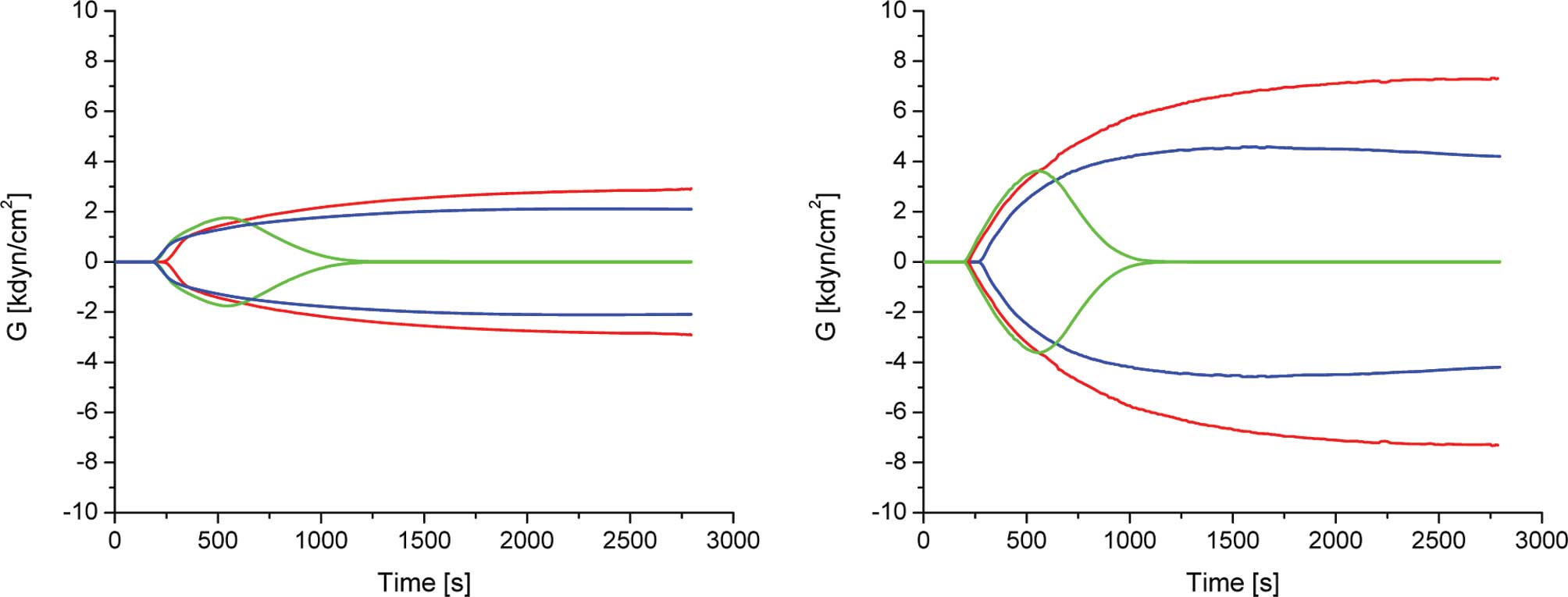
Clot formation of sodium-citrated blood was analyzed by TEG, which allows for the measurement of the overall coagulation profile. TEG also yields data on the kinetics and dynamics of clot formation and clot lysis in whole blood. Most of the parameters were within the normal range with the exception of A (amplitude), which was used to derive the elastic modulus strength: G = [5000A/(100-A)]/1000). As shown in Fig. 1 and Table I, the mean of G of 2.2±0.4 dyn/cm2 was almost 2-fold less than the reported normal range (4.6–10.9 dyn/cm2) (12). A similar pattern was observed for TEG of PAI-1-deficient and normal mouse blood (13).

Figure 1.

Clotting was induced by addition of CaCl2. (A) Thromboelastogram of the patient. Blood: red, control; green, blood treated with tPA; blue, blood treated with tPA and PAI-1. (B) For comparison a thromboelastogram of blood from an individual not affected with the PAI-1 deficiency is shown. Red, control; green, blood treated with tPA; blue, treated with tPA andPAI-1.

Table I.

Thromboelastogram parameters of the blood of the studied patient.

Table I.

Thromboelastogram parameters of the blood of the studied patient.

R (min)K (min)An (°)MA (mm)MG (dyn/cm2)LY30 (min)
Normal2–81–355–7851–694.6–10.90–8
Control4.2±0.13.0±0.265.6±1.234.7±1.32.7±0.20
tPA3.4±0.12.1±0.469.0±2.827.6±2.31.9±0.286.4±0.8
tPA+PAI-13.3±0.14.2±0.670.5±5.229.3±1.62.1±0.20

[i] The critical parameters of blood clotting measured by TEG are as follows: R is the time from the start of the reaction until a measurable clot is detected, K is the time from the R point until a certain clot firmness is achieved, An is the maximum angle that represents kinetics of clotting, LY 30 represents clot lysis 30 min after MA (maximum amplitude); G (elastic modulus strength) is derived from A (amplitude) by the formula G = [5000A/(100-A)]/1000. It measures actual clot strength in dyn/cm2, presented here as kdyn/cm2; MG is G at maximum amplitude.

Therefore, the PAI-1 gene was sequenced for possible mutations. PAI-1 gene sequencing revealed that the patient had a heterozygous mutation G to A at nucleotide position 4497 in exon 2, resulting in the replacement of alanine 15 (GCC) to threonine (ACC) at the signal peptide.

Discussion

PAI-1 deficiency was first reported in 1989, when undetectable PAI-1 activity and antigen levels were noted in a 76-year-old man with a life-long bleeding tendency (14,15). At that time this condition was considered extremely rare. Since then, more cases have been reported in the literature (2,3,14). PAI-1 deficiency seems to be more common than previously thought, possibly due to misdiagnosis or lack of awareness of this condition by primary physicians.

Initially, PAI-1 deficiency and its related bleeding diathesis was defined as a very low PAI-1 antigen (less than 4 ng/ml) or activity (lower than 1 IU/ml) (3,16). However, hereditary PAI-1 deficiency and severe menorrhagia have been reported in patients with a PAI-1 antigen level of 11.4 ng/ml (4.0–43 ng/ml) and PAI-1 activity less than 5 AU/ml (5–37 AU/ml) (17). The levels of PAI-1 in our reported case were similar, which initially challenged our assumption of PAI-1 deficiency. The TEG analysis revealed weak blood clotting, which indicated a low platelet count contradicting PAI-1 deficiency. However, her platelet count was slightly elevated. For this reason sequencing of the PAI-1 gene was carried out. A mutation found in the signal peptide strongly suggested that this type of deficiency was related to the secretory dynamics of PAI-1 secretion rather than to its low levels or activity as originally suggested by Zhang at el, who described the first case of an Ala15Thr mutation (2).

To conclude, we considered the PAI-1 mutation to be the likely etiology of the bleeding diathesis in this patient.

Acknowledgements

We thank Dr R. Hart (President, PharmaIP LLC, Greenwich, CT, USA) for the helpful remarks, discussions and support. This work was supported, in part, by grants from PharmaIP LLC and the Frank D. Stranahan Endowment Fund for Oncological Research. Special thanks to the patient for her extraordinary involvement and willingness to provide multiple samples of her blood.

References

1. 

Lopes C, Dina C, Durand E and Froguel P: PAI-1 polymorphisms modulate phenotypes associated with the metabolic syndrome in obese and diabetic Caucasian population. Diabetologia. 46:1284–1290. 2003. View Article : Google Scholar : PubMed/NCBI

2. 

Zhang ZY, Wang ZY, Dong NZ, Bai X, Zhang W and Ruan CG: A case of deficiency of plasma plasminogen activator inhibitor-1 related to Ala15Thr mutation in its signal peptide. Blood Coagul Fibrinolysis. 16:79–84. 2005. View Article : Google Scholar : PubMed/NCBI

3. 

Fay WP, Parker AC, Condrey LR and Shapiro AD: Human plasminogen activator inhibitor-1 (PAI-1) deficiency: characterization of a large kindred with a null mutation in the PAI-1 gene. Blood. 90:204–208. 1997.PubMed/NCBI

4. 

Evans PA, Hawkins K, Lawrence M, Barrow MS, Williams PR and Williams RL: Studies of whole blood coagulation by oscillatory shear, thromboelastography and free oscillation rheometry. Clin Hemorheol Microcirc. 38:267–277. 2008.PubMed/NCBI

5. 

Gallimore MJ, Harris SL, Tappenden KA, Winter M and Jones DW: Urokinase induced fibrinolysis in thromboelastography: a model for studying fibrinolysis and coagulation in whole blood. J Thromb Haemost. 3:2506–2513. 2005. View Article : Google Scholar : PubMed/NCBI

6. 

Carr ME Jr, Krishnamurti C and Alving BM: Effect of plasminogen activator inhibitor-1 on tissue-type plasminogen activator-induced fibrinolysis. Thromb Haemost. 67:106–110. 1992.PubMed/NCBI

7. 

Sugiki M, Maruyama M, Yoshida E, Mihara H, Kamiguti AS and Theakston DG: Enhancement of plasma fibrinolysis in vitro by jararhagin, the main haemorrhagic metalloproteinase in Bothrops jararaca venom. Toxicon. 33:1605–1617. 1995. View Article : Google Scholar : PubMed/NCBI

8. 

Jankun J, Aleem AM, Selman SH, et al: Highly stable plasminogen activator inhibitor type one (VLHL PAI-1) protects fibrin clots from tissue plasminogen activator-mediated fibrinolysis. Int J Mol Med. 20:683–687. 2007.

9. 

Kohro S, Yamakage M, Omote T and Namiki A: In vitro effects of propofol on blood coagulability and fibrinolysis by the use of thromboelastograph technique. Acta Anaesthesiol Scand. 43:217–219. 1999. View Article : Google Scholar : PubMed/NCBI

10. 

Agren A, Wiman B and Schulman S: Laboratory evidence of hyperfibrinolysis in association with low plasminogen activator inhibitor type 1 activity. Blood Coagul Fibrinolysis. 18:657–660. 2007. View Article : Google Scholar : PubMed/NCBI

11. 

Perkowska A, Elhasade A, Durlik M, et al: The effect of chronic allograft rejection on plasma regulators of fibrinolysis. Ann Transplant. 7:44–51. 2002.PubMed/NCBI

12. 

TEG 5000 User's Manual Version 4.2 Software. Haemoscope Corporation 2006.

13. 

Jankun J, Aleem AM, Struniawski R, Lysiak-Szydlowska W, Selman SH and Skrzypczak-Jankun E: Accelerated thrombus lysis in the blood of plasminogen activator inhibitor deficient mice is inhibited by PAI-1 with a very long half-life. Pharmacol Rep. 61:673–680. 2009. View Article : Google Scholar : PubMed/NCBI

14. 

Mehta R and Shapiro AD: Plasminogen activator inhibitor type 1 deficiency. Haemophilia. 14:1255–1260. 2008. View Article : Google Scholar : PubMed/NCBI

15. 

Schleef RR, Higgins DL, Pillemer E and Levitt LJ: Bleeding diathesis due to decreased functional activity of type 1 plasminogen activator inhibitor. J Clin Invest. 83:1747–1752. 1989. View Article : Google Scholar : PubMed/NCBI

16. 

Jankun J and Skrzypczak-Jankun E: Yin and yang of the plasminogen activator inhibitor. Pol Arch Med Wewn. 119:410–417. 2009.PubMed/NCBI

17. 

Repine T and Osswald M: Menorrhagia due to a qualitative deficiency of plasminogen activator inhibitor-1: case report and literature review. Clin Appl Thromb Hemost. 10:293–296. 2004. View Article : Google Scholar : PubMed/NCBI

Related Articles

  • Abstract
  • View
  • Download
  • Twitter
Copy and paste a formatted citation
Spandidos Publications style
Jankun J and Skrzypczak-Jankun E: Bleeding diathesis is associated with an A15T heterozygous mutation in exon 2 of the plasminogen activator inhibitor type 1 . Exp Ther Med 1: 575-577, 2010.
APA
Jankun, J., & Skrzypczak-Jankun, E. (2010). Bleeding diathesis is associated with an A15T heterozygous mutation in exon 2 of the plasminogen activator inhibitor type 1 . Experimental and Therapeutic Medicine, 1, 575-577. https://doi.org/10.3892/etm_00000090
MLA
Jankun, J., Skrzypczak-Jankun, E."Bleeding diathesis is associated with an A15T heterozygous mutation in exon 2 of the plasminogen activator inhibitor type 1 ". Experimental and Therapeutic Medicine 1.4 (2010): 575-577.
Chicago
Jankun, J., Skrzypczak-Jankun, E."Bleeding diathesis is associated with an A15T heterozygous mutation in exon 2 of the plasminogen activator inhibitor type 1 ". Experimental and Therapeutic Medicine 1, no. 4 (2010): 575-577. https://doi.org/10.3892/etm_00000090
Copy and paste a formatted citation
x
Spandidos Publications style
Jankun J and Skrzypczak-Jankun E: Bleeding diathesis is associated with an A15T heterozygous mutation in exon 2 of the plasminogen activator inhibitor type 1 . Exp Ther Med 1: 575-577, 2010.
APA
Jankun, J., & Skrzypczak-Jankun, E. (2010). Bleeding diathesis is associated with an A15T heterozygous mutation in exon 2 of the plasminogen activator inhibitor type 1 . Experimental and Therapeutic Medicine, 1, 575-577. https://doi.org/10.3892/etm_00000090
MLA
Jankun, J., Skrzypczak-Jankun, E."Bleeding diathesis is associated with an A15T heterozygous mutation in exon 2 of the plasminogen activator inhibitor type 1 ". Experimental and Therapeutic Medicine 1.4 (2010): 575-577.
Chicago
Jankun, J., Skrzypczak-Jankun, E."Bleeding diathesis is associated with an A15T heterozygous mutation in exon 2 of the plasminogen activator inhibitor type 1 ". Experimental and Therapeutic Medicine 1, no. 4 (2010): 575-577. https://doi.org/10.3892/etm_00000090
Follow us
  • Twitter
  • LinkedIn
  • Facebook
About
  • Spandidos Publications
  • Careers
  • Cookie Policy
  • Privacy Policy
How can we help?
  • Help
  • Live Chat
  • Contact
  • Email to our Support Team