Introduction
Therapy for COVID-19, particularly during the early
stages of infection, is urgently required. Although COVID-19 is
mostly self-limited, up to 20% of symptomatic cases will develop
severe or critical disease with clinical manifestations, including
pneumonia, acute respiratory distress syndrome, multiorgan system
dysfunction, hypercoagulation and hyperinflammatory manifestations.
Over 47 million cases of COVID-19 globally have resulted in >1.2
million deaths (1).
The FDA has approved only one drug, remdesivir, for
the treatment of COVID-19. In addition, the FDA has granted an
emergency use authorization for the use of baricitinib (Olumiant;
used for the treatment of rheumatoid arthritis) for the treatment
of COVID-19 in some cases. For this reason, investigators have paid
considerable attention to the association between the
administration of commonly used drugs with the outcome of patients
with COVID-19. Aspirin (2-5)
has been reported to reduce mortality. However, as regards other
drugs, some studies have recommended that ibuprofen should be
avoided (6-8).
In addition, the use of omeprazole has been shown to increase
mortality (9). At least one report
has indicted that famotidine decreases mortality (10), while another indicates that the use
of famotidine leads to a poorer prognosis (11).
Data and methods
UK Biobank (UKB). UKB data were used to assess the
association of common drugs with COVID-19 mortality. Electronic
linkage between UKB records and National Health Service COVID-19
laboratory test results in the UK were available from March 16, to
April 26, 2020, including the peak of daily COVID-19
laboratory-confirmed cases. During this time period, the testing of
older age groups was largely restricted to hospital inpatients
exhibiting clinical signs of infection. Thus, test positivity is
considered a good marker of severe COVID-19(12). COVID-19 mortality in the UK was
recorded as 900 deaths per day at this time.
For the data used in the present study, the
inclusion criteria were a positive test for COVID-19, and the
exclusion criteria were negative COVID-19 test or no test
results.
Data processing and statistical
analysis
Data processing was performed on Minerva, a Linux
mainframe with Centos 7.6, at the Icahn School of Medicine at Mount
Sinai. The UKB Data Parser (ukbb_parser) was used, which is a
python-based package that allows easy interfacing with the large UK
Biobank dataset (13). Data were
analyzed using one-way analysis of variance (ANOVA), Tukey's post
hoc test, logistic regression, and Fisher's exact test. Statistical
analysis was performed using SPSS version 22.
Results
The present study evaluated data from 376 subjects,
49% female, 51% male. The age of the subjects was 55.7±9.1 (mean ±
SD) years. The COVID-19 mortality rate was 20.5%.
The association between the use of aspirin,
ibuprofen, paracetamol (acetaminophen), ranitidine, omeprazole and
laxatives with mortality in 376 subjects, 517 responses is shown in
Table I. The variability was
significant (P=0.011, two-tailed Fisher's exact test).
 | Table IAssociation of aspirin, ibuprofen,
paracetamol (acetaminophen), ranitidine, omeprazole and laxatives
with mortality. |
Table I
Association of aspirin, ibuprofen,
paracetamol (acetaminophen), ranitidine, omeprazole and laxatives
with mortality.
| Drug | Count and % | Alive | Deceased | Total |
|---|
| Aspirin | Count | 84 | 35 | 119 |
| | % With drug use | 70.60% | 29.40% | |
| Ibuprofen | Count | 106 | 15 | 121 |
| | % With drug use | 87.60% | 12.40% | |
| Paracetamol | Count | 150 | 34 | 184 |
| | % With drug use | 81.50% | 18.50% | |
| Ranitidine | Count | 11 | 4 | 15 |
| | % With drug use | 73.30% | 26.70% | |
| Omeprazole | Count | 38 | 14 | 52 |
| | % With drug use | 73.10% | 26.90% | |
| Laxatives | Count | 18 | 8 | 26 |
| | % With drug use | 69.20% | 30.80% | |
| No. of subjects | Count | 299 | 77 | 376 |
As regards the use of Fisher's exact test, it should
be noted that this is a statistical test used to determine whether
there are non-random associations between categorical variables.
Only in Table I does such an
association exist, suggesting that the variation in mortality rates
of aspirin, ibuprofen, paracetamol (acetaminophen), ranitidine,
omeprazole and laxatives is meaningful. In the other tables,
variability was not significant, suggesting that the differing
mortalities may not be meaningful. Given the large number of agents
examined, the present study performed as few comparison tests as
possible. When performing hypothesis tests with multiple
comparisons, eventually a result could occur that appears to
demonstrate statistical significance in the dependent variable,
even when there is none.
Aspirin and omeprazole were associated with an
increased mortality. Ibuprofen-related mortality was lower than
laxative-related mortality. Aspirin users were significantly older
(P<0.001, one-way ANOVA; Fig.
1).
The association with mortality of
cholesterol-lowering medications, blood pressure-lowering
medications, insulin, hormone replacement and oral contraceptives
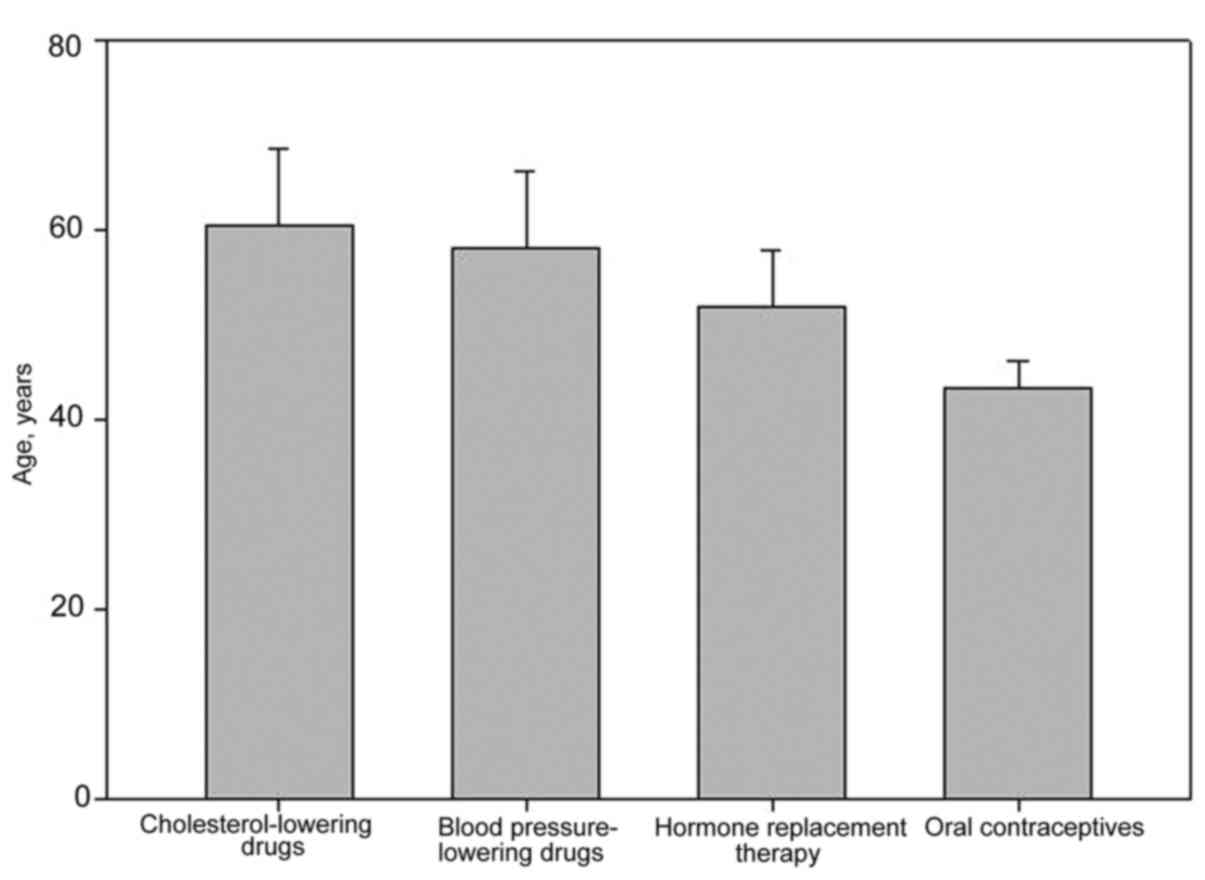
in 134 female subjects and 173 responses is shown in Table II. The variability was
insignificant (P=0.077, two-tailed Fisher's exact test). The age
(mean ± SD) of the female subjects by medication are shown in
Fig. 2. Oral contraceptive users
were significantly younger than hormone replacement users
(P<0.05, Tukey's range test). The hormone replacement users were
significantly younger than the users of cholesterol-lowering
medications and blood pressure-lowering medications (P<0.05,
Tukey's range test). The effect of age on survival was significant;
however, the effect of hormones on survival was not (Table III).
| Table IIAssociation with mortality of
cholesterol lowering medications, blood pressure lowering
medications, insulin, hormone replacement and oral
contraceptives. |
Table II
Association with mortality of
cholesterol lowering medications, blood pressure lowering
medications, insulin, hormone replacement and oral
contraceptives.
| Sex | Type of drug | Count and % | Alive | Deceased | Total |
|---|
| Female |
Cholesterol-lowering | Count | 35 | 12 | 47 |
| | | % With drug use | 74.50% | 25.50% | |
| | Blood
pressure-lowering | Count | 53 | 16 | 69 |
| | | % With drug use | 76.80% | 23.20% | |
| | Insulin therapy | Count | 5 | 2 | 7 |
| | | % With drug use | 71.40% | 28.60% | |
| | Hormone replacement
therapy | Count | 29 | 2 | 31 |
| | | % With drug use | 93.50% | 6.50% | |
| | Oral
contraceptives | Count | 17 | 1 | 19 |
| | | % With drug use | 94.40% | 5.60% | |
| No. of females | | Count | 103 | 21 | 134 |
| Table IIIEffect age and hormones on
survival. |
Table III
Effect age and hormones on
survival.
| | 95% LB | OR | 95% UB | P-value |
|---|
| Age | 1.149 | 1.188 | 1.228 | <0.001 |
| Hormones | 0.102 | 0.477 | 2.240 | 0.348 |
The association of nutritional supplements with
mortality is shown in Table IV.
The lower mortality linked to vitamin D and vitamin B
supplementation, presumably B complex, has been previously observed
(14,15). There was no significant difference
in the mean age (P=0.071, one-way ANOVA; data not shown).
| Table IVAssociation of nutritional supplements
with mortality. |
Table IV
Association of nutritional supplements
with mortality.
| Supplement | Count and % | Alive | Deceased | Total |
|---|
| Vitamin A | Count | 14 | 3 | 17 |
| | % With drug use | 82.40% | 17.60% | |
| Vitamin B | Count | 31 | 5 | 36 |
| | % With drug use | 86.10% | 13.90% | |
| Vitamin C | Count | 50 | 15 | 65 |
| | % With drug
use | 76.90% | 23.10% | |
| Vitamin D | Count | 26 | 3 | 29 |
| | % With drug
use | 89.70% | 10.30% | |
| Vitamin E | Count | 21 | 3 | 24 |
| | % With drug
use | 87.50% | 12.50% | |
| Folate | Count | 17 | 5 | 22 |
| | % With drug
use | 77.30% | 22.70% | |
| Multivitamins | Count | 128 | 35 | 163 |
| | % With drug
use | 78.50% | 21.50% | |
| Total no. of
subjects | Count | 189 | 49 | 238 |
The association of mineral and other dietary
supplements with mortality, in 294 subjects, 456 responses is shown
in Table V. The variability was
insignificant (P=0.983, two-tailed Fisher's exact test).
| Table VAssociation of mineral and other
dietary supplements with mortality. |
Table V
Association of mineral and other
dietary supplements with mortality.
| Supplement | Count and % | Alive | Deceased | Total |
|---|
| Fish oil | Count | 166 | 40 | 206 |
| (including cod
liver oil) | % With drug
use | 80.60% | 19.40% | |
| Glucosamine | Count | 97 | 27 | 124 |
| | % With drug
use | 78.20% | 21.80% | |
| Calcium | Count | 39 | 11 | 50 |
| | % With drug
use | 78.00% | 22.00% | |
| Zinc | Count | 28 | 6 | 34 |
| | % With drug
use | 82.40% | 17.60% | |
| Iron | Count | 20 | 6 | 26 |
| | % With drug
use | 76.90% | 23.10% | |
| Selenium | Count | 13 | 3 | 16 |
| | % With drug
use | 81.30% | 18.80% | |
| Total no. of
subjects | Count | 238 | 56 | 294 |
Discussion
In hospitalized UKB COVID-19 patients, common
comorbidities are hypertension, coronary heart disease, atrial
fibrillation, type 2 diabetes and dementia. All these conditions
are associated with an increased mortality (12).
Coagulopathy and blood clots are a significant
adverse event in patients with COVID-19. Aspirin inhibits the
coagulation due to its effect on platelets and has been reported to
improve patient prognosis (3-5).
The present study was not able to confirm this observation as the
patients on aspirin in the current sample were significantly older
and therefore less likely to survive. Many patients were no doubt
using aspirin for cardioprotection and/or arthritis. Clinical
trials, as for example, the FREEDOM-COVID study (ClinicalTrials.gov identifier: NCT04512079), are
attempting to determine the best anticoagulant strategy for
patients admitted to general medical wards. The ranitidine bismuth
citrate combination has been shown to suppress SARS-CoV-2
replication and to relieve virus-associated pneumonia in Syrian
hamsters (16); however, this
effect may not occur in patients with COVID-19 taking ranitidine.
In the present study, ibuprofen-related mortality (12.4%) was lower
than laxative-related mortality (30.8%), suggesting that ibuprofen
does not worsen the clinical outcome (7,8).
Cholesterol-lowering medications, blood-pressure
lowering medications, hormone replacement therapy and oral
contraceptives seem to have minimal effects on patient outcome. The
younger age of subjects on hormone replacement therapy and oral
contraceptive users most probably explains their reduced
mortality.
Nutritional supplements may increase survival.
Mortality in an Italian nursing home during the COVID-19 pandemic
was shown to be reduced with vitamin D supplementation (14). A vitamin D/magnesium/vitamin B12
combination in older-aged COVID-19 patients was associated with a
significant reduction in the proportion of patients with clinical
deterioration requiring oxygen support, intensive care support, or
both (15). Vitamin D may be a
critical host factor to prevent COVID-19(17), although this hypothesis remains
controversial (18,19). To prevent the cytokine storm, the
use of N-acetylcysteine in both the prevention and adjuvant
therapy of COVID-19 has been suggested; however, the UKB did not
have information on this substance (20).
In conclusion, although some of the associations
described herein among drugs and COVID-19 are not novel, the
present study demonstrates the utility of a new source, the UKB, in
further examining these associations. The association of lifestyle,
comorbidities, medication and phenotypic information with patient
outcomes will become an invaluable source as more UKB data become
available on subjects tested for COVID-19(21).
Acknowledgements
This work was supported in part through the
computational resources and staff expertise provided by Scientific
Computing at the Icahn School of Medicine at Mount Sinai.
Availability of data and materials
All data generated or analyzed during this study are
included in this published article or are held by UK Biobank.
Authors' contributions
SL and PHR contributed equally to the conception,
writing and data analysis of the present study.
Ethics approval and consent to
participate
All patient data were from the UK Biobank. The UK
Biobank application for the present study was approved as UKB
project 57245, SL and PHR.
Patient consent for publication
Not applicable.
Competing interests
The authors declare that they have no competing
interests.
References
|
1
|
Kim PS, Read SW and Fauci AS: Therapy for
early COVID-19: A critical need. JAMA. 324:2149–2150.
2020.PubMed/NCBI View Article : Google Scholar
|
|
2
|
Chow JH, Khanna AK, Kethireddy S, Yamane
D, Levine A, Jackson AM, McCurdy MT, Tabatabai A, Kumar G, Park P,
et al: Aspirin use is associated with decreased mechanical
ventilation, ICU admission, and in-hospital mortality in
hospitalized patients with COVID-19. Anesth Analg: Oct 21, 2020
(Epub ahead of print). doi: 10.1213/ANE.0000000000005292.
|
|
3
|
Haque S, Jawed A, Akhter N, Dar SA, Khan
F, Mandal RK, Areeshi MY, Lohani M and Wahid M: Acetylsalicylic
acid (Aspirin): A potent medicine for preventing COVID-19 deaths
caused by thrombosis and pulmonary embolism. Eur Rev Med Pharmacol
Sci. 24:9244–9245. 2020.PubMed/NCBI View Article : Google Scholar
|
|
4
|
Mohamed-Hussein AA, Aly KM and Ibrahim MA:
Should aspirin be used for prophylaxis of COVID-19-induced
coagulopathy? Med Hypotheses. 144(109975)2020.PubMed/NCBI View Article : Google Scholar
|
|
5
|
Pavoni V, Gianesello L, Pazzi M, Stera C,
Meconi T and Frigieri FC: Venous thromboembolism and bleeding in
critically ill COVID-19 patients treated with higher than standard
low molecular weight heparin doses and aspirin: A call to action.
Thromb Res. 196:313–317. 2020.PubMed/NCBI View Article : Google Scholar
|
|
6
|
Kelleni MT: Early use of non-steroidal
anti-inflammatory drugs in COVID-19 might reverse pathogenesis,
prevent complications and improve clinical outcomes. Biomed
Pharmacother. 133(110982)2021.PubMed/NCBI View Article : Google Scholar
|
|
7
|
Kutti Sridharan G, Kotagiri R,
Chandiramani VH, Mohan BP, Vegunta R, Vegunta R and Rokkam VR:
COVID-19 and avoiding Ibuprofen. How good is the evidence? Am J
Ther. 27:e400–e402. 2020.PubMed/NCBI View Article : Google Scholar
|
|
8
|
Rinott E, Kozer E, Shapira Y, Bar-Haim A
and Youngster I: Ibuprofen use and clinical outcomes in COVID-19
patients. Clin Microbiol Infect. 26:1259.e5–1259.e7.
2020.PubMed/NCBI View Article : Google Scholar
|
|
9
|
Lee SW, Ha EK, Yeniova AÖ, Moon SY, Kim
SY, Koh HY, Yang JM, Jeong SJ, Moon SJ, Cho JY, et al: Severe
clinical outcomes of COVID-19 associated with proton pump
inhibitors: A nationwide cohort study with propensity score
matching. Gut. 70:76–84. 2021.PubMed/NCBI View Article : Google Scholar
|
|
10
|
Mather JF, Seip RL and McKay RG: Impact of
famotidine use on clinical outcomes of hospitalized patients with
COVID-19. Am J Gastroenterol. 115:1617–1623. 2020.PubMed/NCBI View Article : Google Scholar
|
|
11
|
Zhou J, Wang X, Lee S, Wu WK, Cheung BM,
Zhang Q and Tse G: Proton pump inhibitor or famotidine use and
severe COVID-19 disease: A propensity score-matched territory-wide
study. Gut. 2020(323668)2020.PubMed/NCBI View Article : Google Scholar
|
|
12
|
Atkins JL, Masoli JA, Delgado J, Pilling
LC, Kuo CL, Kuchel GA and Melzer D: Preexisting comorbidities
predicting COVID-19 and mortality in the UK Biobank community
cohort. J Gerontol A Biol Sci Med Sci. 75:2224–2230.
2020.PubMed/NCBI View Article : Google Scholar
|
|
13
|
Zhu A, Salminen LE, Thompson PM and
Jahanshad N: The UK Biobank Data Parser: A tool with built in and
customizable filters for brain studies. Organization for Human
Brain Mapping Rome, Italy, June 9-13, 2019.
|
|
14
|
Cangiano B, Fatti LM, Danesi L, Gazzano G,
Croci M, Vitale G, Gilardini L, Bonadonna S, Chiodini I, Caparello
CF, et al: Mortality in an Italian nursing home during COVID-19
pandemic: Correlation with gender, age, ADL, vitamin D
supplementation, and limitations of the diagnostic tests. Aging
(Albany NY). 12:24522–24534. 2020.PubMed/NCBI View Article : Google Scholar
|
|
15
|
Tan CW, Ho LP, Kalimuddin S, Cherng BP,
Teh YE, Thien SY, Wong HM, Tern PJ, Chandran M, Chay JW, et al:
Cohort study to evaluate the effect of vitamin D, magnesium, and
vitamin B12 in combination on progression to severe outcomes in
older patients with coronavirus (COVID-19). Nutrition.
79-80(111017)2020.PubMed/NCBI View Article : Google Scholar
|
|
16
|
Yuan S, Wang R, Chan JF, Zhang AJ, Cheng
T, Chik KK, Ye ZW, Wang S, Lee AC, Jin L, et al: Metallodrug
ranitidine bismuth citrate suppresses SARS-CoV-2 replication and
relieves virus-associated pneumonia in Syrian hamsters. Nat
Microbiol. 5:1439–1448. 2020.PubMed/NCBI View Article : Google Scholar
|
|
17
|
Umhau J: Casting sunlight on an epidemic:
Is vitamin D a critical host factor to prevent COVID-19? J Infect
Dis: Mar 25, 2020 (Epub ahead of print).
|
|
18
|
Rubin R: Sorting out whether vitamin D
deficiency raises COVID-19 risk. JAMA. 325:329–330. 2021.PubMed/NCBI View Article : Google Scholar
|
|
19
|
Murai IH, Fernandes AL, Sales LP, Pinto
AJ, Goessler KF, Duran CS, Silva CR, Franco AS, Macedo MB, Dalmolin
HH, et al: Effect of a single high dose of vitamin D3 on hospital
length of stay in patients with moderate to severe COVID-19: A
Randomized Clinical Trial. JAMA: Feb 17, 2021. doi:
10.1001/jama.2020.26848.
|
|
20
|
De Flora S, Balansky R and La Maestra S:
Rationale for the use of N-acetylcysteine in both prevention
and adjuvant therapy of COVID-19. FASEB J. 34:13185–13193.
2020.PubMed/NCBI View Article : Google Scholar
|
|
21
|
Khanji MY, Aung N, Chahal CA and Petersen
SE: COVID-19 and the UK Biobank-Opportunities and challenges for
research and collaboration with other large population studies.
Front Cardiovasc Med. 7(156)2020.PubMed/NCBI View Article : Google Scholar
|