Spandidos Publications Logo
  • About
    • About Spandidos
    • Aims and Scopes
    • Abstracting and Indexing
    • Editorial Policies
    • Reprints and Permissions
    • Job Opportunities
    • Terms and Conditions
    • Contact
  • Journals
    • All Journals
    • Oncology Letters
      • Oncology Letters
      • Information for Authors
      • Editorial Policies
      • Editorial Board
      • Aims and Scope
      • Abstracting and Indexing
      • Bibliographic Information
      • Archive
    • International Journal of Oncology
      • International Journal of Oncology
      • Information for Authors
      • Editorial Policies
      • Editorial Board
      • Aims and Scope
      • Abstracting and Indexing
      • Bibliographic Information
      • Archive
    • Molecular and Clinical Oncology
      • Molecular and Clinical Oncology
      • Information for Authors
      • Editorial Policies
      • Editorial Board
      • Aims and Scope
      • Abstracting and Indexing
      • Bibliographic Information
      • Archive
    • Experimental and Therapeutic Medicine
      • Experimental and Therapeutic Medicine
      • Information for Authors
      • Editorial Policies
      • Editorial Board
      • Aims and Scope
      • Abstracting and Indexing
      • Bibliographic Information
      • Archive
    • International Journal of Molecular Medicine
      • International Journal of Molecular Medicine
      • Information for Authors
      • Editorial Policies
      • Editorial Board
      • Aims and Scope
      • Abstracting and Indexing
      • Bibliographic Information
      • Archive
    • Biomedical Reports
      • Biomedical Reports
      • Information for Authors
      • Editorial Policies
      • Editorial Board
      • Aims and Scope
      • Abstracting and Indexing
      • Bibliographic Information
      • Archive
    • Oncology Reports
      • Oncology Reports
      • Information for Authors
      • Editorial Policies
      • Editorial Board
      • Aims and Scope
      • Abstracting and Indexing
      • Bibliographic Information
      • Archive
    • Molecular Medicine Reports
      • Molecular Medicine Reports
      • Information for Authors
      • Editorial Policies
      • Editorial Board
      • Aims and Scope
      • Abstracting and Indexing
      • Bibliographic Information
      • Archive
    • World Academy of Sciences Journal
      • World Academy of Sciences Journal
      • Information for Authors
      • Editorial Policies
      • Editorial Board
      • Aims and Scope
      • Abstracting and Indexing
      • Bibliographic Information
      • Archive
    • International Journal of Functional Nutrition
      • International Journal of Functional Nutrition
      • Information for Authors
      • Editorial Policies
      • Editorial Board
      • Aims and Scope
      • Abstracting and Indexing
      • Bibliographic Information
      • Archive
    • International Journal of Epigenetics
      • International Journal of Epigenetics
      • Information for Authors
      • Editorial Policies
      • Editorial Board
      • Aims and Scope
      • Abstracting and Indexing
      • Bibliographic Information
      • Archive
    • Medicine International
      • Medicine International
      • Information for Authors
      • Editorial Policies
      • Editorial Board
      • Aims and Scope
      • Abstracting and Indexing
      • Bibliographic Information
      • Archive
  • Articles
  • Information
    • Information for Authors
    • Information for Reviewers
    • Information for Librarians
    • Information for Advertisers
    • Conferences
  • Language Editing
Spandidos Publications Logo
  • About
    • About Spandidos
    • Aims and Scopes
    • Abstracting and Indexing
    • Editorial Policies
    • Reprints and Permissions
    • Job Opportunities
    • Terms and Conditions
    • Contact
  • Journals
    • All Journals
    • Biomedical Reports
      • Information for Authors
      • Editorial Policies
      • Editorial Board
      • Aims and Scope
      • Abstracting and Indexing
      • Bibliographic Information
      • Archive
    • Experimental and Therapeutic Medicine
      • Information for Authors
      • Editorial Policies
      • Editorial Board
      • Aims and Scope
      • Abstracting and Indexing
      • Bibliographic Information
      • Archive
    • International Journal of Epigenetics
      • Information for Authors
      • Editorial Policies
      • Editorial Board
      • Aims and Scope
      • Abstracting and Indexing
      • Bibliographic Information
      • Archive
    • International Journal of Functional Nutrition
      • Information for Authors
      • Editorial Policies
      • Editorial Board
      • Aims and Scope
      • Abstracting and Indexing
      • Bibliographic Information
      • Archive
    • International Journal of Molecular Medicine
      • Information for Authors
      • Editorial Policies
      • Editorial Board
      • Aims and Scope
      • Abstracting and Indexing
      • Bibliographic Information
      • Archive
    • International Journal of Oncology
      • Information for Authors
      • Editorial Policies
      • Editorial Board
      • Aims and Scope
      • Abstracting and Indexing
      • Bibliographic Information
      • Archive
    • Medicine International
      • Information for Authors
      • Editorial Policies
      • Editorial Board
      • Aims and Scope
      • Abstracting and Indexing
      • Bibliographic Information
      • Archive
    • Molecular and Clinical Oncology
      • Information for Authors
      • Editorial Policies
      • Editorial Board
      • Aims and Scope
      • Abstracting and Indexing
      • Bibliographic Information
      • Archive
    • Molecular Medicine Reports
      • Information for Authors
      • Editorial Policies
      • Editorial Board
      • Aims and Scope
      • Abstracting and Indexing
      • Bibliographic Information
      • Archive
    • Oncology Letters
      • Information for Authors
      • Editorial Policies
      • Editorial Board
      • Aims and Scope
      • Abstracting and Indexing
      • Bibliographic Information
      • Archive
    • Oncology Reports
      • Information for Authors
      • Editorial Policies
      • Editorial Board
      • Aims and Scope
      • Abstracting and Indexing
      • Bibliographic Information
      • Archive
    • World Academy of Sciences Journal
      • Information for Authors
      • Editorial Policies
      • Editorial Board
      • Aims and Scope
      • Abstracting and Indexing
      • Bibliographic Information
      • Archive
  • Articles
  • Information
    • For Authors
    • For Reviewers
    • For Librarians
    • For Advertisers
    • Conferences
  • Language Editing
Login Register Submit
  • This site uses cookies
  • You can change your cookie settings at any time by following the instructions in our Cookie Policy. To find out more, you may read our Privacy Policy.

    I agree
Search articles by DOI, keyword, author or affiliation
Search
Advanced Search
presentation
International Journal of Molecular Medicine
Join Editorial Board Propose a Special Issue
Print ISSN: 1107-3756 Online ISSN: 1791-244X
Journal Cover
June-2014 Volume 33 Issue 6

Full Size Image

Sign up for eToc alerts
Recommend to Library

Journals

International Journal of Molecular Medicine

International Journal of Molecular Medicine

International Journal of Molecular Medicine is an international journal devoted to molecular mechanisms of human disease.

International Journal of Oncology

International Journal of Oncology

International Journal of Oncology is an international journal devoted to oncology research and cancer treatment.

Molecular Medicine Reports

Molecular Medicine Reports

Covers molecular medicine topics such as pharmacology, pathology, genetics, neuroscience, infectious diseases, molecular cardiology, and molecular surgery.

Oncology Reports

Oncology Reports

Oncology Reports is an international journal devoted to fundamental and applied research in Oncology.

Experimental and Therapeutic Medicine

Experimental and Therapeutic Medicine

Experimental and Therapeutic Medicine is an international journal devoted to laboratory and clinical medicine.

Oncology Letters

Oncology Letters

Oncology Letters is an international journal devoted to Experimental and Clinical Oncology.

Biomedical Reports

Biomedical Reports

Explores a wide range of biological and medical fields, including pharmacology, genetics, microbiology, neuroscience, and molecular cardiology.

Molecular and Clinical Oncology

Molecular and Clinical Oncology

International journal addressing all aspects of oncology research, from tumorigenesis and oncogenes to chemotherapy and metastasis.

World Academy of Sciences Journal

World Academy of Sciences Journal

Multidisciplinary open-access journal spanning biochemistry, genetics, neuroscience, environmental health, and synthetic biology.

International Journal of Functional Nutrition

International Journal of Functional Nutrition

Open-access journal combining biochemistry, pharmacology, immunology, and genetics to advance health through functional nutrition.

International Journal of Epigenetics

International Journal of Epigenetics

Publishes open-access research on using epigenetics to advance understanding and treatment of human disease.

Medicine International

Medicine International

An International Open Access Journal Devoted to General Medicine.

Journal Cover
June-2014 Volume 33 Issue 6

Full Size Image

Sign up for eToc alerts
Recommend to Library

  • Article
  • Citations
    • Cite This Article
    • Download Citation
    • Create Citation Alert
    • Remove Citation Alert
    • Cited By
  • Similar Articles
    • Related Articles (in Spandidos Publications)
    • Similar Articles (Google Scholar)
    • Similar Articles (PubMed)
  • Download PDF
  • Download XML
  • View XML
Article Open Access

The combination of rapamycin and MAPK inhibitors enhances the growth inhibitory effect on Nara-H cells

  • Authors:
    • Osamu Nakamura
    • Toshiaki Hitora
    • Yoshiki Yamagami
    • Masaki Mori
    • Hideki Nishimura
    • Ryosuke Horie
    • Konosuke Yamaguchi
    • Tetsuji Yamamoto
  • View Affiliations / Copyright

    Affiliations: Department of Orthopaedic Surgery, Kagawa University School of Medicine, Kagawa 761-0793, Japan
    Copyright: © Nakamura et al. This is an open access article distributed under the terms of Creative Commons Attribution License [CC BY_NC 3.0].
  • Pages: 1491-1497
    |
    Published online on: March 27, 2014
       https://doi.org/10.3892/ijmm.2014.1715
  • Expand metrics +
Metrics: Total Views: 0 (Spandidos Publications: | PMC Statistics: )
Metrics: Total PDF Downloads: 0 (Spandidos Publications: | PMC Statistics: )
Cited By (CrossRef): 0 citations Loading Articles...

This article is mentioned in:


Abstract

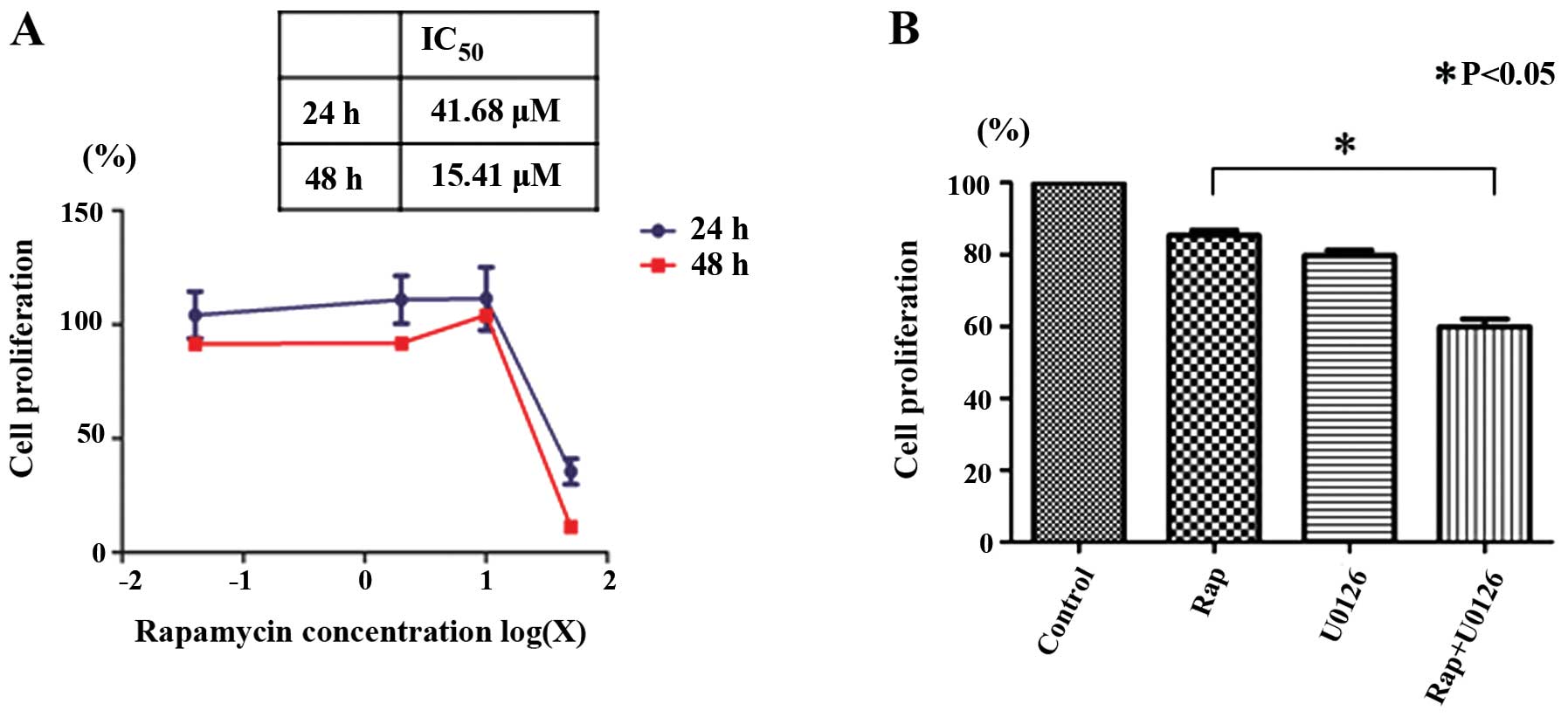
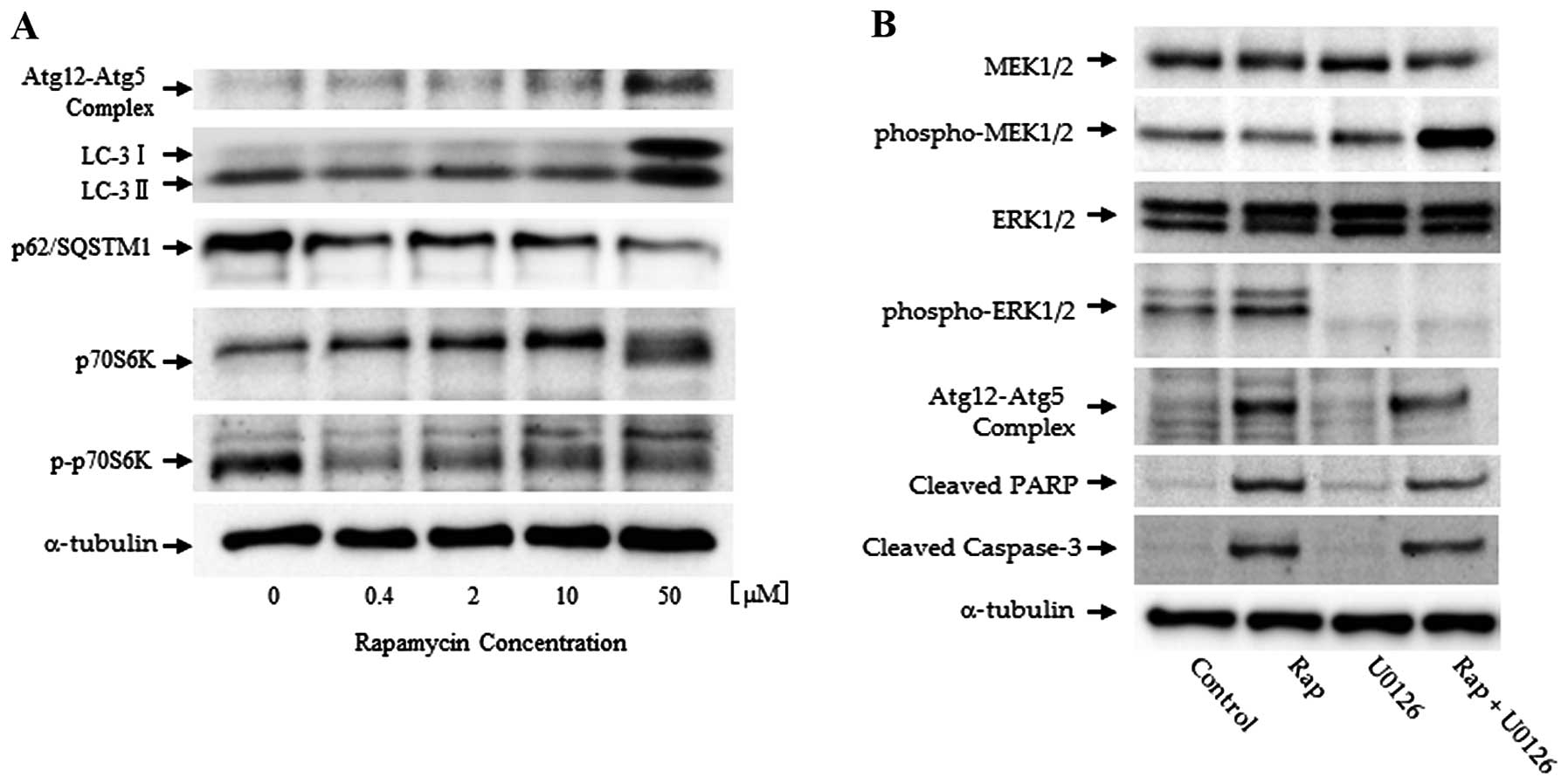
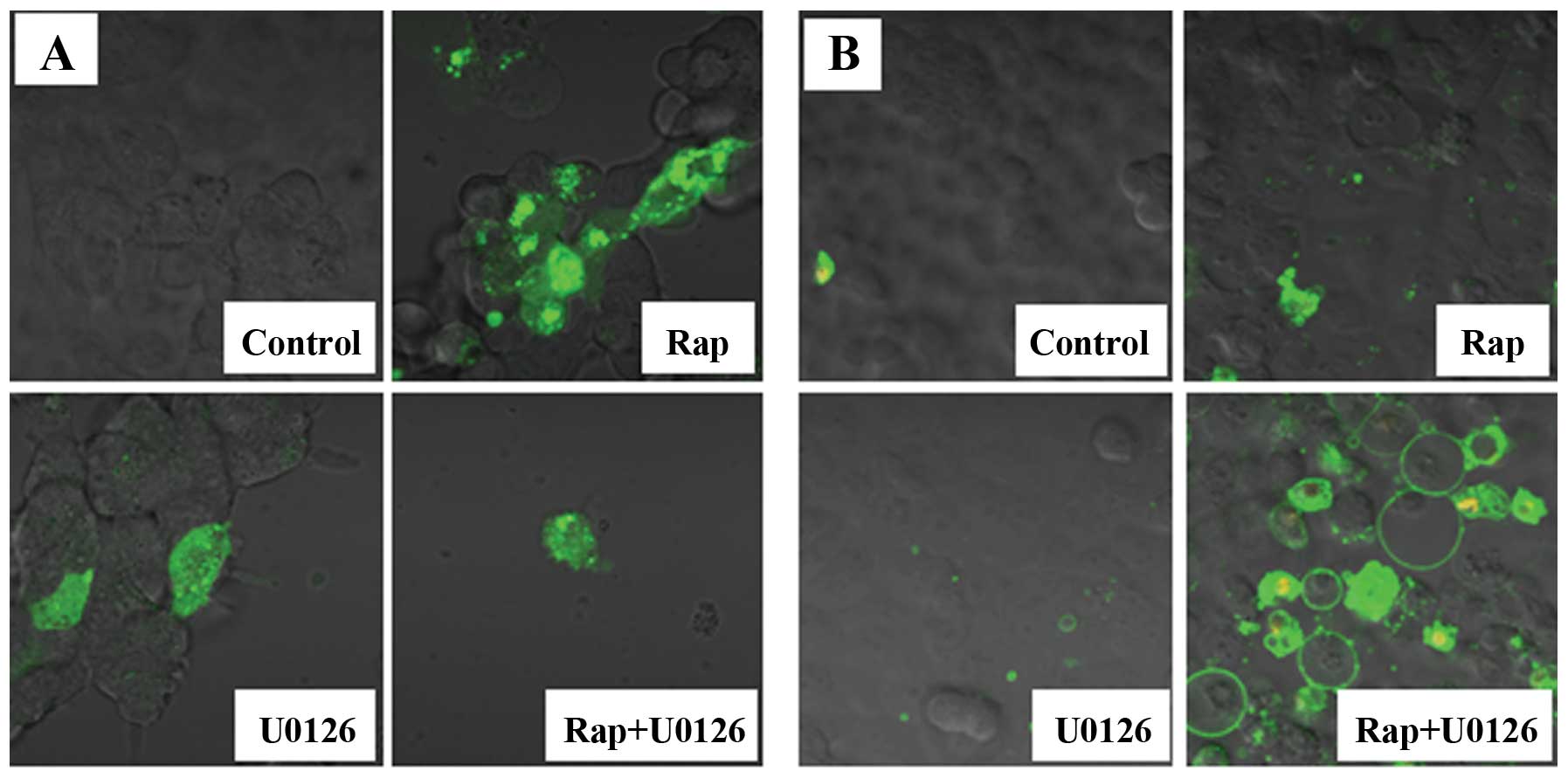
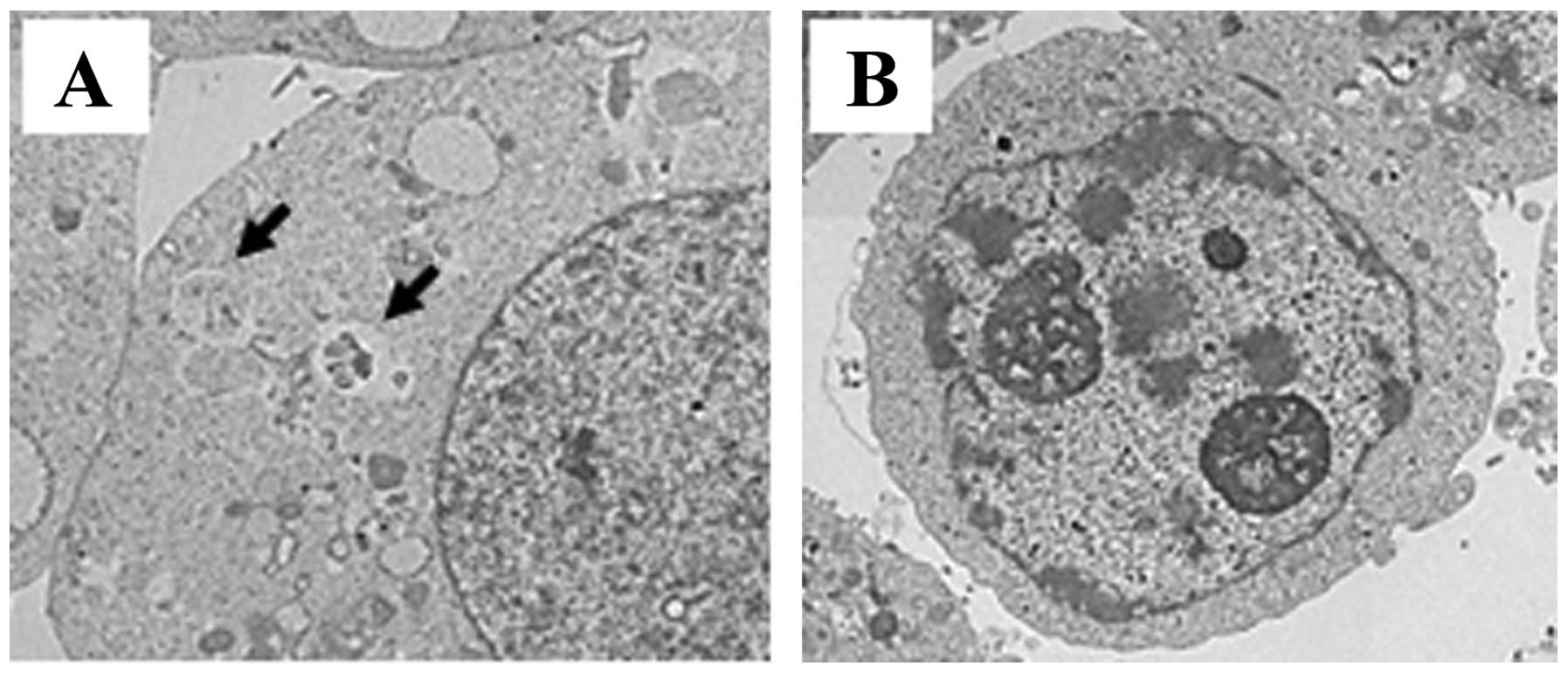
The inhibition of the mammalian target of rapamycin (mTOR) signaling pathway promotes the initiation of autophagy, and the mitogen-activated protein kinase (MAPK)/extracellular signal-regulated protein kinase (ERK) is well known to induce autophagy. Autophagy is a self-defense mechanism of cancer cells that are subjected to antitumor agents, and blocking autophagy can trigger apoptosis. In the present study, we demonstrate that an mTOR inhibitor, rapamycin, induces autophagy in the Nara-H malignant fibrous histiocytoma (MFH) cell line through the activation of ERK1/2. Rapamycin-induced apoptosis was enhanced following the inhibition of the MEK/ERK pathway. In the Nara-H cells, we examined the effects of rapamycin treatment on cell proliferation and on the phosphorylation of the mTOR pathway components and autophagy by western blot analysis. Furthermore, we examined the effects of rapamycin with or without the MEK inhibitor, U0126, on the induction of apoptosis by using fluorescence microscopy. Rapamycin inhibited Nara-H cell proliferation and decreased the phosphorylation of the mTOR pathway in the Nara-H cells. Rapamycin induced the apoptosis of Nara-H cells, and this apoptosis was enhanced by U0126. Simultaneously, phospho-ERK1/2 was activated by rapamycin. The present study demonstrates that rapamycin induces autophagy in Nara-H cells by activating the MEK/ERK signaling pathway, and the rapamycin-induced apoptosis can be enhanced by the MEK inhibitor, U0126. These results suggest that self‑protective mechanisms involving mTOR inhibitors in Nara-H cells are prevented by the inhibition of the MEK/ERK pathway. The combination of an mTOR inhibitor (e.g., rapamycin) and an MEK inhibitor (e.g., U0126) may offer effective treatment for MFH, as this combination effectively activates apoptotic pathways.
View Figures

Figure 1

Figure 2

Figure 3

Figure 4

Figure 5

View References

1 

Hay N and Sonenberg N: Upstream and downstream of mTOR. Genes Dev. 18:1926–1945. 2004. View Article : Google Scholar

2 

Gridelli C, Maione P and Rossi A: The potential role of mTOR inhibitors in non-small cell lung cancer. Oncologist. 13:139–147. 2008. View Article : Google Scholar : PubMed/NCBI

3 

Mita MM and Tolcher AW: The role of mTOR inhibitors for treatment of sarcomas. Curr Oncol Rep. 9:316–322. 2007. View Article : Google Scholar : PubMed/NCBI

4 

Kim KW, Mutter RW, Cao C, et al: Autophagy for cancer therapy through inhibition of pro-apoptotic proteins and mammalian target of rapamycin signaling. J Biol Chem. 281:36883–36890. 2006. View Article : Google Scholar

5 

Hung JY, Hsu YL, Li CT, et al: 6-Shogaol, an active constituent of dietary ginger, induces autophagy by inhibiting the AKT/mTOR pathway in human non-small cell lung cancer A549 cells. J Agric Food Chem. 57:9809–9816. 2009. View Article : Google Scholar : PubMed/NCBI

6 

Tan ML, Ooi JP, Ismail N, Moad AI and Muhammad TS: Programmed cell death pathways and current antitumor targets. Pharm Res. 26:1547–1560. 2009. View Article : Google Scholar : PubMed/NCBI

7 

Amaravadi RK and Thompson CB: The roles of therapy-induced autophagy and necrosis in cancer treatment. Clin Cancer Res. 13:7271–7279. 2007. View Article : Google Scholar : PubMed/NCBI

8 

Pattingre S, Espert L, Biard-Piechaczyk M and Codogno P: Regulation of macroautophagy by mTOR and Beclin 1 complexes. Biochimie. 90:313–323. 2008. View Article : Google Scholar : PubMed/NCBI

9 

Liu D, Yang Y, Liu Q and Wang J: Inhibition of autophagy by 3-MA potentiates cisplatin-induced apoptosis in esophageal squamous cell carcinoma cells. Med Oncol. 28:105–111. 2011. View Article : Google Scholar : PubMed/NCBI

10 

Kanematsu S, Uehara N, Miki H, et al: Autophagy inhibition enhances sulforaphane-induced apoptosis in human breast cancer cells. Anticancer Res. 30:3381–3390. 2010.PubMed/NCBI

11 

Ren Y, Huang F, Liu Y, Yang Y, Jiang Q and Xu C: Autophagy inhibition through PI3K/Akt increases apoptosis by sodium selenite in NB4 cells. BMB Rep. 42:599–604. 2009. View Article : Google Scholar : PubMed/NCBI

12 

Ito Y, Sasaki Y, Horimoto M, et al: Activation of mitogen-activated protein kinases/extracellular signal-regulated kinases in human hepatocellular carcinoma. Hepatology. 27:951–958. 1998. View Article : Google Scholar : PubMed/NCBI

13 

Sasaki K, Hitora T, Nakamura O, Kono R and Yamamoto T: The role of MAPK pathway in bone and soft tissue tumors. Anticancer Res. 31:549–553. 2011.PubMed/NCBI

14 

Carracedo A, Ma L, Teruya-Feldstein J, et al: Inhibition of mTORC1 leads to MAPK pathway activation through a PI3K-dependent feedback loop in human cancer. J Clin Invest. 118:3065–3074. 2008.PubMed/NCBI

15 

Huang S, Yang ZJ, Yu C and Sinicrope FA: Inhibition of mTOR kinase by AZD8055 can antagonize chemotherapy-induced cell death through autophagy induction and down-regulation of p62/sequestosome 1. J Biol Chem. 286:40002–40012. 2011. View Article : Google Scholar : PubMed/NCBI

16 

Yamamoto M, Suzuki SO and Himeno M: Resveratrol-induced autophagy in human U373 glioma cells. Oncol Lett. 1:489–493. 2010. View Article : Google Scholar : PubMed/NCBI

17 

Ozzello L, Stout AP and Murray MR: Cultural characteristics of malignant histiocytomas and fibrous xanthomas. Cancer. 16:331–344. 1963. View Article : Google Scholar : PubMed/NCBI

18 

O’Brien JE and Stout AP: Malignant fibrous xanthomas. Cancer. 17:1445–1455. 1964.

19 

Wardelmann E, Chemnitz JM and Wendtner CM: Targeted therapy of soft tissue sarcomas. Onkologie. 35(Suppl 1): 21–27. 2012. View Article : Google Scholar

20 

Arslan MA, Kutuk O and Basaga H: Protein kinases as drug targets in cancer. Curr Cancer Drug Targets. 6:623–634. 2006. View Article : Google Scholar : PubMed/NCBI

21 

Kiyozuka Y, Nakagawa H, Uemura Y, et al: Novel cell lines established from a human myxoid malignant fibrous histiocytoma arising in the uterus. Cancer Genet Cytogenet. 127:7–15. 2001. View Article : Google Scholar : PubMed/NCBI

22 

Yousefi S, Perozzo R, Schmid I, et al: Calpain-mediated cleavage of Atg5 switches autophagy to apoptosis. Nat Cell Biol. 8:1124–1132. 2006. View Article : Google Scholar

23 

Perez-Carrion MD, Perez-Martinez FC, Merino S, et al: Dendrimer-mediated siRNA delivery knocks down Beclin 1 and potentiates NMDA-mediated toxicity in rat cortical neurons. J Neurochem. 120:259–268. 2012. View Article : Google Scholar : PubMed/NCBI

24 

Pankiv S, Clausen TH, Lamark T, et al: p62/SQSTM1 binds directly to Atg8/LC3 to facilitate degradation of ubiquitinated protein aggregates by autophagy. J Biol Chem. 282:24131–24145. 2007. View Article : Google Scholar : PubMed/NCBI

25 

Joselin AP, Schulze-Osthoff K and Schwerk C: Loss of Acinus inhibits oligonucleosomal DNA fragmentation but not chromatin condensation during apoptosis. J Biol Chem. 281:12475–12484. 2006. View Article : Google Scholar : PubMed/NCBI

26 

Okuno S: Mammalian target of rapamycin inhibitors in sarcomas. Curr Opin Oncol. 18:360–362. 2006. View Article : Google Scholar : PubMed/NCBI

27 

Nakamura O, Hitora T, Akisue T, Kawamoto T, Yamagami Y and Yamamoto T: Inhibition of induced autophagy increases apoptosis of Nara-H cells. Int J Oncol. 39:1545–1552. 2011.

28 

Li B, Takeda T, Tsuiji K, et al: Curcumin induces cross-regulation between autophagy and apoptosis in uterine leiomyosarcoma cells. Int J Gynecol Cancer. 23:803–808. 2013. View Article : Google Scholar : PubMed/NCBI

29 

Guertin DA and Sabatini DM: The pharmacology of mTOR inhibition. Sci Signal. 2:pe242009.PubMed/NCBI

30 

Yang Q and Guan KL: Expanding mTOR signaling. Cell Res. 17:666–681. 2007. View Article : Google Scholar

31 

Kim MS, Kuehn HS, Metcalfe DD and Gilfillan AM: Activation and function of the mTORC1 pathway in mast cells. J Immunol. 180:4586–4595. 2008. View Article : Google Scholar : PubMed/NCBI

32 

Kuo PL, Hsu YL and Cho CY: Plumbagin induces G2-M arrest and autophagy by inhibiting the AKT/mammalian target of rapamycin pathway in breast cancer cells. Mol Cancer Ther. 5:3209–3221. 2006. View Article : Google Scholar : PubMed/NCBI

33 

Han W, Sun J, Feng L, et al: Autophagy inhibition enhances daunorubicin-induced apoptosis in K562 cells. PLoS One. 6:e284912011. View Article : Google Scholar : PubMed/NCBI

34 

Saini KS, Loi S, de Azambuja E, et al: Targeting the PI3K/AKT/mTOR and Raf/MEK/ERK pathways in the treatment of breast cancer. Cancer Treat Rev. 39:935–946. 2013. View Article : Google Scholar : PubMed/NCBI

35 

Wang J, Whiteman MW, Lian H, et al: A non-canonical MEK/ERK signaling pathway regulates autophagy via regulating Beclin 1. J Biol Chem. 284:21412–21424. 2009. View Article : Google Scholar : PubMed/NCBI

Related Articles

  • Abstract
  • View
  • Download
  • Twitter
Copy and paste a formatted citation
Spandidos Publications style
Nakamura O, Hitora T, Yamagami Y, Mori M, Nishimura H, Horie R, Yamaguchi K and Yamamoto T: The combination of rapamycin and MAPK inhibitors enhances the growth inhibitory effect on Nara-H cells. Int J Mol Med 33: 1491-1497, 2014.
APA
Nakamura, O., Hitora, T., Yamagami, Y., Mori, M., Nishimura, H., Horie, R. ... Yamamoto, T. (2014). The combination of rapamycin and MAPK inhibitors enhances the growth inhibitory effect on Nara-H cells. International Journal of Molecular Medicine, 33, 1491-1497. https://doi.org/10.3892/ijmm.2014.1715
MLA
Nakamura, O., Hitora, T., Yamagami, Y., Mori, M., Nishimura, H., Horie, R., Yamaguchi, K., Yamamoto, T."The combination of rapamycin and MAPK inhibitors enhances the growth inhibitory effect on Nara-H cells". International Journal of Molecular Medicine 33.6 (2014): 1491-1497.
Chicago
Nakamura, O., Hitora, T., Yamagami, Y., Mori, M., Nishimura, H., Horie, R., Yamaguchi, K., Yamamoto, T."The combination of rapamycin and MAPK inhibitors enhances the growth inhibitory effect on Nara-H cells". International Journal of Molecular Medicine 33, no. 6 (2014): 1491-1497. https://doi.org/10.3892/ijmm.2014.1715
Copy and paste a formatted citation
x
Spandidos Publications style
Nakamura O, Hitora T, Yamagami Y, Mori M, Nishimura H, Horie R, Yamaguchi K and Yamamoto T: The combination of rapamycin and MAPK inhibitors enhances the growth inhibitory effect on Nara-H cells. Int J Mol Med 33: 1491-1497, 2014.
APA
Nakamura, O., Hitora, T., Yamagami, Y., Mori, M., Nishimura, H., Horie, R. ... Yamamoto, T. (2014). The combination of rapamycin and MAPK inhibitors enhances the growth inhibitory effect on Nara-H cells. International Journal of Molecular Medicine, 33, 1491-1497. https://doi.org/10.3892/ijmm.2014.1715
MLA
Nakamura, O., Hitora, T., Yamagami, Y., Mori, M., Nishimura, H., Horie, R., Yamaguchi, K., Yamamoto, T."The combination of rapamycin and MAPK inhibitors enhances the growth inhibitory effect on Nara-H cells". International Journal of Molecular Medicine 33.6 (2014): 1491-1497.
Chicago
Nakamura, O., Hitora, T., Yamagami, Y., Mori, M., Nishimura, H., Horie, R., Yamaguchi, K., Yamamoto, T."The combination of rapamycin and MAPK inhibitors enhances the growth inhibitory effect on Nara-H cells". International Journal of Molecular Medicine 33, no. 6 (2014): 1491-1497. https://doi.org/10.3892/ijmm.2014.1715
Follow us
  • Twitter
  • LinkedIn
  • Facebook
About
  • Spandidos Publications
  • Careers
  • Cookie Policy
  • Privacy Policy
How can we help?
  • Help
  • Live Chat
  • Contact
  • Email to our Support Team