Spandidos Publications Logo
  • About
    • About Spandidos
    • Aims and Scopes
    • Abstracting and Indexing
    • Editorial Policies
    • Reprints and Permissions
    • Job Opportunities
    • Terms and Conditions
    • Contact
  • Journals
    • All Journals
    • Oncology Letters
      • Oncology Letters
      • Information for Authors
      • Editorial Policies
      • Editorial Board
      • Aims and Scope
      • Abstracting and Indexing
      • Bibliographic Information
      • Archive
    • International Journal of Oncology
      • International Journal of Oncology
      • Information for Authors
      • Editorial Policies
      • Editorial Board
      • Aims and Scope
      • Abstracting and Indexing
      • Bibliographic Information
      • Archive
    • Molecular and Clinical Oncology
      • Molecular and Clinical Oncology
      • Information for Authors
      • Editorial Policies
      • Editorial Board
      • Aims and Scope
      • Abstracting and Indexing
      • Bibliographic Information
      • Archive
    • Experimental and Therapeutic Medicine
      • Experimental and Therapeutic Medicine
      • Information for Authors
      • Editorial Policies
      • Editorial Board
      • Aims and Scope
      • Abstracting and Indexing
      • Bibliographic Information
      • Archive
    • International Journal of Molecular Medicine
      • International Journal of Molecular Medicine
      • Information for Authors
      • Editorial Policies
      • Editorial Board
      • Aims and Scope
      • Abstracting and Indexing
      • Bibliographic Information
      • Archive
    • Biomedical Reports
      • Biomedical Reports
      • Information for Authors
      • Editorial Policies
      • Editorial Board
      • Aims and Scope
      • Abstracting and Indexing
      • Bibliographic Information
      • Archive
    • Oncology Reports
      • Oncology Reports
      • Information for Authors
      • Editorial Policies
      • Editorial Board
      • Aims and Scope
      • Abstracting and Indexing
      • Bibliographic Information
      • Archive
    • Molecular Medicine Reports
      • Molecular Medicine Reports
      • Information for Authors
      • Editorial Policies
      • Editorial Board
      • Aims and Scope
      • Abstracting and Indexing
      • Bibliographic Information
      • Archive
    • World Academy of Sciences Journal
      • World Academy of Sciences Journal
      • Information for Authors
      • Editorial Policies
      • Editorial Board
      • Aims and Scope
      • Abstracting and Indexing
      • Bibliographic Information
      • Archive
    • International Journal of Functional Nutrition
      • International Journal of Functional Nutrition
      • Information for Authors
      • Editorial Policies
      • Editorial Board
      • Aims and Scope
      • Abstracting and Indexing
      • Bibliographic Information
      • Archive
    • International Journal of Epigenetics
      • International Journal of Epigenetics
      • Information for Authors
      • Editorial Policies
      • Editorial Board
      • Aims and Scope
      • Abstracting and Indexing
      • Bibliographic Information
      • Archive
    • Medicine International
      • Medicine International
      • Information for Authors
      • Editorial Policies
      • Editorial Board
      • Aims and Scope
      • Abstracting and Indexing
      • Bibliographic Information
      • Archive
  • Articles
  • Information
    • Information for Authors
    • Information for Reviewers
    • Information for Librarians
    • Information for Advertisers
    • Conferences
  • Language Editing
Spandidos Publications Logo
  • About
    • About Spandidos
    • Aims and Scopes
    • Abstracting and Indexing
    • Editorial Policies
    • Reprints and Permissions
    • Job Opportunities
    • Terms and Conditions
    • Contact
  • Journals
    • All Journals
    • Biomedical Reports
      • Information for Authors
      • Editorial Policies
      • Editorial Board
      • Aims and Scope
      • Abstracting and Indexing
      • Bibliographic Information
      • Archive
    • Experimental and Therapeutic Medicine
      • Information for Authors
      • Editorial Policies
      • Editorial Board
      • Aims and Scope
      • Abstracting and Indexing
      • Bibliographic Information
      • Archive
    • International Journal of Epigenetics
      • Information for Authors
      • Editorial Policies
      • Editorial Board
      • Aims and Scope
      • Abstracting and Indexing
      • Bibliographic Information
      • Archive
    • International Journal of Functional Nutrition
      • Information for Authors
      • Editorial Policies
      • Editorial Board
      • Aims and Scope
      • Abstracting and Indexing
      • Bibliographic Information
      • Archive
    • International Journal of Molecular Medicine
      • Information for Authors
      • Editorial Policies
      • Editorial Board
      • Aims and Scope
      • Abstracting and Indexing
      • Bibliographic Information
      • Archive
    • International Journal of Oncology
      • Information for Authors
      • Editorial Policies
      • Editorial Board
      • Aims and Scope
      • Abstracting and Indexing
      • Bibliographic Information
      • Archive
    • Medicine International
      • Information for Authors
      • Editorial Policies
      • Editorial Board
      • Aims and Scope
      • Abstracting and Indexing
      • Bibliographic Information
      • Archive
    • Molecular and Clinical Oncology
      • Information for Authors
      • Editorial Policies
      • Editorial Board
      • Aims and Scope
      • Abstracting and Indexing
      • Bibliographic Information
      • Archive
    • Molecular Medicine Reports
      • Information for Authors
      • Editorial Policies
      • Editorial Board
      • Aims and Scope
      • Abstracting and Indexing
      • Bibliographic Information
      • Archive
    • Oncology Letters
      • Information for Authors
      • Editorial Policies
      • Editorial Board
      • Aims and Scope
      • Abstracting and Indexing
      • Bibliographic Information
      • Archive
    • Oncology Reports
      • Information for Authors
      • Editorial Policies
      • Editorial Board
      • Aims and Scope
      • Abstracting and Indexing
      • Bibliographic Information
      • Archive
    • World Academy of Sciences Journal
      • Information for Authors
      • Editorial Policies
      • Editorial Board
      • Aims and Scope
      • Abstracting and Indexing
      • Bibliographic Information
      • Archive
  • Articles
  • Information
    • For Authors
    • For Reviewers
    • For Librarians
    • For Advertisers
    • Conferences
  • Language Editing
Login Register Submit
  • This site uses cookies
  • You can change your cookie settings at any time by following the instructions in our Cookie Policy. To find out more, you may read our Privacy Policy.

    I agree
Search articles by DOI, keyword, author or affiliation
Search
Advanced Search
presentation
International Journal of Molecular Medicine
Join Editorial Board Propose a Special Issue
Print ISSN: 1107-3756 Online ISSN: 1791-244X
Journal Cover
December-2025 Volume 56 Issue 6

Full Size Image

Sign up for eToc alerts
Recommend to Library

Journals

International Journal of Molecular Medicine

International Journal of Molecular Medicine

International Journal of Molecular Medicine is an international journal devoted to molecular mechanisms of human disease.

International Journal of Oncology

International Journal of Oncology

International Journal of Oncology is an international journal devoted to oncology research and cancer treatment.

Molecular Medicine Reports

Molecular Medicine Reports

Covers molecular medicine topics such as pharmacology, pathology, genetics, neuroscience, infectious diseases, molecular cardiology, and molecular surgery.

Oncology Reports

Oncology Reports

Oncology Reports is an international journal devoted to fundamental and applied research in Oncology.

Experimental and Therapeutic Medicine

Experimental and Therapeutic Medicine

Experimental and Therapeutic Medicine is an international journal devoted to laboratory and clinical medicine.

Oncology Letters

Oncology Letters

Oncology Letters is an international journal devoted to Experimental and Clinical Oncology.

Biomedical Reports

Biomedical Reports

Explores a wide range of biological and medical fields, including pharmacology, genetics, microbiology, neuroscience, and molecular cardiology.

Molecular and Clinical Oncology

Molecular and Clinical Oncology

International journal addressing all aspects of oncology research, from tumorigenesis and oncogenes to chemotherapy and metastasis.

World Academy of Sciences Journal

World Academy of Sciences Journal

Multidisciplinary open-access journal spanning biochemistry, genetics, neuroscience, environmental health, and synthetic biology.

International Journal of Functional Nutrition

International Journal of Functional Nutrition

Open-access journal combining biochemistry, pharmacology, immunology, and genetics to advance health through functional nutrition.

International Journal of Epigenetics

International Journal of Epigenetics

Publishes open-access research on using epigenetics to advance understanding and treatment of human disease.

Medicine International

Medicine International

An International Open Access Journal Devoted to General Medicine.

Journal Cover
December-2025 Volume 56 Issue 6

Full Size Image

Sign up for eToc alerts
Recommend to Library

  • Article
  • Citations
    • Cite This Article
    • Download Citation
    • Create Citation Alert
    • Remove Citation Alert
    • Cited By
  • Similar Articles
    • Related Articles (in Spandidos Publications)
    • Similar Articles (Google Scholar)
    • Similar Articles (PubMed)
  • Download PDF
  • Download XML
  • View XML

  • Supplementary Files
    • Supplementary_Data1.pdf
    • Supplementary_Data2.pdf
Article Open Access

Piezo knockdown reduces 5‑hydroxytryptamine release from enterochromaffin cells and exacerbates intestinal dyskinesia in mice with functional constipation

  • Authors:
    • Xiangyun Yan
    • Peitao Ma
    • Wen Wang
    • Weijian Zeng
    • Yanqiu Li
    • Yujun Hou
    • Jiangnan Ye
    • Qianhua Zheng
    • Wei Zhang
    • Junpeng Yao
    • Ying Li
  • View Affiliations / Copyright

    Affiliations: School of Acupuncture and Tuina, Chengdu University of Traditional Chinese Medicine, Chengdu, Sichuan 611137, P.R. China
    Copyright: © Yan et al. This is an open access article distributed under the terms of Creative Commons Attribution License.
  • Article Number: 178
    |
    Published online on: September 1, 2025
       https://doi.org/10.3892/ijmm.2025.5619
  • Expand metrics +
Metrics: Total Views: 0 (Spandidos Publications: | PMC Statistics: )
Metrics: Total PDF Downloads: 0 (Spandidos Publications: | PMC Statistics: )
Cited By (CrossRef): 0 citations Loading Articles...

This article is mentioned in:


Abstract

Enterochromaffin (EC) cell dysfunction decreases 5‑hydroxytryptamine (5‑HT) secretion, contributing to functional constipation (FC). However, the underlying mechanisms remain unclear. Piezo ion channels mediate 5‑HT release from EC cells. The present study investigated the roles and mechanisms of Piezo1 and Piezo2 in the pathogenesis of FC and explored possible interactions. In a loperamide‑induced FC mouse model, Piezo1 and Piezo2 were singly or simultaneously knocked down using adeno‑associated viruses. In vitro, their function in EC cells was assessed via lentiviral‑mediated knockdown in the QGP‑1 cell line. In FC mice, the expression of Piezo1 and Piezo2, along with their colocalization with EC cells, was significantly reduced. Knockdown of either channel impaired intestinal motility, prolonged gastrointestinal transit time, delayed gastric emptying and reduced small intestinal propulsion. Correspondingly, 5‑HT, 5‑HT3 receptor and tryptophan hydroxylase‑1 (TPH‑1) levels were decreased. Dual knockdown exacerbated these effects, resulting in colon structural abnormalities, decreased substance P expression and increased serotonin transporter levels. Knockdown of Piezo1 or Piezo2 reduced ERK and protein kinase C (PKC) phosphorylation in colonic tissues, with combined knockdown producing a more pronounced suppression of PKC phosphorylation. Consistently, dual knockdown in EC‑like cells led to more pronounced reductions in intracellular calcium, 5‑HT and TPH‑1 compared with single knockdowns. These findings demonstrated that Piezo1 and Piezo2 play critical and cooperative roles in maintaining intestinal homeostasis in FC mice by jointly inducing calcium ion influx in EC cells, thereby coordinating 5‑HT signaling homeostasis. Targeting Piezo channels may offer novel therapeutic avenues for managing functional constipation.
View Figures

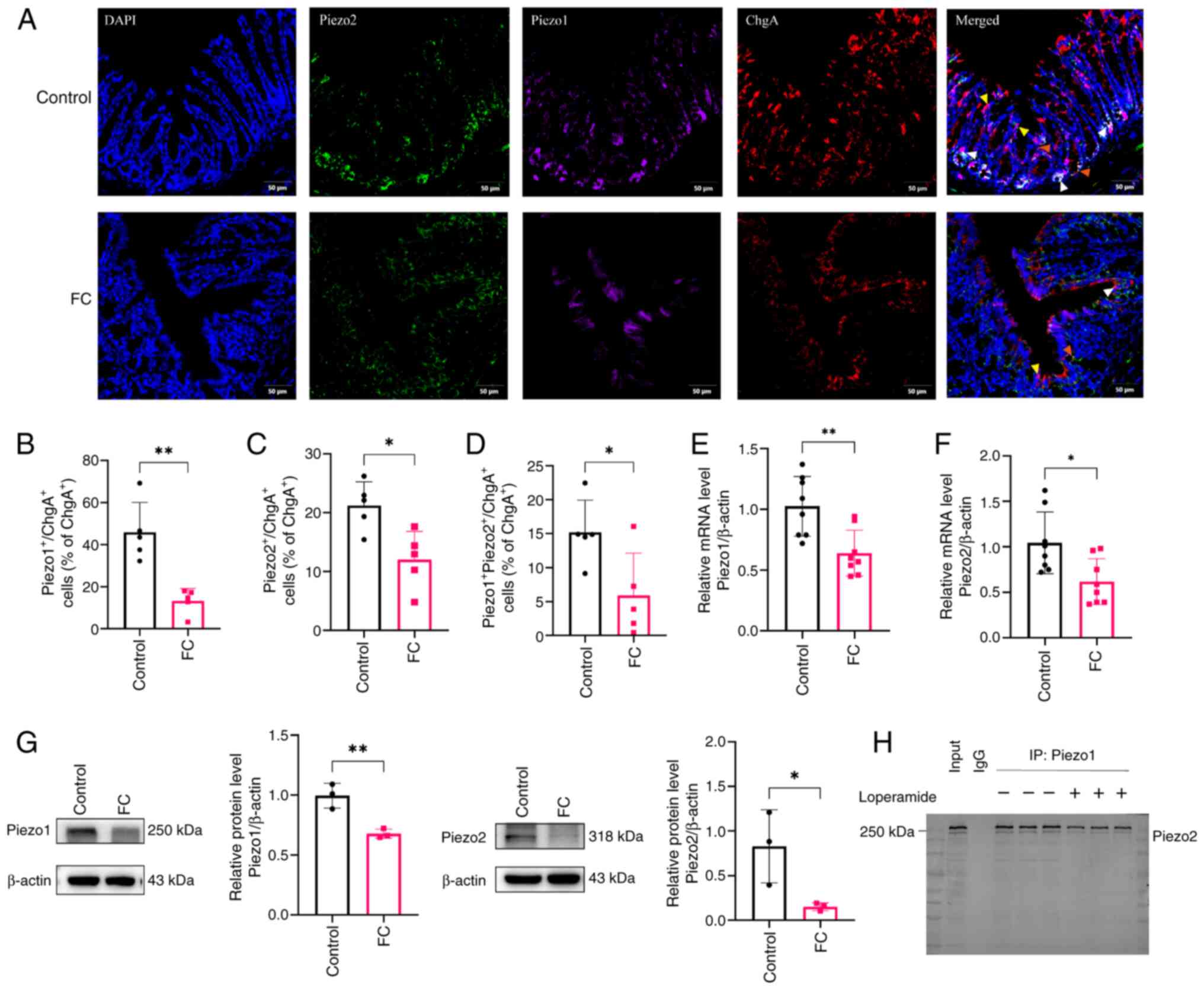
Figure 1

Colocalization and expression of
Piezo1 and Piezo2 in EC cells of FC Mice. (A) Immunofluorescence
staining of Piezo1, Piezo2 and EC cells in colonic sections from
each group. DAPI (blue) indicates nuclei, Piezo2 (green), Piezo1
(purple) and EC cell (red). Scale bar, 50 μm (magnification,
×200). Yellow arrows indicate co-localization of Piezo1 and ChgA;
orange arrows indicate co-localization of Piezo2 and ChgA; white
arrows indicate triple co-localization of Piezo1, Piezo2 and ChgA.
Percentage of (B) Piezo1+ChgA+, (C)
Piezo2+ChgA+ and (D)
Piezo1+Piezo2+ChgA+ cells as a
percentage of total ChgA+ cells in control and FC
groups; n=5 mice per group. (E) Quantification of Piezo1 and (F)
Piezo2 mRNA levels relative to β-actin in the control and FC group;
n=8 mice per group. (G) Western blot analysis of Piezo1 and Piezo2
protein expression in the control and FC groups; n=3 mice per group
Target proteins and internal controls were detected on separate
membranes processed in parallel. The vertical line indicates
membrane separation. (H) Co-immunoprecipitation of Piezo1 and
Piezo2 in colonic tissues from control and FC model mice, with
Piezo1 immunoprecipitated and Piezo2 detected by western blotting.
Data are presented as mean ± SD and were analyzed using an unpaired
two-tailed Student's t-test. Statistical significance indicated as
*P<0.05, **P<0.01. EC, enterochromaffin
cell; FC, functional constipation.

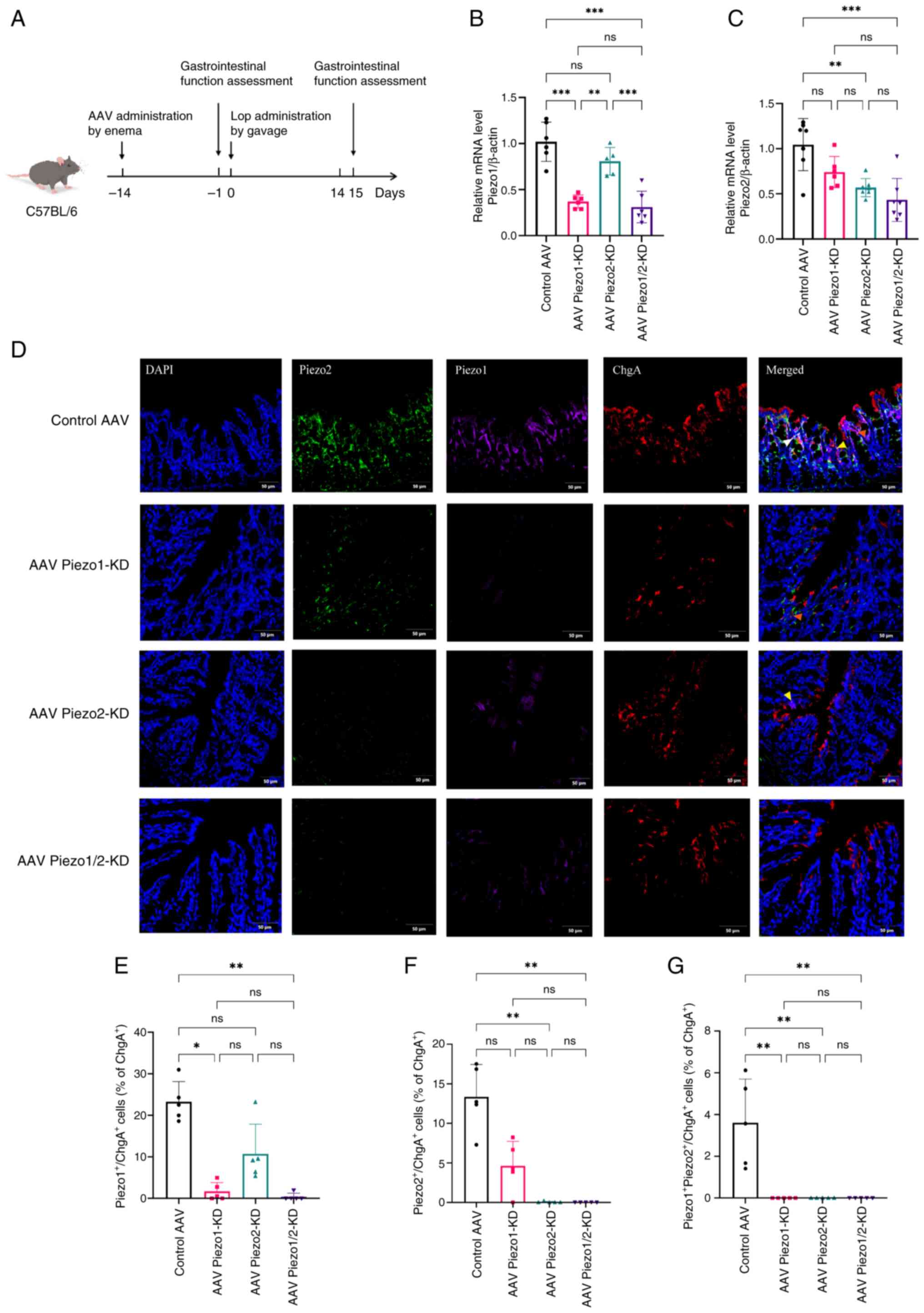
Figure 2

Piezo1/Piezo2 knockdown attenuates
expression of Piezos in EC cells of FC mice. (A) Schematic of the
experimental timeline for AAV-mediated knockdown. RT-qPCR analysis
of (B) Piezo1 and (C) Piezo2 mRNA levels in the control AAV, AAV
Piezo1-KD, AAV Piezo2-KD and AAV Piezo1/2-KD groups; n=5-7 mice per
group. Data analyzed by one-way ANOVA with Tukey's post hoc test.
(D) Immunofluorescence staining of Piezo1, Piezo2 and EC cells in
colonic sections from each group. DAPI (blue) indicates nuclei,
Piezo2 (green), Piezo1 (purple) and EC cell (red). Scale bar, 50
μm (magnification, ×200). Yellow arrows indicate
co-localization of Piezo1 and ChgA; orange arrows indicate
co-localization of Piezo2 and ChgA; white arrows indicate triple
co-localization of Piezo1, Piezo2 and ChgA. Percentage of (E)
Piezo1+ChgA+, (F)
Piezo2+ChgA+ and (G)
Piezo1+Piezo2+ChgA+ cells as a
percentage of total ChgA+ cells in control and knockdown
groups; n=5 mice per group. Data represent mean ± SD and were
analyzed using Kruskal-Wallis test. Statistical significance is
indicated as *P<0.05, **P<0.01,
***P<0.001. ns, not significant; EC, enterochromaffin
cell; FC, functional constipation; AAV, adeno-associated virus; KD,
knockdown.

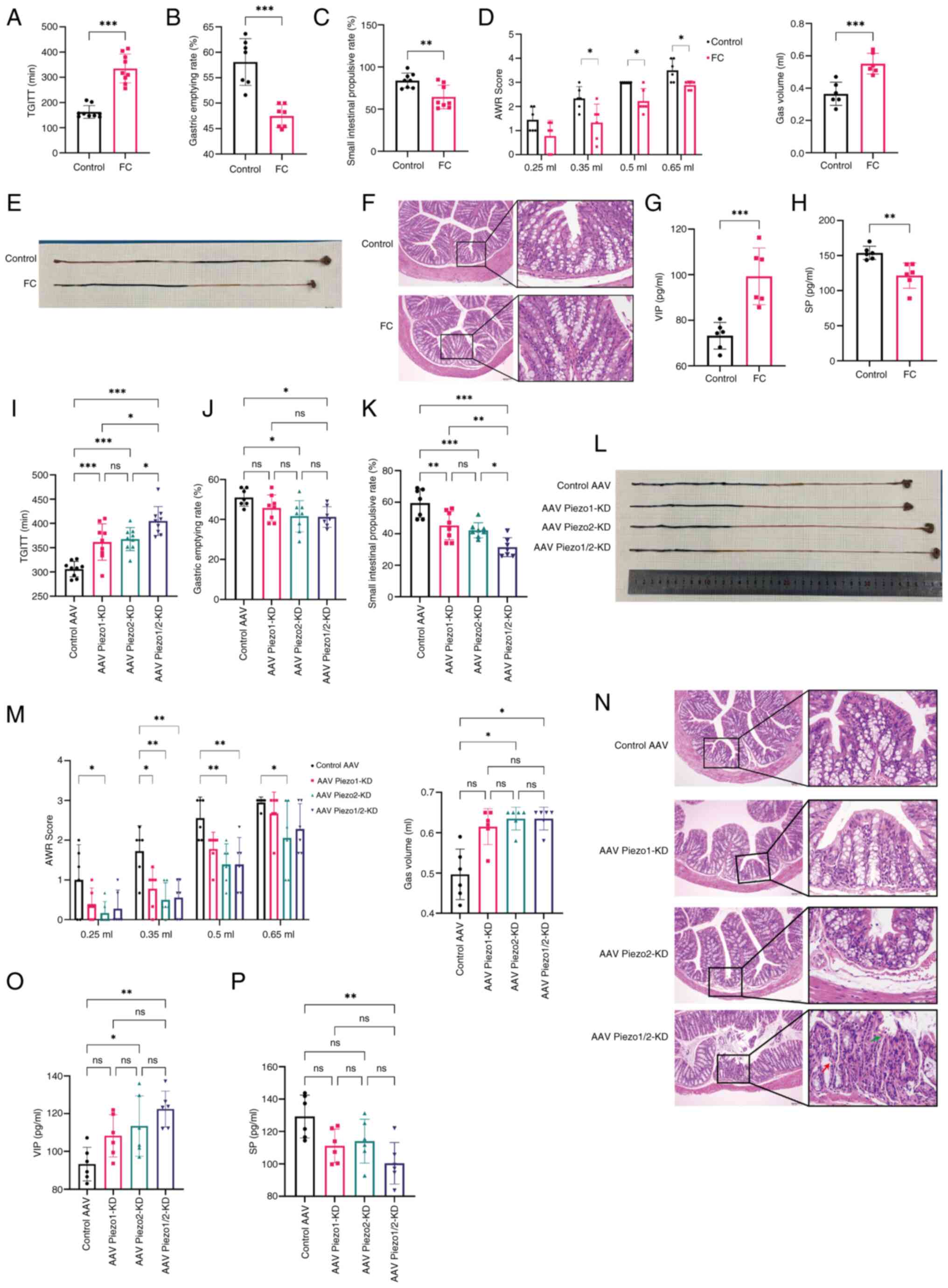
Figure 3

Effects of Piezo1 and Piezo2
knockdown on gastrointestinal motility and colonic sensitivity in
FC Mice. (A-H) General effects of the FC model compared with
control mice. Data were analyzed using an unpaired two-tailed
Student's t-test. (I-P) Effects of individual or simultaneous
Piezo1 and Piezo2 knockdown on gastrointestinal motility and
sensitivity in FC mice. Data were analyzed by one-way ANOVA with
Tukey's post hoc test or Kruskal-Wallis test. (A and I) TGITT, (B
and J) Gastric emptying rate, (C, K, E and L) Small intestinal
transit rate, (D and M) Gas volume required to reach an AWR score
of 3 and AWR scores at gas volumes of 0.25, 0.35, 0.50 and 0.65 ml.
(F and N) Histological analysis of colonic tissue in each group;
n=3 mice per group. Red arrows highlight regions of glandular
necrosis with structural disorganization and green arrows indicate
nuclear pyknosis and cytoplasmic dissolution. Scale bar, 100
μm (left, magnification, ×100) and 10 μm (right,
magnification, ×400). (G and O) Serum levels of VIP in each group,
(H and P) Serum levels of SP in each group. Data were analyzed
using an unpaired two-tailed Student's t-test or one-way ANOVA with
Tukey's post hoc test. n=6-9 mice per group. Data represent mean ±
SD. Statistical significance is indicated as *P<0.05,
**P<0.01, ***P<0.001. FC, functional
constipation; TGITT, total gastrointestinal transit time; AWR,
abdominal withdrawal reflex VIP, vasoactive intestinal peptide; SP,
substance P.

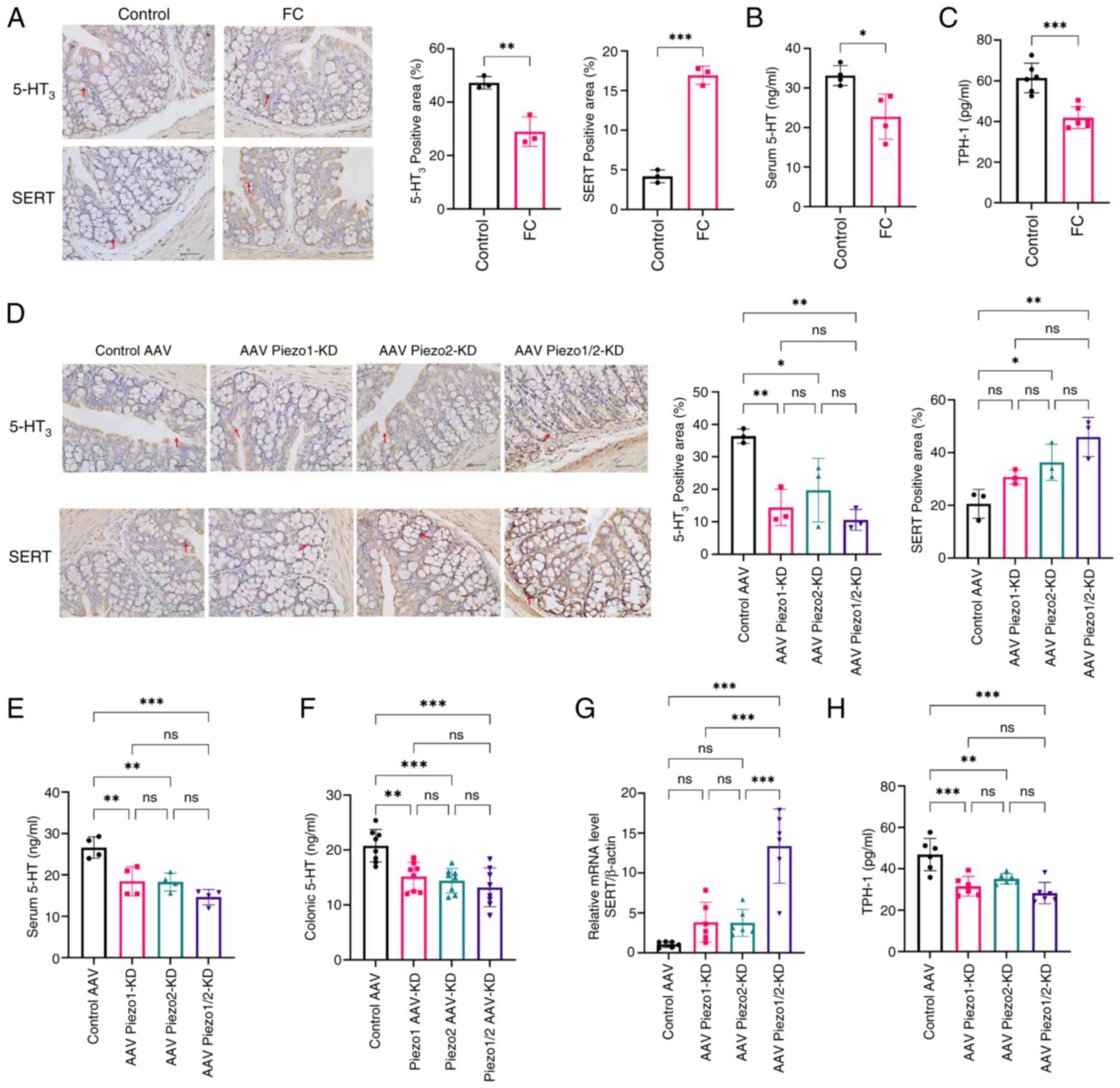
Figure 4

Effects of Piezo1 and Piezo2
knockdown on 5-HT synthesis, release and SERT expression in FC
Mice. (A) Representative immunohistochemical staining of
5-HT3 and SERT in colonic sections from control and FC
mice. Scale bar, 40 μm (magnification, ×400). Quantification
of (B) serum 5-HT and (C) colonic TPH-1 levels in control and FC
mice. Data were analyzed using an unpaired two-tailed Student's
t-test; n=4-6 mice per group. (D) Immunohistochemical staining of
5-HT3 and SERT in colonic sections from control AAV, AAV
Piezo1-KD, AAV Piezo2-KD and AAV Piezo1/2-KD groups. n=3 mice per
group. Scale bar, 40 μm (magnification, ×400). (E and F)
Serum and colonic 5-HT levels in each group, comparing knockdown
groups to the control AAV group. (G and H) Relative mRNA levels of
SERT and colonic TPH-1 levels in each group, comparing knockdown
groups to the control AAV. Data were analyzed by one-way ANOVA with
Tukey's post hoc test. n=4-6 mice per group. Data are presented as
mean ± SD, with statistical significance indicated as
*P<0.05, **P<0.01,
***P<0.001. 5-HT, 5-hydroxytryptamine; SERT,
serotonin transporter; FC, functional constipation; TPH-1,
tryptophan hydroxylase-1; AAV, adeno-associated virus; KD,
knockdown.

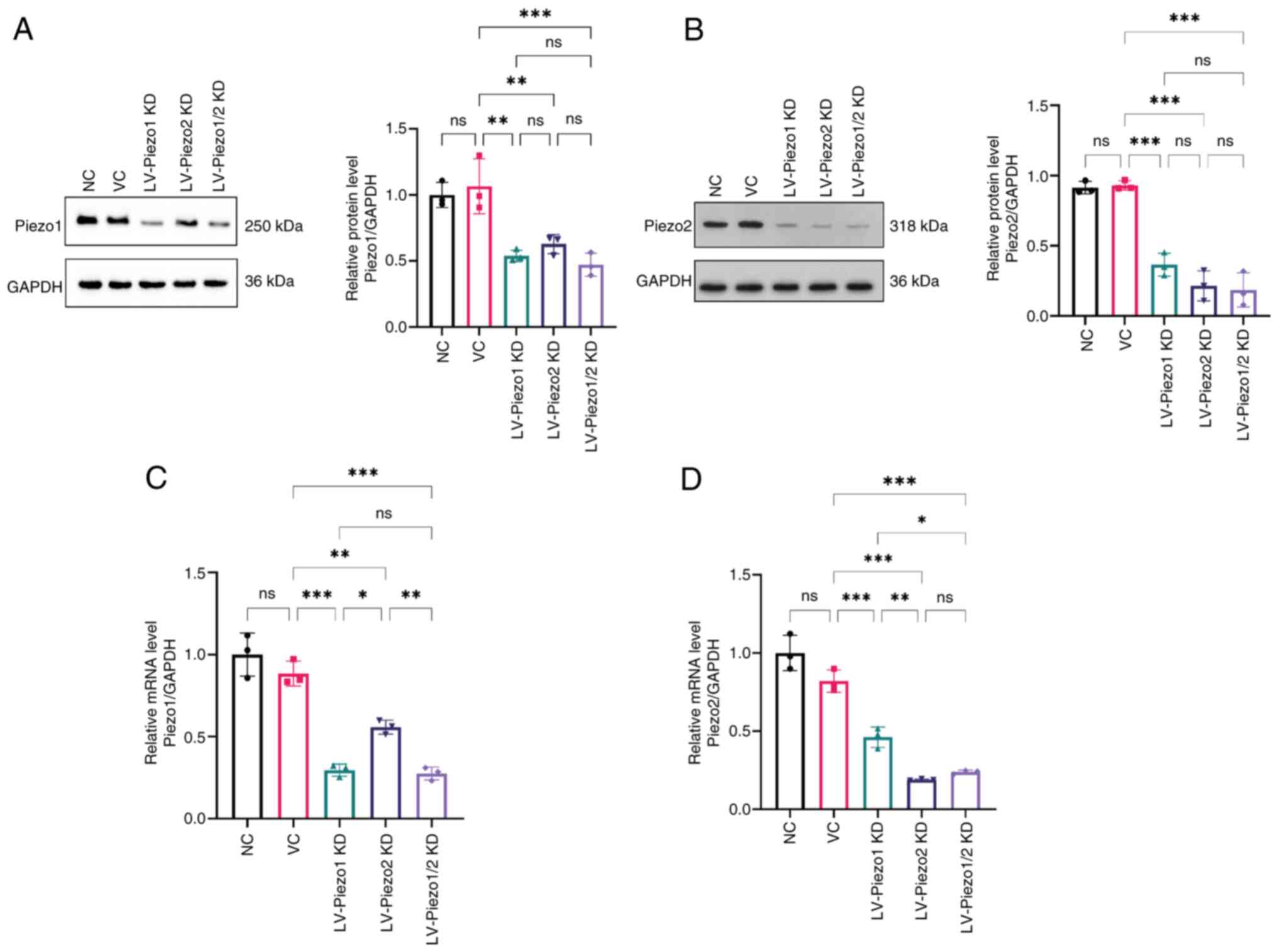
Figure 5

Expression changes of Piezo1 and
Piezo2 in EC cells following individual and combined knockdown.
Representative Western blot analysis of (A) Piezo1 and (B) Piezo2
protein expression in the NC, VC, LV-Piezo1 KD (Piezo1 knockdown),
LV-Piezo2 KD (Piezo2 knockdown) and LV-Piezo1/2 KD (combined Piezo1
and Piezo2 knockdown) groups. GAPDH served as the loading control.
Target proteins and internal controls were detected on separate
membranes processed in parallel. The vertical line indicates
membrane separation. Quantification of (C) Piezo1 and (D) Piezo2
mRNA levels relative to GAPDH; n=3 cells per group. Data are
presented as mean ± SD and were analyzed by one-way ANOVA with
Tukey's post hoc test. Statistical significance indicated as
*P<0.05, **P<0.01,
***P<0.001. EC, enterochromaffin cell; NC, negative
control; VC, vector control; KD, knockdown.

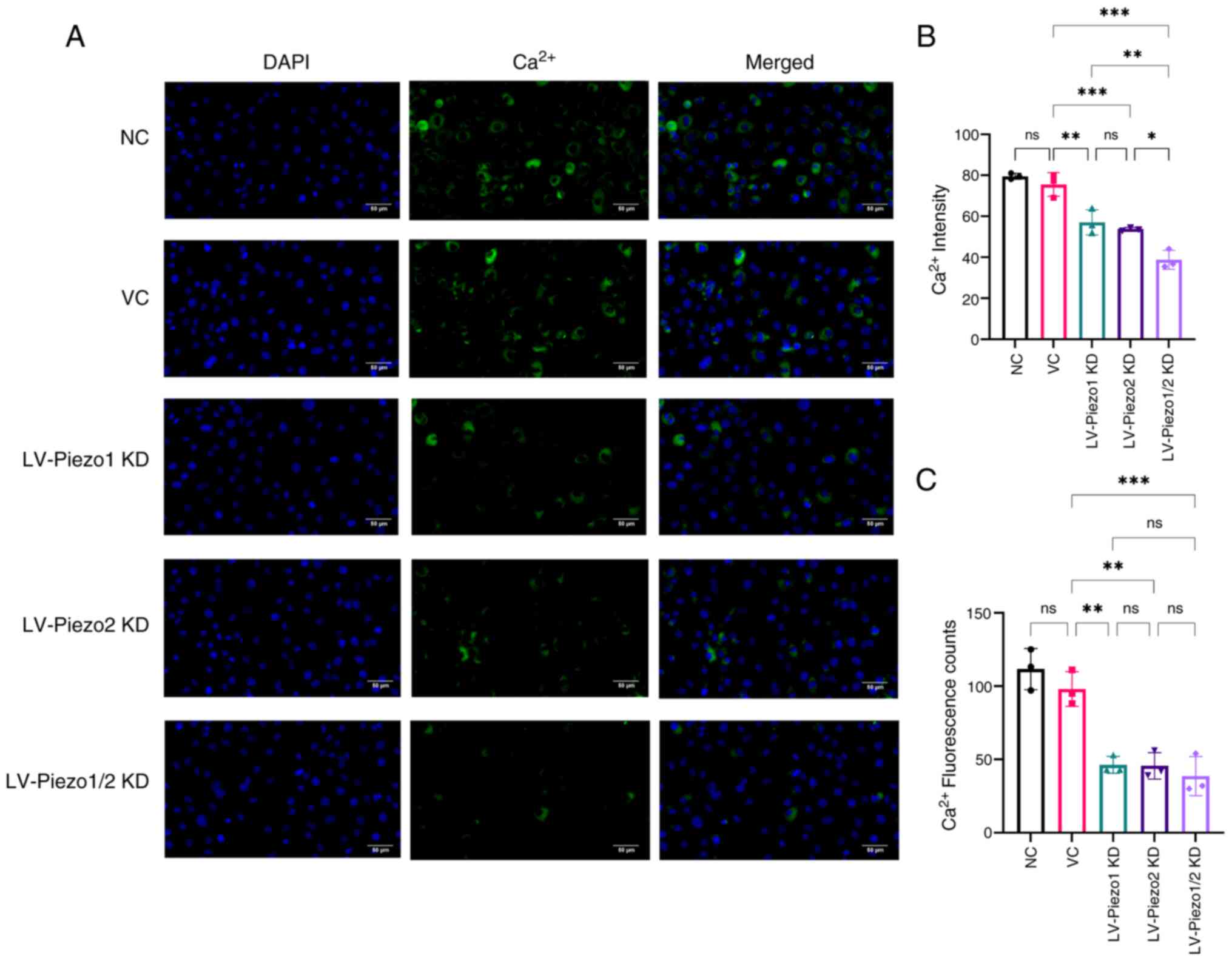
Figure 6

Effect of Piezo1 and Piezo2 knockdown
on intracellular Ca2+ levels in ECs. (A) Representative
immunofluorescence images of intracellular Ca2+ levels
in different groups. DAPI (blue) was used to stain nuclei and
Ca2+ indicator (green) shows intracellular calcium
levels. Merged images display co-localization of nuclei and
Ca2+ fluorescence. Scale bar, 50 μm
(magnification, ×400). (B) Quantification of Ca2+
fluorescence intensity in each group. (C) Quantification of
Ca2+ fluorescence counts in each group; n=3 cells per
group. Data are presented as mean ± SD and were analyzed by one-way
ANOVA with Tukey's post hoc test. Statistical significance
indicated as *P<0.05, **P<0.01,
***P<0.001. ns, not significant; EC, enterochromaffin
cell.

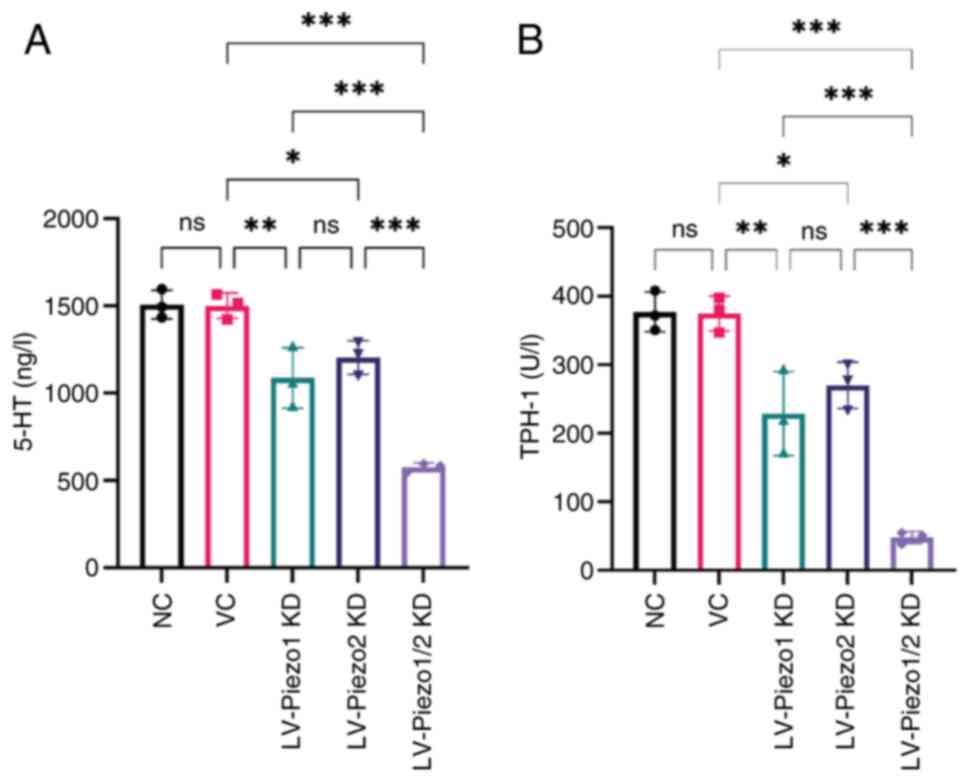
Figure 7

Effect of Piezo1 and Piezo2 knockdown
on 5-HT and TPH-1 levels in enterochromaffin cells. (A)
Quantification of 5-HT levels (ng/l) in the different groups. (B)
Quantification of TPH-1 enzyme activity (U/l) in each group. n=3
cells per group. Data are presented as mean ± SD and were analyzed
by one-way ANOVA with Tukey's post hoc test. Statistical
significance indicated as *P<0.05,
**P<0.01, ***P<0.001. ns, not
significant; 5-HT, 5-hydroxytryptamine; NC, negative control; VC,
vector control; KD, knockdown; TPH-1, tryptophan hydroxylase-1.

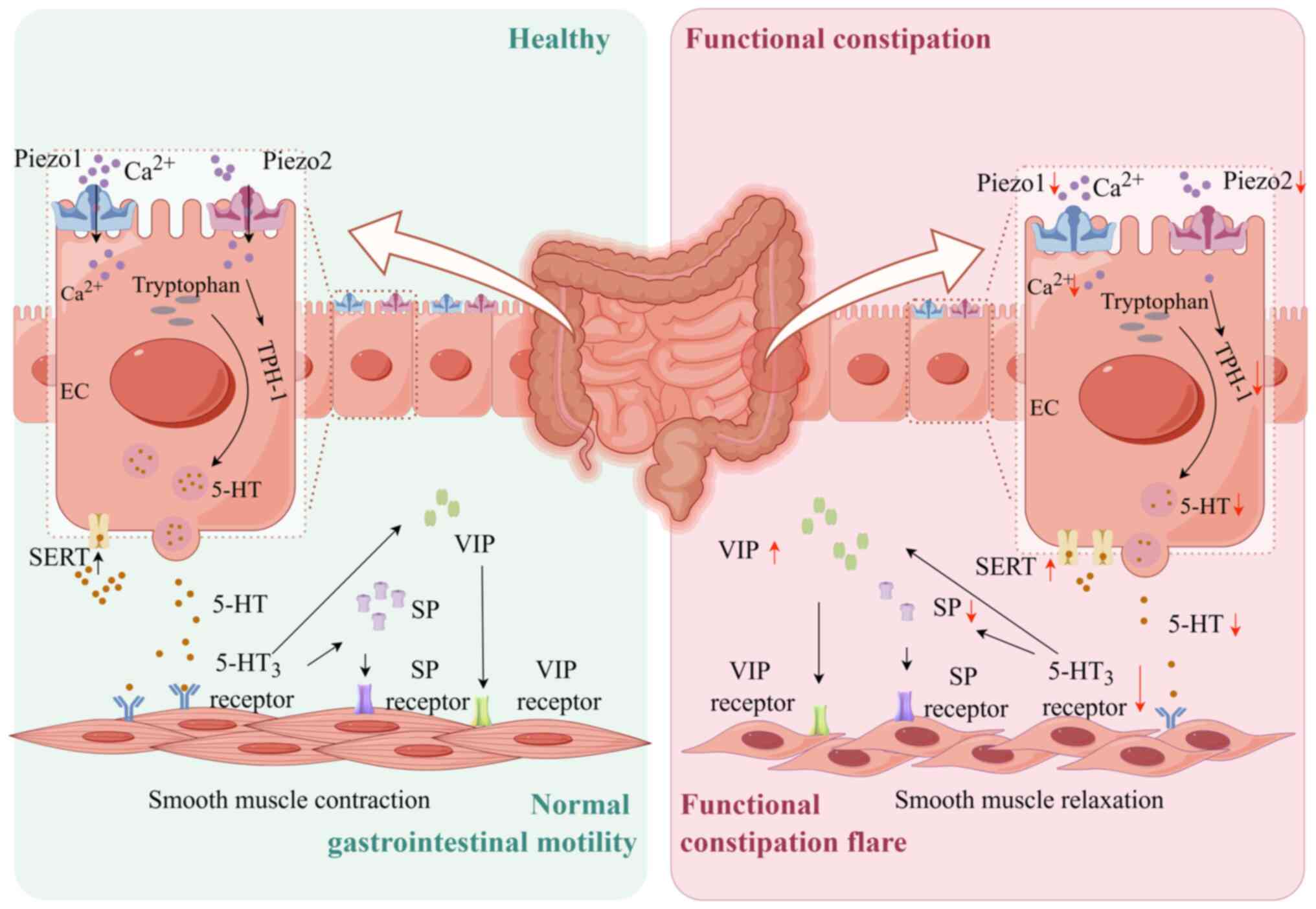
Figure 8

Mechanism diagram of the study. In
functional constipation, Piezo1 and Piezo2 expression is
downregulated, reducing Ca2+ influx and impairing 5-HT
synthesis. Consequently, diminished 5-HT release reduces activation
of 5-HT3 receptors, SP levels decrease and VIP levels
increase, leading to smooth muscle relaxation. Additionally,
heightened SERT activity, exacerbating the deficiency in 5-HT
signaling. These disruptions collectively induce pathological
alterations in intestinal structure and impaired motility, leading
to functional constipation symptoms. (created by figdraw.com). 5-HT, 5-hydroxytryptamine; SP,
substance P; VIP, vasoactive intestinal peptide; SERT, serotonin
transporter; EC, enterochromaffin cell.
View References

1 

Black CJ, Drossman DA, Talley NJ, Ruddy J and Ford AC: Functional gastrointestinal disorders: Advances in understanding and management. Lancet. 396:1664–1674. 2020. View Article : Google Scholar : PubMed/NCBI

2 

Ma C, Congly SE, Novak KL, Belletrutti PJ, Raman M, Woo M, Andrews CN and Nasser Y: Epidemiologic burden and treatment of chronic symptomatic functional bowel disorders in the United States: A nationwide analysis. Gastroenterology. 160:88–98.e4. 2021. View Article : Google Scholar

3 

Rao SSC, Rattanakovit K and Patcharatrakul T: Diagnosis and management of chronic constipation in adults. Nat Rev Gastroenterol Hepatol. 13:295–305. 2016. View Article : Google Scholar : PubMed/NCBI

4 

Barberio B, Judge C, Savarino EV and Ford AC: Global prevalence of functional constipation according to the Rome criteria: A systematic review and meta-analysis. Lancet Gastroenterol Hepatol. 6:638–648. 2021. View Article : Google Scholar : PubMed/NCBI

5 

Palsson OS, Whitehead W, Törnblom H, Sperber AD and Simren M: Prevalence of Rome IV functional bowel disorders among adults in the United States, Canada, and the United Kingdom. Gastroenterology. 158:1262–1273.e3. 2020. View Article : Google Scholar : PubMed/NCBI

6 

Rossen ND, Touhara KK, Castro J, Harrington AM, Caraballo SG, Deng F, Li Y, Brierley SM and Julius D: Population imaging of enterochromaffin cell activity reveals regulation by somatostatin. Proc Natl Acad Sci USA. 122:e25015251222025. View Article : Google Scholar : PubMed/NCBI

7 

Bellono NW, Bayrer JR, Leitch DB, Castro J, Zhang C, O'Donnell TA, Brierley SM, Ingraham HA and Julius D: Enterochromaffin cells are gut chemosensors that couple to sensory neural pathways. Cell. 170:185–198.e16. 2017. View Article : Google Scholar : PubMed/NCBI

8 

Chen Z, Luo J, Li J, Kim G, Stewart A, Urban JF Jr, Huang Y, Chen S, Wu LG, Chesler A, et al: Interleukin-33 promotes serotonin release from enterochromaffin cells for intestinal homeostasis. Immunity. 54:151–163.e6. 2021. View Article : Google Scholar :

9 

Kieslich B, Weiße RH, Brendler J, Ricken A, Schöneberg T and Sträter N: The dimerized pentraxin-like domain of the adhesion G protein-coupled receptor 112 (ADGRG4) suggests function in sensing mechanical forces. J Biol Chem. 299:1053562023. View Article : Google Scholar : PubMed/NCBI

10 

Bayrer JR, Castro J, Venkataraman A, Touhara KK, Rossen ND, Morrie RD, Maddern J, Hendry A, Braverman KN, Garcia-Caraballo S, et al: Gut enterochromaffin cells drive visceral pain and anxiety. Nature. 616:137–142. 2023. View Article : Google Scholar : PubMed/NCBI

11 

Strege PR, Knutson K, Eggers SJ, Li JH, Wang F, Linden D, Szurszewski JH, Milescu L, Leiter AB, Farrugia G and Beyder A: Sodium channel NaV1.3 is important for enterochromaffin cell excitability and serotonin release. Sci Rep. 7:156502017. View Article : Google Scholar

12 

Leiser SF, Miller H, Rossner R, Fletcher M, Leonard A, Primitivo M, Rintala N, Ramos FJ, Miller DL and Kaeberlein M: Cell nonautonomous activation of flavin-containing monooxygenase promotes longevity and health span. Science. 350:1375–1378. 2015. View Article : Google Scholar : PubMed/NCBI

13 

Raouf Z, Steinway SN, Scheese D, Lopez CM, Duess JW, Tsuboi K, Sampah M, Klerk D, El Baassiri M, Moore H, et al: Colitis-induced small intestinal hypomotility is dependent on enteroendocrine cell loss in mice. Cell Mol Gastroenterol Hepatol. 18:53–70. 2024. View Article : Google Scholar : PubMed/NCBI

14 

Bhattarai Y, Williams BB, Battaglioli EJ, Whitaker WR, Till L, Grover M, Linden DR, Akiba Y, Kandimalla KK, Zachos NC, et al: Gut microbiota-produced tryptamine activates an epithelial G-protein-coupled receptor to increase colonic secretion. Cell Host Microbe. 23:775–785.e5. 2018. View Article : Google Scholar : PubMed/NCBI

15 

Zhao J, Zhao L, Zhang S and Zhu C: Modified Liu-Jun-Zi decoction alleviates visceral hypersensitivity in functional dyspepsia by regulating EC cell-5HT3r signaling in duodenum. J Ethnopharmacol. 250:1124682020. View Article : Google Scholar

16 

Nygaard A, Zachariassen LG, Larsen KS, Kristensen AS and Loland CJ: Fluorescent non-canonical amino acid provides insight into the human serotonin transporter. Nat Commun. 15:92672024. View Article : Google Scholar : PubMed/NCBI

17 

Wei L, Singh R, Ha SE, Martin AM, Jones LA, Jin B, Jorgensen BG, Zogg H, Chervo T, Gottfried-Blackmore A, et al: Serotonin deficiency is associated with delayed gastric emptying. Gastroenterology. 160:2451–2466.e19. 2021. View Article : Google Scholar : PubMed/NCBI

18 

Cremon C, Carini G, Wang B, Vasina V, Cogliandro RF, De Giorgio R, Stanghellini V, Grundy D, Tonini M, De Ponti F, et al: Intestinal serotonin release, sensory neuron activation, and abdominal pain in irritable bowel syndrome. Am J Gastroenterol. 106:1290–1298. 2011. View Article : Google Scholar : PubMed/NCBI

19 

Jin B, Ha SE, Wei L, Singh R, Zogg H, Clemmensen B, Heredia DJ, Gould TW, Sanders KM and Ro S: Colonic motility is improved by the activation of 5-HT2B receptors on interstitial cells of cajal in diabetic mice. Gastroenterology. 161:608–622.e7. 2021. View Article : Google Scholar

20 

Nan N, Gong MX, Wang Q, Li MJ, Xu R, Ma Z, Wang SH, Zhao H and Xu YS: Wuzhuyu decoction relieves hyperalgesia by regulating central and peripheral 5-HT in chronic migraine model rats. Phytomedicine. 96:1539052022. View Article : Google Scholar : PubMed/NCBI

21 

Alcaino C, Knutson KR, Treichel AJ, Yildiz G, Strege PR, Linden DR, Li JH, Leiter AB, Szurszewski JH, Farrugia G and Beyder A: A population of gut epithelial enterochromaffin cells is mechanosensitive and requires Piezo2 to convert force into serotonin release. Proc Natl Acad Sci USA. 115:E7632–E7641. 2018. View Article : Google Scholar : PubMed/NCBI

22 

Kefauver JM, Ward AB and Patapoutian A: Discoveries in structure and physiology of mechanically activated ion channels. Nature. 587:567–576. 2020. View Article : Google Scholar : PubMed/NCBI

23 

Gudipaty SA, Lindblom J, Loftus PD, Redd MJ, Edes K, Davey CF, Krishnegowda V and Rosenblatt J: Mechanical stretch triggers rapid epithelial cell division through Piezo1. Nature. 543:118–121. 2017. View Article : Google Scholar : PubMed/NCBI

24 

Baghdadi MB, Houtekamer RM, Perrin L, Rao-Bhatia A, Whelen M, Decker L, Bergert M, Pérez-Gonzàlez C, Bouras R, Gropplero G, et al: PIEZO-dependent mechanosensing is essential for intestinal stem cell fate decision and maintenance. Science. 386:eadj76152024. View Article : Google Scholar : PubMed/NCBI

25 

Ma S, Dubin AE, Zhang Y, Mousavi SAR, Wang Y, Coombs AM, Loud M, Andolfo I and Patapoutian A: A role of PIEZO1 in iron metabolism in mice and humans. Cell. 184:969–982.e13. 2021. View Article : Google Scholar : PubMed/NCBI

26 

Swain SM and Liddle RA: Mechanosensing Piezo channels in gastrointestinal disorders. J Clin Invest. 133:e1719552023. View Article : Google Scholar : PubMed/NCBI

27 

He H, Zhou J, Xu X, Zhou P, Zhong H and Liu M: Piezo channels in the intestinal tract. Front Physiol. 15:13563172024. View Article : Google Scholar : PubMed/NCBI

28 

Sugisawa E, Takayama Y, Takemura N, Kondo T, Hatakeyama S, Kumagai Y, Sunagawa M, Tominaga M and Maruyama K: RNA sensing by gut Piezo1 is essential for systemic serotonin synthesis. Cell. 182:609–624.e21. 2020. View Article : Google Scholar : PubMed/NCBI

29 

Ma T, Li Y, Yang N, Wang H, Shi X, Liu Y, Jin H, Kwok LY, Sun Z and Zhang H: Efficacy of a postbiotic and its components in promoting colonic transit and alleviating chronic constipation in humans and mice. Cell Rep Med. 6:1020932025. View Article : Google Scholar : PubMed/NCBI

30 

Xu MM, Guo Y, Chen Y, Zhang W, Wang L and Li Y: Electro-acupuncture promotes gut motility and alleviates functional constipation by regulating gut microbiota and increasing butyric acid generation in mice. J Integr Med. 21:397–406. 2023. View Article : Google Scholar : PubMed/NCBI

31 

Lewis SJ and Heaton KW: Stool form scale as a useful guide to intestinal transit time. Scand J Gastroenterol. 32:920–924. 1997. View Article : Google Scholar : PubMed/NCBI

32 

Segura MM, Mangion M, Gaillet B and Garnier A: New developments in lentiviral vector design, production and purification. Expert Opin Biol Ther. 13:987–1011. 2013. View Article : Google Scholar : PubMed/NCBI

33 

Livak KJ and Schmittgen TD: Analysis of relative gene expression data using real-time quantitative PCR and the 2(-Delta Delta C(T)) method. Methods. 25:402–408. 2001. View Article : Google Scholar

34 

Li J, Zheng H, Liu J, Ding J, Guo Q and Zhang N: Effects of functional red pine seed direct-drinking oil on constipation and intestinal barrier function in mice. Antioxidants (Basel). 14:142024. View Article : Google Scholar

35 

Yin J, Liang Y, Wang D, Yan Z, Yin H, Wu D and Su Q: Naringenin induces laxative effects by upregulating the expression levels of c-Kit and SCF, as well as those of aquaporin 3 in mice with loperamide-induced constipation. Int J Mol Med. 41:649–658. 2018.

36 

Wu J, Lewis AH and Grandl J: Touch, tension, and transduction-the function and regulation of Piezo ion channels. Trends Biochem Sci. 42:57–71. 2017. View Article : Google Scholar

37 

Yang X, Lin C, Chen X, Li S, Li X and Xiao B: Structure deformation and curvature sensing of PIEZO1 in lipid membranes. Nature. 604:377–383. 2022. View Article : Google Scholar : PubMed/NCBI

38 

Passini FS, Jaeger PK, Saab AS, Hanlon S, Chittim NA, Arlt MJ, Ferrari KD, Haenni D, Caprara S, Bollhalder M, et al: Shear-stress sensing by PIEZO1 regulates tendon stiffness in rodents and influences jumping performance in humans. Nat Biomed Eng. 5:1457–1471. 2021. View Article : Google Scholar : PubMed/NCBI

39 

Huang Y, Mo H, Yang J, Gao L, Tao T, Shu Q, Guo W, Zhao Y, Lyu J, Wang Q, et al: Mechano-regulation of GLP-1 production by Piezo1 in intestinal L cells. Elife. 13:RP978542024. View Article : Google Scholar : PubMed/NCBI

40 

Liu Y, Fang F, Xiong Y, Wu J, Li X, Li G, Bai T, Hou X and Song J: Reprogrammed fecal and mucosa-associated intestinal microbiota and weakened mucus layer in intestinal goblet cell-specific Piezo1-deficient mice. Front Cell Infect Microbiol. 12:10353862022. View Article : Google Scholar

41 

Servin-Vences MR, Lam RM, Koolen A, Wang Y, Saade DN, Loud M, Kacmaz H, Frausto S, Zhang Y, Beyder A, et al: PIEZO2 in somatosensory neurons controls gastrointestinal transit. Cell. 186:3386–3399. 2023. View Article : Google Scholar : PubMed/NCBI

42 

Xu Y, Xiong Y, Liu Y, Li G, Bai T, Zheng G, Hou X and Song J: Activation of goblet cell Piezo1 alleviates mucus barrier damage in mice exposed to WAS by inhibiting H3K9me3 modification. Cell Biosci. 13:72023. View Article : Google Scholar : PubMed/NCBI

43 

Chang JE, Buechler MB, Gressier E, Turley SJ and Carroll MC: Mechanosensing by Peyer's patch stroma regulates lymphocyte migration and mucosal antibody responses. Nat Immunol. 20:1506–1516. 2019. View Article : Google Scholar : PubMed/NCBI

44 

Xie Z, Rose L, Feng J, Zhao Y, Lu Y, Kane H, Hibberd TJ, Hu X, Wang Z, Zang K, et al: Enteric neuronal Piezo1 maintains mechanical and immunological homeostasis by sensing force. Cell. 188:2417–2432.e19. 2025. View Article : Google Scholar : PubMed/NCBI

45 

Swain SM, Romac JMJ, Shahid RA, Pandol SJ, Liedtke W, Vigna SR and Liddle RA: TRPV4 channel opening mediates pressure-induced pancreatitis initiated by Piezo1 activation. J Clin Invest. 130:2527–2541. 2020. View Article : Google Scholar : PubMed/NCBI

46 

Borbiro I, Badheka D and Rohacs T: Activation of TRPV1 channels inhibits mechanosensitive Piezo channel activity by depleting membrane phosphoinositides. Sci Signal. 8:ra152015. View Article : Google Scholar : PubMed/NCBI

47 

Xie Z, Feng J, Hibberd TJ, Chen BN, Zhao Y, Zang K, Hu X, Yang X, Chen L, Brookes SJ, et al: Piezo2 channels expressed by colon-innervating TRPV1-lineage neurons mediate visceral mechanical hypersensitivity. Neuron. 111:526–538.e4. 2023. View Article : Google Scholar :

48 

Song Y, Fothergill LJ, Lee KS, Liu BY, Koo A, Perelis M, Diwakarla S, Callaghan B, Huang J, Wykosky J, et al: Stratification of enterochromaffin cells by single-cell expression analysis. Elife. 12:RP905962025. View Article : Google Scholar : PubMed/NCBI

49 

Kharchenko PV, Silberstein L and Scadden DT: Bayesian approach to single-cell differential expression analysis. Nat Methods. 11:740–742. 2014. View Article : Google Scholar : PubMed/NCBI

50 

Wang F, Knutson K, Alcaino C, Linden DR, Gibbons SJ, Kashyap P, Grover M, Oeckler R, Gottlieb PA, Li HJ, et al: Mechanosensitive ion channel Piezo2 is important for enterochromaffin cell response to mechanical forces. J Physiol. 595:79–91. 2017. View Article : Google Scholar :

51 

Qian W, Hadi T, Silvestro M, Ma X, Rivera CF, Bajpai A, Li R, Zhang Z, Qu H, Tellaoui RS, et al: Microskeletal stiffness promotes aortic aneurysm by sustaining pathological vascular smooth muscle cell mechanosensation via Piezo1. Nat Commun. 13:5122022. View Article : Google Scholar : PubMed/NCBI

52 

Bi Y, Li H, Diao M, Liu Q, Huang L, Tao Y, Wan Y and Lin X: Piezo1 overexpression in the uterus contributes to myometrium contraction and inflammation-associated preterm birth. J Transl Med. 22:11402024. View Article : Google Scholar : PubMed/NCBI

53 

Luo M, Gu R, Wang C, Guo J, Zhang X, Ni K, Liu L, Pan Y, Li J and Deng L: High stretch associated with mechanical ventilation promotes piezo1-mediated migration of airway smooth muscle cells. Int J Mol Sci. 25:17482024. View Article : Google Scholar : PubMed/NCBI

54 

Dalghi MG, Ruiz WG, Clayton DR, Montalbetti N, Daugherty SL, Beckel JM, Carattino MD and Apodaca G: Functional roles for PIEZO1 and PIEZO2 in urothelial mechanotransduction and lower urinary tract interoception. JCI Insight. 6:e1529842021. View Article : Google Scholar : PubMed/NCBI

55 

Bai X, De Palma G, Boschetti E, Nishiharo Y, Lu J, Shimbori C, Costanzini A, Saqib Z, Kraimi N, Sidani S, et al: Vasoactive intestinal polypeptide plays a key role in the microbial-neuroimmune control of intestinal motility. Cell Mol Gastroenterol Hepatol. 17:383–398. 2024. View Article : Google Scholar :

56 

Talbot J, Hahn P, Kroehling L, Nguyen H, Li D and Littman DR: Feeding-dependent VIP neuron-ILC3 circuit regulates the intestinal barrier. Nature. 579:575–580. 2020. View Article : Google Scholar : PubMed/NCBI

57 

Yin Y, Zhong L, Wang JW, Zhao XY, Zhao WJ and Kuang HX: Tong Xie Yao Fang relieves irritable bowel syndrome in rats via mechanisms involving regulation of 5-hydroxytryptamine and substance P. World J Gastroenterol. 21:4536–4546. 2015. View Article : Google Scholar : PubMed/NCBI

58 

Chin A, Svejda B, Gustafsson BI, Granlund AB, Sandvik AK, Timberlake A, Sumpio B, Pfragner R, Modlin IM and Kidd M: The role of mechanical forces and adenosine in the regulation of intestinal enterochromaffin cell serotonin secretion. Am J Physiol Gastrointest Liver Physiol. 302:G397–G405. 2012. View Article : Google Scholar :

59 

Zhu Z, Chen X, Chen S, Hu C, Guo R, Wu Y, Liu Z, Shu X and Jiang M: Examination of the mechanism of Piezo ion channel in 5-HT synthesis in the enterochromaffin cell and its association with gut motility. Front Endocrinol (Lausanne). 14:11935562023. View Article : Google Scholar : PubMed/NCBI

60 

Caulier A, Jankovsky N, Demont Y, Ouled-Haddou H, Demagny J, Guitton C, Merlusca L, Lebon D, Vong P, Aubry A, et al: PIEZO1 activation delays erythroid differentiation of normal and hereditary xerocytosis-derived human progenitor cells. Haematologica. 105:610–622. 2020. View Article : Google Scholar :

61 

Garnock-Jones KP: Prucalopride: A review in chronic idiopathic constipation. Drugs. 76:99–110. 2016. View Article : Google Scholar

62 

Mugie SM, Korczowski B, Bodi P, Green A, Kerstens R, Ausma J, Ruth M, Levine A and Benninga MA: Prucalopride is no more effective than placebo for children with functional constipation. Gastroenterology. 147:1285–1295.e1. 2014. View Article : Google Scholar : PubMed/NCBI

63 

Chang L, Chey WD, Imdad A, Almario CV, Bharucha AE, Diem S, Greer KB, Hanson B, Harris LA, Ko C, et al: American gastroenterological association-american college of gastroenterology clinical practice guideline: Pharmacological management of chronic idiopathic constipation. Gastroenterology. 164:1086–1106. 2023. View Article : Google Scholar : PubMed/NCBI

64 

Liu S, Yang X, Chen X, Zhang X, Jiang J, Yuan J, Liu W, Wang L, Zhou H, Wu K, et al: An intermediate open structure reveals the gating transition of the mechanically activated PIEZO1 channel. Neuron. 113:590–604.e6. 2025. View Article : Google Scholar

65 

Doihara H, Nozawa K, Kojima R, Kawabata-Shoda E, Yokoyama T and Ito H: QGP-1 cells release 5-HT via TRPA1 activation; a model of human enterochromaffin cells. Mol Cell Biochem. 331:239–245. 2009. View Article : Google Scholar : PubMed/NCBI

Related Articles

  • Abstract
  • View
  • Download
  • Twitter
Copy and paste a formatted citation
Spandidos Publications style
Yan X, Ma P, Wang W, Zeng W, Li Y, Hou Y, Ye J, Zheng Q, Zhang W, Yao J, Yao J, et al: Piezo knockdown reduces 5‑hydroxytryptamine release from enterochromaffin cells and exacerbates intestinal dyskinesia in mice with functional constipation. Int J Mol Med 56: 178, 2025.
APA
Yan, X., Ma, P., Wang, W., Zeng, W., Li, Y., Hou, Y. ... Li, Y. (2025). Piezo knockdown reduces 5‑hydroxytryptamine release from enterochromaffin cells and exacerbates intestinal dyskinesia in mice with functional constipation. International Journal of Molecular Medicine, 56, 178. https://doi.org/10.3892/ijmm.2025.5619
MLA
Yan, X., Ma, P., Wang, W., Zeng, W., Li, Y., Hou, Y., Ye, J., Zheng, Q., Zhang, W., Yao, J., Li, Y."Piezo knockdown reduces 5‑hydroxytryptamine release from enterochromaffin cells and exacerbates intestinal dyskinesia in mice with functional constipation". International Journal of Molecular Medicine 56.6 (2025): 178.
Chicago
Yan, X., Ma, P., Wang, W., Zeng, W., Li, Y., Hou, Y., Ye, J., Zheng, Q., Zhang, W., Yao, J., Li, Y."Piezo knockdown reduces 5‑hydroxytryptamine release from enterochromaffin cells and exacerbates intestinal dyskinesia in mice with functional constipation". International Journal of Molecular Medicine 56, no. 6 (2025): 178. https://doi.org/10.3892/ijmm.2025.5619
Copy and paste a formatted citation
x
Spandidos Publications style
Yan X, Ma P, Wang W, Zeng W, Li Y, Hou Y, Ye J, Zheng Q, Zhang W, Yao J, Yao J, et al: Piezo knockdown reduces 5‑hydroxytryptamine release from enterochromaffin cells and exacerbates intestinal dyskinesia in mice with functional constipation. Int J Mol Med 56: 178, 2025.
APA
Yan, X., Ma, P., Wang, W., Zeng, W., Li, Y., Hou, Y. ... Li, Y. (2025). Piezo knockdown reduces 5‑hydroxytryptamine release from enterochromaffin cells and exacerbates intestinal dyskinesia in mice with functional constipation. International Journal of Molecular Medicine, 56, 178. https://doi.org/10.3892/ijmm.2025.5619
MLA
Yan, X., Ma, P., Wang, W., Zeng, W., Li, Y., Hou, Y., Ye, J., Zheng, Q., Zhang, W., Yao, J., Li, Y."Piezo knockdown reduces 5‑hydroxytryptamine release from enterochromaffin cells and exacerbates intestinal dyskinesia in mice with functional constipation". International Journal of Molecular Medicine 56.6 (2025): 178.
Chicago
Yan, X., Ma, P., Wang, W., Zeng, W., Li, Y., Hou, Y., Ye, J., Zheng, Q., Zhang, W., Yao, J., Li, Y."Piezo knockdown reduces 5‑hydroxytryptamine release from enterochromaffin cells and exacerbates intestinal dyskinesia in mice with functional constipation". International Journal of Molecular Medicine 56, no. 6 (2025): 178. https://doi.org/10.3892/ijmm.2025.5619
Follow us
  • Twitter
  • LinkedIn
  • Facebook
About
  • Spandidos Publications
  • Careers
  • Cookie Policy
  • Privacy Policy
How can we help?
  • Help
  • Live Chat
  • Contact
  • Email to our Support Team