Spandidos Publications Logo
  • About
    • About Spandidos
    • Aims and Scopes
    • Abstracting and Indexing
    • Editorial Policies
    • Reprints and Permissions
    • Job Opportunities
    • Terms and Conditions
    • Contact
  • Journals
    • All Journals
    • Oncology Letters
      • Oncology Letters
      • Information for Authors
      • Editorial Policies
      • Editorial Board
      • Aims and Scope
      • Abstracting and Indexing
      • Bibliographic Information
      • Archive
    • International Journal of Oncology
      • International Journal of Oncology
      • Information for Authors
      • Editorial Policies
      • Editorial Board
      • Aims and Scope
      • Abstracting and Indexing
      • Bibliographic Information
      • Archive
    • Molecular and Clinical Oncology
      • Molecular and Clinical Oncology
      • Information for Authors
      • Editorial Policies
      • Editorial Board
      • Aims and Scope
      • Abstracting and Indexing
      • Bibliographic Information
      • Archive
    • Experimental and Therapeutic Medicine
      • Experimental and Therapeutic Medicine
      • Information for Authors
      • Editorial Policies
      • Editorial Board
      • Aims and Scope
      • Abstracting and Indexing
      • Bibliographic Information
      • Archive
    • International Journal of Molecular Medicine
      • International Journal of Molecular Medicine
      • Information for Authors
      • Editorial Policies
      • Editorial Board
      • Aims and Scope
      • Abstracting and Indexing
      • Bibliographic Information
      • Archive
    • Biomedical Reports
      • Biomedical Reports
      • Information for Authors
      • Editorial Policies
      • Editorial Board
      • Aims and Scope
      • Abstracting and Indexing
      • Bibliographic Information
      • Archive
    • Oncology Reports
      • Oncology Reports
      • Information for Authors
      • Editorial Policies
      • Editorial Board
      • Aims and Scope
      • Abstracting and Indexing
      • Bibliographic Information
      • Archive
    • Molecular Medicine Reports
      • Molecular Medicine Reports
      • Information for Authors
      • Editorial Policies
      • Editorial Board
      • Aims and Scope
      • Abstracting and Indexing
      • Bibliographic Information
      • Archive
    • World Academy of Sciences Journal
      • World Academy of Sciences Journal
      • Information for Authors
      • Editorial Policies
      • Editorial Board
      • Aims and Scope
      • Abstracting and Indexing
      • Bibliographic Information
      • Archive
    • International Journal of Functional Nutrition
      • International Journal of Functional Nutrition
      • Information for Authors
      • Editorial Policies
      • Editorial Board
      • Aims and Scope
      • Abstracting and Indexing
      • Bibliographic Information
      • Archive
    • International Journal of Epigenetics
      • International Journal of Epigenetics
      • Information for Authors
      • Editorial Policies
      • Editorial Board
      • Aims and Scope
      • Abstracting and Indexing
      • Bibliographic Information
      • Archive
    • Medicine International
      • Medicine International
      • Information for Authors
      • Editorial Policies
      • Editorial Board
      • Aims and Scope
      • Abstracting and Indexing
      • Bibliographic Information
      • Archive
  • Articles
  • Information
    • Information for Authors
    • Information for Reviewers
    • Information for Librarians
    • Information for Advertisers
    • Conferences
  • Language Editing
Spandidos Publications Logo
  • About
    • About Spandidos
    • Aims and Scopes
    • Abstracting and Indexing
    • Editorial Policies
    • Reprints and Permissions
    • Job Opportunities
    • Terms and Conditions
    • Contact
  • Journals
    • All Journals
    • Biomedical Reports
      • Information for Authors
      • Editorial Policies
      • Editorial Board
      • Aims and Scope
      • Abstracting and Indexing
      • Bibliographic Information
      • Archive
    • Experimental and Therapeutic Medicine
      • Information for Authors
      • Editorial Policies
      • Editorial Board
      • Aims and Scope
      • Abstracting and Indexing
      • Bibliographic Information
      • Archive
    • International Journal of Epigenetics
      • Information for Authors
      • Editorial Policies
      • Editorial Board
      • Aims and Scope
      • Abstracting and Indexing
      • Bibliographic Information
      • Archive
    • International Journal of Functional Nutrition
      • Information for Authors
      • Editorial Policies
      • Editorial Board
      • Aims and Scope
      • Abstracting and Indexing
      • Bibliographic Information
      • Archive
    • International Journal of Molecular Medicine
      • Information for Authors
      • Editorial Policies
      • Editorial Board
      • Aims and Scope
      • Abstracting and Indexing
      • Bibliographic Information
      • Archive
    • International Journal of Oncology
      • Information for Authors
      • Editorial Policies
      • Editorial Board
      • Aims and Scope
      • Abstracting and Indexing
      • Bibliographic Information
      • Archive
    • Medicine International
      • Information for Authors
      • Editorial Policies
      • Editorial Board
      • Aims and Scope
      • Abstracting and Indexing
      • Bibliographic Information
      • Archive
    • Molecular and Clinical Oncology
      • Information for Authors
      • Editorial Policies
      • Editorial Board
      • Aims and Scope
      • Abstracting and Indexing
      • Bibliographic Information
      • Archive
    • Molecular Medicine Reports
      • Information for Authors
      • Editorial Policies
      • Editorial Board
      • Aims and Scope
      • Abstracting and Indexing
      • Bibliographic Information
      • Archive
    • Oncology Letters
      • Information for Authors
      • Editorial Policies
      • Editorial Board
      • Aims and Scope
      • Abstracting and Indexing
      • Bibliographic Information
      • Archive
    • Oncology Reports
      • Information for Authors
      • Editorial Policies
      • Editorial Board
      • Aims and Scope
      • Abstracting and Indexing
      • Bibliographic Information
      • Archive
    • World Academy of Sciences Journal
      • Information for Authors
      • Editorial Policies
      • Editorial Board
      • Aims and Scope
      • Abstracting and Indexing
      • Bibliographic Information
      • Archive
  • Articles
  • Information
    • For Authors
    • For Reviewers
    • For Librarians
    • For Advertisers
    • Conferences
  • Language Editing
Login Register Submit
  • This site uses cookies
  • You can change your cookie settings at any time by following the instructions in our Cookie Policy. To find out more, you may read our Privacy Policy.

    I agree
Search articles by DOI, keyword, author or affiliation
Search
Advanced Search
presentation
International Journal of Molecular Medicine
Join Editorial Board Propose a Special Issue
Print ISSN: 1107-3756 Online ISSN: 1791-244X
Journal Cover
December-2025 Volume 56 Issue 6

Full Size Image

Sign up for eToc alerts
Recommend to Library

Journals

International Journal of Molecular Medicine

International Journal of Molecular Medicine

International Journal of Molecular Medicine is an international journal devoted to molecular mechanisms of human disease.

International Journal of Oncology

International Journal of Oncology

International Journal of Oncology is an international journal devoted to oncology research and cancer treatment.

Molecular Medicine Reports

Molecular Medicine Reports

Covers molecular medicine topics such as pharmacology, pathology, genetics, neuroscience, infectious diseases, molecular cardiology, and molecular surgery.

Oncology Reports

Oncology Reports

Oncology Reports is an international journal devoted to fundamental and applied research in Oncology.

Experimental and Therapeutic Medicine

Experimental and Therapeutic Medicine

Experimental and Therapeutic Medicine is an international journal devoted to laboratory and clinical medicine.

Oncology Letters

Oncology Letters

Oncology Letters is an international journal devoted to Experimental and Clinical Oncology.

Biomedical Reports

Biomedical Reports

Explores a wide range of biological and medical fields, including pharmacology, genetics, microbiology, neuroscience, and molecular cardiology.

Molecular and Clinical Oncology

Molecular and Clinical Oncology

International journal addressing all aspects of oncology research, from tumorigenesis and oncogenes to chemotherapy and metastasis.

World Academy of Sciences Journal

World Academy of Sciences Journal

Multidisciplinary open-access journal spanning biochemistry, genetics, neuroscience, environmental health, and synthetic biology.

International Journal of Functional Nutrition

International Journal of Functional Nutrition

Open-access journal combining biochemistry, pharmacology, immunology, and genetics to advance health through functional nutrition.

International Journal of Epigenetics

International Journal of Epigenetics

Publishes open-access research on using epigenetics to advance understanding and treatment of human disease.

Medicine International

Medicine International

An International Open Access Journal Devoted to General Medicine.

Journal Cover
December-2025 Volume 56 Issue 6

Full Size Image

Sign up for eToc alerts
Recommend to Library

  • Article
  • Citations
    • Cite This Article
    • Download Citation
    • Create Citation Alert
    • Remove Citation Alert
    • Cited By
  • Similar Articles
    • Related Articles (in Spandidos Publications)
    • Similar Articles (Google Scholar)
    • Similar Articles (PubMed)
  • Download PDF
  • Download XML
  • View XML

  • Supplementary Files
    • Supplementary_Data1.pdf
    • Supplementary_Data2.pdf
Article Open Access

Apelin‑13 in the paraventricular nucleus (PVN) attenuates myocardial ischemia through V1a receptors in PVN/nucleus tractus solitarii (NTS) and GARγ2 in NTS

  • Authors:
    • Wen Yan
    • Dan Wang
    • Xinmin Zhang
    • Chengluan Xuan
  • View Affiliations / Copyright

    Affiliations: Department of Anesthesia, The Second Hospital of Jilin University, Changchun, Jilin 130021, P.R. China, Department of Anesthesia, The First Hospital of Jilin University, Changchun, Jilin 130021, P.R. China
    Copyright: © Yan et al. This is an open access article distributed under the terms of Creative Commons Attribution License.
  • Article Number: 211
    |
    Published online on: September 30, 2025
       https://doi.org/10.3892/ijmm.2025.5652
  • Expand metrics +
Metrics: Total Views: 0 (Spandidos Publications: | PMC Statistics: )
Metrics: Total PDF Downloads: 0 (Spandidos Publications: | PMC Statistics: )
Cited By (CrossRef): 0 citations Loading Articles...

This article is mentioned in:


Abstract

The apelin system plays a significant role in central blood pressure regulation, but its role in the neural control of myocardial protection remains poorly understood. The present study evaluated the effects of apelin‑13 in the paraventricular nucleus (PVN) on myocardial infarction (MI). In a male rat MI model, apelin‑13 expression was decreased in PVN, while Vasopressin 1a (V1a) receptor expression was increased in both PVN and nucleus tractus solitarii (NTS) and GABAA receptor (GAR)γ2 expression was increased in NTS. Cardiac function was assessed after microinjection of apelin‑13 or gene transfer of apelin‑13 into the PVN. Apelin‑13 overexpression in PVN markedly improved MI cardiac function, as evidenced by left ventricular end‑diastolic diameter, left ventricular end‑systolic diameter, left ventricular ejection fraction and left ventricular fractional shortening, along with decreased plasma noradrenaline and increased vasopressin levels. Mechanistically, both TGF‑β/Smad signaling and Bax/Bcl‑2 expression were implicated in heart tissue. Additionally, serum levels of four parasympathetic neuropeptides (somatostatin, cholecystokinin, glucagon‑like peptide‑1 and vasoactive intestinal peptide) were elevated in parallel with cardiac function improvement. Notably, V1a receptor antagonist administration in PVN/NTS or GAR agonist treatment in NTS attenuated the cardioprotective effects of apelin‑13. These findings demonstrated that PVN apelin‑13 overexpression improves cardiac function through V1a receptors (PVN/NTS) and GARγ2 (NTS), involving both parasympathetic neuroendocrine activation and modulation of myocardial apoptotic/inflammatory pathways. The present study provided novel insights into neural mechanisms of cardiovascular regulation.
View Figures

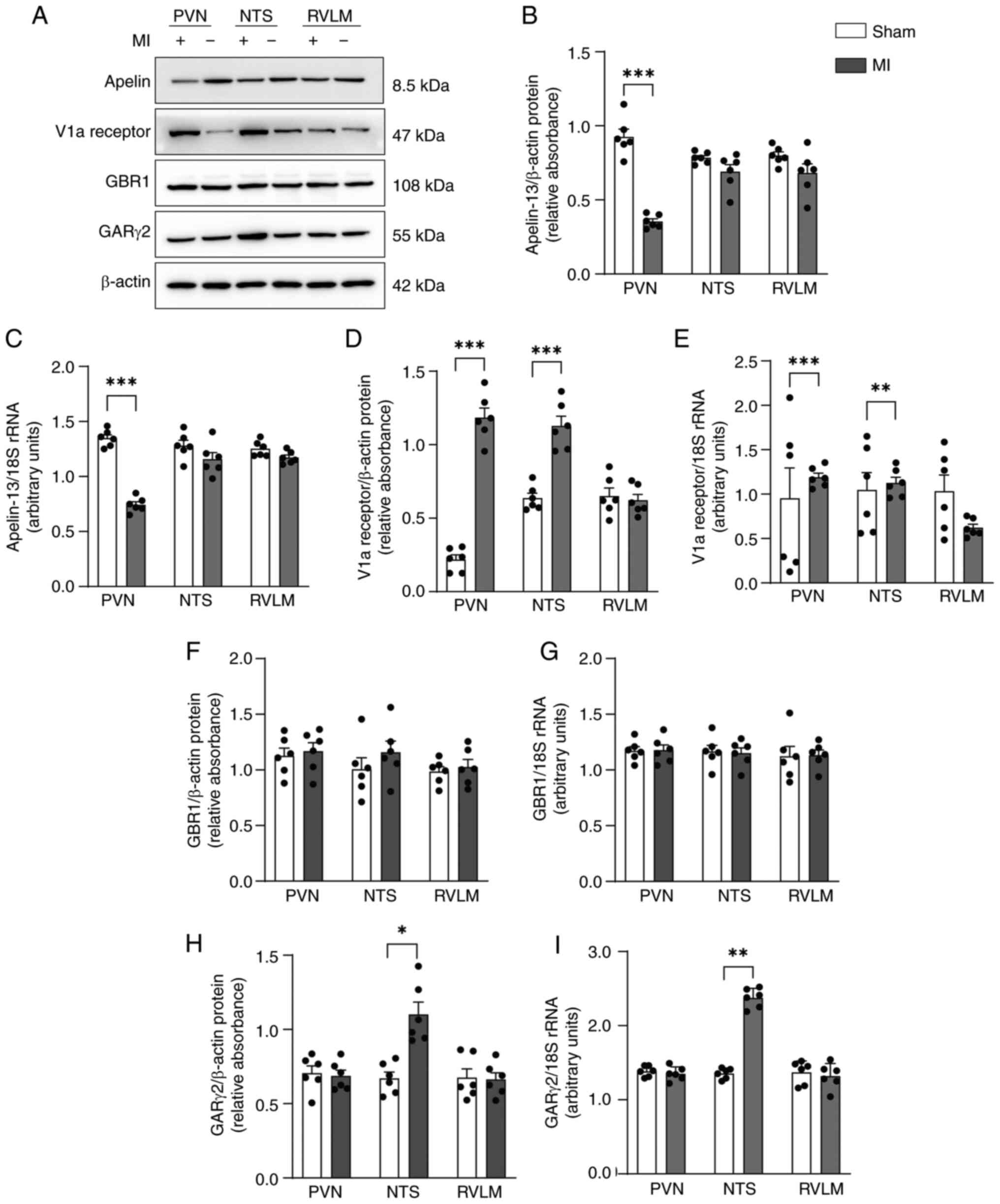
Figure 1

Expression of apelin-13, the V1a
receptor and the GARγ2 receptor in MI model rats. (A)
Representative western blots of apelin-13, the V1a receptor, the
GBR1 and the GARγ2 in the PVN, NTS and RVLM from MI model rats and
sham-operated control rats. (B) Quantification of apelin-13 protein
levels. (C) mRNA expression levels of apelin-13. (D) Quantification
of V1a receptor protein levels. (E) mRNA expression levels of the
V1a receptor. (F) Quantification of GBR1 protein levels. (G) mRNA
expression levels of GBR1. (H) Quantification of GARγ2 protein
levels. (I) mRNA expression levels of GARγ2. Normality was tested
using the Shapiro-Wilk test. The data (n=6 rats per group; 3
technical replicates) in B-I are shown as mean ± SEM and were
analyzed using an unpaired two-tailed t test.
*P<0.05; **P<0.01;
***P<0.001. Post-hoc power exceeded 80% for all
comparisons. V1a, Vasopressin 1a; GAR, GABAA receptor;
MI, myocardial infarction; GBR1, GABAB receptor1; PVN,
paraventricular nucleus; NTS, nucleus tractus solitarii; RVLM,
rostral ventrolateral medulla.

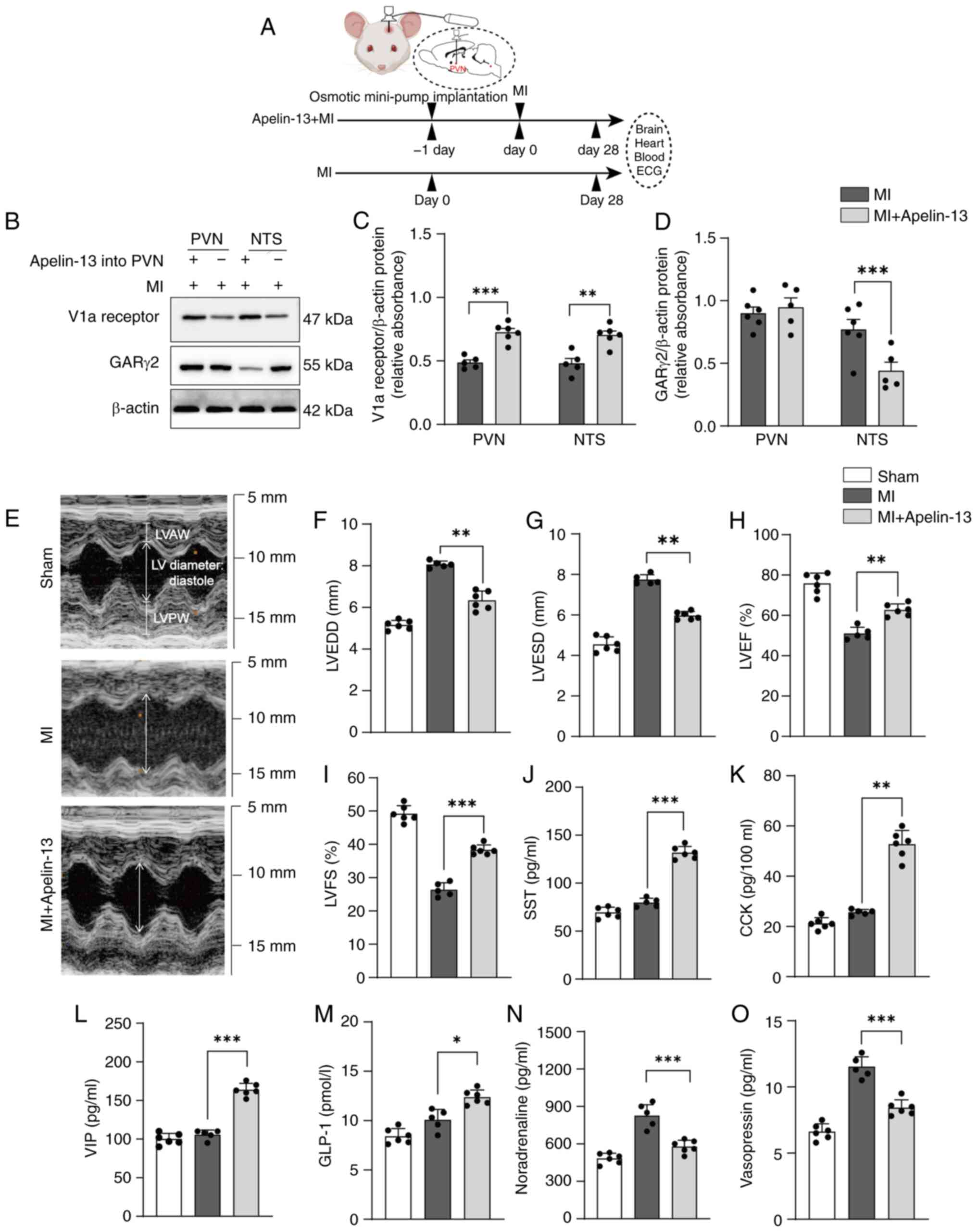
Figure 2

Effects of apelin-13 microinjection
into the PVN on cardiac function in MI model rats. (A) MI models
were established one day after implanting an osmotic mini-pump
delivering apelin-13 into the PVN. Cardiac function was assessed
and tissue samples were collected 28 days after mini-pump
implantation. (B) Representative western blots for the V1a receptor
and GARγ2 in the PVN and NTS from MI model rats and MI model rats
continuously microinjected with apelin-13 into the PVN for 28 days.
(C) Quantification of V1a receptor protein levels. (D)
Quantification of GARγ2 receptor protein levels. (E) Representative
ultrasound images (M-mode) performed on days 28 after MI and
sham-operated control. Echocardiographic results for (F) LVEDD, (G)
LVESD, (H) LVEF and (I) LVFS (n=6 in the sham-operated control
group; n=5 in the MI group, one rat succumbed at 20 days; n=6 in
the MI + apelin group). Plasma levels of (J) SST, (K) CCK, (L) VIP,
(M) GLP-1, (N) noradrenaline and (O) vasopressin (n=6 in the
sham-operated control group; n=5 in the MI group, one rat succumbed
at 20 days; n=6 in the MI + apelin group). Normality was tested
using the Shapiro-Wilk test. The data in C-D show mean ± SEM; F-O
show mean ± SD. Statistical significance was determined by one-way
ANOVA, followed by Tukey's multiple-comparisons test.
*P<0.05; **P<0.01;
***P<0.001. Post-hoc power exceeded 80% for all
comparisons. PVN, paraventricular nucleus; MI, myocardial
infarction; V1a, Vasopressin 1a; GAR, GABAA receptor;
NTS, nucleus tractus solitarii; LVEDD, left ventricular
end-diastolic diameter; LVESD, lower left ventricular end-systolic
diameter; LVEF, left ventricular ejection fraction; LVFS, left
ventricular fraction shortening; SST, isomatostatin; CCK,
cholecystokinin; VIP, vasoactive intestinal peptide; GLP-1,
glucagon-like peptide 1.

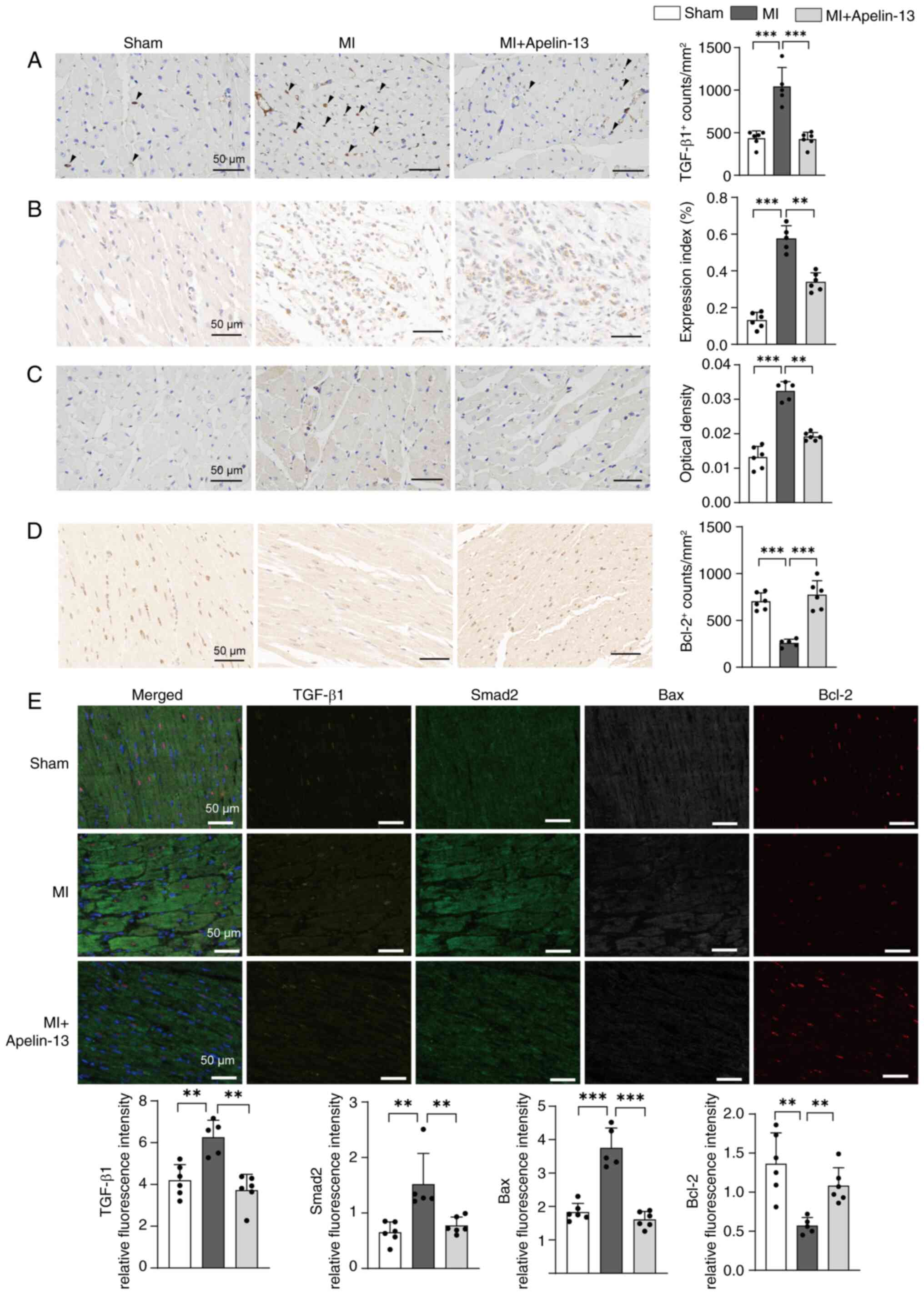
Figure 3

Effects of continuous apelin-13
infusion into the PVN on myocardial ischemia-associated apoptotic
and inflammatory protein expression in MI rats. (A) Representative
image and quantification of TGF-β1+ cells. (B)
Representative image and expression index of Smad2. (C)
Representative image and optical density of Bax. (D) Representative
image and quantification of Bcl-2+ cells. (E)
Representative multiplex fluorescent immunohistochemistry staining
images and relative fluorescence intensity of TGF-β1, Smad2, Bax
and Bcl-2 (n=6 in the sham-operated control group; n=5 in the MI
group, one rat succumbed at 20 days; n=6 in the MI + apelin group).
Normality was tested using the Shapiro-Wilk test. The data are
shown as mean ± SD and were analyzed using one-way ANOVA, followed
by Tukey's multiple-comparisons test. *P<0.05;
**P<0.01; ***P<0.001. Post-hoc power
exceeded 80% for all key comparisons. PVN, paraventricular nucleus;
MI, myocardial infarction.

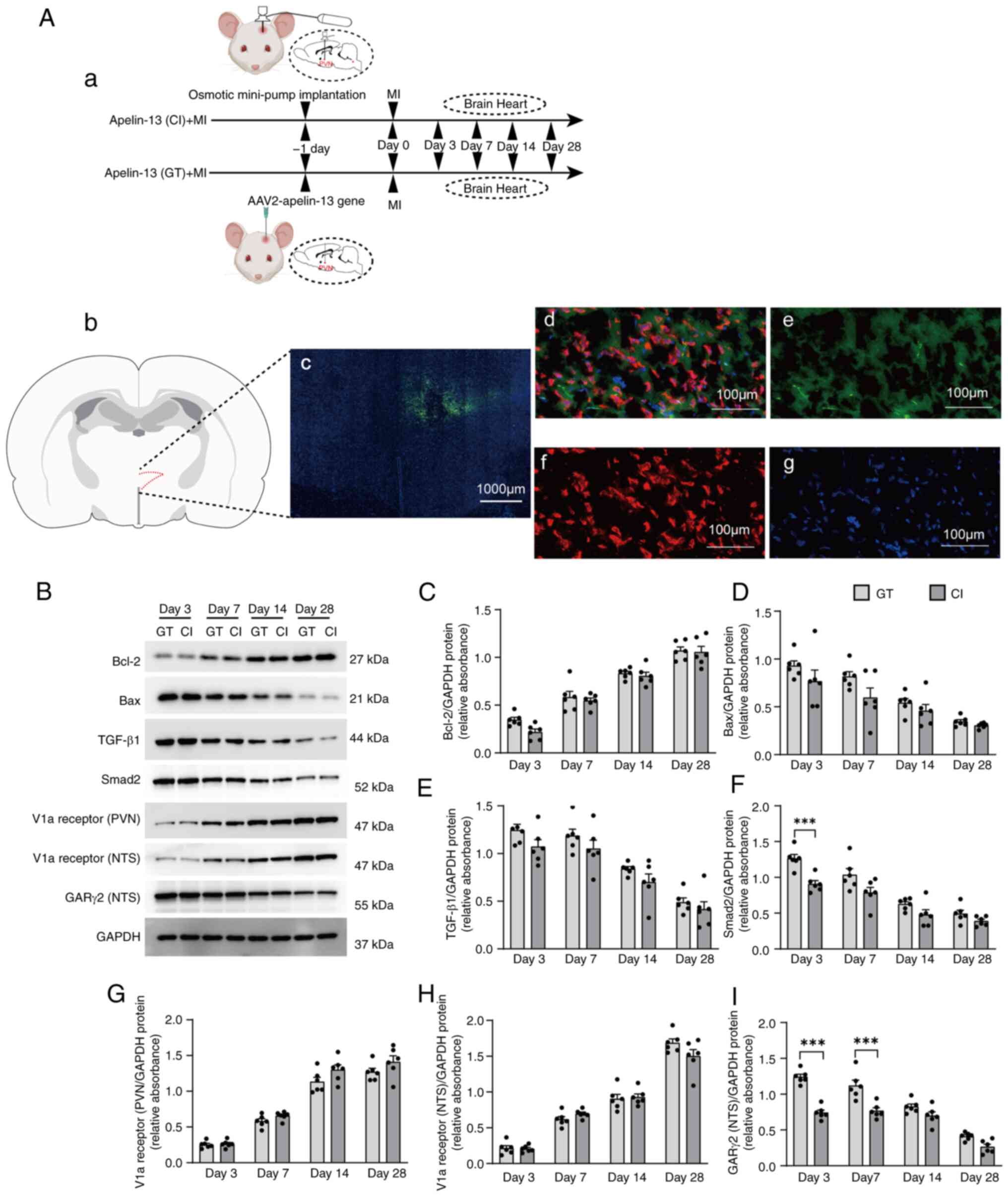
Figure 4

Comparison of effects between
apelin-13 gene transfer and continuous infusion approaches. (Aa)
After implanting apelin-13 osmotic mini-pumps or delivering
AAV2-apelin-13 to the PVN, MI was induced and heart and brain
tissues collected at 3-, 7-, 14- and 28-days post-MI (n=6 in each
group). Location of the stained PVN brain sections shown in (b) and
(c), based on the rat brain atlas of C. Watson and G. Paxinos
(24). (c) Fluorescence
micrograph (magnification, ×10) demonstrating the localization of
apelin-13 within the PVN. 3v is the third ventricle. (d) Overlap of
(e), (f) and (g), showing that the green fluorescence is neuronally
located. (e) Fluorescence micrograph (magnification, ×40)
indicating the localization of apelin-13 in PVN cells immunostained
with an anti-apelin antibody (green). (f) Same field of cells as in
panel (e), immunostained with anti-NeuN antibodies (red). (g) DAPI
staining of the same field of cells in panel (e). (B) Molecular
pathways regulating apoptotic and inflammatory pathways were
assessed through western blotting of the expression of Bax, Bcl-2,
TGF-β1 and Smad2 over time in MI model rats and the expression of
the V1a receptor and GARγ2 induced by apelin-13 overexpression in
the PVN. (C and I) Quantification of the fold change in target gene
expression vs. GAPDH expression. The data (n=6 rats per group, 3
technical replicates) in (C-I) are shown as mean ± SEM and were
analyzed via an unpaired two-tailed t test. *P<0.05;
**P<0.01; ***P<0.001. Post-hoc power
exceeded 80% for all key comparisons. PVN, paraventricular nucleus;
MI, myocardial infarction; GT, gene transfer; CI, continuous
infusion.

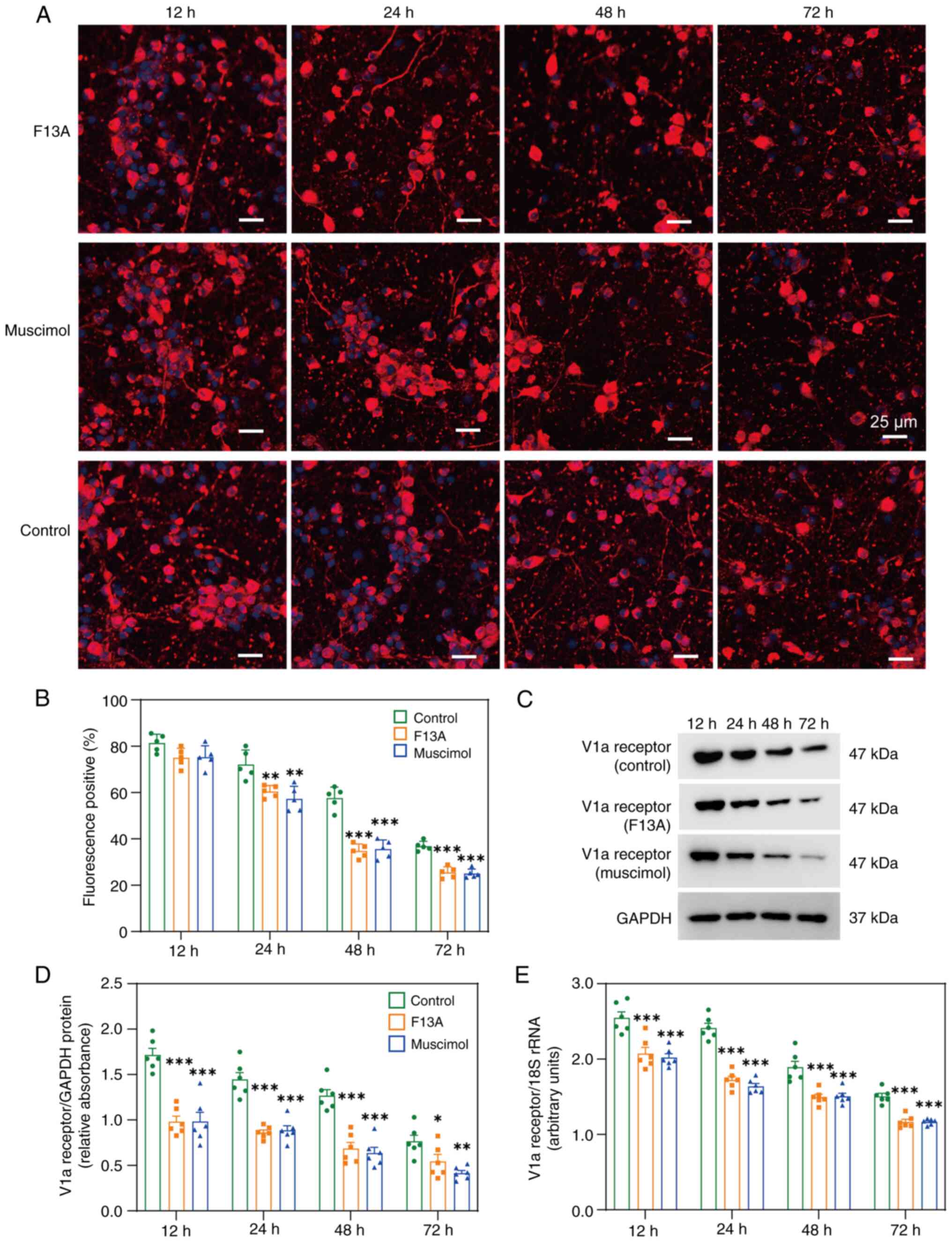
Figure 5

Effects of the APJ receptor and the
GARγ2 receptor on the V1a receptor in primary cultured neurons. (A)
Immunofluorescence of F13A-, muscimol- and control-treated primary
neurons. Neurons were treated for 12, 24, 48, or 72 h. (B)
Representative positive fluorescence. (C and D) Representative
western blot image of the V1a receptor in primary cultured neurons
treated with F13A and muscimol and quantification of V1a receptor
expression. (E) mRNA expression levels of the V1a receptor in
neurons treated with F13A and muscimol. The data (n=5 experiments)
in (B) are shown as mean ± SD and were analyzed via one-way ANOVA,
followed by Dunnett's multiple-comparisons test. Normality was
tested using the Shapiro-Wilk test. The data (n=5; 3 technical
replicates) in (D and E) are shown as mean ± SEM and were analyzed
via one-way ANOVA, followed by Dunnett's multiple-comparisons test.
*P<0.05; **P<0.01; and
***P<0.001vs. the control group. Post-hoc power
exceeded 80% for all key comparisons. APJ, orphan
G-protein-coupled; GAR, GABAA receptor; V1a, Vasopressin
1a.

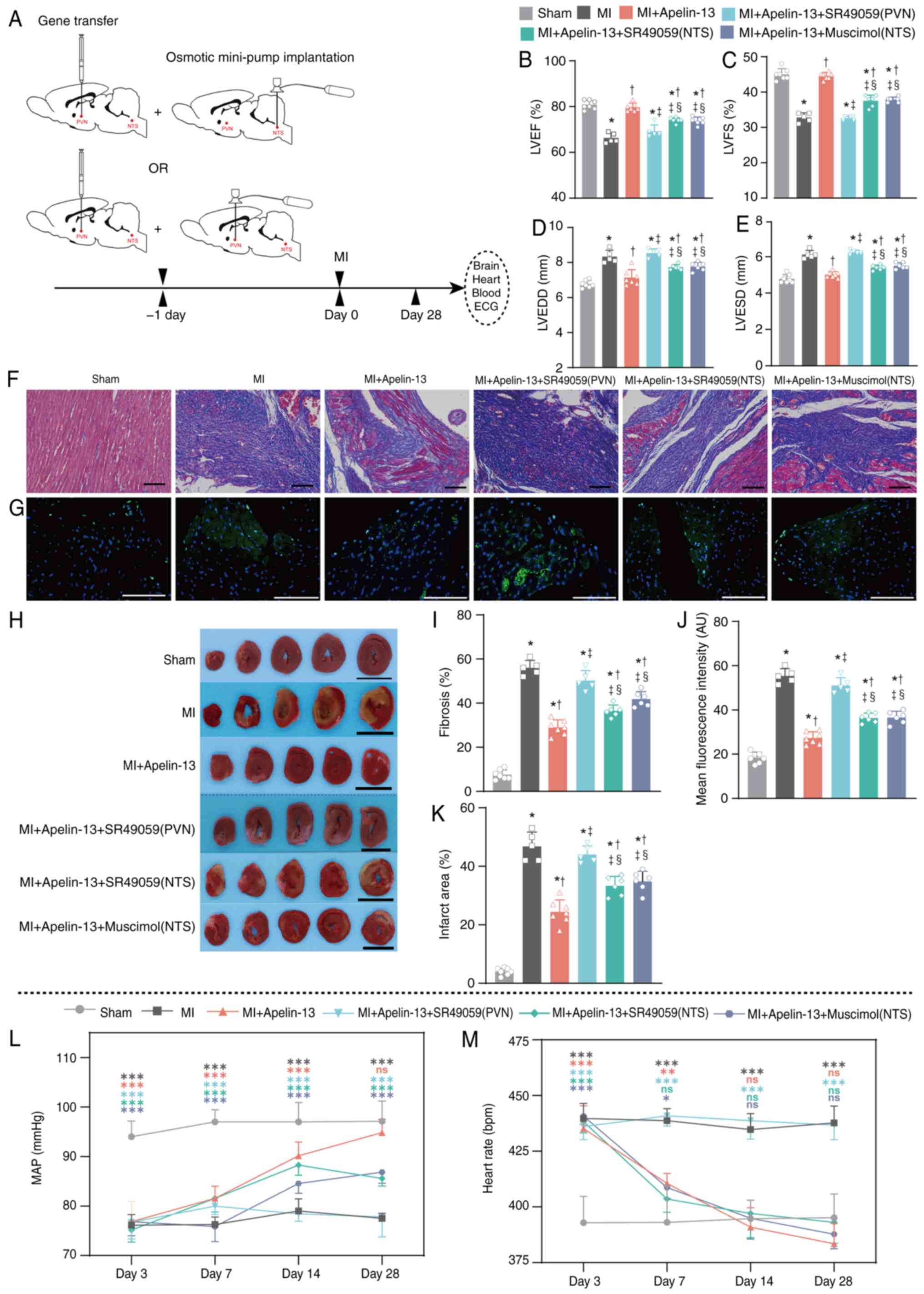
Figure 6

Effect of apelin-13 overexpression
(AAV2-apelin-13 gene transfer) in the PVN on V1a receptor-mediated
improvements in cardiac function and cardiac morphology in MI model
rats. (A) The MI model was constructed one day following the
transfer of the apelin-13 gene into PVN and the implantation of
mini-pump (7 rats in each group). Echocardiographic results for (B)
LVEF, (C) LVSF, (D) LVEDD and (E) LVESD. (F) Representative
Masson's trichrome staining and (I) quantification. (G)
Representative TUNEL staining and (J) quantification of TUNEL
staining. (H) Representative TTC staining and (K) quantification.
The black scale bar in F is 100 μm; the white scale bar in G
is 50 μm; and the black scale bar in I is 1 cm. At 28 days
after MI modelling, the sham-operated control group had 7 rats, the
MI group had 5 rats (2 rats succumbed), the MI + apelin-13 group
had 7 rats, the MI + apelin-13 + SR49059 (PVN) group had 5 rats (2
rats succumbed), the MI + apelin-13 + SR49059 (NTS) group had 6
rats (1 rat succumbed) and the MI + apelin-13 + muscimol (NTS)
group had 6 rats (1 rat succumbed). Normality was tested using the
Shapiro-Wilk test. The data in B-E and H-M are shown as means ± SDs
and were analyzed using one-way ANOVA, followed by Tukey's
multiple-comparisons test. In B-E and H-K, *P<0.05
vs. sham-operated control group; †P<0.05 vs. MI
group; ‡P<0.05 vs. MI + apelin-13 group;
§P<0.05 vs. MI + apelin-13 + SR49059(PVN);
#P<0.05 vs. MI + apelin-13 + SR49059 (NTS). The (L)
MAP and (M) heart rate were recorded in a conscious state at days
3, 7, 14 and 28 after MI modelling. *P<0.05;
**P<0.01; ***P<0.001; and ns, not
significant, vs. the sham-operated control group. Post-hoc power
exceeded 80% for all key comparisons. PVN, paraventricular nucleus;
V1a, Vasopressin 1a; MI, myocardial infarction; ECG,
Echocardiographic; LVEF, left ventricular ejection fraction; LVFS,
left ventricular fraction shortening; LVEDD, left ventricular
end-diastolic diameter; LVESD, lower left ventricular end-systolic
diameter; NTS, nucleus tractus solitarii; MAP, mean arterial
pressure.

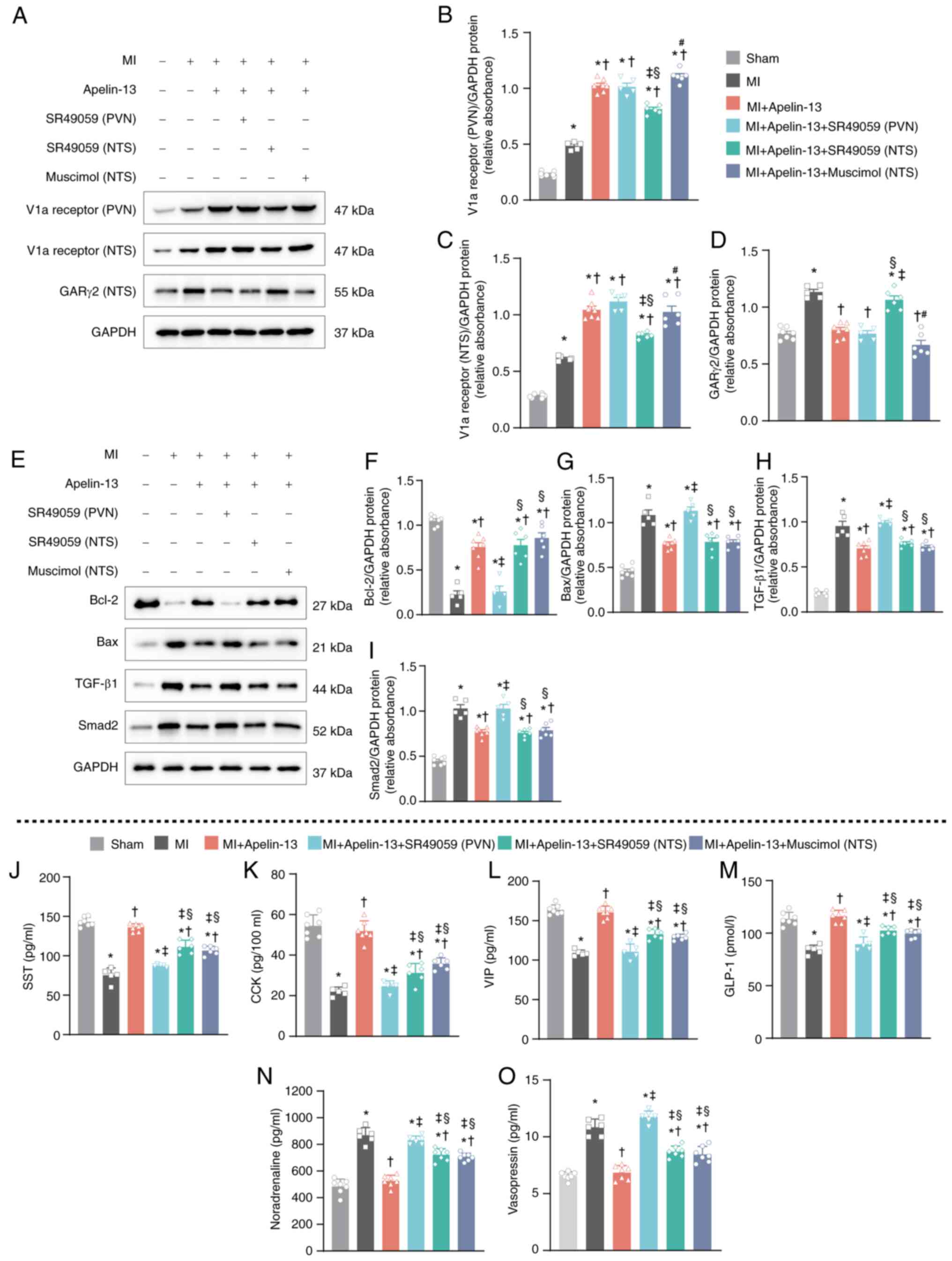
Figure 7

Mechanisms of the effect of apelin-13
overexpression (AAV2-apelin-13 gene transfer) in the PVN on V1a
receptor-mediated improvement in cardiac function in MI model rats.
(A) Representative western blot image of V1a receptor expression in
the PVN or NTS and GARγ2 expression in the NTS. (B-D)
Quantification of V1a receptor expression. (E) Representative
western blotting to assess Bcl-2, Bax, TGF-β1 and Smad2 protein
levels in the heart and (F-I) quantification of the protein levels.
Plasma levels of (J) SST, (K) CCK, (L) VIP and (M) GLP-1 (n=7 in
the sham-operated control group; n=5 in the MI group, 2 rats
succumbed; n=7 in the MI + apelin-13 group; n=5 in the MI +
apelin-13 + SR49059 (PVN) group, 2 rats succumbed; n=6 in the MI +
apelin-13 + SR49059 (NTS) group, 1 rat succumbed; n=6 in the MI +
apelin-13 + muscimol (NTS) group, 1 rat succumbed). Representative
plasma levels of (N) noradrenaline and (O) vasopressin (n=7 in the
sham-operated control group; n=6 in the MI group, 1 rat succumbed;
n=7 in the MI + apelin-13 group; n=6 in the MI + apelin-13 +
SR49059 (PVN) group, 1 rat succumbed; n=6 in the MI + apelin-13 +
SR49059 (NTS) group, 1 rat succumbed; n=7 in the MI + apelin-13 +
muscimol (NTS) group). Normality was tested using the Shapiro-Wilk
test. The data in B-D and F-I show mean ± SEM; data in J-O are
shown as mean ± SD and were analyzed via one-way ANOVA, followed by
Tukey's multiple-comparisons test. In B-D and F-O,
*P<0.05 vs. sham-operated control group;
†P<0.05 vs. MI group; ‡P<0.05 vs. MI +
apelin-13 group; §P<0.05 vs. MI + apelin-13 + SR49059
(PVN); #P<0.05 vs. MI + apelin-13 + SR49059 (NTS).
Post-hoc power exceeded 80% for all key comparisons. PVN,
paraventricular nucleus; V1a, Vasopressin 1a; MI, myocardial
infarction; NTS, nucleus tractus solitarii; GAR, GABAA
receptor; SST, isomatostatin; CCK, cholecystokinin; VIP, vasoactive
intestinal peptide; GLP-1, glucagon-like peptide 1.

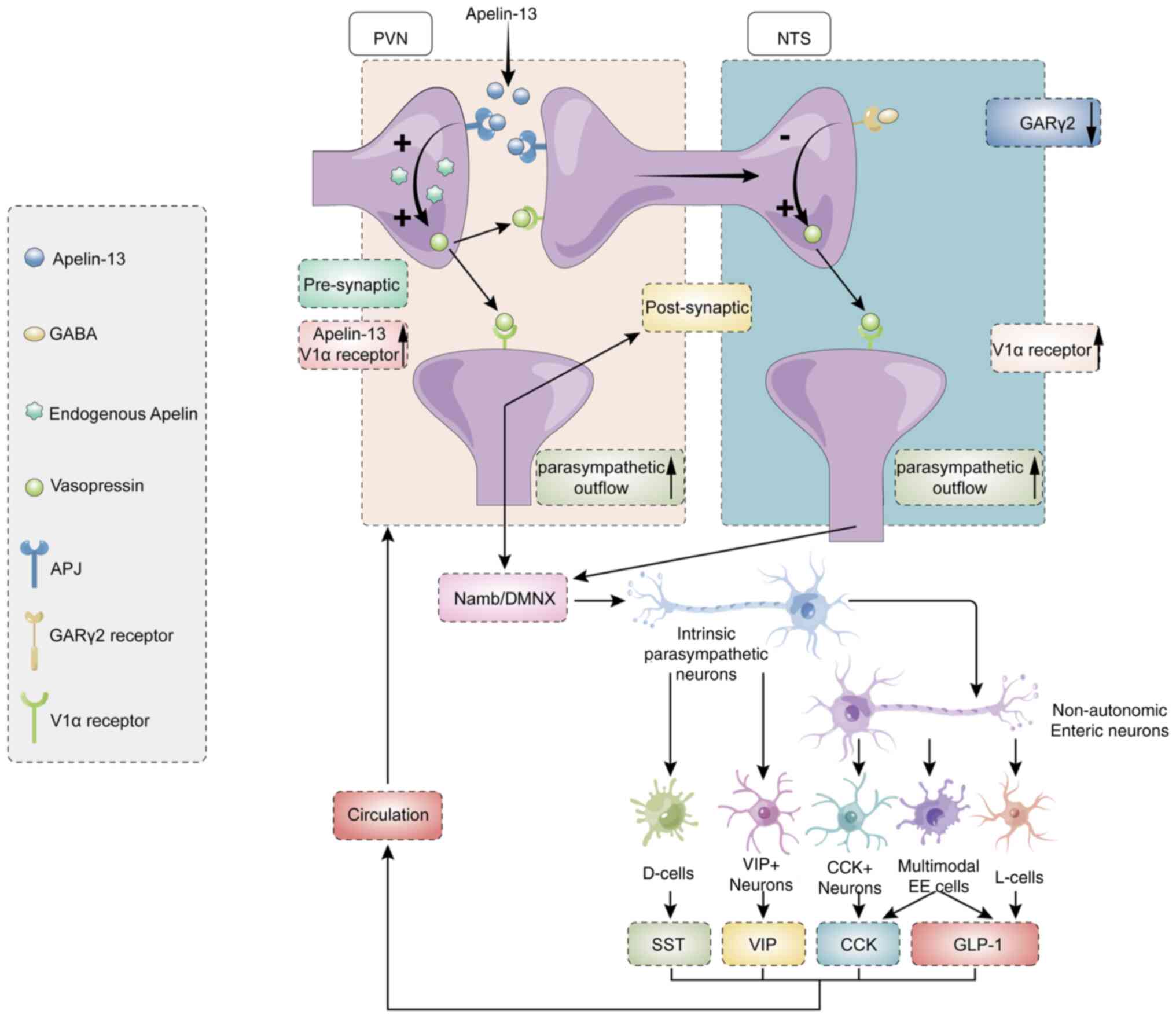
Figure 8

Graphical model summarizing the
hypothesized pathway. Overexpression of apelin-13 in the PVN
promotes upregulation of V1a receptors in both the PVN and NTS,
while downregulating GARγ2 in the NTS. These neural modifications
collectively enhance parasympathetic outflow. Furthermore,
paraventricular endocrine system secretes circulating neurohumoral
factors that systemically mediate cardioprotection. PVN,
paraventricular nucleus; V1a, Vasopressin 1a; MI, myocardial
infarction; NTS, nucleus tractus solitarii; GAR, GABAA
receptor; SST, isomatostatin; CCK, cholecystokinin; GLP-1,
glucagon-like peptide 1; VIP, vasoactive intestinal peptide.
View References

1 

Chen Z, Venkat P, Seyfried D, Chopp M, Yan T and Chen J: Brain-heart interaction: Cardiac complications after stroke. Circ Res. 121:451–468. 2017. View Article : Google Scholar : PubMed/NCBI

2 

Simats A, Sager H and Liesz A: Heart brain axis in health and disease: Role of innate and adaptive immunity. Cardiovasc Res. 120:2325–2335. 2025. View Article : Google Scholar

3 

Zhao B, Li T, Fan Z, Yang Y, Shu J, Yang X, Wang X, Luo T, Tang J, Xiong D, et al: Heart-brain connections: Phenotypic and genetic insights from magnetic resonance images. Science. 380:abn65982023. View Article : Google Scholar : PubMed/NCBI

4 

Herman JP and Tasker JG: Paraventricular hypothalamic mechanisms of chronic stress adaptation. Front Endocrinol (Lausanne). 7:1372016. View Article : Google Scholar : PubMed/NCBI

5 

Benarroch EE: The central autonomic network: Functional organization, dysfunction, and perspective. Mayo Clin Proc. 68:988–1001. 1993. View Article : Google Scholar : PubMed/NCBI

6 

Infanger DW, Cao X, Butler SD, Burmeister MA, Zhou Y, Stupinski JA, Sharma RV and Davisson RL: Silencing nox4 in the paraventricular nucleus improves myocardial infarction-induced cardiac dysfunction by attenuating sympathoexcitation and peri-infarct apoptosis. Circ Res. 106:1763–1774. 2010. View Article : Google Scholar : PubMed/NCBI

7 

Tatemoto K, Hosoya M, Habata Y, Fujii R, Kakegawa T, Zou MX, Kawamata Y, Fukusumi S, Hinuma S, Kitada C, et al: Isolation and characterization of a novel endogenous peptide ligand for the human APJ receptor. Biochem Biophys Res Commun. 251:471–476. 1998. View Article : Google Scholar : PubMed/NCBI

8 

Lee DK, Cheng R, Nguyen T, Fan T, Kariyawasam AP, Liu Y, Osmond DH, George SR and O'Dowd BF: Characterization of apelin, the ligand for the APJ receptor. J Neurochem. 74:34–41. 2000. View Article : Google Scholar : PubMed/NCBI

9 

Yang N, Li T, Cheng J, Tuo Q and Shen J: Role of apelin/APJ system in hypothalamic-pituitary axis. Clin Chim Acta. 499:149–153. 2019. View Article : Google Scholar : PubMed/NCBI

10 

Lv SY, Chen WD and Wang YD: The apelin/APJ system in psychosis and neuropathy. Front Pharmacol. 11:3202020. View Article : Google Scholar : PubMed/NCBI

11 

Masaki T, Yasuda T and Yoshimatsu H: Apelin-13 microinjection into the paraventricular nucleus increased sympathetic nerve activity innervating brown adipose tissue in rats. Brain Res Bull. 87:540–543. 2012. View Article : Google Scholar : PubMed/NCBI

12 

Ji M, Wang Q, Zhao Y, Shi L, Zhou Z and Li Y: Targeting hypertension: superoxide anions are involved in apelin induced long-term high blood pressure and sympathetic activity in the paraventricular nucleus. Curr Neurovasc Res. 16:455–464. 2019. View Article : Google Scholar

13 

Zhang Q, Yao F, Raizada MK, O'Rourke ST and Sun C: Apelin gene transfer into the rostral ventrolateral medulla induces chronic blood pressure elevation in normotensive rats. Circ Res. 104:1421–1428. 2009. View Article : Google Scholar : PubMed/NCBI

14 

De Mota N, Reaux-Le Goazigo A, El Messari S, Chartrel N, Roesch D, Dujardin C, Kordon C, Vaudry H, Moos F and Llorens-Cortes C: Apelin, a potent diuretic neuropeptide counteracting vasopressin actions through inhibition of vasopressin neuron activity and vasopressin release. Proc Natl Acad Sci USA. 101:10464–10469. 2004. View Article : Google Scholar : PubMed/NCBI

15 

Griffiths PR, Lolait SJ, Harris LE, Paton JFR and O'Carroll AM: Vasopressin V1a receptors mediate the hypertensive effects of [Pyr1]apelin-13 in the rat rostral ventrolateral medulla. J Physiol. 595:3303–3318. 2017. View Article : Google Scholar : PubMed/NCBI

16 

Czarzasta K, Cudnoch-Jedrzejewska A, Szczepanska-Sadowska, Fus L, Puchalska L, Gondek A, Dobruch J, Gomolka R, Wrzesien R, Zera T, et al: The role of apelin in central cardiovascular regulation in rats with post-infarct heart failure maintained on a normal fat or high fat diet. Clin Exp Pharmacol Physiol. 43:983–994. 2016. View Article : Google Scholar : PubMed/NCBI

17 

Kuriyama K, Hirouchi M and Kimura H: Neurochemical and molecular pharmacological aspects of the GABA(B) receptor. Neurochem Res. 25:1233–1239. 2000. View Article : Google Scholar : PubMed/NCBI

18 

Li B, Liu Q, Xuan C, Guo L, Shi R, Zhang Q, O'Rourke ST, Liu K and Sun C: GABAB receptor gene transfer into the nucleus tractus solitarii induces chronic blood pressure elevation in normotensive rats. Circ J. 77:2558–2566. 2013. View Article : Google Scholar : PubMed/NCBI

19 

Dampney RA: Functional organization of central pathways regulating the cardiovascular system. Physiol Rev. 74:323–364. 1994. View Article : Google Scholar : PubMed/NCBI

20 

Korpal AK, Han SY, Schwenke DO and Brown CH: A switch from GABA inhibition to excitation of vasopressin neurons exacerbates the development angiotensin II-dependent hypertension. J Neuroendocrinol. Dec 9–2017.Epub ahead of print. PubMed/NCBI

21 

Klok MD, Jakobsdottir S and Drent ML: The role of leptin and ghrelin in the regulation of food intake and body weight in humans: A review. Obes Rev. 8:21–34. 2007. View Article : Google Scholar : PubMed/NCBI

22 

Gorky J and Schwaber J: Conceptualization of a parasympathetic endocrine system. Front Neurosci. 13:10082019. View Article : Google Scholar : PubMed/NCBI

23 

Livak KJ and Schmittgen TD: Analysis of relative gene expression data using real-time quantitative PCR and the 2(-Delta Delta C(T)) method. Methods. 25:402–408. 2001. View Article : Google Scholar

24 

Watson C and Paxinos G: The rat brain in stereotaxic coordinates. 5th ed. Amsterdam: Elsevier; 2004, pp. 51–57

25 

Zhao Y, Li Y, Li Z, Xu B, Chen P and Yang X: Superoxide anions modulate the performance of apelin in the paraventricular nucleus on sympathetic activity and blood pressure in spontaneously hypertensive rats. Peptides. 121:1700512019. View Article : Google Scholar

26 

Kc P, Balan KV, Tjoe SS, Martin RJ, Lamanna JC, Haxhiu MA and Dick TE: Increased vasopressin transmission from the paraventricular nucleus to the rostral medulla augments cardiorespiratory outflow in chronic intermittent hypoxia-conditioned rats. J Physiol. 588:725–740. 2010. View Article : Google Scholar : PubMed/NCBI

27 

Benarroch EE: Paraventricular nucleus, stress response, and cardiovascular disease. Clin Auton Res. 15:254–263. 2005. View Article : Google Scholar : PubMed/NCBI

28 

Havakuk O, King KS, Grazette L, Yoon AJ, Fong M, Bregman N, Elkayam U and Kloner RA: Heart failure-induced brain injury. J Am Coll Cardiol. 69:1609–1616. 2017. View Article : Google Scholar : PubMed/NCBI

29 

Silvani A, Calandra-Buonaura G, Dampney RA and Cortelli P: Brain-heart interactions: Physiology and clinical implications. Philos Trans A Math Phys Eng Sci. 374:201501812016.PubMed/NCBI

30 

Coote JH: Myths and realities of the cardiac vagus. J Physiol. 591:4073–4085. 2013. View Article : Google Scholar : PubMed/NCBI

31 

Kim JJ and Hibbs RE: Direct structural insights into GABAA receptor pharmacology. Trends Biochem Sci. 46:502–517. 2021. View Article : Google Scholar : PubMed/NCBI

32 

Komnenov D, Quaal H and Rossi NF: V1a and V1b vasopressin receptors within the paraventricular nucleus contribute to hypertension in male rats exposed to chronic mild unpredictable stress. Am J Physiol Regul Integr Comp Physiol. 320:R213–R225. 2021. View Article : Google Scholar

33 

Dalzell JR, Rocchiccioli JP, Weir RA, Jackson CE, Padmanabhan N, Gardner RS, Petrie MC and McMurray JJ: The emerging potential of the apelin-APJ system in heart failure. J Card Fail. 21:489–498. 2015. View Article : Google Scholar : PubMed/NCBI

34 

Vörös I, Sághy É, Pohóczky K, Makkos A, Onódi Z, Brenner GB, Baranyai T, Ágg B, Váradi B, Kemény Á, et al: Somatostatin and its receptors in myocardial ischemia/reperfusion injury and cardioprotection. Front Pharmacol. 12:6636552021. View Article : Google Scholar : PubMed/NCBI

35 

Han Z, Bi S, Xu Y, Dong X, Mei L, Lin H and Li X: Cholecystokinin expression in the development of myocardial hypertrophy. Scanning. 2021:82315592021. View Article : Google Scholar : PubMed/NCBI

36 

Simms-Williams N, Treves N, Yin H, Lu S, Yu O, Pradhan R, Renoux C, Suissa S and Azoulay L: Effect of combination treatment with glucagon-like peptide-1 receptor agonists and sodium-glucose cotransporter-2 inhibitors on incidence of cardiovascular and serious renal events: Population based cohort study. BMJ. 385:e0782422024. View Article : Google Scholar : PubMed/NCBI

37 

Duggan KA, Hodge G, Chen J and Hunter T: Vasoactive intestinal peptide infusion reverses existing myocardial fibrosis in the rat. Eur J Pharmacol. 862:1726292019. View Article : Google Scholar : PubMed/NCBI

38 

Sarker M, Chowdhury N, Bristy AT, Emran T, Karim R, Ahmed R, Shaki MM, Sharkar SM, Sayedur Rahman GM and Reza HM: Astaxanthin protects fludrocortisone acetate-induced cardiac injury by attenuating oxidative stress, fibrosis, and inflammation through TGF-β/Smad signaling pathway. Biomed Pharmacother. 181:1177032024. View Article : Google Scholar

39 

Liu H, Yu L, Yang L and Green MS: Vasoplegic syndrome: An update on perioperative considerations. J Clin Anesth. 40:63–71. 2017. View Article : Google Scholar : PubMed/NCBI

40 

Fu Q, Yu Q, Luo H, Liu Z, Ma X, Wang H and Cheng Z: Protective effects of wogonin in the treatment of central nervous system and degenerative diseases. Brain Res Bull. 221:1112022025. View Article : Google Scholar : PubMed/NCBI

41 

Liu Y, Donovan M, Jia X and Wang Z: The ventromedial hypothalamic circuitry and male alloparental behaviour in a socially monogamous rodent species. Eur J Neurosci. 50:3689–3701. 2019. View Article : Google Scholar : PubMed/NCBI

42 

Loveland JL and Fernald RD: Differential activation of vasotocin neurons in contexts that elicit aggression and courtship. Behav Brain Res. 317:188–203. 2017. View Article : Google Scholar

43 

Yan R, Liu Q, Zhang D, Li K, Li Y, Nie Y, Zhang Y, Li P, Mao S and Li H: Inhibition of spreading depolarizations by targeting GABAA receptors and voltage-gated sodium channels improves neurological deficits in rats with traumatic brain injury. Br J Pharmacol. Jun 24–2025.Epub ahead of print. View Article : Google Scholar

44 

Greenwood M, Gillard BT, Murphy D and Greenwood MP: Dimerization of hub protein DYNLL1 and bZIP transcription factor CREB3L1 enhances transcriptional activation of CREB3L1 target genes like arginine vasopressin. Peptides. 179:1712692024. View Article : Google Scholar : PubMed/NCBI

45 

Szczepanska-Sadowska E, Czarzasta K, Bogacki-Rychlik W and Kowara M: The interaction of vasopressin with hormones of the hypothalamo-pituitary-adrenal axis: The significance for therapeutic strategies in cardiovascular and metabolic diseases. Int J Mol Sci. 25:73942024. View Article : Google Scholar : PubMed/NCBI

Related Articles

  • Abstract
  • View
  • Download
  • Twitter
Copy and paste a formatted citation
Spandidos Publications style
Yan W, Wang D, Zhang X and Xuan C: Apelin‑13 in the paraventricular nucleus (PVN) attenuates myocardial ischemia through V1a receptors in PVN/nucleus tractus solitarii (NTS) and GAR&gamma;2 in NTS. Int J Mol Med 56: 211, 2025.
APA
Yan, W., Wang, D., Zhang, X., & Xuan, C. (2025). Apelin‑13 in the paraventricular nucleus (PVN) attenuates myocardial ischemia through V1a receptors in PVN/nucleus tractus solitarii (NTS) and GAR&gamma;2 in NTS. International Journal of Molecular Medicine, 56, 211. https://doi.org/10.3892/ijmm.2025.5652
MLA
Yan, W., Wang, D., Zhang, X., Xuan, C."Apelin‑13 in the paraventricular nucleus (PVN) attenuates myocardial ischemia through V1a receptors in PVN/nucleus tractus solitarii (NTS) and GAR&gamma;2 in NTS". International Journal of Molecular Medicine 56.6 (2025): 211.
Chicago
Yan, W., Wang, D., Zhang, X., Xuan, C."Apelin‑13 in the paraventricular nucleus (PVN) attenuates myocardial ischemia through V1a receptors in PVN/nucleus tractus solitarii (NTS) and GAR&gamma;2 in NTS". International Journal of Molecular Medicine 56, no. 6 (2025): 211. https://doi.org/10.3892/ijmm.2025.5652
Copy and paste a formatted citation
x
Spandidos Publications style
Yan W, Wang D, Zhang X and Xuan C: Apelin‑13 in the paraventricular nucleus (PVN) attenuates myocardial ischemia through V1a receptors in PVN/nucleus tractus solitarii (NTS) and GAR&gamma;2 in NTS. Int J Mol Med 56: 211, 2025.
APA
Yan, W., Wang, D., Zhang, X., & Xuan, C. (2025). Apelin‑13 in the paraventricular nucleus (PVN) attenuates myocardial ischemia through V1a receptors in PVN/nucleus tractus solitarii (NTS) and GAR&gamma;2 in NTS. International Journal of Molecular Medicine, 56, 211. https://doi.org/10.3892/ijmm.2025.5652
MLA
Yan, W., Wang, D., Zhang, X., Xuan, C."Apelin‑13 in the paraventricular nucleus (PVN) attenuates myocardial ischemia through V1a receptors in PVN/nucleus tractus solitarii (NTS) and GAR&gamma;2 in NTS". International Journal of Molecular Medicine 56.6 (2025): 211.
Chicago
Yan, W., Wang, D., Zhang, X., Xuan, C."Apelin‑13 in the paraventricular nucleus (PVN) attenuates myocardial ischemia through V1a receptors in PVN/nucleus tractus solitarii (NTS) and GAR&gamma;2 in NTS". International Journal of Molecular Medicine 56, no. 6 (2025): 211. https://doi.org/10.3892/ijmm.2025.5652
Follow us
  • Twitter
  • LinkedIn
  • Facebook
About
  • Spandidos Publications
  • Careers
  • Cookie Policy
  • Privacy Policy
How can we help?
  • Help
  • Live Chat
  • Contact
  • Email to our Support Team