Spandidos Publications Logo
  • About
    • About Spandidos
    • Aims and Scopes
    • Abstracting and Indexing
    • Editorial Policies
    • Reprints and Permissions
    • Job Opportunities
    • Terms and Conditions
    • Contact
  • Journals
    • All Journals
    • Oncology Letters
      • Oncology Letters
      • Information for Authors
      • Editorial Policies
      • Editorial Board
      • Aims and Scope
      • Abstracting and Indexing
      • Bibliographic Information
      • Archive
    • International Journal of Oncology
      • International Journal of Oncology
      • Information for Authors
      • Editorial Policies
      • Editorial Board
      • Aims and Scope
      • Abstracting and Indexing
      • Bibliographic Information
      • Archive
    • Molecular and Clinical Oncology
      • Molecular and Clinical Oncology
      • Information for Authors
      • Editorial Policies
      • Editorial Board
      • Aims and Scope
      • Abstracting and Indexing
      • Bibliographic Information
      • Archive
    • Experimental and Therapeutic Medicine
      • Experimental and Therapeutic Medicine
      • Information for Authors
      • Editorial Policies
      • Editorial Board
      • Aims and Scope
      • Abstracting and Indexing
      • Bibliographic Information
      • Archive
    • International Journal of Molecular Medicine
      • International Journal of Molecular Medicine
      • Information for Authors
      • Editorial Policies
      • Editorial Board
      • Aims and Scope
      • Abstracting and Indexing
      • Bibliographic Information
      • Archive
    • Biomedical Reports
      • Biomedical Reports
      • Information for Authors
      • Editorial Policies
      • Editorial Board
      • Aims and Scope
      • Abstracting and Indexing
      • Bibliographic Information
      • Archive
    • Oncology Reports
      • Oncology Reports
      • Information for Authors
      • Editorial Policies
      • Editorial Board
      • Aims and Scope
      • Abstracting and Indexing
      • Bibliographic Information
      • Archive
    • Molecular Medicine Reports
      • Molecular Medicine Reports
      • Information for Authors
      • Editorial Policies
      • Editorial Board
      • Aims and Scope
      • Abstracting and Indexing
      • Bibliographic Information
      • Archive
    • World Academy of Sciences Journal
      • World Academy of Sciences Journal
      • Information for Authors
      • Editorial Policies
      • Editorial Board
      • Aims and Scope
      • Abstracting and Indexing
      • Bibliographic Information
      • Archive
    • International Journal of Functional Nutrition
      • International Journal of Functional Nutrition
      • Information for Authors
      • Editorial Policies
      • Editorial Board
      • Aims and Scope
      • Abstracting and Indexing
      • Bibliographic Information
      • Archive
    • International Journal of Epigenetics
      • International Journal of Epigenetics
      • Information for Authors
      • Editorial Policies
      • Editorial Board
      • Aims and Scope
      • Abstracting and Indexing
      • Bibliographic Information
      • Archive
    • Medicine International
      • Medicine International
      • Information for Authors
      • Editorial Policies
      • Editorial Board
      • Aims and Scope
      • Abstracting and Indexing
      • Bibliographic Information
      • Archive
  • Articles
  • Information
    • Information for Authors
    • Information for Reviewers
    • Information for Librarians
    • Information for Advertisers
    • Conferences
  • Language Editing
Spandidos Publications Logo
  • About
    • About Spandidos
    • Aims and Scopes
    • Abstracting and Indexing
    • Editorial Policies
    • Reprints and Permissions
    • Job Opportunities
    • Terms and Conditions
    • Contact
  • Journals
    • All Journals
    • Biomedical Reports
      • Information for Authors
      • Editorial Policies
      • Editorial Board
      • Aims and Scope
      • Abstracting and Indexing
      • Bibliographic Information
      • Archive
    • Experimental and Therapeutic Medicine
      • Information for Authors
      • Editorial Policies
      • Editorial Board
      • Aims and Scope
      • Abstracting and Indexing
      • Bibliographic Information
      • Archive
    • International Journal of Epigenetics
      • Information for Authors
      • Editorial Policies
      • Editorial Board
      • Aims and Scope
      • Abstracting and Indexing
      • Bibliographic Information
      • Archive
    • International Journal of Functional Nutrition
      • Information for Authors
      • Editorial Policies
      • Editorial Board
      • Aims and Scope
      • Abstracting and Indexing
      • Bibliographic Information
      • Archive
    • International Journal of Molecular Medicine
      • Information for Authors
      • Editorial Policies
      • Editorial Board
      • Aims and Scope
      • Abstracting and Indexing
      • Bibliographic Information
      • Archive
    • International Journal of Oncology
      • Information for Authors
      • Editorial Policies
      • Editorial Board
      • Aims and Scope
      • Abstracting and Indexing
      • Bibliographic Information
      • Archive
    • Medicine International
      • Information for Authors
      • Editorial Policies
      • Editorial Board
      • Aims and Scope
      • Abstracting and Indexing
      • Bibliographic Information
      • Archive
    • Molecular and Clinical Oncology
      • Information for Authors
      • Editorial Policies
      • Editorial Board
      • Aims and Scope
      • Abstracting and Indexing
      • Bibliographic Information
      • Archive
    • Molecular Medicine Reports
      • Information for Authors
      • Editorial Policies
      • Editorial Board
      • Aims and Scope
      • Abstracting and Indexing
      • Bibliographic Information
      • Archive
    • Oncology Letters
      • Information for Authors
      • Editorial Policies
      • Editorial Board
      • Aims and Scope
      • Abstracting and Indexing
      • Bibliographic Information
      • Archive
    • Oncology Reports
      • Information for Authors
      • Editorial Policies
      • Editorial Board
      • Aims and Scope
      • Abstracting and Indexing
      • Bibliographic Information
      • Archive
    • World Academy of Sciences Journal
      • Information for Authors
      • Editorial Policies
      • Editorial Board
      • Aims and Scope
      • Abstracting and Indexing
      • Bibliographic Information
      • Archive
  • Articles
  • Information
    • For Authors
    • For Reviewers
    • For Librarians
    • For Advertisers
    • Conferences
  • Language Editing
Login Register Submit
  • This site uses cookies
  • You can change your cookie settings at any time by following the instructions in our Cookie Policy. To find out more, you may read our Privacy Policy.

    I agree
Search articles by DOI, keyword, author or affiliation
Search
Advanced Search
presentation
International Journal of Molecular Medicine
Join Editorial Board Propose a Special Issue
Print ISSN: 1107-3756 Online ISSN: 1791-244X
Journal Cover
January-2026 Volume 57 Issue 1

Full Size Image

Sign up for eToc alerts
Recommend to Library

Journals

International Journal of Molecular Medicine

International Journal of Molecular Medicine

International Journal of Molecular Medicine is an international journal devoted to molecular mechanisms of human disease.

International Journal of Oncology

International Journal of Oncology

International Journal of Oncology is an international journal devoted to oncology research and cancer treatment.

Molecular Medicine Reports

Molecular Medicine Reports

Covers molecular medicine topics such as pharmacology, pathology, genetics, neuroscience, infectious diseases, molecular cardiology, and molecular surgery.

Oncology Reports

Oncology Reports

Oncology Reports is an international journal devoted to fundamental and applied research in Oncology.

Experimental and Therapeutic Medicine

Experimental and Therapeutic Medicine

Experimental and Therapeutic Medicine is an international journal devoted to laboratory and clinical medicine.

Oncology Letters

Oncology Letters

Oncology Letters is an international journal devoted to Experimental and Clinical Oncology.

Biomedical Reports

Biomedical Reports

Explores a wide range of biological and medical fields, including pharmacology, genetics, microbiology, neuroscience, and molecular cardiology.

Molecular and Clinical Oncology

Molecular and Clinical Oncology

International journal addressing all aspects of oncology research, from tumorigenesis and oncogenes to chemotherapy and metastasis.

World Academy of Sciences Journal

World Academy of Sciences Journal

Multidisciplinary open-access journal spanning biochemistry, genetics, neuroscience, environmental health, and synthetic biology.

International Journal of Functional Nutrition

International Journal of Functional Nutrition

Open-access journal combining biochemistry, pharmacology, immunology, and genetics to advance health through functional nutrition.

International Journal of Epigenetics

International Journal of Epigenetics

Publishes open-access research on using epigenetics to advance understanding and treatment of human disease.

Medicine International

Medicine International

An International Open Access Journal Devoted to General Medicine.

Journal Cover
January-2026 Volume 57 Issue 1

Full Size Image

Sign up for eToc alerts
Recommend to Library

  • Article
  • Citations
    • Cite This Article
    • Download Citation
    • Create Citation Alert
    • Remove Citation Alert
    • Cited By
  • Similar Articles
    • Related Articles (in Spandidos Publications)
    • Similar Articles (Google Scholar)
    • Similar Articles (PubMed)
  • Download PDF
  • Download XML
  • View XML

  • Supplementary Files
    • Supplementary_Data1.pdf
    • Supplementary_Data2.pdf
    • Supplementary_Data3.xlsx
Article Open Access

METTL3 inhibits LINC00312 to suppress osteoporosis progression in a YTHDF2‑dependent manner

  • Authors:
    • Yang Wang
    • Yihao Tian
    • Gang Yao
  • View Affiliations / Copyright

    Affiliations: Department of Ultrasound, Shengjing Hospital, China Medical University, Shenyang, Liaoning 110004, P.R. China, Department of Pathology, General Hospital of Northern Theater Command, Beifang Hospital of China Medical University, Shenyang, Liaoning 110004, P.R. China, Department of Orthopedic Surgery, Shengjing Hospital, China Medical University, Shenyang, Liaoning 110004, P.R. China
    Copyright: © Wang et al. This is an open access article distributed under the terms of Creative Commons Attribution License.
  • Article Number: 28
    |
    Published online on: November 20, 2025
       https://doi.org/10.3892/ijmm.2025.5699
  • Expand metrics +
Metrics: Total Views: 0 (Spandidos Publications: | PMC Statistics: )
Metrics: Total PDF Downloads: 0 (Spandidos Publications: | PMC Statistics: )
Cited By (CrossRef): 0 citations Loading Articles...

This article is mentioned in:


Abstract

The regulation of methylation and non‑coding RNAs plays important roles in the pathogenesis of osteoporosis. Most microRNAs (miRNAs or miRs) exert their biological functions through target genes. Long non‑coding RNAs function as competing endogenous RNAs. hFOB 1.19 cells were transfected with miR‑4765, LINC00312 and METTL3‑related molecules. LINC00312 and miR‑4765 expression was detected by PCR, whereas cleaved caspase 3 and FOXK2/SFRP1 levels were detected by western blotting. Micro‑computed tomography was used to detect the bone microstructure. Diabetic mice received treatments targeting METTL3 and LINC00312. FOXK2/SFRP1 expression was detected using PCR and immunohistochemistry. The results showed that miR‑4765 overexpression reduced FOXK2/SFRP1 and cleaved caspase 3 expression, causing cell apoptosis. LINC00312 inhibition was observed both in vitro and in vivo. LINC00312 binds directly to miR‑4765, whereas miR‑4765 binds directly to FOXK2/SFRP1. METTL3 and YTHDF2 directly bind LINC00312 and reduce its expression by altering its methylation levels. In conclusion, LINC00312 promotes the apoptosis of hFOB 1.19 cells by targeting the miR‑4765/FOXK2/SFRP1 axis, and METTL3 regulates LINC00312 expression in a YTHDF2‑dependent manner.
View Figures

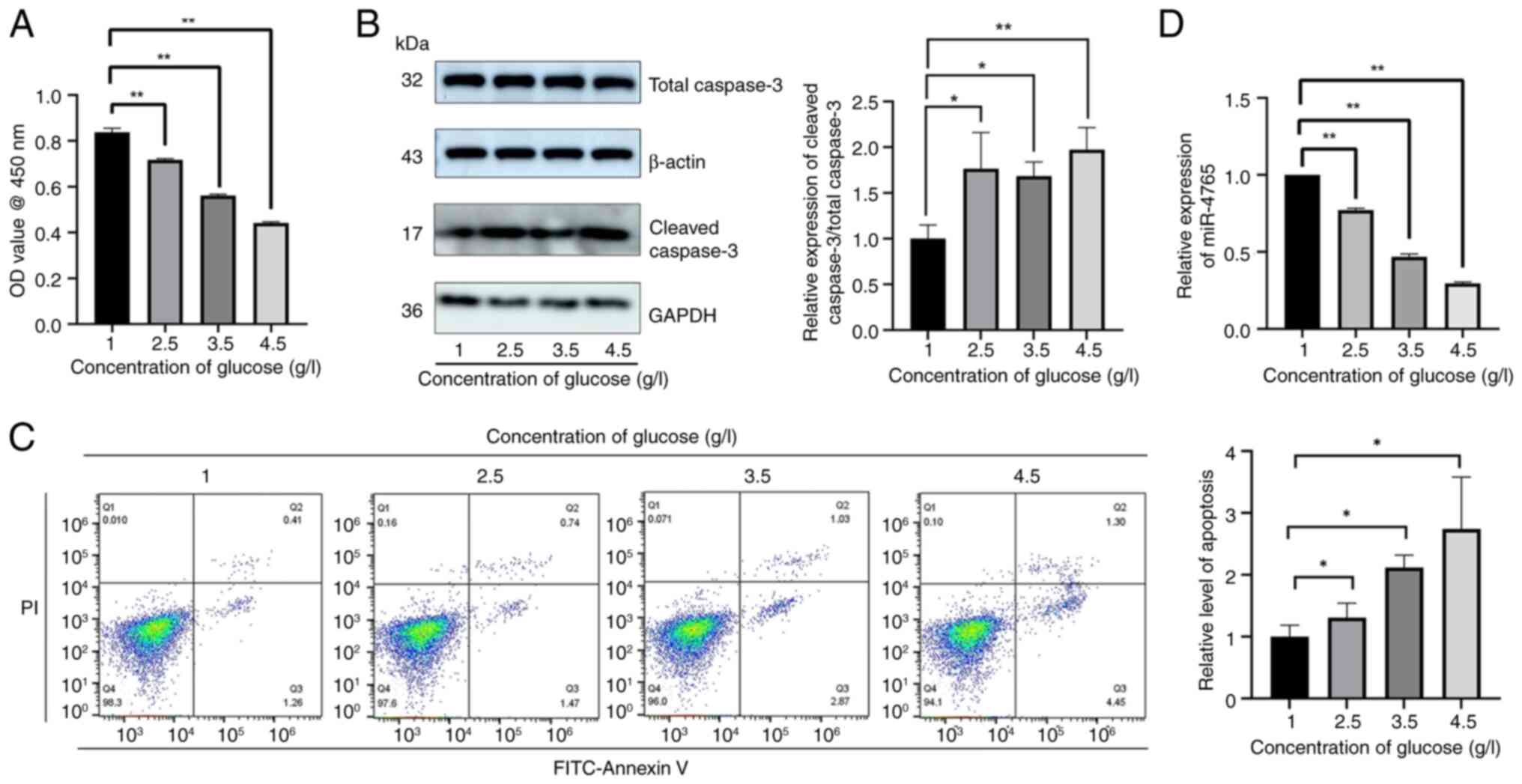
Figure 1

Hyperglycemia can induce hFOB 1.19
cell apoptosis and inhibit miR-4765 expression. (A) Viability of
hFOB 1.19 cells under various glucose concentrations (1, 2.5, 3.5
or 4.5 g/l). Cell viability was expressed as OD values. (B) Cleaved
caspase-3 protein expression in hFOB 1.19 cells under various
glucose concentrations (1, 2.5, 3.5 or 4.5 g/l). (C) Apoptosis
levels detected using Annexin V staining in hFOB 1.19 cells under
various glucose concentrations (1, 2.5, 3.5 or 4.5 g/l). (D)
miR-4765 expression in hFOB 1.19 cells under various glucose
concentrations (1, 2.5, 3.5 or 4.5 g/l). Data are presented as the
mean ± standard deviation (n=3). *P<0.05 and
**P<0.01. OD, optical density; miR, microRNA.

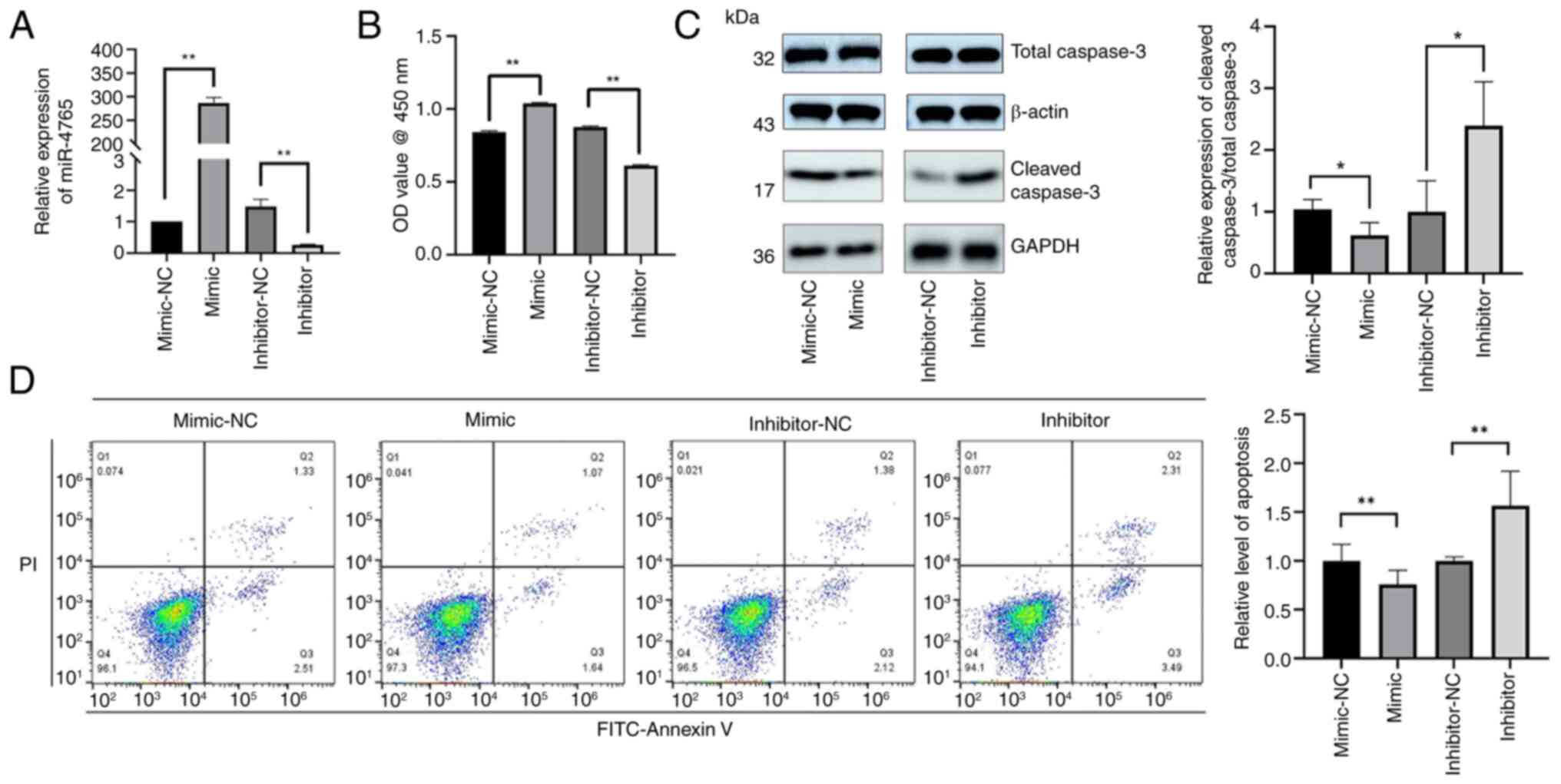
Figure 2

miR-4765 can inhibit hFOB 1.19 cell
apoptosis. (A) Transfection efficiency of miR-4765 mimics and
inhibitors. (B) Viability of hFOB 1.19 cells after transfection
with miR-4765 mimics, inhibitors, and the corresponding NCs. Cell
viability was expressed as OD values. (C) Cleaved caspase-3 protein
expression after transfection with miR-4765 mimics, inhibitors, and
the corresponding NCs. (D) Apoptosis levels detected using Annexin
V staining after transfection with miR-4765 mimics, inhibitors, and
corresponding NCs. Data are presented as the mean ± standard
deviation (n=3). *P<0.05 and **P<0.01.
miR, microRNA; OD, optical density; NC, negative control.

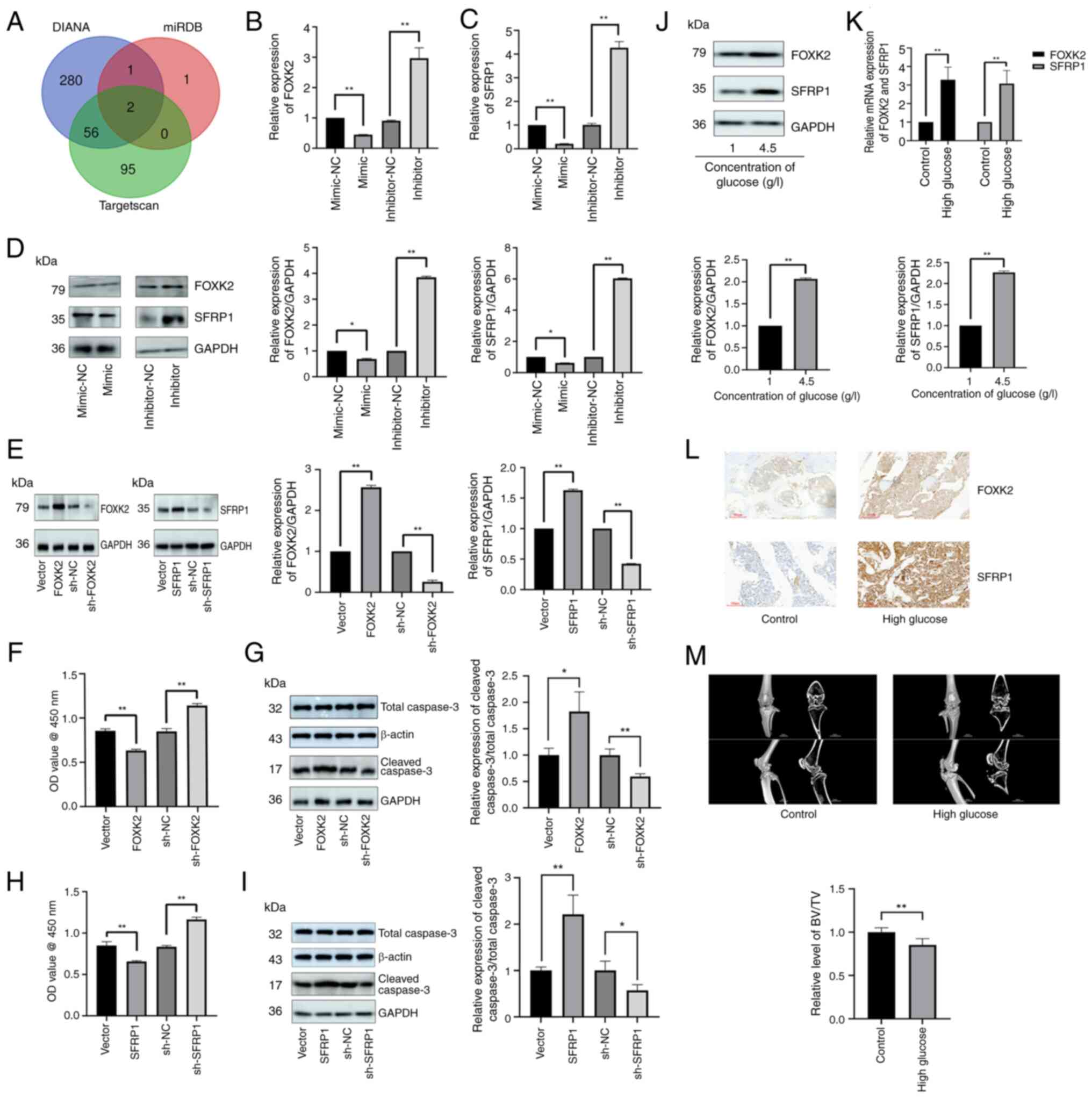
Figure 3

FOXK2 and SFRP1 are potential target
genes of miR-4765 predicted using databases. (A) Venn diagram of
target genes overlapping with miR-4765 from three different
databases (TargetScan, miRDB and DIANA). (B) FOXK2 mRNA expression
after transfection with miR-4765 mimics, inhibitors, and the
corresponding NCs. (C) SFRP1 mRNA expression after transfection
with miR-4765 mimics, inhibitors, and the corresponding NCs. (D)
FOXK2 and SFRP1 protein expression after transfection with miR-4765
mimics, inhibitors, and corresponding NCs. (E) Transfection
efficiency of FOXK2 and SFRP1 OE plasmids, sh-FOXK2 and sh-SFRP1,
and the corresponding NCs. (F) Viability of hFOB 1.19 cells after
transfection with FOXK2 OE plasmid, sh-FOXK2, and the corresponding
NCs. Cell viability was expressed as OD values. (G) Cleaved
caspase-3 protein expression after transfection with FOXK2 OE
plasmid, sh-FOXK2, and the corresponding NCs. (H) Viability of hFOB
1.19 cells after transfection with SFRP1 OE plasmid, sh-SFRP1, and
the corresponding NCs. Cell viability was expressed as OD values.
(I) Cleaved caspase-3 protein expression after transfection with
SFRP1 OE plasmid, sh-SFRP1, and the corresponding NCs. (J) FOXK2
and SFRP1 expression in hFOB 1.19 cells under various glucose
concentrations (1 or 4.5 g/l). (K) FOXK2 and SFRP1 mRNA expression
in the bone tissues of control and diabetic mice. (L) FOXK2 and
SFRP1 protein expression determined via immunohistochemical
staining in the bone tissues of control and diabetic mice with OP.
(M) Micro-computed tomography of the knee joint in control and
diabetic mice with OP. Data are presented as the mean ± SD (n=3).
*P<0.05 and **P<0.01. miR, microRNA;
NC, negative control; sh-, short hairpin; OD, optical density; OE,
overexpression; OP, osteoporosis.

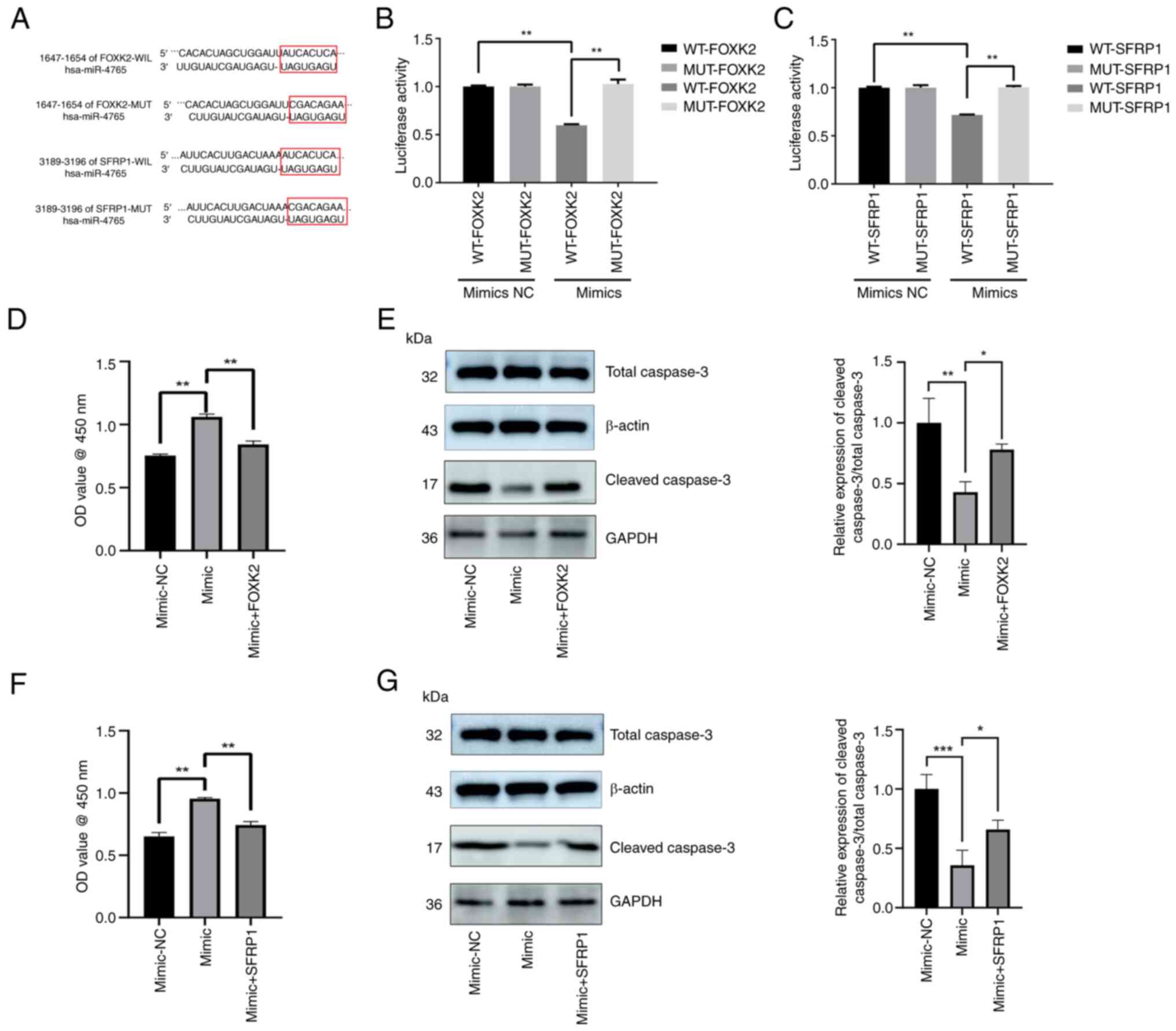
Figure 4

miR-4765 can be directly combined
with the 3'-UTR of FOXK2 and SFRP1. (A) Binding sites for miR-4765
and FOXK2, miR-4765 and SFRP1. (B) Luciferase activity in 293T
cells co-transfected with miR-4765 mimic and FOXK2 WT or MUT
3'-UTR. (C) Luciferase activity in 293T cells co-transfected with
miR-4765 mimic and SFRP1 WT or MUT 3'-UTR. (D) Viability of hFOB
1.19 cells after co-transfection with FOXK2 OE plasmids and
miR-4765 mimics and the corresponding NCs. Cell viability was
expressed as OD values. (E) Cleaved caspase-3 protein expression
after co-transfection with FOXK2 OE plasmids and miR-4765 mimics
and the corresponding NCs. (F) Viability of hFOB 1.19 cells after
co-transfection with SFRP1 OE plasmids and miR-4765 mimics and the
corresponding NCs. Cell viability was expressed as OD values. (G)
Cleaved caspase-3 protein expression after co-transfection with
SFRP1 OE plasmids and miR-4765 mimics and the corresponding NCs.
Data are presented as the mean ± standard deviation (n=3).
*P<0.05, **P<0.01 and
***P<0.001. miR, microRNA; UTR, untranslated region;
WT, wild type; MUT, mutant; OD, optical density; NC, negative
control; OE, overexpression.

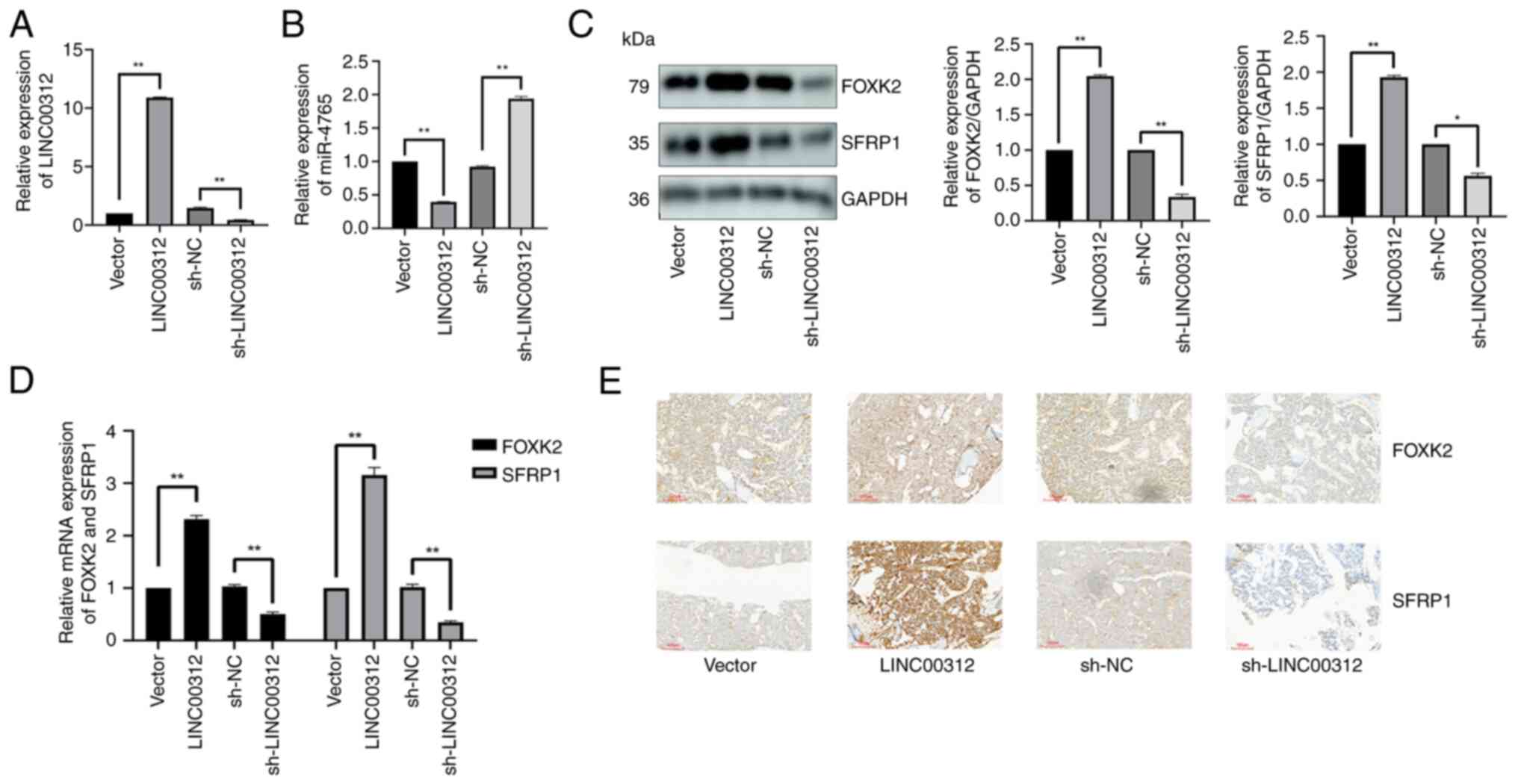
Figure 5

LINC00312 may act as an miR-4765
sponge to regulate FOXK2 and SFRP1 as predicted using the database.
(A) Transfection efficiency of LINC00312 OE plasmids and
sh-LINC00312. (B) miR-4765 expression after transfection with
LINC00312 OE plasmids, sh-LINC00312, and the corresponding NCs. (C)
FOXK2 and SFRP1 protein expression after transfection with
LINC00312 OE plasmids, sh-LINC00312, and the corresponding NCs. (D)
FOXK2 and SFRP1 mRNA expression in the bone tissues of diabetic
mice with OP after adenovirus transfection with LINC00312 OE
plasmids, sh-LINC00312, and the corresponding NCs. (E) FOXK2 and
SFRP1 protein expression determined using immunohistochemical
staining in the bone tissues of diabetic mice with OP after
adenovirus transfection with LINC00312 OE plasmids, sh-LINC00312,
and the corresponding NCs. Data are presented as the mean ±
standard deviation (n=3). *P<0.05 and
**P<0.01. miR, microRNA; NC, negative control; OE,
overexpression; sh-, short hairpin; OP, osteoporosis.

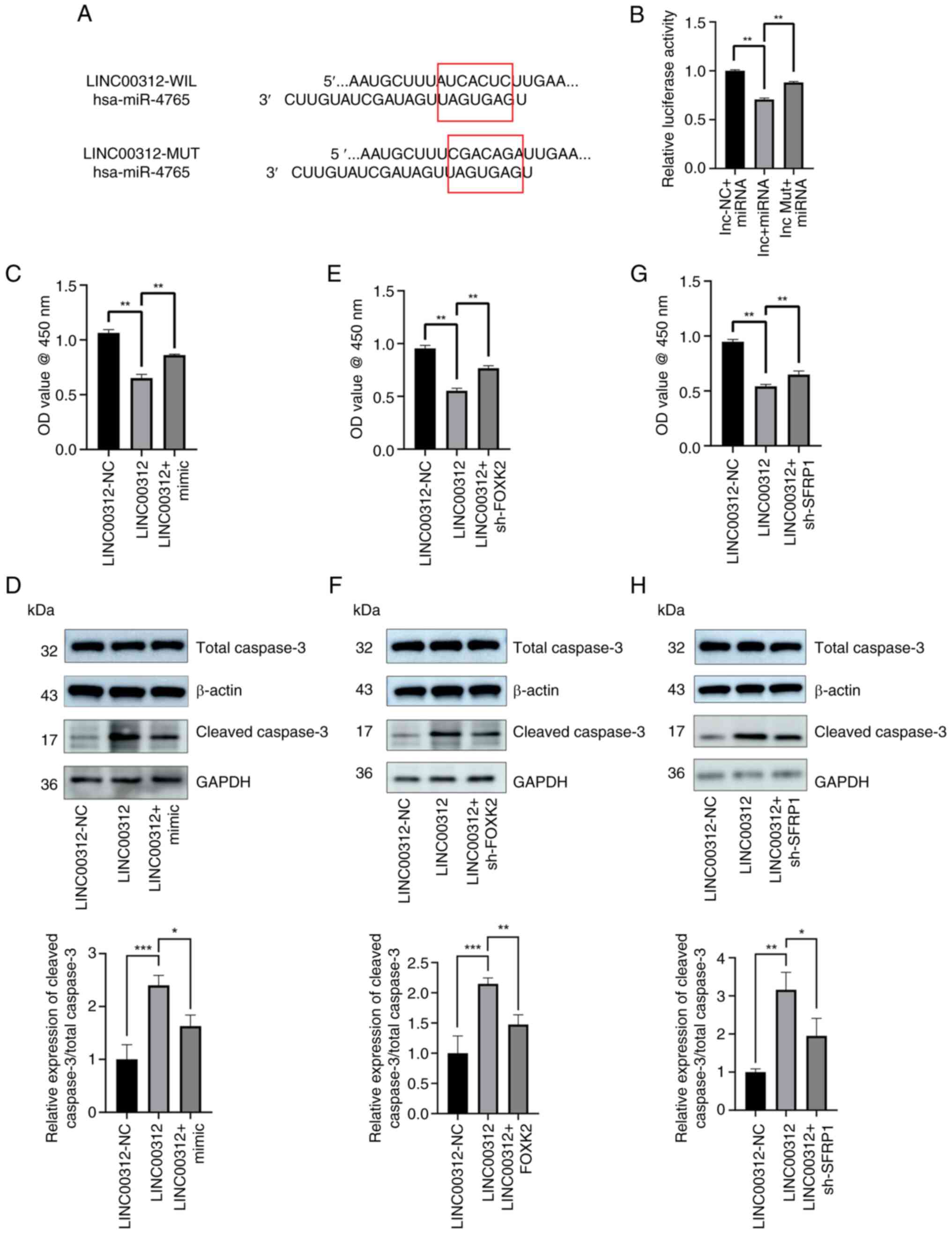
Figure 6

LINC00312 can be directly combined
with miR-4765. (A) Binding sites for LINC00312 and miR-4765. (B)
Luciferase activity in 293T cells co-transfected with miR-4765
mimics and LINC00312 WT or MUT 3' region. (C) Viability of hFOB
1.19 cells after co-transfection with LINC00312 OE plasmids and
miR-4765 mimics and the corresponding NCs. Cell viability was
expressed as OD values. (D) Cleaved caspase-3 protein expression
after co-transfection with LINC00312 OE plasmids and miR-4765
mimics and the corresponding NCs. (E) Viability of hFOB 1.19 cells
after co-transfection with LINC00312 OE plasmids and sh-FOXK2 and
the corresponding NCs. Cell viability was expressed as OD values.
(F) Cleaved caspase-3 protein expression after co-transfection with
LINC00312 OE plasmids and sh-FOXK2 and the corresponding NCs. (G)
Viability of hFOB 1.19 cells after co-transfection with LINC00312
OE plasmids and sh-SFRP1 and the corresponding NCs. Cell viability
was expressed as OD values. (H) Cleaved caspase-3 protein
expression after co-transfection with LINC00312 OE plasmids and
sh-SFRP1 and the corresponding NCs. Data are presented as the mean
± standard deviation (n=3). *P<0.05,
**P<0.01 and ***P<0.001. miR, microRNA;
WT, wild type; MUT, mutant; OD, optical density; NC, negative
control; OE, overexpression; sh-, short hairpin.

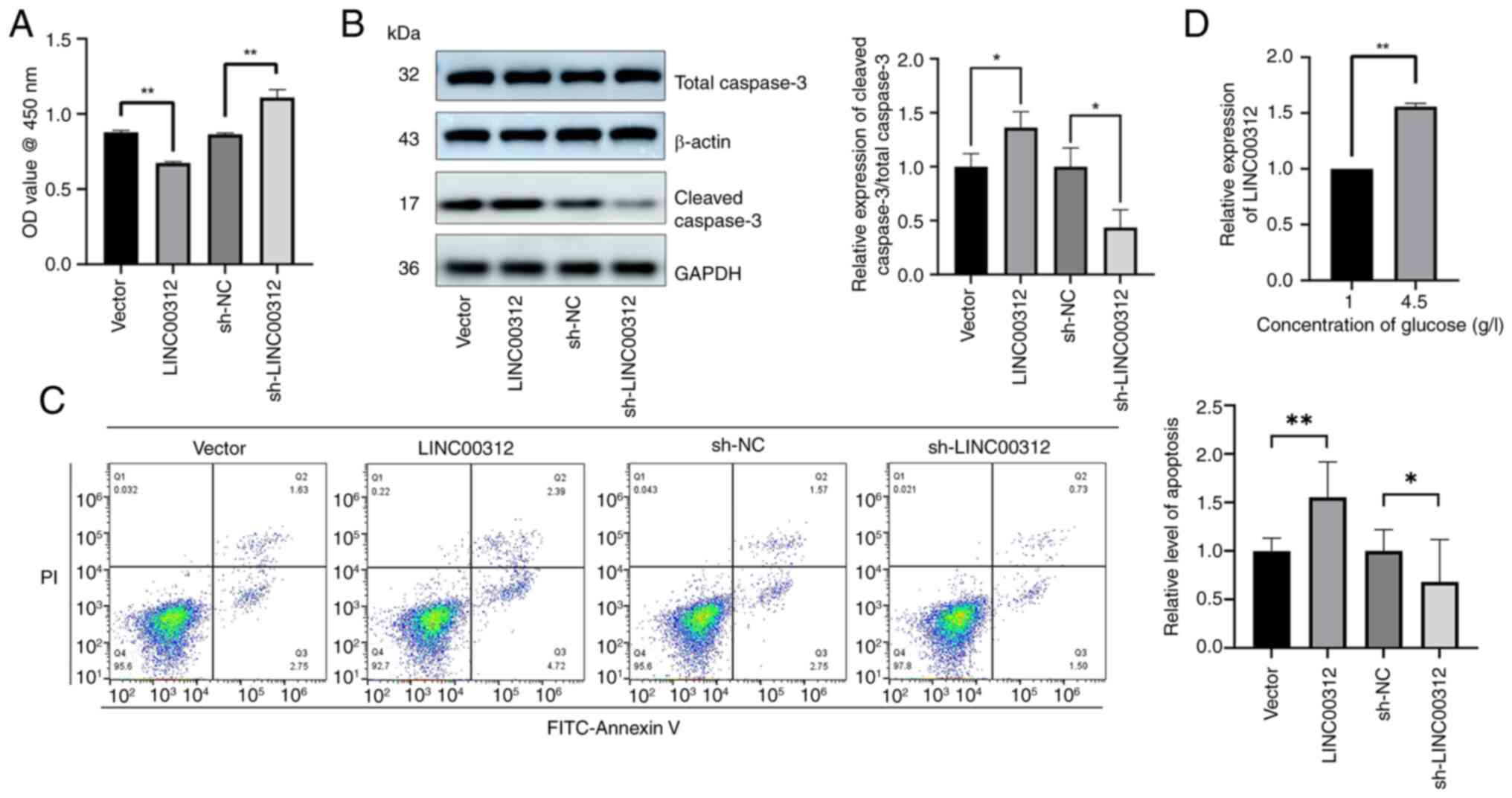
Figure 7

LINC00312 can promote hFOB 1.19 cells
apoptosis. (A) Viability of hFOB 1.19 cells after transfection with
LINC00312 OE plasmids, sh-LINC00312, and the corresponding NCs.
Cell viability was expressed as OD values. (B) Cleaved caspase-3
protein expression after transfection with LINC00312 OE plasmids,
sh-LINC00312, and the corresponding NCs. (C) Apoptosis levels
determined via Annexin V staining after transfection with LINC00312
OE plasmids, sh-LINC00312, and the corresponding NCs. (D) LINC00312
expression in hFOB 1.19 cells under various glucose concentrations
(1 or 4.5 g/l). Data are presented as the mean ± standard deviation
(n=3). *P<0.05 and **P<0.01. OD,
optical density; NC, negative control; OE, overexpression; sh-,
short hairpin.

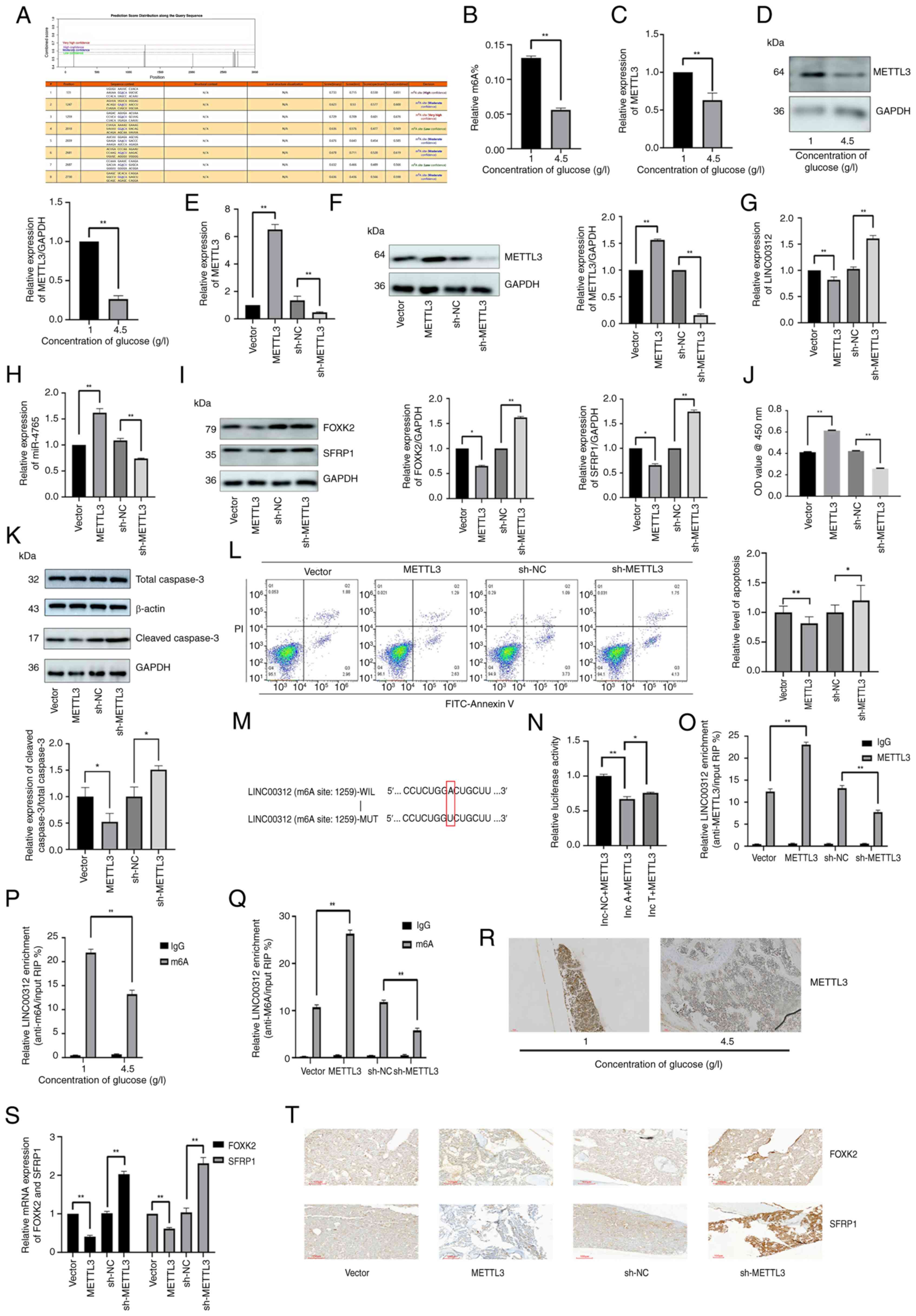
Figure 8

METTL3 reduces the expression level
of LINC00312 by increasing its methylation level. (A) SRAMP was
used to predict the possible m6A modification locations of
LINC00312. (B) Relative m6A level of hFOB 1.19 cells under various
glucose concentrations (1 or 4.5 g/l) determined via m6A
colorimetric analysis. (C) METTL3 mRNA expression in hFOB 1.19
cells under various glucose concentrations (1 or 4.5 g/l). (D)
METTL3 protein expression in hFOB 1.19 cells under various glucose
concentrations (1 or 4.5 g/l). (E) Transfection efficiency of
METTL3 OE plasmids and sh-METTL3. METTL3 mRNA expression after
transfection with METTL3 OE plasmids, sh-METTL3, and the
corresponding NCs. (F) Transfection efficiency of METTL3 OE
plasmids and sh-METTL3; METTL3 protein expression after
transfection with METTL3 OE plasmids, sh-METTL3, and the
corresponding NCs. (G) LINC00312 expression after transfection with
METTL3 OE plasmids, sh-METTL3, and the corresponding NCs. (H)
miR-4765 expression after transfection with METTL3 OE plasmids,
sh-METTL3, and the corresponding NCs. (I) FOXK2 and SFRP1 protein
expression after transfection with METTL3 OE plasmids, sh-METTL3,
and the corresponding NCs. (J) Viability of hFOB 1.19 cells after
transfection with METTL3 OE plasmid, sh-METTL3, and the
corresponding NCs. Cell viability was expressed as OD values. (K)
Cleaved caspase-3 protein expression after transfection with METTL3
OE plasmids, sh-METTL3, and the corresponding NCs. (L) Apoptosis
levels determined via Annexin V staining after transfection with
METTL3 OE plasmids, sh-METTL3, and the corresponding NCs. (M) m6A
modification locations of LINC00312. (N) Luciferase activity in
293T cells co-transfected with METTL3 OE plasmids and LINC00312 WT
or MUT 3'-region. (O) Relative enrichment of METTL3 in LINC00312
after transfection with METTL3 OE plasmids, sh-METTL3, and the
corresponding NCs. (P) Relative enrichment of m6A in LINC00312
under various glucose concentrations (1 or 4.5 g/l) determined via
methylated RNA immunoprecipitation-quantitative PCR assays. (Q)
Relative enrichment of m6A in LINC00312 after transfection with
METTL3 OE plasmids, sh-METTL3, and the corresponding NCs. (R)
METTL3 protein expression determined via IHC staining in the bone
tissues of diabetic mice with OP and non-diabetic mice. (S) FOXK2
and SFRP1 mRNA expression in the bone tissues of diabetic mice with
OP after adenovirus transfection with METTL3 OE plasmids,
sh-METTL3, and the corresponding NCs. (T) FOXK2 and SFRP1 protein
expression determined via IHC staining in the bone tissues of
diabetic mice with OP after adenovirus transfection with METTL3 OE
plasmids, sh-METTL3, and the corresponding NCs. Data are presented
as the mean ± standard deviation (n=3). *P<0.05 and
**P<0.01. OE, overexpression; sh-, short hairpin; WT,
wild type; MUT, mutant; NC, negative control; OD, optical density;
miR, microRNA; OP, osteoporosis; IHC, immunohistochemical.

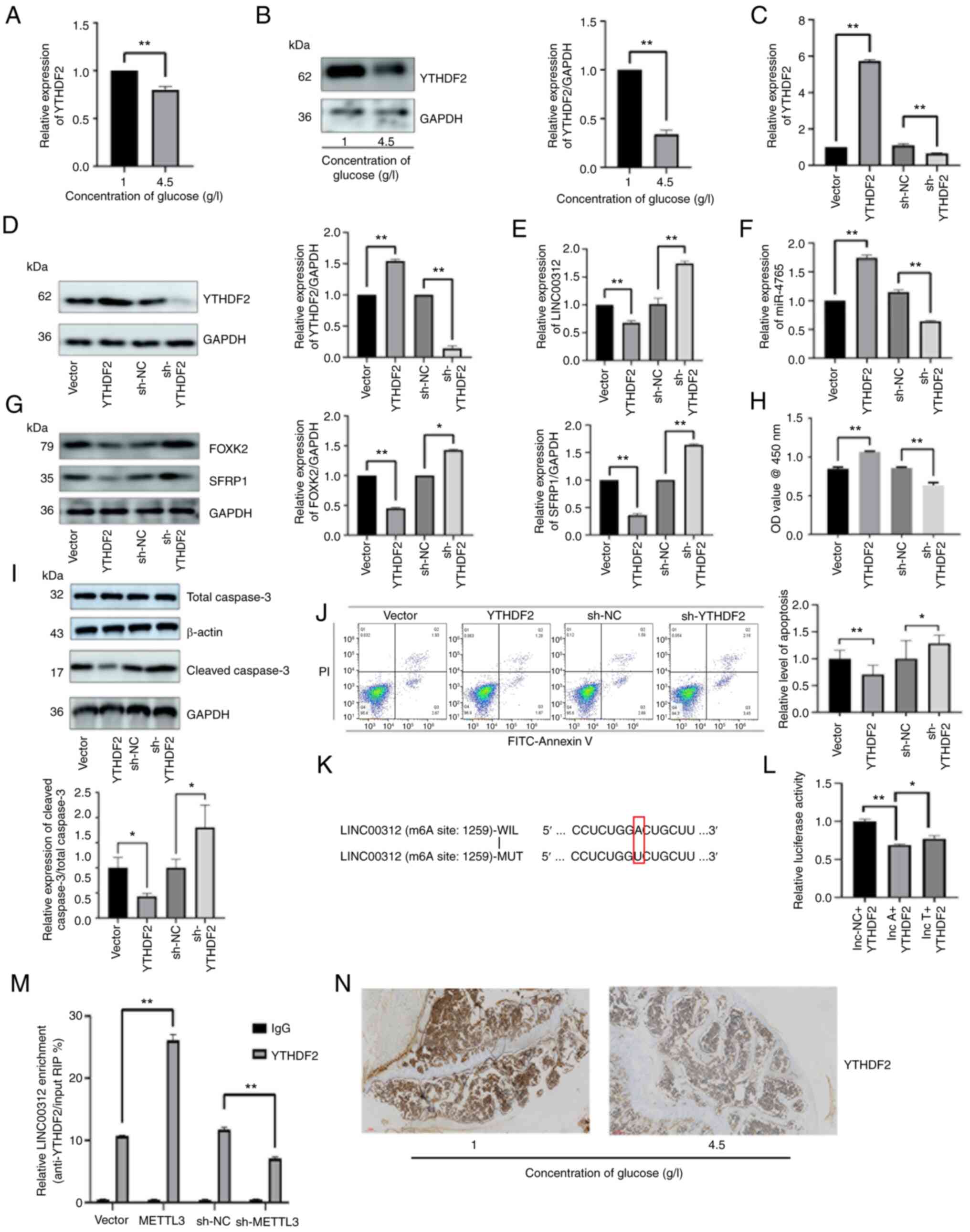
Figure 9

YTHDF2 participates in increasing the
methylation level of LINC00312. (A) YTHDF2 mRNA expression in hFOB
1.19 cells under various glucose concentrations (1 or 4.5 g/l). (B)
YTHDF2 protein expression in hFOB 1.19 cells under various glucose
concentrations (1 or 4.5 g/l). (C) Transfection efficiency of
YTHDF2 OE plasmids and sh-YTHDF2. YTHDF2 mRNA expression after
transfection with YTHDF2 OE plasmids, sh-YTHDF2, and the
corresponding NCs. (D) Transfection efficiency of YTHDF2 OE
plasmids and sh-YTHDF2. YTHDF2 protein expression after
transfection with YTHDF2 OE plasmids, sh-YTHDF2, and the
corresponding NCs. (E) LINC00312 expression after transfection with
YTHDF2 OE plasmids, sh-YTHDF2 and the corresponding NCs. (F)
miR-4765 expression after transfection with YTHDF2 OE plasmids,
sh-YTHDF2, and the corresponding NCs. (G) FOXK2 and SFRP1 protein
expression after transfection with YTHDF2 OE plasmids, sh-YTHDF2,
and the corresponding NCs. (H) Viability of hFOB 1.19 cells after
transfection with YTHDF2 OE plasmids, sh-YTHDF2, and the
corresponding NCs. Cell viability was expressed as OD values. (I)
Cleaved caspase-3 protein expression after transfection with YTHDF2
OE plasmids, sh-YTHDF2, and the corresponding NCs. (J) Apoptosis
level determined via Annexin V staining after transfection with
YTHDF2 OE plasmids, sh-YTHDF2, and the corresponding NCs. (K) m6A
modification locations of LINC00312. (L) Luciferase activity in
293T cells co-transfected with YTHDF2 OE plasmids and LINC00312 WT
or MUT 3'-region. (M) Relative enrichment of YTHDF2 in LINC00312
after transfection with METTL3 OE plasmids, sh-METTL3, and the
corresponding NCs. (N) YTHDF2 protein expression determined via
immunohistochemical staining in the bone tissues of diabetic mice
with osteoporosis and non-diabetic mice. Data are presented as the
mean ± standard deviation (n=3). *P<0.05 and
**P<0.01. WT, wild type; MUT, mutant; NC, negative
control; OD, optical density; OE, overexpression; sh-, short
hairpin; miR, microRNA.

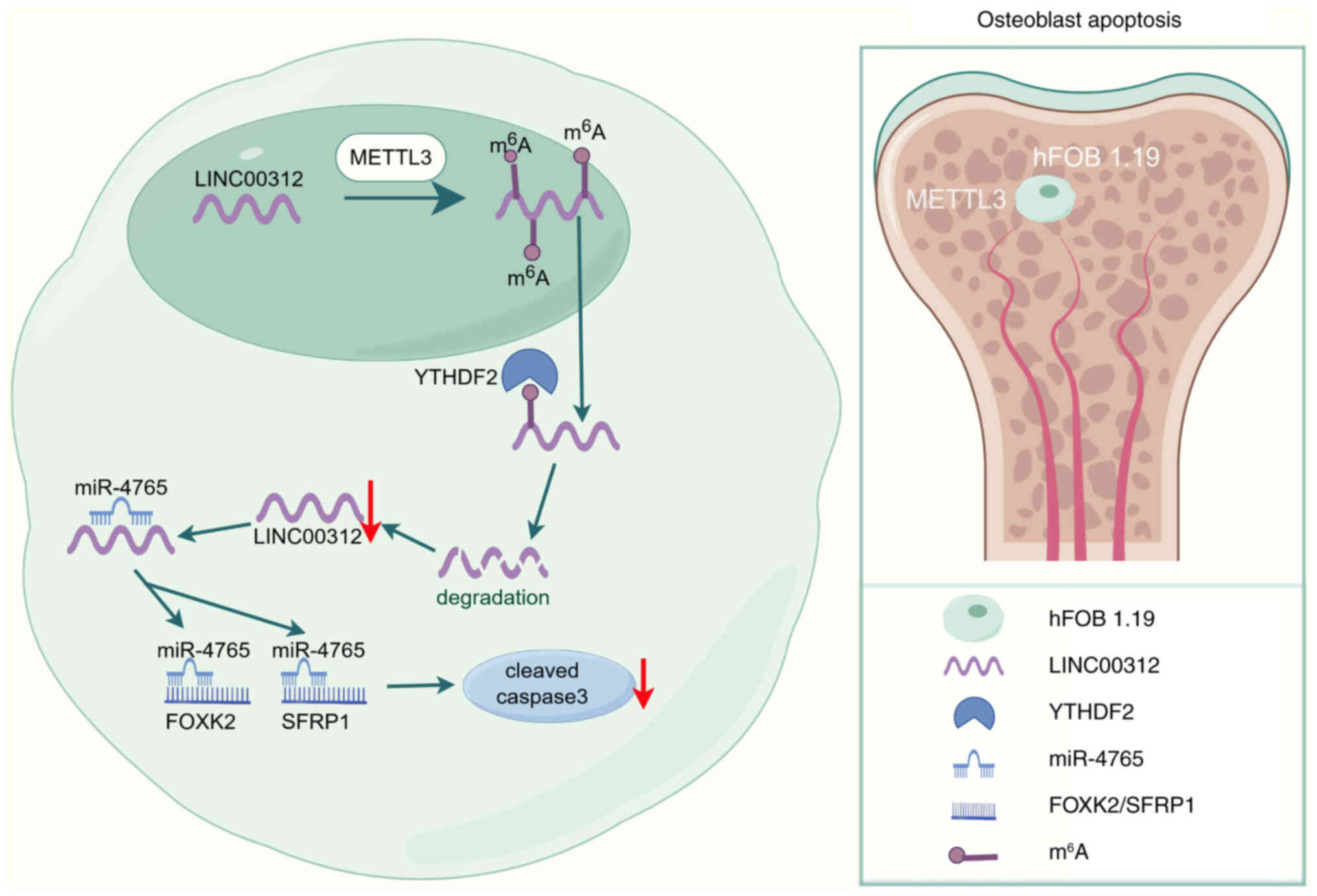
Figure 10

Graphic abstract. LINC00312 increases
apoptosis of hFOB 1.19 cells by targeting the miR-4765-FOXK2/SFRP1
axis, which is m6A modified by METTL3 in a YTHDF2-dependent manner.
miR, microRNA. The image was created using www.Figdraw.com.
View References

1 

Hendrickx G, Boudin E and Van Hul W: A look behind the scenes: The risk and pathogenesis of primary osteoporosis. Nat Rev Rheumatol. 11:462–474. 2015. View Article : Google Scholar : PubMed/NCBI

2 

US Preventive Services Task Force; Grossman DC, Curry SJ, Owens DK, Barry MJ, Caughey AB, Davidson KW, Doubeni CA, Epling JW Jr, Kemper AR, et al: Vitamin D, calcium, or combined supplementation for the primary prevention of fractures in community-dwelling adults: US preventive services task force recommendation statement. JAMA. 319:1592–1599. 2018. View Article : Google Scholar : PubMed/NCBI

3 

Kern LM, Powe NR, Levine MA, Fitzpatrick AL, Harris TB, Robbins J and Fried LP: Association between screening for osteoporosis and the incidence of hip fracture. Ann Intern Med. 142:173–181. 2005. View Article : Google Scholar : PubMed/NCBI

4 

Chotiyarnwong P and McCloskey EV: Pathogenesis of glucocorticoid-induced osteoporosis and options for treatment. Nat Rev Endocrinol. 16:437–447. 2020. View Article : Google Scholar : PubMed/NCBI

5 

Ambrogini E, Almeida M, Martin-Millan M, Paik JH, Depinho RA, Han L, Goellner J, Weinstein RS, Jilka RL, O'Brien CA and Manolagas SC: FoxO-mediated defense against oxidative stress in osteoblasts is indispensable for skeletal homeostasis in mice. Cell Metab. 11:136–146. 2010. View Article : Google Scholar : PubMed/NCBI

6 

Wu M, Ai W, Chen L, Zhao S and Liu E: Bradykinin receptors and EphB2/EphrinB2 pathway in response to high glucose-induced osteoblast dysfunction and hyperglycemia-induced bone deterioration in mice. Int J Mol Med. 37:565–574. 2016. View Article : Google Scholar : PubMed/NCBI

7 

Wongdee K and Charoenphandhu N: Update on type 2 diabetes-related osteoporosis. World J Diabetes. 6:673–678. 2015. View Article : Google Scholar : PubMed/NCBI

8 

Kushwaha P, Ahmad N, Dhar YV, Verma A, Haldar S, Mulani FA, Trivedi PK, Mishra PR, Thulasiram HV and Trivedi R: Estrogen receptor activation in response to Azadirachtin A stimulates osteoblast differentiation and bone formation in mice. J Cell Physiol. 234:23719–23735. 2019. View Article : Google Scholar : PubMed/NCBI

9 

Tyagi AM, Mansoori MN, Srivastava K, Khan MP, Kureel J, Dixit M, Shukla P, Trivedi R, Chattopadhyay N and Singh D: Enhanced immunoprotective effects by anti-IL-17 antibody translates to improved skeletal parameters under estrogen deficiency compared with anti-RANKL and anti-TNF-α antibodies. J Bone Miner Res. 29:1981–1992. 2014. View Article : Google Scholar : PubMed/NCBI

10 

Tamura Y, Kawao N, Yano M, Okada K, Okumoto K, Chiba Y, Matsuo O and Kaji H: Role of plasminogen activator inhibitor-1 in glucocorticoid-induced diabetes and osteopenia in mice. Diabetes. 64:2194–2206. 2015. View Article : Google Scholar : PubMed/NCBI

11 

Rojas E, Carlini RG, Clesca P, Arminio A, Suniaga O, De Elguezabal K, Weisinger JR, Hruska KA and Bellorin-Font E: The pathogenesis of osteodystrophy after renal transplantation as detected by early alterations in bone remodeling. Kidney Int. 63:1915–1923. 2003. View Article : Google Scholar : PubMed/NCBI

12 

Zhang H, Wang Y and He Z: Glycine-histidine-lysine (GHK) alleviates neuronal apoptosis due to intracerebral hemorrhage via the miR-339-5p/VEGFA pathway. Front Neurosci. 12:6442018. View Article : Google Scholar : PubMed/NCBI

13 

Xu X, Yang J, Ye Y, Chen G, Zhang Y, Wu H, Song Y, Feng M, Feng X, Chen X, et al: SPTBN1 prevents primary osteoporosis by modulating osteoblasts proliferation and differentiation and blood vessels formation in bone. Front Cell Dev Biol. 9:6537242021. View Article : Google Scholar : PubMed/NCBI

14 

Zhang Y, Cao X, Li P, Fan Y, Zhang L, Li W and Liu Y: PSMC6 promotes osteoblast apoptosis through inhibiting PI3K/AKT signaling pathway activation in ovariectomy-induced osteoporosis mouse model. J Cell Physiol. 235:5511–5524. 2020. View Article : Google Scholar : PubMed/NCBI

15 

Glasner H, Riml C, Micura R and Breuker K: Label-free, direct localization and relative quantitation of the RNA nucleobase methylations m6A, m5C, m3U, and m5U by top-down mass spectrometry. Nucleic Acids Res. 45:8014–8025. 2017. View Article : Google Scholar : PubMed/NCBI

16 

Kang HJ, Cheon NY, Park H, Jeong GW, Ye BJ, Yoo EJ, Lee JH, Hur JH, Lee EA, Kim H, et al: TonEBP recognizes R-loops and initiates m6A RNA methylation for R-loop resolution. Nucleic Acids Res. 49:269–284. 2021. View Article : Google Scholar :

17 

Blanco S, Bandiera R, Popis M, Hussain S, Lombard P, Aleksic J, Sajini A, Tanna H, Cortés-Garrido R, Gkatza N, et al: Stem cell function and stress response are controlled by protein synthesis. Nature. 534:335–340. 2016. View Article : Google Scholar : PubMed/NCBI

18 

Shen W, Gao C, Cueto R, Liu L, Fu H, Shao Y, Yang WY, Fang P, Choi ET, Wu Q, et al: Homocysteine-methionine cycle is a metabolic sensor system controlling methylation-regulated pathological signaling. Redox Biol. 28:1013222020. View Article : Google Scholar

19 

Qin Y, Li L, Luo E, Hou J, Yan G, Wang D, Qiao Y and Tang C: Role of m6A RNA methylation in cardiovascular disease (Review). Int J Mol Med. 46:1958–1972. 2020. View Article : Google Scholar : PubMed/NCBI

20 

Abelson S: Eureka-DMA: An easy-to-operate graphical user interface for fast comprehensive investigation and analysis of DNA microarray data. BMC Bioinformatics. 15:532014. View Article : Google Scholar : PubMed/NCBI

21 

Zhou X, Su Z, Sammons RD, Peng Y, Tranel PJ, Stewart CN Jr and Yuan JS: Novel software package for cross-platform transcriptome analysis (CPTRA). BMC Bioinformatics. 10(Suppl 11): S162009. View Article : Google Scholar : PubMed/NCBI

22 

De-Ugarte L, Yoskovitz G, Balcells S, Güerri-Fernández R, Martinez-Diaz S, Mellibovsky L, Urreizti R, Nogués X, Grinberg D, García-Giralt N and Díez-Pérez A: MiRNA profiling of whole trabecular bone: Identification of osteoporosis-related changes in MiRNAs in human hip bones. BMC Med Genomics. 8:752015. View Article : Google Scholar : PubMed/NCBI

23 

Sukonina V, Ma H, Zhang W, Bartesaghi S, Subhash S, Heglind M, Foyn H, Betz MJ, Nilsson D, Lidell ME, et al: FOXK1 and FOXK2 regulate aerobic glycolysis. Nature. 566:279–283. 2019. View Article : Google Scholar : PubMed/NCBI

24 

Shan L, Zhou X, Liu X, Wang Y, Su D, Hou Y, Yu N, Yang C, Liu B, Gao J, et al: FOXK2 elicits massive transcription repression and suppresses the hypoxic response and breast cancer carcinogenesis. Cancer Cell. 30:708–722. 2016. View Article : Google Scholar : PubMed/NCBI

25 

Bowman CJ, Ayer DE and Dynlacht BD: Foxk proteins repress the initiation of starvation-induced atrophy and autophagy programs. Nat Cell Biol. 16:1202–1214. 2014. View Article : Google Scholar : PubMed/NCBI

26 

Zhang F, Ma X, Li H, Zhang Y, Li X, Chen L, Guo G, Gao Y, Gu L, Xie Y, et al: FOXK2 suppresses the malignant phenotype and induces apoptosis through inhibition of EGFR in clear-cell renal cell carcinoma. Int J Cancer. 142:2543–2557. 2018. View Article : Google Scholar : PubMed/NCBI

27 

Marais A, Ji Z, Child ES, Krause E, Mann DJ and Sharrocks AD: Cell cycle-dependent regulation of the forkhead transcription factor FOXK2 by CDK•cyclin complexes. J Biol Chem. 285:35728–35739. 2010. View Article : Google Scholar : PubMed/NCBI

28 

Cui Z, Liu L, Kwame Amevor F, Zhu Q, Wang Y, Li D, Shu G, Tian Y and Zhao X: High expression of miR-204 in chicken atrophic ovaries promotes granulosa cell apoptosis and inhibits autophagy. Front Cell Dev Biol. 8:5800722020. View Article : Google Scholar : PubMed/NCBI

29 

Esteve P, Rueda-Carrasco J, Inés Mateo M, Martin-Bermejo MJ, Draffin J, Pereyra G, Sandonís Á, Crespo I, Moreno I, Aso E, et al: Elevated levels of secreted-frizzled-related-protein 1 contribute to Alzheimer's disease pathogenesis. Nat Neurosci. 22:1258–1268. 2019. View Article : Google Scholar : PubMed/NCBI

30 

Esteve P, Sandonìs A, Cardozo M, Malapeira J, Ibañez C, Crespo I, Marcos S, Gonzalez-Garcia S, Toribio ML, Arribas J, et al: SFRPs act as negative modulators of ADAM10 to regulate retinal neurogenesis. Nat Neurosci. 14:562–569. 2011. View Article : Google Scholar : PubMed/NCBI

31 

Rodriguez J, Esteve P, Weinl C, Ruiz JM, Fermin Y, Trousse F, Dwivedy A, Holt C and Bovolenta P: SFRP1 regulates the growth of retinal ganglion cell axons through the Fz2 receptor. Nat Neurosci. 8:1301–1309. 2005. View Article : Google Scholar : PubMed/NCBI

32 

Renström J, Istvanffy R, Gauthier K, Shimono A, Mages J, Jardon-Alvarez A, Kröger M, Schiemann M, Busch DH, Esposito I, et al: Secreted frizzled-related protein 1 extrinsically regulates cycling activity and maintenance of hematopoietic stem cells. Cell Stem Cell. 5:157–167. 2009. View Article : Google Scholar : PubMed/NCBI

33 

Gu H, Shi S, Xiao F, Huang Z, Xu J, Chen G, Zhou K, Lu L and Yin X: MiR-1-3p regulates the differentiation of mesenchymal stem cells to prevent osteoporosis by targeting secreted frizzled-related protein 1. Bone. 137:1154442020. View Article : Google Scholar : PubMed/NCBI

34 

Tang L, Lu W, Huang J, Tang X, Zhang H and Liu S: miR-144 promotes the proliferation and differentiation of bone mesenchymal stem cells by downregulating the expression of SFRP1. Mol Med Rep. 20:270–280. 2019.PubMed/NCBI

35 

Gu H, Wu L, Chen H, Huang Z, Xu J, Zhou K, Zhang Y, Chen J, Xia J and Yin X: Identification of differentially expressed microRNAs in the bone marrow of osteoporosis patients. Am J Transl Res. 11:2940–2954. 2019.PubMed/NCBI

36 

Zhang X, Zhu Y, Zhang C, Liu J, Sun T, Li D, Na Q, Xian CJ, Wang L and Teng Z: miR-542-3p prevents ovariectomy-induced osteoporosis in rats via targeting SFRP1. J Cell Physiol. 233:6798–6806. 2018. View Article : Google Scholar : PubMed/NCBI

37 

Liu HP, Hao DJ, Wang XD, Hu HM, Li YB and Dong XH: MiR-30a-3p promotes ovariectomy-induced osteoporosis in rats via targeting SFRP1. Eur Rev Med Pharmacol Sci. 23:9754–9760. 2019.PubMed/NCBI

38 

Guo Z, Wang YH, Xu H, Yuan CS, Zhou HH, Huang WH, Wang H and Zhang W: LncRNA linc00312 suppresses radiotherapy resistance by targeting DNA-PKcs and impairing DNA damage repair in nasopharyngeal carcinoma. Cell Death Dis. 12:692021. View Article : Google Scholar : PubMed/NCBI

39 

No authors listed. Expression of concern: Overexpression of long intergenic noncoding RNA LINC00312 inhibits the invasion and migration of thyroid cancer cells by down-regulating microRNA-197-3p. Biosci Rep. 40:BSR–20170109_EOC. 2020.

40 

Peng Z, Wang J, Shan B, Li B, Peng W, Dong Y, Shi W, Zhao W, He D, Duan M, et al: The long noncoding RNA LINC00312 induces lung adenocarcinoma migration and vasculogenic mimicry through directly binding YBX1. Mol Cancer. 17:1672018. View Article : Google Scholar : PubMed/NCBI

41 

No authors listed. Retraction: Overexpression of long intergenic noncoding RNA LINC00312 inhibits the invasion and migration of thyroid cancer cells by down-regulating microRNA-197-3p. Biosci Rep. 41:BSR–20170109_RET. 2021.

42 

Zhang C, Wang M, Shi C, Shi F and Pei C: Long non-coding RNA Linc00312 modulates the sensitivity of ovarian cancer to cisplatin via the Bcl-2/Caspase-3 signaling pathway. Biosci Trends. 12:309–316. 2018. View Article : Google Scholar : PubMed/NCBI

43 

Wu J, Zhou X, Fan Y, Cheng X, Lu B and Chen Z: Long non-coding RNA 00312 downregulates cyclin B1 and inhibits hepatocellular carcinoma cell proliferation in vitro and in vivo. Biochem Biophys Res Commun. 497:173–180. 2018. View Article : Google Scholar : PubMed/NCBI

44 

Zhu Q, Lv T, Wu Y, Shi X, Liu H and Song Y: Long non-coding RNA 00312 regulated by HOXA5 inhibits tumour proliferation and promotes apoptosis in non-small cell lung cancer. J Cell Mol Med. 21:2184–2198. 2017. View Article : Google Scholar : PubMed/NCBI

45 

Zhang W, Huang C, Gong Z, Zhao Y, Tang K, Li X, Fan S, Shi L, Li X, Zhang P, et al: Expression of LINC00312, a long intergenic non-coding RNA, is negatively correlated with tumor size but positively correlated with lymph node metastasis in nasopharyngeal carcinoma. J Mol Histol. 44:545–554. 2013. View Article : Google Scholar : PubMed/NCBI

46 

Liu J, Chen M, Ma L, Dang X and Du G: piRNA-36741 regulates BMP2-mediated osteoblast differentiation via METTL3 controlled m6A modification. Aging (Albany NY). 13:23361–23375. 2021. View Article : Google Scholar : PubMed/NCBI

47 

Yan G, Yuan Y, He M, Gong R, Lei H, Zhou H, Wang W, Du W, Ma T, Liu S, et al: m6A methylation of precursor-miR-320/RUNX2 controls osteogenic potential of bone marrow-derived mesenchymal stem cells. Mol Ther Nucleic Acids. 19:421–436. 2020. View Article : Google Scholar : PubMed/NCBI

48 

Luo D, Peng S, Li Q, Rao P, Tao G, Wang L and Xiao J: Methyltransferase-like 3 modulates osteogenic differentiation of adipose-derived stem cells in osteoporotic rats. J Gene Med. 25:e34812023. View Article : Google Scholar : PubMed/NCBI

49 

Wu Y, Xie L, Wang M, Xiong Q, Guo Y, Liang Y, Li J, Sheng R, Deng P, Wang Y, et al: Mettl3-mediated m6A RNA methylation regulates the fate of bone marrow mesenchymal stem cells and osteoporosis. Nat Commun. 9:47722018. View Article : Google Scholar

50 

Wu T, Tang H, Yang J, Yao Z, Bai L, Xie Y, Li Q and Xiao J: METTL3-m6 A methylase regulates the osteogenic potential of bone marrow mesenchymal stem cells in osteoporotic rats via the Wnt signalling pathway. Cell Prolif. 55:e132342022. View Article : Google Scholar

51 

Peng J, Zhan Y and Zong Y: METTL3-mediated LINC00657 promotes osteogenic differentiation of mesenchymal stem cells via miR-144-3p/BMPR1B axis. Cell Tissue Res. 388:301–312. 2022. View Article : Google Scholar : PubMed/NCBI

52 

Li L, Wang B, Zhou X, Ding H, Sun C, Wang Y, Zhang F and Zhao J: METTL3-mediated long non-coding RNA MIR99AHG methylation targets miR-4660 to promote bone marrow mesenchymal stem cell osteogenic differentiation. Cell Cycle. 22:476–493. 2023. View Article : Google Scholar :

53 

Tian S, Li YL, Wang J, Dong RC, Wei J, Ma Y and Liu YQ: Chinese ecliptae herba [Eclipta prostrata (L.) L.] extract and its component wedelolactone enhances osteoblastogenesis of bone marrow mesenchymal stem cells via targeting METTL3-mediated m6A RNA methylation. J Ethnopharmacol. 312:1164332023. View Article : Google Scholar

54 

Lin Y, Shen X, Ke Y, Lan C, Chen X, Liang B, Zhang Y and Yan S: Activation of osteoblast ferroptosis via the METTL3/ASK1-p38 signaling pathway in high glucose and high fat (HGHF)-induced diabetic bone loss. FASEB J. 36:e221472022. View Article : Google Scholar : PubMed/NCBI

55 

Wang C, Zhang X, Chen R, Zhu X and Lian N: EGR1 mediates METTL3/m6A/CHI3L1 to promote osteoclastogenesis in osteoporosis. Genomics. 115:1106962023. View Article : Google Scholar

56 

Xiao J, Xu Z, Deng Z, Xie J and Qiu Y: METTL3 facilitates osteoblast differentiation and bone regeneration via m6A-dependent maturation of pri-miR-324-5p. Cell Immunol. 413:1049742025. View Article : Google Scholar : PubMed/NCBI

57 

Song Y, Gao H, Pan Y, Gu Y, Sun W and Liu J: METTL3 promotes osteogenesis by regulating N6-methyladenosine-dependent primary processing of hsa-miR-4526. Stem Cells. 43:sxae0892025. View Article : Google Scholar : PubMed/NCBI

58 

Wang W, Qiao SC, Wu XB, Sun B, Yang JG, Li X, Zhang X, Qian SJ, Gu YX and Lai HC: Circ_0008542 in osteoblast exosomes promotes osteoclast-induced bone resorption through m6A methylation. Cell Death Dis. 12:6282021. View Article : Google Scholar : PubMed/NCBI

59 

Liu J, Chen X and Yu X: Unraveling the role of N6-methylation modification: From bone biology to osteoporosis. Int J Med Sci. 22:2545–2559. 2025. View Article : Google Scholar : PubMed/NCBI

60 

Song J, Wang Y, Zhu Z, Wang W, Yang H and Shan Z: Negative regulation of LINC01013 by METTL3 and YTHDF2 enhances the osteogenic differentiation of senescent pre-osteoblast cells induced by hydrogen peroxide. Adv Biol (Weinh). 8:e23006422024. View Article : Google Scholar : PubMed/NCBI

61 

Sun Q, Zhao T, Li B, Li M, Luo P, Zhang C, Chen G, Cao Z, Li Y, Du M and He H: FTO/RUNX2 signaling axis promotes cementoblast differentiation under normal and inflammatory condition. Biochim Biophys Acta Mol Cell Res. 1869:1193582022. View Article : Google Scholar : PubMed/NCBI

62 

Wang Z, Tang Y, Liu Y, Zeng Y and Zhang M: ALKBH5 mediates FGF21 m6A demethylation in human bone marrow mesenchymal stem cells under high glucose conditions. Biochem Biophys Res Commun. 774:1520422025. View Article : Google Scholar : PubMed/NCBI

63 

Fang C, He M, Li D and Xu Q: YTHDF2 mediates LPS-induced osteoclastogenesis and inflammatory response via the NF-κB and MAPK signaling pathways. Cell Signal. 85:1100602021. View Article : Google Scholar

64 

He J, Zhao Y, Zhang Y, Zhang Z, Li D and Xu Q: FTO regulates osteoclast development by modulating the proliferation and apoptosis of osteoclast precursors in inflammatory conditions. Cell Signal. 117:1110982024. View Article : Google Scholar : PubMed/NCBI

Related Articles

  • Abstract
  • View
  • Download
  • Twitter
Copy and paste a formatted citation
Spandidos Publications style
Wang Y, Tian Y and Yao G: METTL3 inhibits LINC00312 to suppress osteoporosis progression in a YTHDF2‑dependent manner. Int J Mol Med 57: 28, 2026.
APA
Wang, Y., Tian, Y., & Yao, G. (2026). METTL3 inhibits LINC00312 to suppress osteoporosis progression in a YTHDF2‑dependent manner. International Journal of Molecular Medicine, 57, 28. https://doi.org/10.3892/ijmm.2025.5699
MLA
Wang, Y., Tian, Y., Yao, G."METTL3 inhibits LINC00312 to suppress osteoporosis progression in a YTHDF2‑dependent manner". International Journal of Molecular Medicine 57.1 (2026): 28.
Chicago
Wang, Y., Tian, Y., Yao, G."METTL3 inhibits LINC00312 to suppress osteoporosis progression in a YTHDF2‑dependent manner". International Journal of Molecular Medicine 57, no. 1 (2026): 28. https://doi.org/10.3892/ijmm.2025.5699
Copy and paste a formatted citation
x
Spandidos Publications style
Wang Y, Tian Y and Yao G: METTL3 inhibits LINC00312 to suppress osteoporosis progression in a YTHDF2‑dependent manner. Int J Mol Med 57: 28, 2026.
APA
Wang, Y., Tian, Y., & Yao, G. (2026). METTL3 inhibits LINC00312 to suppress osteoporosis progression in a YTHDF2‑dependent manner. International Journal of Molecular Medicine, 57, 28. https://doi.org/10.3892/ijmm.2025.5699
MLA
Wang, Y., Tian, Y., Yao, G."METTL3 inhibits LINC00312 to suppress osteoporosis progression in a YTHDF2‑dependent manner". International Journal of Molecular Medicine 57.1 (2026): 28.
Chicago
Wang, Y., Tian, Y., Yao, G."METTL3 inhibits LINC00312 to suppress osteoporosis progression in a YTHDF2‑dependent manner". International Journal of Molecular Medicine 57, no. 1 (2026): 28. https://doi.org/10.3892/ijmm.2025.5699
Follow us
  • Twitter
  • LinkedIn
  • Facebook
About
  • Spandidos Publications
  • Careers
  • Cookie Policy
  • Privacy Policy
How can we help?
  • Help
  • Live Chat
  • Contact
  • Email to our Support Team