Spandidos Publications Logo
  • About
    • About Spandidos
    • Aims and Scopes
    • Abstracting and Indexing
    • Editorial Policies
    • Reprints and Permissions
    • Job Opportunities
    • Terms and Conditions
    • Contact
  • Journals
    • All Journals
    • Oncology Letters
      • Oncology Letters
      • Information for Authors
      • Editorial Policies
      • Editorial Board
      • Aims and Scope
      • Abstracting and Indexing
      • Bibliographic Information
      • Archive
    • International Journal of Oncology
      • International Journal of Oncology
      • Information for Authors
      • Editorial Policies
      • Editorial Board
      • Aims and Scope
      • Abstracting and Indexing
      • Bibliographic Information
      • Archive
    • Molecular and Clinical Oncology
      • Molecular and Clinical Oncology
      • Information for Authors
      • Editorial Policies
      • Editorial Board
      • Aims and Scope
      • Abstracting and Indexing
      • Bibliographic Information
      • Archive
    • Experimental and Therapeutic Medicine
      • Experimental and Therapeutic Medicine
      • Information for Authors
      • Editorial Policies
      • Editorial Board
      • Aims and Scope
      • Abstracting and Indexing
      • Bibliographic Information
      • Archive
    • International Journal of Molecular Medicine
      • International Journal of Molecular Medicine
      • Information for Authors
      • Editorial Policies
      • Editorial Board
      • Aims and Scope
      • Abstracting and Indexing
      • Bibliographic Information
      • Archive
    • Biomedical Reports
      • Biomedical Reports
      • Information for Authors
      • Editorial Policies
      • Editorial Board
      • Aims and Scope
      • Abstracting and Indexing
      • Bibliographic Information
      • Archive
    • Oncology Reports
      • Oncology Reports
      • Information for Authors
      • Editorial Policies
      • Editorial Board
      • Aims and Scope
      • Abstracting and Indexing
      • Bibliographic Information
      • Archive
    • Molecular Medicine Reports
      • Molecular Medicine Reports
      • Information for Authors
      • Editorial Policies
      • Editorial Board
      • Aims and Scope
      • Abstracting and Indexing
      • Bibliographic Information
      • Archive
    • World Academy of Sciences Journal
      • World Academy of Sciences Journal
      • Information for Authors
      • Editorial Policies
      • Editorial Board
      • Aims and Scope
      • Abstracting and Indexing
      • Bibliographic Information
      • Archive
    • International Journal of Functional Nutrition
      • International Journal of Functional Nutrition
      • Information for Authors
      • Editorial Policies
      • Editorial Board
      • Aims and Scope
      • Abstracting and Indexing
      • Bibliographic Information
      • Archive
    • International Journal of Epigenetics
      • International Journal of Epigenetics
      • Information for Authors
      • Editorial Policies
      • Editorial Board
      • Aims and Scope
      • Abstracting and Indexing
      • Bibliographic Information
      • Archive
    • Medicine International
      • Medicine International
      • Information for Authors
      • Editorial Policies
      • Editorial Board
      • Aims and Scope
      • Abstracting and Indexing
      • Bibliographic Information
      • Archive
  • Articles
  • Information
    • Information for Authors
    • Information for Reviewers
    • Information for Librarians
    • Information for Advertisers
    • Conferences
  • Language Editing
Spandidos Publications Logo
  • About
    • About Spandidos
    • Aims and Scopes
    • Abstracting and Indexing
    • Editorial Policies
    • Reprints and Permissions
    • Job Opportunities
    • Terms and Conditions
    • Contact
  • Journals
    • All Journals
    • Biomedical Reports
      • Information for Authors
      • Editorial Policies
      • Editorial Board
      • Aims and Scope
      • Abstracting and Indexing
      • Bibliographic Information
      • Archive
    • Experimental and Therapeutic Medicine
      • Information for Authors
      • Editorial Policies
      • Editorial Board
      • Aims and Scope
      • Abstracting and Indexing
      • Bibliographic Information
      • Archive
    • International Journal of Epigenetics
      • Information for Authors
      • Editorial Policies
      • Editorial Board
      • Aims and Scope
      • Abstracting and Indexing
      • Bibliographic Information
      • Archive
    • International Journal of Functional Nutrition
      • Information for Authors
      • Editorial Policies
      • Editorial Board
      • Aims and Scope
      • Abstracting and Indexing
      • Bibliographic Information
      • Archive
    • International Journal of Molecular Medicine
      • Information for Authors
      • Editorial Policies
      • Editorial Board
      • Aims and Scope
      • Abstracting and Indexing
      • Bibliographic Information
      • Archive
    • International Journal of Oncology
      • Information for Authors
      • Editorial Policies
      • Editorial Board
      • Aims and Scope
      • Abstracting and Indexing
      • Bibliographic Information
      • Archive
    • Medicine International
      • Information for Authors
      • Editorial Policies
      • Editorial Board
      • Aims and Scope
      • Abstracting and Indexing
      • Bibliographic Information
      • Archive
    • Molecular and Clinical Oncology
      • Information for Authors
      • Editorial Policies
      • Editorial Board
      • Aims and Scope
      • Abstracting and Indexing
      • Bibliographic Information
      • Archive
    • Molecular Medicine Reports
      • Information for Authors
      • Editorial Policies
      • Editorial Board
      • Aims and Scope
      • Abstracting and Indexing
      • Bibliographic Information
      • Archive
    • Oncology Letters
      • Information for Authors
      • Editorial Policies
      • Editorial Board
      • Aims and Scope
      • Abstracting and Indexing
      • Bibliographic Information
      • Archive
    • Oncology Reports
      • Information for Authors
      • Editorial Policies
      • Editorial Board
      • Aims and Scope
      • Abstracting and Indexing
      • Bibliographic Information
      • Archive
    • World Academy of Sciences Journal
      • Information for Authors
      • Editorial Policies
      • Editorial Board
      • Aims and Scope
      • Abstracting and Indexing
      • Bibliographic Information
      • Archive
  • Articles
  • Information
    • For Authors
    • For Reviewers
    • For Librarians
    • For Advertisers
    • Conferences
  • Language Editing
Login Register Submit
  • This site uses cookies
  • You can change your cookie settings at any time by following the instructions in our Cookie Policy. To find out more, you may read our Privacy Policy.

    I agree
Search articles by DOI, keyword, author or affiliation
Search
Advanced Search
presentation
International Journal of Molecular Medicine
Join Editorial Board Propose a Special Issue
Print ISSN: 1107-3756 Online ISSN: 1791-244X
Journal Cover
February-2026 Volume 57 Issue 2

Full Size Image

Sign up for eToc alerts
Recommend to Library

Journals

International Journal of Molecular Medicine

International Journal of Molecular Medicine

International Journal of Molecular Medicine is an international journal devoted to molecular mechanisms of human disease.

International Journal of Oncology

International Journal of Oncology

International Journal of Oncology is an international journal devoted to oncology research and cancer treatment.

Molecular Medicine Reports

Molecular Medicine Reports

Covers molecular medicine topics such as pharmacology, pathology, genetics, neuroscience, infectious diseases, molecular cardiology, and molecular surgery.

Oncology Reports

Oncology Reports

Oncology Reports is an international journal devoted to fundamental and applied research in Oncology.

Experimental and Therapeutic Medicine

Experimental and Therapeutic Medicine

Experimental and Therapeutic Medicine is an international journal devoted to laboratory and clinical medicine.

Oncology Letters

Oncology Letters

Oncology Letters is an international journal devoted to Experimental and Clinical Oncology.

Biomedical Reports

Biomedical Reports

Explores a wide range of biological and medical fields, including pharmacology, genetics, microbiology, neuroscience, and molecular cardiology.

Molecular and Clinical Oncology

Molecular and Clinical Oncology

International journal addressing all aspects of oncology research, from tumorigenesis and oncogenes to chemotherapy and metastasis.

World Academy of Sciences Journal

World Academy of Sciences Journal

Multidisciplinary open-access journal spanning biochemistry, genetics, neuroscience, environmental health, and synthetic biology.

International Journal of Functional Nutrition

International Journal of Functional Nutrition

Open-access journal combining biochemistry, pharmacology, immunology, and genetics to advance health through functional nutrition.

International Journal of Epigenetics

International Journal of Epigenetics

Publishes open-access research on using epigenetics to advance understanding and treatment of human disease.

Medicine International

Medicine International

An International Open Access Journal Devoted to General Medicine.

Journal Cover
February-2026 Volume 57 Issue 2

Full Size Image

Sign up for eToc alerts
Recommend to Library

  • Article
  • Citations
    • Cite This Article
    • Download Citation
    • Create Citation Alert
    • Remove Citation Alert
    • Cited By
  • Similar Articles
    • Related Articles (in Spandidos Publications)
    • Similar Articles (Google Scholar)
    • Similar Articles (PubMed)
  • Download PDF
  • Download XML
  • View XML
Article Open Access

Selective autophagic degradation of glycolytic activator PFKFB3 contributes to maintaining intestinal epithelial barrier in inflammatory bowel disease

  • Authors:
    • Yiyang Pan
    • Feng Yang
    • Liucan Wang
    • Tianshu Yang
    • Guangsheng Du
    • Cong Xu
    • Hua Yang
    • Min Yu
    • Weidong Xiao
  • View Affiliations / Copyright

    Affiliations: General Surgery Laboratory, Department of General Surgery, Xinqiao Hospital, Army Medical University, Chongqing 400037, P.R. China, General Surgery Laboratory, Department of General Surgery, Chongqing General Hospital, Chongqing University, Chongqing 401147, P.R. China
    Copyright: © Pan et al. This is an open access article distributed under the terms of Creative Commons Attribution License.
  • Article Number: 43
    |
    Published online on: December 10, 2025
       https://doi.org/10.3892/ijmm.2025.5714
  • Expand metrics +
Metrics: Total Views: 0 (Spandidos Publications: | PMC Statistics: )
Metrics: Total PDF Downloads: 0 (Spandidos Publications: | PMC Statistics: )
Cited By (CrossRef): 0 citations Loading Articles...

This article is mentioned in:


Abstract

Inflammatory bowel disease (IBD) is a chronic idiopathic intestinal inflammatory disease with increasing incidence worldwide. However, the treatment of IBD is still limited and has not reached the expected therapeutic effect and new therapeutic targets are still to be discovered. Impaired autophagy and abnormal glycolysis levels were observed both in the in vivo and in vitro intestinal inflammation models, suggesting a relationship between autophagy and glycolysis in IBD. Subsequently, it demonstrated that autophagy negatively regulated the glycolysis of IECs by degradation of the key glycolytic enzyme 6‑phosphofructo‑2‑kinase/fructose‑2,6‑bisphosphatase 3 (PFKFB3). Co‑immunoprecipitation was employed to demonstrate that PFKFB3 ubiquitinated by fizzy and cell division cycle 20 related 1 E3 ligase and was then recognized by P62 autophagy receptor for degradation. Notably, increased PFKFB3 expression was detected both in patients with CD and DSS‑induced colitis. Inhibiting PFKFB3 enzyme activity relieved DSS‑induced intestinal inflammation and intestinal epithelial barrier damage. The present study proposed a combined therapy targeting autophagy and glycolysis might become a new choice for clinical treatment of IBD.
View Figures

Figure 1

Impaired autophagy and upregulated
glycolysis levels in IECs were observed under inflammatory
conditions. (A) Establishment of acute colitis mouse model and
chronic colitis mouse model. (B) The protein levels of P62 and LC3b
in colonic epithelial cells of acute DSS-induced mice (n=3) and
chronic DSS-induced mice (n=3) determined by western blot analysis.
(C) mRNA levels of PFKP, LDHA, HK2, PKM2, PFKFB3 in DSS-induced
mice epithelial cells. (D) Autophagic flux was measured by
transfecting cells with mRFP-GFP-LC3 dual-fluorescence adenovirus
(Ad-LC3), allowing differentiation between autophagosomes
(mRFP+/GFP+ fluorescence, appearing as yellow puncta) and
autolysosomes (mRFP+/GFP-fluorescence, appearing as red puncta).
TNF-α (200 ng/ml) induced epithelial cells for 48 h. Representative
immunofluorescence images were shown. (Original magnification,
×20). Quantification of LC3 puncta number of representative cells.
(E) Relative glucose content and lactate (Lac) production in
control vs. TNF-α induced epithelial cells. (F) 2-NBDG and (G)
BCECF fluorescent counter-staining in TNF-α induced epithelial
cells vs. control. Representative immunofluorescence images were
shown. (Original magnification, ×20). Quantitative fluorescence
intensity of 2-NBDG and BCECF (n=3). Data were presented as the
mean ± SD of n=3 per group. Statistical analysis was performed
using unpaired t-tests. ****P<0.0001,
***P<0.001, **P<0.01,
*P<0.05, ns, non-significant vs. control group. IECs,
intestinal epithelial cells; DSS, dextran sulfate sodium salt;
2-NBDG, 2-deoxy-2-[(7-nitro-2,1,3-benzoxadiazol-4-yl)
amino]-D-glucose; BCECF, 2',7'-bis(carboxyethyl)-5(6)-carboxyfluorescein.

Figure 2

Knockdown of ATG7 in IECs resulted in
increased glycolysis levels. (A) mRNA levels of ATG7 in control vs.
sh-ATG7 epithelial cells. (B) Relative glucose content and lactate
(Lac) production in control vs. sh-ATG7 epithelial cells. (C)
2-NBDG and (D) BCECF fluorescent counter-staining in ATG7 knockdown
epithelial cells vs. control. Representative immunofluorescence
images were shown. (Original magnification, ×20). Quantitative
fluorescence intensity of 2-NBDG and BCECF. (E) Enzymatic
activities of PFK-1 in ATG7-knockdown epithelial cells vs. control
(n=3). P-values were calculated using an unpaired t-test. The
values were presented as the means ± SEM, n=3,
*P<0.05, **P<0.01,
***P<0.001, ****P<0.0001. ATG,
autophagy related gene; IECs, intestinal epithelial cells; sh,
short hairpin; si, small interfering; 2-NBDG,
2-deoxy-2-[(7-nitro-2,1,3-benzoxadiazol-4-yl) amino]-D-glucose;
BCECF, 2',7'-bis(carboxyethyl)-5(6)-carboxyfluorescein; PFK-1,
phosphofructokinase-1.

Figure 3

Autophagy agonists and inhibitors
regulated glycolysis. (A) Relative glucose content and Lac
production in control vs. Baf A1 treated IECs. (B) Relative glucose
content and Lac production in control vs. rapamycin treated IECs.
(C and D) 2-NBDG and BCECF fluorescent counter-staining in
rapamycin or BafA1 treated IECs vs. control. Representative
immunofluorescence images were shown. (Original magnification,
×20). Quantitative fluorescence intensity of 2-NBDG and BCECF
(n=3). (E) Enzymatic activities of PFK-1 in rapamycin or BafA1
treated IECs vs. control (n=3). P-values were calculated using
One-way ANOVA followed by Tukey's post-hoc test. The values were
presented as the means ± SEM, *P<0.05,
**P<0.01, ***P<0.001,
****P<0.0001. Lac, lactate; Baf A1, bafilomycin A1;
IECs, intestinal epithelial cells; 2-NBDG,
2-deoxy-2-[(7-nitro-2,1,3-benzoxadiazol-4-yl) amino]-D-glucose;
BCECF, 2',7'-bis(carboxyethyl)-5(6)-carboxyfluorescein; PFK-1,
phosphofructokinase-1.

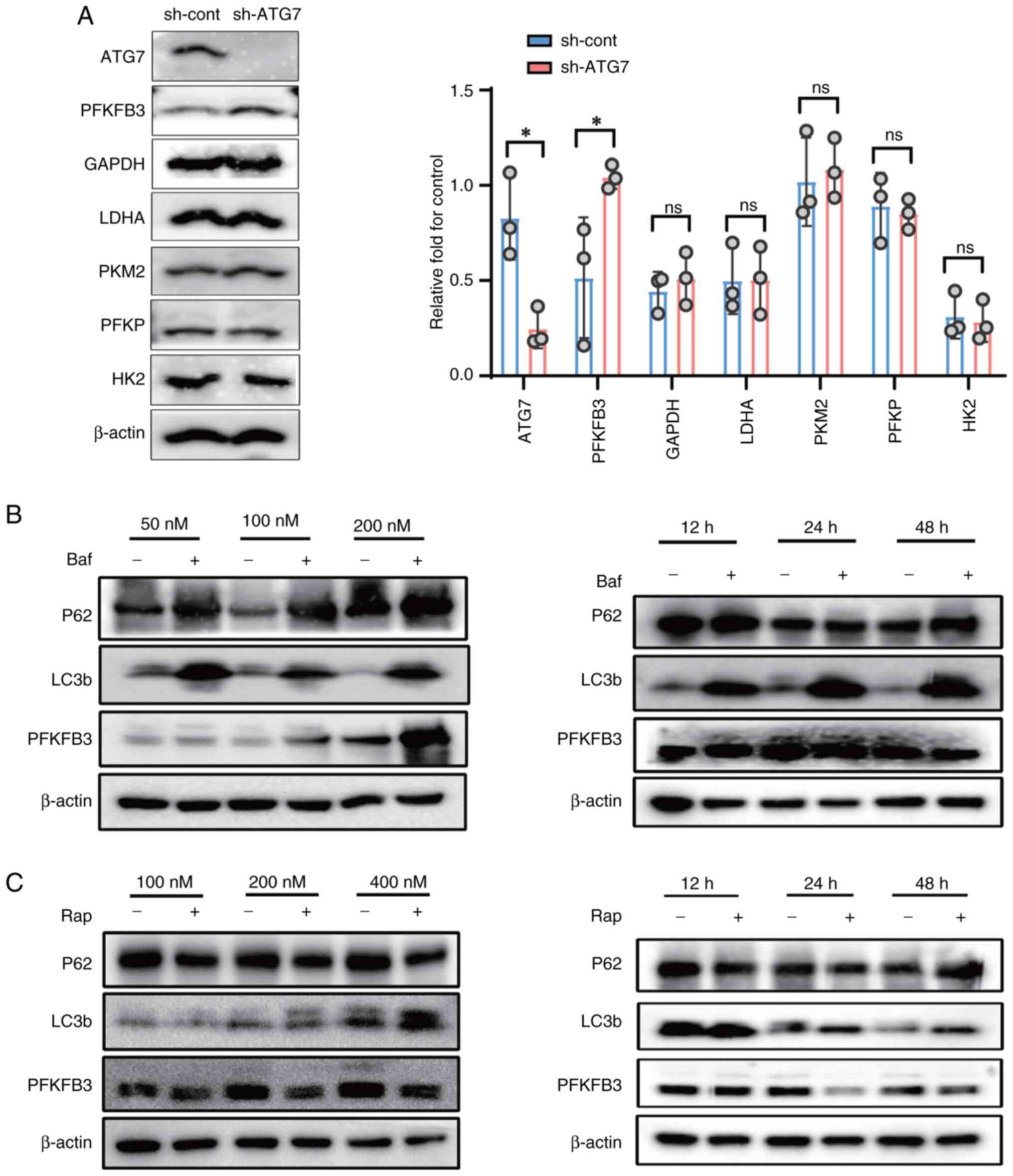
Figure 4

Autophagy regulated glycolysis levels
through PFKFB3. (A) Knockdown ATG7 had no effect on the expression
levels of genes encoding glycolytic proteins except PFKFB3.
Normalized quantification of mean gray intensity was determined
from three separate experiments. The values were presented as the
means ± SEM. Protein levels of P62, LC3b and PFKFB3 in control vs.
(B) rapamycin or (C) Baf A1 treated epithelial cells. P-values were
calculated using an unpaired t-test. The values were presented as
the means ± SEM, *P<0.05. ns, non-significant.
PFKFB3, 6-phosphofructo-2-kinase/fructose-2,6-bisphosphatase 3;
ATG, autophagy related gene; Baf A1, bafilomycin A1.

Figure 5

PFKFB3 played a key role in autophagy
regulating of the glycolysis of IECs. (A) The verification of
PFKFB3 knockdown and overexpression by western blotting. Relative
glucose content and Lac production in PFKFB3 knockdown IECs treated
with (B) Baf A1 (200 nM) or (E) rapamycin (200 nM). (C and F)
2-NBDG and (D and G) BCECF fluorescent counter-staining in
rapamycin or BafA1 treated PFKFB3 knockdown IECs vs. control.
Representative immunofluorescence images are shown. (Original
magnification, ×20) with quantitative fluorescence intensity of
2-NBDG and BCECF (n=3). (H) Relative glucose content and Lac
production in PFKFB3 OE IECs treated with rapamycin (200 nM). (I)
2-NBDG and (J) BCECF fluorescent counter-staining in rapamycin
treated PFKFB3 OE IECs vs. control. Representative
immunofluorescence images are shown (Original magnification, ×20)
and quantitative fluorescence intensity of 2-NBDG and BCECF (n=3).
P-values were calculated using One-way ANOVA followed by Tukey's
post-hoc test. The values were presented as the means ± SEM,
*P<0.05, **P<0.01,
***P<0.001, ****P<0.0001. PFKFB3,
6-phosphofructo-2-kinase/fructose-2,6-bisphosphatase 3; Lac,
lactate; IECs, intestinal epithelial cells; Baf A1, bafilomycin A1;
2-NBDG, 2-deoxy-2-[(7-nitro-2,1,3-benzoxadiazol-4-yl)
amino]-D-glucose; BCECF, 2',7'-bis(carboxyethyl)-5(6)-carboxyfluorescein; OE,
overexpression.

Figure 6

Mechanism of autophagy ubiquitination
degrading PFKFB3 protein. (A) NCM460 cells were treated with
rapamycin (200 nM) and cells were collected after treatment with
100 μg/ml CHX at the indicated time. The protein levels of
PFKFB3 were detected by western blotting. A total of three
independent experiments were repeated. (B) Representative images of
the NCM460 stained with PFKFB3 and P62. Scale bar, 10 μm.
(C) Immunoprecipitation assays of NCM460 cells with anti-PFKFB3 and
anti-P62 followed by immunoblotting with antibodies against the
indicated proteins. (D) Verification of Flag-tagged P62/SQSTM1
overexpression NCM460 cells by western blotting. (E) Flag-tagged
P62/SQSTM1 overexpression NCM460 cells were collected after being
treated with 100 μg/ml CHX at the indicated time. The
protein levels of PFKFB3 were detected by western blotting. A total
of three independent experiments were repeated. (F) Verification of
Flag-tagged PFKFB3 overexpression NCM460 cells by western blotting.
Immunoprecipitation assays of Flag-tagged PFKFB3 NCM460 cells with
anti-Flag and anti-FZR1/Cdh1 followed by immunoblotting with
antibodies against the indicated proteins. (G) FZR1 knockdown
NCM460 cells were collected after treated with 100 μg/ml CHX
at the indicated time. The protein levels of PFKFB3 were detected
by western blotting. A total of three independent experiments were
repeated. (H) FZR1 knockdown NCM460 cells were transfected with
HA-Ub plasmid. Immunoprecipitated PFKFB3 proteins were analyzed by
immunoblot analysis for ubiquitination and P62. The protein levels
of P62, PFKFB3 and FZR1/Cdh1 were detected in FZR1 knockdown NCM460
cells by western blotting. (I) Cells overexpressing Flag-tagged
FZR1 were transfected with the HA-Ub plasmid. Immunoprecipitation
of PFKFB3 was performed to assess the levels of K63- and K48-linked
polyubiquitin chains via western blotting. Western blot analysis
was further used to determine the protein expression levels of
Flag, PFKFB3 and FZR1/Cdh1 in FZR1-overexpressing NCM460 cells.
PFKFB3, 6-phosphofructo-2-kinase/fructose-2,6-bisphosphatase 3;
CHX, cycloheximide; HA-Ub, hemagglutinin-tagged ubiquitin; FZR1,
Fizzy and cell division cycle 20 related 1.

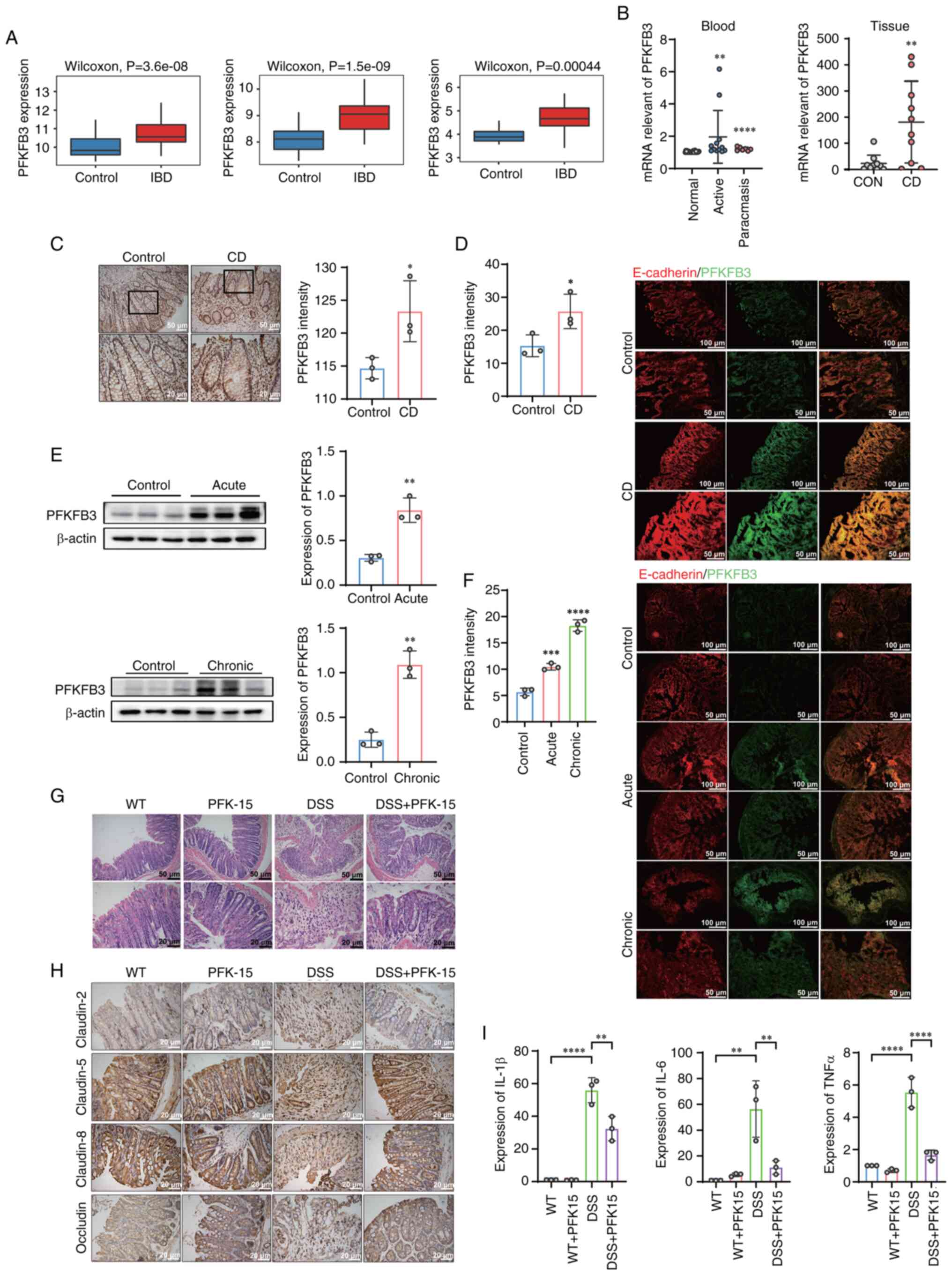
Figure 7

PFKFB3 was upregulated in IBD. (A)
Analysis of PFKFB3 mRNA expression in normal and Crohn's disease
tissues within public datasets (GSE119600, GSE126124, GSE112057).
(B) mRNA levels of PFKPFB3 in control (n=10) vs. tissue of patients
with Crohn's disease (n=10), control (n=26) vs. blood of patients
with Crohn's disease (active stage n=12; remission stage n=7). (C)
Immunohistochemical staining of PFKFB3 in tissue of patients with
Crohn's disease and semiquantitative analysis (n=3). (D)
Immunofluorescence images of PFKFB3 in colonic epithelial tissue of
patients with Crohn's disease and quantification of the
fluorescence intensity of PFKFB3 (n=3). (E) Protein levels of
PFKFB3 in control vs. colonic epithelium of DSS-induced mice (acute
n=3, chronic n=3). (F) Immunofluorescence images of PFKFB3 in
colonic epithelium of DSS-induced mice and quantification of the
fluorescence intensity of PFKFB3 (acute n=3, chronic n=3). (G)
Representative hematoxylin and eosin staining of the colon.
DSS-induced colitis mice were treated with intraperitoneal
injection of PFK-15 every three days. (H) Immunohistochemical
staining of claudin-5, claudin-8, claudin-2 and occludin in colon
tissue. (I) mRNA levels of IL-6, TNF-α and IL-1β. The P values for
all figures except B, F, and H were calculated using unpaired
t-tests, while one-way ANOVA followed by Tukey's multiple
comparisons test was used for B, F and H. The values were presented
as the means ± SEM, *P<0.05, **P<0.01,
***P<0.001, ****P<0.0001. PFKFB3,
6-phosphofructo-2-kinase/fructose-2,6-bisphosphatase 3; IBD,
inflammatory bowel disease; DSS, dextran sulfate sodium salt;
PFK-1, phosphofructokinase-1; CD, Crohn's disease; WT,
Wild-type.
View References

1 

Li S, Zhang F and Zhang Q: Pathological features-based targeted delivery strategies in IBD therapy: A mini review. Biomed Pharmacother. 151:1130792022. View Article : Google Scholar : PubMed/NCBI

2 

Torres J, Mehandru S, Colombel JF and Peyrin-Biroulet L: Crohn's disease. Lancet. 389:1741–1755. 2017. View Article : Google Scholar

3 

Mizushima N and Komatsu M: Autophagy: Renovation of cells and tissues. Cell. 147:728–741. 2011. View Article : Google Scholar : PubMed/NCBI

4 

Foerster EG, Mukherjee T, Cabral-Fernandes L, Rocha JDB, Girardin SE and Philpott DJ: How autophagy controls the intestinal epithelial barrier. Autophagy. 18:86–103. 2022. View Article : Google Scholar :

5 

Saha K, Ganapathy AS, Wang A, Morris NM, Suchanec E, Ding W, Yochum G, Koltun W, Nighot M, Ma T and Nighot P: Autophagy reduces the degradation and promotes membrane localization of occludin to enhance the intestinal epithelial tight junction barrier against paracellular macromolecule flux. J Crohns Colitis. 17:433–449. 2023. View Article : Google Scholar :

6 

Aden K, Tran F, Ito G, Sheibani-Tezerji R, Lipinski S, Kuiper JW, Tschurtschenthaler M, Saveljeva S, Bhattacharyya J, Häsler R, et al: ATG16L1 orchestrates interleukin-22 signaling in the intestinal epithelium via cGAS-STING. J Exp Med. 215:2868–2886. 2018. View Article : Google Scholar : PubMed/NCBI

7 

Zhou C, Li L, Li T, Sun L, Yin J, Guan H, Wang L, Zhu H, Xu P, Fan X, et al: SCFAs induce autophagy in intestinal epithelial cells and relieve colitis by stabilizing HIF-1alpha. J Mol Med (Berl). 98:1189–1202. 2020. View Article : Google Scholar : PubMed/NCBI

8 

Pral LP, Fachi JL, Corrêa RO, Colonna M and Vinolo MAR: Hypoxia and HIF-1 as key regulators of gut microbiota and host interactions. Trends Immunol. 42:604–621. 2021. View Article : Google Scholar : PubMed/NCBI

9 

Rath E, Moschetta A and Haller D: Mitochondrial function-gatekeeper of intestinal epithelial cell homeostasis. Nat Rev Gastroenterol Hepatol. 15:497–516. 2018. View Article : Google Scholar : PubMed/NCBI

10 

Ho GT and Theiss AL: Mitochondria and inflammatory bowel diseases: Toward a stratified therapeutic intervention. Ann Rev Physiol. 84:435–459. 2022. View Article : Google Scholar

11 

Adolph TE, Meyer M, Schwärzler J, Mayr L, Grabherr F and Tilg H: The metabolic nature of inflammatory bowel diseases. Nat Rev Gastroenterol Hepatol. 19:753–767. 2022. View Article : Google Scholar : PubMed/NCBI

12 

Vermeulen N, Vermeire S, Arijs I, Michiels G, Ballet V, Derua R, Waelkens E, Van Lommel L, Schuit F, Rutgeerts P and Bossuyt X: Seroreactivity against glycolytic enzymes in inflammatory bowel disease. Inflamm Bowel Dis. 17:557–564. 2011. View Article : Google Scholar

13 

Shimshoni E, Ghini V, Solomonov I, Luchinat C, Sagi I and Turano P: Integrated metabolomics and proteomics of symptomatic and early pre-symptomatic states of colitis. bioRxiv. https://doi.org/10.1101/2020.03.22.002196.

14 

Hamade H, Stamps JT, Stamps DT, More SK, Thomas LS, Blackwood AY, Lahcene NL, Castanon SL, Salumbides BC, Shimodaira Y, et al: BATF3 protects against metabolic syndrome and maintains intestinal epithelial homeostasis. Front Immunol. 13:8410652022. View Article : Google Scholar : PubMed/NCBI

15 

Khaloian S, Rath E, Hammoudi N, Gleisinger E, Blutke A, Giesbertz P, Berger E, Metwaly A, Waldschmitt N, Allez M and Haller D: Mitochondrial impairment drives intestinal stem cell transition into dysfunctional Paneth cells predicting Crohn's disease recurrence. Gut. 69:1939–1951. 2020. View Article : Google Scholar : PubMed/NCBI

16 

Livak KJ and Schmittgen TD: Analysis of relative gene expression data using real-time quantitative PCR and the 2 (-Delta Delta C(T)) method. Methods. 25:402–408. 2001. View Article : Google Scholar

17 

Levine B and Kroemer G: Biological functions of autophagy genes: A disease perspective. Cell. 176:11–42. 2019. View Article : Google Scholar : PubMed/NCBI

18 

Collier JJ, Oláhová M, McWilliams TG and Taylor RW: ATG7 safeguards human neural integrity. Autophagy. 17:2651–2653. 2021. View Article : Google Scholar : PubMed/NCBI

19 

Lane JD, Korolchuk VI, Murray JT, Lamark T, Svenning S and Johansen T: Regulation of selective autophagy: The p62/SQSTM1 paradigm. Essays in Biochemistry. 61:609–624. 2017. View Article : Google Scholar

20 

Vargas JNS, Hamasaki M, Kawabata T, Youle RJ and Yoshimori T: The mechanisms and roles of selective autophagy in mammals. Nat Rev Mol Cell Biol. 24:167–185. 2022. View Article : Google Scholar : PubMed/NCBI

21 

Ohtake F, Saeki Y, Ishido S, Kanno J and Tanaka K: The K48-K63 branched ubiquitin chain regulates NF-κB signaling. Mol Cell. 64:251–266. 2016. View Article : Google Scholar : PubMed/NCBI

22 

Renz C, Asimaki E, Meister C, Albanèse V, Petriukov K, Krapoth NC, Wegmann S, Wollscheid HP, Wong RP, Fulzele A, et al: Ubiquiton-An inducible, linkage-specific polyubiquitylation tool. Mol Cell. 84:386–400.e311. 2024. View Article : Google Scholar

23 

Telpaz S and Bel S: Autophagy in intestinal epithelial cells prevents gut inflammation. Trends Cell Biol. 33:817–819. 2023. View Article : Google Scholar : PubMed/NCBI

24 

Larabi A, Barnich N and Nguyen HTT: New insights into the interplay between autophagy, gut microbiota and inflammatory responses in IBD. Autophagy. 16:38–51. 2020. View Article : Google Scholar :

25 

Zhou M, Xu W, Wang J, Yan J, Shi Y, Zhang C, Ge W, Wu J, Du P and Chen Y: Boosting mTOR-dependent autophagy via upstream TLR4-MyD88-MAPK signalling and downstream NF-kappaB pathway quenches intestinal inflammation and oxidative stress injury. EBioMedicine. 35:345–360. 2018. View Article : Google Scholar : PubMed/NCBI

26 

Shi W, Peng K, Yu H, Wang Z, Xia S, Xiao S, Tian D, Vallance BA and Yu Q: Autotaxin (ATX) inhibits autophagy leading to exaggerated disruption of intestinal epithelial barrier in colitis. Biochim Biophys Acta Mol Basis Dis. 1869:1666472023. View Article : Google Scholar : PubMed/NCBI

27 

Bian X, Jiang H, Meng Y, Li YP, Fang J and Lu Z: Regulation of gene expression by glycolytic and gluconeogenic enzymes. Trends Cell Biol. 32:786–799. 2022. View Article : Google Scholar : PubMed/NCBI

28 

Martin FP, Rezzi S, Philippe D, Tornier L, Messlik A, Hölzlwimmer G, Baur P, Quintanilla-Fend L, Loh G, Blaut M, et al: Metabolic assessment of gradual development of moderate experimental colitis in IL-10 deficient mice. J Proteome Res. 8:2376–2387. 2009. View Article : Google Scholar : PubMed/NCBI

29 

Yang J, Zhou RM and Ma ZY: Autophagy and energy metabolism. Autophagy: Biology and diseases: Basic Science. 1206:329–357. 2019. View Article : Google Scholar

30 

Prakasam G, Singh RK, Iqbal MA, Saini SK, Tiku AB and Bamezai RNK: Pyruvate kinase M knockdown-induced signaling via AMP-activated protein kinase promotes mitochondrial biogenesis, autophagy, and cancer cell survival. J Biol Chem. 292:15561–15576. 2017. View Article : Google Scholar : PubMed/NCBI

31 

Yan X, Tian R, Sun J, Zhao Y, Liu B, Su J, Li M, Sun W and Xu X: Sorafenib-induced autophagy promotes glycolysis by upregulating the p62/HDAC6/HSP90 axis in hepatocellular carcinoma cells. Front Pharmacol. 12:7886672022. View Article : Google Scholar : PubMed/NCBI

32 

Kotowski K, Rosik J, Machaj F, Supplitt S, Wiczew D, Jabłońska K, Wiechec E, Ghavami S and Dzięgiel P: Role of PFKFB3 and PFKFB4 in cancer: Genetic basis, impact on disease development/progression, and potential as therapeutic targets. Cancers (Basel). 13:9092021. View Article : Google Scholar : PubMed/NCBI

33 

La Belle Flynn A, Calhoun BC, Sharma A, Chang JC, Almasan A and Schiemann WP: Autophagy inhibition elicits emergence from metastatic dormancy by inducing and stabilizing Pfkfb3 expression. Nat Commun. 10:36682019. View Article : Google Scholar : PubMed/NCBI

34 

Almeida A, Bolaños JP and Moncada S: E3 ubiquitin ligase APC/C-Cdh1 accounts for the Warburg effect by linking glycolysis to cell proliferation. Proc Natl Acad Sci USA. 107:738–741. 2009. View Article : Google Scholar

35 

Zhou Z, Plug LG, Patente TA, de Jonge-Muller ESM, Elmagd AA, van der Meulen-de Jong AE, Everts B, Barnhoorn MC and Hawinkels LJAC: Increased stromal PFKFB3-mediated glycolysis in inflammatory bowel disease contributes to intestinal inflammation. Front Immunol. 13:2022. View Article : Google Scholar

36 

Pan YY, Deng Y, Su S, Yin JH, Chen YH, Wang LC, Sun LH, Xiao WD and Du GS: Structure composition and intracellular transport of clathrin-mediated intestinal transmembrane tight junction protein. Inflammation. 46:18–34. 2022. View Article : Google Scholar : PubMed/NCBI

37 

Wang Y, Li H, Jiang S, Fu D, Lu X, Lu M, Li Y, Luo D, Wu K, Xu Y, et al: The glycolytic enzyme PFKFB3 drives kidney fibrosis through promoting histone lactylation-mediated NF-κB family activation. Kidney Int. 106:226–240. 2024. View Article : Google Scholar : PubMed/NCBI

38 

Shi L, Pan H, Liu Z, Xie J and Han W: Roles of PFKFB3 in cancer. Signal Transduct Target Ther. 2:170442017. View Article : Google Scholar : PubMed/NCBI

39 

Chen N, Xie QM, Song SM, Guo SN, Fang Y, Fei GH and Wu HM: Dexamethasone protects against asthma via regulating Hif-1α-glycolysis-lactate axis and protein lactylation. Int Immunopharmacol. 131:1117912024. View Article : Google Scholar

40 

Zhang H, Cui Z, Cheng D, Du Y, Guo X, Gao R, Chen J, Sun W, He R, Ma X, et al: RNF186 regulates EFNB1 (ephrin B1)-EPHB2-induced autophagy in the colonic epithelial cells for the maintenance of intestinal homeostasis. Autophagy. 17:3030–3047. 2021. View Article : Google Scholar :

41 

Yuan S, Liu BH, Cheng WW, Meng H, Hou XT, Xue JC, Zhang HM and Zhang QG: Polyphyllin Ⅵ modulates macrophage polarization through autophagy-NLRP3 inflammasome to alleviate inflammatory bowel disease. Phytomedicine. 143:1566402025. View Article : Google Scholar

42 

Retnakumar SV and Muller S: Pharmacological autophagy regulators as therapeutic agents for inflammatory bowel diseases. Trends Mol Med. 25:516–537. 2019. View Article : Google Scholar : PubMed/NCBI

43 

Shao BZ, Yao Y, Zhai JS, Zhu JH, Li JP and Wu K: The role of autophagy in inflammatory bowel disease. Front Physiol. 12:6211322021. View Article : Google Scholar : PubMed/NCBI

44 

Zhou M, Zhi J, Zhi J, Xiong Z, Wu F, Lu Y and Hu Q: Polysaccharide from Strongylocentrotus nudus eggs regulates intestinal epithelial autophagy through CD36/PI3K-Akt pathway to ameliorate inflammatory bowel disease. Int J Biol Macromol. 244:1253732023. View Article : Google Scholar : PubMed/NCBI

Related Articles

  • Abstract
  • View
  • Download
  • Twitter
Copy and paste a formatted citation
Spandidos Publications style
Pan Y, Yang F, Wang L, Yang T, Du G, Xu C, Yang H, Yu M and Xiao W: Selective autophagic degradation of glycolytic activator PFKFB3 contributes to maintaining intestinal epithelial barrier in inflammatory bowel disease. Int J Mol Med 57: 43, 2026.
APA
Pan, Y., Yang, F., Wang, L., Yang, T., Du, G., Xu, C. ... Xiao, W. (2026). Selective autophagic degradation of glycolytic activator PFKFB3 contributes to maintaining intestinal epithelial barrier in inflammatory bowel disease. International Journal of Molecular Medicine, 57, 43. https://doi.org/10.3892/ijmm.2025.5714
MLA
Pan, Y., Yang, F., Wang, L., Yang, T., Du, G., Xu, C., Yang, H., Yu, M., Xiao, W."Selective autophagic degradation of glycolytic activator PFKFB3 contributes to maintaining intestinal epithelial barrier in inflammatory bowel disease". International Journal of Molecular Medicine 57.2 (2026): 43.
Chicago
Pan, Y., Yang, F., Wang, L., Yang, T., Du, G., Xu, C., Yang, H., Yu, M., Xiao, W."Selective autophagic degradation of glycolytic activator PFKFB3 contributes to maintaining intestinal epithelial barrier in inflammatory bowel disease". International Journal of Molecular Medicine 57, no. 2 (2026): 43. https://doi.org/10.3892/ijmm.2025.5714
Copy and paste a formatted citation
x
Spandidos Publications style
Pan Y, Yang F, Wang L, Yang T, Du G, Xu C, Yang H, Yu M and Xiao W: Selective autophagic degradation of glycolytic activator PFKFB3 contributes to maintaining intestinal epithelial barrier in inflammatory bowel disease. Int J Mol Med 57: 43, 2026.
APA
Pan, Y., Yang, F., Wang, L., Yang, T., Du, G., Xu, C. ... Xiao, W. (2026). Selective autophagic degradation of glycolytic activator PFKFB3 contributes to maintaining intestinal epithelial barrier in inflammatory bowel disease. International Journal of Molecular Medicine, 57, 43. https://doi.org/10.3892/ijmm.2025.5714
MLA
Pan, Y., Yang, F., Wang, L., Yang, T., Du, G., Xu, C., Yang, H., Yu, M., Xiao, W."Selective autophagic degradation of glycolytic activator PFKFB3 contributes to maintaining intestinal epithelial barrier in inflammatory bowel disease". International Journal of Molecular Medicine 57.2 (2026): 43.
Chicago
Pan, Y., Yang, F., Wang, L., Yang, T., Du, G., Xu, C., Yang, H., Yu, M., Xiao, W."Selective autophagic degradation of glycolytic activator PFKFB3 contributes to maintaining intestinal epithelial barrier in inflammatory bowel disease". International Journal of Molecular Medicine 57, no. 2 (2026): 43. https://doi.org/10.3892/ijmm.2025.5714
Follow us
  • Twitter
  • LinkedIn
  • Facebook
About
  • Spandidos Publications
  • Careers
  • Cookie Policy
  • Privacy Policy
How can we help?
  • Help
  • Live Chat
  • Contact
  • Email to our Support Team