Spandidos Publications Logo
  • About
    • About Spandidos
    • Aims and Scopes
    • Abstracting and Indexing
    • Editorial Policies
    • Reprints and Permissions
    • Job Opportunities
    • Terms and Conditions
    • Contact
  • Journals
    • All Journals
    • Oncology Letters
      • Oncology Letters
      • Information for Authors
      • Editorial Policies
      • Editorial Board
      • Aims and Scope
      • Abstracting and Indexing
      • Bibliographic Information
      • Archive
    • International Journal of Oncology
      • International Journal of Oncology
      • Information for Authors
      • Editorial Policies
      • Editorial Board
      • Aims and Scope
      • Abstracting and Indexing
      • Bibliographic Information
      • Archive
    • Molecular and Clinical Oncology
      • Molecular and Clinical Oncology
      • Information for Authors
      • Editorial Policies
      • Editorial Board
      • Aims and Scope
      • Abstracting and Indexing
      • Bibliographic Information
      • Archive
    • Experimental and Therapeutic Medicine
      • Experimental and Therapeutic Medicine
      • Information for Authors
      • Editorial Policies
      • Editorial Board
      • Aims and Scope
      • Abstracting and Indexing
      • Bibliographic Information
      • Archive
    • International Journal of Molecular Medicine
      • International Journal of Molecular Medicine
      • Information for Authors
      • Editorial Policies
      • Editorial Board
      • Aims and Scope
      • Abstracting and Indexing
      • Bibliographic Information
      • Archive
    • Biomedical Reports
      • Biomedical Reports
      • Information for Authors
      • Editorial Policies
      • Editorial Board
      • Aims and Scope
      • Abstracting and Indexing
      • Bibliographic Information
      • Archive
    • Oncology Reports
      • Oncology Reports
      • Information for Authors
      • Editorial Policies
      • Editorial Board
      • Aims and Scope
      • Abstracting and Indexing
      • Bibliographic Information
      • Archive
    • Molecular Medicine Reports
      • Molecular Medicine Reports
      • Information for Authors
      • Editorial Policies
      • Editorial Board
      • Aims and Scope
      • Abstracting and Indexing
      • Bibliographic Information
      • Archive
    • World Academy of Sciences Journal
      • World Academy of Sciences Journal
      • Information for Authors
      • Editorial Policies
      • Editorial Board
      • Aims and Scope
      • Abstracting and Indexing
      • Bibliographic Information
      • Archive
    • International Journal of Functional Nutrition
      • International Journal of Functional Nutrition
      • Information for Authors
      • Editorial Policies
      • Editorial Board
      • Aims and Scope
      • Abstracting and Indexing
      • Bibliographic Information
      • Archive
    • International Journal of Epigenetics
      • International Journal of Epigenetics
      • Information for Authors
      • Editorial Policies
      • Editorial Board
      • Aims and Scope
      • Abstracting and Indexing
      • Bibliographic Information
      • Archive
    • Medicine International
      • Medicine International
      • Information for Authors
      • Editorial Policies
      • Editorial Board
      • Aims and Scope
      • Abstracting and Indexing
      • Bibliographic Information
      • Archive
  • Articles
  • Information
    • Information for Authors
    • Information for Reviewers
    • Information for Librarians
    • Information for Advertisers
    • Conferences
  • Language Editing
Spandidos Publications Logo
  • About
    • About Spandidos
    • Aims and Scopes
    • Abstracting and Indexing
    • Editorial Policies
    • Reprints and Permissions
    • Job Opportunities
    • Terms and Conditions
    • Contact
  • Journals
    • All Journals
    • Biomedical Reports
      • Information for Authors
      • Editorial Policies
      • Editorial Board
      • Aims and Scope
      • Abstracting and Indexing
      • Bibliographic Information
      • Archive
    • Experimental and Therapeutic Medicine
      • Information for Authors
      • Editorial Policies
      • Editorial Board
      • Aims and Scope
      • Abstracting and Indexing
      • Bibliographic Information
      • Archive
    • International Journal of Epigenetics
      • Information for Authors
      • Editorial Policies
      • Editorial Board
      • Aims and Scope
      • Abstracting and Indexing
      • Bibliographic Information
      • Archive
    • International Journal of Functional Nutrition
      • Information for Authors
      • Editorial Policies
      • Editorial Board
      • Aims and Scope
      • Abstracting and Indexing
      • Bibliographic Information
      • Archive
    • International Journal of Molecular Medicine
      • Information for Authors
      • Editorial Policies
      • Editorial Board
      • Aims and Scope
      • Abstracting and Indexing
      • Bibliographic Information
      • Archive
    • International Journal of Oncology
      • Information for Authors
      • Editorial Policies
      • Editorial Board
      • Aims and Scope
      • Abstracting and Indexing
      • Bibliographic Information
      • Archive
    • Medicine International
      • Information for Authors
      • Editorial Policies
      • Editorial Board
      • Aims and Scope
      • Abstracting and Indexing
      • Bibliographic Information
      • Archive
    • Molecular and Clinical Oncology
      • Information for Authors
      • Editorial Policies
      • Editorial Board
      • Aims and Scope
      • Abstracting and Indexing
      • Bibliographic Information
      • Archive
    • Molecular Medicine Reports
      • Information for Authors
      • Editorial Policies
      • Editorial Board
      • Aims and Scope
      • Abstracting and Indexing
      • Bibliographic Information
      • Archive
    • Oncology Letters
      • Information for Authors
      • Editorial Policies
      • Editorial Board
      • Aims and Scope
      • Abstracting and Indexing
      • Bibliographic Information
      • Archive
    • Oncology Reports
      • Information for Authors
      • Editorial Policies
      • Editorial Board
      • Aims and Scope
      • Abstracting and Indexing
      • Bibliographic Information
      • Archive
    • World Academy of Sciences Journal
      • Information for Authors
      • Editorial Policies
      • Editorial Board
      • Aims and Scope
      • Abstracting and Indexing
      • Bibliographic Information
      • Archive
  • Articles
  • Information
    • For Authors
    • For Reviewers
    • For Librarians
    • For Advertisers
    • Conferences
  • Language Editing
Login Register Submit
  • This site uses cookies
  • You can change your cookie settings at any time by following the instructions in our Cookie Policy. To find out more, you may read our Privacy Policy.

    I agree
Search articles by DOI, keyword, author or affiliation
Search
Advanced Search
presentation
International Journal of Molecular Medicine
Join Editorial Board Propose a Special Issue
Print ISSN: 1107-3756 Online ISSN: 1791-244X
Journal Cover
April-2026 Volume 57 Issue 4

Full Size Image

Sign up for eToc alerts
Recommend to Library

Journals

International Journal of Molecular Medicine

International Journal of Molecular Medicine

International Journal of Molecular Medicine is an international journal devoted to molecular mechanisms of human disease.

International Journal of Oncology

International Journal of Oncology

International Journal of Oncology is an international journal devoted to oncology research and cancer treatment.

Molecular Medicine Reports

Molecular Medicine Reports

Covers molecular medicine topics such as pharmacology, pathology, genetics, neuroscience, infectious diseases, molecular cardiology, and molecular surgery.

Oncology Reports

Oncology Reports

Oncology Reports is an international journal devoted to fundamental and applied research in Oncology.

Experimental and Therapeutic Medicine

Experimental and Therapeutic Medicine

Experimental and Therapeutic Medicine is an international journal devoted to laboratory and clinical medicine.

Oncology Letters

Oncology Letters

Oncology Letters is an international journal devoted to Experimental and Clinical Oncology.

Biomedical Reports

Biomedical Reports

Explores a wide range of biological and medical fields, including pharmacology, genetics, microbiology, neuroscience, and molecular cardiology.

Molecular and Clinical Oncology

Molecular and Clinical Oncology

International journal addressing all aspects of oncology research, from tumorigenesis and oncogenes to chemotherapy and metastasis.

World Academy of Sciences Journal

World Academy of Sciences Journal

Multidisciplinary open-access journal spanning biochemistry, genetics, neuroscience, environmental health, and synthetic biology.

International Journal of Functional Nutrition

International Journal of Functional Nutrition

Open-access journal combining biochemistry, pharmacology, immunology, and genetics to advance health through functional nutrition.

International Journal of Epigenetics

International Journal of Epigenetics

Publishes open-access research on using epigenetics to advance understanding and treatment of human disease.

Medicine International

Medicine International

An International Open Access Journal Devoted to General Medicine.

Journal Cover
April-2026 Volume 57 Issue 4

Full Size Image

Sign up for eToc alerts
Recommend to Library

  • Article
  • Citations
    • Cite This Article
    • Download Citation
    • Create Citation Alert
    • Remove Citation Alert
    • Cited By
  • Similar Articles
    • Related Articles (in Spandidos Publications)
    • Similar Articles (Google Scholar)
    • Similar Articles (PubMed)
  • Download PDF
  • Download XML
  • View XML

  • Supplementary Files
    • Supplementary_Data1.pdf
    • Supplementary_Data2.pdf
Article Open Access

miRNA‑378a‑5p attenuates the development of abdominal aortic aneurysm via ABLIM1‑MKL1 signaling pathways

  • Authors:
    • Jing Wang
    • Yujia Zou
    • Yani Wang
    • Zheming Yang
    • Daoshen Liu
    • Xiaolin Su
    • Haixu Song
    • Kai Xu
    • Chenghui Yan
    • Dan Liu
    • Yaling Han
  • View Affiliations / Copyright

    Affiliations: State Key Laboratory of Frigid Zone Cardiovascular Diseases, Department of Cardiology and Cardiovascular Research Institute, General Hospital of Northern Theater Command, Shenyang, Liaoning 110016, P.R. China
    Copyright: © Wang et al. This is an open access article distributed under the terms of Creative Commons Attribution License.
  • Article Number: 97
    |
    Published online on: February 16, 2026
       https://doi.org/10.3892/ijmm.2026.5768
  • Expand metrics +
Metrics: Total Views: 0 (Spandidos Publications: | PMC Statistics: )
Metrics: Total PDF Downloads: 0 (Spandidos Publications: | PMC Statistics: )
Cited By (CrossRef): 0 citations Loading Articles...

This article is mentioned in:


Abstract

Abdominal aortic aneurysm (AAA) is a fatal cardiovascular disease with no effective drug treatment currently available. The aberrant expression levels of microRNAs (miRNAs or miRs) contribute to AAA pathogenesis. In the present study, miRNA microarray analysis was performed to screen for differentially expressed miRNAs in the aortas of AAA mice compared with those in control mice, and to clarify the role and mechanism of miRNA‑378a‑5p (miR‑378a‑5p) in the AAA development. A comprehensive miRNA microarray analysis was conducted to screen for differentially expressed miRNAs in the aortas of AAA mice and control mice. Reverse transcription‑quantitative polymerase chain reaction (RT‑qPCR) was used to detect the expression levels of miR‑378a‑5p in the serum and aortas of patients with AAA and mice. To clarify the role of miR‑378a‑5p in the AAA development in vivo, miR‑378a‑5p antagomir and angomir were administered to ApoE‑/‑ mice using tail venous injection, followed by Angiotensin II (Ang II) infusion. Next, the role of miR‑378a‑5p in the phenotypic switching and migration of vascular smooth muscle cells (VSMCs) was examined in vivo and in vitro. Mechanistically, the targets of miR‑378a‑5p were identified by bioinformatics analysis, luciferase assay, RT‑qPCR and western blotting. Co‑immunoprecipitation assay combined with mass spectrometry were carried out for excavating potential downstream effectors. The expression of miR‑378a‑5p was decreased in the serum and aortas of patients with AAA (aortic dissection) and mice, and tumor necrosis factor‑α‑treated VSMCs. In vivo, the antagomir‑378a‑5p aggravated AAA formation, as evidenced by a larger maximal aortic diameter and greater medial elastin degradation than in control mice. miR‑378a‑5p angomir had the opposite effect. In vitro, miR‑378a‑5p overexpression significantly promoted the contraction ability and suppressed the migration of VSMCs, whereas miR‑378a‑5p knockdown inhibited the contraction ability and increased the migration of VSMCs. Mechanistically, it was identified that miR‑378a‑5p played a protective role in AAA development by regulating actin‑binding LIM protein 1 (ABLIM1)‑megakaryoblastic leukemia 1 (MKL1) pathway. miR‑378a‑5p exerts protective effects against AAA by maintaining VSMCs homeostasis via the ABLIM1‑MKL1 pathway. Therefore, targeting miR‑378a‑5p may be an attractive therapeutic strategy for AAA treatment.
View Figures

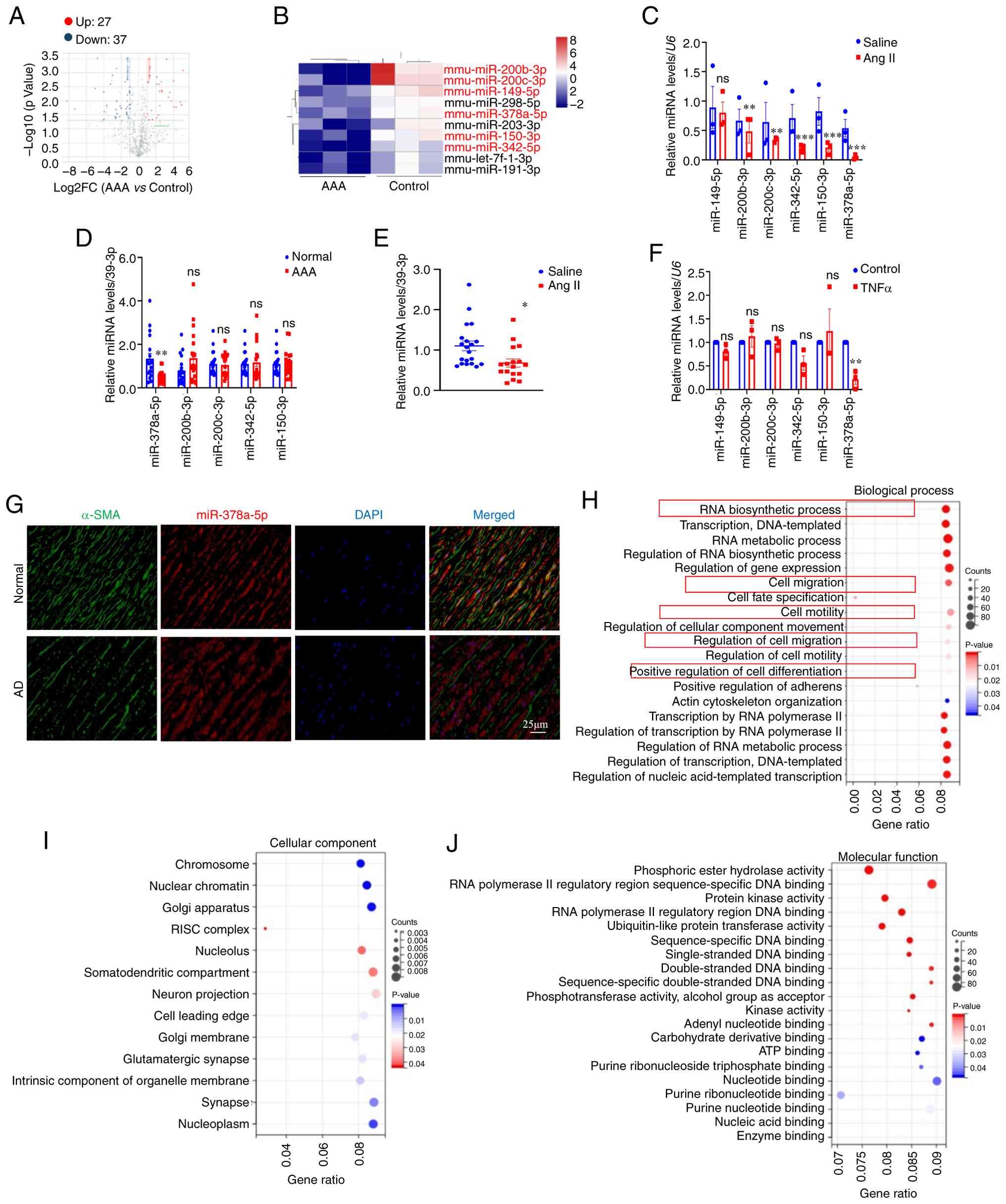
Figure 1

miR-378a-5p is downregulated in mice
with Ang II-induced AAA and TNFα-induced VSMCs. (A) Volcano plot of
64 differential miRNA expression in the aortas of Ang II and
saline-treated mice. (B) Heatmap of differentially expressed miRNAs
in mice treated with Ang II compared with the saline group,
|log2(Fold change)|≥2, P<0.05. Blue indicated low relative
expression, while red indicated high relative expression. (C)
RT-qPCR analysis of miRNAs in the aortas of Ang II and
saline-treated mice (n=3 per group). (D) RT-qPCR analysis of miRNAs
in the serum of patients with AAA and normal individuals (n=20 per
group). (E) RT-qPCR analysis of miRNAs in the serum of Ang II and
saline-treated mice (n=20 per group). (F) RT-qPCR analysis of
miRNAs in the TNFα-treated VSMCs (n=3 per group). (G) Fluorescence
in situ hybridization was performed to detect the
miR-378a-5p expression in human aorta tissues. (H) The
GO-Biological Process signaling pathways of the target genes of
miR-378a-5p were analyzed using DIANA TOOLS-miRPath algorithm. (I)
The GO-Cellular Component signaling pathways of the target genes of
miR-378a-5p were analyzed using DIANA TOOLS-miRPath algorithm. (J)
The GO-Molecular Function signaling pathways of the target genes of
miR-378a-5p were analyzed using DIANA TOOLS-miRPath algorithm. Data
are presented as the mean±SEM. P-values were calculated by
Student's t test. *P<0.05, **P<0.01 and
***P<0.001 vs. saline, Normal or Control. miR or
miRNA, microRNA; Ang II, angiotensin-II; AAA, abdominal aortic
aneurysm; VSMCs, vascular smooth muscle cells; RT-qPCR, reverse
transcription-quantitative PCR; GO, Gene Ontology; ns, not
significant.

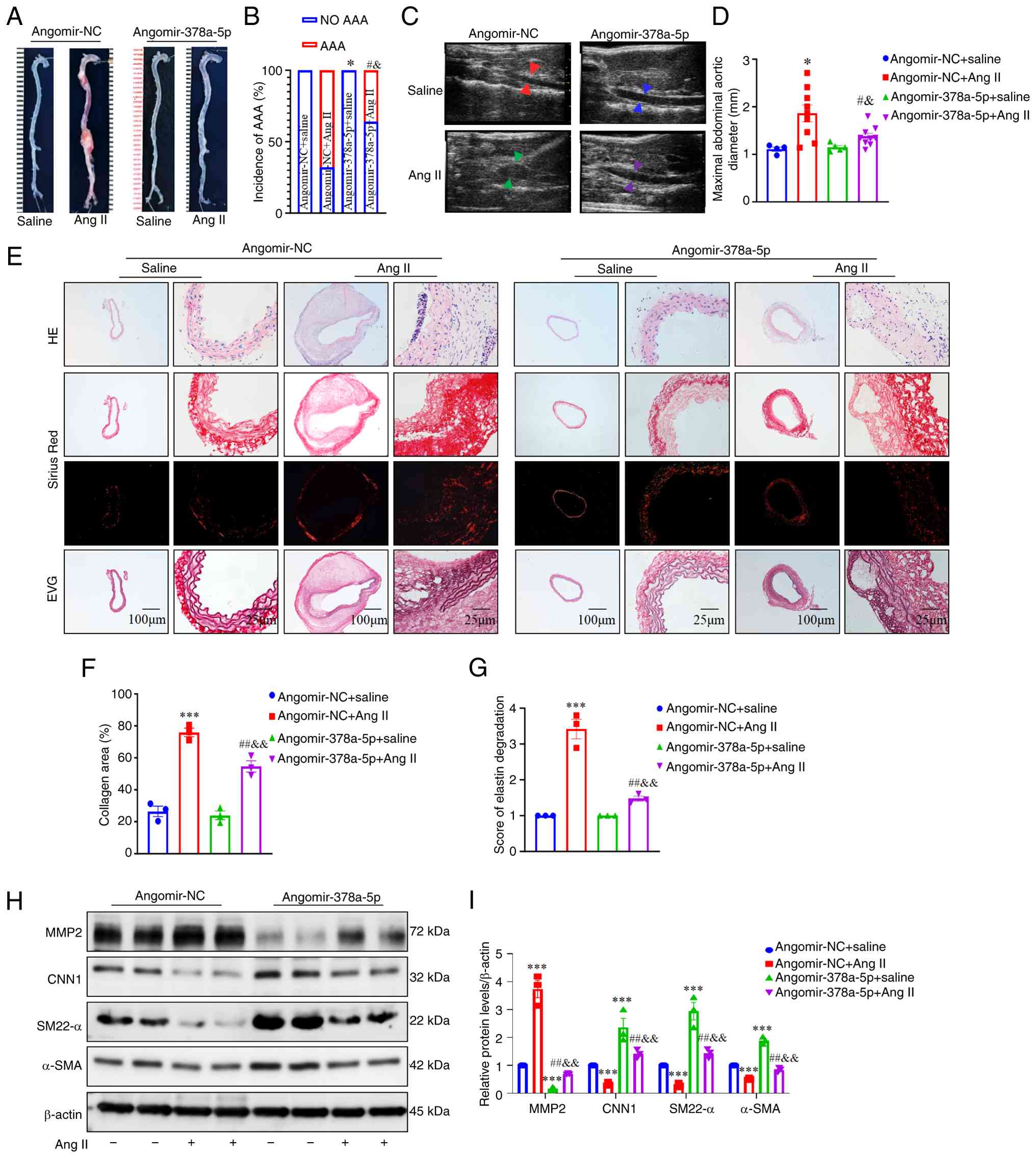
Figure 2

Overexpression of miR-378a-5p
prevents Ang II-induced AAA formation in apolipoprotein E-deficient
mice. (A) Gross specimen image of aortas from AAA models treated
with angomir-NC or angomir-378a-5p, followed by Ang II infusion.
(B) The incidence of AAA in Ang II-infused mice treated with
angomir-NC or angomir-378a-5p (n=10 in Ang II groups and n=5 in
saline groups). (C and D) Ultrasound images and inner diameter
quantification of the suprarenal abdominal aorta (n=10 in Ang II
groups and n=5 in saline groups). (E) Representative H&E,
Sirius red and EVG staining of the abdominal aorta in different
groups. (F) Quantification of fibrosis in aorta tissues (n=3 per
group). (G) Quantification of the degree of elastic fiber
degradation levels in the abdominal aortic wall (n=3 per group). (H
and I) Representative western blots and quantification of the
protein levels of MMP2, CNN1, α-SMA and SM22-α in aortas from AAA
models treated with angomir-NC or angomir-378a-5p (n=3 per group).
Data are presented as the mean ± SEM. P-values were calculated by
Student's t test (for C), two-way ANOVA with Holm-Sidak multiple
comparisons test (for F, G and I), AAA incidence was analyzed with
the Fisher exact test (for B). *P<0.05 and
***P<0.001 vs. angomir-NC + saline;
#P<0.05 and ##P<0.01 vs. angomir-NC +
Ang II; &P<0.05 and
&&P<0.01 vs. angomir-378a-5p. miR or miRNA,
microRNA; Ang II, angiotensin-II; AAA, abdominal aortic aneurysm;
NC, negative control; EVG, Verhoeff-Van Gieson; α-SMA, α-smooth
muscle actin; SM22-α, smooth muscle 22α; MMP2, matrix
metalloproteinase 2; CNN1, calponin 1.

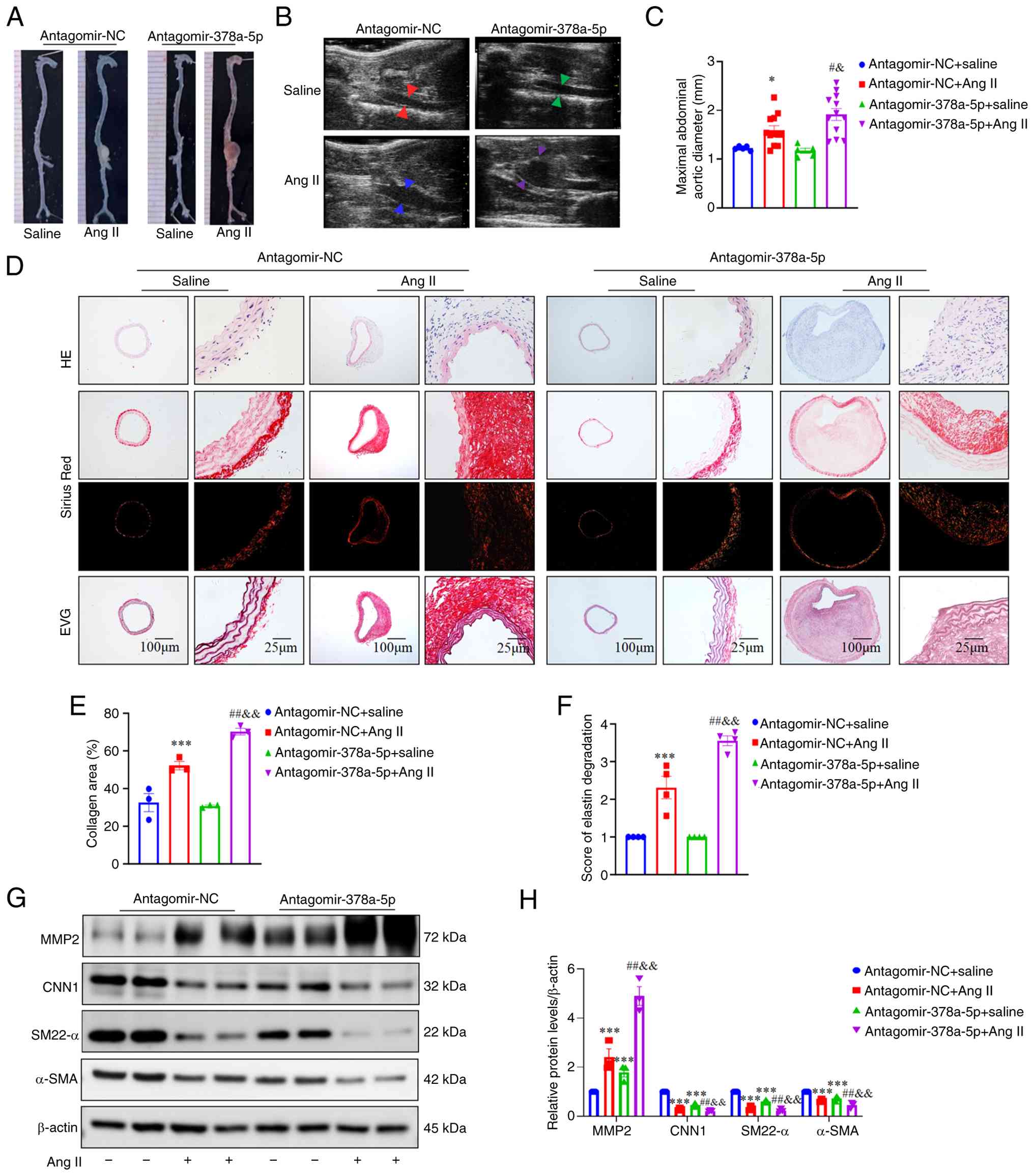
Figure 3

Knockdown of miR-378a-5p promotes AAA
formation in Ang II-infused apolipoprotein E-deficient mice. (A)
Gross specimen image of aortas from AAA models treated with
antagomir-NC or antagomir-378a-5p. (B and C) Ultrasound images and
inner diameter quantification of the suprarenal abdominal aorta
(n=15 in Ang II groups and n=5 in saline groups). (D)
Representative H&E, Sirius red and EVG staining of the
abdominal aorta in different groups. (E) Quantification of fibrosis
in aorta tissues (n=3 per group). (F) Quantification of the degree
of elastic fiber degradation levels in the abdominal aortic wall
(n=4 per group). (G and H) Representative western blots and
quantification of the protein expression levels of MMP2, CNN1,
α-SMA and SM22-α in aortas from AAA models treated with
antagomir-NC or antagomir-378a-5p (n=3 per group). Data are
presented as the mean ± SEM. P-values were calculated by Student's
t test (for C), two-way ANOVA with Holm-Sidak multiple comparisons
test (for E, F and H), *P<0.05 and
***P<0.001 vs. antagomir-NC + saline;
#P<0.05 and ##P<0.01 vs. antagomir-NC +
Ang II; &P<0.05 and
&&P<0.01 vs. antagomir-378a-5p. miR or miRNA,
microRNA; Ang II, angiotensin-II; AAA, abdominal aortic aneurysm;
NC, negative control; EVG, Verhoeff-Van Gieson; α-SMA, α-smooth
muscle actin; SM22-α, smooth muscle 22α; MMP2, matrix
metalloproteinase 2; CNN1, calponin 1.

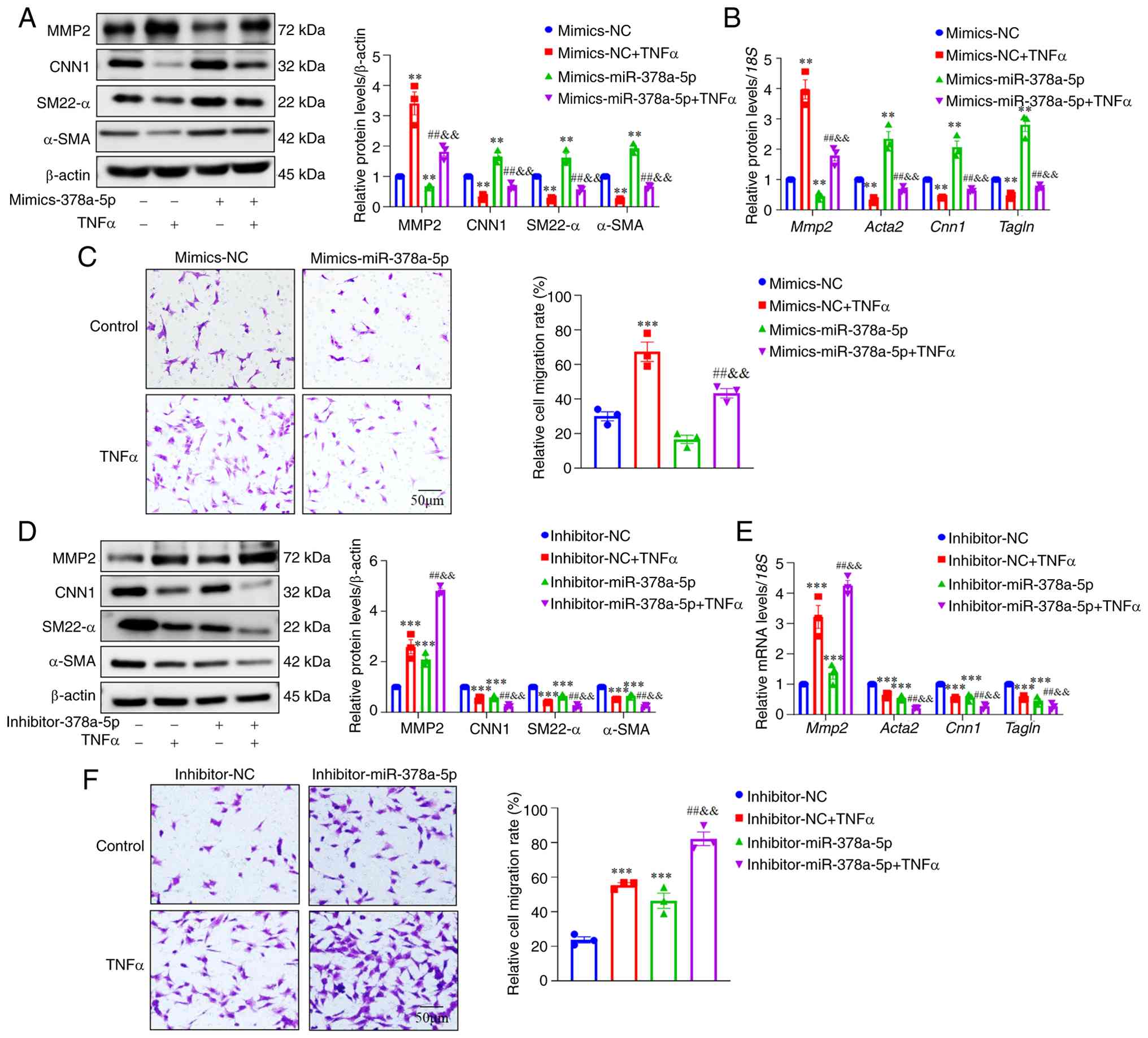
Figure 4

miR-378a-5p inhibitor promotes VSMCs'
phenotypic transformation and migration, while miR-378a-5p mimics
inhibits VSMCs' phenotypic transformation and migration. (A) VSMCs
were transfected with mimics-miR-378a-5p or mimics-NC for 24 h,
followed by TNFα treatment (10 ng/ml) for additional 24 h.
Representative western blots and quantification of MMP2, CNN1,
α-SMA and SM22-α were shown. (B) The mRNA expression of
Mmp2, Cnn1, Acta2 and Tagln was
determined by RT-qPCR. (C) Cell migration was assessed using a
Transwell assay in mimics-miR-378a-5p or mimics-NC
transfected-VSMCs. (D) VSMCs were transfected with
inhibitor-miR-378a-5p or inhibitor-NC for 24 h, followed by TNFα
treatment (10 ng/ml) for additional 24 h. Representative western
blots and quantification of MMP2, CNN1, α-SMA and SM22-α were
shown. (E) The mRNA expression of Mmp2, Cnn1,
Acta2 and Tagln was determined by RT-qPCR. (F) Cell
migration was assessed using a Transwell assay in
inhibitor-miR-378a-5p and inhibitor-NC transfected-VSMCs. Data are
presented as the mean ± SEM (n=3 per group). P-values were
calculated by two-way ANOVA with Holm-Sidak multiple comparisons
test. **P<0.01 and ***P<0.001 vs.
mimics-NC or inhibitor-NC; ##P<0.01 vs. mimics-NC +
TNFα or inhibitor-NC + TNFα; &&P<0.01 vs.
mimics-miR-378a-5p or inhibitor-miR-378a-5p. miR or miRNA,
microRNA; VSMCs, vascular smooth muscle cells; α-SMA, α-smooth
muscle actin; SM22-α, smooth muscle 22α; MMP2, matrix
metalloproteinase 2; CNN1, calponin 1; RT-qPCR, reverse
transcription-quantitative PCR; NC, negative control.

Figure 5

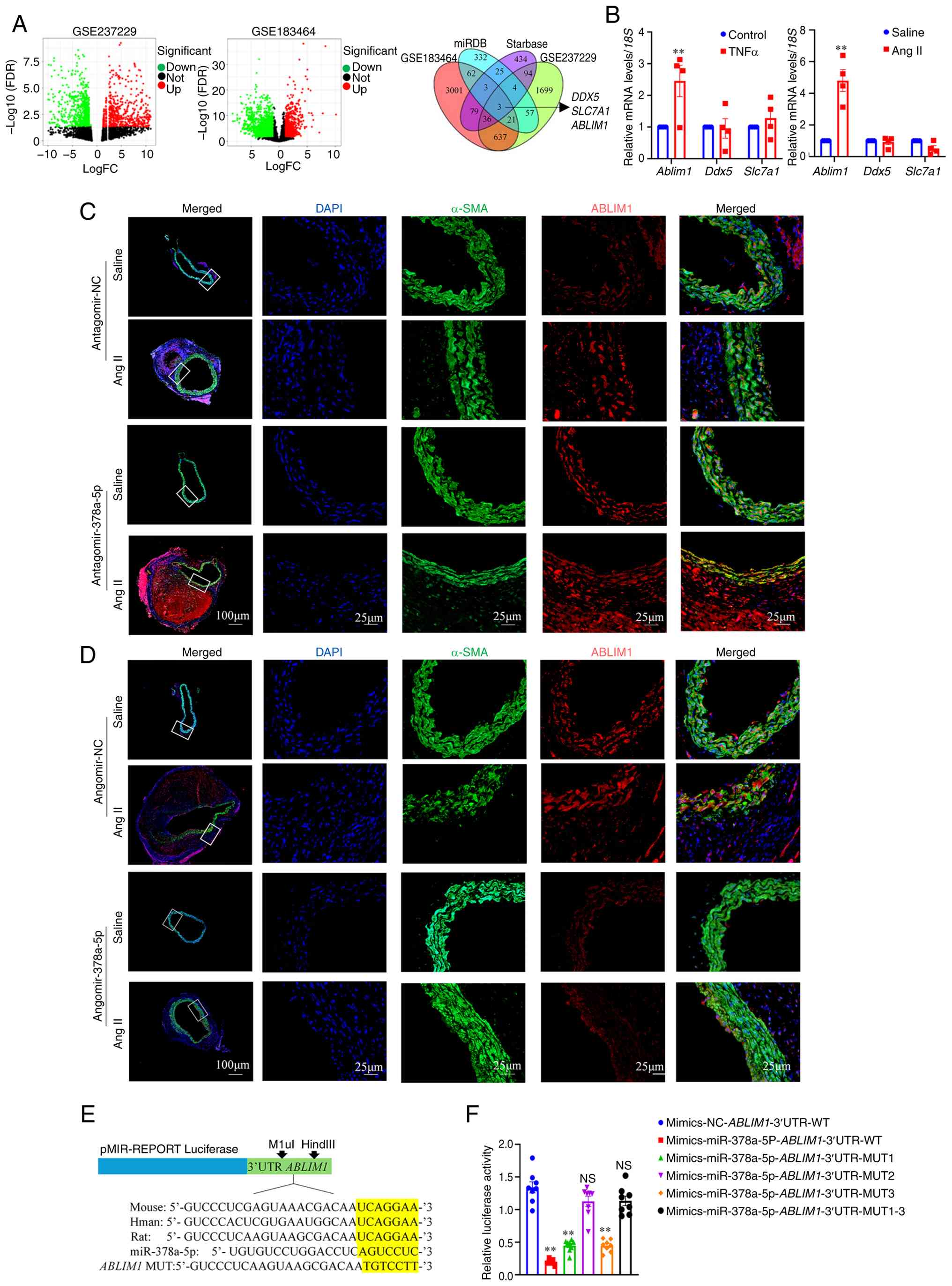
ABLIM1 is a downstream target of
miR-378a-5p and involves in abdominal aortic aneurysm development.
(A) Volcano plot of differently expressed genes in GSE183464 and
GSE237229 database. Venn diagram showed intersection of
differentially expressed genes and predicted target genes including
ABLIM1, DDX5 and SLC7A1. (B) RT-qPCR analysis
of target genes Ablim1, Ddx5 and Slc7a1 in the
TNFα-treated vascular smooth muscle cells (n=3 per group). RT-qPCR
analysis of Ablim1, Ddx5 and Slc7a1 in the
aortas of Ang II-treated mice (n=3 per group). (C) ABLIM1
expression in the aortas treated-with antagomir-NC or
antagomir-378a-5p was identified using by immunofluorescence
staining. ABLIM1 (red), α-SMA (green) and DAPI (blue). (D)
Representative images of immunofluorescence staining identified
ABLIM1 expression in aortas with angomir-NC or angomir-378a-5p.
ABLIM1 (red), α-SMA (green) and DAPI (blue). (E) Conservatism
analysis of the binding site for miR-378a-5p and ABLIM1 in in
humans, mice and rat. (F) Luciferase activity in 293T cells
transfected with mimics-miR-378a-5p together with
ABLIM1-3'UTR-wild type or mutant plasmid. Data are presented
as the mean ± SEM. P-values were calculated by Student's t test
(for B). **P<0.01 vs. Control or saline or
mimics-NC-ABLIM1-3'UTR-WT. ABLIM1, actin-binding LIM protein
1; miR or miRNA, microRNA; RT-qPCR, reverse
transcription-quantitative PCR; α-SMA, α-smooth muscle actin; NC,
negative control; UTR, untranslated region; WT, wild-type; MUT,
mutated.

Figure 6

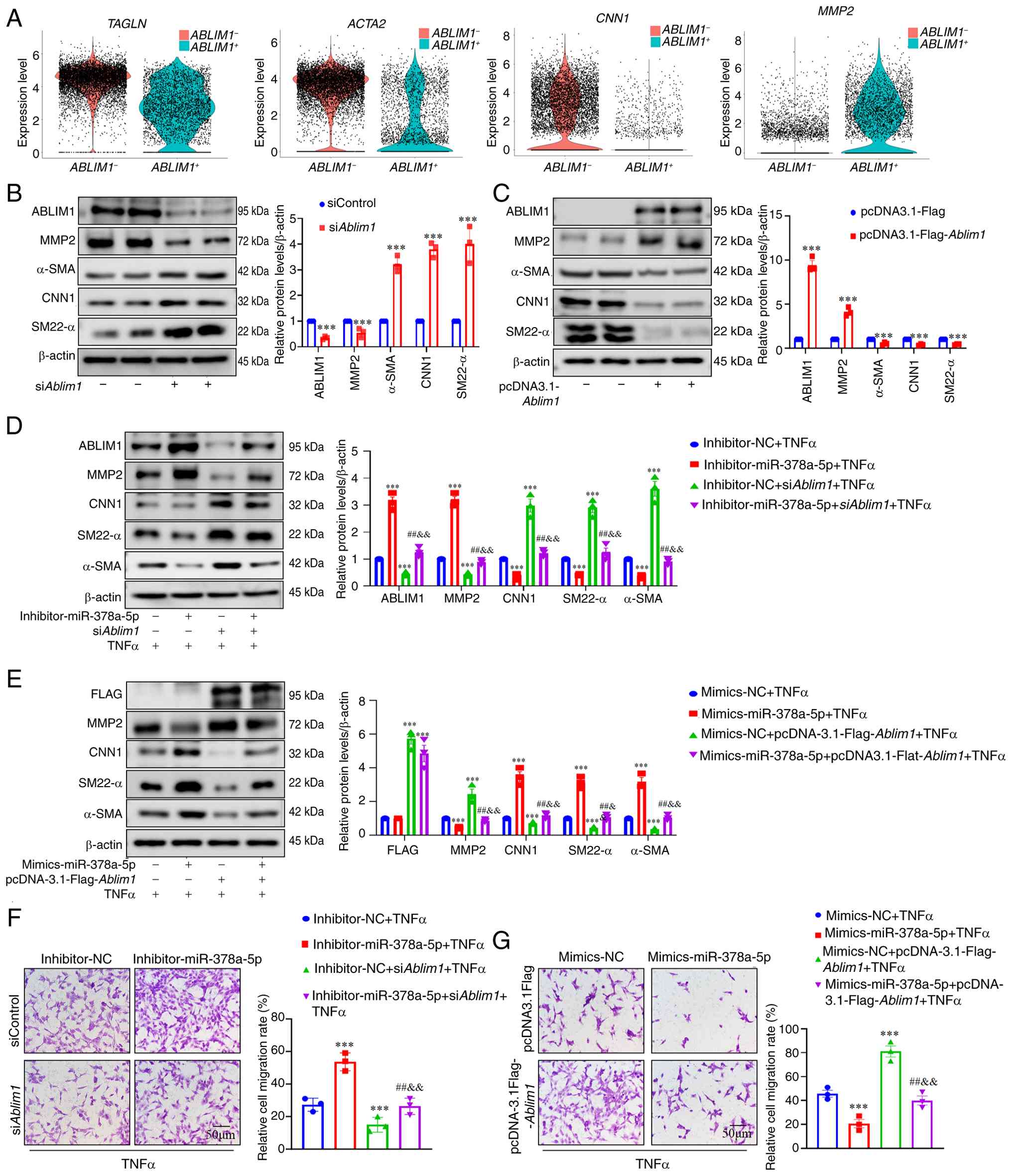
miR-378a-5p regulates phenotypic
transformation and migration of VSMCs by targeting ABLIM1. (A)
Normalized expression of ACTA2, TAGLN, CNN1 and
MMP2 transcripts in aortic VSMCs expressing ABLIM1
(blue) or not (red). (B) Western blots and quantification to
evaluate the expression of MMP2, CNN1, α-SMA, SM22-α in the VSMCs
transfected with siAblim1 or siControl (n=3 per group). (C)
Western blots to evaluate the expression of MMP2, CNN1, α-SMA,
SM22-α in the VSMCs transfected with pcDNA3.1-Flag-Ablim1 or
pcDNA3.1-Flag. (D) VSMCs were transfected with
inhibitor-miR-378a-5p or inhibitor-NC and followed by
siAblim1 transfection. Representative western blots and
quantification of MMP2, CNN1, α-SMA and SM22-α are shown. (E) VSMCs
were transfected with mimics-miR-378a-5p or mimics-NC, followed by
pcDNA3.1-Flag-Ablim1 transfection. Representative western
blots and quantification of MMP2, CNN1, α-SMA and SM22-α are
presented. (F) VSMCs migration was assessed using a Transwell assay
in VSMCs transfected with inhibitor-miR-378a-5p or inhibitor-NC
together with siAblim1 transfection. (G) VSMCs migration was
assessed using a Transwell assay in VSMCs transfected with
mimics-miR-378a-5p or mimics-NC together with
pcDNA3.1-Flag-Ablim1 transfection. Data are presented as the
the mean±SEM (n=3 per group). P-values were calculated by two-way
ANOVA with Holm-Sidak multiple comparisons test.
***P<0.001 vs. siControl or pcDNA3.1-Flag,
mimics-NC+TNFα or inhibitor-NC + TNFα; ##P<0.01 vs
mimics-NC + pcDNA3.1-Flag1-Ablim1 + TNFα or
inhibitor-NC+siAblim1 + TNFα; &&P<0.01
vs. mimics-miR-378a-5p + TNFα or inhibitor-miR-378a-5p + TNFα. miR
or miRNA, microRNA; VSMCs, vascular smooth muscle cells; α-SMA,
α-smooth muscle actin; SM22α, smooth muscle 22α; MMP2, matrix
metalloproteinase 2; CNN1, calponin 1; si-, small interfering; NC,
negative control.

Figure 7

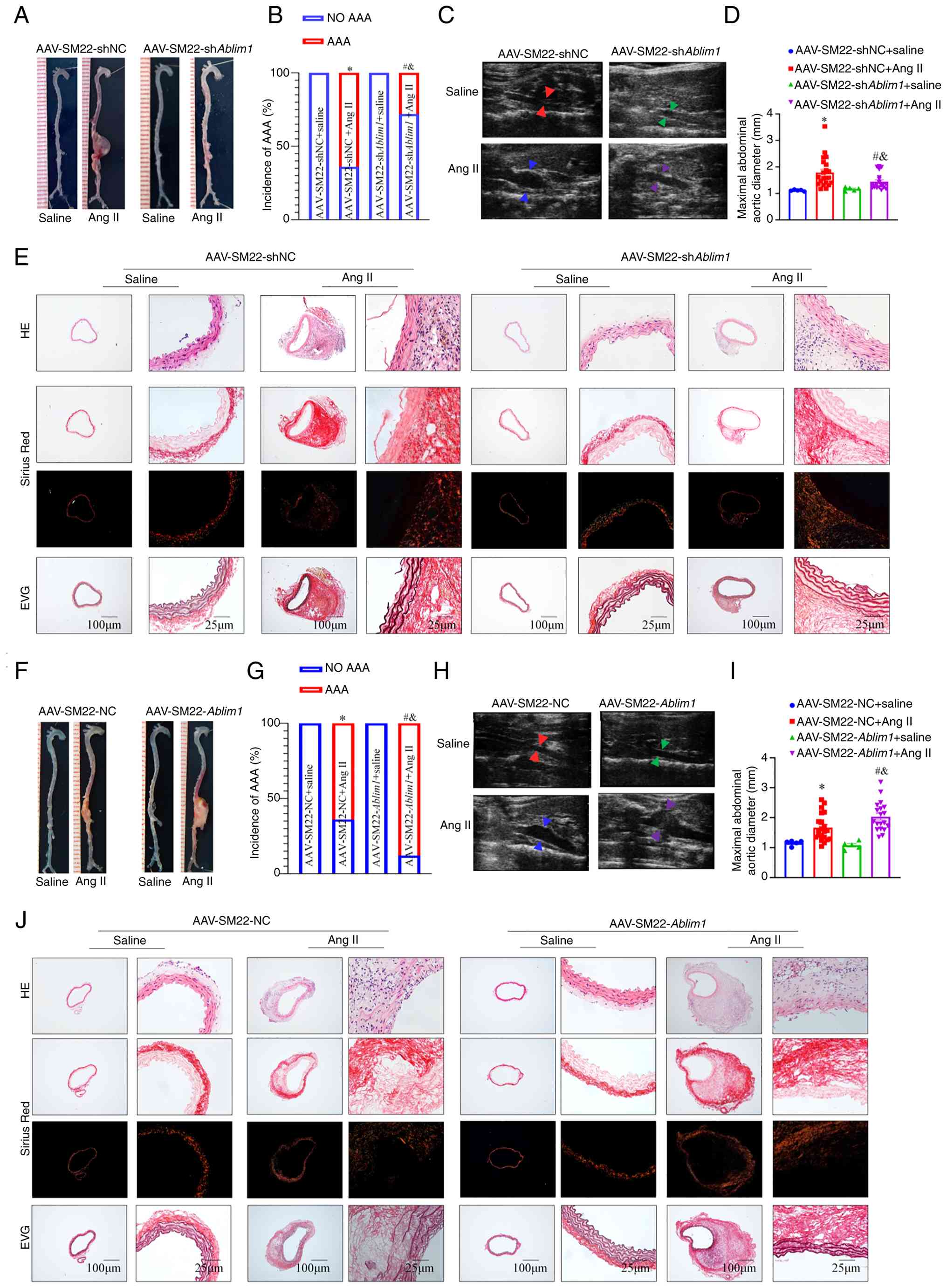
Knockdown of ABLIM1 prevents
Ang II-induced AAA formation, and overexpression of A BLIM1
aggravates Ang II-induced AAA formation. (A) Gross specimen image
of aortas from AAA models treated with AAV-SM22-shAblim1 or
AAV-SM22-shNC. (B) The incidence of AAA in Ang II-infused mice
treated with AAV-SM22-shAblim1 or AAV-SM22-shNC (n=25 in Ang
II groups and n=5 in saline groups). (C and D) Ultrasound images
and inner diameter quantification of the suprarenal abdominal aorta
(n=25 in Ang II groups and n=5 in saline groups). (E)
Representative H&E, Sirius red and EVG staining of the
abdominal aorta in different groups. (F) Gross specimen image of
aortas from AAA models treated with AAV-SM22-Ablim1 or
AAV-SM22-NC. (G) The incidence of AAA in Ang II-infused mice
treated with AAV-SM22-Ablim1 or AAV-SM22-NC (n=25 in Ang II
groups and n=9 in saline groups). (H and I) Ultrasound images and
inner diameter quantification of the suprarenal abdominal aorta
(n=25 in Ang II groups and n=5 in saline groups). (J)
Representative H&E, Sirius red and EVG staining of the
abdominal aorta in different groups. Data are presented as the mean
± SEM. P-values were calculated by two-way ANOVA with Holm-Sidak
multiple comparisons test (for B, D, G and I).
*P<0.05 vs. AAV-SM22-NC + saline or AAV-SM22-shNC +
saline; #P<0.05 vs. AAV-SM22-Ablim1 + saline
or AAV-SM22-shAblim1 + saline; &P<0.05 vs.
AAV-SM22-NC + Ang II or AAV-SM22-shNC + Ang II. ABLIM1,
actin-binding LIM protein 1; Ang II, angiotensin-II; AAA, abdominal
aortic aneurysm; sh-, short hairpin; NC, negative control; EVG,
Verhoeff-Van Gieson.

Figure 8

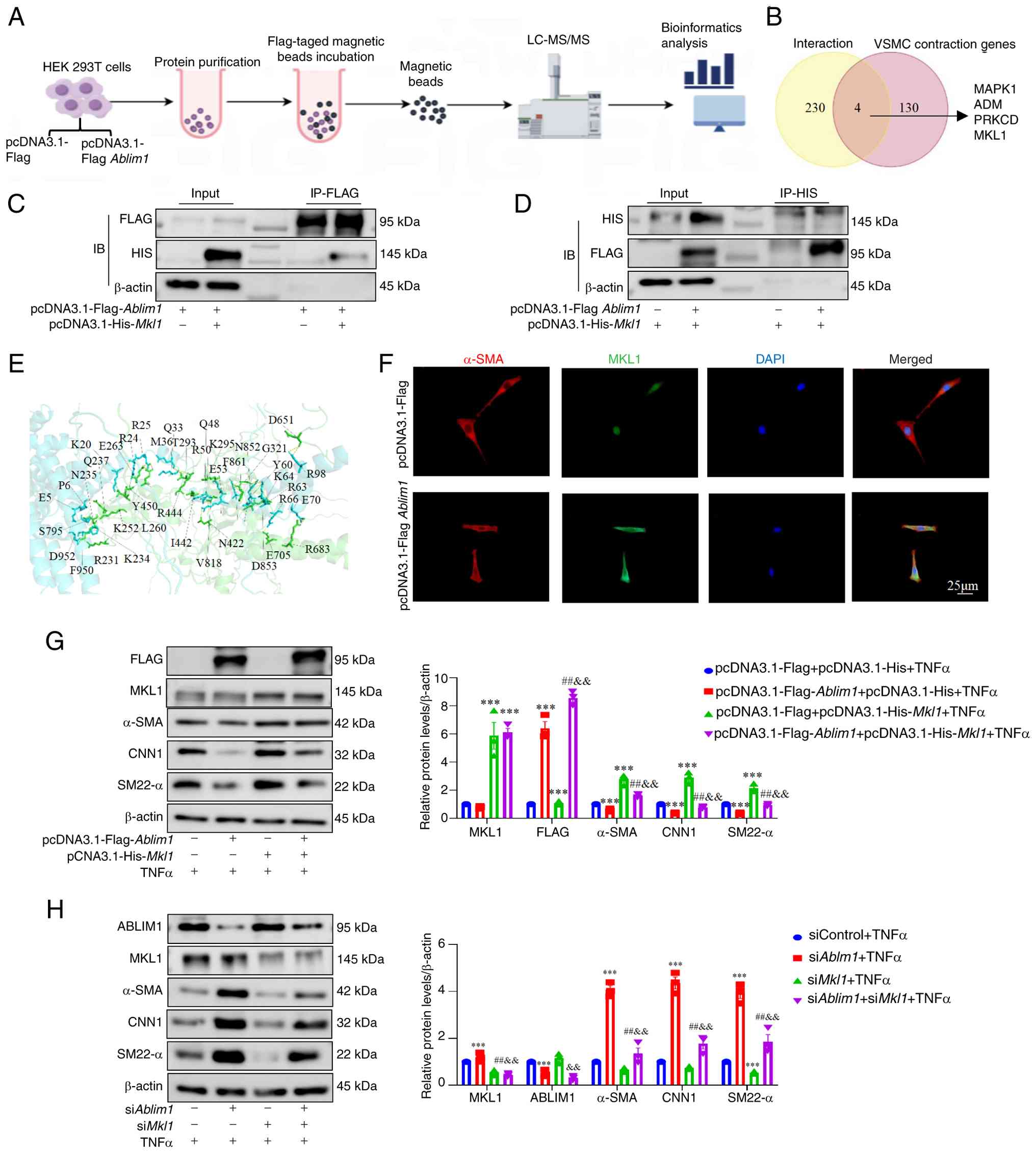
ABLIM1 regulates VSMCs' contractile
phenotype through interacting with MKL1. (A) Experimental flowchart
of Co-immunoprecipitation assay combined with mass spectrometry.
(B) Venn diagram showed the intersection of four proteins. (C) 293T
cells were transfected with pcDNA3.1-Flag-Ablim1 and
pcDNA3.1-His-Mkl1. Lysates were immunoprecipitated with
anti-Flag magnetic beads and blotted with anti-Flag and anti-His
antibodies. (D) 293T cells were transfected with
pcDNA3.1-Flag-Ablim1 and pcDNA3.1-His-Mkl1. Lysates
were immunoprecipitated with anti-His magnetic beads and blotted
with anti-Flag and anti-His antibodies. (E) Molecular docking mode
of ABLIM1 and MKL1. (F) Immunofluorescence images stained with
anti-α-SMA, anti-MKL1 antibody in the VSMCs transfected with
pcDNA3.1-Flag-Ablim1 and pcDNA3.1-Flag. (G) VSMCs were
transfected with pcDNA3.1-Flag-Ablim1 and
pcDNA3.1-His-Mkl1, followed by TNFα treatment.
Representative western blots and quantification of Flag, MKL1,
MMP2, CNN1, α-SMA and SM22-α were shown. (H) VSMCs were transfected
with siAblim1 and siMkl1, followed by TNFα treatment.
Representative western blots and quantification of ABLIM1, MKL1,
MMP2, CNN1, α-SMA and SM22-α were shown. Data are presented as the
mean ± SEM (n=3 per group). P-values were calculated by two-way
ANOVA with Holm-Sidak multiple comparisons test.
***P<0.001 vs. pcDNA3.1-Flag + pcDNA3.1-His + TNFα or
siControl + TNFα; ##P<0.01 vs. pcDNA3.
1-Flag-Ablim1 + pcDNA3.1-His + TNFα or siAblim1 +
TNFα, &&P<0.01 vs. pcDNA3.1-Flag +
pcDNA3.1-His-Mkl1 + TNFα or siMkl1 + TNFα. ABLIM1,
actin-binding LIM protein 1; VSMCs, vascular smooth muscle cells;
VSMCs, vascular smooth muscle cells; MKL1, megakaryoblastic
leukemia 1; α-SMA, α-smooth muscle actin; SM22α, smooth muscle 22α;
MMP2, matrix metalloproteinase 2; CNN1, calponin 1; si-, small
interfering.
View References

1 

Pinard A, Jones GT and Milewicz DM: Genetics of thoracic and abdominal aortic diseases. Circ Res. 124:588–606. 2019. View Article : Google Scholar : PubMed/NCBI

2 

Wanhainen A, Van Herzeele I, Bastos Goncalves F, Bellmunt Montoya S, Berard X, Boyle JR, D'Oria M, Prendes CF, Karkos CD, Kazimierczak A, et al: Editor's choice-European society for vascular surgery (ESVS) 2024 clinical practice guidelines on the management of abdominal aortoiliac artery aneurysms. Eur J Vasc Endovasc Surg. 67:192–331. 2024. View Article : Google Scholar : PubMed/NCBI

3 

Golledge J, Thanigaimani S, Powell JT and Tsao PS: Pathogenesis and management of abdominal aortic aneurysm. Eur Heart J. 44:2682–2697. 2023. View Article : Google Scholar : PubMed/NCBI

4 

Golledge J: Abdominal aortic aneurysm: Update on pathogenesis and medical treatments. Nat Rev Cardiol. 16:225–242. 2019. View Article : Google Scholar

5 

Gao J, Cao H, Hu G, Wu Y, Xu Y, Cui H, Lu HS and Zheng L: The mechanism and therapy of aortic aneurysms. Signal Transduct Target Ther. 8:552023. View Article : Google Scholar : PubMed/NCBI

6 

Rombouts KB, van Merrienboer TAR, Ket JCF, Bogunovic N, van der Velden J and Yeung KK: The role of vascular smooth muscle cells in the development of aortic aneurysms and dissections. Eur J Clin Invest. 52:e136972022. View Article : Google Scholar :

7 

Zhuge Y, Zhang J, Qian F, Wen Z, Niu C, Xu K, Ji H, Rong X, Chu M and Jia C: Role of smooth muscle cells in cardiovascular disease. Int J Biol Sci. 16:2741–2751. 2020. View Article : Google Scholar : PubMed/NCBI

8 

Owens GK, Kumar MS and Wamhoff BR: Molecular regulation of vascular smooth muscle cell differentiation in development and disease. Physiol Rev. 84:767–801. 2004. View Article : Google Scholar : PubMed/NCBI

9 

Frismantiene A, Philippova M, Erne P and Resink TJ: Smooth muscle cell-driven vascular diseases and molecular mechanisms of VSMC plasticity. Cell Signal. 52:48–64. 2018. View Article : Google Scholar : PubMed/NCBI

10 

Tang HY, Chen AQ, Zhang H, Gao XF, Kong XQ and Zhang JJ: Vascular smooth muscle cells phenotypic switching in cardiovascular diseases. Cells. 11:40602022. View Article : Google Scholar : PubMed/NCBI

11 

Wang S, Liu D, Zhang X and Tian X: Regulation of matrix metalloproteinase-2 and matrix metalloproteinase-9 in abdominal aortic aneurysm. Cardiol Discov. 3:212–220. 2023.

12 

Chen H: microRNA-based cancer diagnosis and therapy. Int J Mol Sci. 25:2302023. View Article : Google Scholar

13 

Bhaskaran M and Mohan M: MicroRNAs: History, biogenesis, and their evolving role in animal development and disease. Vet Pathol. 51:759–774. 2024. View Article : Google Scholar

14 

Mohr AM and Mott JL: Overview of microRNA biology. Semin Liver Dis. 35:3–11. 2015. View Article : Google Scholar : PubMed/NCBI

15 

Wang G, Luo Y, Gao X, Liang Y, Yang F, Wu J, Fang D and Luo M: MicroRNA regulation of phenotypic transformations in vascular smooth muscle: Relevance to vascular remodeling. Cell Mol Life Sci. 80:1442023. View Article : Google Scholar : PubMed/NCBI

16 

Nguyen DND, Chilian WM, Zain SM, Daud MF and Pung YF: MicroRNA regulation of vascular smooth muscle cells and its significance in cardiovascular diseases. Can J Physiol Pharmacol. 99:827–838. 2021. View Article : Google Scholar : PubMed/NCBI

17 

Maegdefessel L, Azuma J, Toh R, Merk DR, Deng A, Chin JT, Raaz U, Schoelmerich AM, Raiesdana A, Leeper NJ, et al: Inhibition of microRNA-29b reduces murine abdominal aortic aneurysm development. J Clin Invest. 122:497–506. 2012. View Article : Google Scholar : PubMed/NCBI

18 

Yamasaki T, Horie T, Koyama S, Nakao T, Baba O, Kimura M, Sowa N, Sakamoto K, Yamazaki K, Obika S, et al: Inhibition of microRNA-33b specifically ameliorates abdominal aortic aneurysm formation via suppression of inflammatory pathways. Sci Rep. 12:119842022. View Article : Google Scholar : PubMed/NCBI

19 

Maegdefessel L, Azuma J, Toh R, Deng A, Merk DR, Raiesdana A, Leeper NJ, Raaz U, Schoelmerich AM, McConnell MV, et al: MicroRNA-21 blocks abdominal aortic aneurysm development and nicotine-augmented expansion. Sci Transl Med. 4:122ra222012. View Article : Google Scholar : PubMed/NCBI

20 

Maegdefessel L, Spin JM, Raaz U, Eken SM, Toh R, Azuma J, Adam M, Nakagami F, Heymann HM, Chernogubova E, et al: miR-24 limits aortic vascular inflammation and murine abdominal aneurysm development. Nat Commun. 5:52142014. View Article : Google Scholar : PubMed/NCBI

21 

Zhang H, Wang Y, Bian X and Yin H: MicroRNA-194 acts as a suppressor during abdominal aortic aneurysm via inhibition of KDM3A-mediated BNIP3. Life Sci. 277:1193092021. View Article : Google Scholar : PubMed/NCBI

22 

Ma X, Yao H, Yang Y, Jin L, Wang Y, Wu L, Yang S and Cheng K: miR-195 suppresses abdominal aortic aneurysm through the TNF-α/NF-κB and VEGF/PI3K/Akt pathway. Int J Mol Med. 41:2350–2358. 2018.PubMed/NCBI

23 

Li K, Zhang J, Zhang M, Wu Y, Lu X and Zhu Y: miR-378a-5p inhibits the proliferation of colorectal cancer cells by downregulating CDK1. World J Surg Oncol. 19:542021. View Article : Google Scholar : PubMed/NCBI

24 

Nadeem U, Ye G, Salem M and Peng C: MicroRNA-378a-5p targets cyclin G2 to inhibit fusion and differentiation in BeWo cells. Biol Reprod. 91:762014. View Article : Google Scholar : PubMed/NCBI

25 

He Y, Shi Q, Ling Y, Guo H, Fei Y, Wu R, Tang C, Zhang X and Yao L: ABLIM1, a novel ubiquitin E3 ligase, promotes growth and metastasis of colorectal cancer through targeting IĸBα ubiquitination and activating NF-ĸB signaling. Cell Death Differ. 31:203–216. 2024. View Article : Google Scholar : PubMed/NCBI

26 

Liu D, Wang X, Liu Y, Li C, Zhang Z and Lv P: Actin-Binding LIM 1 (ABLIM1) inhibits glioblastoma progression and serves as a novel prognostic biomarker. Dis Markers. 2022:95168082022. View Article : Google Scholar : PubMed/NCBI

27 

Roof DJ, Hayes A, Adamian M, Chishti AH and Li T: Molecular characterization of abLIM, a novel actin-binding and double zinc finger protein. J Cell Biol. 138:575–588. 1997. View Article : Google Scholar : PubMed/NCBI

28 

Ohsawa N, Koebis M, Mitsuhashi H, Nishino I and Ishiura S: ABLIM1 splicing is abnormal in skeletal muscle of patients with DM1 and regulated by MBNL, CELF and PTBP1. Genes Cells. 20:121–134. 2015. View Article : Google Scholar

29 

McDonald OG and Owens GK: Programming smooth muscle plasticity with chromatin dynamics. Circ Res. 100:1428–1441. 2007. View Article : Google Scholar : PubMed/NCBI

30 

Miralles F, Posern G, Zaromytidou AI and Treisman R: Actin dynamics control SRF activity by regulation of its coactivator MAL. Cell. 113:329–342. 2003. View Article : Google Scholar : PubMed/NCBI

31 

Cen B, Selvaraj A, Burgess RC, Hitzler JK, Ma Z, Morris SW and Prywes R: Megakaryoblastic leukemia 1, a potent transcriptional coactivator for serum response factor (SRF), is required for serum induction of SRF target genes. Mol Cell Biol. 23:6597–6608. 2003. View Article : Google Scholar : PubMed/NCBI

32 

Friedman RM, Truong HD, Aronson MR, Brown EA, Angelozzi M, Chen JF, Zur KB, Lefebvre V and Gottardi R: Inhibition of the MRTF-A/SRF signaling axis alleviates vocal fold scarring. Matrix Biol. 137:1–11. 2025. View Article : Google Scholar : PubMed/NCBI

33 

Sun Y, Boyd K, Xu W, Ma J, Jackson CW, Fu A, Shillingford JM, Robinson GW, Hennighausen L, Hitzler JK, et al: Acute myeloid leukemia-associated Mkl1 (Mrtf-a) is a key regulator of mammary gland function. Mol Cell Biol. 26:5809–5826. 2006. View Article : Google Scholar : PubMed/NCBI

34 

Wu H, Wang J, Bu Y, Li J, Li Y, Jing Q, Wang X, Yan C, Liu D and Han Y: Pentamethylquercetin attenuates angiotensin II-induced abdominal aortic aneurysm formation by blocking nuclear translocation of C/EBPβ at Lys253. Biochim Biophys Acta Mol Basis Dis. 1870:1672242024. View Article : Google Scholar

35 

Yang L, Sui HG, Wang MM, Li JY, He XF, Li JY and Wang XZ: MiR-30c-1-3p targets matrix metalloproteinase 9 involved in the rupture of abdominal aortic aneurysms. J Mol Med (Berl). 100:1209–1221. 2022. View Article : Google Scholar : PubMed/NCBI

36 

Livak KJ and Schmittgen TD: Analysis of relative gene expression data using real-time quantitative PCR and the 2(-delta delta C(T)) method. Methods. 25:402–408. 2001. View Article : Google Scholar

37 

Wen Y, Liu Y, Li Q, Tan J, Fu X, Liang Y, Tuo Y, Liu L, Zhou X, LiuFu D, et al: Spatiotemporal ATF3 expression determines VSMC fate in abdominal aortic aneurysm. Circ Res. 134:1495–1511. 2024. View Article : Google Scholar : PubMed/NCBI

38 

Tastsoglou S, Skoufos G, Miliotis M, Karagkouni D, Koutsoukos I, Karavangeli A, Kardaras FS and Hatzigeorgiou AG: DIANA-miRPath v4.0: Expanding target-based miRNA functional analysis in cell-type and tissue contexts. Nucleic Acids Res. 51:W154–W159. 2023. View Article : Google Scholar : PubMed/NCBI

39 

Hu Y, Cai Z and He B: Smooth muscle heterogeneity and plasticity in health and aortic aneurysmal disease. Int J Mol Sci. 24:117012023. View Article : Google Scholar : PubMed/NCBI

40 

Zhao G, Zhao Y, Lu H, Chang Z, Liu H, Wang H, Liang W, Liu Y, Zhu T, Rom O, et al: BAF60c prevents abdominal aortic aneurysm formation through epigenetic control of vascular smooth muscle cell homeostasis. J Clin Invest. 132:e1583092022. View Article : Google Scholar : PubMed/NCBI

41 

Chen M, Yang D, Zhou Y, Yang C, Lin W, Li J, Liu J, Ye J, Huang W, Ma W, et al: Colchicine blocks abdominal aortic aneurysm development by maintaining vascular smooth muscle cell homeostasis. Int J Biol Sci. 20:2092–2110. 2024. View Article : Google Scholar : PubMed/NCBI

42 

Nappi F: Current opinion in acute aortic dissection. Cardiol Discov. Jan 3–2025.Epub ahead of print.

43 

Lu H, Du W, Ren L, Hamblin MH, Becker RC, Chen YE and Fan Y: Vascular smooth muscle cells in aortic aneurysm: From genetics to mechanisms. J Am Heart Assoc. 10:e0236012021. View Article : Google Scholar : PubMed/NCBI

44 

Petsophonsakul P, Furmanik M, Forsythe R, Dweck M, Schurink GW, Natour E, Reutelingsperger C, Jacobs M, Mees B and Schurgers L: Role of vascular smooth muscle cell phenotypic switching and calcification in aortic aneurysm formation. Arterioscler Thromb Vasc Biol. 39:1351–1368. 2019. View Article : Google Scholar : PubMed/NCBI

45 

Ailawadi G, Moehle CW, Pei H, Walton SP, Yang Z, Kron IL, Lau CL and Owens GK: Smooth muscle phenotypic modulation is an early event in aortic aneurysms. J Thorac Cardiovasc Surg. 138:1392–1399. 2009. View Article : Google Scholar : PubMed/NCBI

46 

Li X, Yang Y, Wang Z, Jiang S, Meng Y, Song X, Zhao L, Zou L, Li M and Yu T: Targeting non-coding RNAs in unstable atherosclerotic plaques: Mechanism, regulation, possibilities, and limitations. Int J Biol Sci. 17:3413–3427. 2021. View Article : Google Scholar : PubMed/NCBI

47 

Zhou Y, Wang M, Zhang J, Xu P and Wang H: MicroRNA-29a-3p regulates abdominal aortic aneurysm development and progression via direct interaction with PTEN. J Cell Physiol. 235:9414–9423. 2020. View Article : Google Scholar : PubMed/NCBI

48 

Shi X, Ma W, Li Y, Wang H, Pan S, Tian Y, Xu C and Li L: MiR-144-5p limits experimental abdominal aortic aneurysm formation by mitigating M1 macrophage-associated inflammation: Suppression of TLR2 and OLR1. J Mol Cell Cardiol. 143:1–14. 2020. View Article : Google Scholar : PubMed/NCBI

49 

Machado IF, Teodoro JS, Palmeira CM and Rolo AP: miR-378a: A new emerging microRNA in metabolism. Cell Mol Life Sci. 77:1947–1958. 2020. View Article : Google Scholar

50 

Pan X, Zhao L, Quan J, Liu K, Lai Y, Li Z, Zhang Z, Xu J, Xu W, Guan X, et al: MiR-378a-5p acts as a tumor suppressor in renal cell carcinoma and is associated with the good prognosis of patients. Am J Transl Res. 11:2207–2218. 2019.PubMed/NCBI

51 

Zhang Y, Zhang P and Deng C: miR-378a-5p regulates CAMKK2/AMPK pathway to contribute to cerebral ischemia/reperfusion injury-induced neuronal apoptosis. Folia Histochem Cytobiol. 59:57–65. 2021. View Article : Google Scholar : PubMed/NCBI

52 

Sha T, Li J, Sun S, Li J, Zhao X, Li Z and Cui Z: YEATS domain-containing 2 (YEATS2), targeted by microRNA miR-378a-5p, regulates growth and metastasis in head and neck squamous cell carcinoma. Bioengineered. 12:7286–7296. 2021. View Article : Google Scholar : PubMed/NCBI

53 

Bhandari R, Shaikh II, Bhandari R and Chapagain S: LINC01023 promotes the hepatoblastoma tumorigenesis via miR-378a-5p/WNT3 axis. Mol Cell Biochem. 478:1867–1885. 2023. View Article : Google Scholar

54 

Yan C and Jin Y: Silencing of long noncoding RNA MIAT inhibits the viability and proliferation of breast cancer cells by promoting miR-378a-5p expression. Open Med (Wars). 18:202306762023. View Article : Google Scholar : PubMed/NCBI

55 

Liu S, Yang Y, Jiang S, Xu H, Tang N, Lobo A, Zhang R, Liu S, Yu T and Xin H: MiR-378a-5p regulates proliferation and migration in vascular smooth muscle cell by targeting CDK1. Front Genet. 10:222019. View Article : Google Scholar : PubMed/NCBI

56 

Narahara H, Sakai E, Yamaguchi Y, Narahara S, Iwatake M, Okamoto K, Yoshida N and Tsukuba T: Actin binding LIM 1 (abLIM1) negatively controls osteoclastogenesis by regulating cell migration and fusion. J Cell Physiol. 234:486–499. 2018. View Article : Google Scholar : PubMed/NCBI

57 

Koshelev M, Sarma S, Price RE, Wehrens XH and Cooper TA: Heart-specific overexpression of CUGBP1 reproduces functional and molecular abnormalities of myotonic dystrophy type 1. Hum Mol Genet. 19:1066–1075. 2010. View Article : Google Scholar : PubMed/NCBI

58 

Yang S, Liu C, Guo Y, Li G, Li D, Yan X and Zhu X: Self-construction of actin networks through phase separation-induced abLIM1 condensates. Proc Natl Acad Sci USA. 119:e21224201192022. View Article : Google Scholar : PubMed/NCBI

59 

Li G, Huang S, Yang S, Wang J, Cao J, Czajkowsky DM, Shao Z and Zhu X: abLIM1 constructs non-erythroid cortical actin networks to prevent mechanical tension-induced blebbing. Cell Discov. 4:422018. View Article : Google Scholar : PubMed/NCBI

60 

Zhou J, Zhang M, Fang H, El-Mounayri O, Rodenberg JM, Imbalzano AN and Herring BP: The SWI/SNF chromatin remodeling complex regulates myocardin-induced smooth muscle-specific gene expression. Arterioscler Thromb Vasc Biol. 29:921–928. 2009. View Article : Google Scholar : PubMed/NCBI

61 

Wang DZ, Li S, Hockemeyer D, Sutherland L, Wang Z, Schratt G, Richardson JA, Nordheim A and Olson EN: Potentiation of serum response factor activity by a family of myocardin-related transcription factors. Proc Natl Acad Sci USA. 99:14855–14860. 2002. View Article : Google Scholar : PubMed/NCBI

Related Articles

  • Abstract
  • View
  • Download
  • Twitter
Copy and paste a formatted citation
Spandidos Publications style
Wang J, Zou Y, Wang Y, Yang Z, Liu D, Su X, Song H, Xu K, Yan C, Liu D, Liu D, et al: miRNA‑378a‑5p attenuates the development of abdominal aortic aneurysm via ABLIM1‑MKL1 signaling pathways. Int J Mol Med 57: 97, 2026.
APA
Wang, J., Zou, Y., Wang, Y., Yang, Z., Liu, D., Su, X. ... Han, Y. (2026). miRNA‑378a‑5p attenuates the development of abdominal aortic aneurysm via ABLIM1‑MKL1 signaling pathways. International Journal of Molecular Medicine, 57, 97. https://doi.org/10.3892/ijmm.2026.5768
MLA
Wang, J., Zou, Y., Wang, Y., Yang, Z., Liu, D., Su, X., Song, H., Xu, K., Yan, C., Liu, D., Han, Y."miRNA‑378a‑5p attenuates the development of abdominal aortic aneurysm via ABLIM1‑MKL1 signaling pathways". International Journal of Molecular Medicine 57.4 (2026): 97.
Chicago
Wang, J., Zou, Y., Wang, Y., Yang, Z., Liu, D., Su, X., Song, H., Xu, K., Yan, C., Liu, D., Han, Y."miRNA‑378a‑5p attenuates the development of abdominal aortic aneurysm via ABLIM1‑MKL1 signaling pathways". International Journal of Molecular Medicine 57, no. 4 (2026): 97. https://doi.org/10.3892/ijmm.2026.5768
Copy and paste a formatted citation
x
Spandidos Publications style
Wang J, Zou Y, Wang Y, Yang Z, Liu D, Su X, Song H, Xu K, Yan C, Liu D, Liu D, et al: miRNA‑378a‑5p attenuates the development of abdominal aortic aneurysm via ABLIM1‑MKL1 signaling pathways. Int J Mol Med 57: 97, 2026.
APA
Wang, J., Zou, Y., Wang, Y., Yang, Z., Liu, D., Su, X. ... Han, Y. (2026). miRNA‑378a‑5p attenuates the development of abdominal aortic aneurysm via ABLIM1‑MKL1 signaling pathways. International Journal of Molecular Medicine, 57, 97. https://doi.org/10.3892/ijmm.2026.5768
MLA
Wang, J., Zou, Y., Wang, Y., Yang, Z., Liu, D., Su, X., Song, H., Xu, K., Yan, C., Liu, D., Han, Y."miRNA‑378a‑5p attenuates the development of abdominal aortic aneurysm via ABLIM1‑MKL1 signaling pathways". International Journal of Molecular Medicine 57.4 (2026): 97.
Chicago
Wang, J., Zou, Y., Wang, Y., Yang, Z., Liu, D., Su, X., Song, H., Xu, K., Yan, C., Liu, D., Han, Y."miRNA‑378a‑5p attenuates the development of abdominal aortic aneurysm via ABLIM1‑MKL1 signaling pathways". International Journal of Molecular Medicine 57, no. 4 (2026): 97. https://doi.org/10.3892/ijmm.2026.5768
Follow us
  • Twitter
  • LinkedIn
  • Facebook
About
  • Spandidos Publications
  • Careers
  • Cookie Policy
  • Privacy Policy
How can we help?
  • Help
  • Live Chat
  • Contact
  • Email to our Support Team