Respiratory diseases, including pulmonary fibrosis
(PF), chronic obstructive pulmonary disease (COPD), lung cancer and
acute lung injury (ALI), are characterized by high morbidity and
mortality globally, representing a major health burden (1). The intricate pathophysiology
underlying these conditions, coupled with the current limitations
in therapeutic interventions, imposes substantial clinical and
socioeconomic challenges that markedly impair patients' quality of
life (2). In China, chronic
respiratory diseases are prevalent diseases, with COPD, lung
cancer, PF and infectious diseases (particularly tuberculosis and
pneumonia) being the most prevalent forms (3). Epidemiological data indicate that
~13.7% of the Chinese population aged ≥40 years experience COPD,
corresponding to nearly 100 million affected individuals (4). The primary etiological factors
include tobacco smoking and ambient air pollution, which are
collectively responsible for a substantial proportion of the
disease burden (4). Lung cancer
represents a major public health challenge in China and it is
characterized by high incidence and mortality rates, with low early
diagnosis rates and substantial treatment costs posing significant
barriers to effective disease management (3). Similarly, PF and infectious
pulmonary diseases (especially drug-resistant tuberculosis) present
ongoing clinical challenges. The incidence of interstitial lung
diseases, including PF, has continued to increase. Although
anti-fibrotic agents such as pirfenidone and nintedanib have been
incorporated into clinical practice, their therapeutic benefits
remain limited and these drugs are associated with considerable
financial burdens. Given the complex etiological factors
contributing to pulmonary pathologies and their substantial
mortality rates, the development of novel therapeutic strategies is
of paramount importance. In this context, sirtuins, comprising a
conserved family of NAD+-dependent deacetylases that regulate
crucial cellular processes including metabolism, aging, stress
responses and epigenetic modulation, have emerged as promising
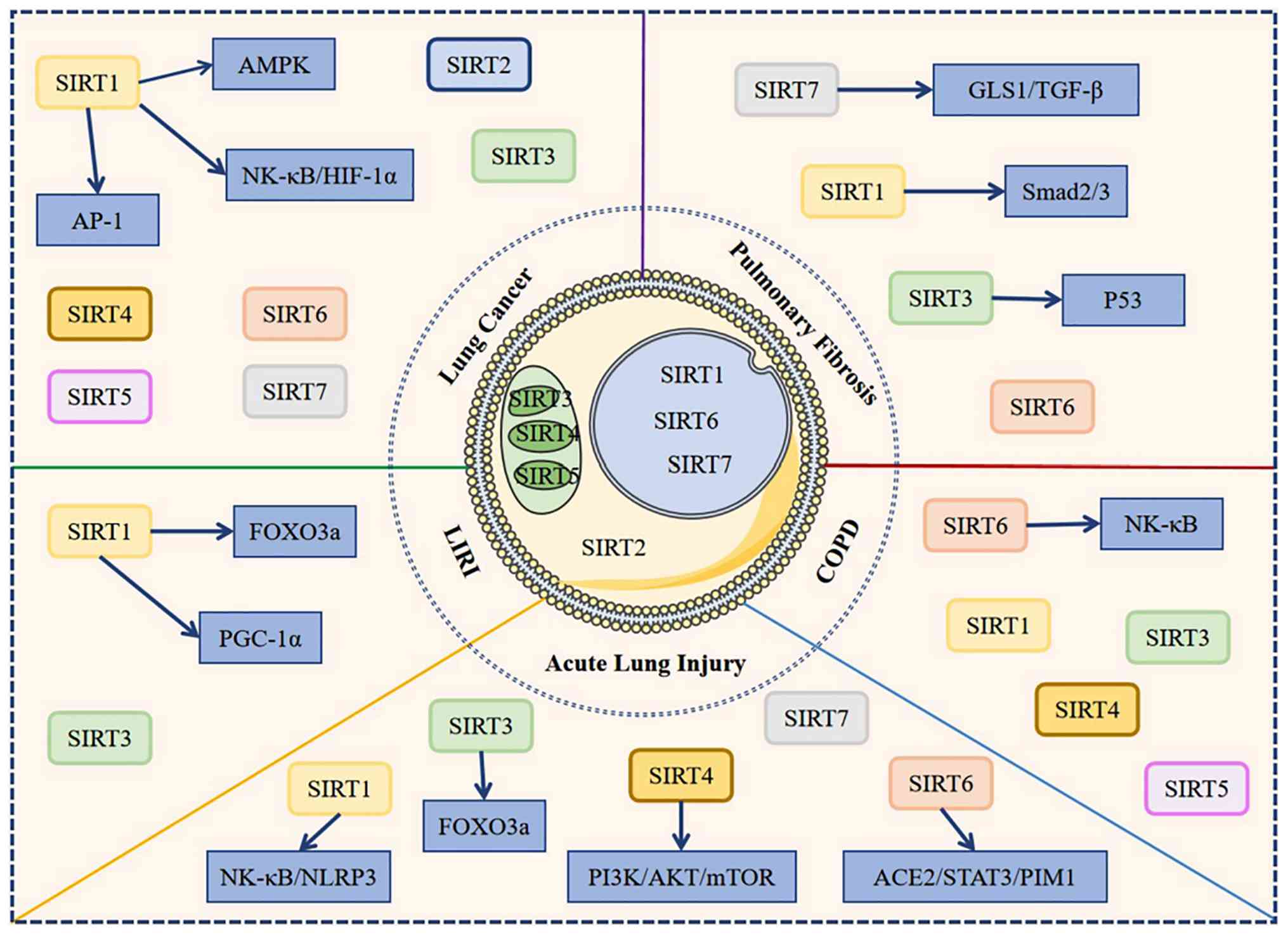
targets (5,6). Notably, specific sirtuin isoforms
(SIRT1, SIRT3 and SIRT6) have been increasingly implicated in
pulmonary pathophysiology, with accumulating evidence supporting
their critical roles in various lung disease processes (7) (Fig.
1).
Sirtuins were originally identified in yeast as
silent information regulator 2 (Sir2) proteins (8). These proteins, encoded by the SIR
gene family, were initially characterized for their roles in
chromatin silencing through modulation of chromatin structure
accessibility in Saccharomyces cerevisiae (9,10). Subsequent research has revealed
that Sir2 homologs are ubiquitous across all biological domains,
including archaea, bacteria and eukaryotes (11). Sirtuins have emerged as crucial
regulators of diverse cellular processes that enhance cellular
survival and longevity, including DNA repair, transcriptional
regulation, metabolic homeostasis and stress response pathways
(12). At the molecular level,
sirtuins catalyze NAD+-dependent deacetylation, removing modified
acyl groups from lysine residues from both histone and non-histone
protein substrates. This enzymatic activity yields three products:
deacetylated proteins, nicotinamide and 2'-O-acyl-ADP-ribose
(13,14). Notably, the NAD+ dependence of
sirtuins establishes them as cellular energy sensors, enabling the
integration of metabolic status with targeted lysine deacetylation
in various subcellular compartments (15,16).
The sirtuin family of class III histone
deacetylases, which are evolutionarily conserved from prokaryotes
to eukaryotes, are uniquely inhibited by nicotinamide (17). Mammalian systems express seven
distinct sirtuin isoforms (SIRT1-7) that can be phylogenetically
divided into four classes based on their amino acid sequence
homology: Class I (SIRT1-3), class II (SIRT4), class III (SIRT5)
and class IV (SIRT6-7) (12,18,19). Structurally, sirtuins exhibit
conserved catalytic domains of ~270 amino acids that mediate their
functional diversity. The canonical sirtuin architecture comprises
a large Rossmann fold domain responsible for NAD+ binding and a
smaller zinc-binding domain containing helical structures. These
domains form a cleft that accommodates acetylated substrates,
facilitating their binding and subsequent deacetylation (20,21).
The seven mammalian sirtuin isoforms display
distinct subcellular localization patterns, enzymatic activities
and substrate specificities, reflecting their diverse functional
roles (22,23). SIRT1-7 are encoded by genes
located at unique chromosomal loci (10q22.1, 19q13, 11p15.5, 12q,
5p23, 19p13.3 and 17q25, respectively) and their gene sizes varying
from 6-37 kb (24,25). Subcellular compartmentalization
critically determines sirtuin function. SIRT1 primarily localizes
to the nucleus but it exhibits nucleocytoplasmic shuttling, as
evidenced by heterokaryon assays (26,27). This ubiquitously expressed
deacetylase participates in numerous physiological and pathological
processes, including cell cycle regulation and apoptosis, DNA
damage repair, metabolic homeostasis, oxidative stress response and
cellular senescence and longevity modulation (28). SIRT2 displays dynamic
localization, transitioning between the cytoplasm and nucleus
during G2/M phase progression (29). Beyond its established roles in
microtubule dynamics and cell cycle control, emerging evidence has
implicated SIRT2 in neurodegenerative disease pathogenesis
(30). The mitochondrial
sirtuins (SIRT3-5) serve as crucial regulators of oxidative
metabolism and energy homeostasis (22). Among these, SIRT3 plays
particularly diverse roles through the coordination of
mitochondrial signaling pathways, including the substrate-specific
deacetylation modulation of oxidative phosphorylation, reactive
oxygen species detoxification, fatty acid β-oxidation,
tricarboxylic acid cycle flux and amino acid metabolism (31). Beyond their canonical deacetylase
function, SIRT4-6 exhibit additional enzymatic activities that are
essential for metabolic regulation and stress adaptation. Notably,
SIRT4 demonstrates robust ADP-ribosyltransferase activity, through
which it post-translationally modifies target proteins to modulate
critical processes including insulin secretion and amino acid
metabolism (32). SIRT5 is a key
metabolic regulator that removes malonyl and succinyl groups from
lysine residues, thereby influencing mitochondrial function and
urea cycle activity (33). SIRT6
possesses dual enzymatic capabilities, functioning as both a
deacetylase and a long-chain deacetylase, facilitating its central
role in maintaining genomic stability through DNA repair mechanisms
and telomere maintenance (34).
Although both SIRT6 and SIRT7 are nuclear proteins, they exhibit
distinct subnuclear distributions. Specifically, SIRT6 primarily
associates with chromatin, whereas SIRT7 predominantly localizes to
the nucleolus. This compartmentalization facilitates their
coordinated regulation of transcriptional and metabolic networks
(35,36). Collectively, these
multifunctional enzymes both orchestrate metabolic and bioenergetic
pathways and serve as crucial guardians of cellular homeostasis
under stress conditions. These diverse activities position sirtuins
as promising therapeutic targets for age-related and metabolic
disorders.
PF represents a terminal pathological manifestation
of numerous chronic lung disorders and constitutes the most
prevalent form of interstitial lung disease. This progressive
condition ultimately leads to respiratory failure and severe
complications, with current therapeutic approaches offering only
palliative management rather than curative solutions (37,38). Idiopathic pulmonary fibrosis
(IPF), the most common subtype of PF, has an exceptionally complex
pathogenesis that remains incompletely elucidated. Current
standard-of-care pharmacotherapies, primarily comprising
glucocorticoids and immunosuppressants, aim to slow disease
progression, but their clinical efficacy is limited (39,40). Although several approved
treatments are available, their utility is constrained by
significant adverse effects and marginal improvements in disease
outcomes, underscoring the urgent need for novel therapeutic agents
(41,42).
Emerging research has identified sirtuins as
critical modulators of PF progression, positioning them as
promising molecular targets for anti-fibrotic drug development
(43). Among these proteins,
SIRT1 is particularly well characterized, both serving as a key
endogenous regulator of fibrotic processes and demonstrating
diagnostic potential for IPF. Mechanistically, SIRT1 exerts its
anti-fibrotic effects by modulating the Smad2/3 signaling pathway,
thereby suppressing the expression of pro-fibrotic genes and
proteins in activated fibroblasts (44,45). Emerging evidence demonstrates
that pharmacological inhibition of SIRT2 suppresses fibroblast
activation and attenuates PF progression via modulation of the
Smad2/3 signaling pathway (46).
Furthermore, accumulating studies suggest that SIRT3, SIRT6 and
SIRT7 have potential protective roles in the pathogenesis of PF
(43). SIRT3 is particularly
noteworthy, as it regulates p53-mediated senescence pathways in
lung epithelial cells, thereby influencing both the initiation and
progression of fibrotic processes (47). According to experimental studies,
SIRT3 deficiency exacerbates PF by increasing mitochondrial DNA
damage and apoptosis in alveolar epithelial cells (48), whereas SIRT3 overexpression
protects against asbestos-induced fibrosis by preserving
mitochondrial integrity and reducing fibroblast recruitment
(49). Similarly, SIRT6 can
mitigate bleomycin-induced PF by activating lipolytic metabolic
pathways (50). Complementing
these findings, Choudhury et al identified SIRT7 as a novel
endogenous regulator of glutaminase 1 expression, demonstrating its
capacity to inhibit transforming growth factor-β-mediated fibrotic
responses (51).
The role of SIRT1 in cancer pathogenesis remains
controversial, with accumulating evidence demonstrating both
oncogenic and tumor-suppressive functions in a context-dependent
manner. Elevated SIRT1 expression has been documented in several
malignancies, including acute myeloid leukemia, prostate cancer and
non-melanoma skin cancer, suggesting its potential tumor-promoting
effects (56,57). Conversely, downregulation of
SIRT1 has been observed in other cancer types such as breast
carcinoma, bladder cancer, glioblastoma, ovarian cancer and
prostate cancer (58). In lung
cancer, emerging evidence indicates that SIRT1 activation
suppresses cancer cell migration by inhibiting
epithelial-mesenchymal transition (EMT) (59). Furthermore, under hypoxic
conditions, SIRT1 modulates key metastatic regulators including
NF-κB and hypoxia-inducible factor-1α, thereby influencing lung
cancer progression (60). This
regulatory pattern appears conserved across cancer types, as
demonstrated by studies in ovarian cancer, in which
hypoxia-mediated SIRT1 downregulation promotes EMT (61). Notably, the anti-inflammatory
properties of SIRT1 might contribute to its tumor-suppressive
effects. During lung cancer metastasis, pro-inflammatory factor
accumulation is counteracted by the SIRT1-mediated suppression of
NF-κB and activator protein 1 signaling pathways (62). Conversely, SIRT1 deficiency leads
to constitutive activation of these pathways, resulting in
sustained inflammatory responses that can exacerbate malignant
progression (63,64). In addition, quercetin has been
demonstrated to induce apoptosis in A549 and H1299 lung cancer cell
lines through SIRT1/AMPK pathway-mediated autophagy (65). Similarly SIRT1, the precise role
of SIRT2 in tumorigenesis remains controversial, with studies
reporting both tumor-suppressive and oncogenic functions (66,67). Notably, SIRT2-mediated
deacetylation of extracellular proteins has been reported to
promote lung cancer metastasis (68). In contrast to the dual roles of
SIRT1 and SIRT2, SIRT3 exhibits consistent tumor-suppressive
activity in lung cancer (69).
SIRT3 inhibits the growth and metastasis of small-cell lung cancer,
enhances DNA damage repair and confers radioresistance in non-small
cell lung cancer (NSCLC) cells (70,71). NSCLC, one of the most prevalent
malignant tumors, has significant associations with multiple
sirtuin family members. Current evidence indicates that all seven
sirtuins participate in the pathogenesis of NSCLC through distinct
mechanisms. Specifically, SIRT4 regulates mitochondrial dynamics to
suppress NSCLC progression (72), SIRT5 induces apoptosis by
inhibiting DNA damage (73),
SIRT6 silencing triggers cell cycle arrest and apoptosis (74) and SIRT7 promotes tumor
progression through destabilization of the ARF tumor suppressor
(75).
COPD is the third leading cause of mortality
globally and it is characterized by progressive and irreversible
airflow limitation (76,77). This debilitating respiratory
disorder manifests through two primary pathological phenotypes:
small airway disease resulting from peribronchial fibrosis and
emphysema caused by alveolar wall destruction (78). Clinically, COPD presents with
persistent respiratory symptoms including chronic cough and sputum
production, markedly impairing patients' quality of life while
posing substantial socioeconomic burdens (79).
Emerging evidence has highlighted the crucial
involvement of sirtuins in the pathogenesis of COPD. SIRT1 provides
protective effects by mitigating endoplasmic reticulum stress,
apoptosis, oxidative stress and inflammation in COPD models,
positioning it as a potential therapeutic target (80-82). Similarly, SIRT3 exerts protective
effects against cigarette smoke-induced COPD by suppressing airway
epithelial mitochondrial oxidative stress through MnSOD
upregulation, suggesting its potential as a preventive target
(83). SIRT6, which exhibits
reduced expression in lung tissues from patients with COPD, plays a
protective role by inhibiting cigarette smoke extract-induced
cellular senescence. Mechanistically, SIRT6 deficiency leads to
NF-κB activation; telomere shortening; and β-catenin, VEGF and NRF2
downregulation, thereby exacerbating oxidative stress and
accelerating emphysema progression (84,85). Although the mitochondrial
sirtuins SIRT4 and SIRT5 can theoretically influence COPD
pathogenesis through mitochondrial regulation, their specific roles
remain poorly characterized and further investigation is
warranted.
Lung ischemia-reperfusion injury (LIRI) represents a
severe complication following lung transplantation that markedly
compromises graft function and recipient survival while increasing
postoperative morbidity and mortality rates (86). This pathophysiological process,
resulting from unavoidable organ ischemia and subsequent
reperfusion during transplantation, typically manifests as acute
aseptic inflammation (87). The
underlying mechanisms of LIRI involve multiple interconnected
pathological processes, including oxidative stress, calcium
overload, endoplasmic reticulum stress, inflammatory responses,
dysregulated autophagy and apoptotic pathways (88,89). SIRT1 has emerged as a key
regulator in the pathogenesis of LIRI. Experimental evidence
demonstrates that nicotinamide pretreatment activates SIRT1 in
isolated perfused rat lungs, attenuating oxidative stress and
preserving pulmonary barrier function (90), β-hydroxybutyrate pretreatment
suppresses alveolar macrophage pyroptosis via the SIRT1/Forkhead
Box O3 (FOXO3) axis, thereby mitigating LIRI (91); Kaempferol administration
ameliorates LIRI through SIRT1/PGC-1α-mediated mitochondrial
protection, thereby reducing oxidative stress and apoptosis
(92).
In addition to SIRT1, SIRT3 has been identified as
another crucial sirtuin involved in the pathogenesis of LIRI.
Experimental studies have demonstrated that pharmacological SIRT3
activation by melatonin, hydrogen sulfide and procyanidin B2
protects against various forms of LIRI (93-95). Conversely, SIRT3 downregulation
exacerbates LIRI through enhanced mitochondrial fission and
oxidative stress (96). These
collective findings position both SIRT1 and SIRT3 as promising
therapeutic targets for LIRI treatment. Notably, although SIRT1 has
been well documented to participate in ischemia-reperfusion
injuries across multiple organ systems including the brain,
intestine and kidneys (97-99), the potential pleiotropic effects
of SIRT3 in extrapulmonary ischemia-reperfusion contexts remain to
be elucidated.
ALI is characterized by acute hypoxemic respiratory
failure resulting from diffuse damage to the alveolar-capillary
membrane caused by various direct or indirect insults, leading to
interstitial and alveolar edema. Emerging evidence has implicated
multiple sirtuins (SIRT1, SIRT3, SIRT4, SIRT6 and SIRT7) in the
pathogenesis of ALI. Among these, SIRT1 has been the most
extensively investigated because of its multifaceted roles in
different ALI models, followed by SIRT3. The contributions of other
sirtuins to ALI remain relatively unexplored.
Current research demonstrates that pharmacological
agents including metformin, quercetin and artesunate protect
against lipopolysaccharide- or sepsis-induced ALI through distinct
SIRT1-dependent mechanisms, including modulation of the
SIRT1/NF-κB/NLRP3 inflammasome pathway (100), regulation of the
SIRT1/P53/SLC7A11 axis (101);
activation of the Sirt1/Nrf2/Gpx4 antioxidant system (102) and enhancement of SIRT1/AMPK
signaling (103). These
findings underscore the central role of SIRT1 in ALI
therapeutics.
Similarly, SIRT3 plays a crucial protective role in
sepsis-induced ALI through FOXO3a regulation. Under septic
conditions, decreased SIRT3 levels lead to FOXO3a hyperacetylation,
exacerbating oxidative stress and cellular apoptosis, thereby
aggravating lung injury (104).
Conversely, SIRT3 upregulation promotes FOXO3a deacetylation and
activation, attenuating apoptotic pathways and ameliorating ALI
severity. Emerging evidence demonstrates that pharmacological
activation of SIRT3 protects against ALI through distinct molecular
mechanisms. Menaquinone-4 mitigates ALI by activating the
SIRT3/p53/SLC7A11 pathway (105), whereas stellate ganglion block
ameliorates LPS-induced ALI through the SIRT3-mediated regulation
of oxidative stress (106).
These findings collectively highlight SIRT3 modulation as a
promising therapeutic strategy for ALI prevention and
treatment.
Although less extensively studied, other sirtuins
also participate in the pathogenesis of ALI. SIRT4 overexpression
attenuates sepsis-induced ALI by modulating the JAK2/STAT3 and
PI3K/AKT/mTOR signaling axes (107). SIRT6 protects against
LPS-induced lung injury through the ACE2/STAT3/PIM1-mediated
suppression of epithelial cell inflammation and apoptosis (108), with SIRT6 deficiency
exacerbating p53-dependent ferroptosis in murine ALI models
(109). In addition, the
miRNA-762/SIRT7 axis has been implicated in regulating LPS-induced
ALI pathogenesis (110).
Emerging evidence has highlighted the crucial
involvement of sirtuins in the pathogenesis of various pulmonary
disorders. Extensive preclinical investigations have established
that sirtuins are master regulators of multiple pathological
processes in lung diseases, including PF, COPD, lung carcinoma and
ALI, primarily through their modulation of oxidative stress,
inflammatory cascades, mitochondrial dynamics, programmed cell
death and fibrogenesis.
Among the seven mammalian sirtuin isoforms, SIRT1
and SIRT3 are the most extensively characterized members involved
in pulmonary pathophysiology. These proteins exert their protective
effects through two principal mechanisms: epigenetic regulation of
pro-inflammatory and pro-fibrotic gene expression via the
deacetylation of key transcription factors (FOXO3a, p53 and NF-κB)
and preservation of cellular homeostasis through the maintenance of
mitochondrial integrity and enhancement of endogenous antioxidant
defenses. Although preliminary studies have suggested the potential
involvement of other sirtuins (SIRT4, SIRT6, SIRT7) in pulmonary
disease modulation, their precise molecular mechanisms and
pathophysiological significance remain incompletely understood and
warrant systematic investigation.
Despite significant advances in understanding
sirtuin biology in pulmonary diseases, several critical knowledge
gaps warrant further investigation. First, although the functional
roles of SIRT1 and SIRT3 have been extensively characterized, those
of other sirtuin isoforms (particularly SIRT2 and SIRT5) in lung
pathophysiology remain poorly understood. Systematic studies are
needed to elucidate their cell type-specific functions across
distinct pulmonary cell populations, including alveolar epithelial
cells, fibroblasts and immune cells. Second, the environmental
regulation of sirtuin activity represents an important but
understudied area. Key questions include the ability of common
environmental compounds (such as cigarette smoke, particulate
matter and occupational toxins) to modulate sirtuin expression and
enzymatic activity and the potential roles of epigenetic mechanisms
(such as DNA methylation, histone modifications and non-coding
RNAs) in mediating these effects. Addressing these questions is
essential for understanding disease heterogeneity and developing
personalized therapeutic approaches.
From a translational perspective, several challenges
must be overcome. First, current sirtuin modulators (such as
resveratrol and nicotinamide) lack sufficient target specificity
and optimal pharmacokinetic profiles. Second, tissue-specific
delivery systems are needed to achieve therapeutic sirtuin
modulation in the lungs while minimizing off-target effects. Third,
the pleiotropic roles of sirtuins in aging and metabolic regulation
necessitate comprehensive safety assessments in preclinical models
to evaluate potential adverse effects.
Future research should focus on integrated
multiomics analysis (combining transcriptome, proteome and
metabolomics to systematically analyze the regulatory network of
sirtuins in lung diseases), gene editing and organoid modeling
(constructing lung organoids genetically modified by sirtuins using
CRISPR-Cas9 technology to simulate the disease process and screen
for potential drugs) and clinical translational research (promoting
clinical trials of sirtuin modulators in clinical trials,
especially efficacy assessments in patients with IPF and COPD).
In conclusion, the mechanisms of action of sirtuins
in lung diseases and translational medicine research are being
extensively explored. In-depth exploration of their molecular
regulatory networks and the development of targeted drugs combined
with precision medicine strategies are expected to provide
breakthroughs in the treatment of lung diseases. Future research
should combine basic and clinical aspects to promote the
translation of sirtuin-targeting strategies from laboratory
research to practical medical applications.
Not applicable.
SX performed research and wrote the main manuscript
text. WC, XL and YW conducted an investigation on research methods
and processes. YK provided funds, checked the manuscript,
participated in the present study and made substantial
contributions to the conception, design and interpretation of data.
Data authentication is not applicable. All authors read and
approved the final manuscript.
Not applicable.
Not applicable.
The authors declare that they have no competing
interests.
Not applicable.
The present study was supported by Zunyi Science and Technology
Programme Project (grant no. 2024-202), the Doctoral Scientific
Research Foundation of the Affiliated Hospital of Zunyi Medical
University (grant no. 2013-08) and Research Grant on Scientific and
Technological Subjects of Traditional Chinese Medicine and Ethnic
Medicine for the Administration of Traditional Chinese Medicine of
Guizhou Province (grant no. QZYY-2024-189).
|
1
|
Liang H, Yang T, Liu Z, Jian W, Chen Y, Li
B, Yan Z, Xu W, Chen L, Qi Y, et al: LungDiag: Empowering
artificial intelligence for respiratory diseases diagnosis based on
electronic health records, a multicenter study. MedComm (2020).
6:e700432025. View Article : Google Scholar : PubMed/NCBI
|
|
2
|
Liu J, Wang J, Xiong A, Zhang L, Zhang Y,
Liu Y, Xiong Y, Li G and He X: Mitochondrial quality control in
lung diseases: Current research and future directions. Front
Physiol. 14:12366512023. View Article : Google Scholar : PubMed/NCBI
|
|
3
|
Avci E, Sarvari P, Savai R, Seeger W and
Pullamsetti SS: Epigenetic mechanisms in parenchymal lung diseases:
Bystanders or therapeutic targets? Int J Mol Sci. 23:5462022.
View Article : Google Scholar : PubMed/NCBI
|
|
4
|
Che L, Yu C, Chen G, Lin J, Xie Z, Xia T,
Luo W, Cai X and Liu S: The inflammatory response induced by RELMβ
upregulates IL-8 and IL-1β expression in bronchial epithelial cells
in COPD. Int J Chron Obstruct Pulmon Dis. 16:2503–2513. 2021.
View Article : Google Scholar
|
|
5
|
Tralamazza SM, Gluck-Thaler E, Feurtey A
and Croll D: Copy number variation introduced by a massive mobile
element facilitates global thermal adaptation in a fungal wheat
pathogen. Nat Commun. 15:57282024. View Article : Google Scholar : PubMed/NCBI
|
|
6
|
Chen Y, Xiao H, Liu Z, Teng F, Yang A,
Geng B, Sheng X and Xia Y: Sirt1: An increasingly interesting
molecule with a potential role in bone metabolism and osteoporosis.
Biomolecules. 14:9702024. View Article : Google Scholar : PubMed/NCBI
|
|
7
|
Huang P, Qin D, Qin Y, Tao S and Liu G:
SIRT3/6/7: promising therapeutic targets for pulmonary fibrosis.
Front Cell Dev Biol. 13:15573842025. View Article : Google Scholar : PubMed/NCBI
|
|
8
|
Grozinger CM, Chao ED, Blackwell HE,
Moazed D and Schreiber SL: Identification of a class of small
molecule inhibitors of the sirtuin family of NAD-dependent
deacetylases by phenotypic screening. J Biol Chem. 276:38837–38843.
2001. View Article : Google Scholar : PubMed/NCBI
|
|
9
|
Rine J and Herskowitz I: Four genes
responsible for a position effect on expression from HML and HMR in
Saccharomyces cerevisiae. Genetics. 116:9–22. 1987. View Article : Google Scholar : PubMed/NCBI
|
|
10
|
Loo S and Rine J: Silencers and domains of
generalized repression. Science. 264:1768–1771. 1994. View Article : Google Scholar : PubMed/NCBI
|
|
11
|
Frye RA: Phylogenetic classification of
prokaryotic and eukaryotic Sir2-like proteins. Biochem Biophys Res
Commun. 273:793–798. 2000. View Article : Google Scholar : PubMed/NCBI
|
|
12
|
Michan S and Sinclair D: Sirtuins in
mammals: Insights into their biological function. Biochem J.
404:1–13. 2007. View Article : Google Scholar : PubMed/NCBI
|
|
13
|
Landry J, Slama JT and Sternglanz R: Role
of NAD(+) in the deacetylase activity of the SIR2-like proteins.
Biochem Biophys Res Commun. 278:685–690. 2000. View Article : Google Scholar : PubMed/NCBI
|
|
14
|
Jackson MD and Denu JM: Structural
identification of 2'- and 3'-O-acetyl-ADP-ribose as novel
metabolites derived from the Sir2 family of beta -NAD+-dependent
histone/protein deacetylases. J Biol Chem. 277:18535–18544. 2002.
View Article : Google Scholar : PubMed/NCBI
|
|
15
|
Anderson KA, Madsen AS, Olsen CA and
Hirschey MD: Metabolic control by sirtuins and other enzymes that
sense NAD+, NADH, or their ratio. Biochim Biophys Acta Bioenerg.
1858:991–998. 2017. View Article : Google Scholar : PubMed/NCBI
|
|
16
|
Bursch KL, Goetz CJ and Smith BC: Current
trends in Sirtuin activator and inhibitor development. Molecules.
29:11852024. View Article : Google Scholar : PubMed/NCBI
|
|
17
|
Seto E and Yoshida M: Erasers of histone
acetylation: The histone deacetylase enzymes. Cold Spring Harb
Perspect Biol. 6:a0187132014. View Article : Google Scholar : PubMed/NCBI
|
|
18
|
Houtkooper RH, Pirinen E and Auwerx J:
Sirtuins as regulators of metabolism and healthspan. Nat Rev Mol
Cell Biol. 13:225–238. 2012. View
Article : Google Scholar : PubMed/NCBI
|
|
19
|
Sharma A, Mahur P, Muthukumaran J, Singh
AK and Jain M: Shedding light on structure, function and regulation
of human sirtuins: A comprehensive review. 3 Biotech. 13:292023.
View Article : Google Scholar : PubMed/NCBI
|
|
20
|
Vassilopoulos A, Fritz KS, Petersen DR and
Gius D: The human sirtuin family: Evolutionary divergences and
functions. Hum Genomics. 5:485–496. 2011. View Article : Google Scholar : PubMed/NCBI
|
|
21
|
Jin L, Wei W, Jiang Y, Peng H, Cai J, Mao
C, Dai H, Choy W, Bemis JE, Jirousek MR, et al: Crystal structures
of human SIRT3 displaying substrate-induced conformational changes.
J Biol Chem. 284:24394–24405. 2009. View Article : Google Scholar : PubMed/NCBI
|
|
22
|
Michishita E, Park JY, Burneskis JM,
Barrett JC and Horikawa I: Evolutionarily conserved and
nonconserved cellular localizations and functions of human SIRT
proteins. Mol Biol Cell. 16:4623–4635. 2005. View Article : Google Scholar : PubMed/NCBI
|
|
23
|
Bheda P, Jing H, Wolberger C and Lin H:
The substrate specificity of sirtuins. Annu Rev Biochem.
85:405–429. 2016. View Article : Google Scholar : PubMed/NCBI
|
|
24
|
Finkel T, Deng CX and Mostoslavsky R:
Recent progress in the biology and physiology of sirtuins. Nature.
460:587–591. 2009. View Article : Google Scholar : PubMed/NCBI
|
|
25
|
Vall-Llaura N, Mir N, Garrido L, Vived C
and Cabiscol E: Redox control of yeast Sir2 activity is involved in
acetic acid resistance and longevity. Redox Biol. 24:1012292019.
View Article : Google Scholar : PubMed/NCBI
|
|
26
|
Tanno M, Sakamoto J, Miura T, Shimamoto K
and Horio Y: Nucleocytoplasmic shuttling of the NAD+-dependent
histone deacetylase SIRT1. J Biol Chem. 282:6823–6832. 2007.
View Article : Google Scholar : PubMed/NCBI
|
|
27
|
Yanagisawa S, Baker JR, Vuppusetty C, Koga
T, Colley T, Fenwick P, Donnelly LE, Barnes PJ and Ito K: The
dynamic shuttling of SIRT1 between cytoplasm and nuclei in
bronchial epithelial cells by single and repeated cigarette smoke
exposure. PLoS One. 13:e01939212018. View Article : Google Scholar : PubMed/NCBI
|
|
28
|
Nandave M, Acharjee R, Bhaduri K, Upadhyay
J, Rupanagunta GP and Ansari MN: A pharmacological review on SIRT 1
and SIRT 2 proteins, activators, and inhibitors: Call for further
research. Int J Biol Macromol. 242:1245812023. View Article : Google Scholar : PubMed/NCBI
|
|
29
|
Vaquero A, Scher MB, Lee DH, Sutton A,
Cheng HL, Alt FW, Serrano L, Sternglanz R and Reinberg D: SirT2 is
a histone deacetylase with preference for histone H4 Lys 16 during
mitosis. Genes Dev. 20:1256–1261. 2006. View Article : Google Scholar : PubMed/NCBI
|
|
30
|
Wang Y, Yang J, Hong T, Chen X and Cui L:
SIRT2: Controversy and multiple roles in disease and physiology.
Ageing Res Rev. 55:1009612019. View Article : Google Scholar : PubMed/NCBI
|
|
31
|
Torrens-Mas M, Oliver J, Roca P and
Sastre-Serra J: SIRT3: Oncogene and tumor suppressor in cancer.
Cancers (Basel). 9:902017. View Article : Google Scholar : PubMed/NCBI
|
|
32
|
Wang C, Liu Y, Zhu Y and Kong C: Functions
of mammalian SIRT4 in cellular metabolism and research progress in
human cancer. Oncol Lett. 20:112020.PubMed/NCBI
|
|
33
|
Nishida Y, Rardin MJ, Carrico C, He W,
Sahu AK, Gut P, Najjar R, Fitch M, Hellerstein M, Gibson BW and
Verdin E: SIRT5 regulates both cytosolic and mitochondrial protein
malonylation with glycolysis as a major target. Mol Cell.
59:321–332. 2015. View Article : Google Scholar : PubMed/NCBI
|
|
34
|
Chang AR, Ferrer CM and Mostoslavsky R:
SIRT6, a mammalian deacylase with multitasking abilities. Physiol
Rev. 100:145–169. 2020. View Article : Google Scholar
|
|
35
|
Mostoslavsky R, Chua KF, Lombard DB, Pang
WW, Fischer MR, Gellon L, Liu P, Mostoslavsky G, Franco S, Murphy
MM, et al: Genomic instability and aging-like phenotype in the
absence of mammalian SIRT6. Cell. 124:315–329. 2006. View Article : Google Scholar : PubMed/NCBI
|
|
36
|
Emmons M, Boulware D, Sullivan DM and
Hazlehurst LA: Topoisomerase II beta levels are a determinant of
melphalan-induced DNA crosslinks and sensitivity to cell death.
Biochem Pharmacol. 72:11–18. 2006. View Article : Google Scholar : PubMed/NCBI
|
|
37
|
Zhang J, Zhang L, Chen Y, Fang X, Li B and
Mo C: The role of cGAS-STING signaling in pulmonary fibrosis and
its therapeutic potential. Front Immunol. 14:12732482023.
View Article : Google Scholar : PubMed/NCBI
|
|
38
|
Diwan R, Bhatt HN, Beaven E and Nurunnabi
M: Emerging delivery approaches for targeted pulmonary fibrosis
treatment. Adv Drug Deliv Rev. 204:1151472023. View Article : Google Scholar : PubMed/NCBI
|
|
39
|
Kropski JA and Blackwell TS: Progress in
understanding and treating idiopathic pulmonary fibrosis. Annu Rev
Med. 70:211–224. 2019. View Article : Google Scholar : PubMed/NCBI
|
|
40
|
Huh JY, Lee JH and Song JW: Efficacy and
safety of combination therapy with pirfenidone and nintedanib in
patients with idiopathic pulmonary fibrosis. Front Pharmacol.
14:13019232023. View Article : Google Scholar
|
|
41
|
Cottin V and Maher T: Long-term clinical
and real-world experience with pirfenidone in the treatment of
idiopathic pulmonary fibrosis. Eur Respir Rev. 24:58–64. 2015.
View Article : Google Scholar : PubMed/NCBI
|
|
42
|
Fala L: Ofev (Nintedanib): First tyrosine
kinase inhibitor approved for the treatment of patients with
idiopathic pulmonary fibrosis. Am Health Drug Benefits. 8(Spec
Feature): 101–104. 2015.PubMed/NCBI
|
|
43
|
Mazumder S, Barman M, Bandyopadhyay U and
Bindu S: Sirtuins as endogenous regulators of lung fibrosis: A
current perspective. Life Sci. 258:1182012020. View Article : Google Scholar : PubMed/NCBI
|
|
44
|
Shen P, Deng X, Chen Z, Ba X, Qin K, Huang
Y, Huang Y, Li T, Yan J and Tu S: SIRT1: A potential therapeutic
target in autoimmune diseases. Front Immunol. 12:7791772021.
View Article : Google Scholar : PubMed/NCBI
|
|
45
|
Avila-Carrasco L, Majano P, Sánchez-Toméro
JA, Selgas R, López-Cabrera M, Aguilera A and González Mateo G:
Natural plants compounds as modulators of epithelial-to-mesenchymal
transition. Front Pharmacol. 10:7152019. View Article : Google Scholar : PubMed/NCBI
|
|
46
|
Gong H, Zheng C, Lyu X, Dong L, Tan S and
Zhang X: Inhibition of Sirt2 alleviates fibroblasts activation and
pulmonary fibrosis via Smad2/3 pathway. Front Pharmacol.
12:7561312021. View Article : Google Scholar : PubMed/NCBI
|
|
47
|
Li N, Xiong R, Li G, Wang B and Geng Q:
PM2.5 contributed to pulmonary epithelial senescence and
ferroptosis by regulating USP3-SIRT3-P53 axis. Free Radic Biol Med.
205:291–304. 2023. View Article : Google Scholar : PubMed/NCBI
|
|
48
|
Jablonski RP, Kim SJ, Cheresh P, Williams
DB, Morales-Nebreda L, Cheng Y, Yeldandi A, Bhorade S, Pardo A,
Selman M, et al: SIRT3 deficiency promotes lung fibrosis by
augmenting alveolar epithelial cell mitochondrial DNA damage and
apoptosis. FASEB J. 31:2520–2532. 2017. View Article : Google Scholar : PubMed/NCBI
|
|
49
|
Cheresh P, Kim SJ, Jablonski R, Watanabe
S, Lu Z, Chi M, Helmin KA, Gius D, Budinger GRS and Kamp DW: SIRT3
overexpression ameliorates asbestos-induced pulmonary fibrosis,
mt-DNA damage, and lung fibrogenic monocyte recruitment. Int J Mol
Sci. 22:68562021. View Article : Google Scholar : PubMed/NCBI
|
|
50
|
He J, Yu C, Shen Y, Huang J, Zhou Y, Gu J,
Cao Y and Zheng Q: Sirtuin 6 ameliorates bleomycin-induced
pulmonary fibrosis via activation of lipid catabolism. J Cell
Physiol. 239:e310272024. View Article : Google Scholar
|
|
51
|
Choudhury M, Yin X, Schaefbauer KJ, Kang
JH, Roy B, Kottom TJ, Limper AH and Leof EB: SIRT7-mediated
modulation of glutaminase 1 regulates TGF-β-induced pulmonary
fibrosis. FASEB J. 34:8920–8940. 2020. View Article : Google Scholar : PubMed/NCBI
|
|
52
|
Reck M, Heigener DF, Mok T, Soria JC and
Rabe KF: Management of non-small-cell lung cancer: Recent
developments. Lancet. 382:709–719. 2013. View Article : Google Scholar : PubMed/NCBI
|
|
53
|
Jemal A, Center MM, DeSantis C and Ward
EM: Global patterns of cancer incidence and mortality rates and
trends. Cancer Epidemiol Biomarkers Prev. 19:1893–1907. 2010.
View Article : Google Scholar : PubMed/NCBI
|
|
54
|
Barta JA, Powell CA and Wisnivesky JP:
Global epidemiology of lung cancer. Ann Glob Health. 85:82019.
View Article : Google Scholar : PubMed/NCBI
|
|
55
|
Kim J, Lee H and Huang BW: Lung cancer:
Diagnosis, treatment principles, and screening. Am Fam Physician.
105:487–494. 2022.PubMed/NCBI
|
|
56
|
Bradbury CA, Khanim FL, Hayden R, Bunce
CM, White DA, Drayson MT, Craddock C and Turner BM: Histone
deacetylases in acute myeloid leukaemia show a distinctive pattern
of expression that changes selectively in response to deacetylase
inhibitors. Leukemia. 19:1751–1759. 2005. View Article : Google Scholar : PubMed/NCBI
|
|
57
|
Huffman DM, Grizzle WE, Bamman MM, Kim J,
Eltoum IA, Elgavish A and Nagy TR: SIRT1 is significantly elevated
in mouse and human prostate cancer. Cancer Res. 67:6612–6618. 2007.
View Article : Google Scholar : PubMed/NCBI
|
|
58
|
Wang RH, Sengupta K, Li C, Kim HS, Cao L,
Xiao C, Kim S, Xu X, Zheng Y, Chilton B, et al: Impaired DNA damage
response, genome instability, and tumorigenesis in SIRT1 mutant
mice. Cancer Cell. 14:312–323. 2008. View Article : Google Scholar : PubMed/NCBI
|
|
59
|
Hosseninia S, Ameli A, Aslani MR,
Pourfarzi F and Ghobadi H: Serum levels of sirtuin-1 in patients
with lung cancer and its association with karnofsky performance
status. Acta Biomed. 92:e20210122021.PubMed/NCBI
|
|
60
|
Sun L, Li H, Chen J, Dehennaut V, Zhao Y,
Yang Y, Iwasaki Y, Kahn-Perles B, Leprince D, Chen Q, et al: A
SUMOylation-dependent pathway regulates SIRT1 transcription and
lung cancer metastasis. J Natl Cancer Inst. 105:887–898. 2013.
View Article : Google Scholar : PubMed/NCBI
|
|
61
|
Sun L, Li H, Chen J, Iwasaki Y, Kubota T,
Matsuoka M, Shen A, Chen Q and Xu Y: PIASy mediates hypoxia-induced
SIRT1 transcriptional repression and epithelial-to-mesenchymal
transition in ovarian cancer cells. J Cell Sci. 126:3939–3947.
2013.PubMed/NCBI
|
|
62
|
Aslani MR, Matin S, Nemati A,
Mesgari-Abbasi M, Ghorbani S and Ghobadi H: Effects of conjugated
linoleic acid supplementation on serum levels of interleukin-6 and
sirtuin 1 in COPD patients. Avicenna J Phytomed. 10:305–315.
2020.PubMed/NCBI
|
|
63
|
Chen L, Mu Y and Greene WC: Acetylation of
RelA at discrete sites regulates distinct nuclear functions of
NF-kappaB. EMBO J. 21:6539–6548. 2002. View Article : Google Scholar : PubMed/NCBI
|
|
64
|
Gao Z and Ye J: Inhibition of
transcriptional activity of c-JUN by SIRT1. Biochem Biophys Res
Commun. 376:793–796. 2008. View Article : Google Scholar : PubMed/NCBI
|
|
65
|
Guo H, Ding H, Tang X, Liang M, Li S,
Zhang J and Cao J: Quercetin induces pro-apoptotic autophagy via
SIRT1/AMPK signaling pathway in human lung cancer cell lines A549
and H1299 in vitro. Thoracic Cancer. 12:1415–1422. 2021. View Article : Google Scholar : PubMed/NCBI
|
|
66
|
McGlynn LM, Zino S, MacDonald AI, Curle J,
Reilly JE, Mohammed ZM, McMillan DC, Mallon E, Payne AP, Edwards J
and Shiels PG: SIRT2: Tumor suppressor or tumor promoter in
operable breast cancer? Eur J Cancer. 50:290–301. 2014. View Article : Google Scholar
|
|
67
|
Jing H, Hu J, He B, Negrón Abril YL,
Stupinski J, Weiser K, Carbonaro M, Chiang YL, Southard T,
Giannakakou P, et al: A SIRT2-Selective inhibitor promotes c-Myc
oncoprotein degradation and exhibits broad anticancer activity.
Cancer Cell. 29:767–768. 2016. View Article : Google Scholar : PubMed/NCBI
|
|
68
|
Wu M, Zhang JB, Xiong YW, Zhao YX, Zheng
MG, Huang XL, Huang F, Wu XX, Li X, Fan WJ, et al: Promotion of
lung cancer metastasis by SIRT2-Mediated extracellular protein
deacetylation. Adv Sci (Weinh). 10:22054622023. View Article : Google Scholar :
|
|
69
|
Chen X, Hao B, Li D, Reiter RJ, Bai Y,
Abay B, Chen G, Lin S, Zheng T, Ren Y, et al: Melatonin inhibits
lung cancer development by reversing the Warburg effect via
stimulating the SIRT3/PDH axis. J Pineal Res. 71:e127552021.
View Article : Google Scholar : PubMed/NCBI
|
|
70
|
Cao K, Chen Y, Zhao S, Huang Y, Liu T, Liu
H, Li B, Cui J, Cai J, Bai C, et al: Sirt3 promoted DNA damage
repair and radioresistance through ATM-Chk2 in non-small cell lung
cancer cells. J Cancer. 12:5464–5472. 2021. View Article : Google Scholar : PubMed/NCBI
|
|
71
|
Wang X, Zeng Q, Li Z, Yang X, Xia W and
Chen Z: Adjudin synergizes with paclitaxel and inhibits cell growth
and metastasis by regulating the sirtuin 3-Forkhead box O3a axis in
human small-cell lung cancer. Thorac Cancer. 10:642–658. 2019.
View Article : Google Scholar : PubMed/NCBI
|
|
72
|
Fu L, Dong Q, He J, Wang X, Xing J, Wang
E, Qiu X and Li Q: SIRT4 inhibits malignancy progression of NSCLCs,
through mitochondrial dynamics mediated by the ERK-Drp1 pathway.
Oncogene. 36:2724–2736. 2017. View Article : Google Scholar
|
|
73
|
Zhou B, Yang Y, Pang X, Shi J, Jiang T and
Zheng X: Quercetin inhibits DNA damage responses to induce
apoptosis via SIRT5/PI3K/AKT pathway in non-small cell lung cancer.
Biomed Pharmacother. 165:1150712023. View Article : Google Scholar : PubMed/NCBI
|
|
74
|
Krishnamoorthy V and Vilwanathan R:
Silencing Sirtuin 6 induces cell cycle arrest and apoptosis in
non-small cell lung cancer cell lines. Genomics. 112:3703–3712.
2020. View Article : Google Scholar : PubMed/NCBI
|
|
75
|
Kumari P, Tarighi S, Fuchshuber E, Li L,
Fernández-Duran I, Wang M, Ayoson J, Castelló-García JM,
Gámez-García A, Espinosa-Alcantud M, et al: SIRT7 promotes lung
cancer progression by destabilizing the tumor suppressor ARF. Proc
Natl Acad Sci USA. 121:e24092691212024. View Article : Google Scholar : PubMed/NCBI
|
|
76
|
Halpin DMG, Celli BR, Criner GJ, Frith P,
López Varela MV, Salvi S, Vogelmeier CF, Chen R, Mortimer K, Montes
de Oca M, et al: The GOLD Summit on chronic obstructive pulmonary
disease in low- and middle-income countries. Int J Tuberc Lung Dis.
23:1131–1141. 2019. View Article : Google Scholar : PubMed/NCBI
|
|
77
|
Cornelius T: Clinical guideline highlights
for the hospitalist: GOLD COPD update 2024. J Hosp Med. 19:818–820.
2024. View Article : Google Scholar : PubMed/NCBI
|
|
78
|
Barnes PJ: Inflammatory endotypes in COPD.
Allergy. 74:1249–1256. 2019. View Article : Google Scholar : PubMed/NCBI
|
|
79
|
Xu J, Zeng Q, Li S, Su Q and Fan H:
Inflammation mechanism and research progress of COPD. Front
Immunol. 15:14046152024. View Article : Google Scholar : PubMed/NCBI
|
|
80
|
Li S, Huang Q and He B: SIRT1 as a
potential therapeutic target for chronic obstructive pulmonary
disease. Lung. 201:201–215. 2023. View Article : Google Scholar : PubMed/NCBI
|
|
81
|
Zhang L, Luo B, Ting Y, He S, Xie L and
Sun S: SIRT1 attenuates endoplasmic reticulum stress and apoptosis
in rat models of COPD. Growth Factors. 38:94–104. 2020. View Article : Google Scholar : PubMed/NCBI
|
|
82
|
Wang Y, Chen J, Chen W, Liu L, Dong M, Ji
J, Hu D and Zhang N: LINC00987 ameliorates COPD by regulating
LPS-Induced cell apoptosis, oxidative stress, inflammation and
autophagy through Let-7b-5p/SIRT1 axis. Int J Chron Obstruct Pulmon
Dis. 15:3213–3225. 2020. View Article : Google Scholar : PubMed/NCBI
|
|
83
|
Zhang M, Zhang Y, Roth M, Zhang L, Shi R,
Yang X, Li Y and Zhang J: Sirtuin 3 inhibits airway epithelial
mitochondrial oxidative stress in cigarette smoke-induced COPD.
Oxid Med Cell Longev. 2020:75829802020. View Article : Google Scholar : PubMed/NCBI
|
|
84
|
Barnes PJ: Senescence in COPD and its
comorbidities. Annu Rev Physiol. 79:517–539. 2017. View Article : Google Scholar
|
|
85
|
Takasaka N, Araya J, Hara H, Ito S,
Kobayashi K, Kurita Y, Wakui H, Yoshii Y, Yumino Y, Fujii S, et al:
Autophagy induction by SIRT6 through attenuation of insulin-like
growth factor signaling is involved in the regulation of human
bronchial epithelial cell senescence. J Immunol. 192:958–968. 2014.
View Article : Google Scholar
|
|
86
|
Forgie KA, Fialka N, Freed DH and
Nagendran J: Lung transplantation, pulmonary endothelial
inflammation, and ex-situ lung perfusion: A review. Cells.
10:14172021. View Article : Google Scholar : PubMed/NCBI
|
|
87
|
Laubach VE and Sharma AK: Mechanisms of
lung ischemia-reperfusion injury. Curr Opin Organ Transplant.
21:246–252. 2016. View Article : Google Scholar : PubMed/NCBI
|
|
88
|
Ferrari RS and Andrade CF: Oxidative
stress and lung ischemia-reperfusion injury. Oxid Med Cell Longev.
2015:5909872015. View Article : Google Scholar : PubMed/NCBI
|
|
89
|
Haihua C, Wei W, Kun H, Yuanli L and Fei
L: Cobra venom factor-induced complement depletion protects against
lung ischemia reperfusion injury through alleviating blood-air
barrier damage. Sci Rep. 8:103462018. View Article : Google Scholar : PubMed/NCBI
|
|
90
|
Wu NC and Wang JJ: Niacin pretreatment
attenuates lung ischemia and reperfusion-induced pulmonary barrier
function impairment by reducing oxidative stress and activating
SIRT1 in an isolated-perfused rat lung model. Transplant Proc.
50:2834–2838. 2018. View Article : Google Scholar : PubMed/NCBI
|
|
91
|
Lu F, Wang R, Cheng Y and Li X:
Preconditioning with β-hydroxybutyrate attenuates lung
ischemia-reperfusion injury by suppressing alveolar macrophage
pyroptosis through the SIRT1-FOXO3 signaling pathway. FASEB J.
38:e700272024. View Article : Google Scholar
|
|
92
|
Yang C, Yang W, He Z, Guo J, Yang X, Wang
R and Li H: Kaempferol alleviates oxidative stress and apoptosis
through mitochondria-dependent pathway during lung
ischemia-reperfusion injury. Front Pharmacol. 12:6244022021.
View Article : Google Scholar : PubMed/NCBI
|
|
93
|
Zhao J, Wang G, Han K, Wang Y, Wang L, Gao
J, Zhao S, Wang G, Chen S, Luo A, et al: Mitochondrial PKM2
deacetylation by procyanidin B2-induced SIRT3 upregulation
alleviates lung ischemia/reperfusion injury. Cell Death Dis.
13:5942022. View Article : Google Scholar : PubMed/NCBI
|
|
94
|
Song Z, Yan C, Zhan Y, Wang Q, Zhang Y and
Jiang T: Melatonin attenuates lung ischemia-reperfusion injury
through SIRT3 signaling-dependent mitophagy in type 2 diabetic
rats. Exp Lung Res. 49:101–115. 2023. View Article : Google Scholar : PubMed/NCBI
|
|
95
|
Jiang T, Liu Y, Meng Q, Lv X, Yue Z, Ding
W, Liu T and Cui X: Hydrogen sulfide attenuates lung
ischemia-reperfusion injury through SIRT3-dependent regulation of
mitochondrial function in type 2 diabetic rats. Surgery.
165:1014–1026. 2019. View Article : Google Scholar : PubMed/NCBI
|
|
96
|
Liu C, Pei S, Dai H, Liu Z, Ye M, Liu H,
He X, Wu S, Qin Y and Lin F: Downregulation of SIRT3 aggravates
lung ischemia reperfusion injury by increasing mitochondrial
fission and oxidative stress through HIF-1α-Dependent mechanisms.
Oxid Med Cell Longev. 2022:90419142022. View Article : Google Scholar
|
|
97
|
Meng S, Wang B and Li W: LncRNA MALAT1
improves cerebral ischemia-reperfusion injury and cognitive
dysfunction by regulating miR-142-3p/SIRT1 axis. Int J Neurosci.
133:740–753. 2023. View Article : Google Scholar
|
|
98
|
Hansen LW, Khader A, Yang WL, Prince JM,
Nicastro JM, Coppa GF and Wang P: Sirtuin 1 activator SRT1720
protects against organ injury induced by intestinal
ischemia-reperfusion. Shock. 45:359–366. 2016. View Article : Google Scholar
|
|
99
|
Liu Z, Li C, Li Y, Yu L and Qu M: Propofol
reduces renal ischemia reperfusion-mediated necroptosis by
up-regulation of SIRT1 in rats. Inflammation. 45:2038–2051. 2022.
View Article : Google Scholar : PubMed/NCBI
|
|
100
|
Zhang Y, Zhang H, Li S, Huang K, Jiang L
and Wang Y: Metformin alleviates LPS-induced acute lung injury by
regulating the SIRT1/NF-κB/NLRP3 pathway and inhibiting endothelial
cell pyroptosis. Front Pharmacol. 13:8013372022. View Article : Google Scholar
|
|
101
|
Chen Z, Li J, Peng H, Zhang M, Wu X, Gui
F, Li W, Ai F, Yu B and Liu Y: Meteorin-like/Meteorin-β protects
LPS-induced acute lung injury by activating SIRT1-P53-SLC7A11
mediated ferroptosis pathway. Mol Med. 29:1442023. View Article : Google Scholar
|
|
102
|
Deng S, Li J, Li L, Lin S, Yang Y, Liu T,
Zhang T, Xie G, Wu D and Xu Y: Quercetin alleviates
lipopolysaccharide-induced acute lung injury by inhibiting
ferroptosis via the Sirt1/Nrf2/Gpx4 pathway. Int J Mol Med.
52:1182023. View Article : Google Scholar
|
|
103
|
Sang A, Wang Y, Wang S, Wang Q, Wang X, Li
X and Song X: Quercetin attenuates sepsis-induced acute lung injury
via suppressing oxidative stress-mediated ER stress through
activation of SIRT1/AMPK pathways. Cell Signal. 96:1103632022.
View Article : Google Scholar
|
|
104
|
Wu Z, Wang Y, Lu S, Yin L and Dai L: SIRT3
alleviates sepsis-induced acute lung injury by inhibiting
pyroptosis via regulating the deacetylation of FoxO3a. Pulm
Pharmacol Ther. 82:1022442023. View Article : Google Scholar : PubMed/NCBI
|
|
105
|
Gao N, Liu XY, Chen J, Hu TP, Wang Y and
Zhang GQ: Menaquinone-4 alleviates sepsis-associated acute lung
injury via activating SIRT3-p53/SLC7A11 pathway. J Inflamm Res.
17:7675–7685. 2024. View Article : Google Scholar : PubMed/NCBI
|
|
106
|
Dai S, Ji J, Li R, Gao L and He X:
Stellate ganglion block attenuates LPS-Induced acute lung injury by
activating Sirt3 regulation of oxidative stress and inflammation.
Biomedicines. 12:11482024. View Article : Google Scholar : PubMed/NCBI
|
|
107
|
Xie C, Wang T, Liu A, Huang B, Zeng W, Li
Z, Peng S and Wu S: Sirt4 overexpression modulates the JAK2/STAT3
and PI3K/AKT/mTOR axes to alleviate sepsis-induced acute lung
injury. Cell Biochem Biophys. 83:1785–1798. 2025. View Article : Google Scholar
|
|
108
|
Yang J and Chen X: SIRT6 attenuates
LPS-induced inflammation and apoptosis of lung epithelial cells in
acute lung injury through ACE2/STAT3/PIM1 signaling. Immun Inflamm
Dis. 11:e8092023. View Article : Google Scholar : PubMed/NCBI
|
|
109
|
Cao Y, Peng T, Ai C, Li Z, Lei X, Li G, Li
T, Wang X and Cai S: Inhibition of SIRT6 aggravates p53-mediated
ferroptosis in acute lung injury in mice. Heliyon. 9:e222722023.
View Article : Google Scholar : PubMed/NCBI
|
|
110
|
Wang C, Chen Y, Cheng NT, Yang ZT, Tang HX
and Xu M: MicroRNA-762 modulates lipopolysaccharide-induced acute
lung injury via SIRT7. Immunol Invest. 51:1407–1422. 2022.
View Article : Google Scholar
|