Spandidos Publications Logo
  • About
    • About Spandidos
    • Aims and Scopes
    • Abstracting and Indexing
    • Editorial Policies
    • Reprints and Permissions
    • Job Opportunities
    • Terms and Conditions
    • Contact
  • Journals
    • All Journals
    • Oncology Letters
      • Oncology Letters
      • Information for Authors
      • Editorial Policies
      • Editorial Board
      • Aims and Scope
      • Abstracting and Indexing
      • Bibliographic Information
      • Archive
    • International Journal of Oncology
      • International Journal of Oncology
      • Information for Authors
      • Editorial Policies
      • Editorial Board
      • Aims and Scope
      • Abstracting and Indexing
      • Bibliographic Information
      • Archive
    • Molecular and Clinical Oncology
      • Molecular and Clinical Oncology
      • Information for Authors
      • Editorial Policies
      • Editorial Board
      • Aims and Scope
      • Abstracting and Indexing
      • Bibliographic Information
      • Archive
    • Experimental and Therapeutic Medicine
      • Experimental and Therapeutic Medicine
      • Information for Authors
      • Editorial Policies
      • Editorial Board
      • Aims and Scope
      • Abstracting and Indexing
      • Bibliographic Information
      • Archive
    • International Journal of Molecular Medicine
      • International Journal of Molecular Medicine
      • Information for Authors
      • Editorial Policies
      • Editorial Board
      • Aims and Scope
      • Abstracting and Indexing
      • Bibliographic Information
      • Archive
    • Biomedical Reports
      • Biomedical Reports
      • Information for Authors
      • Editorial Policies
      • Editorial Board
      • Aims and Scope
      • Abstracting and Indexing
      • Bibliographic Information
      • Archive
    • Oncology Reports
      • Oncology Reports
      • Information for Authors
      • Editorial Policies
      • Editorial Board
      • Aims and Scope
      • Abstracting and Indexing
      • Bibliographic Information
      • Archive
    • Molecular Medicine Reports
      • Molecular Medicine Reports
      • Information for Authors
      • Editorial Policies
      • Editorial Board
      • Aims and Scope
      • Abstracting and Indexing
      • Bibliographic Information
      • Archive
    • World Academy of Sciences Journal
      • World Academy of Sciences Journal
      • Information for Authors
      • Editorial Policies
      • Editorial Board
      • Aims and Scope
      • Abstracting and Indexing
      • Bibliographic Information
      • Archive
    • International Journal of Functional Nutrition
      • International Journal of Functional Nutrition
      • Information for Authors
      • Editorial Policies
      • Editorial Board
      • Aims and Scope
      • Abstracting and Indexing
      • Bibliographic Information
      • Archive
    • International Journal of Epigenetics
      • International Journal of Epigenetics
      • Information for Authors
      • Editorial Policies
      • Editorial Board
      • Aims and Scope
      • Abstracting and Indexing
      • Bibliographic Information
      • Archive
    • Medicine International
      • Medicine International
      • Information for Authors
      • Editorial Policies
      • Editorial Board
      • Aims and Scope
      • Abstracting and Indexing
      • Bibliographic Information
      • Archive
  • Articles
  • Information
    • Information for Authors
    • Information for Reviewers
    • Information for Librarians
    • Information for Advertisers
    • Conferences
  • Language Editing
Spandidos Publications Logo
  • About
    • About Spandidos
    • Aims and Scopes
    • Abstracting and Indexing
    • Editorial Policies
    • Reprints and Permissions
    • Job Opportunities
    • Terms and Conditions
    • Contact
  • Journals
    • All Journals
    • Biomedical Reports
      • Information for Authors
      • Editorial Policies
      • Editorial Board
      • Aims and Scope
      • Abstracting and Indexing
      • Bibliographic Information
      • Archive
    • Experimental and Therapeutic Medicine
      • Information for Authors
      • Editorial Policies
      • Editorial Board
      • Aims and Scope
      • Abstracting and Indexing
      • Bibliographic Information
      • Archive
    • International Journal of Epigenetics
      • Information for Authors
      • Editorial Policies
      • Editorial Board
      • Aims and Scope
      • Abstracting and Indexing
      • Bibliographic Information
      • Archive
    • International Journal of Functional Nutrition
      • Information for Authors
      • Editorial Policies
      • Editorial Board
      • Aims and Scope
      • Abstracting and Indexing
      • Bibliographic Information
      • Archive
    • International Journal of Molecular Medicine
      • Information for Authors
      • Editorial Policies
      • Editorial Board
      • Aims and Scope
      • Abstracting and Indexing
      • Bibliographic Information
      • Archive
    • International Journal of Oncology
      • Information for Authors
      • Editorial Policies
      • Editorial Board
      • Aims and Scope
      • Abstracting and Indexing
      • Bibliographic Information
      • Archive
    • Medicine International
      • Information for Authors
      • Editorial Policies
      • Editorial Board
      • Aims and Scope
      • Abstracting and Indexing
      • Bibliographic Information
      • Archive
    • Molecular and Clinical Oncology
      • Information for Authors
      • Editorial Policies
      • Editorial Board
      • Aims and Scope
      • Abstracting and Indexing
      • Bibliographic Information
      • Archive
    • Molecular Medicine Reports
      • Information for Authors
      • Editorial Policies
      • Editorial Board
      • Aims and Scope
      • Abstracting and Indexing
      • Bibliographic Information
      • Archive
    • Oncology Letters
      • Information for Authors
      • Editorial Policies
      • Editorial Board
      • Aims and Scope
      • Abstracting and Indexing
      • Bibliographic Information
      • Archive
    • Oncology Reports
      • Information for Authors
      • Editorial Policies
      • Editorial Board
      • Aims and Scope
      • Abstracting and Indexing
      • Bibliographic Information
      • Archive
    • World Academy of Sciences Journal
      • Information for Authors
      • Editorial Policies
      • Editorial Board
      • Aims and Scope
      • Abstracting and Indexing
      • Bibliographic Information
      • Archive
  • Articles
  • Information
    • For Authors
    • For Reviewers
    • For Librarians
    • For Advertisers
    • Conferences
  • Language Editing
Login Register Submit
  • This site uses cookies
  • You can change your cookie settings at any time by following the instructions in our Cookie Policy. To find out more, you may read our Privacy Policy.

    I agree
Search articles by DOI, keyword, author or affiliation
Search
Advanced Search
presentation
International Journal of Oncology
Join Editorial Board Propose a Special Issue
Print ISSN: 1019-6439 Online ISSN: 1791-2423
Journal Cover
April-2015 Volume 46 Issue 4

Full Size Image

Cover Legend PDF

Sign up for eToc alerts
Recommend to Library

Journals

International Journal of Molecular Medicine

International Journal of Molecular Medicine

International Journal of Molecular Medicine is an international journal devoted to molecular mechanisms of human disease.

International Journal of Oncology

International Journal of Oncology

International Journal of Oncology is an international journal devoted to oncology research and cancer treatment.

Molecular Medicine Reports

Molecular Medicine Reports

Covers molecular medicine topics such as pharmacology, pathology, genetics, neuroscience, infectious diseases, molecular cardiology, and molecular surgery.

Oncology Reports

Oncology Reports

Oncology Reports is an international journal devoted to fundamental and applied research in Oncology.

Experimental and Therapeutic Medicine

Experimental and Therapeutic Medicine

Experimental and Therapeutic Medicine is an international journal devoted to laboratory and clinical medicine.

Oncology Letters

Oncology Letters

Oncology Letters is an international journal devoted to Experimental and Clinical Oncology.

Biomedical Reports

Biomedical Reports

Explores a wide range of biological and medical fields, including pharmacology, genetics, microbiology, neuroscience, and molecular cardiology.

Molecular and Clinical Oncology

Molecular and Clinical Oncology

International journal addressing all aspects of oncology research, from tumorigenesis and oncogenes to chemotherapy and metastasis.

World Academy of Sciences Journal

World Academy of Sciences Journal

Multidisciplinary open-access journal spanning biochemistry, genetics, neuroscience, environmental health, and synthetic biology.

International Journal of Functional Nutrition

International Journal of Functional Nutrition

Open-access journal combining biochemistry, pharmacology, immunology, and genetics to advance health through functional nutrition.

International Journal of Epigenetics

International Journal of Epigenetics

Publishes open-access research on using epigenetics to advance understanding and treatment of human disease.

Medicine International

Medicine International

An International Open Access Journal Devoted to General Medicine.

Journal Cover
April-2015 Volume 46 Issue 4

Full Size Image

Cover Legend PDF

Sign up for eToc alerts
Recommend to Library

  • Article
  • Citations
    • Cite This Article
    • Download Citation
    • Create Citation Alert
    • Remove Citation Alert
    • Cited By
  • Similar Articles
    • Related Articles (in Spandidos Publications)
    • Similar Articles (Google Scholar)
    • Similar Articles (PubMed)
  • Download PDF
  • Download XML
  • View XML
Article

Molecular response of 4T1-induced mouse mammary tumours and healthy tissues to zinc treatment

  • Authors:
    • Marketa Sztalmachova
    • Jaromir Gumulec
    • Martina Raudenska
    • Hana Polanska
    • Monika Holubova
    • Jan Balvan
    • Kristyna Hudcova
    • Lucia Knopfova
    • Rene Kizek
    • Vojtech Adam
    • Petr Babula
    • Michal Masarik
  • View Affiliations / Copyright

    Affiliations: Department of Pathological Physiology, Faculty of Medicine, Masaryk University, CZ-625 00 Brno, Czech Republic, Department of Experimental Biology, Faculty of Science, Masaryk University, CZ-625 00 Brno, Czech Republic, Central European Institute of Technology, Brno University of Technology, CZ-616 00 Brno, Czech Republic, Department of Physiology, Faculty of Medicine, Masaryk University, CZ-625 00 Brno, Czech Republic
  • Pages: 1810-1818
    |
    Published online on: February 9, 2015
       https://doi.org/10.3892/ijo.2015.2883
  • Expand metrics +
Metrics: Total Views: 0 (Spandidos Publications: | PMC Statistics: )
Metrics: Total PDF Downloads: 0 (Spandidos Publications: | PMC Statistics: )
Cited By (CrossRef): 0 citations Loading Articles...

This article is mentioned in:


Abstract

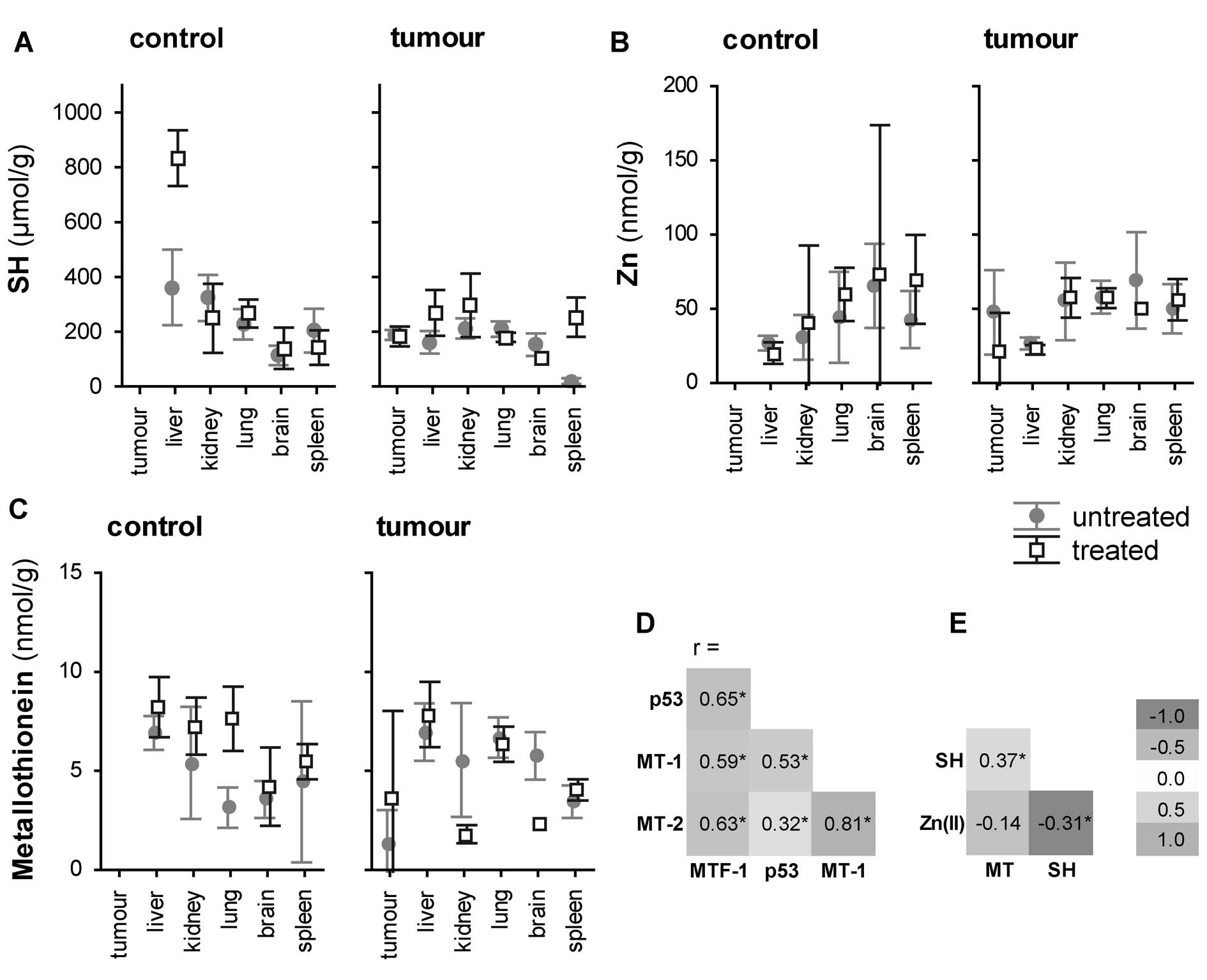
Breast cancer patients negative for the nuclear oestrogen receptor α have a particularly poor prognosis. Therefore, the 4T1 cell line (considered as a triple-negative model) was chosen to induce malignancy in mice. The aim of the present study was to assess if zinc ions, provided in excess, may significantly modify the process of mammary oncogenesis. Zn(II) ions were chosen because of their documented antitumour effects. Zn(II) is also known to induce the expression of metallothioneins (MT) and glutathion (GSH). A total dose of zinc sulphate per one gram of mouse weight used in the experiment was 0.15 mg. We studied the expression of MT1, MT2, TP53 and MTF-1 genes and also examined the effect of the tumour on antioxidant capacity. Tumour-free mice had significantly higher expression levels of the studied genes (p<0.003). Significant differences were also revealed in the gene expression between the tissues (p<0.001). The highest expression levels were observed in the liver. As compared to brain, lung and liver, significantly lower concentrations of MT protein were found in the primary tumour; an inverse trend was observed in the concentration of Zinc(II). In non-tumour mice, the amount of hepatic hydrosulphuryl groups significantly increased by the exposure to Zn(II), but the animals with tumour induction showed no similar trend. The primary tumour size of zinc-treated animals was 20% smaller (p=0.002); however, no significant effect on metastasis progression due to the zinc treatment was discovered. In conclusion, Zn(II) itself may mute the growth of primary breast tumours especially at their early stages.
View Figures

Figure 1

Figure 2

Figure 3

Figure 4

Figure 5

View References

1 

Giacinti L, Claudio PP, Lopez M and Giordano A: Epigenetic information and estrogen receptor alpha expression in breast cancer. Oncologist. 11:1–8. 2006. View Article : Google Scholar : PubMed/NCBI

2 

Yerlikaya A, Okur E and Ulukaya E: The p53-independent induction of apoptosis in breast cancer cells in response to proteasome inhibitor bortezomib. Tumor Biol. 33:1385–1392. 2012. View Article : Google Scholar

3 

Ford CE, Ekstrom EJ and Andersson T: Wnt-5a signaling restores tamoxifen sensitivity in estrogen receptor-negative breast cancer cells (Retracted Article. See vol 107, pg 22360, 2010). Proc Natl Acad Sci USA. 106:3919–3924. 2009. View Article : Google Scholar

4 

Miller FR, Miller BE and Heppner GH: Characterization of metastatic heterogeneity among subpopulations of a single-mouse mammary-tumor: heterogeneity in phenotypic stability. Invasion Metastasis. 3:22–31. 1983.

5 

Tao K, Fang M, Alroy J and Sahagian GG: Imagable 4T1 model for the study of late stage breast cancer. BMC Cancer. 8:2282008. View Article : Google Scholar : PubMed/NCBI

6 

Aslakson CJ and Miller FR: Selective events in the metastatic process defined by analysis of the sequential dissemination of subpopulations of a mouse mammary-tumor. Cancer Res. 52:1399–1405. 1992.PubMed/NCBI

7 

Cui Y, Vogt S, Olson N, Glass AG and Rohan TE: Levels of zinc, selenium, calcium, and iron in benign breast tissue and risk of subsequent breast cancer. Cancer Epidemiol Biomark Prev. 16:1682–1685. 2007. View Article : Google Scholar

8 

Grattan BJ and Freake HC: Zinc and cancer: implications for LIV-1 in breast cancer. Nutrients. 4:648–675. 2012. View Article : Google Scholar : PubMed/NCBI

9 

Chasapis CT, Loutsidou AC, Spiliopoulou CA and Stefanidou ME: Zinc and human health: an update. Arch Toxicol. 86:521–534. 2012. View Article : Google Scholar

10 

Liuzzi JP and Cousins RJ: Mammalian zinc transporters. Annu Rev Nutr. 24:151–172. 2004. View Article : Google Scholar : PubMed/NCBI

11 

Lee R, Woo W, Wu B, Kummer A, Duminy H and Xu Z: Zinc accumulation in N-methyl-N-nitrosourea-induced rat mammary tumors is accompanied by an altered expression of ZnT-1 and metallothionein. Exp Biol Med. 228:689–696. 2003.

12 

Taylor KM, Morgan HE, Johnson A, Hadley LJ and Nicholson RI: Structure-function analysis of LIV-1, the breast cancer-associated protein that belongs to a new subfamily of zinc transporters. Biochem J. 375:51–59. 2003. View Article : Google Scholar : PubMed/NCBI

13 

Kagara N, Tanaka N, Noguchi S and Hirano T: Zinc and its transporter ZIP10 are involved in invasive behavior of breast cancer cells. Cancer Sci. 98:692–697. 2007. View Article : Google Scholar : PubMed/NCBI

14 

Taylor KM, Vichova P, Jordan N, Hiscox S, Hendley R and Nicholson RI: ZIP7-mediated intracellular zinc transport contributes to aberrant growth factor signaling in antihormone-resistant breast cancer cells. Endocrinology. 149:4912–4920. 2008. View Article : Google Scholar : PubMed/NCBI

15 

Maret W: Zinc coordination environments in proteins as redox sensors and signal transducers. Antioxid Redox Signal. 8:1419–1441. 2006. View Article : Google Scholar : PubMed/NCBI

16 

Gumulec J, Masarik M, Krizkova S, et al: Insight to physiology and pathology of zinc(II) ions and their actions in breast and prostate carcinoma. Curr Med Chem. 18:5041–5051. 2011. View Article : Google Scholar : PubMed/NCBI

17 

Gumulec J, Masarik M, Adam V, Eckschlager T, Provaznik I and Kizek R: Serum and tissue zinc in epithelial malignancies: a meta-analysis. PLoS One. 9:e997902014. View Article : Google Scholar : PubMed/NCBI

18 

Gumulec J, Raudenska M, Adam V, Kizek R and Masarik M: Metallothionein - immunohistochemical cancer biomarker: a meta-analysis. PLoS One. 9:e853462014. View Article : Google Scholar : PubMed/NCBI

19 

Holubova M, Axmanova M, Gumulec J, et al: KRAS NF-kappa B is involved in the development of zinc resistance and reduced curability in prostate cancer. Metallomics. 6:1240–1253. 2014. View Article : Google Scholar : PubMed/NCBI

20 

Ruttkay-Nedecky B, Nejdl L, Gumulec J, et al: The role of metallothionein in oxidative stress. Int J Mol Sci. 14:6044–6066. 2013. View Article : Google Scholar : PubMed/NCBI

21 

Sato M and Bremner I: Oxygen free-radicals and metallothionein. Free Radic Biol Med. 14:325–337. 1993. View Article : Google Scholar : PubMed/NCBI

22 

Masarik M, Gumulec J, Hlavna M, et al: Analysis of metallothionein and glutathione in prostate cells as markers of oxidative stress. Int J Mol Med. 30:S46. 2012.

23 

Aschner M, Conklin DR, Yao CP, Allen JW and Tan KH: Induction of astrocyte metallothioneins (MTs) by zinc confers resistance against the acute cytotoxic effects of methylmercury on cell swelling, Na+ uptake, and K+ release. Brain Res. 813:254–261. 1998. View Article : Google Scholar : PubMed/NCBI

24 

Cai L and Cherian MG: Zinc-metallothionein protects from DNA damage induced by radiation better than glutathione and copper- or cadmium-metallothioneins. Toxicol Lett. 136:193–198. 2003. View Article : Google Scholar

25 

Min KS, Nishida K and Onosaka S: Protective effect of metallothionein to ras DNA damage induced by hydrogen peroxide and ferric ion-nitrilotriacetic acid. Chem Biol Interact. 122:137–152. 1999. View Article : Google Scholar

26 

Takahashi S: Molecular functions of metallothionein and its role in hematological malignancies. J Hematol Oncol. 5:412012. View Article : Google Scholar : PubMed/NCBI

27 

Otsuka F, Iwamatsu A, Suzuki K, Ohsawa M, Hamer DH and Koizumi S: Purification and characterization of a protein that binds to metal-responsive elements of the human metallothionein II(a) gene. J Biol Chem. 269:23700–23707. 1994.PubMed/NCBI

28 

Smirnova IV, Bittel DC, Ravindra R, Jiang HM and Andrews GK: Zinc and cadmium can promote rapid nuclear translocation of metal response element-binding transcription factor-1. J Biol Chem. 275:9377–9384. 2000. View Article : Google Scholar : PubMed/NCBI

29 

Fan LZ and Cherian MG: Potential role of p53 on metallothionein induction in human epithelial breast cancer cells. Br J Cancer. 87:1019–1026. 2002. View Article : Google Scholar : PubMed/NCBI

30 

Ostrakhovitch EA, Olsson PE, von Hofsten J and Cherian MG: P53 mediated regulation of metallothionen transcription in breast cancer cells. J Cell Biochem. 102:1571–1583. 2007. View Article : Google Scholar : PubMed/NCBI

31 

Fan S, Smith ML, Rivet DJ, et al: Disruption of p53 function sensitizes breast-cancer MCF-7 cells to cisplatin and pentoxifylline. Cancer Res. 55:1649–1654. 1995.PubMed/NCBI

32 

Woo W and Xu ZM: Body zinc distribution profile during N-methyl-N-nitrosourea-induced mammary tumorigenesis in rats at various levels of dietary zinc intake. Biol Trace Elem Res. 87:157–169. 2002. View Article : Google Scholar : PubMed/NCBI

33 

Masarik M, Gumulec J, Hlavna M, et al: Monitoring of the prostate tumour cells redox state and real-time proliferation by novel biophysical techniques and fluorescent staining. Integr Biol. 4:672–684. 2012. View Article : Google Scholar

34 

Domingo JL, Llobet JM, Paternain JL and Corbella J: Acute zinc intoxication - comparison of the antidotal efficacy of several chelating-agents. Vet Hum Toxicol. 30:224–228. 1988.PubMed/NCBI

35 

Kotoh T, Dhar DK, Masunaga R, et al: Antiangiogenic therapy of human esophageal cancers with thalidomide in nude mice. Surgery. 125:536–544. 1999. View Article : Google Scholar : PubMed/NCBI

36 

Xanthopoulos JM, Romano AE and Majumdar SK: Response of mouse breast cancer cells to anastrozole, tamoxifen, and the combination. J Biomed Biotechnol. 2005:10–19. 2005. View Article : Google Scholar : PubMed/NCBI

37 

Kizek R, Trnkova L and Palecek E: Determination of metallothionein at the femtomole level by constant current stripping chronopotentiometry. Anal Chem. 73:4801–4807. 2001. View Article : Google Scholar : PubMed/NCBI

38 

Ellman GL: Tissue sulfhydryl groups. Arch Biochem Biophys. 82:70–77. 1959. View Article : Google Scholar : PubMed/NCBI

39 

Franklin RB and Costello LC: Zinc as an anti-tumor agent in prostate cancer and in other cancers. Arch Biochem Biophys. 463:211–217. 2007. View Article : Google Scholar : PubMed/NCBI

40 

Hou G, Dick R, Zeng C and Brewer GJ: Comparison of lowering copper levels with tetrathiomolybdate and zinc on mouse tumor and doxorubicin models. Transl Res. 148:309–314. 2006. View Article : Google Scholar : PubMed/NCBI

41 

Silva MP, Silva DM, Conceicao ALC, Ribeiro-Silva A and Poletti ME: Role of Ca, Fe, Cu and Zn in breast cancer: study by X-ray fluorescence techniques and immunohistochemical analysis. X-Ray Spectrom. 42:303–311. 2013. View Article : Google Scholar

42 

Nakshatri H, BhatNakshatri P, Martin DA, Goulet RJ and Sledge GW: Constitutive activation of NF-kappa B during progression of breast cancer to hormone-independent growth. Mol Cell Biol. 17:3629–3639. 1997.PubMed/NCBI

43 

Uzzo RG, Leavis P, Hatch W, et al: Zinc inhibits nuclear factor-kappa B activation and sensitizes prostate cancer cells to cytotoxic agents. Clin Cancer Res. 8:3579–3583. 2002.PubMed/NCBI

44 

Franklin RB and Costello LC: The important role of the apoptotic effects of zinc in the development of cancers. J Cell Biochem. 106:750–757. 2009. View Article : Google Scholar : PubMed/NCBI

45 

Feng P, Li TL, Guan ZX, Franklin RB and Costello LC: Direct effect of zinc on mitochondrial apoptogenesis in prostate cells. Prostate. 52:311–318. 2002. View Article : Google Scholar : PubMed/NCBI

46 

Jones PA and Laird PW: Cancer epigenetics comes of age. Nat Genet. 21:163–167. 1999. View Article : Google Scholar : PubMed/NCBI

47 

Ushijima T and Okochi-Takada E: Aberrant methylations in cancer cells: where do they come from? Cancer Sci. 96:206–211. 2005. View Article : Google Scholar : PubMed/NCBI

48 

Wallwork JC and Duerre JA: Effect of zinc-deficiency on methionine metabolism, methylation reactions and protein-synthesis in isolated perfused rat-liver. J Nutr. 115:252–262. 1985.PubMed/NCBI

49 

Marks PA and Xu WS: Histone deacetylase inhibitors: potential in cancer therapy. J Cell Biochem. 107:600–608. 2009. View Article : Google Scholar : PubMed/NCBI

50 

Finnin MS, Donigian JR and Pavletich NP: Structure of the histone deacetylase SIRT2. Nat Struct Biol. 8:621–625. 2001. View Article : Google Scholar : PubMed/NCBI

51 

Somoza JR, Skene RJ, Katz BA, et al: Structural snapshots of human HDAC8 provide insights into the class I histone deacetylases. Structure. 12:1325–1334. 2004. View Article : Google Scholar

52 

Fatemi M, Hermann A, Pradhan S and Jeltsch A: The activity of the murine DNA methyltransferase Dnmt1 is controlled by interaction of the catalytic domain with the N-terminal part of the enzyme leading to an allosteric activation of the enzyme after binding to methylated DNA. J Mol Biol. 309:1189–1199. 2001. View Article : Google Scholar : PubMed/NCBI

53 

Zhou Q, Atadja P and Davidson NE: Histone deacetylase inhibitor LBH589 reactivates silenced estrogen receptor alpha (ER) gene expression without loss of DNA hypermethylation. Cancer Biol Ther. 6:64–69. 2007. View Article : Google Scholar

54 

Shimizu M, Hochadel JF, Fulmer BA and Waalkes MP: Effect of glutathione depletion and metallothionein gene expression on arsenic-induced cytotoxicity and c-myc expression in vitro. Toxicol Sci. 45:204–211. 1998.PubMed/NCBI

55 

Feng JF, Lu L, Zeng P, et al: Serum total oxidant/antioxidant status and trace element levels in breast cancer patients. Int J Clin Oncol. 17:575–583. 2012. View Article : Google Scholar

56 

Kasapovic J, Pejic S, Todorovic A, Stojiljkovic V and Pajovic SB: Antioxidant status and lipid peroxidation in the blood of breast cancer patients of different ages. Cell Biochem Funct. 26:723–730. 2008. View Article : Google Scholar : PubMed/NCBI

57 

Al-Qubaisi MS, Rasedee A, Flaifel MH, et al: Cytotoxicity of nickel zinc ferrite nanoparticles on cancer cells of epithelial origin. Int J Nanomed. 8:2497–2508. 2013. View Article : Google Scholar

58 

Skrajnowska D, Bobrowska B, Tokarz A, Kuras M, Rybicki P and Wachowicz M: The Effect of Zinc- and copper sulphate supplementation on tumor and hair concentrations of trace elements (Zn, Cu, Fe, Ca, Mg, P) in rats with DMBA-induced breast bancer. Pol J Environ Stud. 20:1585–1592. 2011.

59 

Mills BJ, Broghamer WL, Higgins PJ and Lindeman RD: Inhibition of tumor-growth by zinc depletion of rats. J Nutr. 114:746–752. 1984.PubMed/NCBI

60 

Pories WJ, DeWys WD, Flynn A, Mansour EG and Strain WH: Implications of the inhibition of animal tumors by dietary zinc deficiency. Adv Exp Med Biol. 91:243–257. 1977. View Article : Google Scholar : PubMed/NCBI

61 

Dewys W, Pories WJ, Richter MC and Strain WH: Inhibition of Walker 256 carcinosarcoma growth by dietary zinc deficiency. Proc Soc Exp Biol Med. 135:17–22. 1970. View Article : Google Scholar : PubMed/NCBI

62 

McQuitty JT, Dewys WD, Monaco L, et al: Inhibition of tumor growth by dietary zinc deficiency. Cancer Res. 30:1387–1390. 1970.PubMed/NCBI

63 

Tang DG and Honn KV: Apoptosis of W256 carcinosarcoma cells of the monocytoid origin induced by NDGA involves lipid peroxidation and depletion of GSH: role of 12-lipoxygenase in regulating tumor cell survival. J Cell Physiol. 172:155–170. 1997. View Article : Google Scholar : PubMed/NCBI

64 

Gardner HA, Kellen JA, Wong AHC, Szalai JP and Katic M: Characterization of different cell subpopulations derived from an experimental tumor-model. Cancer Invest. 6:161–165. 1988. View Article : Google Scholar

65 

Costlow ME, Buschow RA and McGuire WL: Prolactin receptors in an estrogen receptor-deficient mammary-carcinoma. Science. 184:85–86. 1974. View Article : Google Scholar : PubMed/NCBI

66 

Kau P, Nagaraja GM, Zheng H, et al: A mouse model for triple-negative breast cancer tumor-initiating cells (TNBC-TICs) exhibits similar aggressive phenotype to the human disease. BMC Cancer. 12:1202012. View Article : Google Scholar

67 

Drasin DJ, Robin TP and Ford HL: Breast cancer epithelial-to-mesenchymal transition: examining the functional consequences of plasticity. Breast Cancer Res. 13:2262011. View Article : Google Scholar : PubMed/NCBI

68 

Pulaski BA and Ostrand-Rosenberg S: Mouse 4T1 breast tumor model. Curr Protoc Immunol. Chapter 20(Unit 20): 22001.

69 

Ames BN: Micronutrients prevent cancer and delay aging. Toxicol Lett. 103:5–18. 1998. View Article : Google Scholar

70 

Ho E: Zinc deficiency, DNA damage and cancer risk. J Nutr Biochem. 15:572–578. 2004. View Article : Google Scholar : PubMed/NCBI

Related Articles

  • Abstract
  • View
  • Download
  • Twitter
Copy and paste a formatted citation
Spandidos Publications style
Sztalmachova M, Gumulec J, Raudenska M, Polanska H, Holubova M, Balvan J, Hudcova K, Knopfova L, Kizek R, Adam V, Adam V, et al: Molecular response of 4T1-induced mouse mammary tumours and healthy tissues to zinc treatment. Int J Oncol 46: 1810-1818, 2015.
APA
Sztalmachova, M., Gumulec, J., Raudenska, M., Polanska, H., Holubova, M., Balvan, J. ... Masarik, M. (2015). Molecular response of 4T1-induced mouse mammary tumours and healthy tissues to zinc treatment. International Journal of Oncology, 46, 1810-1818. https://doi.org/10.3892/ijo.2015.2883
MLA
Sztalmachova, M., Gumulec, J., Raudenska, M., Polanska, H., Holubova, M., Balvan, J., Hudcova, K., Knopfova, L., Kizek, R., Adam, V., Babula, P., Masarik, M."Molecular response of 4T1-induced mouse mammary tumours and healthy tissues to zinc treatment". International Journal of Oncology 46.4 (2015): 1810-1818.
Chicago
Sztalmachova, M., Gumulec, J., Raudenska, M., Polanska, H., Holubova, M., Balvan, J., Hudcova, K., Knopfova, L., Kizek, R., Adam, V., Babula, P., Masarik, M."Molecular response of 4T1-induced mouse mammary tumours and healthy tissues to zinc treatment". International Journal of Oncology 46, no. 4 (2015): 1810-1818. https://doi.org/10.3892/ijo.2015.2883
Copy and paste a formatted citation
x
Spandidos Publications style
Sztalmachova M, Gumulec J, Raudenska M, Polanska H, Holubova M, Balvan J, Hudcova K, Knopfova L, Kizek R, Adam V, Adam V, et al: Molecular response of 4T1-induced mouse mammary tumours and healthy tissues to zinc treatment. Int J Oncol 46: 1810-1818, 2015.
APA
Sztalmachova, M., Gumulec, J., Raudenska, M., Polanska, H., Holubova, M., Balvan, J. ... Masarik, M. (2015). Molecular response of 4T1-induced mouse mammary tumours and healthy tissues to zinc treatment. International Journal of Oncology, 46, 1810-1818. https://doi.org/10.3892/ijo.2015.2883
MLA
Sztalmachova, M., Gumulec, J., Raudenska, M., Polanska, H., Holubova, M., Balvan, J., Hudcova, K., Knopfova, L., Kizek, R., Adam, V., Babula, P., Masarik, M."Molecular response of 4T1-induced mouse mammary tumours and healthy tissues to zinc treatment". International Journal of Oncology 46.4 (2015): 1810-1818.
Chicago
Sztalmachova, M., Gumulec, J., Raudenska, M., Polanska, H., Holubova, M., Balvan, J., Hudcova, K., Knopfova, L., Kizek, R., Adam, V., Babula, P., Masarik, M."Molecular response of 4T1-induced mouse mammary tumours and healthy tissues to zinc treatment". International Journal of Oncology 46, no. 4 (2015): 1810-1818. https://doi.org/10.3892/ijo.2015.2883
Follow us
  • Twitter
  • LinkedIn
  • Facebook
About
  • Spandidos Publications
  • Careers
  • Cookie Policy
  • Privacy Policy
How can we help?
  • Help
  • Live Chat
  • Contact
  • Email to our Support Team