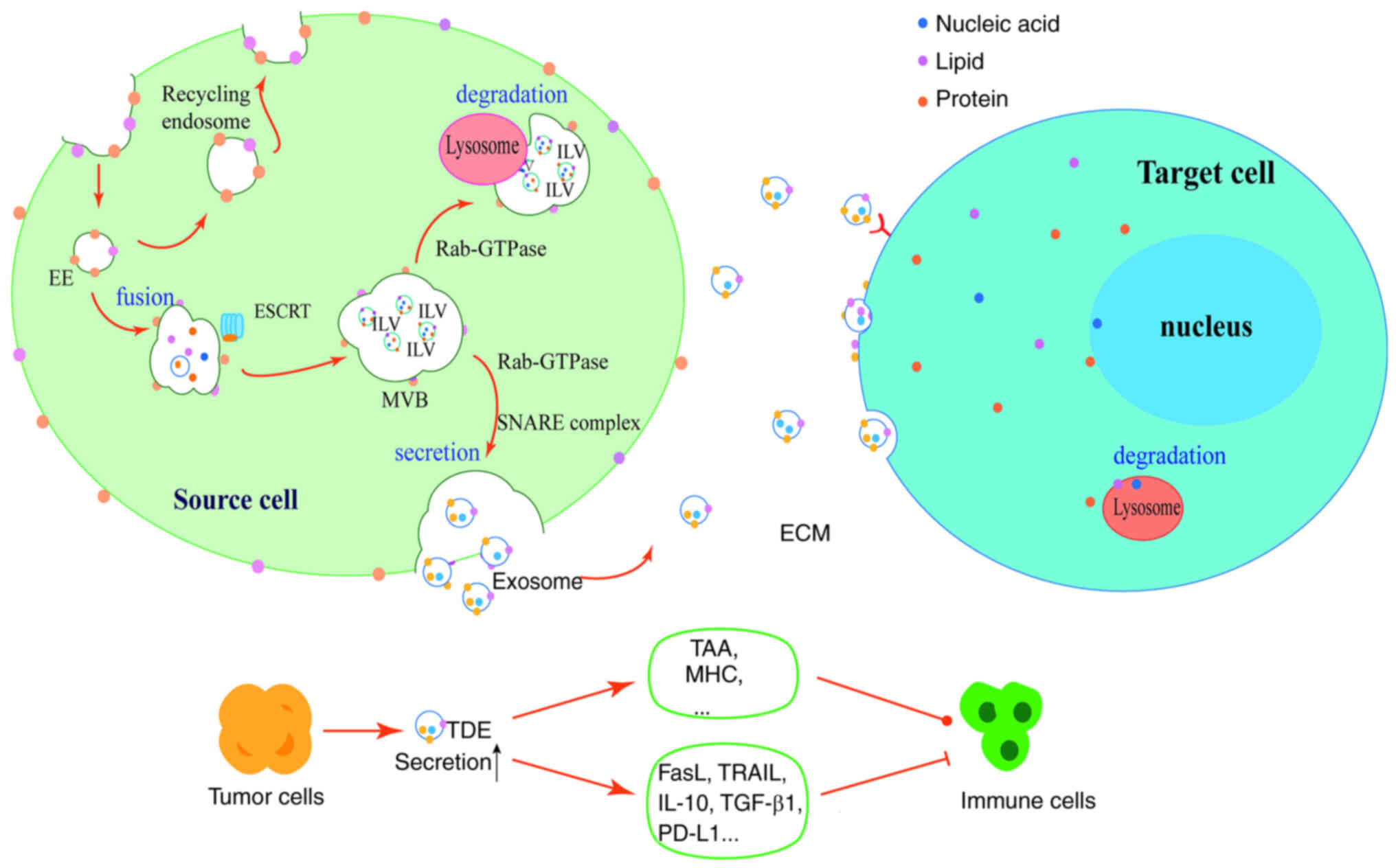
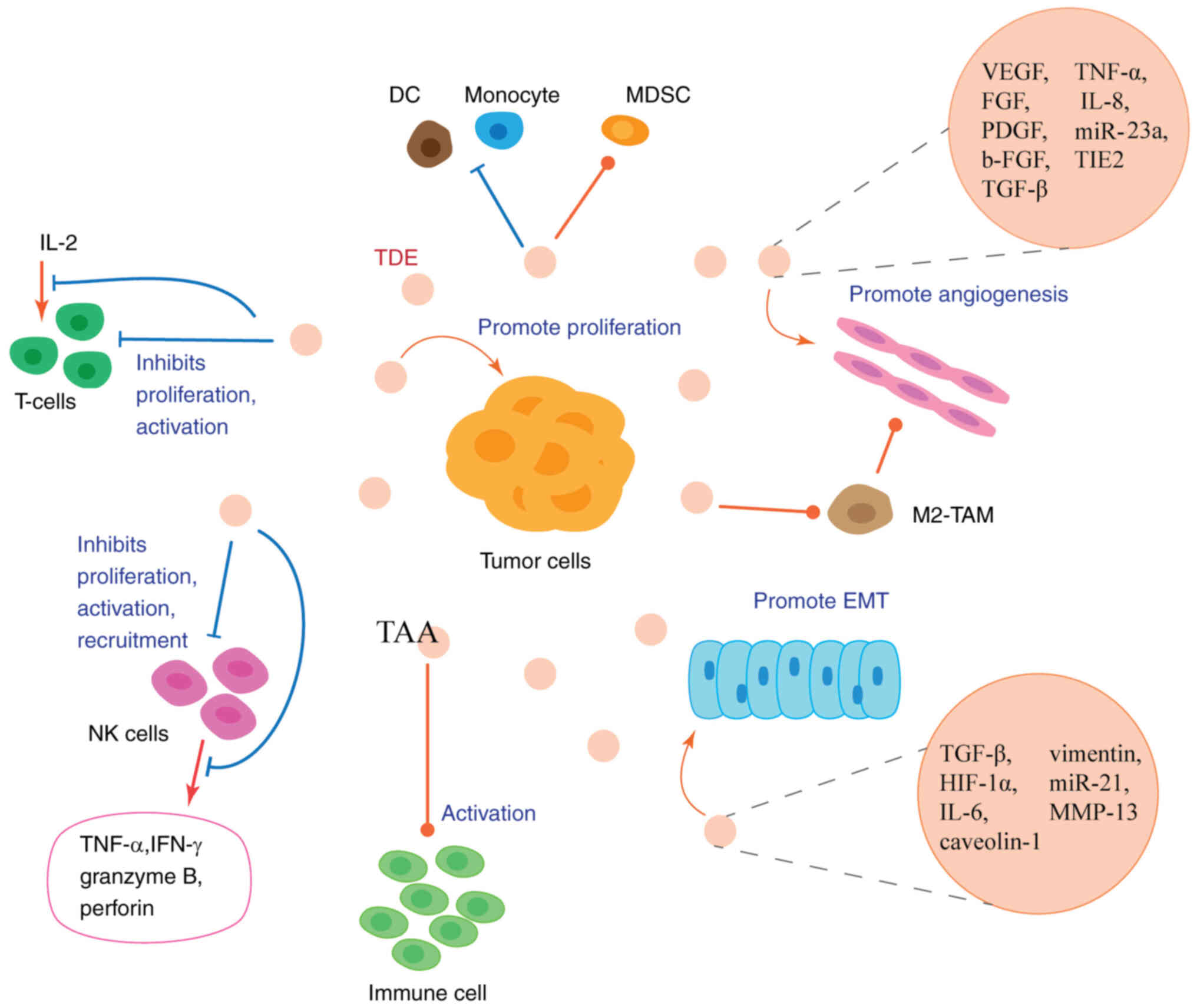
|
1
|
Hao Q, Wu Y, Wu Y, Wang P and Vadgama JV:
Tumor-Derived exosomes in tumor-induced immune suppression. Int J
Mol Sci. 23:14612022. View Article : Google Scholar : PubMed/NCBI
|
|
2
|
Fu M, Gu J, Jiang P, Qian H, Xu W and
Zhang X: Exosomes in gastric cancer: Roles, mechanisms, and
applications. Mol Cancer. 18:412019. View Article : Google Scholar : PubMed/NCBI
|
|
3
|
Gurung S, Perocheau D, Touramanidou L and
Baruteau J: The exosome journey: From biogenesis to uptake and
intracellular signalling. Cell Commun Signal. 19:472021. View Article : Google Scholar : PubMed/NCBI
|
|
4
|
Whiteside TL: Tumor-Derived exosomes and
their role in cancer progression. Adv Clin Chem. 74:103–141. 2016.
View Article : Google Scholar : PubMed/NCBI
|
|
5
|
Hurley JH and Ren X: The circuitry of
cargo flux in the ESCRT pathway. J Cell Biol. 185:185–187. 2009.
View Article : Google Scholar : PubMed/NCBI
|
|
6
|
Hou PP and Chen HZ: Extracellular vesicles
in the tumor immune microenvironment. Cancer Lett. 516:48–56. 2021.
View Article : Google Scholar : PubMed/NCBI
|
|
7
|
Wei D, Zhan W, Gao Y, Huang L, Gong R,
Wang W, Zhang R, Wu Y, Gao S and Kang T: RAB31 marks and controls
an ESCRT-independent exosome pathway. Cell Res. 31:157–177. 2021.
View Article : Google Scholar : PubMed/NCBI
|
|
8
|
Koh HM, Jang BG and Kim DC: Prognostic
significance of Rab27 expression in solid cancer: A systematic
review and meta-analysis. Sci Rep. 10:141362020. View Article : Google Scholar : PubMed/NCBI
|
|
9
|
Borchers AC, Langemeyer L and Ungermann C:
Who's in control? Principles of Rab GTPase activation in
endolysosomal membrane trafficking and beyond. J Cell Biol.
220:e2021051202021. View Article : Google Scholar : PubMed/NCBI
|
|
10
|
Mashouri L, Yousefi H, Aref AR, Ahadi AM,
Molaei F and Alahari SK: Exosomes: Composition, biogenesis, and
mechanisms in cancer metastasis and drug resistance. Mol Cancer.
18:752019. View Article : Google Scholar : PubMed/NCBI
|
|
11
|
van Niel G, Porto-Carreiro I, Simoes S and
Raposo G: Exosomes: A common pathway for a specialized function. J
Biochem. 140:13–21. 2006. View Article : Google Scholar : PubMed/NCBI
|
|
12
|
Wei Z, Batagov AO, Schinelli S, Wang J,
Wang Y, El Fatimy R, Rabinovsky R, Balaj L, Chen CC, Hochberg F, et
al: Coding and noncoding landscape of extracellular RNA released by
human glioma stem cells. Nat Commun. 8:11452017. View Article : Google Scholar : PubMed/NCBI
|
|
13
|
Kalluri R: The biology and function of
exosomes in cancer. J Clin Invest. 126:1208–1215. 2016. View Article : Google Scholar : PubMed/NCBI
|
|
14
|
He G, Peng X, Wei S, Yang S, Li X, Huang
M, Tang S, Jin H, Liu J, Zhang S, et al: Exosomes in the hypoxic
TME: From release, uptake and biofunctions to clinical
applications. Mol Cancer. 21:192022. View Article : Google Scholar : PubMed/NCBI
|
|
15
|
Dorayappan KDP, Wanner R, Wallbillich JJ,
Saini U, Zingarelli R, Suarez AA, Cohn DE and Selvendiran K:
Hypoxia-induced exosomes contribute to a more aggressive and
chemoresistant ovarian cancer phenotype: A novel mechanism linking
STAT3/Rab proteins. Oncogene. 37:3806–3821. 2018. View Article : Google Scholar : PubMed/NCBI
|
|
16
|
Lewitowicz P, Matykiewicz J, Koziel D,
Chrapek M, Horecka-Lewitowicz A and Gluszek S: CD63 and GLUT-1
overexpression could predict a poor clinical outcome in GIST: A
study of 54 cases with follow-up. Gastroenterol Res Pract.
2016:64783742016. View Article : Google Scholar : PubMed/NCBI
|
|
17
|
Valdez SR, Patterson SI, Ezquer ME,
Torrecilla M, Lama MC and Seltzer AM: Acute sublethal global
hypoxia induces transient increase of GAP-43 immunoreactivity in
the striatum of neonatal rats. Synapse. 61:124–137. 2007.
View Article : Google Scholar : PubMed/NCBI
|
|
18
|
Liu J, Ren L, Li S, Li W, Zheng X, Yang Y,
Fu W, Yi J, Wang J and Du G: The biology, function, and
applications of exosomes in cancer. Acta Pharm Sin B. 11:2783–2797.
2021. View Article : Google Scholar : PubMed/NCBI
|
|
19
|
Bobrie A and Théry C: Exosomes and
communication between tumours and the immune system: Are all
exosomes equal? Biochem Soc Trans. 41:263–267. 2013. View Article : Google Scholar : PubMed/NCBI
|
|
20
|
Trams EG, Lauter CJ, Salem N Jr and Heine
U: Exfoliation of membrane ecto-enzymes in the form of
micro-vesicles. Biochim Biophys Acta. 645:63–70. 1981. View Article : Google Scholar : PubMed/NCBI
|
|
21
|
Wan Z, Gao X, Dong Y, Zhao Y, Chen X, Yang
G and Liu L: Exosome-mediated cell-cell communication in tumor
progression. Am J Cancer Res. 8:1661–1673. 2018.PubMed/NCBI
|
|
22
|
Mulcahy LA, Pink RC and Carter DR: Routes
and mechanisms of extracellular vesicle uptake. J Extracell
Vesicles. 3:246412014. View Article : Google Scholar : PubMed/NCBI
|
|
23
|
Hoshino A, Costa-Silva B, Shen TL,
Rodrigues G, Hashimoto A, Tesic Mark M, Molina H, Kohsaka S, Di
Giannatale A, Ceder S, et al: Tumour exosome integrins determine
organotropic metastasis. Nature. 527:329–335. 2015. View Article : Google Scholar : PubMed/NCBI
|
|
24
|
Tian X, Shen H, Li Z, Wang T and Wang S:
Tumor-derived exosomes, myeloid-derived suppressor cells, and tumor
microenvironment. J Hematol Oncol. 12:842019. View Article : Google Scholar : PubMed/NCBI
|
|
25
|
Whiteside TL, Diergaarde B and Hong CS:
Tumor-Derived Exosomes (TEX) and their role in immuno-oncology. Int
J Mol Sci. 22:62342021. View Article : Google Scholar : PubMed/NCBI
|
|
26
|
Wang B, Tan Z and Guan F: Tumor-Derived
exosomes mediate the instability of cadherins and promote tumor
progression. Int J Mol Sci. 20:36522019. View Article : Google Scholar : PubMed/NCBI
|
|
27
|
Jiang C, Zhang N, Hu X and Wang H:
Tumor-associated exosomes promote lung cancer metastasis through
multiple mechanisms. Mol Cancer. 20:1172021. View Article : Google Scholar : PubMed/NCBI
|
|
28
|
Saleem SN and Abdel-Mageed AB:
Tumor-derived exosomes in oncogenic reprogramming and cancer
progression. Cell Mol Life Sci. 72:1–10. 2015. View Article : Google Scholar : PubMed/NCBI
|
|
29
|
Rodrigues-Junior DM, Tsirigoti C, Lim SK,
Heldin CH and Moustakas A: Extracellular vesicles and transforming
growth factor β signaling in cancer. Front Cell Dev Biol.
10:8499382022. View Article : Google Scholar : PubMed/NCBI
|
|
30
|
Hao Y, Baker D and Ten Dijke P:
TGF-β-Mediated epithelial-mesenchymal transition and cancer
metastasis. Int J Mol Sci. 20:27672019. View Article : Google Scholar : PubMed/NCBI
|
|
31
|
Cho JA, Park H, Lim EH and Lee KW:
Exosomes from breast cancer cells can convert adipose
tissue-derived mesenchymal stem cells into myofibroblast-like
cells. Int J Oncol. 40:130–138. 2012.PubMed/NCBI
|
|
32
|
Hsu YL, Hung JY, Chang WA, Lin YS, Pan YC,
Tsai PH, Wu CY and Kuo PL: Hypoxic lung cancer-secreted exosomal
miR-23a increased angiogenesis and vascular permeability by
targeting prolyl hydroxylase and tight junction protein ZO-1.
Oncogene. 36:4929–4942. 2017. View Article : Google Scholar : PubMed/NCBI
|
|
33
|
Alzahrani FA, El-Magd MA,
Abdelfattah-Hassan A, Saleh AA, Saadeldin IM, El-Shetry ES, Badawy
AA and Alkarim S: Potential effect of exosomes derived from cancer
stem cells and MSCs on progression of DEN-Induced HCC in rats. Stem
Cells Int. 2018:80589792018. View Article : Google Scholar : PubMed/NCBI
|
|
34
|
Karabid NM, Wiedemann T, Gulde S, Mohr H,
Segaran RC, Geppert J, Rohm M, Vitale G, Gaudenzi G, Dicitore A, et
al: Angpt2/Tie2 autostimulatory loop controls tumorigenesis. EMBO
Mol Med. 14:e143642022. View Article : Google Scholar : PubMed/NCBI
|
|
35
|
Du S, Qian J, Tan S, Li W, Liu P, Zhao J,
Zeng Y, Xu L, Wang Z and Cai J: Tumor cell-derived exosomes deliver
TIE2 protein to macrophages to promote angiogenesis in cervical
cancer. Cancer Lett. 529:168–179. 2022. View Article : Google Scholar : PubMed/NCBI
|
|
36
|
Liu Y, Gu Y, Han Y, Zhang Q, Jiang Z,
Zhang X, Huang B, Xu X, Zheng J and Cao X: Tumor Exosomal RNAs
promote lung pre-metastatic niche formation by activating alveolar
epithelial TLR3 to recruit neutrophils. Cancer Cell. 30:243–256.
2016. View Article : Google Scholar : PubMed/NCBI
|
|
37
|
Fabbri M, Paone A, Calore F, Galli R,
Gaudio E, Santhanam R, Lovat F, Fadda P, Mao C, Nuovo GJ, et al:
MicroRNAs bind to Toll-like receptors to induce prometastatic
inflammatory response. Proc Natl Acad Sci USA. 109:E2110–E2116.
2012. View Article : Google Scholar : PubMed/NCBI
|
|
38
|
Zhou X, Xie F, Wang L, Zhang L, Zhang S,
Fang M and Zhou F: The function and clinical application of
extracellular vesicles in innate immune regulation. Cell Mol
Immunol. 17:323–334. 2020. View Article : Google Scholar : PubMed/NCBI
|
|
39
|
Naseri M, Bozorgmehr M, Zöller M, Ranaei
Pirmardan E and Madjd Z: Tumor-derived exosomes: The next
generation of promising cell-free vaccines in cancer immunotherapy.
Oncoimmunology. 9:17799912020. View Article : Google Scholar : PubMed/NCBI
|
|
40
|
Li W, Mu D, Tian F, Hu Y, Jiang T, Han Y,
Chen J, Han G and Li X: Exosomes derived from Rab27a-overexpressing
tumor cells elicit efficient induction of antitumor immunity. Mol
Med Rep. 8:1876–1882. 2013. View Article : Google Scholar : PubMed/NCBI
|
|
41
|
Diamond JM, Vanpouille-Box C, Spada S,
Rudqvist NP, Chapman JR, Ueberheide BM, Pilones KA, Sarfraz Y,
Formenti SC and Demaria S: Exosomes Shuttle TREX1-Sensitive
IFN-Stimulatory dsDNA from irradiated cancer cells to DCs. Cancer
Immunol Res. 6:910–920. 2018. View Article : Google Scholar : PubMed/NCBI
|
|
42
|
Plebanek MP, Angeloni NL, Vinokour E, Li
J, Henkin A, Martinez-Marin D, Filleur S, Bhowmick R, Henkin J,
Miller SD, et al: Pre-metastatic cancer exosomes induce immune
surveillance by patrolling monocytes at the metastatic niche. Nat
Commun. 8:13192017. View Article : Google Scholar : PubMed/NCBI
|
|
43
|
Wang M and Zhang B: The immunomodulation
potential of exosomes in tumor microenvironment. J Immunol Res.
2021:37103722021. View Article : Google Scholar : PubMed/NCBI
|
|
44
|
Huntington ND, Cursons J and Rautela J:
The cancer-natural killer cell immunity cycle. Nat Rev Cancer.
20:437–454. 2020. View Article : Google Scholar : PubMed/NCBI
|
|
45
|
Batista IA, Quintas ST and Melo SA: The
interplay of exosomes and NK cells in cancer biology. Cancers
(Basel). 13:4732021. View Article : Google Scholar : PubMed/NCBI
|
|
46
|
Hong CS, Sharma P, Yerneni SS, Simms P,
Jackson EK, Whiteside TL and Boyiadzis M: Circulating exosomes
carrying an immunosuppressive cargo interfere with cellular
immunotherapy in acute myeloid leukemia. Sci Rep. 7:146842017.
View Article : Google Scholar : PubMed/NCBI
|
|
47
|
Liu C, Yu S, Zinn K, Wang J, Zhang L, Jia
Y, Kappes JC, Barnes S, Kimberly RP, Grizzle WE and Zhang HG:
Murine mammary carcinoma exosomes promote tumor growth by
suppression of NK cell function. J Immunol. 176:1375–1385. 2006.
View Article : Google Scholar : PubMed/NCBI
|
|
48
|
Paul S and Lal G: The molecular mechanism
of natural killer cells function and its importance in cancer
immunotherapy. Front Immunol. 8:11242017. View Article : Google Scholar : PubMed/NCBI
|
|
49
|
Hosseini R, Sarvnaz H, Arabpour M, Ramshe
SM, Asef-Kabiri L, Yousefi H, Akbari ME and Eskandari N: Cancer
exosomes and natural killer cells dysfunction: Biological roles,
clinical significance and implications for immunotherapy. Mol
Cancer. 21:152022. View Article : Google Scholar : PubMed/NCBI
|
|
50
|
Liu S, Galat V, Galat Y, Lee YKA,
Wainwright D and Wu J: NK cell-based cancer immunotherapy: From
basic biology to clinical development. J Hematol Oncol. 14:1–17.
2021. View Article : Google Scholar : PubMed/NCBI
|
|
51
|
Pritchard A, Tousif S, Wang Y, Hough K,
Khan S, Strenkowski J, Chacko BK, Darley-Usmar VM and Deshane JS:
Lung tumor cell-derived exosomes promote M2 macrophage
polarization. Cells. 9:13032020. View Article : Google Scholar : PubMed/NCBI
|
|
52
|
Baig MS, Roy A, Rajpoot S, Liu D, Savai R,
Banerjee S, Kawada M, Faisal SM, Saluja R, Saqib U, et al:
Tumor-derived exosomes in the regulation of macrophage
polarization. Inflamm Res. 69:435–451. 2020. View Article : Google Scholar : PubMed/NCBI
|
|
53
|
Li X, Lei Y, Wu M and Li N: Regulation of
macrophage activation and polarization by HCC-Derived Exosomal
lncRNA TUC339. Int J Mol Sci. 19:29582018. View Article : Google Scholar : PubMed/NCBI
|
|
54
|
Panigrahi GK, Praharaj PP, Peak TC, Long
J, Singh R, Rhim JS, Abd Elmageed ZY and Deep G: Hypoxia-induced
exosome secretion promotes survival of African-American and
Caucasian prostate cancer cells. Sci Rep. 8:38532018. View Article : Google Scholar : PubMed/NCBI
|
|
55
|
Wieckowski EU, Visus C, Szajnik M,
Szczepanski MJ, Storkus WJ and Whiteside TL: Tumor-derived
microvesicles promote regulatory T cell expansion and induce
apoptosis in tumor-reactive activated CD8+ T lymphocytes. J
Immunol. 183:3720–3730. 2009. View Article : Google Scholar : PubMed/NCBI
|
|
56
|
Rasihashemi SZ, Rezazadeh Gavgani E,
Majidazar R, Seraji P, Oladghaffari M, Kazemi T and Lotfinejad P:
Tumor-derived exosomal PD-L1 in progression of cancer and
immunotherapy. J Cell Physiol. 237:1648–1660. 2022. View Article : Google Scholar : PubMed/NCBI
|
|
57
|
Yang Y, Li CW, Chan LC, Wei Y, Hsu JM, Xia
W, Cha JH, Hou J, Hsu JL, Sun L and Hung MC: Exosomal PD-L1 harbors
active defense function to suppress T cell killing of breast cancer
cells and promote tumor growth. Cell Res. 28:862–864. 2018.
View Article : Google Scholar : PubMed/NCBI
|
|
58
|
Himes BT, Peterson TE, de Mooij T, Garcia
LMC, Jung MY, Uhm S, Yan D, Tyson J, Jin-Lee HJ, Parney D, et al:
The role of extracellular vesicles and PD-L1 in
glioblastoma-mediated immunosuppressive monocyte induction. Neuro
Oncol. 22:967–978. 2020. View Article : Google Scholar : PubMed/NCBI
|
|
59
|
Zhou K, Guo S, Li F, Sun Q and Liang G:
Exosomal PD-L1: New insights into tumor immune Escape mechanisms
and therapeutic strategies. Front Cell Dev Biol. 8:5692192020.
View Article : Google Scholar : PubMed/NCBI
|
|
60
|
Maybruck BT, Pfannenstiel LW, Diaz-Montero
M and Gastman BR: Tumor-derived exosomes induce CD8+ T cell
suppressors. J Immunother Cancer. 5:652017. View Article : Google Scholar : PubMed/NCBI
|
|
61
|
Czystowska-Kuzmicz M, Sosnowska A, Nowis
D, Ramji K, Szajnik M, Chlebowska-Tuz J, Wolinska E, Gaj P, Grazul
M, Pilch Z, et al: Small extracellular vesicles containing
arginase-1 suppress T-cell responses and promote tumor growth in
ovarian carcinoma. Nat Commun. 10:30002019. View Article : Google Scholar : PubMed/NCBI
|
|
62
|
Whiteside TL: The role of tumor-derived
exosomes (TEX) in shaping anti-tumor immune competence. Cells.
10:30542021. View Article : Google Scholar : PubMed/NCBI
|
|
63
|
Azambuja JH, Ludwig N, Braganhol E and
Whiteside TL: Inhibition of the adenosinergic pathway in cancer
rejuvenates innate and adaptive immunity. Int J Mol Sci.
20:56982019. View Article : Google Scholar : PubMed/NCBI
|
|
64
|
Hosseini R, Asef-Kabiri L, Yousefi H,
Sarvnaz H, Salehi M, Akbari ME and Eskandari N: The roles of
tumor-derived exosomes in altered differentiation, maturation and
function of dendritic cells. Mol Cancer. 20:832021. View Article : Google Scholar : PubMed/NCBI
|
|
65
|
Ning Y, Shen K, Wu Q, Sun X, Bai Y, Xie Y,
Pan J and Qi C: Tumor exosomes block dendritic cells maturation to
decrease the T cell immune response. Immunol Lett. 199:36–43. 2018.
View Article : Google Scholar : PubMed/NCBI
|
|
66
|
Olejarz W, Dominiak A, Zolnierzak A,
Kubiak-Tomaszewska G and Lorenc T: Tumor-Derived exosomes in
immunosuppression and immunotherapy. J Immunol Res.
2020:62724982020. View Article : Google Scholar : PubMed/NCBI
|
|
67
|
Guo X, Qiu W, Liu Q, Qian M, Wang S, Zhang
Z, Gao X, Chen Z, Xue H and Li G: Immunosuppressive effects of
hypoxia-induced glioma exosomes through myeloid-derived suppressor
cells via the miR-10a/Rora and miR-21/Pten Pathways. Oncogene.
37:4239–4259. 2018. View Article : Google Scholar : PubMed/NCBI
|
|
68
|
Xiang X, Poliakov A, Liu C, Liu Y, Deng
ZB, Wang J, Cheng Z, Shah SV, Wang GJ, Zhang L, et al: Induction of
myeloid-derived suppressor cells by tumor exosomes. Int J Cancer.
124:2621–2633. 2009. View Article : Google Scholar : PubMed/NCBI
|
|
69
|
Jones LB, Bell CR, Bibb KE, Gu L, Coats MT
and Matthews QL: Pathogens and their effect on exosome biogenesis
and composition. Biomedicines. 6:792018. View Article : Google Scholar : PubMed/NCBI
|
|
70
|
Toyofuku M, Nomura N and Eberl L: Types
and origins of bacterial membrane vesicles. Nat Rev Microbiol.
17:13–24. 2019. View Article : Google Scholar : PubMed/NCBI
|
|
71
|
Shimoda A, Ueda K, Nishiumi S,
Murata-Kamiya N, Mukai SA, Sawada S, Azuma T, Hatakeyama M and
Akiyoshi K: Exosomes as nanocarriers for systemic delivery of the
Helicobacter pylori virulence factor CagA. Sci Rep. 6:183462016.
View Article : Google Scholar : PubMed/NCBI
|
|
72
|
Xia X, Zhang L, Chi J, Li H, Liu X, Hu T,
Li R, Guo Y, Zhang X, Wang H, et al: Helicobacter pylori infection
impairs endothelial function through an exosome-mediated mechanism.
J Am Heart Assoc. 9:e0141202020. View Article : Google Scholar : PubMed/NCBI
|
|
73
|
Oster P, Vaillant L, Riva E, McMillan B,
Begka C, Truntzer C, Richard C, Leblond MM, Messaoudene M, Machremi
E, et al: Helicobacter pylori infection has a detrimental impact on
the efficacy of cancer immunotherapies. Gut. 71:457–466. 2022.
View Article : Google Scholar : PubMed/NCBI
|
|
74
|
Che Y, Geng B, Xu Y, Miao X, Chen L, Mu X,
Pan J, Zhang C, Zhao T, Wang C, et al: Helicobacter pylori-induced
exosomal MET educates tumour-associated macrophages to promote
gastric cancer progression. J Cell Mol Med. 22:5708–5719. 2018.
View Article : Google Scholar : PubMed/NCBI
|
|
75
|
Brennan CA and Garrett WS: Fusobacterium
nucleatum-symbiont, opportunist and oncobacterium. Nat Rev
Microbiol. 17:156–166. 2019. View Article : Google Scholar : PubMed/NCBI
|
|
76
|
Gholizadeh P, Eslami H and Kafil HS:
Carcinogenesis mechanisms of Fusobacterium nucleatum. Biomed
Pharmacother. 89:918–925. 2017. View Article : Google Scholar : PubMed/NCBI
|
|
77
|
Guo S, Chen J, Chen F, Zeng Q, Liu WL and
Zhang G: Exosomes derived from Fusobacterium nucleatum-infected
colorectal cancer cells facilitate tumour metastasis by selectively
carrying miR-1246/92b-3p/27a-3p and CXCL16. Gut. Nov 10–2020.(Epub
ahead of print).
|
|
78
|
Kapoor NR, Chadha R, Kumar S, Choedon T,
Reddy VS and Kumar V: The HBx gene of hepatitis B virus can
influence hepatic microenvironment via exosomes by transferring its
mRNA and protein. Virus Res. 240:166–174. 2017. View Article : Google Scholar : PubMed/NCBI
|
|
79
|
Jiang Y, Han Q, Zhao H and Zhang J: The
Mechanisms of HBV–Induced hepatocellular carcinoma. J Hepatocell
Carcinoma. 8:435–450. 2021. View Article : Google Scholar : PubMed/NCBI
|
|
80
|
Li S, Li S, Wu S and Chen L: Exosomes
modulate the viral replication and host immune responses in HBV
infection. Biomed Res Int. 2019:21039432019.PubMed/NCBI
|
|
81
|
Shi Y, Du L, Lv D, Li H, Shang J, Lu J,
Zhou L, Bai L and Tang H: Exosomal interferon-induced transmembrane
protein 2 transmitted to dendritic cells inhibits interferon alpha
pathway activation and blocks anti-hepatitis B virus efficacy of
exogenous interferon alpha. Hepatology. 69:2396–2413.
2019.PubMed/NCBI
|
|
82
|
Ye L, Zhu Z, Chen X, Zhang H, Huang J, Gu
S and Zhao X: The importance of exosomal PD-L1 in cancer
progression and its potential as a therapeutic target. Cells.
10:32472021. View Article : Google Scholar : PubMed/NCBI
|
|
83
|
Rizwan MN, Ma Y, Nenkov M, Jin L, Schröder
DC, Westermann M, Gaßler N and Chen Y: Tumor-derived exosomes: Key
players in non-small cell lung cancer metastasis and their
implication for targeted therapy. Mol Carcinog. 61:269–280. 2022.
View Article : Google Scholar : PubMed/NCBI
|
|
84
|
Jing C, Cao H, Qin X, Yu S, Wu J, Wang Z,
Ma R and Feng J: Exosome-mediated gefitinib resistance in lung
cancer HCC827 cells via delivery of miR-21. Oncol Lett.
15:9811–9817. 2018.PubMed/NCBI
|
|
85
|
Lin S, Xu Y, Gan Z, Han K, Hu H, Yao Y,
Huang M and Min D: Monitoring cancer stem cells: Insights into
clinical oncology. Onco Targets Ther. 9:731–740. 2016.PubMed/NCBI
|
|
86
|
Fatima F and Nawaz M: Stem cell-derived
exosomes: Roles in stromal remodeling, tumor progression, and
cancer immunotherapy. Chin J Cancer. 34:541–553. 2015. View Article : Google Scholar : PubMed/NCBI
|
|
87
|
Clara JA, Monge C, Yang Y and Takebe N:
Targeting signalling pathways and the immune microenvironment of
cancer stem cells-a clinical update. Nat Rev Clin Oncol.
17:204–232. 2020. View Article : Google Scholar : PubMed/NCBI
|
|
88
|
Skog J, Würdinger T, van Rijn S, Meijer
DH, Gainche L, Sena-Esteves M, Curry WT Jr, Carter BS, Krichevsky
AM and Breakefield XO: Glioblastoma microvesicles transport RNA and
proteins that promote tumour growth and provide diagnostic
biomarkers. Nat Cell Biol. 10:1470–1476. 2008. View Article : Google Scholar : PubMed/NCBI
|
|
89
|
Muller L, Muller-Haegele S, Mitsuhashi M,
Gooding W, Okada H and Whiteside TL: Exosomes isolated from plasma
of glioma patients enrolled in a vaccination trial reflect
antitumor immune activity and might predict survival.
Oncoimmunology. 4:e10083472015. View Article : Google Scholar : PubMed/NCBI
|
|
90
|
Kim DH, Kim H, Choi YJ, Kim SY, Lee JE,
Sung KJ, Sung YH, Pack CG, Jung MK, Han B, et al: Exosomal PD-L1
promotes tumor growth through immune escape in non-small cell lung
cancer. Exp Mol Med. 51:1–13. 2019. View Article : Google Scholar
|
|
91
|
Poggio M, Hu T, Pai CC, Chu B, Belair CD,
Chang A, Montabana E, Lang UE, Fu Q, Fong L and Blelloch R:
Suppression of exosomal PD-L1 induces systemic anti-tumor immunity
and memory. Cell. 177:414–427.e13. 2019. View Article : Google Scholar : PubMed/NCBI
|
|
92
|
Fan Y, Che X, Qu J, Hou K, Wen T, Li Z, Li
C, Wang S, Xu L, Liu Y and Qu X: Exosomal PD-L1 retains
immunosuppressive activity and is associated with gastric cancer
prognosis. Ann Surg Oncol. 26:3745–3755. 2019. View Article : Google Scholar : PubMed/NCBI
|
|
93
|
Chen G, Huang AC, Zhang W, Zhang G, Wu M,
Xu W, Yu Z, Yang J, Wang B, Sun H, et al: Exosomal PD-L1
contributes to immunosuppression and is associated with anti-PD-1
response. Nature. 560:382–386. 2018. View Article : Google Scholar : PubMed/NCBI
|
|
94
|
Cordonnier M, Nardin C, Chanteloup G,
Derangere V, Algros MP, Arnould L, Garrido C, Aubin F and Gobbo J:
Tracking the evolution of circulating exosomal-PD-L1 to monitor
melanoma patients. J Extracell Vesicles. 9:17108992020. View Article : Google Scholar : PubMed/NCBI
|
|
95
|
Shtam TA, Kovalev RA, Varfolomeeva EY,
Makarov EM, Kil YV and Filatov MV: Exosomes are natural carriers of
exogenous siRNA to human cells in vitro. Cell Commun Signal.
11:882013. View Article : Google Scholar : PubMed/NCBI
|
|
96
|
Kim MS, Haney MJ, Zhao Y, Yuan D, Deygen
I, Klyachko NL, Kabanov AV and Batrakova EV: Engineering
macrophage-derived exosomes for targeted paclitaxel delivery to
pulmonary metastases: In vitro and in vivo evaluations.
Nanomedicine. 14:195–204. 2018. View Article : Google Scholar : PubMed/NCBI
|
|
97
|
Taghikhani A, Farzaneh F, Sharifzad F,
Mardpour S, Ebrahimi M and Hassan ZM: Engineered tumor-derived
extracellular vesicles: Potentials in cancer immunotherapy. Front
Immunol. 11:2212020. View Article : Google Scholar : PubMed/NCBI
|
|
98
|
Xu Z, Zeng S, Gong Z and Yan Y:
Exosome-based immunotherapy: A promising approach for cancer
treatment. Mol Cancer. 19:1602020. View Article : Google Scholar : PubMed/NCBI
|
|
99
|
Zhu L, Kalimuthu S, Gangadaran P, Oh JM,
Lee HW, Baek SH, Jeong SY, Lee SW, Lee J and Ahn BC: Exosomes
derived from natural killer cells exert therapeutic effect in
melanoma. Theranostics. 7:2732–2745. 2017. View Article : Google Scholar : PubMed/NCBI
|
|
100
|
Lee YS, Kim SH, Cho JA and Kim CW:
Introduction of the CIITA gene into tumor cells produces exosomes
with enhanced anti-tumor effects. Exp Mol Med. 43:281–290. 2011.
View Article : Google Scholar : PubMed/NCBI
|
|
101
|
André F, Chaput N, Schartz NE, Flament C,
Aubert N, Bernard J, Lemonnier F, Raposo G, Escudier B, Hsu DH, et
al: Exosomes as potent cell-free peptide-based vaccine. I.
Dendritic cell-derived exosomes transfer functional MHC class
I/peptide complexes to dendritic cells. J Immunol. 172:2126–2136.
2004. View Article : Google Scholar : PubMed/NCBI
|
|
102
|
Morse MA, Garst J, Osada T, Khan S,
Hobeika A, Clay TM, Valente N, Shreeniwas R, Sutton MA, Delcayre A,
et al: A phase I study of dexosome immunotherapy in patients with
advanced non-small cell lung cancer. J Transl Med. 3:92005.
View Article : Google Scholar : PubMed/NCBI
|
|
103
|
Escudier B, Dorval T, Chaput N, André F,
Caby MP, Novault S, Flament C, Leboulaire C, Borg C, Amigorena S,
et al: Vaccination of metastatic melanoma patients with autologous
dendritic cell (DC) derived-exosomes: Results of thefirst phase I
clinical trial. J Transl Med. 3:102005. View Article : Google Scholar : PubMed/NCBI
|
|
104
|
Besse B, Charrier M, Lapierre V, Dansin E,
Lantz O, Planchard D, Le Chevalier T, Livartoski A, Barlesi F,
Laplanche A, et al: Dendritic cell-derived exosomes as maintenance
immunotherapy after first line chemotherapy in NSCLC.
Oncoimmunology. 5:e10710082015. View Article : Google Scholar : PubMed/NCBI
|
|
105
|
Yao Y, Fu C, Zhou L, Mi QS and Jiang A:
DC-Derived exosomes for cancer immunotherapy. Cancers (Basel).
13:36672021. View Article : Google Scholar : PubMed/NCBI
|
|
106
|
Kalluri R and LeBleu VS: The biology,
function, and biomedical applications of exosomes. Science.
367:eaau69772020. View Article : Google Scholar : PubMed/NCBI
|
|
107
|
Xiao D, Dong Z, Zhen L, Xia G, Huang X,
Wang T, Guo H, Yang B, Xu C, Wu W, et al: Combined Exosomal GPC1,
CD82, and Serum CA19-9 as multiplex targets: A specific, sensitive,
and reproducible detection panel for the diagnosis of pancreatic
cancer. Mol Cancer Res. 18:300–310. 2020. View Article : Google Scholar : PubMed/NCBI
|
|
108
|
Li Y, Meng S, Di W, Xia M, Dong L, Zhao Y,
Ling S, He J, Xue X, Chen X and Liu C: Amyloid-β protein and
MicroRNA-384 in NCAM-Labeled exosomes from peripheral blood are
potential diagnostic markers for Alzheimer's disease. CNS Neurosci
Ther. 28:1093–1107. 2022. View Article : Google Scholar : PubMed/NCBI
|
|
109
|
Huang L, Rong Y, Tang X, Yi K, Qi P, Hou
J, Liu W, He Y, Gao X, Yuan C and Wang F: Engineered exosomes as an
in situ DC-primed vaccine to boost antitumor immunity in breast
cancer. Mol Cancer. 21:452022. View Article : Google Scholar : PubMed/NCBI
|
|
110
|
Wang C, Li N, Li Y, Hou S, Zhang W, Meng
Z, Wang S, Jia Q, Tan J, Wang R and Zhang R: Engineering a HEK-293T
exosome-based delivery platform for efficient tumor-targeting
chemotherapy/internal irradiation combination therapy. J
Nanobiotechnology. 20:2472022. View Article : Google Scholar : PubMed/NCBI
|
|
111
|
Bai K, Lee CL, Liu X, Li J, Cao D, Zhang
L, Hu D, Li H, Hou Y, Xu Y, et al: Human placental exosomes induce
maternal systemic immune tolerance by reprogramming circulating
monocytes. J Nanobiotechnology. 20:862022. View Article : Google Scholar : PubMed/NCBI
|
|
112
|
Song L, Luan B, Xu Q, Shi R and Wang X:
microRNA-155-3p delivered by M2 macrophages-derived exosomes
enhances the progression of medulloblastoma through regulation of
WDR82. J Transl Med. 20:132022. View Article : Google Scholar : PubMed/NCBI
|
|
113
|
Gao Y, Yin Z, Qi Y, Peng H, Ma W, Wang R
and Li W: Golgi phosphoprotein 3 promotes angiogenesis and
sorafenib resistance in hepatocellular carcinoma via upregulating
exosomal miR-494-3p. Cancer Cell Int. 22:352022. View Article : Google Scholar : PubMed/NCBI
|
|
114
|
Zhang Y, Wang X, Chen J, Qian D, Gao P,
Qin T, Jiang T, Yi J, Xu T, Huang Y, et al: Exosomes derived from
platelet-rich plasma administration in site mediate cartilage
protection in subtalar osteoarthritis. J Nanobiotechnology.
20:562022. View Article : Google Scholar : PubMed/NCBI
|
|
115
|
Qin Q, Song R, Du P, Gao C, Yao Q and
Zhang JA: Systemic proteomic analysis reveals distinct exosomal
protein profiles in rheumatoid arthritis. J Immunol Res.
2021:94217202021. View Article : Google Scholar : PubMed/NCBI
|
|
116
|
Du Y, Chen L, Li XS, Li XL, Xu XD, Tai SB,
Yang GL, Tang Q, Liu H, Liu SH, et al: Metabolomic identification
of exosome-derived biomarkers for Schizophrenia: A large
multicenter study. Schizophr Bull. 47:615–623. 2021. View Article : Google Scholar : PubMed/NCBI
|
|
117
|
Kohaar I, Chen Y, Banerjee S, Borbiev T,
Kuo HC, Ali A, Ravindranath L, Kagan J, Srivastava S, Dobi A, et
al: A urine exosome gene expression panel distinguishes between
indolent and aggressive prostate cancers at biopsy. J Urol.
205:420–425. 2021. View Article : Google Scholar : PubMed/NCBI
|
|
118
|
Jahan S, Mukherjee S, Ali S, Bhardwaj U,
Choudhary RK, Balakrishnan S, Naseem A, Mir SA, Banawas S,
Alaidarous M, et al: Pioneer role of extracellular vesicles as
modulators of cancer initiation in progression, drug therapy, and
vaccine prospects. Cells. 11:4902022. View Article : Google Scholar : PubMed/NCBI
|
|
119
|
Wang J, Yao Y, Chen X, Wu J, Gu T and Tang
X: Host derived exosomes-pathogens interactions: Potential
functions of exosomes in pathogen infection. Biomed Pharmacother.
108:1451–1459. 2018. View Article : Google Scholar : PubMed/NCBI
|
|
120
|
Yu W, Hurley J, Roberts D, Chakrabortty
SK, Enderle D, Noerholm M, Breakefield XO and Skog JK:
Exosome-based liquid biopsies in cancer: Opportunities and
challenges. Ann Oncol. 32:466–477. 2021. View Article : Google Scholar : PubMed/NCBI
|
|
121
|
Zagrean AM, Hermann DM, Opris I, Zagrean L
and Popa-Wagner A: Multicellular crosstalk between exosomes and the
neurovascular unit after cerebral ischemia. Therapeutic
Implications. Front Neurosci. 12:8112018. View Article : Google Scholar : PubMed/NCBI
|
|
122
|
Luo L, Wu Z, Wang Y and Li H: Regulating
the production and biological function of small extracellular
vesicles: Current strategies, applications and prospects. J
Nanobiotechnology. 19:4222021. View Article : Google Scholar : PubMed/NCBI
|
|
123
|
Rajagopal C and Harikumar KB: The origin
and functions of exosomes in cancer. Front Oncol. 8:662018.
View Article : Google Scholar : PubMed/NCBI
|