Spandidos Publications Logo
  • About
    • About Spandidos
    • Aims and Scopes
    • Abstracting and Indexing
    • Editorial Policies
    • Reprints and Permissions
    • Job Opportunities
    • Terms and Conditions
    • Contact
  • Journals
    • All Journals
    • Oncology Letters
      • Oncology Letters
      • Information for Authors
      • Editorial Policies
      • Editorial Board
      • Aims and Scope
      • Abstracting and Indexing
      • Bibliographic Information
      • Archive
    • International Journal of Oncology
      • International Journal of Oncology
      • Information for Authors
      • Editorial Policies
      • Editorial Board
      • Aims and Scope
      • Abstracting and Indexing
      • Bibliographic Information
      • Archive
    • Molecular and Clinical Oncology
      • Molecular and Clinical Oncology
      • Information for Authors
      • Editorial Policies
      • Editorial Board
      • Aims and Scope
      • Abstracting and Indexing
      • Bibliographic Information
      • Archive
    • Experimental and Therapeutic Medicine
      • Experimental and Therapeutic Medicine
      • Information for Authors
      • Editorial Policies
      • Editorial Board
      • Aims and Scope
      • Abstracting and Indexing
      • Bibliographic Information
      • Archive
    • International Journal of Molecular Medicine
      • International Journal of Molecular Medicine
      • Information for Authors
      • Editorial Policies
      • Editorial Board
      • Aims and Scope
      • Abstracting and Indexing
      • Bibliographic Information
      • Archive
    • Biomedical Reports
      • Biomedical Reports
      • Information for Authors
      • Editorial Policies
      • Editorial Board
      • Aims and Scope
      • Abstracting and Indexing
      • Bibliographic Information
      • Archive
    • Oncology Reports
      • Oncology Reports
      • Information for Authors
      • Editorial Policies
      • Editorial Board
      • Aims and Scope
      • Abstracting and Indexing
      • Bibliographic Information
      • Archive
    • Molecular Medicine Reports
      • Molecular Medicine Reports
      • Information for Authors
      • Editorial Policies
      • Editorial Board
      • Aims and Scope
      • Abstracting and Indexing
      • Bibliographic Information
      • Archive
    • World Academy of Sciences Journal
      • World Academy of Sciences Journal
      • Information for Authors
      • Editorial Policies
      • Editorial Board
      • Aims and Scope
      • Abstracting and Indexing
      • Bibliographic Information
      • Archive
    • International Journal of Functional Nutrition
      • International Journal of Functional Nutrition
      • Information for Authors
      • Editorial Policies
      • Editorial Board
      • Aims and Scope
      • Abstracting and Indexing
      • Bibliographic Information
      • Archive
    • International Journal of Epigenetics
      • International Journal of Epigenetics
      • Information for Authors
      • Editorial Policies
      • Editorial Board
      • Aims and Scope
      • Abstracting and Indexing
      • Bibliographic Information
      • Archive
    • Medicine International
      • Medicine International
      • Information for Authors
      • Editorial Policies
      • Editorial Board
      • Aims and Scope
      • Abstracting and Indexing
      • Bibliographic Information
      • Archive
  • Articles
  • Information
    • Information for Authors
    • Information for Reviewers
    • Information for Librarians
    • Information for Advertisers
    • Conferences
  • Language Editing
Spandidos Publications Logo
  • About
    • About Spandidos
    • Aims and Scopes
    • Abstracting and Indexing
    • Editorial Policies
    • Reprints and Permissions
    • Job Opportunities
    • Terms and Conditions
    • Contact
  • Journals
    • All Journals
    • Biomedical Reports
      • Information for Authors
      • Editorial Policies
      • Editorial Board
      • Aims and Scope
      • Abstracting and Indexing
      • Bibliographic Information
      • Archive
    • Experimental and Therapeutic Medicine
      • Information for Authors
      • Editorial Policies
      • Editorial Board
      • Aims and Scope
      • Abstracting and Indexing
      • Bibliographic Information
      • Archive
    • International Journal of Epigenetics
      • Information for Authors
      • Editorial Policies
      • Editorial Board
      • Aims and Scope
      • Abstracting and Indexing
      • Bibliographic Information
      • Archive
    • International Journal of Functional Nutrition
      • Information for Authors
      • Editorial Policies
      • Editorial Board
      • Aims and Scope
      • Abstracting and Indexing
      • Bibliographic Information
      • Archive
    • International Journal of Molecular Medicine
      • Information for Authors
      • Editorial Policies
      • Editorial Board
      • Aims and Scope
      • Abstracting and Indexing
      • Bibliographic Information
      • Archive
    • International Journal of Oncology
      • Information for Authors
      • Editorial Policies
      • Editorial Board
      • Aims and Scope
      • Abstracting and Indexing
      • Bibliographic Information
      • Archive
    • Medicine International
      • Information for Authors
      • Editorial Policies
      • Editorial Board
      • Aims and Scope
      • Abstracting and Indexing
      • Bibliographic Information
      • Archive
    • Molecular and Clinical Oncology
      • Information for Authors
      • Editorial Policies
      • Editorial Board
      • Aims and Scope
      • Abstracting and Indexing
      • Bibliographic Information
      • Archive
    • Molecular Medicine Reports
      • Information for Authors
      • Editorial Policies
      • Editorial Board
      • Aims and Scope
      • Abstracting and Indexing
      • Bibliographic Information
      • Archive
    • Oncology Letters
      • Information for Authors
      • Editorial Policies
      • Editorial Board
      • Aims and Scope
      • Abstracting and Indexing
      • Bibliographic Information
      • Archive
    • Oncology Reports
      • Information for Authors
      • Editorial Policies
      • Editorial Board
      • Aims and Scope
      • Abstracting and Indexing
      • Bibliographic Information
      • Archive
    • World Academy of Sciences Journal
      • Information for Authors
      • Editorial Policies
      • Editorial Board
      • Aims and Scope
      • Abstracting and Indexing
      • Bibliographic Information
      • Archive
  • Articles
  • Information
    • For Authors
    • For Reviewers
    • For Librarians
    • For Advertisers
    • Conferences
  • Language Editing
Login Register Submit
  • This site uses cookies
  • You can change your cookie settings at any time by following the instructions in our Cookie Policy. To find out more, you may read our Privacy Policy.

    I agree
Search articles by DOI, keyword, author or affiliation
Search
Advanced Search
presentation
Molecular and Clinical Oncology
Join Editorial Board Propose a Special Issue
Print ISSN: 2049-9450 Online ISSN: 2049-9469
Journal Cover
November-December 2014 Volume 2 Issue 6

Full Size Image

Sign up for eToc alerts
Recommend to Library

Journals

International Journal of Molecular Medicine

International Journal of Molecular Medicine

International Journal of Molecular Medicine is an international journal devoted to molecular mechanisms of human disease.

International Journal of Oncology

International Journal of Oncology

International Journal of Oncology is an international journal devoted to oncology research and cancer treatment.

Molecular Medicine Reports

Molecular Medicine Reports

Covers molecular medicine topics such as pharmacology, pathology, genetics, neuroscience, infectious diseases, molecular cardiology, and molecular surgery.

Oncology Reports

Oncology Reports

Oncology Reports is an international journal devoted to fundamental and applied research in Oncology.

Experimental and Therapeutic Medicine

Experimental and Therapeutic Medicine

Experimental and Therapeutic Medicine is an international journal devoted to laboratory and clinical medicine.

Oncology Letters

Oncology Letters

Oncology Letters is an international journal devoted to Experimental and Clinical Oncology.

Biomedical Reports

Biomedical Reports

Explores a wide range of biological and medical fields, including pharmacology, genetics, microbiology, neuroscience, and molecular cardiology.

Molecular and Clinical Oncology

Molecular and Clinical Oncology

International journal addressing all aspects of oncology research, from tumorigenesis and oncogenes to chemotherapy and metastasis.

World Academy of Sciences Journal

World Academy of Sciences Journal

Multidisciplinary open-access journal spanning biochemistry, genetics, neuroscience, environmental health, and synthetic biology.

International Journal of Functional Nutrition

International Journal of Functional Nutrition

Open-access journal combining biochemistry, pharmacology, immunology, and genetics to advance health through functional nutrition.

International Journal of Epigenetics

International Journal of Epigenetics

Publishes open-access research on using epigenetics to advance understanding and treatment of human disease.

Medicine International

Medicine International

An International Open Access Journal Devoted to General Medicine.

Journal Cover
November-December 2014 Volume 2 Issue 6

Full Size Image

Sign up for eToc alerts
Recommend to Library

  • Article
  • Citations
    • Cite This Article
    • Download Citation
    • Create Citation Alert
    • Remove Citation Alert
    • Cited By
  • Similar Articles
    • Related Articles (in Spandidos Publications)
    • Similar Articles (Google Scholar)
    • Similar Articles (PubMed)
  • Download PDF
  • Download XML
  • View XML
Article

Safety of repeated cell‑free and concentrated ascites reinfusion therapy for malignant ascites from gastrointestinal cancer

  • Authors:
    • Osamu Maeda
    • Takafumi Ando
    • Kazuhiro Ishiguro
    • Osamu Watanabe
    • Ryoji Miyahara
    • Masanao Nakamura
    • Kohei Funasaka
    • Furukawa Kazuhiro
    • Yuichi Ando
    • Hidemi Goto
  • View Affiliations / Copyright

    Affiliations: Department of Clinical Oncology and Chemotherapy, Nagoya University Hospital, Nagoya, Aichi 466‑8550, Japan, Department of Gastroenterology and Hepatology, Nagoya University Graduate School of Medicine, Nagoya, Aichi 466‑8550, Japan
  • Pages: 1103-1106
    |
    Published online on: July 4, 2014
       https://doi.org/10.3892/mco.2014.335
  • Expand metrics +
Metrics: Total Views: 0 (Spandidos Publications: | PMC Statistics: )
Metrics: Total PDF Downloads: 0 (Spandidos Publications: | PMC Statistics: )
Cited By (CrossRef): 0 citations Loading Articles...

This article is mentioned in:


Abstract

Malignant ascites due to peritoneal metastasis is one of the major problems caused by advanced gastrointestinal cancer. Although drainage of a large amount of ascitic fluid improves symptoms such as abdominal fullness, it may lead to protein loss and renal dysfunction. Cell‑free and concentrated ascites reinfusion therapy (CART) may help avoid such complications due to paracentesis. The purpose of this study was to evaluate the safety of CART. We performed a total of 51 sessions of CART in 5 patients, 4 of whom had gastric cancer and 1 appendiceal cancer. We retrospectively evaluated laboratory data immediately prior to CART, on the following day, 1 week later and 2 weeks later. We also measured the amount of total protein and albumin in collected and concentrated ascites. The mean amount of collected ascites was 4,007 ml. All the patients exhibited improvement of symptoms such as abdominal fullness. Four patients developed fever (>38˚C) immediately after reinfusion of the concentrated ascites and 3 of these patients required corticosteroid administration. The mean total protein and albumin in the collected ascites were 122 and 64 g, respectively, and those in the concentrated ascites 75 and 39 g, respectively. The serum levels of total protein, albumin and creatinine after CART were almost identical to those prior to CART. Blood hemoglobin concentration was significantly decreased 1 day after CART and returned to baseline levels in 1‑2 weeks. CART does not cause renal dysfunction and does not decrease serum albumin; therefore, repeated CART is safe and may be used to improve the symptoms of malignant ascites from gastrointestinal cancer.

Introduction

Malignant ascites is common in gastrointestinal cancer patients with peritoneal metastasis (1). Treatment of malignant ascites includes anticancer drugs, diuretics and paracentesis. Although paracentesis is effective in improving symptoms such as abdominal fullness and appetite loss, it may lead to loss of protein, since malignant ascites contains considerable amounts of protein. Furthermore, the decrease in circulating plasma volume due to drainage of large amounts of ascitic fluid may cause renal dysfunction.

Cell-free and concentrated ascites reinfusion therapy (CART) is reported to be a useful treatment option for improving the symptoms of massive ascites (2–5). CART completely removes cells from the ascitic fluid and returns the protein from the drained ascites into the body of the patient. However, the safety of CART for malignant ascites of gastrointestinal cancer patients has not been fully elucidated.

In the present study, we analyzed laboratory data, including serum albumin and creatinine, prior to and after CART and measured the amount of total protein and albumin in drained and concentrated ascites to evaluate the safety of CART.

Materials and methods

Patients

A total of 51 sessions of CART were performed in 5 patients (4 with gastric cancer and 1 with appendiceal cancer) at Nagoya University Hospital between September, 2011 and February, 2013. All the patients underwent systemic chemotherapy prior to and after the first session of CART. This study was approved by the Ethics Committee of the Nagoya University Graduate School of Medicine.

CART procedures

We determined the presence of ascites with ultrasonography and puncture was performed with an 18 gauge needle under local anesthesia. Drainage was continued until the flow stopped spontaneously or was interrupted at the physicians’ discretion. We confirmed that endotoxins were not detected in the collected ascites, as it is known that CART is unable to eliminate endotoxins with filtration (6). The collected ascites was filtered through the columns of the AHF-MO model (Asahi Kasei Medical, Tokyo, Japan) and filtered ascites was then concentrated using the columns of the AHF-UP model (Asahi Kasei Medical). The designed optimal concentration ratio was 1/10. The procedure was continued until the whole amount of ascites was processed or until the filters were clogged.

Statistical analysis

An analysis of variance with repeated measures was used to compare the laboratory data between time points.

Results

Patient characteristics and CART

We performed a total of 51 sessions of CART in 5 patients. The patient characteristics are summarized in Table I. The interval between CART sessions was 16.5±12.7 days (range, 2–66 days; median 14 days). Diuretics were administered to all 5 patients. Four of the 5 patients developed fever (>38°C) immediately after initiating the reinfusion of concentrated ascites and a corticosteroid was administered to 3 patients as an antipyretic. No other side effects were observed. The amount of collected ascites per session was 1,180–7,210 ml (mean, 4,007 ml). The amount of protein in collected and concentrated ascites is presented in Table II. The recovery rate of total protein and albumin was ~63%. All the patients eventually succumbed to cancer progression.

Table I

Patient characteristics.

Table I

Patient characteristics.

Case no.Age, yearsGenderOrigin of al cancerPathologic diagnosisDiureticsCART sessionsFeverCorticosteroids
163FStomachTub2-poor+13+−
269FStomachTub2-poor+10++
368FStomachPoor+2−−
474MStomachPoor+8++
544MAppendixMuc+18++

[i] CART, concentrated ascites reinfusion therapy; F, female; M, male; tub2, moderately-differentiated tubular adenocarcinoma; poor, poorly-differentiated adenocarcinoma; muc, mucinous adenocarcinoma.

Table II

Amount of ascites and protein in collected and concentrated ascites in one concentrated ascites reinfusion therapy session.

Table II

Amount of ascites and protein in collected and concentrated ascites in one concentrated ascites reinfusion therapy session.

VariablesMean ± SD
Amount of collected ascites (ml)4,007±1,304
 Total protein in collected ascites (g)121.6±47.9
 Albumin in collected ascites (g)63.8±30.7
Amount of concentrated ascites (ml)561.1±204.9
 Total protein in concentrated ascites (g)75.0±29.8
 Albumin in concentrated ascites (g)39.3±20.8
Recovery rate of total protein (%)63.1±14.9
Recovery rate of albumin (%)63.4±22.2

[i] SD, standard deviation.

Comparison of laboratory data

We evaluated laboratory data prior to CART (on the same or previous day), the following day, 1 week (5–10 days) and 2 weeks (11–17 days) later (Table III). Case 2 received albumin transfusion 5 months prior to the first CART session due to hypoalbuminemia and case 5 received an albumin transfusion immediately prior to the last CART to treat septic shock due to pneumonia. We excluded 6 sessions of case 2 from the analysis, as the patient received an erythrocyte transfusion immediately after CART. Out of 51 sessions, 51, 40, 28 and 33 sessions were available for the evaluation of laboratory data prior to CART, on the following day, 1 week later and 2 weeks later, respectively. The serum levels of total protein and albumin after CART were similar to those prior to CART. Hemoglobin and serum creatinine concentration were decreased on the day following CART and recovered to baseline levels in 1 week.

Table III

Laboratory data prior to and after concentrated ascites reinfusion therapy (CART).

Table III

Laboratory data prior to and after concentrated ascites reinfusion therapy (CART).

VariablesPrior to CARTFollowing dayOne week laterTwo weeks later
Total protein (g/dl)5.65±0.575.50±0.615.79±0.585.68±0.58
Albumin (g/dl)2.80±0.762.77±0.792.78±0.872.88±0.69
Creatinine (mg/dl)0.81±0.230.67±0.200.86±0.340.78±0.24
Hemoglobin (g/dl)10.88±3.019.36±2.9310.91±2.7810.59±3.19

[i] Out of 51 sessions, 51, 40, 28 and 33 sessions were available for evaluation of laboratory data prior to CART, on the following day, one week later and two weeks later, respectively.

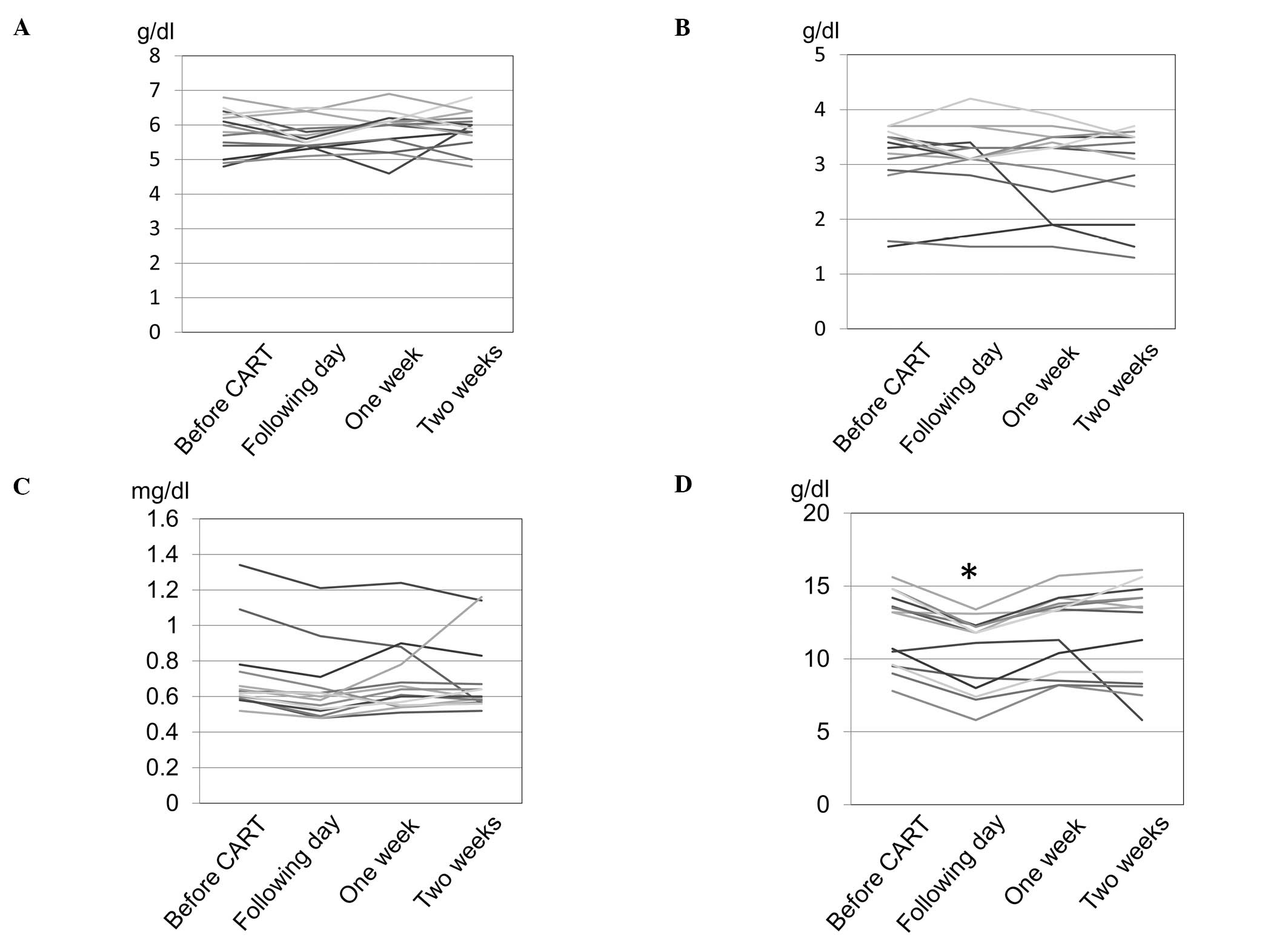
A total of 14 sessions were available for analysis at all 4 time points (Table IV, Fig. 1). Hemoglobin concentration was significantly decreased on the day following CART compared to that prior to CART and recovered to baseline levels in 1 week. There were no significant differences in total protein, albumin and creatinine levels prior to and after CART.

Figure 1

Serum levels of (A) total protein, (B) albumin, (C) creatinine and (D) hemoglobin, measured immediately prior to concentrated ascites reinfusion therapy (CART), on the following day, one week later and two weeks later. Hemoglobin on the day following CART was significantly lower compared to that prior to CART, one week later and two weeks later (*P<0.01).

Table IV

Laboratory data of 14 concentrated ascites reinfusion therapy (CART) sessions for which laboratory data were available at all four time points.

Table IV

Laboratory data of 14 concentrated ascites reinfusion therapy (CART) sessions for which laboratory data were available at all four time points.

VariablesPrior to CARTFollowing dayOne week laterTwo weeks later
Total protein (g/dl)5.81±0.635.71±0.445.86±0.585.89±0.53
Albumin (g/dl)3.11±0.723.08±0.723.01±0.752.94±0.81
Creatinine (mg/dl)0.71±0.230.64±0.200.69±0.200.69±0.21
Hemoglobin (g/dl)12.14±2.53 10.49±2.51a11.95±2.5911.81±3.39

[i] Hemoglobin on the day following CART was significantly lower compared to that prior to CART, one week later and two weeks later (aP<0.01).

Discussion

Britton (7) first investigated the use of CART for patients with liver cirrhosis. CART as a treatment for malignant ascites has also been reported for gastrointestinal (3) and gynecological cancers (3,8,9). A comparison between paracentesis with albumin transfusion and CART for liver cirrhosis patients was reported and the two approaches appeared to exert similar effects (10). However, albumin transfusion may cause infection and entails problems associated with the overuse of blood derivatives.

Drainage of massive amounts of ascitic fluid may cause loss of proteins, including albumin, and may lead to renal dysfunction due to the decrease in the circulating fluid volume. We evaluated the changes in laboratory data and found that total protein and albumin after CART remained at similar levels as those prior to CART and that creatinine did not increase after CART. A maximum of 18 sessions of CART were safely performed in 1 patient. The decrease in serum creatinine and hemoglobin on the day following CART is attributed to the dilution due to the increase of circulating blood plasma, as both creatinine and hemoglobin decreased to a similar degree (83 and 86%, respectively) and returned to baseline levels in 1 week. It is considered that this supplementation of plasma volume may contribute to maintaining renal function.

Of the 5 patients, 4 developed fever after CART, which was considered to be caused by substances in ascites. Katoh et al (11) reported that multiple substances, including fibrin, were the cause of fever after the reinfusion of ascites. The inflammatory cytokine interleukin-6 has also been considered to be a candidate substance causing high fever after CART (12). In our study, corticosteroid was administered at the onset of fever and also administered as a prophylaxis just prior to reinfusion of ascites in patients who had developed fever during prior CART sessions.

In the present study, we analyzed the laboratory data prior to and after CART and concluded that CART was not associated with renal dysfunction and protein loss. Therefore, CART is effective and safe for improving the symptoms of malignant ascites from gastrointestinal cancer.

References

1 

Chung M and Kozuch P: Treatment of malignant ascites. Curr Treat Options Oncol. 9:215–233. 2008. View Article : Google Scholar

2 

Inoue N, Yamazaki Z, Oda T, Sugiura M and Wada T: Treatment of intractable ascites by continuous reinfusion of the sterilized, cell-free and concentrated ascitic fluid. Trans Am Soc Artif Intern Organs. 23:699–702. 1977. View Article : Google Scholar : PubMed/NCBI

3 

Japanese CART Study Group. Matsusaki K, Ohta K, Yoshizawa A and Gyoda Y: Novel cell-free and concentrated ascites reinfusion therapy (KM-CART) for refractory ascites associated with cancerous peritonitis: its effect and future perspectives. Int J Clin Oncol. 16:395–400. 2011. View Article : Google Scholar : PubMed/NCBI

4 

Nakamoto S, Britton RC and Kolff WJ: Ultrafiltration of ascites. Trans Am Soc Artif Intern Organs. 6:15–21. 1960.

5 

Takahashi K, Shibukawa T, Moriyama M and Kitao M: Changes in biochemical data in ascites and serum before and after the treatment of intractable ascites for patients with terminal gynecologic tumor: re-infusion of cell-free and concentrated ascitic fluid. Nihon Gan Chiryo Gakkai Shi. 20:2097–2103. 1985.

6 

Maeda A, Takeda K, Tsuruya K, et al: A case of cell-free and concentrated ascites reinfusion therapy effective for refractory ascites in spontaneous bacterial peritonitis in a renal transplant patient. Case Rep Nephrol Urol. 2:138–144. 2012. View Article : Google Scholar

7 

Britton RC: A new technique for rapid control of cirrhotic ascites. Arch Surg. 83:364–369. 1961. View Article : Google Scholar

8 

Ueda T, Maehara M, Takahashi Y, et al: Clinical significance of cell-free and concentrated ascites re-infusion therapy for advanced and recurrent gynecological cancer. Anticancer Res. 32:2353–2357. 2012.PubMed/NCBI

9 

Kitao M, Takahashi K and Iwaka O: Treatment of intractable ascites at the terminal stage of ovarian carcinoma - reinfusion of the cell-free, concentrated ascitic fluid. Nihon Sanka Fujinka Gakkai Zasshi. 35:1668–1671. 1983.(In Japanese).

10 

Graziotto A, Rossaro L, Inturri P and Salvagnini M: Reinfusion of concentrated ascitic fluid versus total paracentesis. A randomized prospective trial. Dig Dis Sci. 42:1708–1714. 1997. View Article : Google Scholar : PubMed/NCBI

11 

Katoh S, Tatsukawa H, Kondoh M, Inoue M, Ida K and Miyagawa F: Prevention of the febrile reaction occurring on reinfusion of cell-free and concentrated autogenous ascites. Jpn J Med. 30:311–317. 1991. View Article : Google Scholar : PubMed/NCBI

12 

Orimi S, Mizuno K, Narahara M, Umakosi H, Kaihara M and Hashimoto M: A study of appropriate flow rate settings for cell-free and concentrated ascites reinfusion therapy and change of cytokine concentrations in ascites. Ther Apher Dial. 15:411–414. 2011.PubMed/NCBI

Related Articles

  • Abstract
  • View
  • Download
  • Twitter
Copy and paste a formatted citation
Spandidos Publications style
Maeda O, Ando T, Ishiguro K, Watanabe O, Miyahara R, Nakamura M, Funasaka K, Kazuhiro F, Ando Y, Goto H, Goto H, et al: Safety of repeated cell‑free and concentrated ascites reinfusion therapy for malignant ascites from gastrointestinal cancer. Mol Clin Oncol 2: 1103-1106, 2014.
APA
Maeda, O., Ando, T., Ishiguro, K., Watanabe, O., Miyahara, R., Nakamura, M. ... Goto, H. (2014). Safety of repeated cell‑free and concentrated ascites reinfusion therapy for malignant ascites from gastrointestinal cancer. Molecular and Clinical Oncology, 2, 1103-1106. https://doi.org/10.3892/mco.2014.335
MLA
Maeda, O., Ando, T., Ishiguro, K., Watanabe, O., Miyahara, R., Nakamura, M., Funasaka, K., Kazuhiro, F., Ando, Y., Goto, H."Safety of repeated cell‑free and concentrated ascites reinfusion therapy for malignant ascites from gastrointestinal cancer". Molecular and Clinical Oncology 2.6 (2014): 1103-1106.
Chicago
Maeda, O., Ando, T., Ishiguro, K., Watanabe, O., Miyahara, R., Nakamura, M., Funasaka, K., Kazuhiro, F., Ando, Y., Goto, H."Safety of repeated cell‑free and concentrated ascites reinfusion therapy for malignant ascites from gastrointestinal cancer". Molecular and Clinical Oncology 2, no. 6 (2014): 1103-1106. https://doi.org/10.3892/mco.2014.335
Copy and paste a formatted citation
x
Spandidos Publications style
Maeda O, Ando T, Ishiguro K, Watanabe O, Miyahara R, Nakamura M, Funasaka K, Kazuhiro F, Ando Y, Goto H, Goto H, et al: Safety of repeated cell‑free and concentrated ascites reinfusion therapy for malignant ascites from gastrointestinal cancer. Mol Clin Oncol 2: 1103-1106, 2014.
APA
Maeda, O., Ando, T., Ishiguro, K., Watanabe, O., Miyahara, R., Nakamura, M. ... Goto, H. (2014). Safety of repeated cell‑free and concentrated ascites reinfusion therapy for malignant ascites from gastrointestinal cancer. Molecular and Clinical Oncology, 2, 1103-1106. https://doi.org/10.3892/mco.2014.335
MLA
Maeda, O., Ando, T., Ishiguro, K., Watanabe, O., Miyahara, R., Nakamura, M., Funasaka, K., Kazuhiro, F., Ando, Y., Goto, H."Safety of repeated cell‑free and concentrated ascites reinfusion therapy for malignant ascites from gastrointestinal cancer". Molecular and Clinical Oncology 2.6 (2014): 1103-1106.
Chicago
Maeda, O., Ando, T., Ishiguro, K., Watanabe, O., Miyahara, R., Nakamura, M., Funasaka, K., Kazuhiro, F., Ando, Y., Goto, H."Safety of repeated cell‑free and concentrated ascites reinfusion therapy for malignant ascites from gastrointestinal cancer". Molecular and Clinical Oncology 2, no. 6 (2014): 1103-1106. https://doi.org/10.3892/mco.2014.335
Follow us
  • Twitter
  • LinkedIn
  • Facebook
About
  • Spandidos Publications
  • Careers
  • Cookie Policy
  • Privacy Policy
How can we help?
  • Help
  • Live Chat
  • Contact
  • Email to our Support Team