Spandidos Publications Logo
  • About
    • About Spandidos
    • Aims and Scopes
    • Abstracting and Indexing
    • Editorial Policies
    • Reprints and Permissions
    • Job Opportunities
    • Terms and Conditions
    • Contact
  • Journals
    • All Journals
    • Oncology Letters
      • Oncology Letters
      • Information for Authors
      • Editorial Policies
      • Editorial Board
      • Aims and Scope
      • Abstracting and Indexing
      • Bibliographic Information
      • Archive
    • International Journal of Oncology
      • International Journal of Oncology
      • Information for Authors
      • Editorial Policies
      • Editorial Board
      • Aims and Scope
      • Abstracting and Indexing
      • Bibliographic Information
      • Archive
    • Molecular and Clinical Oncology
      • Molecular and Clinical Oncology
      • Information for Authors
      • Editorial Policies
      • Editorial Board
      • Aims and Scope
      • Abstracting and Indexing
      • Bibliographic Information
      • Archive
    • Experimental and Therapeutic Medicine
      • Experimental and Therapeutic Medicine
      • Information for Authors
      • Editorial Policies
      • Editorial Board
      • Aims and Scope
      • Abstracting and Indexing
      • Bibliographic Information
      • Archive
    • International Journal of Molecular Medicine
      • International Journal of Molecular Medicine
      • Information for Authors
      • Editorial Policies
      • Editorial Board
      • Aims and Scope
      • Abstracting and Indexing
      • Bibliographic Information
      • Archive
    • Biomedical Reports
      • Biomedical Reports
      • Information for Authors
      • Editorial Policies
      • Editorial Board
      • Aims and Scope
      • Abstracting and Indexing
      • Bibliographic Information
      • Archive
    • Oncology Reports
      • Oncology Reports
      • Information for Authors
      • Editorial Policies
      • Editorial Board
      • Aims and Scope
      • Abstracting and Indexing
      • Bibliographic Information
      • Archive
    • Molecular Medicine Reports
      • Molecular Medicine Reports
      • Information for Authors
      • Editorial Policies
      • Editorial Board
      • Aims and Scope
      • Abstracting and Indexing
      • Bibliographic Information
      • Archive
    • World Academy of Sciences Journal
      • World Academy of Sciences Journal
      • Information for Authors
      • Editorial Policies
      • Editorial Board
      • Aims and Scope
      • Abstracting and Indexing
      • Bibliographic Information
      • Archive
    • International Journal of Functional Nutrition
      • International Journal of Functional Nutrition
      • Information for Authors
      • Editorial Policies
      • Editorial Board
      • Aims and Scope
      • Abstracting and Indexing
      • Bibliographic Information
      • Archive
    • International Journal of Epigenetics
      • International Journal of Epigenetics
      • Information for Authors
      • Editorial Policies
      • Editorial Board
      • Aims and Scope
      • Abstracting and Indexing
      • Bibliographic Information
      • Archive
    • Medicine International
      • Medicine International
      • Information for Authors
      • Editorial Policies
      • Editorial Board
      • Aims and Scope
      • Abstracting and Indexing
      • Bibliographic Information
      • Archive
  • Articles
  • Information
    • Information for Authors
    • Information for Reviewers
    • Information for Librarians
    • Information for Advertisers
    • Conferences
  • Language Editing
Spandidos Publications Logo
  • About
    • About Spandidos
    • Aims and Scopes
    • Abstracting and Indexing
    • Editorial Policies
    • Reprints and Permissions
    • Job Opportunities
    • Terms and Conditions
    • Contact
  • Journals
    • All Journals
    • Biomedical Reports
      • Information for Authors
      • Editorial Policies
      • Editorial Board
      • Aims and Scope
      • Abstracting and Indexing
      • Bibliographic Information
      • Archive
    • Experimental and Therapeutic Medicine
      • Information for Authors
      • Editorial Policies
      • Editorial Board
      • Aims and Scope
      • Abstracting and Indexing
      • Bibliographic Information
      • Archive
    • International Journal of Epigenetics
      • Information for Authors
      • Editorial Policies
      • Editorial Board
      • Aims and Scope
      • Abstracting and Indexing
      • Bibliographic Information
      • Archive
    • International Journal of Functional Nutrition
      • Information for Authors
      • Editorial Policies
      • Editorial Board
      • Aims and Scope
      • Abstracting and Indexing
      • Bibliographic Information
      • Archive
    • International Journal of Molecular Medicine
      • Information for Authors
      • Editorial Policies
      • Editorial Board
      • Aims and Scope
      • Abstracting and Indexing
      • Bibliographic Information
      • Archive
    • International Journal of Oncology
      • Information for Authors
      • Editorial Policies
      • Editorial Board
      • Aims and Scope
      • Abstracting and Indexing
      • Bibliographic Information
      • Archive
    • Medicine International
      • Information for Authors
      • Editorial Policies
      • Editorial Board
      • Aims and Scope
      • Abstracting and Indexing
      • Bibliographic Information
      • Archive
    • Molecular and Clinical Oncology
      • Information for Authors
      • Editorial Policies
      • Editorial Board
      • Aims and Scope
      • Abstracting and Indexing
      • Bibliographic Information
      • Archive
    • Molecular Medicine Reports
      • Information for Authors
      • Editorial Policies
      • Editorial Board
      • Aims and Scope
      • Abstracting and Indexing
      • Bibliographic Information
      • Archive
    • Oncology Letters
      • Information for Authors
      • Editorial Policies
      • Editorial Board
      • Aims and Scope
      • Abstracting and Indexing
      • Bibliographic Information
      • Archive
    • Oncology Reports
      • Information for Authors
      • Editorial Policies
      • Editorial Board
      • Aims and Scope
      • Abstracting and Indexing
      • Bibliographic Information
      • Archive
    • World Academy of Sciences Journal
      • Information for Authors
      • Editorial Policies
      • Editorial Board
      • Aims and Scope
      • Abstracting and Indexing
      • Bibliographic Information
      • Archive
  • Articles
  • Information
    • For Authors
    • For Reviewers
    • For Librarians
    • For Advertisers
    • Conferences
  • Language Editing
Login Register Submit
  • This site uses cookies
  • You can change your cookie settings at any time by following the instructions in our Cookie Policy. To find out more, you may read our Privacy Policy.

    I agree
Search articles by DOI, keyword, author or affiliation
Search
Advanced Search
presentation
Molecular and Clinical Oncology
Join Editorial Board Propose a Special Issue
Print ISSN: 2049-9450 Online ISSN: 2049-9469
Journal Cover
November-December 2014 Volume 2 Issue 6

Full Size Image

Sign up for eToc alerts
Recommend to Library

Journals

International Journal of Molecular Medicine

International Journal of Molecular Medicine

International Journal of Molecular Medicine is an international journal devoted to molecular mechanisms of human disease.

International Journal of Oncology

International Journal of Oncology

International Journal of Oncology is an international journal devoted to oncology research and cancer treatment.

Molecular Medicine Reports

Molecular Medicine Reports

Covers molecular medicine topics such as pharmacology, pathology, genetics, neuroscience, infectious diseases, molecular cardiology, and molecular surgery.

Oncology Reports

Oncology Reports

Oncology Reports is an international journal devoted to fundamental and applied research in Oncology.

Experimental and Therapeutic Medicine

Experimental and Therapeutic Medicine

Experimental and Therapeutic Medicine is an international journal devoted to laboratory and clinical medicine.

Oncology Letters

Oncology Letters

Oncology Letters is an international journal devoted to Experimental and Clinical Oncology.

Biomedical Reports

Biomedical Reports

Explores a wide range of biological and medical fields, including pharmacology, genetics, microbiology, neuroscience, and molecular cardiology.

Molecular and Clinical Oncology

Molecular and Clinical Oncology

International journal addressing all aspects of oncology research, from tumorigenesis and oncogenes to chemotherapy and metastasis.

World Academy of Sciences Journal

World Academy of Sciences Journal

Multidisciplinary open-access journal spanning biochemistry, genetics, neuroscience, environmental health, and synthetic biology.

International Journal of Functional Nutrition

International Journal of Functional Nutrition

Open-access journal combining biochemistry, pharmacology, immunology, and genetics to advance health through functional nutrition.

International Journal of Epigenetics

International Journal of Epigenetics

Publishes open-access research on using epigenetics to advance understanding and treatment of human disease.

Medicine International

Medicine International

An International Open Access Journal Devoted to General Medicine.

Journal Cover
November-December 2014 Volume 2 Issue 6

Full Size Image

Sign up for eToc alerts
Recommend to Library

  • Article
  • Citations
    • Cite This Article
    • Download Citation
    • Create Citation Alert
    • Remove Citation Alert
    • Cited By
  • Similar Articles
    • Related Articles (in Spandidos Publications)
    • Similar Articles (Google Scholar)
    • Similar Articles (PubMed)
  • Download PDF
  • Download XML
  • View XML
Article

Bladder extragastrointestinal stromal tumor in an adolescent patient: A case‑based review

  • Authors:
    • Fan He
    • Zhenqiang Fang
    • Pei Zhu
    • Wei Huang
    • Longkun Li
  • View Affiliations / Copyright

    Affiliations: Department of Urology, Xinqiao Hospital, The Third Military Medical University, Chongqing 400037, P.R. China
  • Pages: 960-962
    |
    Published online on: July 31, 2014
       https://doi.org/10.3892/mco.2014.366
  • Expand metrics +
Metrics: Total Views: 0 (Spandidos Publications: | PMC Statistics: )
Metrics: Total PDF Downloads: 0 (Spandidos Publications: | PMC Statistics: )
Cited By (CrossRef): 0 citations Loading Articles...

This article is mentioned in:


Abstract

Extragastrointestinal stromal tumors (EGISTs) are mesenchymal tumors occurring outside the gastrointestinal tract, with histological, immunohistochemical and molecular genetic characteristics similar to those of gastrointestinal stromal tumors (GISTs). The immunohistochemical examination usually demonstrates a positive expression for CD117. GISTs are rare neoplasms and EGISTs are even less common. This is the report of a case of EGIST in the urinary bladder of a 15‑year‑old adolescent female patient who presented with painless gross hematuria. Pelvic computed tomography revealed an irregular soft tissue density mass, sized 5.7x4.8 cm, in the bladder. Partial cystectomy was performed in April, 2011. There was no recurrence during follow‑up over the next 35 months, as determined by transabdoninal ultrasonography and cystoscopic examination. The patient in this study did not receive any molecular‑targeted drugs. To the best of our knowledge, this is the first reported case of an EGIST of the urinary bladder in an adolescent patient.

Introduction

The majority of the mesenchymal tumors of the gastrointestinal tract are currently referred to as gastrointestinal stromal tumors (GISTs). The immunohistochemical examination commonly reveals a positive expression for CD117. Extragastrointestinal stromal tumors (EGISTs) are mesenchymal tumors occurring outside the gastrointestinal tract, with histological, immunohistochemical and molecular genetic characteristics very similar to those of GISTs (1). EGISTs are a rare clinical entity and, to date, there has been no report of bladder EGIST in non-adult patients. In this report, we present a mesenchymal tumor removed from the bladder of a 15-year-old female. The patient remains alive and disease-free 35 months after the surgery.

Case study

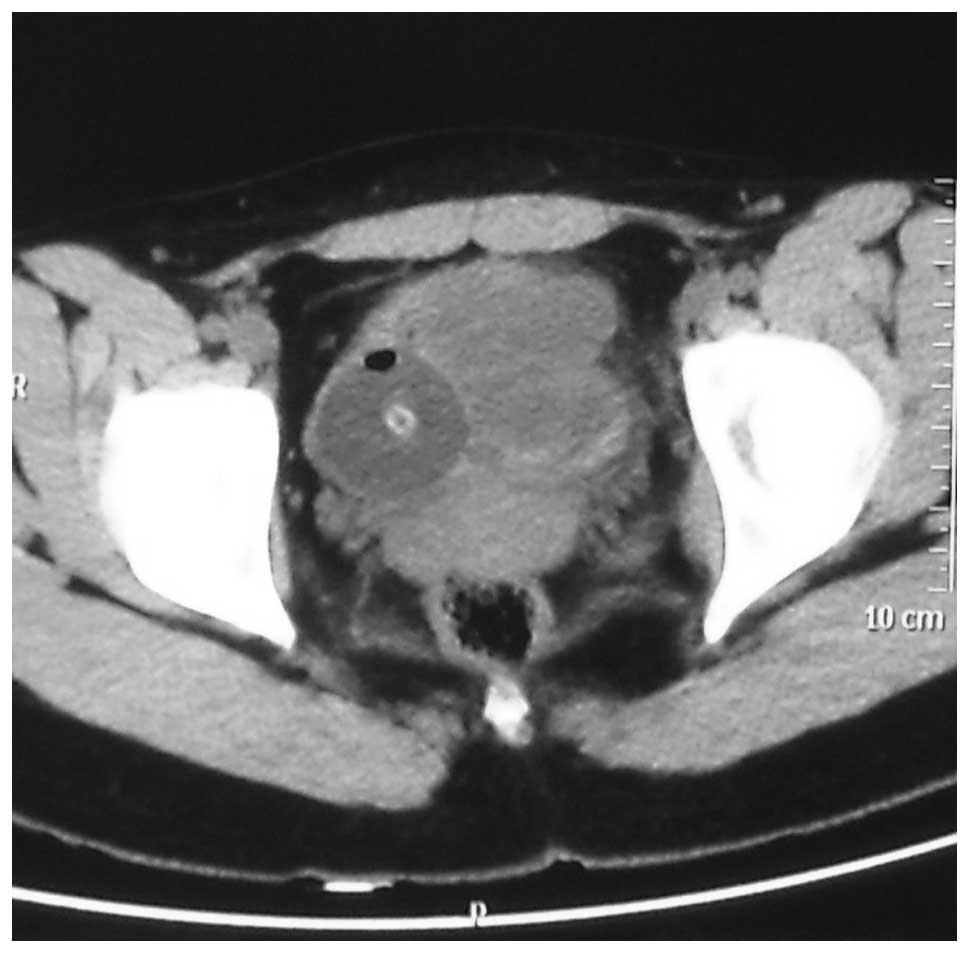
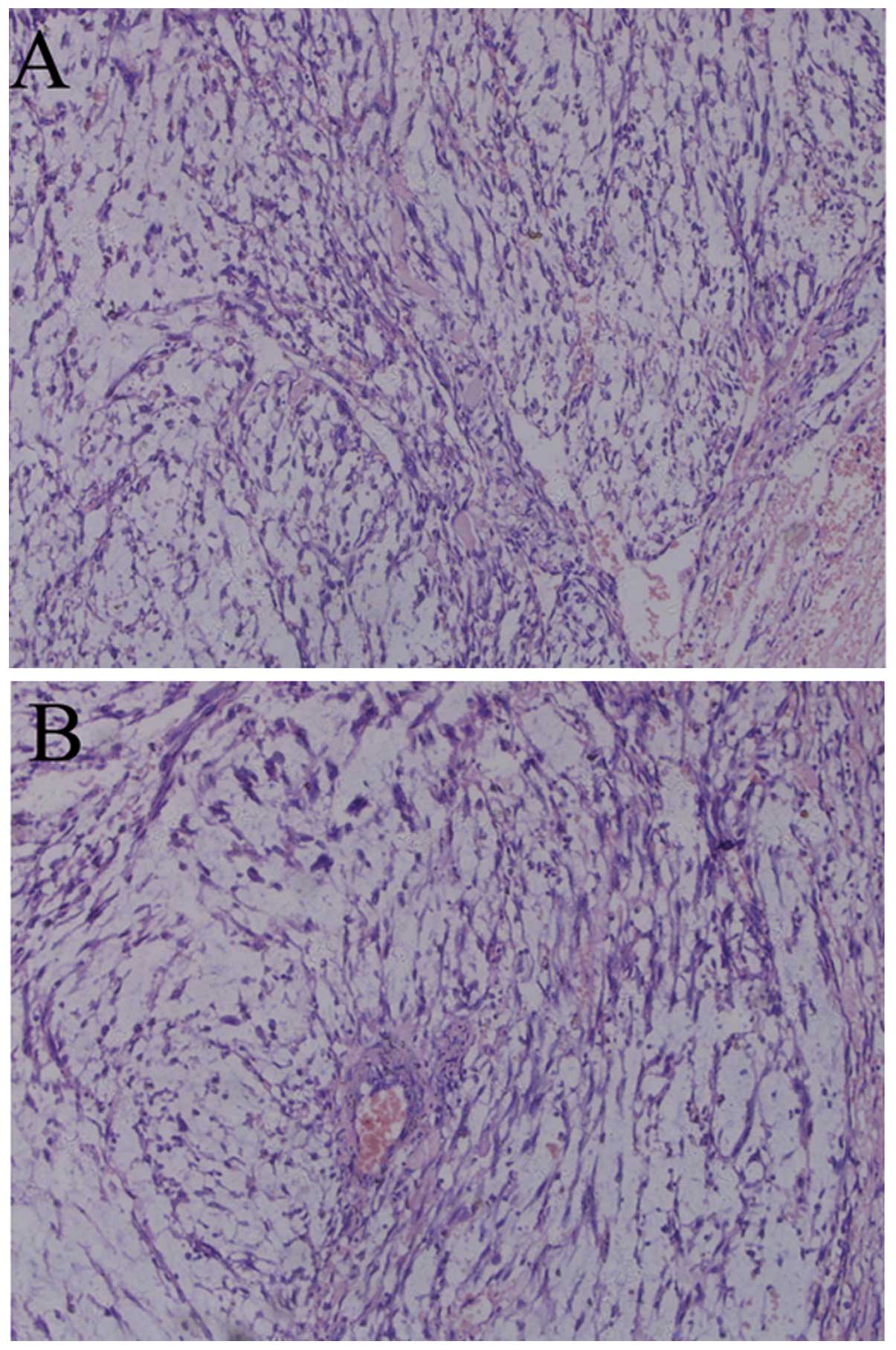
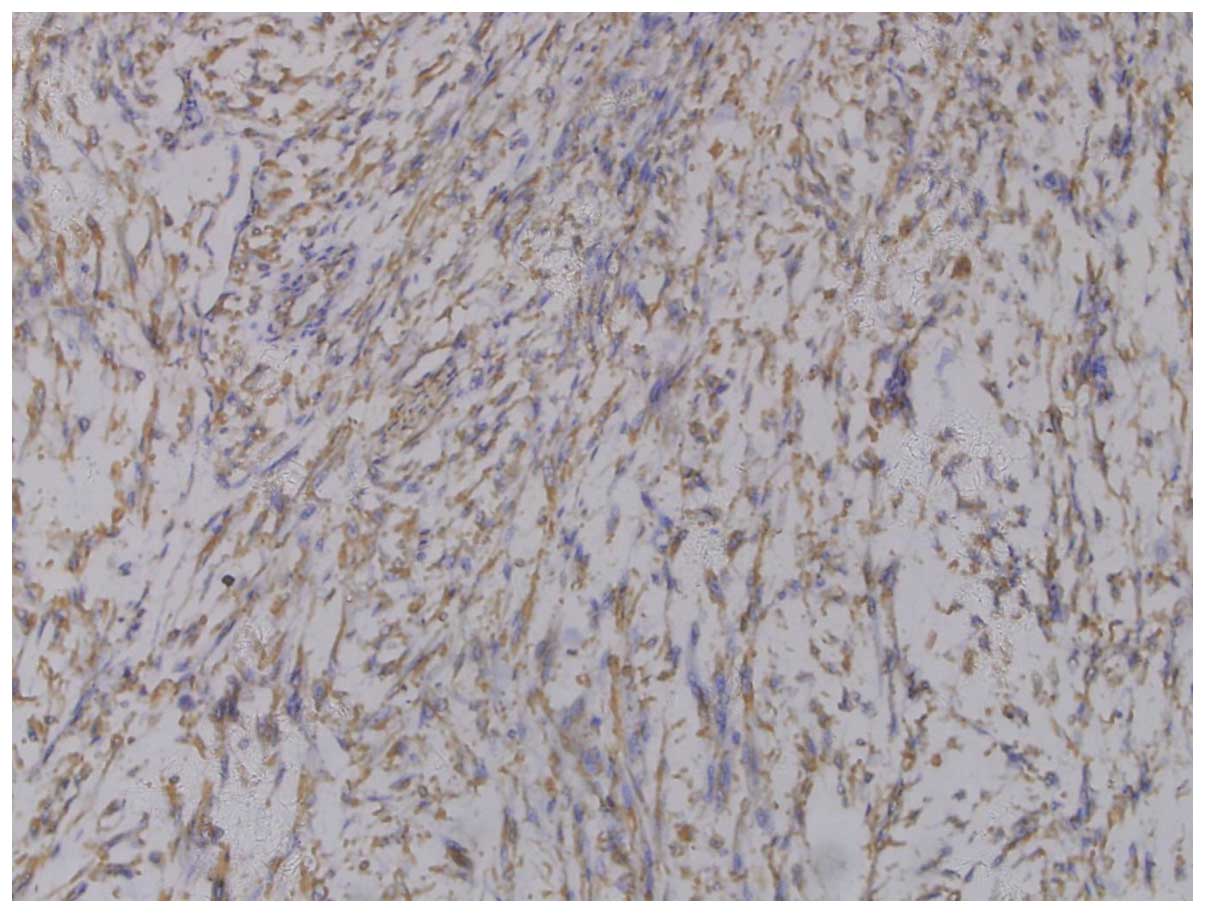
A 15-year-old adolescent female patient was hospitalized following 2 weeks of painless gross hematuria with clots. On admission, the patient had stable vital signs, a pale appearance and no positive abdominal signs. On routine blood examination, the concentration of hemoglobin was 69 g/l. A B-mode ultrasound image indicated a urinary bladder neoplasm and pelvic computed tomography (CT) revealed an irregular soft tissue density mass, sized 5.7×4.8 cm, in the bladder, which exhibited uneven density and obscure boundaries (Fig. 1). The patient was subjected to partial cystectomy and the intraoperative exploration identified a sessile tumor, sized 5.7×4.8×3 cm, in the upper wall of the bladder, which grew along the muscular layer and broke through the mucous layer with associated bleeding. There was no macroscopic invasion of the ureteral opening. The remaining bladder wall was smooth and exhibited no signs of neoplasia. On postoperative pathological examination, the tumor was composed of fusiform cells with abundant acidophilic cytoplasm and clavate nuclei, with both ends round and mostly blunt. The cells were mainly arranged in interwoven bundles or swirls and were mildly atypical (Fig. 2). The mitotic count was 5 per 50 high-power fields (HPFs). Immunohistochemically, the tumor cells strongly expressed CD117 (Fig. 3), vimentin and smooth muscle actin, but were negative for CD34, desmin and S-100 protein. The tumor was diagnosed as an EGIST. The patient in this study did not receive any molecular-targeted drugs due to financial difficulties. During follow-up, transabdoninal ultrasonography and cystoscopic examination identified no evidence of recurrence over the following 35 months.

Figure 1

Computed tomography indicated an irregular soft tissue density mass, sized 5.7×4.8 cm, in the urinary bladder.

Figure 2

Hematoxylin and eosin-stained section of the tumor. (A) The tumor was composed of fusiform cells with abundant acidophilic cytoplasm and clavate nuclei, round at both ends and mostly blunt. (B) The cells were mostly arranged in interwoven bundles or swirls and were mildly atypical.

Figure 3

Tumor cells positively stained for CD117.

Discussion

GISTs are mesenchymal tumors occurring in the gastrointestinal tract and their development is driven by mutant c-kit or platelet-derived growth factor receptor α genes. On mmunohistochemical examination, GISTs exhibit positive expression for CD117 or DOG-1. EGISTs are mesenchymal tumors occurring outside the gastrointestinal tract, with morphological, immunophenotypic and molecular biological characteristics very similar to those of GISTs (1). EGISTs are a rare clinical entity, accounting for <5% of soft tissue tumors (2–4). Furthermore, EGISTs are even more rare in the urinary bladder. Following a literature review, we found 5 cases of patients with bladder EGISTs, including 3 men and 2 women, aged 34–78 years (5–9). To the best of our knowledge, the patient in this study, aged 15 years, is the first non-adult patient presenting with EGIST, indicating that the occurrence of EGISTs is not limited to adults.

The clinical manifestations of EGISTs are non-specific. EGISTs of the bladder are characterized by larger tumor size and are mainly manifested by gross hematuria, which is often caused by bleeding due to tumor invasion of the mucous layer. EGISTs have no specific tumor markers. Furthermore, there are no specific diagnostic criteria for EGISTs on imaging examinations, such as B-mode ultrasound, CT, magnetic resonance imaging and position emission tomography/computed tomography. The current diagnostic criteria for EGISTs were developed according to the immunohistochemical diagnostic criteria for GISTs, i.e., mesenchymal tumors occurring outside the gastrointestinal tract, histologically consisting of fusiform, epithelioid or, occasionally, pleomorphic cells, in a bundle-like or diffuse arrangement; on immunohistochemical examination, the tumor cells are usually positive for CD117 or DOG-1 expression. The main clinical manifestation in our patient was hematuria and the lesion, which was located in the upper wall of the urinary bladder, was relatively large-sized and exhibited typical GIST histological morphology. The immunohistochemical examination revealed positive CD117 expression. Therefore, the diagnosis of EGIST was confirmed.

EGISTs are rare and their pathogenesis has not been fully elucidated. In this study, prompted by the GIST origin from pacemaker cells, also referred to as the interstitial cells of Cajal (ICC), which surround the gastrointestinal nerve plexus, we identified ICC cells in the gastrointestinal tract, as well as several other abdominal organs, extensively involving the bladder. Thus, we hypothesized that ICC carcinogenesis in the bladder is a primary cause of this disease. ICCs express the c-kit protein. The c-kit proto-oncogene is located on human chromosome 4q11-12, of which the product is the growth factor receptor tyrosine kinase type III, a member of the immunoglobulin superfamily, also known as CD117. It was previously demonstrated that c-kit is expressed at relatively high levels in GISTs (up to 81–100%) and is more sensitive compared to CD34 (10–12). However, in GISTs harbouring c-kit gene mutations, the positive rate of DOG-1 is 92% and that of CD117 is 81%, making DOG-1 comparatively a more sensitive and specific indicator. Therefore, in cases of tumors morphologically suspicious for EGIST and negative for CD117 expression, DOG-1 is recommended for diagnosis (13,14).

The prognosis of EGIST appears to be related to morphological characteristics. Generally, compared to GISTs, a tumor may be determined as having malignant potential if it exhibits one of the following characteristics: i) Significantly atypical tumor cells, tumor necrosis, muscular layer invasion, ancient coin-like growth around the vessels and mitotic count ≥10/50 HPFs; or ii) mucosal invasion, perineural invasion, fatty infiltration, vascular invasion and lymph node metastasis. The more common the abovementioned findings, the higher the degree of malignancy (15,16). However, these findings are derived from scattered onset locations and rare cases; therefore, the association between morphological characteristics and biological behavior requires further documentation for substantiation, particularly evidence-based medicine.

EGISTs are considered to be refractory to conventional radiotherapy and chemotherapy and resection is currently the preferred treatment option. The thoroughness of surgical treatment is closely associated with cure; therefore, a complete excision of the tumor by properly expanding the surgical scope is the key to EGIST treatment (17). By administering molecular-targeted drugs, such as imatinib, as neoadjuvant and adjuvant therapy for GISTs, small-scale clinical studies have achieved some clinical efficacy (18). However, in EGISTs, imatinib has been used in fewer cases; thus, our clinical experience is limited. The majority of these drugs are used for the prevention of EGIST relapse following surgery. The patient in our study did not receive any molecular-targeted drugs due to financial difficulties and there was no evidence of recurrence during follow-up over the next 35 months. The efficacy of molecular-targeted drugs, such as imatinib, in the treatment of EGISTs requires further support by clinical cases in the future.

References

1 

Llenas-Garcia J, Guerra-Vales JM, Moreno A, Ibarrola C, Castelbon FJ, Fernandez-Ruiz M, Meneu JC, Ballestin C and Moreno E: Primary extragastrointestinal stromal tumors in the omentum and mesentery: a clinicopathological and immunohistochemical study. Hepatogastroenterology. 55:1002–1005. 2008.PubMed/NCBI

2 

Miettinen M, Monihan JM, Sarlomo-Rikala M, Kovatich AJ, Carr NJ, Emory TS and Sobin LH: Gastrointestinal stromal tumors/smooth muscle tumors (GISTs) primary in the omentum and mesentery: clinicopathologic and immunohistochemical study of 26 cases. Am J Surg Pathol. 23:1109–1118. 1999. View Article : Google Scholar

3 

Reith JD, Goldblum JR, Lyles RH and Weiss SW: Extragastrointestinal (soft tissue) stromal tumors: an analysis of 48 cases with emphasis on histologic predictors of outcome. Mod Pathol. 13:577–585. 2000. View Article : Google Scholar : PubMed/NCBI

4 

Fletcher CD, Berman JJ, Corless C, et al: Diagnosis of gastrointestinal stromal tumors: A consensus approach. Hum Pathol. 33:459–465. 2002. View Article : Google Scholar : PubMed/NCBI

5 

Lasota J, Carlson JA and Miettinen M: Spindle cell tumor of urinary bladder serosa with phenotypic and genotypic features of gastrointestinal stromal tumor. Arch Pathol Lab Med. 124:894–897. 2000.PubMed/NCBI

6 

Krokowski M, Jocham D, Choi H, Feller AC and Horny HP: Malignant extragastrointestinal stromal tumor of bladder. J Urol. 169:1790–1791. 2003. View Article : Google Scholar : PubMed/NCBI

7 

Mekni A, Chelly I, Azzouz H, Ben Ghorbel I, Bellil S, Haouet S, Kchir N, Zitouna M and Bellil K: Extragastrointestinal stromal tumor of the urinary wall bladder: case report and review of the literature. Pathologica. 100:173–175. 2008.PubMed/NCBI

8 

Garcia-Segui A and Gascon M: Gastrointestinal stromal tumour in the urinary bladder. Actas Urol Esp. 35:124–125. 2011.(In Spanish).

9 

Shin HS, Cho CH and Kum YS: Extragastrointestinal stromal tumor of the urinary bladder: a case report. Urol J. 8:165–167. 2011.PubMed/NCBI

10 

Kindblom LG, Remotti HE, Aldenborg F and Meis-Kindblom JM: Gastrointestinal pacemaker cell tumor (GIPACT): gastrointestinal stromal tumors show phenotypic characteristics of the interstitial cells of Cajal. Am J Pathol. 152:1259–1269. 1998.

11 

Hirota S, Isozaki K, Moriyama Y, et al: Gain-of-function mutations of c-kit in human gastrointestinal stromal tumors. Science. 279:577–580. 1998. View Article : Google Scholar : PubMed/NCBI

12 

Sircar K, Hewlett BR, Huizinga JD, Chorneyko K, Berezin I and Riddell RH: Interstitial cells of Cajal as precursors of gastrointestinal stromal tumors. Am J Surg Pathol. 23:377–389. 1999. View Article : Google Scholar : PubMed/NCBI

13 

Espinosa I, Lee CH, Kim MK, et al: A novel monoclonal antibody against DOG1 is a sensitive and specific marker for gastrointestinal stromal tumors. Am J Surg Pathol. 32:210–218. 2008. View Article : Google Scholar : PubMed/NCBI

14 

Long KB, Butrynski JE, Blank SD, Ebrahim KS, Dressel DM, Heinrich MC, Corless CL and Hornick JL: Primary extragastrointestinal stromal tumor of the pleura: report of a unique case with genetic confirmation. Am J Surg Pathol. 34:907–912. 2010. View Article : Google Scholar : PubMed/NCBI

15 

Miettinen M and Lasota J: Gastrointestinal stromal tumors: pathology and prognosis at different sites. Semin Diagn Pathol. 23:70–83. 2006. View Article : Google Scholar : PubMed/NCBI

16 

Joensuu H: Risk stratification of patients diagnosed with gastrointestinal stromal tumor. Hum Pathol. 39:1411–1419. 2008. View Article : Google Scholar : PubMed/NCBI

17 

Badalamenti G, Rodolico V, Fulfaro F, et al: Gastrointestinal stromal tumors (GISTs): focus on histopathological diagnosis and biomolecular features. Ann Oncol. 18(Suppl 6): vi136–vi140. 2007. View Article : Google Scholar : PubMed/NCBI

18 

Dematteo RP, Ballman KV, Antonescu CR, et al; American College of Surgeons Oncology Group (ACOSOG) Intergroup Adjuvant GIST Study Team. Adjuvant imatinib mesylate after resection of localised, primary gastrointestinal stromal tumour: a randomised, double-blind, placebo-controlled trial. Lancet. 373:1097–1104. 2009. View Article : Google Scholar

Related Articles

  • Abstract
  • View
  • Download
  • Twitter
Copy and paste a formatted citation
Spandidos Publications style
He F, Fang Z, Zhu P, Huang W and Li L: Bladder extragastrointestinal stromal tumor in an adolescent patient: A case‑based review. Mol Clin Oncol 2: 960-962, 2014.
APA
He, F., Fang, Z., Zhu, P., Huang, W., & Li, L. (2014). Bladder extragastrointestinal stromal tumor in an adolescent patient: A case‑based review. Molecular and Clinical Oncology, 2, 960-962. https://doi.org/10.3892/mco.2014.366
MLA
He, F., Fang, Z., Zhu, P., Huang, W., Li, L."Bladder extragastrointestinal stromal tumor in an adolescent patient: A case‑based review". Molecular and Clinical Oncology 2.6 (2014): 960-962.
Chicago
He, F., Fang, Z., Zhu, P., Huang, W., Li, L."Bladder extragastrointestinal stromal tumor in an adolescent patient: A case‑based review". Molecular and Clinical Oncology 2, no. 6 (2014): 960-962. https://doi.org/10.3892/mco.2014.366
Copy and paste a formatted citation
x
Spandidos Publications style
He F, Fang Z, Zhu P, Huang W and Li L: Bladder extragastrointestinal stromal tumor in an adolescent patient: A case‑based review. Mol Clin Oncol 2: 960-962, 2014.
APA
He, F., Fang, Z., Zhu, P., Huang, W., & Li, L. (2014). Bladder extragastrointestinal stromal tumor in an adolescent patient: A case‑based review. Molecular and Clinical Oncology, 2, 960-962. https://doi.org/10.3892/mco.2014.366
MLA
He, F., Fang, Z., Zhu, P., Huang, W., Li, L."Bladder extragastrointestinal stromal tumor in an adolescent patient: A case‑based review". Molecular and Clinical Oncology 2.6 (2014): 960-962.
Chicago
He, F., Fang, Z., Zhu, P., Huang, W., Li, L."Bladder extragastrointestinal stromal tumor in an adolescent patient: A case‑based review". Molecular and Clinical Oncology 2, no. 6 (2014): 960-962. https://doi.org/10.3892/mco.2014.366
Follow us
  • Twitter
  • LinkedIn
  • Facebook
About
  • Spandidos Publications
  • Careers
  • Cookie Policy
  • Privacy Policy
How can we help?
  • Help
  • Live Chat
  • Contact
  • Email to our Support Team