Spandidos Publications Logo
  • About
    • About Spandidos
    • Aims and Scopes
    • Abstracting and Indexing
    • Editorial Policies
    • Reprints and Permissions
    • Job Opportunities
    • Terms and Conditions
    • Contact
  • Journals
    • All Journals
    • Oncology Letters
      • Oncology Letters
      • Information for Authors
      • Editorial Policies
      • Editorial Board
      • Aims and Scope
      • Abstracting and Indexing
      • Bibliographic Information
      • Archive
    • International Journal of Oncology
      • International Journal of Oncology
      • Information for Authors
      • Editorial Policies
      • Editorial Board
      • Aims and Scope
      • Abstracting and Indexing
      • Bibliographic Information
      • Archive
    • Molecular and Clinical Oncology
      • Molecular and Clinical Oncology
      • Information for Authors
      • Editorial Policies
      • Editorial Board
      • Aims and Scope
      • Abstracting and Indexing
      • Bibliographic Information
      • Archive
    • Experimental and Therapeutic Medicine
      • Experimental and Therapeutic Medicine
      • Information for Authors
      • Editorial Policies
      • Editorial Board
      • Aims and Scope
      • Abstracting and Indexing
      • Bibliographic Information
      • Archive
    • International Journal of Molecular Medicine
      • International Journal of Molecular Medicine
      • Information for Authors
      • Editorial Policies
      • Editorial Board
      • Aims and Scope
      • Abstracting and Indexing
      • Bibliographic Information
      • Archive
    • Biomedical Reports
      • Biomedical Reports
      • Information for Authors
      • Editorial Policies
      • Editorial Board
      • Aims and Scope
      • Abstracting and Indexing
      • Bibliographic Information
      • Archive
    • Oncology Reports
      • Oncology Reports
      • Information for Authors
      • Editorial Policies
      • Editorial Board
      • Aims and Scope
      • Abstracting and Indexing
      • Bibliographic Information
      • Archive
    • Molecular Medicine Reports
      • Molecular Medicine Reports
      • Information for Authors
      • Editorial Policies
      • Editorial Board
      • Aims and Scope
      • Abstracting and Indexing
      • Bibliographic Information
      • Archive
    • World Academy of Sciences Journal
      • World Academy of Sciences Journal
      • Information for Authors
      • Editorial Policies
      • Editorial Board
      • Aims and Scope
      • Abstracting and Indexing
      • Bibliographic Information
      • Archive
    • International Journal of Functional Nutrition
      • International Journal of Functional Nutrition
      • Information for Authors
      • Editorial Policies
      • Editorial Board
      • Aims and Scope
      • Abstracting and Indexing
      • Bibliographic Information
      • Archive
    • International Journal of Epigenetics
      • International Journal of Epigenetics
      • Information for Authors
      • Editorial Policies
      • Editorial Board
      • Aims and Scope
      • Abstracting and Indexing
      • Bibliographic Information
      • Archive
    • Medicine International
      • Medicine International
      • Information for Authors
      • Editorial Policies
      • Editorial Board
      • Aims and Scope
      • Abstracting and Indexing
      • Bibliographic Information
      • Archive
  • Articles
  • Information
    • Information for Authors
    • Information for Reviewers
    • Information for Librarians
    • Information for Advertisers
    • Conferences
  • Language Editing
Spandidos Publications Logo
  • About
    • About Spandidos
    • Aims and Scopes
    • Abstracting and Indexing
    • Editorial Policies
    • Reprints and Permissions
    • Job Opportunities
    • Terms and Conditions
    • Contact
  • Journals
    • All Journals
    • Biomedical Reports
      • Information for Authors
      • Editorial Policies
      • Editorial Board
      • Aims and Scope
      • Abstracting and Indexing
      • Bibliographic Information
      • Archive
    • Experimental and Therapeutic Medicine
      • Information for Authors
      • Editorial Policies
      • Editorial Board
      • Aims and Scope
      • Abstracting and Indexing
      • Bibliographic Information
      • Archive
    • International Journal of Epigenetics
      • Information for Authors
      • Editorial Policies
      • Editorial Board
      • Aims and Scope
      • Abstracting and Indexing
      • Bibliographic Information
      • Archive
    • International Journal of Functional Nutrition
      • Information for Authors
      • Editorial Policies
      • Editorial Board
      • Aims and Scope
      • Abstracting and Indexing
      • Bibliographic Information
      • Archive
    • International Journal of Molecular Medicine
      • Information for Authors
      • Editorial Policies
      • Editorial Board
      • Aims and Scope
      • Abstracting and Indexing
      • Bibliographic Information
      • Archive
    • International Journal of Oncology
      • Information for Authors
      • Editorial Policies
      • Editorial Board
      • Aims and Scope
      • Abstracting and Indexing
      • Bibliographic Information
      • Archive
    • Medicine International
      • Information for Authors
      • Editorial Policies
      • Editorial Board
      • Aims and Scope
      • Abstracting and Indexing
      • Bibliographic Information
      • Archive
    • Molecular and Clinical Oncology
      • Information for Authors
      • Editorial Policies
      • Editorial Board
      • Aims and Scope
      • Abstracting and Indexing
      • Bibliographic Information
      • Archive
    • Molecular Medicine Reports
      • Information for Authors
      • Editorial Policies
      • Editorial Board
      • Aims and Scope
      • Abstracting and Indexing
      • Bibliographic Information
      • Archive
    • Oncology Letters
      • Information for Authors
      • Editorial Policies
      • Editorial Board
      • Aims and Scope
      • Abstracting and Indexing
      • Bibliographic Information
      • Archive
    • Oncology Reports
      • Information for Authors
      • Editorial Policies
      • Editorial Board
      • Aims and Scope
      • Abstracting and Indexing
      • Bibliographic Information
      • Archive
    • World Academy of Sciences Journal
      • Information for Authors
      • Editorial Policies
      • Editorial Board
      • Aims and Scope
      • Abstracting and Indexing
      • Bibliographic Information
      • Archive
  • Articles
  • Information
    • For Authors
    • For Reviewers
    • For Librarians
    • For Advertisers
    • Conferences
  • Language Editing
Login Register Submit
  • This site uses cookies
  • You can change your cookie settings at any time by following the instructions in our Cookie Policy. To find out more, you may read our Privacy Policy.

    I agree
Search articles by DOI, keyword, author or affiliation
Search
Advanced Search
presentation
Molecular and Clinical Oncology
Join Editorial Board Propose a Special Issue
Print ISSN: 2049-9450 Online ISSN: 2049-9469
Journal Cover
January-February 2015 Volume 3 Issue 1

Full Size Image

Sign up for eToc alerts
Recommend to Library

Journals

International Journal of Molecular Medicine

International Journal of Molecular Medicine

International Journal of Molecular Medicine is an international journal devoted to molecular mechanisms of human disease.

International Journal of Oncology

International Journal of Oncology

International Journal of Oncology is an international journal devoted to oncology research and cancer treatment.

Molecular Medicine Reports

Molecular Medicine Reports

Covers molecular medicine topics such as pharmacology, pathology, genetics, neuroscience, infectious diseases, molecular cardiology, and molecular surgery.

Oncology Reports

Oncology Reports

Oncology Reports is an international journal devoted to fundamental and applied research in Oncology.

Experimental and Therapeutic Medicine

Experimental and Therapeutic Medicine

Experimental and Therapeutic Medicine is an international journal devoted to laboratory and clinical medicine.

Oncology Letters

Oncology Letters

Oncology Letters is an international journal devoted to Experimental and Clinical Oncology.

Biomedical Reports

Biomedical Reports

Explores a wide range of biological and medical fields, including pharmacology, genetics, microbiology, neuroscience, and molecular cardiology.

Molecular and Clinical Oncology

Molecular and Clinical Oncology

International journal addressing all aspects of oncology research, from tumorigenesis and oncogenes to chemotherapy and metastasis.

World Academy of Sciences Journal

World Academy of Sciences Journal

Multidisciplinary open-access journal spanning biochemistry, genetics, neuroscience, environmental health, and synthetic biology.

International Journal of Functional Nutrition

International Journal of Functional Nutrition

Open-access journal combining biochemistry, pharmacology, immunology, and genetics to advance health through functional nutrition.

International Journal of Epigenetics

International Journal of Epigenetics

Publishes open-access research on using epigenetics to advance understanding and treatment of human disease.

Medicine International

Medicine International

An International Open Access Journal Devoted to General Medicine.

Journal Cover
January-February 2015 Volume 3 Issue 1

Full Size Image

Sign up for eToc alerts
Recommend to Library

  • Article
  • Citations
    • Cite This Article
    • Download Citation
    • Create Citation Alert
    • Remove Citation Alert
    • Cited By
  • Similar Articles
    • Related Articles (in Spandidos Publications)
    • Similar Articles (Google Scholar)
    • Similar Articles (PubMed)
  • Download PDF
  • Download XML
  • View XML
Article Open Access

CD4+ T‑lymphocytes are activated by surgical stress following colorectal resection in cancer patients

  • Authors:
    • Kenji Maki
    • Shinsuke Takeno
    • Naoya Aisu
    • Kanefumi Yamashita
    • Masayasu Naito
    • Seiichiro Hoshino
    • Yuichi Yamashita
  • View Affiliations / Copyright

    Affiliations: Department of Gastroenterological Surgery, Faculty of Medicine, Fukuoka University, Fukuoka, Fukuoka 814‑0180, Japan
  • Pages: 79-82
    |
    Published online on: October 13, 2014
       https://doi.org/10.3892/mco.2014.442
  • Expand metrics +
Metrics: Total Views: 0 (Spandidos Publications: | PMC Statistics: )
Metrics: Total PDF Downloads: 0 (Spandidos Publications: | PMC Statistics: )
Cited By (CrossRef): 0 citations Loading Articles...

This article is mentioned in:


Abstract

The aim of the present study was to measure adenosine triphosphate (ATP) levels in CD4+ T cells as a marker of T‑cell activity following surgery for colorectal cancer using the ImmuKnow assay kit. A total of 16 consecutive patients who underwent surgical resection for colorectal cancer between August and December, 2012 were enrolled in this study, of whom 7 underwent laparoscopic resection and 9 underwent open abdominal surgery. The intracellular ATP levels in CD4+ T‑lymphocytes were measured using the ImmuKnow assay kit preoperatively and on the 1st, 4th and 8th postoperative days, as were the white blood cell (WBC) count, lymphocyte count and C‑reactive protein (CRP) levels. The ATP level of the CD4+ T‑cells was significantly elevated on the 1st day following surgery compared to the preoperative level (P<0.01) and gradually returned to preoperative levels; the lymphocyte count was significantly decreased on the 1st postoperative day (P<0.001). In addition, the ImmuKnow assay demonstrated that only the ATP level, but not the WBC count, lymphocyte count or CRP level, exhibited a significant difference on the 1st (P=0.080) and 8th (P=0.042) postoperative days between the laparoscopic and open abdominal surgery groups. In conclusion, the ATP level of CD4+ T‑lymphocytes was increased in response to surgical stress, in tandem with a decrease in the lymphocyte count. Therefore, the ImmuKnow assay kit may be clinically applicable for monitoring the immune response following surgery, as it exhibits a higher sensitivity compared to other assays.

Introduction

The immune cell function assay (ImmuKnow; Cylex, Inc., Columbia, MD, USA), which enables the measurement of the CD4+ T-cell activity, was approved for use by the US Food and Drug Administration in 2002 (1). To date, a number of studies (2–5) have investigated the correlation between the immune response and rejection in transplant recipients since Hooper et al (5) established immune response zones using the ImmuKnow assay in 2005. Those studies demonstrated that low adenosine triphosphate (ATP) levels in CD4+ T cells are associated with increased risk of infection. In addition, it was suggested that monitoring using the ImmuKnow assay may reflect the dynamics of the immune status (4).

In contrast to transplantation, surgical stress induces postoperative immunosuppression, which has been evaluated by measuring interleukin (IL), cortisol and C-reactive protein (CRP) levels and/or the CD4+ T-cell count (6, 7). By contrast, Wu et al (8) reported the reference of CRP, IL-6, IL-8 and HLA-DR levels, but not the CD4/CD8 ratio between laparoscopic and conventional surgery for colon cancer and concluded that the extent of surgical trauma may affect those results. However, these parameters have not been proven sufficient to evaluate the postoperative immune status. Therefore, it is necessary to identify a novel parameter that may be used to accurately evaluate the immune status in postoperative patients.

To the best of our knowledge, there are currently no available studies evaluating the extent of surgical stress by assessing the ATP levels of CD4+ T cells. The aim of this study was to measure ATP levels in CD4+ T cells as a marker of T-cell activity in the acute phase following colorectal surgery using the ImmuKnow assay. We investigated the dynamics of postoperative ATP levels and compared these levels between laparoscopic and conventional open abdominal surgery as an endpoint in this study.

Patients and methods

Patients

A total of 16 consecutive patients with colorectal cancer who underwent surgery at the Department of Gastroenterological Surgery at Fukuoka University Hospital between August and December, 2012 were included in the present study. Patients who had received immunosuppressive drugs or steroids and underwent organ transplantation were excluded. Our sample included 13 men (81.2%) and 3 women (18.8%), with a mean age of 62.4 years (range, 41–84 years). The diagnosis was based on radiological examinations and histological confirmation for staging information. The clinicopathological characteristics of the patients are summarized in Table I. Pathological staging was performed based on the TNM classification of malignant tumors, 7th edition, published by the Union for International Cancer Control (9).

Table I

Clinical characteristics of the patients.

Table I

Clinical characteristics of the patients.

Patient no.
Characteristics(n=16)
Age, years
  Mean (range)62.4 (41–84)
Gender
  Male13
  Female3
Cancer location
  Colon (colectomy)12
  Rectum (anterior resection)4
Surgery
  Open abdominal9
  Laparoscopic7
pStage
  I7
  II5
  IIIa0
  IIIb2
  IV2

The present study was approved by the Medical Ethics Board of Fukuoka University, Faculty of Medicine (no. 12-6-15) and all the patients provided written informed consent prior to enrolment.

ImmuKnow assay

Whole-blood samples from the colon cancer patients were collected using sodium heparin anticoagulant tubes. The ImmuKnow assay was performed according to the manufacturer's protocol. In brief, the blood samples were diluted using sample diluents and incubated for 15–18 h with phytochemagglutinin-L-containing cell lysate at 37°C, in a 5% CO2 incubator. Following incubation, the CD4+ T cells were collected using magnetic particles coated with anti-human CD4 monoclonal antibodies. Following rinsing, the intracellular ATP released by cell lysis was measured using luciferin/luciferase and a luminometer (Tristar LB941; Berthold Technologies GmbH, Bad Wildbad, Germany). The ATP level was calculated in nanograms per milliliter. The ImmuKnow assay was performed in quadruplicates preoperatively and on postoperative days 1, 4 and 8.

Statistical analysis

The correlations between the ImmuKnow assay data and the clinicopathological parameters were statistically analyzed. In addition, the blood laboratory data were examined on the same days as the ImmuKnow assay and these values were investigated for a correlation with the ImmuKnow data. The statistical analysis was performed by paired t-test using JMP Statistical Discovery software (SAS Institute Inc., Cary, NC, USA) and P<0.05 was considered to indicate a statistically significant difference.

Results

TNM staging

According to the TNM classification, 7th edition, 7 patients had stage I, 5 had stage II, 2 had stage IIIb and the remaining 2 had stage IV disease (Table I).

White blood cell (WBC) count

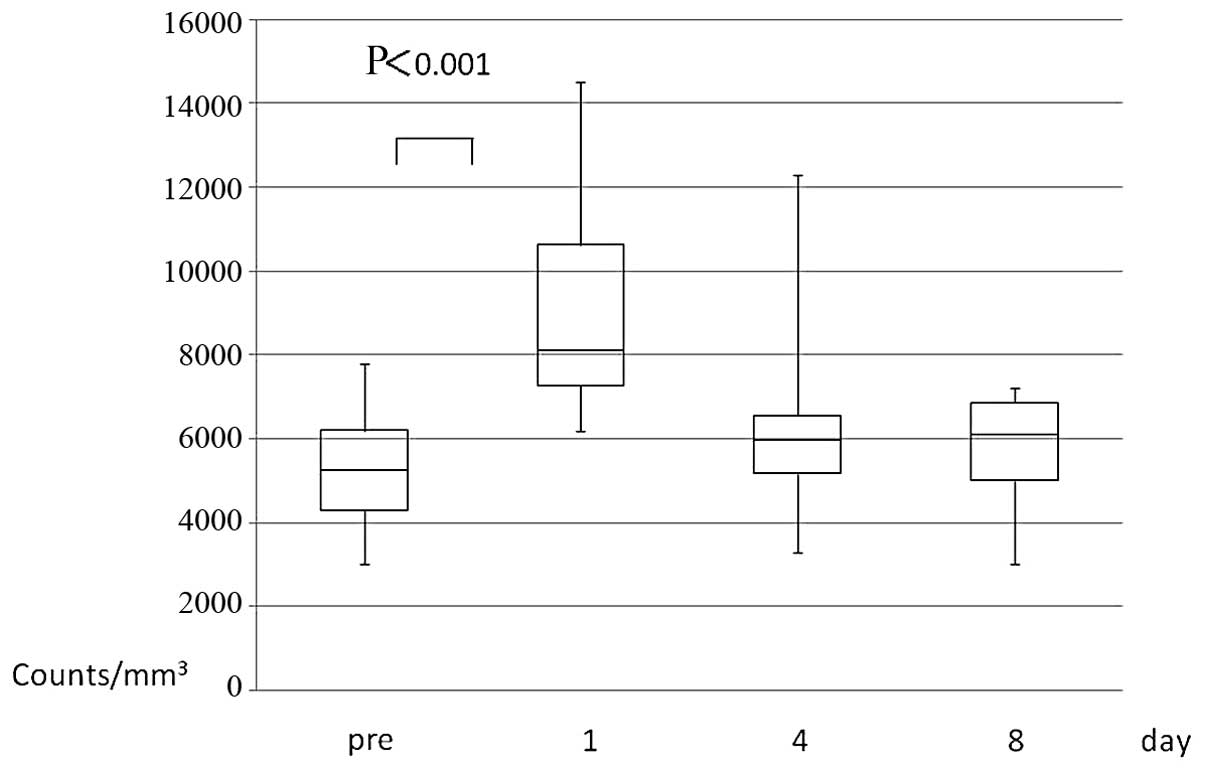
Open abdominal surgery and laparoscopic resection were performed in 9 and 7 patients, respectively (Table I). The WBC count was significantly increased on the 1st postoperative day [mean preoperative vs. 1st postoperative day level ± standard deviation (SD): 5,318.8±1,453.8 vs. 9,087.5±2,5878.6, respectively; P<0.001], followed by a gradual return to the baseline preoperative levels (Fig. 1).

Figure 1

Change in white blood cell count (mean ± standard deviation) following surgery. On the 1st postoperative day, the level increased to a maximum, followed by a gradual decrease over time (P<0.001).

CRP

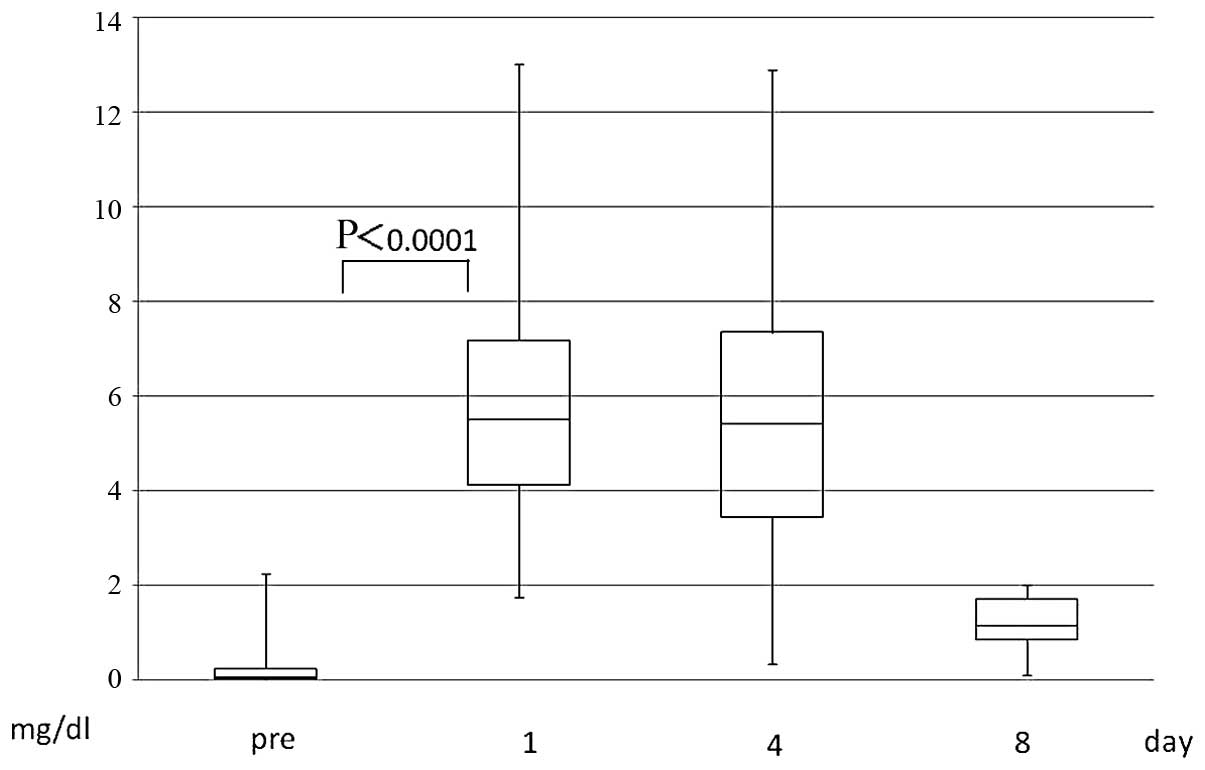
The CRP level (mg/dl) was aberrantly high on the 1st postoperative day (mean preoperative vs. 1st postoperative day level ± SD: 0.27±0.55 vs. 5.91±2.95, respectively; P<0.0001) and the 4th postoperative day, but decreased to normal by the 8th day (Fig. 2).

Figure 2

Change in C-reactive protein level (mean ± standard deviation) following surgery. On the 1st postoperative day, the level increased to a maximum, followed by a gradual decrease over time (P<0.0001).

Lymphocyte count

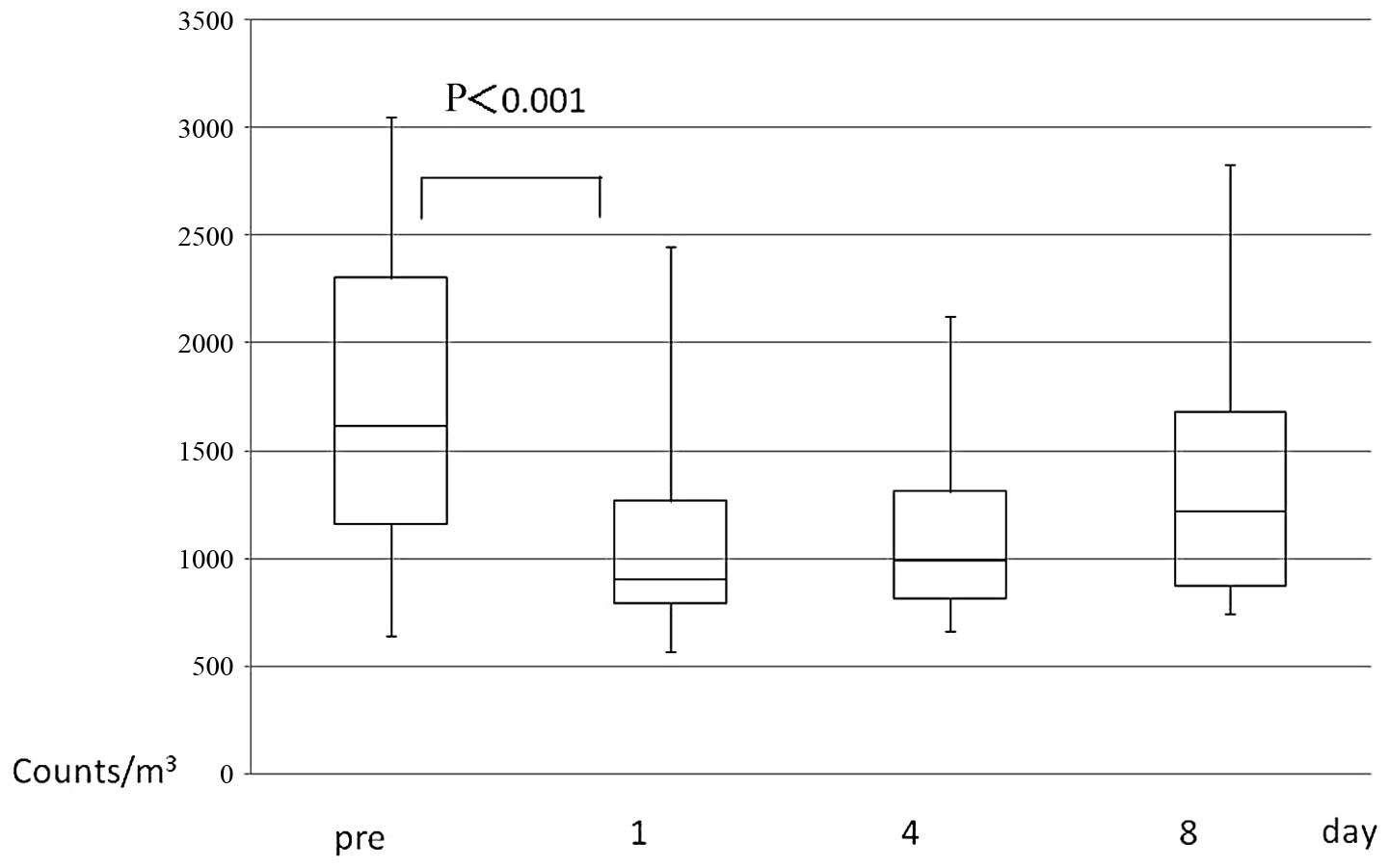
The lymphocyte count decreased significantly on the 1st postoperative day (mean preoperative vs. 1st postoperative day level ± SD: 1,740.7±758.7 vs. 1,095.1±515.8, respectively; P<0.001), but returned to normal on the 8th day (Fig. 3).

Figure 3

Change in lymphocyte count (mean ± standard deviation) following surgery. On the 1st postoperative day, the level decreased to a minimum, followed by a gradual increase over time (P<0.001).

ImmuKnow value

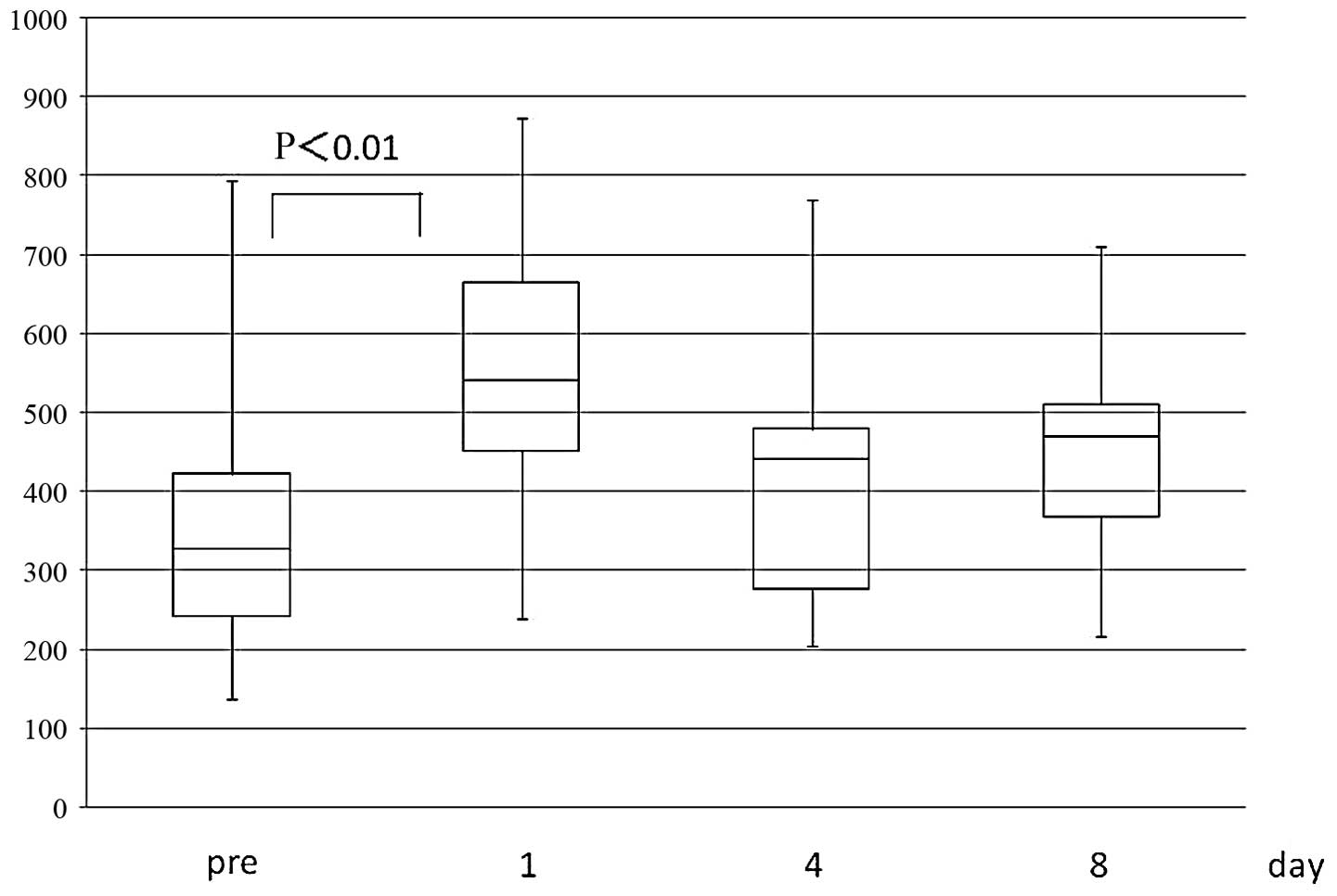
The ImmuKnow value increased significantly on the postoperative 1st day (mean preoperative vs. 1st postoperative day level ± SD: 378.5±193.7 vs. 553.3±172.7, respectively;P<0.01), followed by a gradual return to the preoperative level by the 8th day (Fig. 4).

Figure 4

Change in ImmuKnow assay level (mean ± standard deviation) following surgery. On the 1st postoperative day, the level increased to a maximum, followed by a gradual decrease over time (P<0.01).

Comparison between surgical approaches

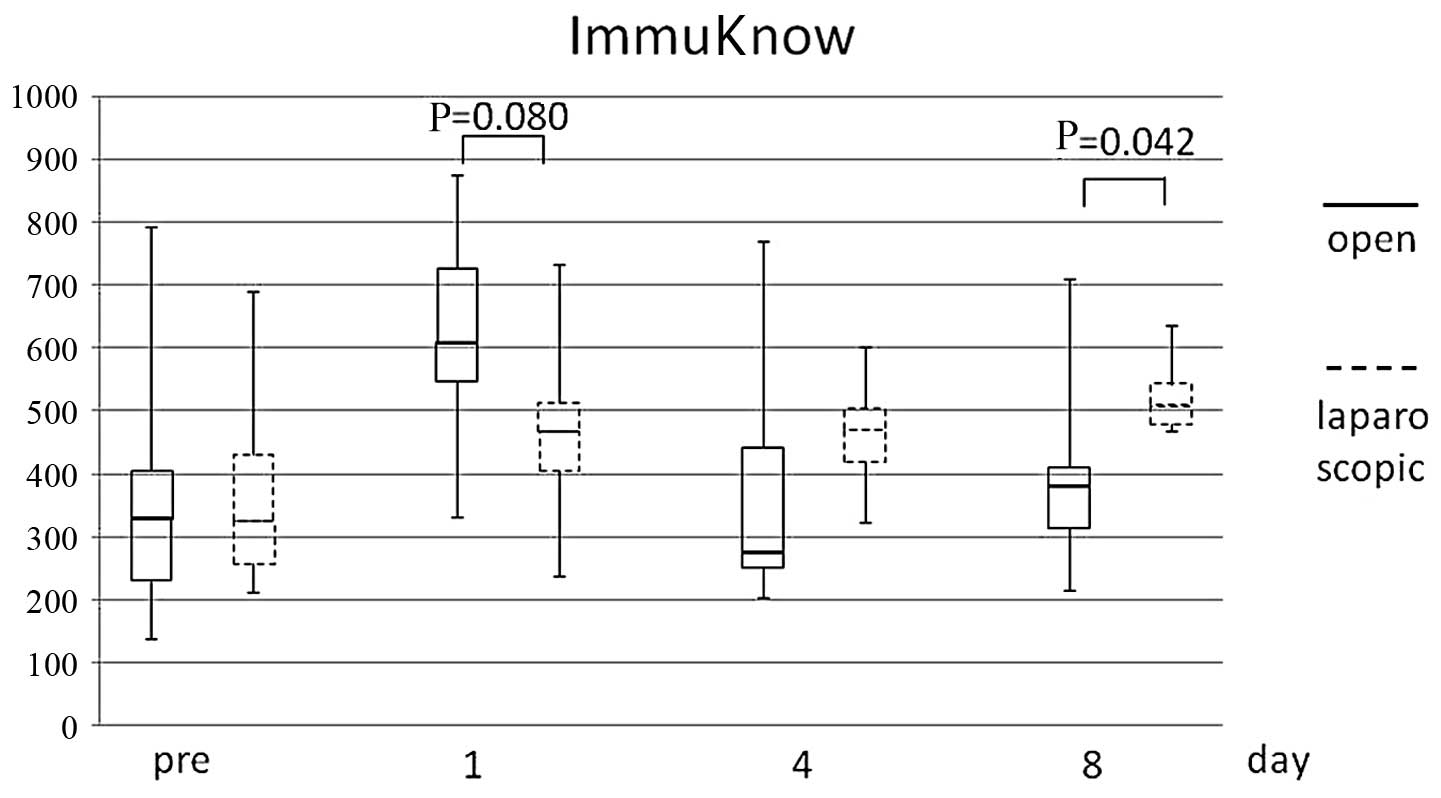
In a comparison between laparoscopic and open abdominal surgery, there were no significant differences in the WBC count, lymphocyte count or CRP value. However, the ImmuKnow assay demonstrated a tendency for the laparoscopic group to exhibit a lower response on the 1st postoperative day (open vs. laparoscopic surgery ± SD: 619.8±166.1 vs. 467.9±150.5, respectively; P=0.080) and a higher response on the 8th postoperative day (open vs. laparoscopic surgery ± SD: 394.0±141.0 vs. 522.1±60.6, respectively; P=0.042) (Fig. 5).

Figure 5

Comparison of ImmuKnow assay level (mean ± standard deviation) between open and laparoscopic surgery. On the 1st postoperative day, a smaller increase was observed in the laparoscopic surgery group (P=0.080). By contrast, the level in the open surgery group was lower compared to that in the laparoscopic group on the 8th postoperative day (P=0.042).

Discussion

Surgical stress induces postoperative immunosuppression. Ogawa et al (6) reported that the peripheral blood lymphocyte count and function were suppressed for ≥2 weeks postoperatively in 20 patients with stage I gastrointestinal cancer who underwent surgical resection. In particular, the CD4/CD8 T-cell ratio was decreased during the postoperative acute phase. Similarly, it was reported that the number of CD4+ T cells was decreased on the 1st day post-cholecystectomy and returned to normal at 5–7 days postoperatively (10).

In contrast to those reports, in our study, the CD4+ T-cell activity was significantly increased on the 1st postoperative day and was gradually reduced by day 4–7 postoperatively. This result may suggest that the CD4+ T-cell activity was stimulated in order to compensate for the decrease in CD4+ T cells due to the postoperative immunosuppression. Therefore, the ImmuKnow assay, which monitors the CD4+ T-cell activity, may be clinically applicable for the monitoring of the postoperative immune status.

Furthermore, when the effects of laparoscopic and open abdominal surgery on the CD4+ T-cell activity were compared, there was a tendency for the laparoscopic approach to exert a more limited effect compared to open surgery, although the difference did not reach statistical significance. Wu et al (8) reported that serum IL-6 and IL-8 levels were higher in the early phase following surgery in the open surgery compared to the laparoscopic surgery group in patients with colorectal cancer. The results of that study were consistent with ours, which demonstrated that ImmuKnow value correlated with acute phase response following colorectal surgery, similar to proinflammatory cytokines. Brune et al (11) also evaluated the immune defense following laparoscopic and open cholecystectomy and reported a more prominent immune suppression in the open surgery group. In addition, Bessler et al (12) reported that the immune activity associated with T-cell function was maintained closer to normal following laparoscopic colorectal surgery compared to open surgery. Thus, ImmuKnow value, as well as cytokine levels, suggest that laparoscopic colorectal surgery was less traumatic compared to open surgery, from the view point of acute phase response.

In addition, the CD4+ T-cell activity revealed a different type of reaction in patients subjected to surgical stress compared to those receiving immunosuppressive drugs. The ImmuKnow activity was found to be low in patients receiving immunosuppressive drugs following transplantation and its level may be used for risk monitoring of the patients to prevent transplant rejection and/or infection. Surgical stress is a well-known immunosuppressive factor following surgery, although the ImmuKnow activity was actually elevated on the 1st postoperative day, when the immunosuppression was considered to be at its peak. The ImmuKnow activity, therefore, may reflect the different mechanisms underlying the suppression of the immune system by surgical stress and pharmacotherapy (2–5). To elucidate the reasons for these differences, a subpopulation analysis of CD4+ T cells may be undertaken in the future. A limitation of the present study was that ImmuKnow is a qualitative assay, but does not directly reflect the level of immunosuppression, as described in the manufacturer's manual.

In conclusion, the immune activity during the acute phase following colorectal surgery may be monitored using the ImmuKnow assay. In addition, the ImmuKnow value may demonstrate the significant difference of the acute phase response between laparoscopic and open colorectal surgery. Futher clinical applications using ImmuKnow assay are expected in the future.

References

1 

Kowalski R, Post D, Schneider MC, et al: Immune cell function testing: an adjunct to therapeutic drug monitoring in transplant patient management. Clin Transplant. 17:77–88. 2003. View Article : Google Scholar : PubMed/NCBI

2 

Kowalski RJ, Post DR, Mannon RB, et al: Assessing relative risks of infection and rejection: a meta-analysis using an immune function assay. Transplantation. 82:663–668. 2006. View Article : Google Scholar : PubMed/NCBI

3 

Husain S, Raza K, Pilewski JM, et al: Experience with immune monitoring in lung transplant recipients: correlation of low immune function with infection. Transplantation. 87:1852–1857. 2009. View Article : Google Scholar : PubMed/NCBI

4 

Xue F, Zhang J, Han L, Li Q, Xu N, Zhou T, Xi Z, Wu Y and Xia Q: Immune cell functional assay in monitoring of adult liver transplantation recipients with infection. Transplantation. 89:620–626. 2010. View Article : Google Scholar : PubMed/NCBI

5 

Hooper E, Hawkins DM, Kowalski RJ, Post DR, Britz JA, Brooks KC and Turman MA: Establishing pediatric immune response zones using the Cylex ImmuKnow assay. Clin Transplant. 19:834–839. 2005. View Article : Google Scholar : PubMed/NCBI

6 

Ogawa K, Hirai M, Katsube T, Murayama M, Hamaguchi K, Shimakawa T, Naritake Y, Hosokawa T and Kajiwara T: Suppression of cellular immunity by surgical stress. Surgery. 127:329–336. 2000. View Article : Google Scholar : PubMed/NCBI

7 

Slade MS, Simmons RL, Yunis E and Greenberg LJ: Immunodepression after major surgery in normal patients. Surgery. 78:363–372. 1975.PubMed/NCBI

8 

Wu FP, Sietses C, von Blomberg BM, van Leeuwen PA, Meijer S and Cuesta MA: Systemic and peritoneal inflammatory response after laparoscopic or conventional colon resection in cancer patients: a prospective, randomized trial. Dis Colon Rectum. 46:147–155. 2003. View Article : Google Scholar

9 

Sobin LH, Gospodarowicz MK and Wittekind C: TNM Classification of Malignant Tumours. 7th. John Wiley & Sons; West Sussex: pp. 100–105. 2009

10 

Vallina VL and Velasco JM: The influence of laparoscopy on lymphocyte subpopulations in the surgical patient. Surg Endosc. 10:481–484. 1996. View Article : Google Scholar : PubMed/NCBI

11 

Brune IB, Wilke W, Hensler T, Feussner H, Holzmann B and Siewert JR: Normal T lymphocyte and monocyte function after minimally invasive surgery. Surg Endosc. 12:1020–1024. 1998. View Article : Google Scholar : PubMed/NCBI

12 

Bessler M, Whelan RL, Halverson A, Treat MR and Nowygrod R: Is immune function better preserved after laparoscopic versus open colon resection? Surg Endosc. 8:881–883. 1994. View Article : Google Scholar : PubMed/NCBI

Related Articles

  • Abstract
  • View
  • Download
  • Twitter
Copy and paste a formatted citation
Spandidos Publications style
Maki K, Takeno S, Aisu N, Yamashita K, Naito M, Hoshino S and Yamashita Y: CD4+ T‑lymphocytes are activated by surgical stress following colorectal resection in cancer patients. Mol Clin Oncol 3: 79-82, 2015.
APA
Maki, K., Takeno, S., Aisu, N., Yamashita, K., Naito, M., Hoshino, S., & Yamashita, Y. (2015). CD4+ T‑lymphocytes are activated by surgical stress following colorectal resection in cancer patients. Molecular and Clinical Oncology, 3, 79-82. https://doi.org/10.3892/mco.2014.442
MLA
Maki, K., Takeno, S., Aisu, N., Yamashita, K., Naito, M., Hoshino, S., Yamashita, Y."CD4+ T‑lymphocytes are activated by surgical stress following colorectal resection in cancer patients". Molecular and Clinical Oncology 3.1 (2015): 79-82.
Chicago
Maki, K., Takeno, S., Aisu, N., Yamashita, K., Naito, M., Hoshino, S., Yamashita, Y."CD4+ T‑lymphocytes are activated by surgical stress following colorectal resection in cancer patients". Molecular and Clinical Oncology 3, no. 1 (2015): 79-82. https://doi.org/10.3892/mco.2014.442
Copy and paste a formatted citation
x
Spandidos Publications style
Maki K, Takeno S, Aisu N, Yamashita K, Naito M, Hoshino S and Yamashita Y: CD4+ T‑lymphocytes are activated by surgical stress following colorectal resection in cancer patients. Mol Clin Oncol 3: 79-82, 2015.
APA
Maki, K., Takeno, S., Aisu, N., Yamashita, K., Naito, M., Hoshino, S., & Yamashita, Y. (2015). CD4+ T‑lymphocytes are activated by surgical stress following colorectal resection in cancer patients. Molecular and Clinical Oncology, 3, 79-82. https://doi.org/10.3892/mco.2014.442
MLA
Maki, K., Takeno, S., Aisu, N., Yamashita, K., Naito, M., Hoshino, S., Yamashita, Y."CD4+ T‑lymphocytes are activated by surgical stress following colorectal resection in cancer patients". Molecular and Clinical Oncology 3.1 (2015): 79-82.
Chicago
Maki, K., Takeno, S., Aisu, N., Yamashita, K., Naito, M., Hoshino, S., Yamashita, Y."CD4+ T‑lymphocytes are activated by surgical stress following colorectal resection in cancer patients". Molecular and Clinical Oncology 3, no. 1 (2015): 79-82. https://doi.org/10.3892/mco.2014.442
Follow us
  • Twitter
  • LinkedIn
  • Facebook
About
  • Spandidos Publications
  • Careers
  • Cookie Policy
  • Privacy Policy
How can we help?
  • Help
  • Live Chat
  • Contact
  • Email to our Support Team