Spandidos Publications Logo
  • About
    • About Spandidos
    • Aims and Scopes
    • Abstracting and Indexing
    • Editorial Policies
    • Reprints and Permissions
    • Job Opportunities
    • Terms and Conditions
    • Contact
  • Journals
    • All Journals
    • Oncology Letters
      • Oncology Letters
      • Information for Authors
      • Editorial Policies
      • Editorial Board
      • Aims and Scope
      • Abstracting and Indexing
      • Bibliographic Information
      • Archive
    • International Journal of Oncology
      • International Journal of Oncology
      • Information for Authors
      • Editorial Policies
      • Editorial Board
      • Aims and Scope
      • Abstracting and Indexing
      • Bibliographic Information
      • Archive
    • Molecular and Clinical Oncology
      • Molecular and Clinical Oncology
      • Information for Authors
      • Editorial Policies
      • Editorial Board
      • Aims and Scope
      • Abstracting and Indexing
      • Bibliographic Information
      • Archive
    • Experimental and Therapeutic Medicine
      • Experimental and Therapeutic Medicine
      • Information for Authors
      • Editorial Policies
      • Editorial Board
      • Aims and Scope
      • Abstracting and Indexing
      • Bibliographic Information
      • Archive
    • International Journal of Molecular Medicine
      • International Journal of Molecular Medicine
      • Information for Authors
      • Editorial Policies
      • Editorial Board
      • Aims and Scope
      • Abstracting and Indexing
      • Bibliographic Information
      • Archive
    • Biomedical Reports
      • Biomedical Reports
      • Information for Authors
      • Editorial Policies
      • Editorial Board
      • Aims and Scope
      • Abstracting and Indexing
      • Bibliographic Information
      • Archive
    • Oncology Reports
      • Oncology Reports
      • Information for Authors
      • Editorial Policies
      • Editorial Board
      • Aims and Scope
      • Abstracting and Indexing
      • Bibliographic Information
      • Archive
    • Molecular Medicine Reports
      • Molecular Medicine Reports
      • Information for Authors
      • Editorial Policies
      • Editorial Board
      • Aims and Scope
      • Abstracting and Indexing
      • Bibliographic Information
      • Archive
    • World Academy of Sciences Journal
      • World Academy of Sciences Journal
      • Information for Authors
      • Editorial Policies
      • Editorial Board
      • Aims and Scope
      • Abstracting and Indexing
      • Bibliographic Information
      • Archive
    • International Journal of Functional Nutrition
      • International Journal of Functional Nutrition
      • Information for Authors
      • Editorial Policies
      • Editorial Board
      • Aims and Scope
      • Abstracting and Indexing
      • Bibliographic Information
      • Archive
    • International Journal of Epigenetics
      • International Journal of Epigenetics
      • Information for Authors
      • Editorial Policies
      • Editorial Board
      • Aims and Scope
      • Abstracting and Indexing
      • Bibliographic Information
      • Archive
    • Medicine International
      • Medicine International
      • Information for Authors
      • Editorial Policies
      • Editorial Board
      • Aims and Scope
      • Abstracting and Indexing
      • Bibliographic Information
      • Archive
  • Articles
  • Information
    • Information for Authors
    • Information for Reviewers
    • Information for Librarians
    • Information for Advertisers
    • Conferences
  • Language Editing
Spandidos Publications Logo
  • About
    • About Spandidos
    • Aims and Scopes
    • Abstracting and Indexing
    • Editorial Policies
    • Reprints and Permissions
    • Job Opportunities
    • Terms and Conditions
    • Contact
  • Journals
    • All Journals
    • Biomedical Reports
      • Information for Authors
      • Editorial Policies
      • Editorial Board
      • Aims and Scope
      • Abstracting and Indexing
      • Bibliographic Information
      • Archive
    • Experimental and Therapeutic Medicine
      • Information for Authors
      • Editorial Policies
      • Editorial Board
      • Aims and Scope
      • Abstracting and Indexing
      • Bibliographic Information
      • Archive
    • International Journal of Epigenetics
      • Information for Authors
      • Editorial Policies
      • Editorial Board
      • Aims and Scope
      • Abstracting and Indexing
      • Bibliographic Information
      • Archive
    • International Journal of Functional Nutrition
      • Information for Authors
      • Editorial Policies
      • Editorial Board
      • Aims and Scope
      • Abstracting and Indexing
      • Bibliographic Information
      • Archive
    • International Journal of Molecular Medicine
      • Information for Authors
      • Editorial Policies
      • Editorial Board
      • Aims and Scope
      • Abstracting and Indexing
      • Bibliographic Information
      • Archive
    • International Journal of Oncology
      • Information for Authors
      • Editorial Policies
      • Editorial Board
      • Aims and Scope
      • Abstracting and Indexing
      • Bibliographic Information
      • Archive
    • Medicine International
      • Information for Authors
      • Editorial Policies
      • Editorial Board
      • Aims and Scope
      • Abstracting and Indexing
      • Bibliographic Information
      • Archive
    • Molecular and Clinical Oncology
      • Information for Authors
      • Editorial Policies
      • Editorial Board
      • Aims and Scope
      • Abstracting and Indexing
      • Bibliographic Information
      • Archive
    • Molecular Medicine Reports
      • Information for Authors
      • Editorial Policies
      • Editorial Board
      • Aims and Scope
      • Abstracting and Indexing
      • Bibliographic Information
      • Archive
    • Oncology Letters
      • Information for Authors
      • Editorial Policies
      • Editorial Board
      • Aims and Scope
      • Abstracting and Indexing
      • Bibliographic Information
      • Archive
    • Oncology Reports
      • Information for Authors
      • Editorial Policies
      • Editorial Board
      • Aims and Scope
      • Abstracting and Indexing
      • Bibliographic Information
      • Archive
    • World Academy of Sciences Journal
      • Information for Authors
      • Editorial Policies
      • Editorial Board
      • Aims and Scope
      • Abstracting and Indexing
      • Bibliographic Information
      • Archive
  • Articles
  • Information
    • For Authors
    • For Reviewers
    • For Librarians
    • For Advertisers
    • Conferences
  • Language Editing
Login Register Submit
  • This site uses cookies
  • You can change your cookie settings at any time by following the instructions in our Cookie Policy. To find out more, you may read our Privacy Policy.

    I agree
Search articles by DOI, keyword, author or affiliation
Search
Advanced Search
presentation
Molecular and Clinical Oncology
Join Editorial Board Propose a Special Issue
Print ISSN: 2049-9450 Online ISSN: 2049-9469
Journal Cover
September-2015 Volume 3 Issue 5

Full Size Image

Sign up for eToc alerts
Recommend to Library

Journals

International Journal of Molecular Medicine

International Journal of Molecular Medicine

International Journal of Molecular Medicine is an international journal devoted to molecular mechanisms of human disease.

International Journal of Oncology

International Journal of Oncology

International Journal of Oncology is an international journal devoted to oncology research and cancer treatment.

Molecular Medicine Reports

Molecular Medicine Reports

Covers molecular medicine topics such as pharmacology, pathology, genetics, neuroscience, infectious diseases, molecular cardiology, and molecular surgery.

Oncology Reports

Oncology Reports

Oncology Reports is an international journal devoted to fundamental and applied research in Oncology.

Experimental and Therapeutic Medicine

Experimental and Therapeutic Medicine

Experimental and Therapeutic Medicine is an international journal devoted to laboratory and clinical medicine.

Oncology Letters

Oncology Letters

Oncology Letters is an international journal devoted to Experimental and Clinical Oncology.

Biomedical Reports

Biomedical Reports

Explores a wide range of biological and medical fields, including pharmacology, genetics, microbiology, neuroscience, and molecular cardiology.

Molecular and Clinical Oncology

Molecular and Clinical Oncology

International journal addressing all aspects of oncology research, from tumorigenesis and oncogenes to chemotherapy and metastasis.

World Academy of Sciences Journal

World Academy of Sciences Journal

Multidisciplinary open-access journal spanning biochemistry, genetics, neuroscience, environmental health, and synthetic biology.

International Journal of Functional Nutrition

International Journal of Functional Nutrition

Open-access journal combining biochemistry, pharmacology, immunology, and genetics to advance health through functional nutrition.

International Journal of Epigenetics

International Journal of Epigenetics

Publishes open-access research on using epigenetics to advance understanding and treatment of human disease.

Medicine International

Medicine International

An International Open Access Journal Devoted to General Medicine.

Journal Cover
September-2015 Volume 3 Issue 5

Full Size Image

Sign up for eToc alerts
Recommend to Library

  • Article
  • Citations
    • Cite This Article
    • Download Citation
    • Create Citation Alert
    • Remove Citation Alert
    • Cited By
  • Similar Articles
    • Related Articles (in Spandidos Publications)
    • Similar Articles (Google Scholar)
    • Similar Articles (PubMed)
  • Download PDF
  • Download XML
  • View XML
Article Open Access

Modified miccoli's thyroid surgery for thyroid diseases

  • Authors:
    • Hui Yu
    • Xin Ge
    • Weikang Pan
    • Huaijie Wang
    • Qiang Huang
    • Yu Dong
    • Ya Gao
    • Jianjun Yu
  • View Affiliations / Copyright

    Affiliations: Department of Pediatric Surgery, The Second Affiliated Hospital, School of Medicine, Xi'an Jiaotong University, Xi'an, Shaanxi 710004, P.R. China, Department of Minimally Invasive Surgery, The People's Hospital of Ningxia Hui Autonomous Region, Yinchuan, Ningxia 750001, P.R. China
    Copyright: © Yu et al. This is an open access article distributed under the terms of Creative Commons Attribution License.
  • Pages: 1014-1018
    |
    Published online on: July 1, 2015
       https://doi.org/10.3892/mco.2015.597
  • Expand metrics +
Metrics: Total Views: 0 (Spandidos Publications: | PMC Statistics: )
Metrics: Total PDF Downloads: 0 (Spandidos Publications: | PMC Statistics: )
Cited By (CrossRef): 0 citations Loading Articles...

This article is mentioned in:


Abstract

Minimally invasive video-assisted thyroidectomy (MIVAT), originally described by Miccoli, is considered to be the most widely practiced and easily reproducible procedure for selected patients with benign and̸or malignant thyroid nodules. Modified techniques based on MIVAT, namely modified Miccoli's thyroid surgery (MMTS), were developed based on MIVAT. This study aimed to evaluate the preliminary results of MMTS compared with those of MIVAT. The enrolling criteria included a benign nodule <3.5 cm in diameter, a malignant tumor <2 cm, no previous neck surgery and no evidence of any suspected lymph node metastasis or local invasion. Unilateral lobectomy was considered for benign lesions and the additional dissection of central compartment (level VI) lymph nodes was applied for malignant disease. The modified techniques included carefully selecting the operative incision, expanding the operative space, embedding a drainage tube in situ and delicately suturing every layer inwards and crosswise, as well as measuring cervical motion. In addition to the comparison of surgical outcomes between MMTS and MIVAT, other surgical parameters, including operative time, blood loss, postoperative drainage, cosmetic satisfaction, peak angle of cervical rotation, length of hospitalization and complications, were retrospectively analyzed. A consecutive series of 70 patients, including 54 cases of benign and 16 cases of malignant disease, initially underwent MIVAT between April, 2008 and May, 2012, while 127 patients, including 98 benign and 29 malignant cases, subsequently underwent MMTS between September, 2011 and October, 2014. Patients who received MMTS exhibited significantly less blood loss (20.3±11.3 vs. 32.3±12.6 ml, P<0.01), lower volume of postoperative drainage (42.77±15.2 vs. 50.48±23.2 ml, P<0.01) and higher cosmetic satisfaction (94.6±3.5 vs. 88.9±2.7%, P<0.01), but a longer operative time (102±36 vs. 50.48±23.2 min, P<0.01) when compared with MIVAT. In addition, a better peak angle of cervical rotation (38.6±4.1˚ vs. 35.3±3.8˚, P=0.25) and shorter length of hospitalization (4.25±1.08 vs. 4.51±1.30 days, P=0.52) was observed in the MMTS group, although the differences with the MIVAT group were not statistically significant. No complications were observed, apart from 2 cases of recurrent laryngeal nerve palsy and 1 case of transient hypocalcemia at the beginning of MIVAT. In conclusion, both MMST and MIVAT are safe and feasible methods of thyroidectomy; however, MMST is associated with less trauma and higher cosmetic satisfaction compared with MIVAT. Therefore, MMST may be used as a standard operative method and prospectively applicable for thyroidectomy, even for early‑stage malignancies.

Introduction

Minimally invasive techniques for thyroidectomy have applied various endoscopic approaches, such as through two or more holes (1), the axillo-bilateral-breast approach (2) and the anterior chest wall approach (3) after the first endoscopic parathyroidectomy in 1996. MIVAT, originally described by Miccoli, has gradually been accepted due to its advantages, such as better cosmetic results compared with traditional procedures and better postoperative outcome, as well as lower medical cost (4–6). The range of applications of MIVAT has expanded rapidly from benign disease to malignancy.

However, the MIVAT procedure has been associated with certain disadvantages, such as limited operative space, use of a thick rubber drainage tube and keloid formation. To address these issues, effective surgical techniques have been investigated; for example, a better operative space may be provided by using a modified retractor. Moreover, placement of a smaller drainage tube of moderate hardness has replaced thick rubber tubes for routine drainage; in addition to carefully selecting the operative incision and suturing every layer inwards and crosswise, sticky dressing was applied for tension-free repair.

The aim of this study was to retrospectively compare the results between patients who underwent MMST and those who underwent MIVAT, in order to establish the safety, feasibility and aesthetic superiority of MMST.

Patients and methods

Patients and criteria

A total of 70 consecutive patients who underwent MIVAT between April, 2008 and May, 2012 and 127 patients who underwent MMTS between September, 2011 and October, 2014 were enrolled in this study. The eligibility and exclusion criteria were as previously described (7).

Preoperative preparations

All the patients underwent thyroid ultrasound and functional examinations in order to exclude hyperthyroidism, hypothyroidism and hyperactive adenoma. A methoxyisobutylisonitrile scan and enhanced computed tomography were also performed to exclude any suspected lymph node metastasis or local invasion. In all the cases, an intraoperative frozen section examination was performed and the paraffin-embedded sections were routinely examined postoperatively.

Modified surgical techniques
Selecting the operative incision

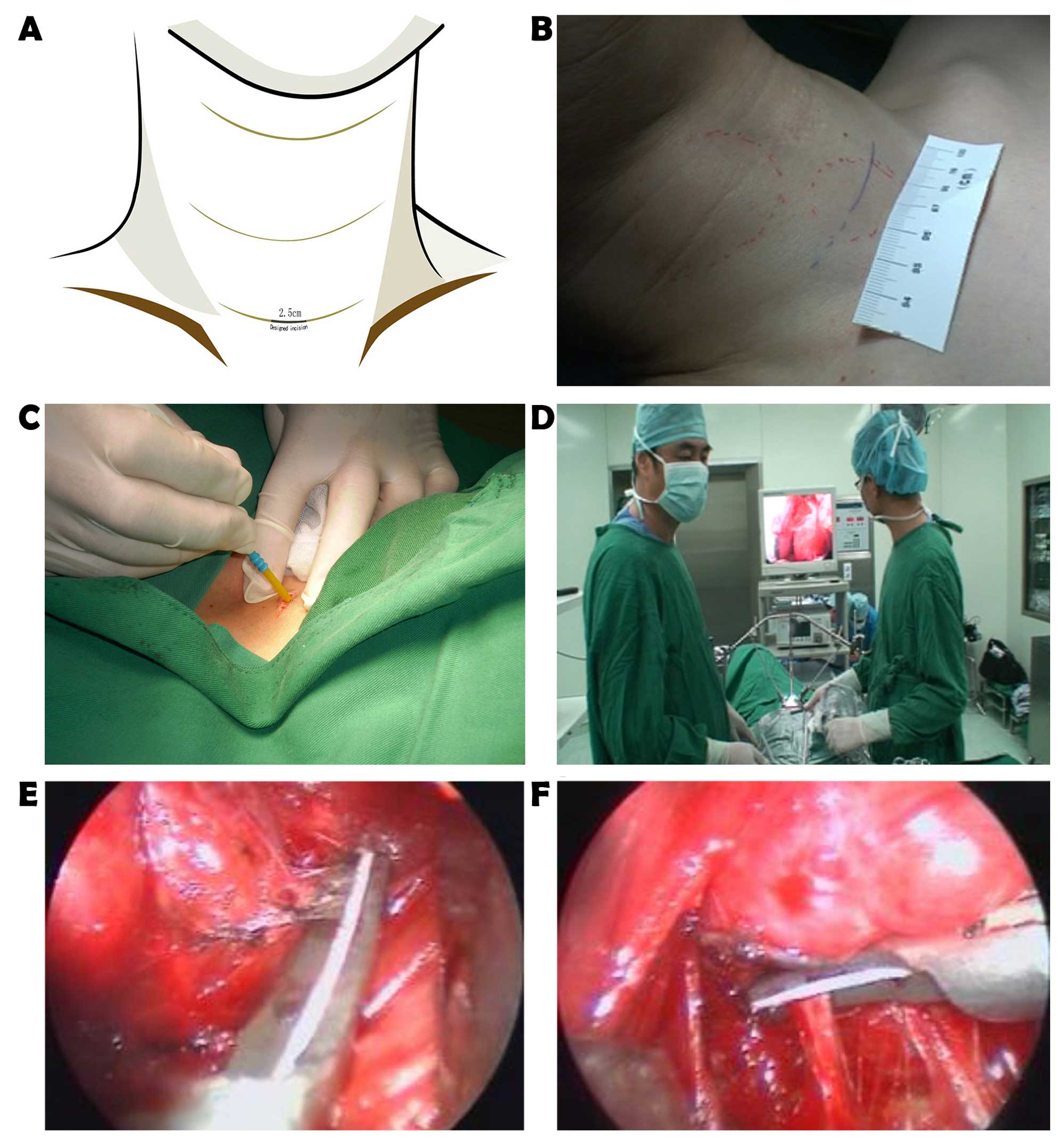
The incision was routinely designed in detail to coincide with last prominent line of Langer (Fig. 1A and B), ~3.0 cm or two fingers above the sternal notch. The primary requirement of the designed incision was to move symmetrically along the last prominent line of Langer (Fig. 1C).

Figure 1.

(A) Schematic illustration of the modified Miccoli's thyroid surgery (MMTS) incision in the upright position. (B) The incision is designed to coincide symmetrically with the last prominent line of Langer. (C) A needle-like electrotome with a rubber tube is used for the MMTS incision and hemostasis. (D) Intraoperative view of the gasless endoscopic setup. (E and F) The procedure was performed under endoscopic vision and the harmonic scalpel facilitated resection and extraction of the lobe.

Expanding the operative space

A gasless lifting system with modified retractors was installed, suspended and fixed in an orderly manner (Fig. 1D). Sufficient working space was created through a 30° (5 mm) endoscope. The procedure was performed under endoscopic vision, with an amplified video (Fig. 1E and F) to help discriminate between different anatomical structures.

Suturing each layer inwards and crosswise

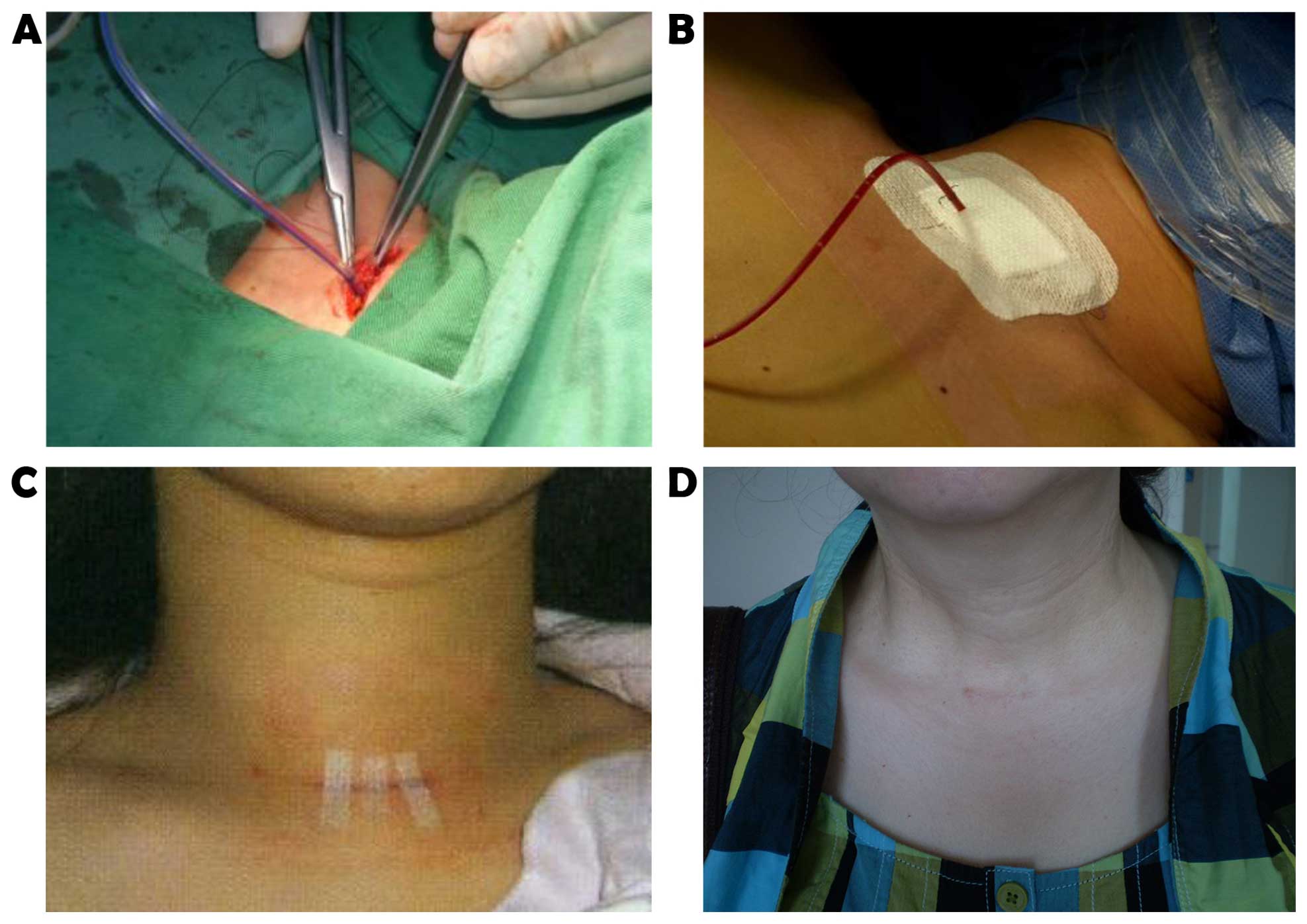
The Hunter line, fascia, platysma and subcutaneous tissue were tightly sutured inwards and crosswise (Fig. 2A) following conventional check-up. The skin was closed through subcuticular suturing and sticky dressing was applied to achieve tension-free repair (Fig. 2B). The joined points of the adjacent layers were not in the same perpendicular line, but rather crosswise-positioned.

Figure 2.

(A and B) A drainage tube was carefully placed in situ and each layer was sutured inwards and crosswise. (C) Cosmetic result of modified Miccoli's thyroid surgery on the 3rd postoperative day. (D) The scar is barely visible 1 month postoperatively.

Placement of the drainage tube in situ

A small tube of moderate hardness, connected to a compressible oval bulb, partly used to maintain an air-free state for effective drainage, was carefully embedded in situ. The steps were similar to those during conventional procedures.

Measuring cervical motion

The method for measuring the precise cervical range of motion was previously reported by our team (7).

Statistical analysis

All the data are presented as means ± standard deviation. Group data from the MIVAT and MMTS groups were analyzed. The non-parametric Mann-Whitney test was used to compare the means of the parameters. A value of P<0.01 was considered to indicate a statistically significant difference.

Results

Patients

A consecutive series of 70 patients, including 54 benign and 16 malignant cases, initially underwent MIVAT between April, 2008 and May, 2012, whereas 127 patients, including 98 benign and 29 malignant cases, subsequently underwent MMTS between September, 2011 and October, 2014. The preoperative characteristics were similar between the MMTS and MIVAT groups (Table I).

Table I.

Clinical characteristics of all the patients undergoing thyroid surgery.

Table I.

Clinical characteristics of all the patients undergoing thyroid surgery.

CharacteristicsMIVAT (n=70)MMST (n=127)
Gender
  F% (F/M)77.14 (54/16)77.95 (99/28)
Age (years)
  Mean ± SD45±946±10
  Range22–6022–65
Max tumor diameter (cm)
  Mean ± SD1.8±0.91.8±0.8
  Range0.2–3.50.2–3.5
Location of tumors
  L% (R/L)54.29 (38/32)53.54 (68/59)

[i] MIVAT, minimally invasive video-assisted thyroidectomy; MMTS, modified Miccoli's thyroid surgery; F, female; M, male; SD, standard deviation; L, left lobe; R, right lobe.

Surgical results

General anesthesia was applied to all the patients and no cases were converted to conventional thyroidectomy. All the MMTS and MIVAT procedures were performed by the same surgeon. The surgical parameters, including operative time, blood loss, postoperative drainage, peak angle of cervical rotation, length of hospitalization and cosmetic satisfaction, are listed in Table II. Two cases of recurrent laryngeal nerve palsy and 1 case of transient hypocalcemia at the beginning of MIVAT recovered following symptomatic treatment. A 12-month follow-up was required, including thyroid ultrasonography and function. The serum thyroglobulin level was measured in patients with malignant lesions. The cosmetic results of MMTS were visible on the 3rd day (Fig. 2C) and the 1st month (Fig. 2D) postoperatively.

Table II.

Intraoperative and follow-up data.

Table II.

Intraoperative and follow-up data.

Surgical parametersMIVAT (n=70)MMST (n=127)P-value
Operative time (min)82±29102±36<0.01
Blood loss (ml)32.3±12.620.3±11.3<0.01
Postoperative drainage (ml)50.48±23.242.77±15.2<0.01
Peak angle of cervical rotation (°)35.3±3.8°38.6±4.1°0.25
Length of hospitalization (days)4.51±1.304.25±1.080.52
Cosmetic satisfaction (%)88.9±2.794.6±3.5<0.01

[i] The data are presented as means ± standard deviation. MMTS, modified Miccoli's thyroid surgery; MIVAT, minimally invasive video-assisted thyroidectomy.

Discussion

Although MIVAT has several advantages, including less postoperative pain, shorter hospital stay, more attractive cosmetic results and reduced distress (8) through transforming growth factor-β serum levels, as well as no additional risks of rupturing the capsule with subsequent cancer cell dissemination (9) and and other thyroidectomy complications, it also has certain disadvantages, such as narrow operative space, use of a thick rubber drainage tube and keloid formation. Based on MIVAT, MMST uses modified surgical techniques to achieve better results and cosmetic satisfaction.

The issue of the thyroidectomy incision was investigated several decades prior. Desault first initiated an anterior median longitudinal incision; next, a similarly lateral incision but parallel to the inner border of the sternocleidomastoid muscle was planned by Billroth; his junior, Kocher, established an 8–10 cm collar incision that became popular in the 20th century (10). Recently, Miccoli introduced the MIVAT procedure (11), which revolutionized minimally invasive thyroidectomy. A 1.5-cm horizontal incision placed 2 cm above the sternal notch is associated with less trauma, compared to other approaches. However, the standards of the incision have not been clearly determined, except for a study reporting that, if placed <2 cm or one fingerbreadth away from the sternal notch, particularly on the manubrium, the incision may result in a hypertrophic scar or keloid (12). In addition, a precise measurable approach was introduced to determine optimal incision placement between the cricoid cartilage and the sternal notch (13). By contrast, another previous study indicated that the incision migrates in different positions (14). Of note, migration of the incision of ~9 mm downwards was observed during postoperative follow-up when changing the body position from upright to supine in a preliminary study (15). Furthermore, cosmetic principles suggest that the remaining incision may result in a hypertrophic scar or keloid when deviating away from the Langer's line and recommend using pre-existing neck creases to better hide the incisions. Therefore, the incision in our department was designed to coincide with the last prominent Langer's line, between the cricoid cartilage and the sternal notch, and was individualized as required.

In practice, cervical motion is considered to be negatively correlated with postoperative pain, and may be a useful parameter to monitor functional recovery; however, this is not a simple and rapid way to evaluate drainage, incision length and duration of hospitalization in clinical practice and only a limited number of studies consider this parameter. The quantifiable angle from the submental area to the maximal degree bilaterally was noted after our patients were encouraged to move their heads, which may be used to measure injuries directly.

Despite the possibility of drainage tube-related damage to the laryngeal nerve and tube blocking by clots, drainage is crucial for preventing hematoma formation from the slow extravasation of blood and lymph fluid in a closed and narrow space. Placing a smaller drainage tube in the thyroid bed is now routinely practiced. Moreover, the air-free state of the smaller tube makes drainage more effective from each layer.

Finally, as an independent indicator reported by Sabuncuoglu et al (16), scar tissue formation of <3 cm is important for cosmetic satisfaction. Therefore, it is crucial for clinicians to study the characteristics of keloid formation.

In conclusion, MMTS is feasible and safe for the treatment of benign and/or malignant thyroid nodules, similar to MIVAT. Furthermore, MMST is associated with less trauma and higher cosmetic satisfaction compared with MIVAT. However, further investigation is required to confirm the long-term outcome and more attention should be focused on keloid formation.

References

1 

Pai SI and Tufano RP: Central compartment neck dissection for thyroid cancer. Technical considerations. ORL J Otorhinolaryngol Relat Spec. 70:292–297. 2008. View Article : Google Scholar : PubMed/NCBI

2 

Bärlehner E and Benhidjeb T: Cervical scarless endoscopic thyroidectomy: Axillo-bilateral-breast approach (ABBA). Surg Endosc. 22:154–157. 2008. View Article : Google Scholar : PubMed/NCBI

3 

Nakano S, Kijima Y, Owaki T, Shirao K, Baba M and Aikou T: Anterior chest wall approach for video-assisted thyroidectomy using a modifed neck skin lifting method. Biomed Pharmacother. 56 (Suppl 1):96S–99S. 2002. View Article : Google Scholar : PubMed/NCBI

4 

Timon C and Miller IS: Minimally invasive video-assisted thyroidectomy: Indications and technique. Laryngoscope. 116:1046–1049. 2006. View Article : Google Scholar : PubMed/NCBI

5 

Lombardi CP, Raffaelli M, Princi P, De Crea C and Bellantone R: Video-assisted thyroidectomy: Report on the experience of a single center in more than four hundred cases. World J Surg. 30:794–801. 2006. View Article : Google Scholar : PubMed/NCBI

6 

Miccoli B, Berti P, Bendinelli C, Conte M, Fasolini F and Martino E: Minimally invasive video-assisted surgery of the thyroid: A preliminary report. Lange becks Arch Surg. 385:261–264. 2000. View Article : Google Scholar

7 

Yu JJ, Bao SL, Yu SL, Zhang DQ, Loo WT, Chow LW, Su L, Cui Z, Chen K, Ma LQ, et al: Minimally invasive video-assisted thyroidectomy for the early-stage differential thyroid carcinoma. J Transl Med. 10 (Suppl 1):S132012. View Article : Google Scholar : PubMed/NCBI

8 

Elaraj DM and Clark OH: Changing management in patients with papillary thyroid cancer. Curr Treat Options Oncol. 8:305–313. 2007. View Article : Google Scholar : PubMed/NCBI

9 

Miccoli P, Berti P, Raffaelli M, Materazzi G, Baldacci S and Rossi G: Comparison between minimally invasive video-assisted thyroidectomy and conventional thyroidectomy: A prospective randomized study. Surgery. 130:1039–1043. 2001. View Article : Google Scholar : PubMed/NCBI

10 

Thompson NW, Olsenn WR and Hoffman GL: The continuing development of the technique of thyroidectomy. Surgery. 73:913–927. 1973.PubMed/NCBI

11 

Pinchot S, Chen H and Sippel R: Incisions and exposure of the neck for thyroidectomy and parathyroidectomy. Operat Tech Gen Surg. 10:63–76. 2008. View Article : Google Scholar

12 

Scott-Conner CE and Dawson DL: Operative anatomy. 1st. JB Lippincott Company; Philadelphia, PA: pp. 388–1993

13 

Xiao GZ and Gao L: A simple method for determining an optimal incision for minimally invasive video-assisted thyroidectomy. Surg Endosc. 22:2100–2101. 2008. View Article : Google Scholar : PubMed/NCBI

14 

Jancewicz S, Sidhu S, Jalaludin B and Campbell P: Optimal position for a cervical collar incision: A prospective study. ANZ J Surg. 72:15–17. 2002. View Article : Google Scholar : PubMed/NCBI

15 

Yu H, Yang YZ, Zhang DQ, Cui Z and Yu JJ: Analysis of cervical dermatoglyph and related factors. Chin Arch Gen Surg. 4:571–572. 2010.

16 

Sabuncuoglu MZ, Sabuncuoglu A, Sozen I, Benzin MF, Cakir T and Cetin R: Minimally invasive surgery using mini anterior incision for thyroid diseases: A prospective cohort study. Int J Clin Exp Med. 7:3404–3409. 2014.PubMed/NCBI

Related Articles

  • Abstract
  • View
  • Download
  • Twitter
Copy and paste a formatted citation
Spandidos Publications style
Yu H, Ge X, Pan W, Wang H, Huang Q, Dong Y, Gao Y and Yu J: Modified miccoli's thyroid surgery for thyroid diseases. Mol Clin Oncol 3: 1014-1018, 2015.
APA
Yu, H., Ge, X., Pan, W., Wang, H., Huang, Q., Dong, Y. ... Yu, J. (2015). Modified miccoli's thyroid surgery for thyroid diseases. Molecular and Clinical Oncology, 3, 1014-1018. https://doi.org/10.3892/mco.2015.597
MLA
Yu, H., Ge, X., Pan, W., Wang, H., Huang, Q., Dong, Y., Gao, Y., Yu, J."Modified miccoli's thyroid surgery for thyroid diseases". Molecular and Clinical Oncology 3.5 (2015): 1014-1018.
Chicago
Yu, H., Ge, X., Pan, W., Wang, H., Huang, Q., Dong, Y., Gao, Y., Yu, J."Modified miccoli's thyroid surgery for thyroid diseases". Molecular and Clinical Oncology 3, no. 5 (2015): 1014-1018. https://doi.org/10.3892/mco.2015.597
Copy and paste a formatted citation
x
Spandidos Publications style
Yu H, Ge X, Pan W, Wang H, Huang Q, Dong Y, Gao Y and Yu J: Modified miccoli's thyroid surgery for thyroid diseases. Mol Clin Oncol 3: 1014-1018, 2015.
APA
Yu, H., Ge, X., Pan, W., Wang, H., Huang, Q., Dong, Y. ... Yu, J. (2015). Modified miccoli's thyroid surgery for thyroid diseases. Molecular and Clinical Oncology, 3, 1014-1018. https://doi.org/10.3892/mco.2015.597
MLA
Yu, H., Ge, X., Pan, W., Wang, H., Huang, Q., Dong, Y., Gao, Y., Yu, J."Modified miccoli's thyroid surgery for thyroid diseases". Molecular and Clinical Oncology 3.5 (2015): 1014-1018.
Chicago
Yu, H., Ge, X., Pan, W., Wang, H., Huang, Q., Dong, Y., Gao, Y., Yu, J."Modified miccoli's thyroid surgery for thyroid diseases". Molecular and Clinical Oncology 3, no. 5 (2015): 1014-1018. https://doi.org/10.3892/mco.2015.597
Follow us
  • Twitter
  • LinkedIn
  • Facebook
About
  • Spandidos Publications
  • Careers
  • Cookie Policy
  • Privacy Policy
How can we help?
  • Help
  • Live Chat
  • Contact
  • Email to our Support Team