Spandidos Publications Logo
  • About
    • About Spandidos
    • Aims and Scopes
    • Abstracting and Indexing
    • Editorial Policies
    • Reprints and Permissions
    • Job Opportunities
    • Terms and Conditions
    • Contact
  • Journals
    • All Journals
    • Oncology Letters
      • Oncology Letters
      • Information for Authors
      • Editorial Policies
      • Editorial Board
      • Aims and Scope
      • Abstracting and Indexing
      • Bibliographic Information
      • Archive
    • International Journal of Oncology
      • International Journal of Oncology
      • Information for Authors
      • Editorial Policies
      • Editorial Board
      • Aims and Scope
      • Abstracting and Indexing
      • Bibliographic Information
      • Archive
    • Molecular and Clinical Oncology
      • Molecular and Clinical Oncology
      • Information for Authors
      • Editorial Policies
      • Editorial Board
      • Aims and Scope
      • Abstracting and Indexing
      • Bibliographic Information
      • Archive
    • Experimental and Therapeutic Medicine
      • Experimental and Therapeutic Medicine
      • Information for Authors
      • Editorial Policies
      • Editorial Board
      • Aims and Scope
      • Abstracting and Indexing
      • Bibliographic Information
      • Archive
    • International Journal of Molecular Medicine
      • International Journal of Molecular Medicine
      • Information for Authors
      • Editorial Policies
      • Editorial Board
      • Aims and Scope
      • Abstracting and Indexing
      • Bibliographic Information
      • Archive
    • Biomedical Reports
      • Biomedical Reports
      • Information for Authors
      • Editorial Policies
      • Editorial Board
      • Aims and Scope
      • Abstracting and Indexing
      • Bibliographic Information
      • Archive
    • Oncology Reports
      • Oncology Reports
      • Information for Authors
      • Editorial Policies
      • Editorial Board
      • Aims and Scope
      • Abstracting and Indexing
      • Bibliographic Information
      • Archive
    • Molecular Medicine Reports
      • Molecular Medicine Reports
      • Information for Authors
      • Editorial Policies
      • Editorial Board
      • Aims and Scope
      • Abstracting and Indexing
      • Bibliographic Information
      • Archive
    • World Academy of Sciences Journal
      • World Academy of Sciences Journal
      • Information for Authors
      • Editorial Policies
      • Editorial Board
      • Aims and Scope
      • Abstracting and Indexing
      • Bibliographic Information
      • Archive
    • International Journal of Functional Nutrition
      • International Journal of Functional Nutrition
      • Information for Authors
      • Editorial Policies
      • Editorial Board
      • Aims and Scope
      • Abstracting and Indexing
      • Bibliographic Information
      • Archive
    • International Journal of Epigenetics
      • International Journal of Epigenetics
      • Information for Authors
      • Editorial Policies
      • Editorial Board
      • Aims and Scope
      • Abstracting and Indexing
      • Bibliographic Information
      • Archive
    • Medicine International
      • Medicine International
      • Information for Authors
      • Editorial Policies
      • Editorial Board
      • Aims and Scope
      • Abstracting and Indexing
      • Bibliographic Information
      • Archive
  • Articles
  • Information
    • Information for Authors
    • Information for Reviewers
    • Information for Librarians
    • Information for Advertisers
    • Conferences
  • Language Editing
Spandidos Publications Logo
  • About
    • About Spandidos
    • Aims and Scopes
    • Abstracting and Indexing
    • Editorial Policies
    • Reprints and Permissions
    • Job Opportunities
    • Terms and Conditions
    • Contact
  • Journals
    • All Journals
    • Biomedical Reports
      • Information for Authors
      • Editorial Policies
      • Editorial Board
      • Aims and Scope
      • Abstracting and Indexing
      • Bibliographic Information
      • Archive
    • Experimental and Therapeutic Medicine
      • Information for Authors
      • Editorial Policies
      • Editorial Board
      • Aims and Scope
      • Abstracting and Indexing
      • Bibliographic Information
      • Archive
    • International Journal of Epigenetics
      • Information for Authors
      • Editorial Policies
      • Editorial Board
      • Aims and Scope
      • Abstracting and Indexing
      • Bibliographic Information
      • Archive
    • International Journal of Functional Nutrition
      • Information for Authors
      • Editorial Policies
      • Editorial Board
      • Aims and Scope
      • Abstracting and Indexing
      • Bibliographic Information
      • Archive
    • International Journal of Molecular Medicine
      • Information for Authors
      • Editorial Policies
      • Editorial Board
      • Aims and Scope
      • Abstracting and Indexing
      • Bibliographic Information
      • Archive
    • International Journal of Oncology
      • Information for Authors
      • Editorial Policies
      • Editorial Board
      • Aims and Scope
      • Abstracting and Indexing
      • Bibliographic Information
      • Archive
    • Medicine International
      • Information for Authors
      • Editorial Policies
      • Editorial Board
      • Aims and Scope
      • Abstracting and Indexing
      • Bibliographic Information
      • Archive
    • Molecular and Clinical Oncology
      • Information for Authors
      • Editorial Policies
      • Editorial Board
      • Aims and Scope
      • Abstracting and Indexing
      • Bibliographic Information
      • Archive
    • Molecular Medicine Reports
      • Information for Authors
      • Editorial Policies
      • Editorial Board
      • Aims and Scope
      • Abstracting and Indexing
      • Bibliographic Information
      • Archive
    • Oncology Letters
      • Information for Authors
      • Editorial Policies
      • Editorial Board
      • Aims and Scope
      • Abstracting and Indexing
      • Bibliographic Information
      • Archive
    • Oncology Reports
      • Information for Authors
      • Editorial Policies
      • Editorial Board
      • Aims and Scope
      • Abstracting and Indexing
      • Bibliographic Information
      • Archive
    • World Academy of Sciences Journal
      • Information for Authors
      • Editorial Policies
      • Editorial Board
      • Aims and Scope
      • Abstracting and Indexing
      • Bibliographic Information
      • Archive
  • Articles
  • Information
    • For Authors
    • For Reviewers
    • For Librarians
    • For Advertisers
    • Conferences
  • Language Editing
Login Register Submit
  • This site uses cookies
  • You can change your cookie settings at any time by following the instructions in our Cookie Policy. To find out more, you may read our Privacy Policy.

    I agree
Search articles by DOI, keyword, author or affiliation
Search
Advanced Search
presentation
Molecular and Clinical Oncology
Join Editorial Board Propose a Special Issue
Print ISSN: 2049-9450 Online ISSN: 2049-9469
Journal Cover
November-2016 Volume 5 Issue 5

Full Size Image

Sign up for eToc alerts
Recommend to Library

Journals

International Journal of Molecular Medicine

International Journal of Molecular Medicine

International Journal of Molecular Medicine is an international journal devoted to molecular mechanisms of human disease.

International Journal of Oncology

International Journal of Oncology

International Journal of Oncology is an international journal devoted to oncology research and cancer treatment.

Molecular Medicine Reports

Molecular Medicine Reports

Covers molecular medicine topics such as pharmacology, pathology, genetics, neuroscience, infectious diseases, molecular cardiology, and molecular surgery.

Oncology Reports

Oncology Reports

Oncology Reports is an international journal devoted to fundamental and applied research in Oncology.

Experimental and Therapeutic Medicine

Experimental and Therapeutic Medicine

Experimental and Therapeutic Medicine is an international journal devoted to laboratory and clinical medicine.

Oncology Letters

Oncology Letters

Oncology Letters is an international journal devoted to Experimental and Clinical Oncology.

Biomedical Reports

Biomedical Reports

Explores a wide range of biological and medical fields, including pharmacology, genetics, microbiology, neuroscience, and molecular cardiology.

Molecular and Clinical Oncology

Molecular and Clinical Oncology

International journal addressing all aspects of oncology research, from tumorigenesis and oncogenes to chemotherapy and metastasis.

World Academy of Sciences Journal

World Academy of Sciences Journal

Multidisciplinary open-access journal spanning biochemistry, genetics, neuroscience, environmental health, and synthetic biology.

International Journal of Functional Nutrition

International Journal of Functional Nutrition

Open-access journal combining biochemistry, pharmacology, immunology, and genetics to advance health through functional nutrition.

International Journal of Epigenetics

International Journal of Epigenetics

Publishes open-access research on using epigenetics to advance understanding and treatment of human disease.

Medicine International

Medicine International

An International Open Access Journal Devoted to General Medicine.

Journal Cover
November-2016 Volume 5 Issue 5

Full Size Image

Sign up for eToc alerts
Recommend to Library

  • Article
  • Citations
    • Cite This Article
    • Download Citation
    • Create Citation Alert
    • Remove Citation Alert
    • Cited By
  • Similar Articles
    • Related Articles (in Spandidos Publications)
    • Similar Articles (Google Scholar)
    • Similar Articles (PubMed)
  • Download PDF
  • Download XML
  • View XML
Case Report

Pregnancy and cesarean delivery after multimodal therapy for vulvar carcinoma: A case report

  • Authors:
    • Kuniaki Toriyabe
    • Haruki Taniguchi
    • Tokihiro Senda
    • Masako Nakano
    • Yoshinari Kobayashi
    • Miho Izawa
    • Hirohiko Tanaka
    • Tetsuo Asakura
    • Tsutomu Tabata
    • Tomoaki Ikeda
  • View Affiliations / Copyright

    Affiliations: Department of Obstetrics and Gynecology, Mie University Graduate School of Medicine, Tsu, Mie 514‑8507, Japan, Department of Obstetrics and Gynecology, Mie Prefectural General Medical Center, Yokkaichi, Mie 510‑8561, Japan
  • Pages: 583-586
    |
    Published online on: September 19, 2016
       https://doi.org/10.3892/mco.2016.1021
  • Expand metrics +
Metrics: Total Views: 0 (Spandidos Publications: | PMC Statistics: )
Metrics: Total PDF Downloads: 0 (Spandidos Publications: | PMC Statistics: )
Cited By (CrossRef): 0 citations Loading Articles...

This article is mentioned in:


Abstract

Reports of pregnancy following treatment for vulvar carcinoma are extremely uncommon, as the main problem of subsequent pregnancy is vulvar scarring following radical surgery. We herein report the case of a patient who was diagnosed with stage I squamous cell carcinoma of the vulva at the age of 17 years and was treated with multimodal therapy, including neoadjuvant chemotherapy, wide local excision with bilateral inguinal lymph node dissection and adjuvant radiotherapy. The patient became pregnant spontaneously 9 years after her initial diagnosis and the antenatal course was good, except for mild acute pyelonephritis at 25 weeks of gestation. An elective caesarean section was performed at 38 weeks of gestation due to vulvar scarring following multimodal therapy, particularly radiotherapy. The patient remains alive and well, without signs of recurrence or metastasis 12 years after her diagnosis and treatment. radical vulvectomy as well as multimodal therapy for vulvar carcinoma, particularly radiotherapy, may cause extensive skin scarring. The presence of vulvar scarring following multimodal therapy for vulvar carcinoma may increase the incidence of caesarean delivery.

Introduction

As carcinoma of the vulva is rare among young women, reports of pregnancy following treatment for vulvar carcinoma are extremely uncommon. The incidence of vulvar carcinoma, however, has recently increased among younger women; thus, there may have been an increase in pregnancy rates following vulvar carcinoma treatment (1). Pregnant women who undergo surgical treatment for vulvar carcinoma, including radical vulvectomy, may have an increased incidence of caesarean delivery (2). In the literature, vulvar scarring following radical vulvectomy was the major reason for pregnant women undergoing caesarean section (2–7). To date, no cases of pregnancy following vulvar carcinoma have been reported in patients who had undergone surgery and radiotherapy.

We herein describe a case in which caesarean section was performed due to the presence of extensive vulvar scarring following multimodal therapy for vulvar carcinoma, including chemotherapy, surgery and radiotherapy.

Case report

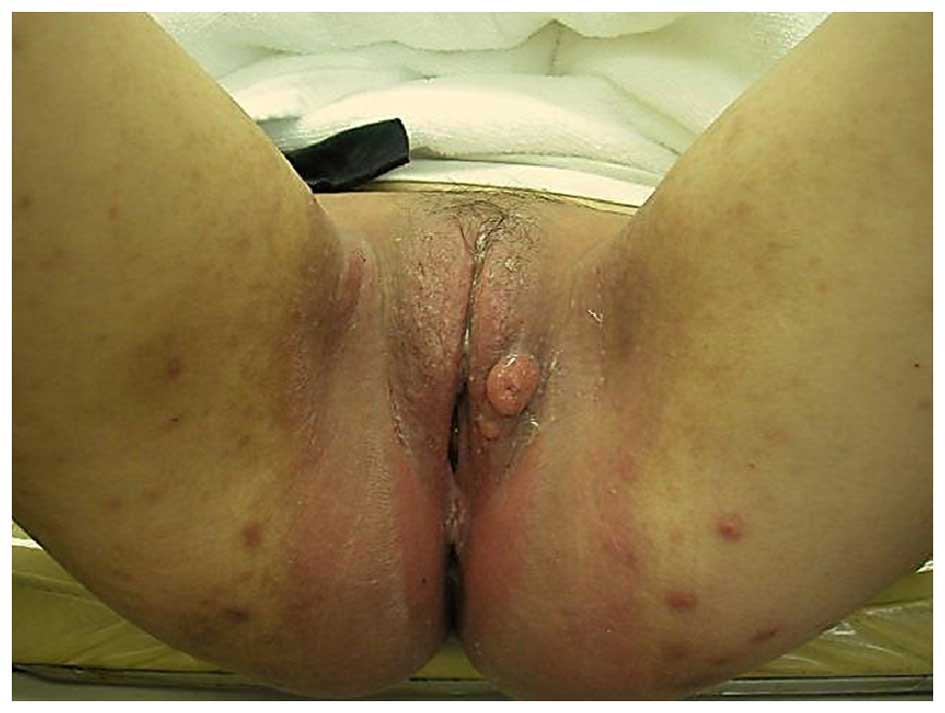
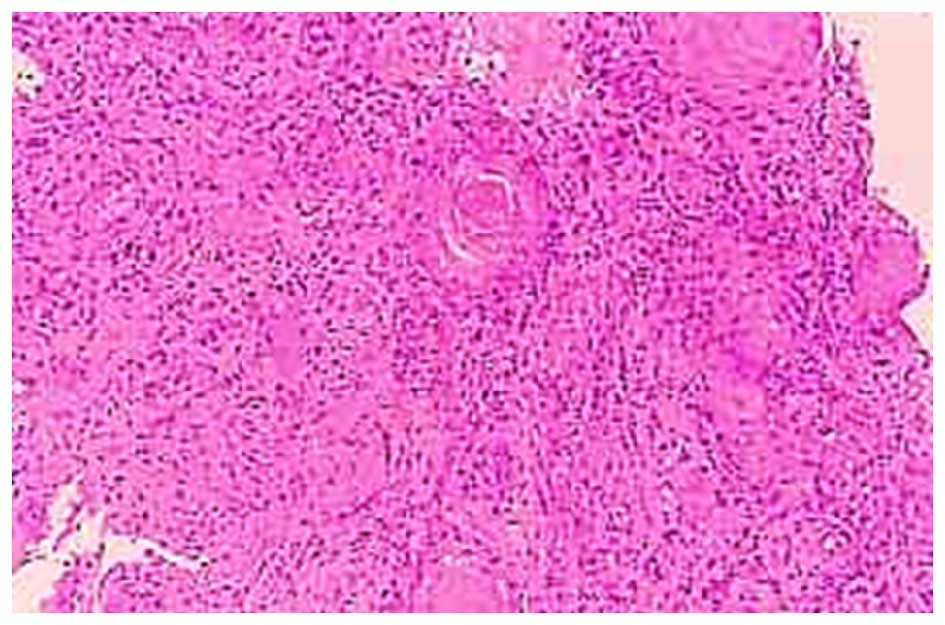
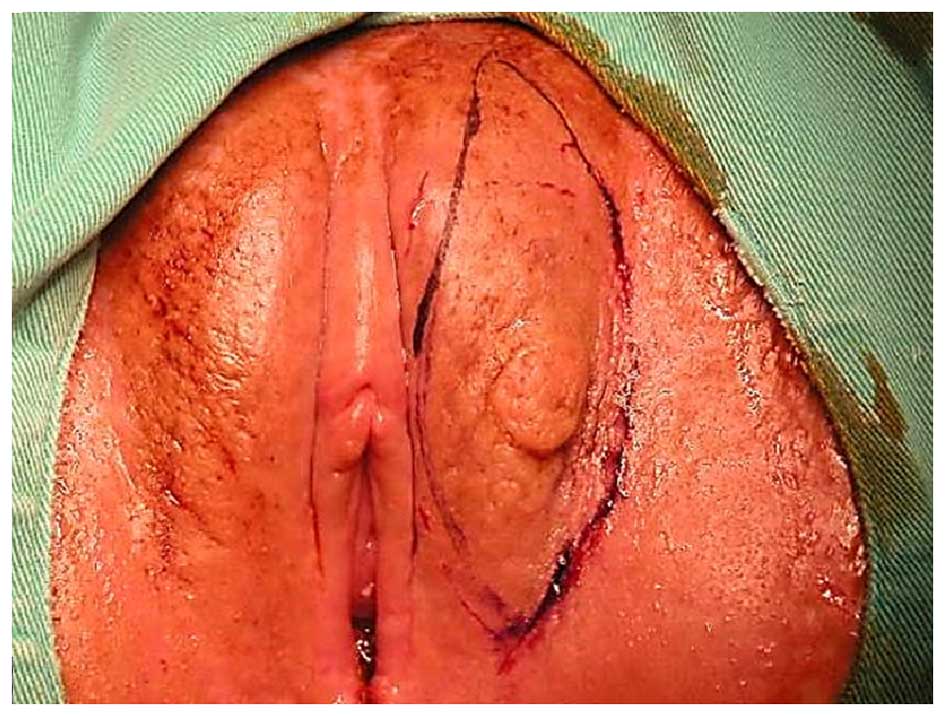
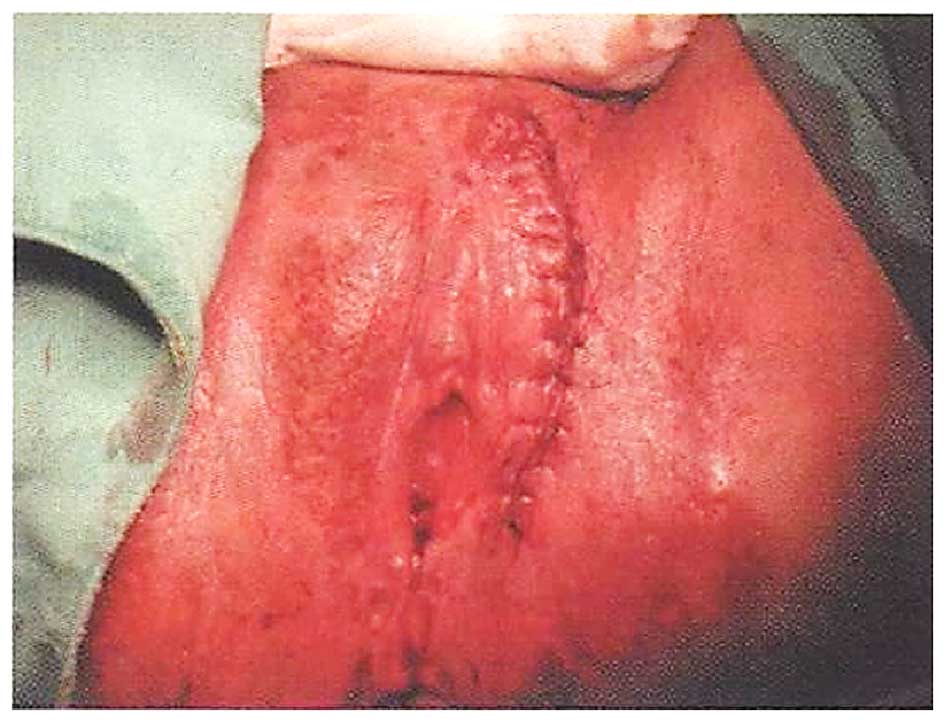
In April, 2003, a 17-year-old, nulligravida Japanese woman, who was a smoker, presented with a 4-month history of a mass (sized >2 cm) with accompanying pruritus in the left labium majus (Fig. 1). Examination of biopsy specimens revealed invasive squamous cell carcinoma with keratin pearl formation and stromal invasion >1 mm in depth (Fig. 2). Screening for sexually transmitted infections, including HIV serology, syphilis serology, Chlamydia trachomatis polymerase chain reaction and Neisseria gonorrhoeae polymerase chain reaction were performed, and were all negative. The serum squamous cell carcinoma antigen level was 2.6 ng/ml (normal value, <1.5 ng/ml). Magnetic resonance imaging (MRI) revealed enlarged inguinal lymph nodes bilaterally. The patient first underwent neoadjuvant chemotherapy (pepleomycin, 5 mg/body intramuscular injection twice a week for 2.5 weeks, 5 cycles of administration in total). The tumor of the vulva was reduced in size following chemotherapy. Subsequently, wide local excision with bilateral inguinal lymph node dissection was performed (Figs. 3 and 4). All surgical margins (≥1 cm) were free of carcinoma cells. The lymph nodes were negative for malignancy and there was no evidence of lymphovascular invasion. The tumor was classified as ypT1bN0M0, and a diagnosis of International Federation of Gynecology and Obstetrics (2008) stage IB keratinizing squamous cell carcinoma of the vulva was confirmed. The specimen was negative for p16 immunohistostaining. The skin surrounding the cancer lesion displayed non-specific chronic eczema, without any vulvar intraepithelial neoplasia. One month after the vulvar surgery, the patient received adjuvant radiotherapy of the vulvar and inguinal regions bilaterally (external-beam irradiation, 1.8 Gy/day in 25 fractions over 5 weeks; total radiation dose, 45.0 Gy).

Figure 1.

A tumor sized >2 cm was identified on the left labium majus on physical examination.

Figure 2.

Biopsy specimen of the vulvar tumor showing invasive squamous cell carcinoma with keratin pearl formation, with stromal invasion of >1 mm in depth (magnification, ×40).

Figure 3.

The vulvar tumor was reduced in size following neoadjuvant chemotherapy and wide local excision was planned.

Figure 4.

The vulvar tumor was resected with a surgical margin of ≥1 cm and the wound was closed using the knotted suture technique.

The patient was prescribed an ointment of steroids and zinc oxide for radiation dermatitis of the vulva and perineum by the dermatologist. There was no dysuria or dyschezia following radiotherapy. No stenosis of the vaginal orifice occurred, but the patient occasionally experienced mild dyspareunia, for which she used lubricants during coitus. The menstrual cycles following multimodal therapy were regular.

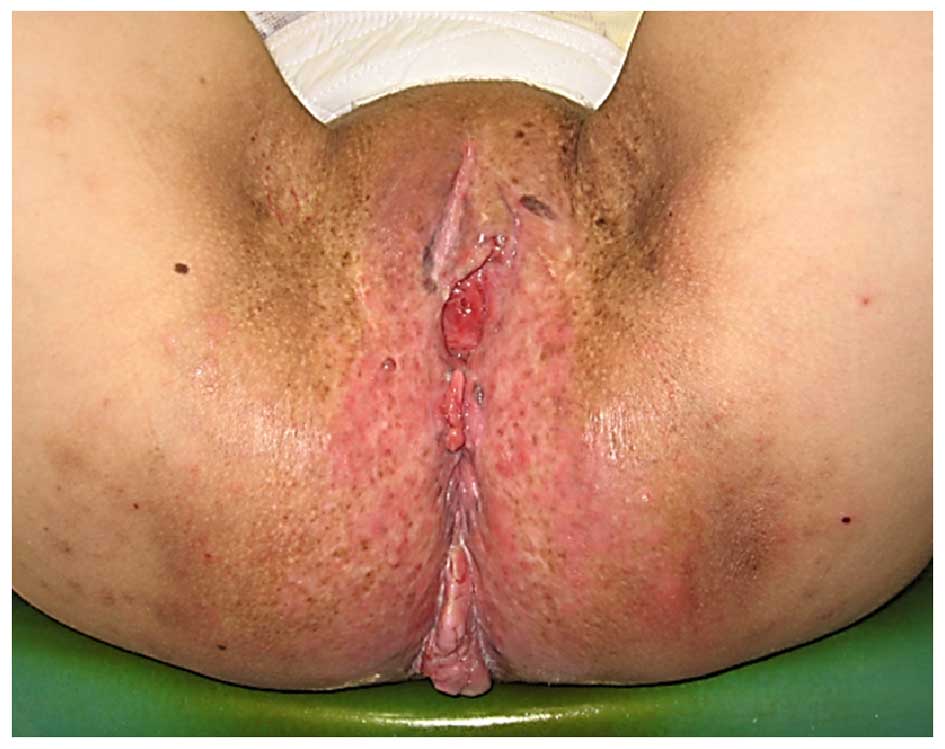
The patient became pregnant spontaneously in January, 2012, at the age of 26 years, 9 years after the diagnosis and treatment of her malignancy. Delivery by caesarean section was planned, due to vulvar scarring extending to the perineum and anal granulation following multimodal therapy, particularly radiotherapy (Fig. 5). There was no edema on the vulva or the lower limbs during pregnancy. The antenatal course was good, except for mild acute pyelonephritis at 25 weeks of gestation, which was considered to be unrelated to her previous treatment. The patient improved after 3 days of intravenous administration of cefmetazole, and there was no relapse of pyelonephritis until delivery. In August, 2012, a healthy female infant was delivered by elective caesarean section under combined spinal epidural anesthesia, at a gestational age of 38 weeks and 2 days. The amount of intraoperative hemorrhage was 1,926 ml, containing amniotic fluid. The newborn weighed 2,625 g and was 45.0 cm tall, with an Apgar score of 8 both at 1 and 5 min. The umbilical cord arterial pH was 7.330 and base excess was −3.1. Placental pathology revealed no abnormal findings.

Figure 5.

Vulvar scarring extending to the perineum and anal granulation.

In April, 2015 (12 years after the initial diagnosis of vulvar carcinoma), the patient was alive and well, without signs of recurrence or metastasis. At the last follow-up, the child was aged 2 years and exhibited good growth and development, except for a case of lymphadenitis purulenta of the neck with febrile convulsions at the age of 1 year.

Discussion

Reports of pregnancy following treatment for vulvar carcinoma are extremely uncommon. Our case involved a Japanese woman who became pregnant after having been treated for vulvar carcinoma. We reviewed 15 cases reported in the literature (Table I) and all the patients remained alive (2–7). Only 1 patient had stage IV disease (metastasis to the pelvic lymph nodes), whereas the others had stage I disease. Vulvar surgery involved 1 case undergoing wide local excision and 14 cases of radical vulvectomy. Radiation therapy was not administered in any of the cases. Recurrence of vulvar lesions was confirmed in 3 of the 14 cases with a long follow-up reported in the literature. All 3 recurrent cases were treated by local excision. Of the 10 cases who were nulliparous at treatment for vulvar cancer, 8 underwent caesarean section; the remaining 2 cases had a normal vaginal delivery (premature labor in 1 case and labor induction for intrauterine fetal death in the other case). Of the 5 parous cases at treatment for malignancy, 4 had a normal vaginal delivery and the remaining patient underwent a caesarean section. Thus, the mode of delivery following treatment for vulvar carcinoma may be affected by parity at treatment.

Table I.

Previous studies reporting pregnancy and delivery outcomes following treatment for vulvar carcinoma.

Table I.

Previous studies reporting pregnancy and delivery outcomes following treatment for vulvar carcinoma.

First author, year (Refs.)Age, yearsParityCancer stageVulvar surgeryRadiation therapyTime from treatment to pregnancy confirmationDeliveryGestation at deliveryComplicationBirth weight, gRecurrenceOutcome from treatment
Rubin, 1953 (6)371IRV–9 monthsNVD–36 weeksPremature labor2,190–27 months
Dahle, 1959 (3)270IRV–3 yearsCS (obstetric)38 weeksTwins, PIH3,110/2,380–5 years
Collins, 1960 (4)350IVRV–1 yearCS (2nd-look laparotomy)Term–3,500–11 years
Gemmel, 1960 (5)190IRV–24 monthsCS (vulvar scarring)Preterm–1,930–108 months
280IRV–19 monthsCS (vulvar scarring)Term–3,175Early SCC at perineum171 months
300IRV–33 monthsCS (obstetric)TermPIH2,495–70 months
303IRV–19 monthsNVD–TermPIH3,400–7 years
313IRV–6 monthsNVD+TermProteinuria3,685–66 months
320IRV–13 monthsNVD–36 weeksPremature labor, retained placenta2,015–114 months
321IRV–31 monthsNVD+TermEpisiotomy detachmen3,345–73 months
330IRV–2 yearsCS (vulvar scarring)Term–3,345–79 months
390IRV–33 monthsCS (obstetric)PretermPIH, NRFS, stillbirth1,815–10 years
Palmer, 2009 (2)291IRV–2 yearsCS (vulvar scarring)38 weeks–NAAIN20 years
360IWLE–20 monthsNVD?29 weeksIUFD, labor inductionNAVIN9 years
Arjona, 2011 (7)260IRV–89 monthsCS (vulvar scarring)39 weeks–NANANA
Present case170IWLE+9 yearsCS (vulvar scarring)38 weeksPN2,625–12 years

[i] RV, radical vulvectomy; WLE, wide local excision; CS, caesarean section; SCC, squamous cell carcinoma; NVD+, normal vaginal delivery with episiotomy; NVD-, without episiotomy; NVD?, unknown episiotomy; PIH, pregnancy-induced hypertension; NRFS, non-reassuring fetal status; IUFD, intrauterine fetal death; AIN, anal intraepithelial neoplasia; VIN, vulvar intraepithelial neoplasia; NA, not available; PN, pyelonephritis.

The major reason for caesarean section being performed in the reported cases was vulvar scarring following treatment for vulvar carcinoma; however, the obstetrical reasons were minor. In our review, 5 of 9 cases who had undergone caesarean delivery had vulvar scarring following radical vulvectomy for vulvar carcinoma. In contrast to the reported cases, however, the vulva of our patient was scarred following multimodal therapy for vulvar cancer, including chemotherapy, surgery and radiotherapy. For vulvar carcinoma, surgical therapy, including wide local excision, simple vulvectomy and radical vulvectomy, with or without bilateral inguinal lymph node dissection, are currently the standard treatment. In certain cases, however, radiotherapy with or without chemotherapy may also be performed in addition to surgical therapy (8,9). Our patient first presented with a vulvar tumor sized >2 cm and enlarged inguinal lymph nodes on MRI at the age of 17 years. Following tumor shrinkage with neoadjuvant chemotherapy, wide local excision was performed. Subsequently, although the inguinal lymph nodes were negative for malignancy, adjuvant radiotherapy was administered for potential future local recurrence and inguinal lymph node metastasis. Although our case did not undergo major surgery on the vulva, radiotherapy caused extensive skin scarring, extending from the vulva to the perineum. Moreover, granulation tissue developed around the anus. Thus, an elective caesarean delivery was planned to avoid complicated lacerations during delivery.

In conclusion, pregnancy following treatment for vulvar carcinoma may be accompanied by post-treatment vulvar scarring. In addition to radical vulvectomy, multimodal therapy, particularly radiotherapy, may also cause extensive skin scarring. When considering radiotherapy for vulvar carcinoma in young patients, the risk of vulvar scarring and the probability of future delivery by caesarean section should be explained to the patients.

References

1 

Hampl M, Deckers-Figiel S, Hampl JA, Rein D and Bender HG: New aspects of vulvar cancer: Changes in localization and age of onset. Gynecol Oncol. 109:340–345. 2008. View Article : Google Scholar : PubMed/NCBI

2 

Palmer JE and Tidy JA: Pregnancy following vulvar squamous cell carcinoma: A report of two cases. J Gynecol Oncol. 20:254–256. 2009. View Article : Google Scholar : PubMed/NCBI

3 

Dahle T: Carcinoma of the vulva and subsequent successful pregnancy. Acta Obstet Gynecol Scand. 38:448–452. 1959. View Article : Google Scholar : PubMed/NCBI

4 

Collins JH, Birch HW, Pailet M and Avent JK: Pregnancy and delivery following extensive vulvectomy. Am J Obstet Gynecol. 80:167–171. 1960.PubMed/NCBI

5 

Gemmell AA and Haines M: Pregnancy following radical vulvectomy for carcinoma of the vulva. J Obstet Gynaecol Br Emp. 67:199–207. 1960. View Article : Google Scholar : PubMed/NCBI

6 

Rubin A and Lewis GC Jr: Pregnancy and vaginal delivery following radical surgery for cancer of the vulva; review of the literature and case report. Am J Obstet Gynecol. 65:1347–1349. 1953. View Article : Google Scholar : PubMed/NCBI

7 

Arjona JE, Velasco E, Cervelo P, Espejo E, Pizarro I, Carrasco S and Castelo-Branco C: Pregnancy following radical vulvectomy for carcinoma of the vulva: A case report and literature review. Eur J Obstet Gynecol Reprod Biol. 158:113–114. 2011. View Article : Google Scholar : PubMed/NCBI

8 

Mahner S, Jueckstock J, Hilpert F, Neuser P, Harter P, de Gregorio N, Hasenburg A, Sehouli J, Habermann A, Hillemanns P, et al: AGO-CaRE 1 investigators: Adjuvant therapy in lymph node-positive vulvar cancer: The AGO-CaRE-1 Study. J Natl Cancer Ins. 107:dju4262015. View Article : Google Scholar

9 

Matsuo K, Whitman SA, Blake EA, Conturie CL, Ciccone MA, Jung CE, Takiuchi T and Nishimura M: Feto-maternal outcome of pregnancy complicated by vulvar cancer: A systematic review of literature. Eur J Obstet Gyn Reprod Biol. 179:216–223. 2014. View Article : Google Scholar

Related Articles

  • Abstract
  • View
  • Download
  • Twitter
Copy and paste a formatted citation
Spandidos Publications style
Toriyabe K, Taniguchi H, Senda T, Nakano M, Kobayashi Y, Izawa M, Tanaka H, Asakura T, Tabata T, Ikeda T, Ikeda T, et al: Pregnancy and cesarean delivery after multimodal therapy for vulvar carcinoma: A case report. Mol Clin Oncol 5: 583-586, 2016.
APA
Toriyabe, K., Taniguchi, H., Senda, T., Nakano, M., Kobayashi, Y., Izawa, M. ... Ikeda, T. (2016). Pregnancy and cesarean delivery after multimodal therapy for vulvar carcinoma: A case report. Molecular and Clinical Oncology, 5, 583-586. https://doi.org/10.3892/mco.2016.1021
MLA
Toriyabe, K., Taniguchi, H., Senda, T., Nakano, M., Kobayashi, Y., Izawa, M., Tanaka, H., Asakura, T., Tabata, T., Ikeda, T."Pregnancy and cesarean delivery after multimodal therapy for vulvar carcinoma: A case report". Molecular and Clinical Oncology 5.5 (2016): 583-586.
Chicago
Toriyabe, K., Taniguchi, H., Senda, T., Nakano, M., Kobayashi, Y., Izawa, M., Tanaka, H., Asakura, T., Tabata, T., Ikeda, T."Pregnancy and cesarean delivery after multimodal therapy for vulvar carcinoma: A case report". Molecular and Clinical Oncology 5, no. 5 (2016): 583-586. https://doi.org/10.3892/mco.2016.1021
Copy and paste a formatted citation
x
Spandidos Publications style
Toriyabe K, Taniguchi H, Senda T, Nakano M, Kobayashi Y, Izawa M, Tanaka H, Asakura T, Tabata T, Ikeda T, Ikeda T, et al: Pregnancy and cesarean delivery after multimodal therapy for vulvar carcinoma: A case report. Mol Clin Oncol 5: 583-586, 2016.
APA
Toriyabe, K., Taniguchi, H., Senda, T., Nakano, M., Kobayashi, Y., Izawa, M. ... Ikeda, T. (2016). Pregnancy and cesarean delivery after multimodal therapy for vulvar carcinoma: A case report. Molecular and Clinical Oncology, 5, 583-586. https://doi.org/10.3892/mco.2016.1021
MLA
Toriyabe, K., Taniguchi, H., Senda, T., Nakano, M., Kobayashi, Y., Izawa, M., Tanaka, H., Asakura, T., Tabata, T., Ikeda, T."Pregnancy and cesarean delivery after multimodal therapy for vulvar carcinoma: A case report". Molecular and Clinical Oncology 5.5 (2016): 583-586.
Chicago
Toriyabe, K., Taniguchi, H., Senda, T., Nakano, M., Kobayashi, Y., Izawa, M., Tanaka, H., Asakura, T., Tabata, T., Ikeda, T."Pregnancy and cesarean delivery after multimodal therapy for vulvar carcinoma: A case report". Molecular and Clinical Oncology 5, no. 5 (2016): 583-586. https://doi.org/10.3892/mco.2016.1021
Follow us
  • Twitter
  • LinkedIn
  • Facebook
About
  • Spandidos Publications
  • Careers
  • Cookie Policy
  • Privacy Policy
How can we help?
  • Help
  • Live Chat
  • Contact
  • Email to our Support Team