Spandidos Publications Logo
  • About
    • About Spandidos
    • Aims and Scopes
    • Abstracting and Indexing
    • Editorial Policies
    • Reprints and Permissions
    • Job Opportunities
    • Terms and Conditions
    • Contact
  • Journals
    • All Journals
    • Oncology Letters
      • Oncology Letters
      • Information for Authors
      • Editorial Policies
      • Editorial Board
      • Aims and Scope
      • Abstracting and Indexing
      • Bibliographic Information
      • Archive
    • International Journal of Oncology
      • International Journal of Oncology
      • Information for Authors
      • Editorial Policies
      • Editorial Board
      • Aims and Scope
      • Abstracting and Indexing
      • Bibliographic Information
      • Archive
    • Molecular and Clinical Oncology
      • Molecular and Clinical Oncology
      • Information for Authors
      • Editorial Policies
      • Editorial Board
      • Aims and Scope
      • Abstracting and Indexing
      • Bibliographic Information
      • Archive
    • Experimental and Therapeutic Medicine
      • Experimental and Therapeutic Medicine
      • Information for Authors
      • Editorial Policies
      • Editorial Board
      • Aims and Scope
      • Abstracting and Indexing
      • Bibliographic Information
      • Archive
    • International Journal of Molecular Medicine
      • International Journal of Molecular Medicine
      • Information for Authors
      • Editorial Policies
      • Editorial Board
      • Aims and Scope
      • Abstracting and Indexing
      • Bibliographic Information
      • Archive
    • Biomedical Reports
      • Biomedical Reports
      • Information for Authors
      • Editorial Policies
      • Editorial Board
      • Aims and Scope
      • Abstracting and Indexing
      • Bibliographic Information
      • Archive
    • Oncology Reports
      • Oncology Reports
      • Information for Authors
      • Editorial Policies
      • Editorial Board
      • Aims and Scope
      • Abstracting and Indexing
      • Bibliographic Information
      • Archive
    • Molecular Medicine Reports
      • Molecular Medicine Reports
      • Information for Authors
      • Editorial Policies
      • Editorial Board
      • Aims and Scope
      • Abstracting and Indexing
      • Bibliographic Information
      • Archive
    • World Academy of Sciences Journal
      • World Academy of Sciences Journal
      • Information for Authors
      • Editorial Policies
      • Editorial Board
      • Aims and Scope
      • Abstracting and Indexing
      • Bibliographic Information
      • Archive
    • International Journal of Functional Nutrition
      • International Journal of Functional Nutrition
      • Information for Authors
      • Editorial Policies
      • Editorial Board
      • Aims and Scope
      • Abstracting and Indexing
      • Bibliographic Information
      • Archive
    • International Journal of Epigenetics
      • International Journal of Epigenetics
      • Information for Authors
      • Editorial Policies
      • Editorial Board
      • Aims and Scope
      • Abstracting and Indexing
      • Bibliographic Information
      • Archive
    • Medicine International
      • Medicine International
      • Information for Authors
      • Editorial Policies
      • Editorial Board
      • Aims and Scope
      • Abstracting and Indexing
      • Bibliographic Information
      • Archive
  • Articles
  • Information
    • Information for Authors
    • Information for Reviewers
    • Information for Librarians
    • Information for Advertisers
    • Conferences
  • Language Editing
Spandidos Publications Logo
  • About
    • About Spandidos
    • Aims and Scopes
    • Abstracting and Indexing
    • Editorial Policies
    • Reprints and Permissions
    • Job Opportunities
    • Terms and Conditions
    • Contact
  • Journals
    • All Journals
    • Biomedical Reports
      • Information for Authors
      • Editorial Policies
      • Editorial Board
      • Aims and Scope
      • Abstracting and Indexing
      • Bibliographic Information
      • Archive
    • Experimental and Therapeutic Medicine
      • Information for Authors
      • Editorial Policies
      • Editorial Board
      • Aims and Scope
      • Abstracting and Indexing
      • Bibliographic Information
      • Archive
    • International Journal of Epigenetics
      • Information for Authors
      • Editorial Policies
      • Editorial Board
      • Aims and Scope
      • Abstracting and Indexing
      • Bibliographic Information
      • Archive
    • International Journal of Functional Nutrition
      • Information for Authors
      • Editorial Policies
      • Editorial Board
      • Aims and Scope
      • Abstracting and Indexing
      • Bibliographic Information
      • Archive
    • International Journal of Molecular Medicine
      • Information for Authors
      • Editorial Policies
      • Editorial Board
      • Aims and Scope
      • Abstracting and Indexing
      • Bibliographic Information
      • Archive
    • International Journal of Oncology
      • Information for Authors
      • Editorial Policies
      • Editorial Board
      • Aims and Scope
      • Abstracting and Indexing
      • Bibliographic Information
      • Archive
    • Medicine International
      • Information for Authors
      • Editorial Policies
      • Editorial Board
      • Aims and Scope
      • Abstracting and Indexing
      • Bibliographic Information
      • Archive
    • Molecular and Clinical Oncology
      • Information for Authors
      • Editorial Policies
      • Editorial Board
      • Aims and Scope
      • Abstracting and Indexing
      • Bibliographic Information
      • Archive
    • Molecular Medicine Reports
      • Information for Authors
      • Editorial Policies
      • Editorial Board
      • Aims and Scope
      • Abstracting and Indexing
      • Bibliographic Information
      • Archive
    • Oncology Letters
      • Information for Authors
      • Editorial Policies
      • Editorial Board
      • Aims and Scope
      • Abstracting and Indexing
      • Bibliographic Information
      • Archive
    • Oncology Reports
      • Information for Authors
      • Editorial Policies
      • Editorial Board
      • Aims and Scope
      • Abstracting and Indexing
      • Bibliographic Information
      • Archive
    • World Academy of Sciences Journal
      • Information for Authors
      • Editorial Policies
      • Editorial Board
      • Aims and Scope
      • Abstracting and Indexing
      • Bibliographic Information
      • Archive
  • Articles
  • Information
    • For Authors
    • For Reviewers
    • For Librarians
    • For Advertisers
    • Conferences
  • Language Editing
Login Register Submit
  • This site uses cookies
  • You can change your cookie settings at any time by following the instructions in our Cookie Policy. To find out more, you may read our Privacy Policy.

    I agree
Search articles by DOI, keyword, author or affiliation
Search
Advanced Search
presentation
Molecular and Clinical Oncology
Join Editorial Board Propose a Special Issue
Print ISSN: 2049-9450 Online ISSN: 2049-9469
Journal Cover
May-2016 Volume 4 Issue 5

Full Size Image

Sign up for eToc alerts
Recommend to Library

Journals

International Journal of Molecular Medicine

International Journal of Molecular Medicine

International Journal of Molecular Medicine is an international journal devoted to molecular mechanisms of human disease.

International Journal of Oncology

International Journal of Oncology

International Journal of Oncology is an international journal devoted to oncology research and cancer treatment.

Molecular Medicine Reports

Molecular Medicine Reports

Covers molecular medicine topics such as pharmacology, pathology, genetics, neuroscience, infectious diseases, molecular cardiology, and molecular surgery.

Oncology Reports

Oncology Reports

Oncology Reports is an international journal devoted to fundamental and applied research in Oncology.

Experimental and Therapeutic Medicine

Experimental and Therapeutic Medicine

Experimental and Therapeutic Medicine is an international journal devoted to laboratory and clinical medicine.

Oncology Letters

Oncology Letters

Oncology Letters is an international journal devoted to Experimental and Clinical Oncology.

Biomedical Reports

Biomedical Reports

Explores a wide range of biological and medical fields, including pharmacology, genetics, microbiology, neuroscience, and molecular cardiology.

Molecular and Clinical Oncology

Molecular and Clinical Oncology

International journal addressing all aspects of oncology research, from tumorigenesis and oncogenes to chemotherapy and metastasis.

World Academy of Sciences Journal

World Academy of Sciences Journal

Multidisciplinary open-access journal spanning biochemistry, genetics, neuroscience, environmental health, and synthetic biology.

International Journal of Functional Nutrition

International Journal of Functional Nutrition

Open-access journal combining biochemistry, pharmacology, immunology, and genetics to advance health through functional nutrition.

International Journal of Epigenetics

International Journal of Epigenetics

Publishes open-access research on using epigenetics to advance understanding and treatment of human disease.

Medicine International

Medicine International

An International Open Access Journal Devoted to General Medicine.

Journal Cover
May-2016 Volume 4 Issue 5

Full Size Image

Sign up for eToc alerts
Recommend to Library

  • Article
  • Citations
    • Cite This Article
    • Download Citation
    • Create Citation Alert
    • Remove Citation Alert
    • Cited By
  • Similar Articles
    • Related Articles (in Spandidos Publications)
    • Similar Articles (Google Scholar)
    • Similar Articles (PubMed)
  • Download PDF
  • Download XML
  • View XML
Article

Fibroepithelioma of Pinkus: Solitary tumor or sign of a complex gastrointestinal syndrome

  • Authors:
    • Caterina Longo
    • Giovanni Pellacani
    • Aldo Tomasi
    • Victor Desmond Mandel
    • Giovanni Ponti
  • View Affiliations / Copyright

    Affiliations: Dermatology and Skin Cancer Unit, Arcispedale Santa Maria Nuova‑IRCCS, I‑42123 Reggio Emilia, Italy, Department of Dermatology, University of Modena and Reggio Emilia, I‑41100 Modena, Italy, Department of Clinical and Diagnostic Medicine and Public Health, University of Modena and Reggio Emilia, I‑41100 Modena, Italy
  • Pages: 797-800
    |
    Published online on: February 26, 2016
       https://doi.org/10.3892/mco.2016.794
  • Expand metrics +
Metrics: Total Views: 0 (Spandidos Publications: | PMC Statistics: )
Metrics: Total PDF Downloads: 0 (Spandidos Publications: | PMC Statistics: )
Cited By (CrossRef): 0 citations Loading Articles...

This article is mentioned in:


Abstract

Fibroepithelioma of Pinkus (FEP), which is considered to be an uncommon variant of basal cell carcinoma, has been described in association with other systemic diseases. However, no specific studies are currently available on this subject. The aim of our study was to evaluate the clinical and morphological characteristics of FEP and investigate whether this rare tumor is a single entity or seen in the context of a more complex syndrome. We retrospectively analyzed 49 cases of FEP diagnosed and excised in a single academic institution from 1995 to 2011. The tumors were mainly located on the trunk (77.55%), followed by the lower extremities (12.20%) and the head and neck (10.20%). In 9 of the 49 cases (18%), FEP was associated with gastrointestinal tumors. The abovementioned cases are presented in an attempt to make clinicians more aware of a possible association between FEP and gastrointestinal cancer. Although a possible underlying common genetic background between FEP and gastrointestinal tumors was not provided, our study suggests that patients with FEP should be screened for the occurrence of gastrointestinal tumors.

Introduction

Fibroepithelioma of Pinkus (FEP) is considered to be an uncommon variant of basal cell carcinoma (BCC) (1), although it was recently described as a trichoblastoma (2,3). Clinically, FEP appears as a solitary non-pigmented or brownish to gray, well-outlined flat or polypoid lesion, with peculiar dermoscopic and confocal aspects (4) and with a predilection for the lower trunk (Fig. 1).
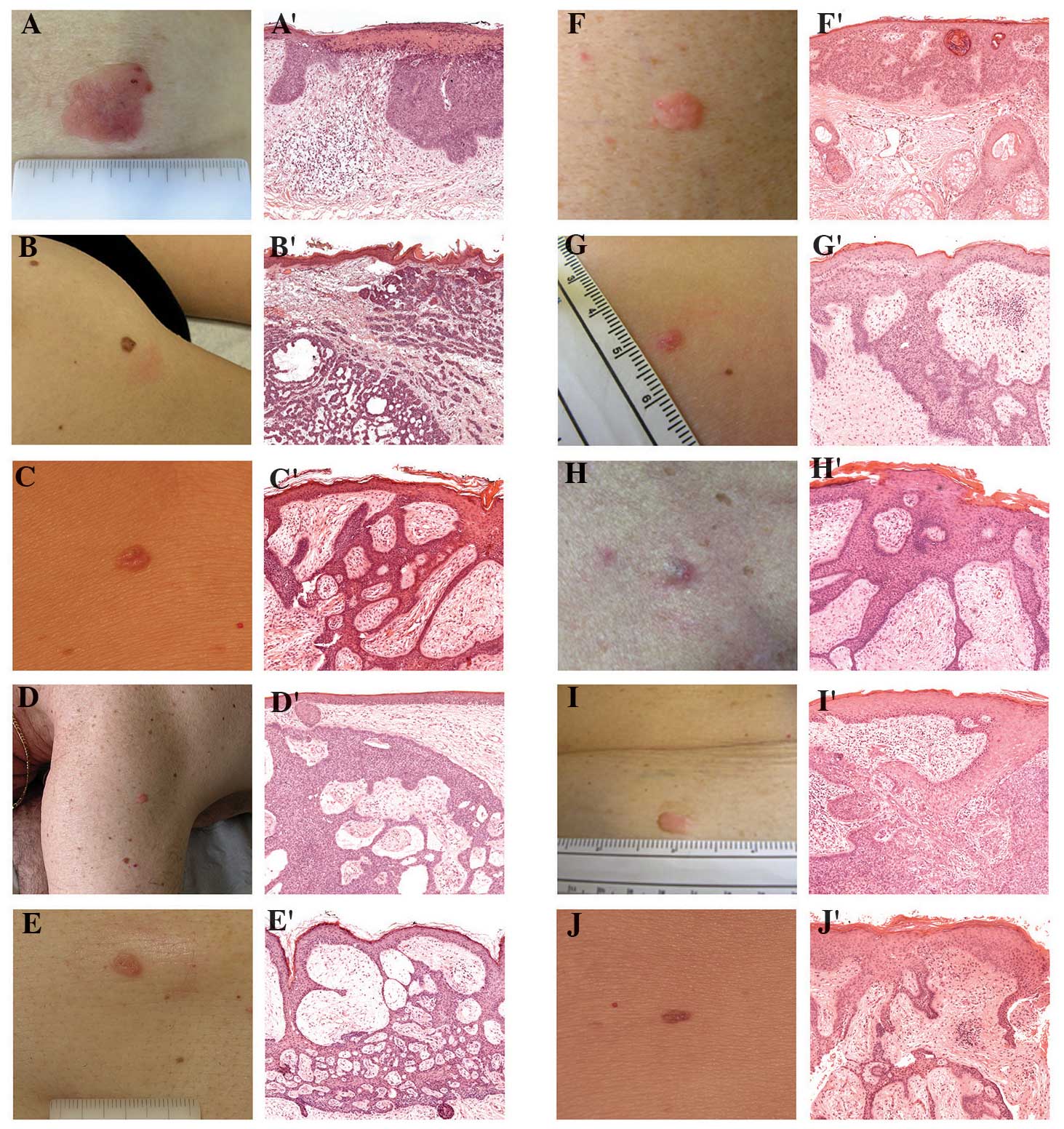
Figure 1.

(A-J) Clinical and histological images of fibroepitheliomas of Pinkus (FEPs) collected in our Department. Clinically, FEP appears as a solitary non-pigmented, flat or polypoid lesion, most commonly localized on the trunk or the extremities: (A) Male, aged 50 years, with FEP of the trunk; (B) female, aged 36 years, with FEP of the trunk; (C) female, aged 32 years, with FEP of the left lower limb; (D) male, aged 63 years, with FEP of the left shoulder; (E) female, aged 38 years, with a FEP of the right lower limb; (F) male, aged 47 years, with a FEP of the trunk; (G) female, aged 39 years, with FEP of the left lower limb; (H) male, aged 59 years, with FEP of the trunk; (I) female, aged 44 years, with FEP of the trunk; and (J) female, aged 34 years, with FEP of the trunk. (A′-J′) Histopathological images of the respective lesions: FEP exhibits numerous long, thin, branching and anastomosing cords of basaloid cells within a fibrotic stroma. Hematoxylin and eosin staining; original magnification, ×5.

Histopathologically, FEP is characterized by numerous thin anastomosing cords of basaloid cells extending downward from the epidermis into the dermis within a fibrotic stroma (Fig. 1).

Unlike the common types of BCC, FEP exhibits an overwhelming predilection for the trunk (particularly the lower back) and the extremities, with only 5% of the tumors arising on sun-damaged skin. The clinical differential diagnosis includes a wide spectrum of lesions, such as skin tags or dermal nevi. However, the diagnosis is easier when the clinical examination is combined with dermoscopy and confocal microscopy (4,5).

Although FEP was originally described by Pinkus as a variant of BCC, the nature of this tumor remains a subject of debate.

The strong predilection for the lumbar region (not sun-exposed area) and for the female gender differentiates FEP from other BCC subtypes that usually arise on sun-exposed areas and/or predominantly in men.

Furthermore, FEP exhibits a peculiar histopathological architecture, as well as the presence of Merkel cells, which are usually absent in BCCs but found in trichoblastomas.

Thus far, FEP has been described as a solitary lesion or in association with Paget's disease in a limited number of case series. However, no studies have been performed to investigate whether this lesion arises as an isolated rare tumor or in patients harboring specific diseases.

The aim of our study was the characterization of a consecutive series of FEPs to identify a possible association of this tumor with concomitant diseases.

Patients and methods

Cases

All the histopathologically-proven cases of FEP excised in a single referral center (Department of Dermatology, University of Modena and Reggio Emilia, Modena, Italy) from 1995 to 2011 were retrospectively reviewed. Clinical data including gender, location and age were recorded. Location was divided into head and neck, trunk, back, genitalia, upper extremities and lower extremities.

The data on excised tumors (skin tumors or visceral malignancies) were retrieved from the database of the Department of Pathology at the University of Modena and Reggio Emilia.

Moreover, the medical records of all the patients, such as radiological examinations or surgical procedures, were reviewed to obtain a complete picture of each patient's health status. The present study was conducted in accordance with the principles of the Declaration of Helsinki.

This study's protocol and the submitted manuscript have been approved by the Institutional Review Board of the Department of Surgery, School of Medicine, Dentistry and Morphological Sciences, University of Modena and Reggio Emilia (Modena, Italy).

Results

Association of FEP with cancer

A total of 49 cases of FEP were identified, mainly located on the trunk (77.55%), followed by the lower extremities (12.20%) and the head and neck (10.20%). The mean age of the patients was 64.04 years and 31 of the patients were female (63%). The tumors found in patients with FEP are listed in Table I. Of the 49 patients, 9 (18%) were found to have gastrointestinal tumors, 4 patients (8%) had breast carcinoma and 7 patients (14%) had other cancers. More specifically, 6 patients had colonic adenocarcinoma and 3 patients had neuroendocrine gastrointestinal tumors. Of the 49 patients, 1 (3%) was affected with mammary Paget's disease and 1 with perianal extramammary Paget's dissease.

Table I.

Non-skin tumors diagnosed in patients with fibroepithelioma of Pinkus.

Table I.

Non-skin tumors diagnosed in patients with fibroepithelioma of Pinkus.

Gender

TumorsMale, n=18 (37%)Female, n=31 (63%)Total n=49 (100%)
Gastrointestinal tumors5 (28)4 (13)9 (18)
  Upper1 (20)1 (25)2 (22)
  Lower4 (80)3 (75)7 (78)
Colonic Adenocarcinoma3 (60)3 (75)6 (67)
Neuroendocrine gastrointestinal tumor2 (40)1 (25)3 (33)
Extramammary perianal Paget's disease0 (0)1 (3)1 (2)
Mammary Pagets disease0 (0)1 (3)1 (2)
Breast carcinoma0 (0)4 (13)4 (8)
Other cancers4 (22)3 (10)7 (14)

In all but 2 cases, FEP appeared 1–2 years prior to the internal malignancies, whereas in these 2 cases the malignancies occurred synchronously with FEP.

Discussion

FEP is a rare tumor that is considered to be a variant of BCC, although its classification remains to be clarified. Moreover, the specific skin location and gender predilection differentiates this tumor from ‘classical’ BCC. Furthermore, BCC and FEP share certain characteristics, such as the expression of androgen receptor, which is minimal in trichoblastomas (6). However, FEPs and trichoblastomas display Merkel cells, which are usually absent in BCC (7).

In the present study, we observed an association between FEP and gastrointestinal tumors. FEP was previously reported in the literature in association with Paget's disease (7), breast cancer (8,9) and, as a variant of BCC, Gorlin-Goltz syndrome (10). However, conclusive epidemiological and biomolecular data on these clinical associations are currently lacking (11,12).

Considering our data, we may hypothesize a pathogenetic association between FEP and gastrointestinal neuroendocrine tumors, due to the common embryogenic origin of Merkel cells and neuroendocrine cells from the neural crest. Similar to the well-known genodermatosis (13), a common aberration of genes implicated in mesoectodermal differentiation may play a role in the pathogenesis of FEPs and gastrointestinal adenocarcinomas. Mutation in the tumor suppressor gene TP53 may predispose to the development of FEP (14). Similar to BCC, it has been hypothesized that mutations in the Patched 1 gene (PTCH1), which is responsible for inhibitory signaling in the Hedgehog pathway, may also lead to the development of FEP.

In our study, we did not investigate for PTCH1 mutations or another possible genetic background, although the association of FEP with gastrointestinal tumors appears to be part of a more complex, although still not well defined phenotype, rather than a coincidental finding.

Gastrointestinal tumors may be associated with either Gorlin-Goltz syndrome or trichilemmal lesions (13). As regards the latter condition, Cowden syndrome is characterized by the occurrence of several tumors, including breast, endometrial, thyroid, kidney and colorectal cancers, in association with dermatological manifestations such as oral/skin papillomas and trichilemmomas, and with PTEN mutations (13). Interestingly, dermatological signs may occur prior to systemic symptoms (13). If we consider FEP as a trichoblastoma, it appears more likely that this rare skin tumor should be considered to be part of the cutaneous spectrum of Cowden syndrome (in which hamartomas and colon carcinomas have been recently described) (15), or as a tumor associated with a new syndrome including gastrointestinal tumors. Furthermore, our cases were characterized by early onset of FEP followed by the development of gastrointestinal tumors. This peculiar onset of dermatological diseases may be seen in the context of genodermatosis (12).

Although a possible underlying common genetic substrate between FEP and gastrointestinal tumors was not identified, our study included a consecutive large series of FEPs from a single academic institution, with a careful examination of the patients' medical history. However, additional cases are required to confirm this association and assess its predictive value. It is recommended that FEP patients are clinically evaluated and screened for gastrointestinal tumors. Our clinico-epidemiological findings raise the question of whether FEP is a single entity or part of a more complex and not yet defined gastrointestinal syndrome.

Acknowledgements

All the authors made significant intellectual contributions to this study and each author listed has read and approved the submitted manuscript.

References

1 

Pinkus H: Premalignant fibroepithelial tumors of skin. AMA Arch Dermatol Syphilol. 67:598–615. 1953. View Article : Google Scholar

2 

Bowen AR and LeBoit PE: Fibroepithelioma of Pinkus is a fenestrated trichoblastoma. Am J Dermatopathol. 27:149–154. 2005. View Article : Google Scholar : PubMed/NCBI

3 

Sellheyer K, Nelson P and Kutzner H: Fibroepithelioma of Pinkus is a true basal cell carcinoma developing in association with a newly identified tumour-specific type of epidermal hyperplasia. Br J Dermatol. 166:88–97. 2012. View Article : Google Scholar : PubMed/NCBI

4 

Longo C, Soyer HP, Pepe P, Casari A, Wurm EM, Guitera P and Pellacani G: In vivo confocal microscopic pattern of fibroepithelioma of Pinkus. Arch Dermatol. 148:5562012. View Article : Google Scholar : PubMed/NCBI

5 

Zalaudek I, Ferrara G, Broganelli P, Moscarella E, Mordente I, Giacomel J and Argenziano G: Dermoscopy patterns of fibroepithelioma of Pinkus. Arch Dermatol. 142:1318–1322. 2006. View Article : Google Scholar : PubMed/NCBI

6 

Katona TM, Ravis SM, Perkins SM, Moores WB and Billings SD: Expression of androgen receptor by fibroepithelioma of Pinkus: Evidence supporting classification as a basal cell carcinoma variant? Am J Dermatopathol. 29:7–12. 2007. View Article : Google Scholar : PubMed/NCBI

7 

Warner TF, Burgess H and Mohs FE: Extramammary Paget's disease in fibroepithelioma of Pinkus. J Cutan Pathol. 9:340–344. 1982. View Article : Google Scholar : PubMed/NCBI

8 

Bryant J: Fibroepithelioma of Pinkus overlying breast cancer. Arch Dermatol. 121:3101985. View Article : Google Scholar : PubMed/NCBI

9 

Sandbank M and Baschan D: Multiple trichoepitelioma and breast carcinoma. Simultaneous appearance of epithelioma adenoides cysticum and infiltrating lobular carcinoma of the breast. Arch Dermatol. 114:12301978. View Article : Google Scholar : PubMed/NCBI

10 

Gorlin RJ and Goltz RW: Multiple nevoid basal-cell epithelioma, jaw cysts and bifid rib. A syndrome. N Engl J Med. 262:908–912. 1960. View Article : Google Scholar : PubMed/NCBI

11 

Prodinger PM, Sarbia M, Massmann J, Straka C, Meyer G and Steinlein OK: Gorlin syndrome associated with small bowel carcinoma and mesenchymal proliferation of the gastrointestinal tract: Case report and review of literature. BMC Cancer. 10:3602010. View Article : Google Scholar : PubMed/NCBI

12 

Ponti G, Pellacani G, Seidenari S, Pollio A, Muscatello U and Tomasi A: Cancer-associated genodermatoses: Skin neoplasms as clues to hereditary tumor syndromes. Crit Rev Oncol Hematol. 85:239–256. 2013. View Article : Google Scholar : PubMed/NCBI

13 

Saldanha G, Fletcher A and Slater DN: Basal cell carcinoma: A dermatopathological and molecular biological update. Br J Dermatol. 148:195–202. 2003. View Article : Google Scholar : PubMed/NCBI

14 

Sidhu GS, Chandra P and Cassai ND: Merkel cells, normal and neoplastic: An update. Ultrastruct Pathol. 29:287–294. 2005. View Article : Google Scholar : PubMed/NCBI

15 

Stanich PP, Owens VL, Sweetser S, Khambatta S, Smyrk TC, Richardson RL, Goetz MP and Patnaik MM: Colonic polyposis and neoplasia in Cowden syndrome. Mayo Clin Proc. 86:489–492. 2011. View Article : Google Scholar : PubMed/NCBI

Related Articles

  • Abstract
  • View
  • Download
  • Twitter
Copy and paste a formatted citation
Spandidos Publications style
Longo C, Pellacani G, Tomasi A, Mandel VD and Ponti G: Fibroepithelioma of Pinkus: Solitary tumor or sign of a complex gastrointestinal syndrome. Mol Clin Oncol 4: 797-800, 2016.
APA
Longo, C., Pellacani, G., Tomasi, A., Mandel, V.D., & Ponti, G. (2016). Fibroepithelioma of Pinkus: Solitary tumor or sign of a complex gastrointestinal syndrome. Molecular and Clinical Oncology, 4, 797-800. https://doi.org/10.3892/mco.2016.794
MLA
Longo, C., Pellacani, G., Tomasi, A., Mandel, V. D., Ponti, G."Fibroepithelioma of Pinkus: Solitary tumor or sign of a complex gastrointestinal syndrome". Molecular and Clinical Oncology 4.5 (2016): 797-800.
Chicago
Longo, C., Pellacani, G., Tomasi, A., Mandel, V. D., Ponti, G."Fibroepithelioma of Pinkus: Solitary tumor or sign of a complex gastrointestinal syndrome". Molecular and Clinical Oncology 4, no. 5 (2016): 797-800. https://doi.org/10.3892/mco.2016.794
Copy and paste a formatted citation
x
Spandidos Publications style
Longo C, Pellacani G, Tomasi A, Mandel VD and Ponti G: Fibroepithelioma of Pinkus: Solitary tumor or sign of a complex gastrointestinal syndrome. Mol Clin Oncol 4: 797-800, 2016.
APA
Longo, C., Pellacani, G., Tomasi, A., Mandel, V.D., & Ponti, G. (2016). Fibroepithelioma of Pinkus: Solitary tumor or sign of a complex gastrointestinal syndrome. Molecular and Clinical Oncology, 4, 797-800. https://doi.org/10.3892/mco.2016.794
MLA
Longo, C., Pellacani, G., Tomasi, A., Mandel, V. D., Ponti, G."Fibroepithelioma of Pinkus: Solitary tumor or sign of a complex gastrointestinal syndrome". Molecular and Clinical Oncology 4.5 (2016): 797-800.
Chicago
Longo, C., Pellacani, G., Tomasi, A., Mandel, V. D., Ponti, G."Fibroepithelioma of Pinkus: Solitary tumor or sign of a complex gastrointestinal syndrome". Molecular and Clinical Oncology 4, no. 5 (2016): 797-800. https://doi.org/10.3892/mco.2016.794
Follow us
  • Twitter
  • LinkedIn
  • Facebook
About
  • Spandidos Publications
  • Careers
  • Cookie Policy
  • Privacy Policy
How can we help?
  • Help
  • Live Chat
  • Contact
  • Email to our Support Team












