Spandidos Publications Logo
  • About
    • About Spandidos
    • Aims and Scopes
    • Abstracting and Indexing
    • Editorial Policies
    • Reprints and Permissions
    • Job Opportunities
    • Terms and Conditions
    • Contact
  • Journals
    • All Journals
    • Oncology Letters
      • Oncology Letters
      • Information for Authors
      • Editorial Policies
      • Editorial Board
      • Aims and Scope
      • Abstracting and Indexing
      • Bibliographic Information
      • Archive
    • International Journal of Oncology
      • International Journal of Oncology
      • Information for Authors
      • Editorial Policies
      • Editorial Board
      • Aims and Scope
      • Abstracting and Indexing
      • Bibliographic Information
      • Archive
    • Molecular and Clinical Oncology
      • Molecular and Clinical Oncology
      • Information for Authors
      • Editorial Policies
      • Editorial Board
      • Aims and Scope
      • Abstracting and Indexing
      • Bibliographic Information
      • Archive
    • Experimental and Therapeutic Medicine
      • Experimental and Therapeutic Medicine
      • Information for Authors
      • Editorial Policies
      • Editorial Board
      • Aims and Scope
      • Abstracting and Indexing
      • Bibliographic Information
      • Archive
    • International Journal of Molecular Medicine
      • International Journal of Molecular Medicine
      • Information for Authors
      • Editorial Policies
      • Editorial Board
      • Aims and Scope
      • Abstracting and Indexing
      • Bibliographic Information
      • Archive
    • Biomedical Reports
      • Biomedical Reports
      • Information for Authors
      • Editorial Policies
      • Editorial Board
      • Aims and Scope
      • Abstracting and Indexing
      • Bibliographic Information
      • Archive
    • Oncology Reports
      • Oncology Reports
      • Information for Authors
      • Editorial Policies
      • Editorial Board
      • Aims and Scope
      • Abstracting and Indexing
      • Bibliographic Information
      • Archive
    • Molecular Medicine Reports
      • Molecular Medicine Reports
      • Information for Authors
      • Editorial Policies
      • Editorial Board
      • Aims and Scope
      • Abstracting and Indexing
      • Bibliographic Information
      • Archive
    • World Academy of Sciences Journal
      • World Academy of Sciences Journal
      • Information for Authors
      • Editorial Policies
      • Editorial Board
      • Aims and Scope
      • Abstracting and Indexing
      • Bibliographic Information
      • Archive
    • International Journal of Functional Nutrition
      • International Journal of Functional Nutrition
      • Information for Authors
      • Editorial Policies
      • Editorial Board
      • Aims and Scope
      • Abstracting and Indexing
      • Bibliographic Information
      • Archive
    • International Journal of Epigenetics
      • International Journal of Epigenetics
      • Information for Authors
      • Editorial Policies
      • Editorial Board
      • Aims and Scope
      • Abstracting and Indexing
      • Bibliographic Information
      • Archive
    • Medicine International
      • Medicine International
      • Information for Authors
      • Editorial Policies
      • Editorial Board
      • Aims and Scope
      • Abstracting and Indexing
      • Bibliographic Information
      • Archive
  • Articles
  • Information
    • Information for Authors
    • Information for Reviewers
    • Information for Librarians
    • Information for Advertisers
    • Conferences
  • Language Editing
Spandidos Publications Logo
  • About
    • About Spandidos
    • Aims and Scopes
    • Abstracting and Indexing
    • Editorial Policies
    • Reprints and Permissions
    • Job Opportunities
    • Terms and Conditions
    • Contact
  • Journals
    • All Journals
    • Biomedical Reports
      • Information for Authors
      • Editorial Policies
      • Editorial Board
      • Aims and Scope
      • Abstracting and Indexing
      • Bibliographic Information
      • Archive
    • Experimental and Therapeutic Medicine
      • Information for Authors
      • Editorial Policies
      • Editorial Board
      • Aims and Scope
      • Abstracting and Indexing
      • Bibliographic Information
      • Archive
    • International Journal of Epigenetics
      • Information for Authors
      • Editorial Policies
      • Editorial Board
      • Aims and Scope
      • Abstracting and Indexing
      • Bibliographic Information
      • Archive
    • International Journal of Functional Nutrition
      • Information for Authors
      • Editorial Policies
      • Editorial Board
      • Aims and Scope
      • Abstracting and Indexing
      • Bibliographic Information
      • Archive
    • International Journal of Molecular Medicine
      • Information for Authors
      • Editorial Policies
      • Editorial Board
      • Aims and Scope
      • Abstracting and Indexing
      • Bibliographic Information
      • Archive
    • International Journal of Oncology
      • Information for Authors
      • Editorial Policies
      • Editorial Board
      • Aims and Scope
      • Abstracting and Indexing
      • Bibliographic Information
      • Archive
    • Medicine International
      • Information for Authors
      • Editorial Policies
      • Editorial Board
      • Aims and Scope
      • Abstracting and Indexing
      • Bibliographic Information
      • Archive
    • Molecular and Clinical Oncology
      • Information for Authors
      • Editorial Policies
      • Editorial Board
      • Aims and Scope
      • Abstracting and Indexing
      • Bibliographic Information
      • Archive
    • Molecular Medicine Reports
      • Information for Authors
      • Editorial Policies
      • Editorial Board
      • Aims and Scope
      • Abstracting and Indexing
      • Bibliographic Information
      • Archive
    • Oncology Letters
      • Information for Authors
      • Editorial Policies
      • Editorial Board
      • Aims and Scope
      • Abstracting and Indexing
      • Bibliographic Information
      • Archive
    • Oncology Reports
      • Information for Authors
      • Editorial Policies
      • Editorial Board
      • Aims and Scope
      • Abstracting and Indexing
      • Bibliographic Information
      • Archive
    • World Academy of Sciences Journal
      • Information for Authors
      • Editorial Policies
      • Editorial Board
      • Aims and Scope
      • Abstracting and Indexing
      • Bibliographic Information
      • Archive
  • Articles
  • Information
    • For Authors
    • For Reviewers
    • For Librarians
    • For Advertisers
    • Conferences
  • Language Editing
Login Register Submit
  • This site uses cookies
  • You can change your cookie settings at any time by following the instructions in our Cookie Policy. To find out more, you may read our Privacy Policy.

    I agree
Search articles by DOI, keyword, author or affiliation
Search
Advanced Search
presentation
Molecular and Clinical Oncology
Join Editorial Board Propose a Special Issue
Print ISSN: 2049-9450 Online ISSN: 2049-9469
Journal Cover
July-2016 Volume 5 Issue 1

Full Size Image

Sign up for eToc alerts
Recommend to Library

Journals

International Journal of Molecular Medicine

International Journal of Molecular Medicine

International Journal of Molecular Medicine is an international journal devoted to molecular mechanisms of human disease.

International Journal of Oncology

International Journal of Oncology

International Journal of Oncology is an international journal devoted to oncology research and cancer treatment.

Molecular Medicine Reports

Molecular Medicine Reports

Covers molecular medicine topics such as pharmacology, pathology, genetics, neuroscience, infectious diseases, molecular cardiology, and molecular surgery.

Oncology Reports

Oncology Reports

Oncology Reports is an international journal devoted to fundamental and applied research in Oncology.

Experimental and Therapeutic Medicine

Experimental and Therapeutic Medicine

Experimental and Therapeutic Medicine is an international journal devoted to laboratory and clinical medicine.

Oncology Letters

Oncology Letters

Oncology Letters is an international journal devoted to Experimental and Clinical Oncology.

Biomedical Reports

Biomedical Reports

Explores a wide range of biological and medical fields, including pharmacology, genetics, microbiology, neuroscience, and molecular cardiology.

Molecular and Clinical Oncology

Molecular and Clinical Oncology

International journal addressing all aspects of oncology research, from tumorigenesis and oncogenes to chemotherapy and metastasis.

World Academy of Sciences Journal

World Academy of Sciences Journal

Multidisciplinary open-access journal spanning biochemistry, genetics, neuroscience, environmental health, and synthetic biology.

International Journal of Functional Nutrition

International Journal of Functional Nutrition

Open-access journal combining biochemistry, pharmacology, immunology, and genetics to advance health through functional nutrition.

International Journal of Epigenetics

International Journal of Epigenetics

Publishes open-access research on using epigenetics to advance understanding and treatment of human disease.

Medicine International

Medicine International

An International Open Access Journal Devoted to General Medicine.

Journal Cover
July-2016 Volume 5 Issue 1

Full Size Image

Sign up for eToc alerts
Recommend to Library

  • Article
  • Citations
    • Cite This Article
    • Download Citation
    • Create Citation Alert
    • Remove Citation Alert
    • Cited By
  • Similar Articles
    • Related Articles (in Spandidos Publications)
    • Similar Articles (Google Scholar)
    • Similar Articles (PubMed)
  • Download PDF
  • Download XML
  • View XML
Case Report

Anaplastic lymphoma kinase‑positive squamous cell carcinoma of the lung: A case report

  • Authors:
    • Yoko Yamamoto
    • Ken Kodama
    • Tomohiro Maniwa
    • Masashi Takeda
    • Hiroki Kishima
  • View Affiliations / Copyright

    Affiliations: Department of Thoracic Surgery, Yao Municipal Hospital, Yao, Osaka 581‑0069, Japan, Department of Pathology, Yao Municipal Hospital, Yao, Osaka 581‑0069, Japan, Department of Surgery, Kishima Hospital Main Division, Yao, Osaka 581‑0069, Japan
  • Pages: 61-63
    |
    Published online on: April 26, 2016
       https://doi.org/10.3892/mco.2016.878
  • Expand metrics +
Metrics: Total Views: 0 (Spandidos Publications: | PMC Statistics: )
Metrics: Total PDF Downloads: 0 (Spandidos Publications: | PMC Statistics: )
Cited By (CrossRef): 0 citations Loading Articles...

This article is mentioned in:


Abstract

It is widely known that echinoderm microtubule‑associated protein‑like 4 anaplastic lymphoma kinase (EML4‑ALK) rearrangement mostly occurs in the adenocarcinoma subtype of non‑small‑cell lung cancer (NSCLC). Patients with squamous cell carcinoma harboring the ALK rearrangement are extremely rare. This is a case report of a squamous cell carcinoma patient with EML4‑ALK rearrangement. An elderly man with a heavy smoking history presented with a mass lesion in the right main bronchus. Bronchoscopic biopsy of the tumor confirmed a diagnosis of squamous cell carcinoma, and it was proven to harbor ALK rearrangement, based on fluorescence in situ hybridization, but not epidermal growth factor receptor mutations. The patient underwent radiation therapy, with a markedly favorable response. ALK‑targeted treatment may be a viable option if disease progression occurs in such a case in the future.

Introduction

The echinoderm microtubule-associated protein-like 4-ALK (EML4-ALK) fusion gene is a known oncogenic driver in non-small-cell lung cancer (NSCLC), with ALK-translocated NSCLCs accounting for ~5% of all NSCLCs and 20% of cases in never-smokers (1). This fusion gene is also associated with younger age and the adenocarcinoma subtype of NSCLC. As cases with squamous cell carcinoma of the lung harboring ALK gene rearrangement are extremely rare (2), its molecular analysis is not routinely recommended by the National Comprehensive Cancer Network (NCCN) guideline for the treatment of NSCLC (version 2, 2013) (https://www.tri-kobe.org/nccn/guideline/lung/english/non_small.pdf). We herein describe a rare case of an elderly male smoker with squamous cell carcinoma of the lung harboring ALK rearrangement.

Case presentation

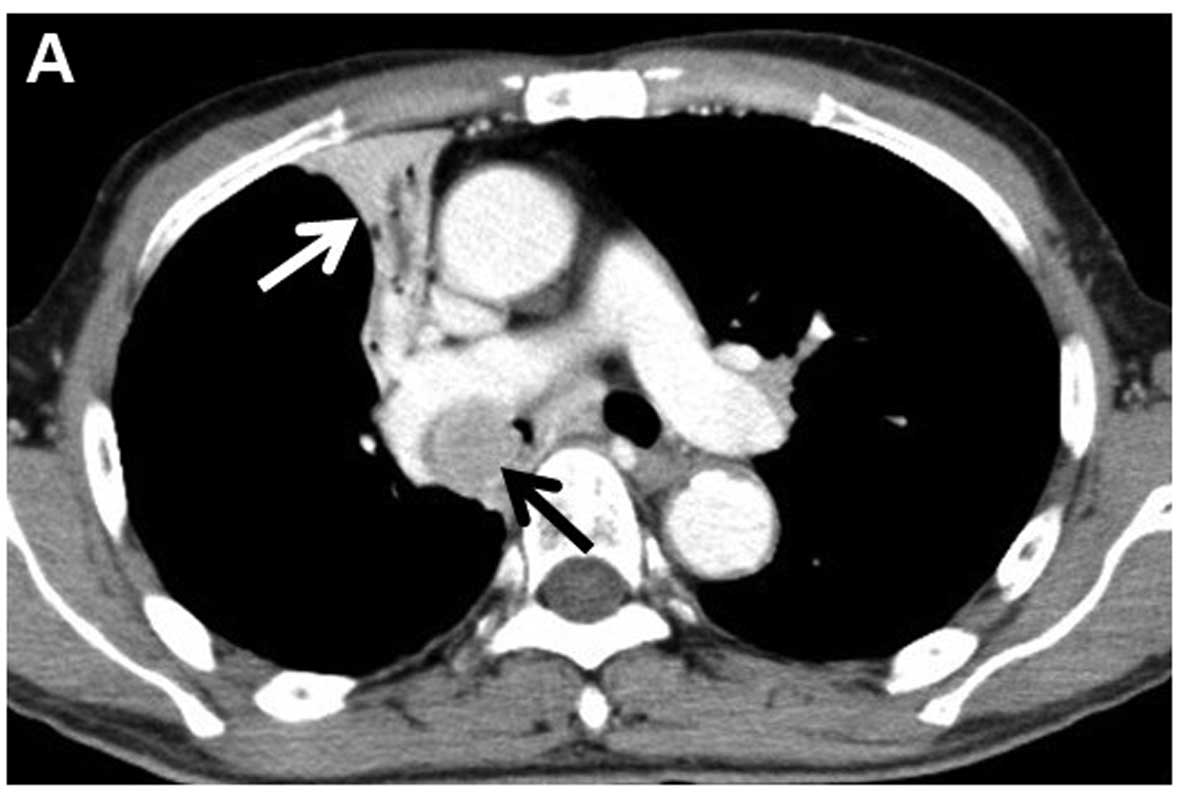
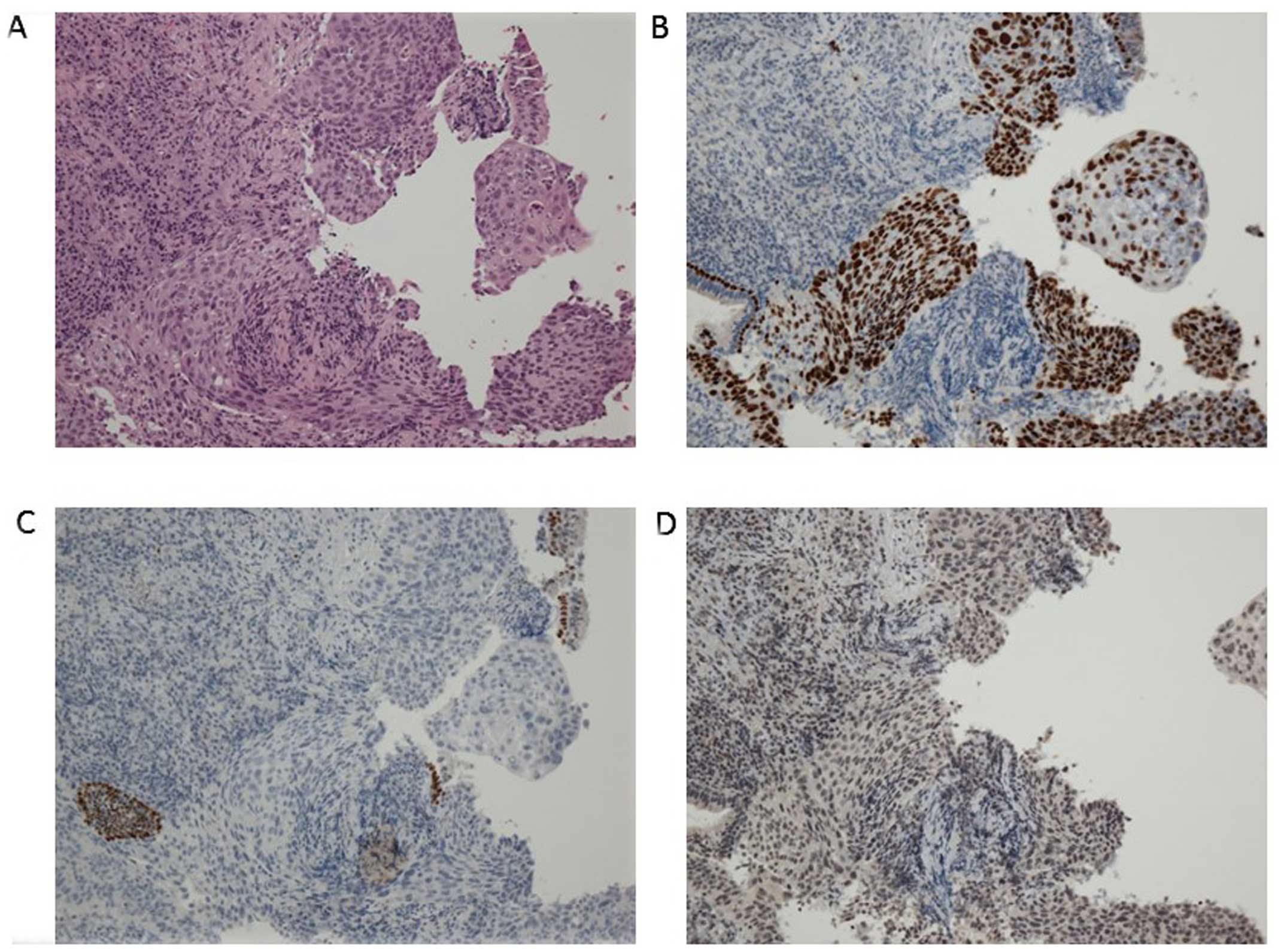
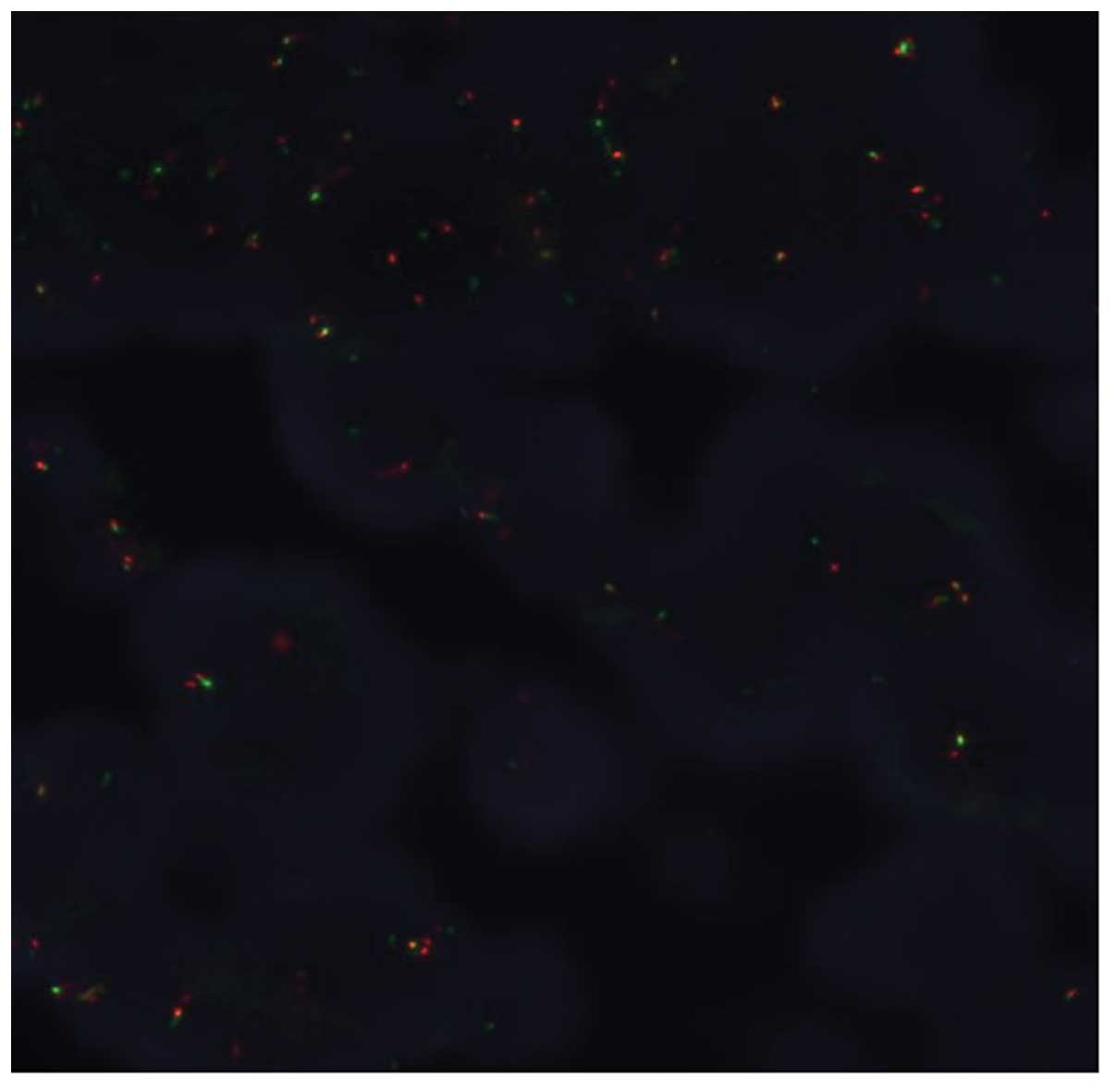
A 76-year-old Japanese man was referred to Yao Municipal Hospital due to dyspnea and weight loss. The patient required oxygen supplementation. The past medical history was unremarkable, apart from smoking history (20 pack-years). The serum levels of cytokeratin-19 fragment and carcinoembryonic antigen were elevated to 3.9 ng/ml (normal, <3.5 ng/m) and 65.8 ng/ml (normal, <5.0 ng/ml), respectively. A chest radiograph demonstrated right upper lobe atelectasis. Computed tomography (CT) revealed a 26-mm nodule in the right main bronchus and multiple enlarged mediastinal lymph nodes (Fig. 1). Magnetic resonance imaging of the brain revealed no brain metastasis. A pathological diagnosis of squamous cwell carcinoma was made using bronchoscopic biopsy (Fig. 2A). There was no component of adenocarcinoma or other histological type in the biopsy specimen. To further determine the histological subtype, we performed immunohistochemistry (IHC), which was positive for p40 and negative for thyroid transcription factor-1 and napsin A (Fig. 2B–D). Molecular analysis revealed wild-type epidermal growth factor receptor gene status. Although ALK testing using IHC (the iAEP method, ALK detection kit; Nichirei Bioscience, Tokyo, Japan) was negative, fluorescence in situ hybridization analysis with break-apart probes for the ALK gene (Vysis Abbott Molecular, Des Plaines, IL, USA) revealed the presence of an ALK rearrangement (Fig. 3). Based on these results, the patient was clinically diagnosed with T3N2M0, stage IIIA squamous cell carcinoma. The patient had an Easter Cooperative Oncology Group performance status score of 2, and received radiation therapy to the primary site and the mediastinum at a dose of 60 Gy in 30 fractions. A CT scan at 4 months post-treatment revealed improvement of the atelectasis, with a marked decrease in the size of the tumor. The patient is being regularly followed-up as an outpatient, without oxygen supplementation.

Figure 1.

Computed tomography revealed a 26-mm nodule (black arrow) in the right main bronchus and right upper lobe atelectasis (white arrow).

Figure 2.

Histopathological and immunohistological findings. (A) Hematoxylin and eosin staining showed squamous cell carcinoma (magnification, ×40). (B) Positive immunostaining for p40 and negative immunostaining for (C) thyroid transcription factor-1 and (D) napsin A.

Figure 3.

Anaplastic lymphoma kinase (ALK) break-apart fluorescence in situ hybridization showing one fusion signal, and separated red and green signals, revealing ALK rearrangements. The rearrangement-positive cell rate was 20%.

Discussion

The EML4-ALK fusion gene has been identified as a potent oncogenic driver in NSCLC. ALK-translocated NSCLCs account for ~5% of all NSCLCs and 20% of NSCLCs in never-smokers (1). ALK rearrangement has been associated with several clinicopathological characteristics: Never- or light smokers, younger age at diagnosis, adenocarcinoma histology, signet ring cells, and mutual exclusivity from other major driver genes (1). These clinicopathological characteristics were not applicable to our case, as the patient was a current smoker with hilar-type squamous cell carcinoma. ALK rearrangement in squamous cell carcinoma is extremely rare, with an estimated prevalence of ALK rearrangement in squamous cell carcinoma of the lung of only ~0.2–2.5% (2). Thus, its molecular analysis when excluding adenocarcinoma is not routinely recommended in the NCCN guideline for the treatment of NSCLC (version 2, 2013).

It is widely known that ALK inhibitors, such as crizotinib or alectinib, have significantly improved treatment response among NSCLC patients with ALK rearrangement. The determination of ALK-positive status is necessary to identify patients with advanced NSCLC who are most likely to benefit from targeted therapy with an ALK inhibitor. The gold standard for the detection of predictive ALK rearrangements is currently break-apart FISH, as it is able to detect all known ALK rearrangements and was clinically validated in crizotinib clinical trials (3). However, our case was positive for FISH with a 20% rearrangement-positive cell rate, but negative on IHC. As a possible explanation for this mismatch, the distinction of IHC 1+ from IHC 0 may be subjective. Re-testing of IHC is desirable; however, there was no residual sample for further testing in this case.

It remains unclear whether ALK-positive squamous cell carcinoma patients show a marked response to ALK-targeted therapies, which is generally effective for ALK-positive lung adenocarcinoma. According to two recent case reports published in China, two 55-year-old female non-smokers with ALK-positive squamous cell carcinoma responded to crizotinib (4,5). By contrast, Tamiya et al reported the case of a 78-year-old male former smoker with ALK-positive squamous cell carcinoma who did not respond to alectinib, a second-generation ALK inhibitor (6), although the tumor cells were confirmed to be diffusely and strongly positive (3+) for ALK on IHC, as well as FISH.

Although this mutation is rare in squamous cell carcinoma, its presence may provide additional treatment options. Our local policy has been to test all patients with advanced NSCLC who may benefit from targeted treatment for activating mutations with sufficient biopsy specimens. In the patient described in this report, subsequent ALK-targeted treatment may be a viable option.

In summary, we reported a case of ALK-positive squamous cell carcinoma of the lung. Oncologist should recognize that ALK translocation may be present in squamous cell carcinoma of the lung, for which targeted therapy may be an effective option.

References

1. 

Shaw AT, Yeap BY, Mino-Knudson M, Digumarthy SR, Costa DB, Heist RS, Solomon B, Stubbs H, Admane S, McDermott U, et al: Clinical features and outcome of patients with non-small-cell lung cancer who harbor EML4-ALK. J Clin Oncol. 27:4247–4253. 2009. View Article : Google Scholar : PubMed/NCBI

2. 

Caliò A, Nottegar A, Gilioli E, Bria E, Pilotto S, Peretti U, Kinspergher S, Simonato F, Pedron S, Knuutila S, et al: ALK/EML4 fusion gene may be found in pure squamous carcinoma of the lung. J Thorac Oncol. 9:729–732. 2014. View Article : Google Scholar : PubMed/NCBI

3. 

Teixido C, Karachaliou N, Peg V, Gimenez-Capitan A and Rosell R: Concordance of IHC, FISH and RT-PCR for EML4-ALK rearrangements. Transl Lung Cancer Res. 3:70–74. 2014.PubMed/NCBI

4. 

Wang Q, He Y, Yang X, Wang Y and Xiao H: Extraordinary response to crizotinib in a woman with squamous cell lung cancer after two courses of failed chemotherapy. BMC Pulm Med. 14:832014. View Article : Google Scholar : PubMed/NCBI

5. 

Zhang Q, Wang J and Zhang S: ALK-rearranged squamous cell lung cancer: A case report. Int J Cjin Exp Pathol. 8:2195–2198. 2015.

6. 

Tamiya A, Shimizu S and Atagi S: A case of squamous cell carcinoma harboring an EML4/ALK rearrangement that was unsuccessfully treated with the ALK inhibitor alectinib. J Thorac Oncol. 10:e742015. View Article : Google Scholar : PubMed/NCBI

Related Articles

  • Abstract
  • View
  • Download
  • Twitter
Copy and paste a formatted citation
Spandidos Publications style
Yamamoto Y, Kodama K, Maniwa T, Takeda M and Kishima H: Anaplastic lymphoma kinase‑positive squamous cell carcinoma of the lung: A case report. Mol Clin Oncol 5: 61-63, 2016.
APA
Yamamoto, Y., Kodama, K., Maniwa, T., Takeda, M., & Kishima, H. (2016). Anaplastic lymphoma kinase‑positive squamous cell carcinoma of the lung: A case report. Molecular and Clinical Oncology, 5, 61-63. https://doi.org/10.3892/mco.2016.878
MLA
Yamamoto, Y., Kodama, K., Maniwa, T., Takeda, M., Kishima, H."Anaplastic lymphoma kinase‑positive squamous cell carcinoma of the lung: A case report". Molecular and Clinical Oncology 5.1 (2016): 61-63.
Chicago
Yamamoto, Y., Kodama, K., Maniwa, T., Takeda, M., Kishima, H."Anaplastic lymphoma kinase‑positive squamous cell carcinoma of the lung: A case report". Molecular and Clinical Oncology 5, no. 1 (2016): 61-63. https://doi.org/10.3892/mco.2016.878
Copy and paste a formatted citation
x
Spandidos Publications style
Yamamoto Y, Kodama K, Maniwa T, Takeda M and Kishima H: Anaplastic lymphoma kinase‑positive squamous cell carcinoma of the lung: A case report. Mol Clin Oncol 5: 61-63, 2016.
APA
Yamamoto, Y., Kodama, K., Maniwa, T., Takeda, M., & Kishima, H. (2016). Anaplastic lymphoma kinase‑positive squamous cell carcinoma of the lung: A case report. Molecular and Clinical Oncology, 5, 61-63. https://doi.org/10.3892/mco.2016.878
MLA
Yamamoto, Y., Kodama, K., Maniwa, T., Takeda, M., Kishima, H."Anaplastic lymphoma kinase‑positive squamous cell carcinoma of the lung: A case report". Molecular and Clinical Oncology 5.1 (2016): 61-63.
Chicago
Yamamoto, Y., Kodama, K., Maniwa, T., Takeda, M., Kishima, H."Anaplastic lymphoma kinase‑positive squamous cell carcinoma of the lung: A case report". Molecular and Clinical Oncology 5, no. 1 (2016): 61-63. https://doi.org/10.3892/mco.2016.878
Follow us
  • Twitter
  • LinkedIn
  • Facebook
About
  • Spandidos Publications
  • Careers
  • Cookie Policy
  • Privacy Policy
How can we help?
  • Help
  • Live Chat
  • Contact
  • Email to our Support Team