Spandidos Publications Logo
  • About
    • About Spandidos
    • Aims and Scopes
    • Abstracting and Indexing
    • Editorial Policies
    • Reprints and Permissions
    • Job Opportunities
    • Terms and Conditions
    • Contact
  • Journals
    • All Journals
    • Oncology Letters
      • Oncology Letters
      • Information for Authors
      • Editorial Policies
      • Editorial Board
      • Aims and Scope
      • Abstracting and Indexing
      • Bibliographic Information
      • Archive
    • International Journal of Oncology
      • International Journal of Oncology
      • Information for Authors
      • Editorial Policies
      • Editorial Board
      • Aims and Scope
      • Abstracting and Indexing
      • Bibliographic Information
      • Archive
    • Molecular and Clinical Oncology
      • Molecular and Clinical Oncology
      • Information for Authors
      • Editorial Policies
      • Editorial Board
      • Aims and Scope
      • Abstracting and Indexing
      • Bibliographic Information
      • Archive
    • Experimental and Therapeutic Medicine
      • Experimental and Therapeutic Medicine
      • Information for Authors
      • Editorial Policies
      • Editorial Board
      • Aims and Scope
      • Abstracting and Indexing
      • Bibliographic Information
      • Archive
    • International Journal of Molecular Medicine
      • International Journal of Molecular Medicine
      • Information for Authors
      • Editorial Policies
      • Editorial Board
      • Aims and Scope
      • Abstracting and Indexing
      • Bibliographic Information
      • Archive
    • Biomedical Reports
      • Biomedical Reports
      • Information for Authors
      • Editorial Policies
      • Editorial Board
      • Aims and Scope
      • Abstracting and Indexing
      • Bibliographic Information
      • Archive
    • Oncology Reports
      • Oncology Reports
      • Information for Authors
      • Editorial Policies
      • Editorial Board
      • Aims and Scope
      • Abstracting and Indexing
      • Bibliographic Information
      • Archive
    • Molecular Medicine Reports
      • Molecular Medicine Reports
      • Information for Authors
      • Editorial Policies
      • Editorial Board
      • Aims and Scope
      • Abstracting and Indexing
      • Bibliographic Information
      • Archive
    • World Academy of Sciences Journal
      • World Academy of Sciences Journal
      • Information for Authors
      • Editorial Policies
      • Editorial Board
      • Aims and Scope
      • Abstracting and Indexing
      • Bibliographic Information
      • Archive
    • International Journal of Functional Nutrition
      • International Journal of Functional Nutrition
      • Information for Authors
      • Editorial Policies
      • Editorial Board
      • Aims and Scope
      • Abstracting and Indexing
      • Bibliographic Information
      • Archive
    • International Journal of Epigenetics
      • International Journal of Epigenetics
      • Information for Authors
      • Editorial Policies
      • Editorial Board
      • Aims and Scope
      • Abstracting and Indexing
      • Bibliographic Information
      • Archive
    • Medicine International
      • Medicine International
      • Information for Authors
      • Editorial Policies
      • Editorial Board
      • Aims and Scope
      • Abstracting and Indexing
      • Bibliographic Information
      • Archive
  • Articles
  • Information
    • Information for Authors
    • Information for Reviewers
    • Information for Librarians
    • Information for Advertisers
    • Conferences
  • Language Editing
Spandidos Publications Logo
  • About
    • About Spandidos
    • Aims and Scopes
    • Abstracting and Indexing
    • Editorial Policies
    • Reprints and Permissions
    • Job Opportunities
    • Terms and Conditions
    • Contact
  • Journals
    • All Journals
    • Biomedical Reports
      • Information for Authors
      • Editorial Policies
      • Editorial Board
      • Aims and Scope
      • Abstracting and Indexing
      • Bibliographic Information
      • Archive
    • Experimental and Therapeutic Medicine
      • Information for Authors
      • Editorial Policies
      • Editorial Board
      • Aims and Scope
      • Abstracting and Indexing
      • Bibliographic Information
      • Archive
    • International Journal of Epigenetics
      • Information for Authors
      • Editorial Policies
      • Editorial Board
      • Aims and Scope
      • Abstracting and Indexing
      • Bibliographic Information
      • Archive
    • International Journal of Functional Nutrition
      • Information for Authors
      • Editorial Policies
      • Editorial Board
      • Aims and Scope
      • Abstracting and Indexing
      • Bibliographic Information
      • Archive
    • International Journal of Molecular Medicine
      • Information for Authors
      • Editorial Policies
      • Editorial Board
      • Aims and Scope
      • Abstracting and Indexing
      • Bibliographic Information
      • Archive
    • International Journal of Oncology
      • Information for Authors
      • Editorial Policies
      • Editorial Board
      • Aims and Scope
      • Abstracting and Indexing
      • Bibliographic Information
      • Archive
    • Medicine International
      • Information for Authors
      • Editorial Policies
      • Editorial Board
      • Aims and Scope
      • Abstracting and Indexing
      • Bibliographic Information
      • Archive
    • Molecular and Clinical Oncology
      • Information for Authors
      • Editorial Policies
      • Editorial Board
      • Aims and Scope
      • Abstracting and Indexing
      • Bibliographic Information
      • Archive
    • Molecular Medicine Reports
      • Information for Authors
      • Editorial Policies
      • Editorial Board
      • Aims and Scope
      • Abstracting and Indexing
      • Bibliographic Information
      • Archive
    • Oncology Letters
      • Information for Authors
      • Editorial Policies
      • Editorial Board
      • Aims and Scope
      • Abstracting and Indexing
      • Bibliographic Information
      • Archive
    • Oncology Reports
      • Information for Authors
      • Editorial Policies
      • Editorial Board
      • Aims and Scope
      • Abstracting and Indexing
      • Bibliographic Information
      • Archive
    • World Academy of Sciences Journal
      • Information for Authors
      • Editorial Policies
      • Editorial Board
      • Aims and Scope
      • Abstracting and Indexing
      • Bibliographic Information
      • Archive
  • Articles
  • Information
    • For Authors
    • For Reviewers
    • For Librarians
    • For Advertisers
    • Conferences
  • Language Editing
Login Register Submit
  • This site uses cookies
  • You can change your cookie settings at any time by following the instructions in our Cookie Policy. To find out more, you may read our Privacy Policy.

    I agree
Search articles by DOI, keyword, author or affiliation
Search
Advanced Search
presentation
Molecular and Clinical Oncology
Join Editorial Board Propose a Special Issue
Print ISSN: 2049-9450 Online ISSN: 2049-9469
Journal Cover
October-2016 Volume 5 Issue 4

Full Size Image

Sign up for eToc alerts
Recommend to Library

Journals

International Journal of Molecular Medicine

International Journal of Molecular Medicine

International Journal of Molecular Medicine is an international journal devoted to molecular mechanisms of human disease.

International Journal of Oncology

International Journal of Oncology

International Journal of Oncology is an international journal devoted to oncology research and cancer treatment.

Molecular Medicine Reports

Molecular Medicine Reports

Covers molecular medicine topics such as pharmacology, pathology, genetics, neuroscience, infectious diseases, molecular cardiology, and molecular surgery.

Oncology Reports

Oncology Reports

Oncology Reports is an international journal devoted to fundamental and applied research in Oncology.

Experimental and Therapeutic Medicine

Experimental and Therapeutic Medicine

Experimental and Therapeutic Medicine is an international journal devoted to laboratory and clinical medicine.

Oncology Letters

Oncology Letters

Oncology Letters is an international journal devoted to Experimental and Clinical Oncology.

Biomedical Reports

Biomedical Reports

Explores a wide range of biological and medical fields, including pharmacology, genetics, microbiology, neuroscience, and molecular cardiology.

Molecular and Clinical Oncology

Molecular and Clinical Oncology

International journal addressing all aspects of oncology research, from tumorigenesis and oncogenes to chemotherapy and metastasis.

World Academy of Sciences Journal

World Academy of Sciences Journal

Multidisciplinary open-access journal spanning biochemistry, genetics, neuroscience, environmental health, and synthetic biology.

International Journal of Functional Nutrition

International Journal of Functional Nutrition

Open-access journal combining biochemistry, pharmacology, immunology, and genetics to advance health through functional nutrition.

International Journal of Epigenetics

International Journal of Epigenetics

Publishes open-access research on using epigenetics to advance understanding and treatment of human disease.

Medicine International

Medicine International

An International Open Access Journal Devoted to General Medicine.

Journal Cover
October-2016 Volume 5 Issue 4

Full Size Image

Sign up for eToc alerts
Recommend to Library

  • Article
  • Citations
    • Cite This Article
    • Download Citation
    • Create Citation Alert
    • Remove Citation Alert
    • Cited By
  • Similar Articles
    • Related Articles (in Spandidos Publications)
    • Similar Articles (Google Scholar)
    • Similar Articles (PubMed)
  • Download PDF
  • Download XML
  • View XML
Case Report

Hypersomnia as the first presentation in a patient with insulinoma: A case report and review of the literature

  • Authors:
    • Jiali Pu
    • Baorong Zhang
    • Xinzhen Yin
  • View Affiliations / Copyright

    Affiliations: Department of Neurology, Second Affiliated Hospital, College of Medicine, Zhejiang University, Hangzhou, Zhejiang 310009, P.R. China
  • Pages: 480-482
    |
    Published online on: July 27, 2016
       https://doi.org/10.3892/mco.2016.969
  • Expand metrics +
Metrics: Total Views: 0 (Spandidos Publications: | PMC Statistics: )
Metrics: Total PDF Downloads: 0 (Spandidos Publications: | PMC Statistics: )
Cited By (CrossRef): 0 citations Loading Articles...

This article is mentioned in:


Abstract

Insulinoma is a rare neuroendocrine tumor. Hypersomnia as the first presentation in a patient with insulinoma is even more rare and may be easy to misdiagnose. We are herein reporting a case of insulinoma initially presenting with prolonged sleep time and extreme difficulty in waking. The abovementioned symptoms occurred every 2‑3 months. Over the last 2 months, the attacks had become more frequent and severe. On computed tomography examination, a 12x9‑mm cystic nodule was detected in the uncinate process of the pancreas, which was pathologically diagnosed as insulinoma. Since resection, the symptom of hypersomnia has not occurred again. The aim of the present report was to raise awareness among physicians to consider insulinoma in the differential diagnosis of hypersomnia in patients without other known diseases.

Introduction

Insulinoma is a rare neuroendocrine tumor (annual incidence, 4/1,000,000 individuals), which is derived from β-cells in the pancreas and secretes insulin (1). The main clinical manifestations include altered mental status, visual disturbances, amnesia, coma and abnormal behavior (2,3). Seizures are also common in patients with insulinoma (4–7). Insulinoma is often misdiagnosed as neurological diseases, due to its insidious and deceptive symptoms. In retrospective reviews, ≤64% patients with insulinoma presenting with neuropsychiatric symptoms were misdiagnosed with neurological disorders (8,9). However, hypersomnia is an extremely rare clinical presentation in patients with insulinoma, with only 2 cases reported in the literature to date (10,11). We herein report the case of a male patient who was admitted to our Department of Neurology for severe excessive daytime sleepiness associated with insulinoma-induced hypoglycemia.

Case report

A 62-year-old man was admitted to our hospital for recurrent episodes of prolonged sleepiness over the last 3 years. Initially, the patient presented with prolonged sleep time and extreme difficulty to wake up; after the attacks, his usual sleep pattern was spontaneously recovered. The abovementioned symptoms occurred every 2–3 months. Over the last 2 months, the attacks became increasingly frequent and severe, occurring as often as every 3 days. The patient continuously slept for 20–24 h daily; his spouse also noted abnormal behaviors, such as that the patient was unable to concentrate, suffered from mild memory loss, was unable to speak and was scantily dressed within the first half an hour after waking up.

The body mass index of the patient was 19.2 kg/m2. Surprisingly, the neurological examination was normal and the mini-mental status examination score was 25. The fingertip blood glucose test on admission and the cerebrospinal fluid examination were normal. Brain magnetic resonance imaging and routine electroencephalography (EEG) also did not reveal any abnormalities.

On the second day of admission, an extremely low level of blood glucose (20.7 mg/dl) was observed. However, the patient reported no symptoms of shakiness, palpitations, perspiration or numbness. Medicated sugared water was administered to reverse the hypoglycemic status. The pituitary and adrenal hormone levels were normal. In order to identify the cause of hypoglycemia, a 75-g oral glucose tolerance test was performed. The results revealed a low plasma glucose level (34.56 mg/dl) at baseline, with a corresponding insulin level of 410.2 IU/ml. A repeat test revealed a plasma glucose level of 33.1 mg/dl, with a corresponding insulin level of 226.87 IU/ml. Thus, the diagnosis of idiopathic hypersomnia was taken into consideration.

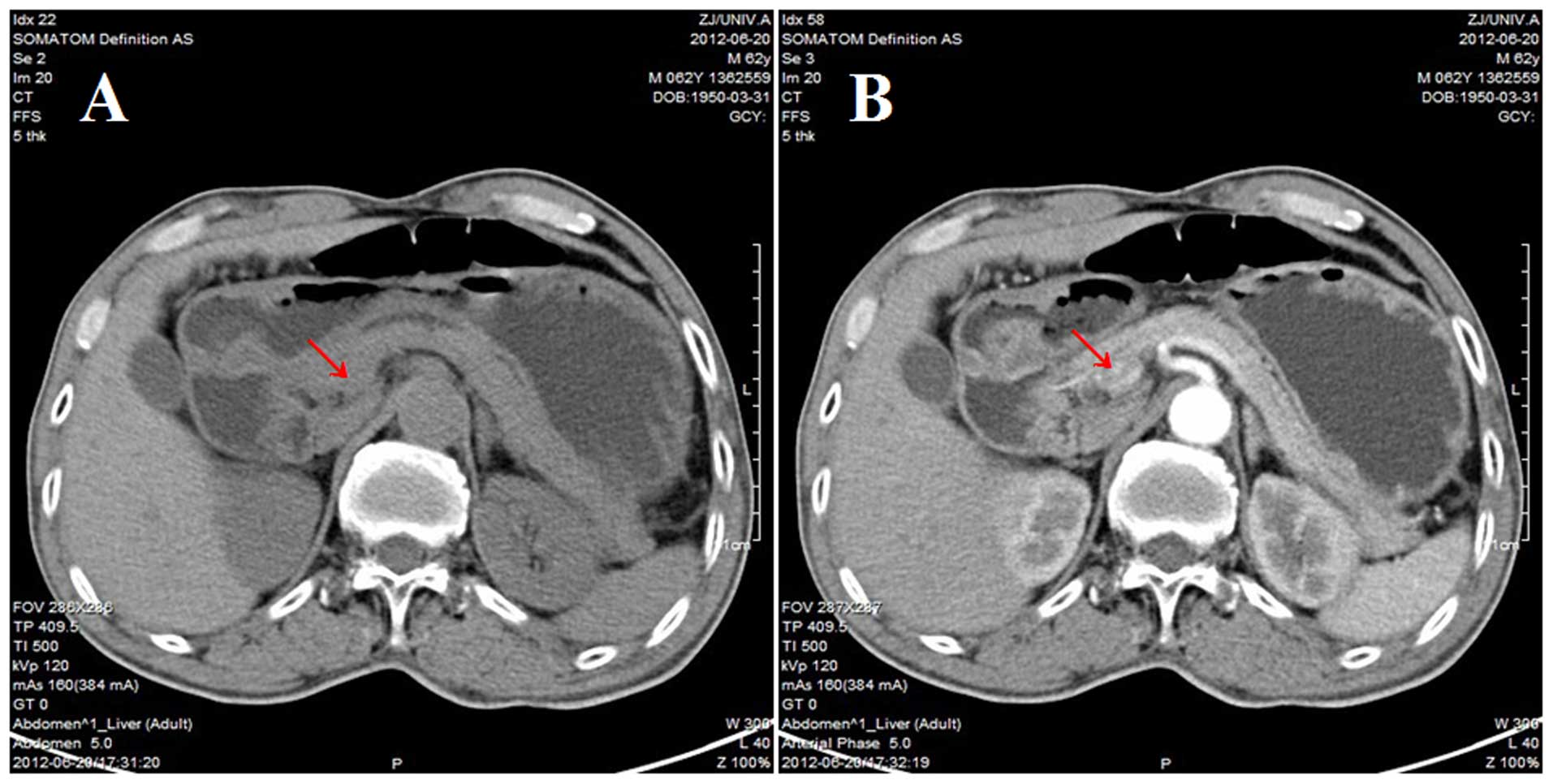
A computed tomography (CT) scan was performed and it revealed a 12×9-mm cystic nodule in the uncinate process of the pancreas (Fig. 1). The patient was referred to the Department of General Surgery and underwent resection of the tumor. On histopathological examination, the tumor was confirmed to be an insulinoma. The blood glucose levels fluctuated between 100.8 and 189 mg/dl after the operation, whereas during the 2-year follow-up, the glucose levels fluctuated between 98.6 and 111.6 mg/dl and hypersomnia did not occur again.

Figure 1.

Computed tomography (CT) scan of the upper abdomen. (A) The CT scan did not reveal any abnormalities (arrow indicates the location of the tumor). (B) On enhanced CT scan, a 12×9-mm cystic nodule was identified in the uncinate process of the pancreas (arrow), exhibiting high density, which was diagnosed as insulinoma on histopathological examination.

Discussion

In the present case, hypersomnia was the main neurological symptom for which the patient sought medical consultation. The extremely low blood glucose level raised the suspicion that hypersomnia and hypoglycemia were induced by insulinoma. In order to identify whether hypersomnia was due to hypoglycemia, blood glucose monitoring was simultaneously performed. The patient was entirely free from hypersomnia during >18 months of follow-up following insulinoma resection. Thus, it was concluded that the hypersomnia was caused by insulinoma-induced hypoglycemia.

Insulinoma is the most common pancreatic endocrine tumor; it is derived from β-cells and secretes excessive insulin. Insulinoma was often misdiagnosed as primary neurological or psychiatric disorders, due to the transient EEG abnormalities observed during hypoglycemic episodes. Insulinoma presenting as seizures or paroxysmal disorders has been commonly reported (4–7), suggesting it may lead to brain injury due to hypoglycemia. However, insulinoma-related hypersomnia is extremely rare, with only 2 cases reported in the literature to date: Maestri et al (10) reported the case of a 32-year-old woman with a history of increased need for sleep, difficulty in waking up, a very low blood glucose level (32 mg/dl) and a hypodense mass in the pancreatic tail on CT scan, which indicated that insulinoma patients may present with hypersomnia. Additionally, Dhume et al (11) reported another case of insulinoma associated with unconsciousness following repeated episodes of inability to arise from sleep and convulsions. It has been reported that hypoglycemia may induce autonomic failure in diabetic patients (12). In the present case, maintaining normal glucose levels eliminated hypersomnia and reversed the EEG findings to normal. When healthy individuals and diabetic patients maintained non-rapid eye movement sleep, the sympathetic responses to hypoglycemia were decreased (13). Furthermore, hypersomnia was completely eliminated in patients following insulinoma resection. All other possible causes, including medical, neurological and psychiatric disorders or medications, were excluded. Therefore, hypersomnia was attributed to insulinoma-induced hypoglycemia. Similar to the present case, the diagnosis of insulinoma was delayed in those cases due to misattribution of the symptoms to psychiatric or neurological disorders. This delayed diagnosis may be detrimental to the patients, since hypersomnia may precede syncope due to hypoglycemia. Early diagnosis may prevent the fatal outcome of such patients, although it may be difficult due to the non-specific clinical manifestations. Hence, the aim of the present case report is to raise awareness among physicians to consider insulinoma in the differential diagnosis of hypersomnia in patients without other known diseases.

Regarding treatment, surgical resection of insulinoma is required. According to the literature, surgical resection of insulinoma is curative in ~90% of the cases (1). In addition, routine glucose monitoring should be included in the management of these patients. Annual follow-up is also required.

In conclusion, this was a rare case of insulinoma manifesting as hypersomnia. This case highights the need to recognize that, on rare occasions, hypersomnia may be an unusual manifestation of insulinoma. Surgical resection is the recommended treatment for insulinoma presenting as hypersomnia and the prognosis appears to be favorable.

This study was approved by the Department of Medicine of the Second Affiliated Hospital, Zhejiang University and the informed consent was obtained from the patient for the publication of the case details.

Acknowledgements

The present study was supported by the Zhejiang Province Foundations of Department of Science and Technology (grant no. 2012C23088) and the Health and Family Planning Commission of Zhejiang Province (grant no. 2012KYB099).

References

1 

Service FJ, McMahon MM, O'Brien PC and Ballard DJ: Functioning insulinoma-incidence, recurrence, and long-term survival of patients: A 60-year study. Mayo Clin Proc. 66:711–719. 1991. View Article : Google Scholar : PubMed/NCBI

2 

Shin JJ, Gorden P and Libutti SK: Insulinoma: Pathophysiology, localization and management. Future Oncol. 6:229–237. 2010. View Article : Google Scholar : PubMed/NCBI

3 

Boukhman MP, Karam JH, Shaver J, Siperstein AE, Duh QY and Clark OH: Insulinoma-experience from 1950 to 1995. West J Med. 169:98–104. 1998.PubMed/NCBI

4 

Bazil CW and Pack A: Insulinoma presenting as seizure disorder. Neurology. 56:817–818. 2001. View Article : Google Scholar : PubMed/NCBI

5 

Wang S, Hu HT, Wen SQ, Wang Z, Zhang BR and Ding MP: An insulinoma with clinical and electroencephalographic features resembling complex partial seizures. J Zhejiang Univ Sci B. 9:496–499. 2008. View Article : Google Scholar : PubMed/NCBI

6 

Gupta M, Batra A, Hirve M, Chowdhury D, Khwaja GA and Mishra PK: Paroxysmal dystonic choreoathetosis with symptomatic seizures secondary to hypoglycemia caused by insulinoma. Ann Indian Acad Neurol. 14:313–315. 2011. View Article : Google Scholar : PubMed/NCBI

7 

Striano P and Striano S: Insulinoma presenting as refractory late-onset epilepsy. Epilepsia. 47:452author reply 452. 2006. View Article : Google Scholar : PubMed/NCBI

8 

Ding Y, Wang S, Liu J, Yang Y, Liu Z, Li J, Zhang B, Chen Y and Ding M: Neuropsychiatric profiles of patients with insulinomas. Eur Neurol. 63:48–51. 2010. View Article : Google Scholar : PubMed/NCBI

9 

Dizon AM, Kowalyk S and Hoogwerf BJ: Neuroglycopenic and other symptoms in patients with insulinomas. Am J Med. 106:307–310. 1999. View Article : Google Scholar : PubMed/NCBI

10 

Maestri M, Monzani F, Bonanni E, Di Coscio E, Cignoni F, Dardano A, Iudice A and Murri L: Insulinoma presenting as idiopathic hypersomnia. Neurol Sci. 31:349–352. 2010. View Article : Google Scholar : PubMed/NCBI

11 

Dhume VM, Amarapurkar AD, Rege JD, Kandalkar BM and Varthakavi P: Insulinoma-a case report. Indian J Pathol Microbiol. 47:540–541. 2004.PubMed/NCBI

12 

Cryer PE: Mechanisms of hypoglycemia-associated autonomic failure and its component syndromes in diabetes. Diabetes. 54:3592–3601. 2005. View Article : Google Scholar : PubMed/NCBI

13 

Jones TW, Porter P, Sherwin RS, Davis EA, O'Leary P, Frazer F, Byrne G, Stick S and Tamborlane WV: Decreased epinephrine responses to hypoglycemia during sleep. N Engl J Med. 338:1657–1662. 1998. View Article : Google Scholar : PubMed/NCBI

Related Articles

  • Abstract
  • View
  • Download
  • Twitter
Copy and paste a formatted citation
Spandidos Publications style
Pu J, Zhang B and Yin X: Hypersomnia as the first presentation in a patient with insulinoma: A case report and review of the literature. Mol Clin Oncol 5: 480-482, 2016.
APA
Pu, J., Zhang, B., & Yin, X. (2016). Hypersomnia as the first presentation in a patient with insulinoma: A case report and review of the literature. Molecular and Clinical Oncology, 5, 480-482. https://doi.org/10.3892/mco.2016.969
MLA
Pu, J., Zhang, B., Yin, X."Hypersomnia as the first presentation in a patient with insulinoma: A case report and review of the literature". Molecular and Clinical Oncology 5.4 (2016): 480-482.
Chicago
Pu, J., Zhang, B., Yin, X."Hypersomnia as the first presentation in a patient with insulinoma: A case report and review of the literature". Molecular and Clinical Oncology 5, no. 4 (2016): 480-482. https://doi.org/10.3892/mco.2016.969
Copy and paste a formatted citation
x
Spandidos Publications style
Pu J, Zhang B and Yin X: Hypersomnia as the first presentation in a patient with insulinoma: A case report and review of the literature. Mol Clin Oncol 5: 480-482, 2016.
APA
Pu, J., Zhang, B., & Yin, X. (2016). Hypersomnia as the first presentation in a patient with insulinoma: A case report and review of the literature. Molecular and Clinical Oncology, 5, 480-482. https://doi.org/10.3892/mco.2016.969
MLA
Pu, J., Zhang, B., Yin, X."Hypersomnia as the first presentation in a patient with insulinoma: A case report and review of the literature". Molecular and Clinical Oncology 5.4 (2016): 480-482.
Chicago
Pu, J., Zhang, B., Yin, X."Hypersomnia as the first presentation in a patient with insulinoma: A case report and review of the literature". Molecular and Clinical Oncology 5, no. 4 (2016): 480-482. https://doi.org/10.3892/mco.2016.969
Follow us
  • Twitter
  • LinkedIn
  • Facebook
About
  • Spandidos Publications
  • Careers
  • Cookie Policy
  • Privacy Policy
How can we help?
  • Help
  • Live Chat
  • Contact
  • Email to our Support Team